
KMCT College of Pharmaceutical Sciences Technical Campus, Kallanthode, NITC, Calicut
This study aims to investigate the phytochemical constituents of Acalypha fruticosa Forssk ethanolic extract and to develop and evaluate a herbal cream intended for topical application in skin-related disorders. Acalypha fruticosa, a traditionally used medicinal plant, is known for its anti-inflammatory, antimicrobial, and wound-healing properties, making it a promising candidate for herbal dermatological formulations. The aerial parts of the plant were collected, authenticated, and subjected to Soxhlet extraction using 70% ethanol. Preliminary phytochemical screening revealed the presence of bioactive constituents such as alkaloids, flavonoids, tannins, phenolic compounds, saponins, steroids, and glycosides. Alkaloid constituents were further confirmed using thin layer chromatography (TLC). Based on the phytochemical findings, a water-in-oil (W/O) type herbal cream was formulated incorporating the ethanolic extract along with suitable excipients. The formulated creams were evaluated for physicochemical parameters including appearance, pH, viscosity, spreadability, homogeneity, phase separation, and stability. The optimized formulation demonstrated acceptable pH suitable for skin application, good spreadability, appropriate viscosity, and stability without any signs of phase separation. The study highlights the potential of Acalypha fruticosa as a valuable herbal ingredient in topical formulations and supports its traditional use in the management of skin ailments. Further biological and dermatological studies are warranted to establish its therapeutic efficacy and clinical applicability.
Medicinal plants have served as the foundation of traditional healthcare systems since antiquity and continue to play a vital role in modern therapeutics. The use of plant-derived materials, crude extracts, or isolated phytoconstituents for the treatment and prevention of diseases represents a time-tested therapeutic modality. Even today, a significant proportion of modern drugs are derived directly or indirectly from natural products, underscoring their pharmacological relevance. Botanicals such as Ispaghula, Garlic, Ginkgo biloba, St. John’s Wort, and Saw Palmetto have gained widespread acceptance among contemporary physicians due to their proven efficacy and safety profiles. Despite this, only a small fraction of the world’s terrestrial plants—approximately 35%—have been scientifically investigated for their bioactive constituents, leaving vast potential for research and drug development from medicinal plants.
Ethnopharmacology, which involves the scientific study of traditional medicinal practices, provides valuable leads for the discovery of novel therapeutic agents. Validation of traditional knowledge through systematic scientific evaluation not only supports the development of new herbal formulations but also promotes sustainable utilization of indigenous medicinal resources. Furthermore, integrating quality control, standardization, and conservation strategies with herbal research can yield substantial socioeconomic benefits, particularly for developing countries where medicinal plants form an integral part of primary healthcare.
Acalypha fruticosa Forssk, belonging to the family Euphorbiaceae, is an aromatic shrub widely distributed in tropical regions of Africa, Southern India, Sri Lanka, and Myanmar. Traditionally, the plant has been used for the treatment of various ailments such as stomach disorders, dyspepsia, rheumatism, dermatitis, wounds, scabies, and inflammatory conditions. Leaves of A. fruticosa are commonly applied externally for skin infections and sores, indicating its dermatological significance. Previous phytochemical investigations have reported the presence of biologically active constituents including alkaloids, flavonoids, tannins, saponins, steroids, triterpenoids, anthraquinones, and sugars. Advanced analytical studies such as GC–MS analysis have identified compounds like 1,2-benzenedicarboxylic acid dioctyl ester and n-hexadecanoic acid, which contribute to the plant’s pharmacological properties.
Among the various phytoconstituents, alkaloids represent a particularly important class of secondary metabolites due to their diverse biological activities. Alkaloids are nitrogen-containing compounds that exhibit antimicrobial, anti-inflammatory, analgesic, and antioxidant properties. These activities support the traditional use of A. fruticosa in the management of skin disorders, wounds, and inflammatory conditions. In topical formulations, alkaloid-rich extracts can help reduce microbial load, alleviate inflammation, neutralize free radicals, and promote skin healing, making them suitable candidates for herbal creams.
Extraction plays a crucial role in isolating these bioactive compounds from plant materials. Various extraction techniques such as maceration, Soxhlet extraction, supercritical fluid extraction, microwave-assisted extraction, and ultrasound-assisted extraction are employed depending on the nature of the phytoconstituents and the desired yield. Among these, Soxhlet extraction remains one of the most widely used and reliable methods for exhaustive extraction of phytochemicals, particularly when the compounds of interest have limited solubility and require controlled heating.
Characterization of plant extracts is essential to ensure their quality, safety, and efficacy. Preliminary phytochemical screening helps identify the major classes of phytoconstituents present in the extract, while chromatographic techniques such as Thin Layer Chromatography (TLC) and High-Performance Thin Layer Chromatography (HPTLC) are widely used for qualitative and quantitative analysis of natural products. These techniques aid in confirming the presence of specific bioactive compounds and provide a basis for standardization of herbal formulations.
Herbal creams are topical semisolid emulsions containing both aqueous and oily phases, formulated to deliver active ingredients directly to the skin. Depending on the nature of the emulsion, herbal creams may be classified as oil-in-water (O/W) or water-in-oil (W/O) systems. The selection of suitable excipients such as emulsifiers, preservatives, emollients, and fragrances plays a critical role in determining the stability, spreadability, penetration, and patient acceptability of the formulation. An ideal herbal cream should possess good skin penetration, non-irritating properties, ease of application, acceptable pH, and stability during storage.
In view of the traditional medicinal importance of Acalypha fruticosa, its rich phytochemical composition, and the growing demand for safe and effective herbal dermatological products, the present study was undertaken to extract, characterize, and formulate a herbal cream incorporating the ethanolic extract of Acalypha fruticosa. The formulated cream was evaluated for its physicochemical properties to assess its suitability for topical application, thereby providing scientific validation for its traditional use in skin-related conditions.
METHODLOGY
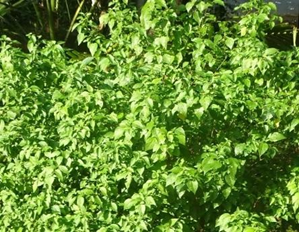
The collected aerial parts were washed with running water and subjected to shade-dried at room temperature for 7–10 days. The dried material was homogenised using a grinder to obtain moderately coarse (22/60) powder. Moderately coarse powder of size (22/60) is that powder which all the particles pass through sieve NO: 22 and not more than 40% pass through a sieve NO: 60) The powder is stored in an airtight container until extraction.
Preparation of ethanolic extract : The powder weighing 30g of dried aerial parts was subjected to Soxhlet extraction using 200ml of 70% ethanol. The extraction was carried out until the extractive solution became Colourless. The solvent was then removed by distillation to separate it from the extract. The remaining extract was concentrated using an electrical water bath. The obtained semi-solid was weighed and percentage yield was Calculated. The concentrate was stored in a desicator for further analysis.
TLC analysis
TLC was used to detect alkaloid constituents from the ethanolic extract of Acalypha fruticosa. Separation was performed on silica gel using n butanol: acetic acid: water (4: 1: 5) as mobile phase and alkaloids were visualized with Hager’s reagent.
Procedure for TLC :
1. Preparation and Activation of Plates: Glass plates were thoroughly cleaned, dried, and coated uniformly with a slurry of silica gel 60 prepared in distilled water. The coated plates were air-dried and activated in a hot-air oven at 100 °C for 1 hour. After activation, the plates were cooled in a desiccator until use.
2. Preparation of Mobile Phase: The mobile phase consisting of n-butanol : acetic acid : water (4 : 1 : 5) was freshly prepared and transferred to the development chamber, which was closed and allowed to saturate for 10–15 minutes.
3. Sample Application: A baseline was marked 1.5 cm from the lower edge of the plate. Small, concentrated spots of the ethanolic extract were applied using a capillary tube and allowed to dry.
4. Development of Plate: The spotted plate was placed in the chamber ensuring the sample line remained above the solvent level. Ascending development was carried out until the solvent front reached approximately three-fourths of the plate length. The plate was removed, solvent front marked, and air-dried.
5. Visualization: The dried plate was sprayed with Hager’s reagent, and yellow-colored spots appeared within 1–3 minutes. Rf values were calculated using the formula:
Rf=Distance travelled by the spotDistance travelled by the solvent front

Method of preparation of acalypha fruticosa herbal cream
The herbal cream was prepared by a conventional emulsification method. Beeswax, mineral oil, soft paraffin, and cetyl alcohol were accurately weighed and melted together at approximately 70 °C in a water bath to form the oil phase. Separately, borax was dissolved in distilled water and heated to the same temperature (70–75 °C) to obtain the aqueous phase. The hot aqueous phase was gradually added to the oil phase with continuous stirring until a uniform emulsion was formed. The ethanolic extract of Acalypha fruticosa, previously dissolved in a small quantity of ethanol or warm water, was incorporated into the emulsion after cooling to about 40 °C, followed by continuous stirring to ensure uniform distribution. After cooling to room temperature, rose oil was added for fragrance. The final formulation was transferred into sterile, airtight containers and stored at room temperature for further evaluation.
Evaluation of Herbal Cream
The prepared herbal cream was evaluated for various physicochemical parameters to assess its quality, stability, and suitability for topical application, following standard procedures.
RESULT AND DISCUSSION
The aerial parts of Acalypha fruticosa Forssk were authenticated by Dr. V. S. Hareesh, confirming its identity in the Euphorbiaceae family. A voucher specimen (No. 7795) was deposited at MBGIPS, ensuring accuracy and reproducibility of the study.
The plant is an erect, much-branched shrub with a cylindrical, woody, greenish-brown stem. Leaf characteristics are summarized below:
Table 1 : Morphological characters of Acalypha fruticosa leaf
|
Characteristic |
Description |
|
Type |
Simple |
|
Arrangement |
Alternate |
|
Shape |
Ovate |
|
Margin |
Serrated |
|
Apex |
Acute |
|
Colour |
Dark green (upper), light green (lower) |
|
Taste |
Mildly bitter |
|
Odour |
Aromatic |
|
Length |
4 cm |
|
Width |
3 cm |
|
Petiole |
Short |
The dried aerial parts of Acalypha fruticosa were coarsely powdered and extracted using Soxhlet apparatus with 200 mL of 70% ethanol. The extraction was maintained at approximately 60?°C for 2 days to ensure complete recovery of ethanol-soluble constituents.
Table 2 : Summarizes the colour, consistency, and yield of ethanolic extract
|
Solvent |
Colour |
Consistency |
Yield (%w/w) |
|
Ethanol (200 mL) |
Dark green |
Sticky |
14.38 |
Table 3 : Results of Phytochemical Analysis of Ethanolic Extract
|
Sr. No |
Chemical Test |
Observation |
|
1 |
Alkaloids |
Mayer’s: +, Hager’s: +, Wagner’s: +, Dragendorff’s: + |
|
2 |
Flavonoids |
Shinoda: +, Lead acetate: + |
|
3 |
Phenolic compounds & Tannins |
Ferric chloride: +, Lead acetate: +, Bromine water: + |
|
4 |
Saponins |
Foam test: + |
|
5 |
Steroids |
Salkowski: +, Liebermann-Burchard: + |
|
6 |
Volatile oils |
+ |
|
7 |
Glycosides |
Cardiac: +, Anthraquinone: -, Saponin: +, Cyanogenic: +, Coumarin: + |
|
8 |
Carbohydrates |
Molisch: +, Fehling: + |
|
9 |
Proteins |
Biuret: +, Million’s: + |
|
10 |
Amino acids |
Ninhydrin: - |
Table 4 : Result of TLC analysis
|
Sample |
Solvent System |
Rf Value |
Colour of Spots |
Inference |
|
Ethanolic extract of Acalypha fruticosa |
n-Butanol: Acetic acid: Water (4:1:5) |
0.46, 0.77 |
Yellow |
Presence of alkaloid-type compounds |
Table 5 : Observations of Developed Herbal Cream
|
Ingredient |
Function |
|
Beeswax |
Consistency and stability |
|
Borax |
Emulsion stabilizer |
|
Mineral oil |
Smoothness |
|
Soft paraffin |
Emollient |
|
Cetyl alcohol |
Structure stabilizer |
|
Distilled water |
Solvent for emulsion |
|
Acalypha fruticosa extract |
Phytochemical activity |
|
Methyl paraben |
Preservative |
|
Rose oil |
Fragrance |
1. Physical Appearance / Visual Inspection
Table 6 : Evaluation of physical characteristics
|
Characteristic |
F1 |
F2 |
F3 |
F4 |
F5 |
|
Colour |
Olive green |
Olive green |
Olive green |
Olive green |
Olive green |
|
Odour |
Pleasant |
Pleasant |
Pleasant |
Pleasant |
Pleasant |
|
State |
Semisolid |
Semisolid |
Semisolid |
Semisolid |
Semisolid |
|
Consistency |
Smooth |
Smooth |
Smooth |
Smooth |
Smooth |
2. Type of Cream (Dye Test)
Table 7 : Results of Dye test
|
Formulation |
Type of Cream |
|
F1 |
W/O |
|
F2 |
W/O |
|
F3 |
W/O |
|
F4 |
W/O |
|
F5 |
W/O |
3. pH Determination
Table 8 : Results of pH determination
|
Formulation |
pH |
|
F1 |
5.5 |
|
F2 |
5.6 |
|
F3 |
5.7 |
|
F4 |
5.8 |
|
F5 |
5.9 |
4. Viscosity
Table 9: Viscosity Measurement of herbal Cream
|
Formulation |
Viscosity (Cps) |
|
F1 |
24,140 |
|
F2 |
25,240 |
|
F3 |
27,640 |
|
F4 |
28,500 |
|
F5 |
31,200 |
5. Spreadability
Table 10 : Spreadability measurements of the Developed Herbal Cream
|
Formulation |
Spreadability (cm) |
|
F1 |
5.3 |
|
F2 |
5.0 |
|
F3 |
4.6 |
|
F4 |
4.2 |
|
F5 |
4.0 |
6. Phase Separation
Table 11 : Observation of Phase separation
|
Formulation |
Phase Separation |
|
F1 |
None |
|
F2 |
None |
|
F3 |
None |
|
F4 |
None |
|
F5 |
Slight |
7. Stability Testing
Table 12 : Results of stability test
|
Formulation |
Stability |
|
F1 |
No separation |
|
F2 |
No separation |
|
F3 |
No separation |
|
F4 |
No separation |
|
F5 |
No separation |
Table 13 : Results for the optimized formulation F3
|
Parameter |
Result |
|
Colour |
Olive green |
|
Odour |
Pleasant |
|
State |
Semisolid |
|
Consistency |
Smooth |
|
Type |
Water-in-oil |
|
pH |
5.7 |
|
Viscosity |
27,640?Cps |
|
Spreadability |
4.6?cm |
|
Phase Separation |
None |
|
Stability |
Stable, no separation |
CONCLUSION
The current research authenticated and phytochemically examined Acalypha fruticosa Forssk. The plant's identity was confirmed by botanical authentication and morphological characterization. Soxhlet extraction with ethanol gave a crude extract, and the extractive value was 14.38% w/w. Preliminary phytochemical screening showed the presence of alkaloids, flavonoids, glycosides, tannins, saponins, and phenolic compounds, which justify the use of the plant in traditional medicine. The TLC technique showed the presence of alkaloids with Rf values of 0.46 and 0.77, thus suggesting the presence of compounds with anti-inflammatory and antioxidant potential.
Five water-in-oil herbal cream formulations (F1 F5) were prepared and assessed for physicochemical parameters. Of these, formulation F3 exhibited the best characteristics, such as a pH in the recommended range, good spreadability, suitable viscosity, a homogeneous appearance, and stability without phase separation. In general, this research scientifically validates the use of Acalypha fruticosa herbal cream to treat skin disorders. It is advisable to carry out further investigations that include biological evaluation at the molecular level, advanced phytochemical profiling, and long-term stability studies to explore its clinical and cosmetic utilities.
REFERENCES

Mariyumakutty V T, Adithya V, Fathima Murshida K, Kamil Latheef, Phytochemical Investigation and Herbal Cream Development from Acalypha Fruticosa Forssk Ethanolic Extract, Int. J. of Pharm. Sci., 2026, Vol 4, Issue 1, 1618-1625. https://doi.org/10.5281/zenodo.18272647
 10.5281/zenodo.18272647
