
Department of Pharmaceutical Chemistry, Maharashtra Institute of Pharmacy, Betala Bramhapuri, Maharashtra, India.
Mouth dissolving film is a rapidly dissolving dosage form that dissolves in the mouth within a second without the need for Water. It is mainly used for pediatric and geriatric patients due to its flexibility and patient compliance. Mouth-dissolving Film (MDF) is also known as Oro dispersible Film (ODF). The Oro dispersible is the term referred to in the dosage form, which is dispersed or disintegrated into the mouth, i.e. the oral cavity. The required time to be disintegrated should be no more than 3 minutes. Cavity dosage forms are available. These tablets and mouth-dissolving Film, which is placed in the oral cavity, then releases A drug, acting instantaneously, show a rapid onset of action. An ideal ODF should exhibit Adequate Flexibility, elasticity, softness, and resistance to breakage, minimum disintegration time and taste compliance. Mouth dissolving Film is a solid oral drug delivery system, in which a water-soluble polymer is involved to disintegrate the film rapidly. Mouth-dissolving Film is placed on the tongue, where it quickly dissolves, integrates into the mouth with Saliva and is absorbed via the mouth and directly reaches into the systemic circulation, bypassing the first pass metabolism. Basically, those drugs irritate the gastrointestinal tract (GIT).
Orally disintegrating films (ODFs) are a type of drug delivery system that dissolves quickly in the mouth, releasing the active ingredient. ODFs are macromolecular, hydrophilic polymers and are designed to provide a convenient and comfortable way to administer medications.
Mouth Dissolving Film is a rapidly dissolving dosage form that dissolves in the mouth within a few seconds without the Need for water. [1,2] These medicines are mainly used for pediatric and geriatric patients due to their flexibility and patient-dispersible-dissolving films (OFDFs), also known as oral disintegrating films (ODFs) or Oro dispersible films. [3].
Oro dispersible films (ODFs) are innovative dosage forms that dissolve or disintegrate in the oral cavity, providing a quick and easy way to administer medications. With an ideal disintegration time of under 3 minutes, ODFs offer a convenient solution for patients with dysphagia (difficulty swallowing), geriatric and pediatric patients, and those undergoing anticancer therapy. [4].
These thin polymeric strips release the medication instantly, providing a rapid onset of action. To ensure effectiveness, ODFs should possess key characteristics such as flexibility, elasticity, softness, and resistance to breaking, while also conforming to taste standards. Various evaluation methods, including in vitro disintegration and in vivo drug release studies, are used to assess the performance of ODFs. As a relatively new addition to the European Pharmacopoeia’s monograph on Oro mucosal preparations, ODFs hold promise for improving medication delivery and patient outcomes. As a relatively new addition to the European Pharmacopoeia’s monograph on Oro mucosal preparations, ODFs hold promise for improving medication delivery and patient outcomes.
Quick dissolving oral films are a novel system of drug delivery that provides Improved bioavailability, rapid onset of action, and avoids first-pass metabolism. Oral Mucosa has a permeability that is 4-1000 times larger than skin. The development of fast-dissolving oral films aims to address swallowing difficulties commonly experienced by children and elderly patients.
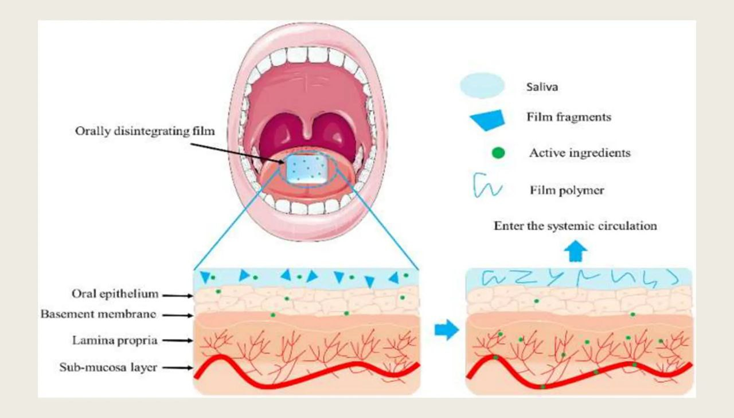
Figure 1: Oral Disintegrating Film
History of mouth dissolving Film: The concept of mouth dissolving films originated in North America in the 1970s, initially used for breath fresheners and personal care products. Pfizer pioneered the development of fast-dissolving films with their Listerine pocket packs. [7] Over time, technology evolved, and pharmaceutical companies began exploring its potential for medication delivery. Today, numerous companies, including Labtech GmbH and APR, are formulating oral fast-dissolving films, shifting from traditional tablet dosage forms. These films are now being used not only for breath freshening but also as a delivery system for over the counter and prescription medications. [8]
There are two routes of administration, i.e Buccal and sublingual films are meant to be held in the mouth so that the medicine can be absorbed directly through the tissues inside the mouth (oral mucosa).
These types of mouth-dissolving films help the medicine enter the bloodstream directly and quickly. [9]
Advantages and Disadvantages of mouth-dissolving Film:
Advantages of MDDDS:
Disadvantages
1. Limited drug load only suitable for low-dose medication
2. Stability issues – sensitive to moisture and humidity, requiring special packaging.
3.Taste masking challenges – especially for extremely bitter drugs.
4.Manufacturing complexity – more intricate formulation and processing compared to conventional tablets. [10]
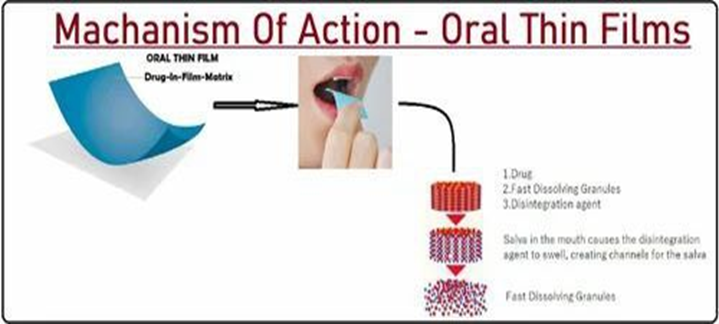
Figure 3] Mechanism of action MDFs
Benefits of mouth-dissolving Film: [11]
1. Quick Dissolution: They dissolve quickly in the Mouth adhesive large surface area.
2. Flexible and Durable: Less likely to break compared to tablets, easy to carry and handle.
3. Easy to Take: No water needed, great for people who have trouble swallowing.
4. Convenient: Can be used anytime, anywhere.
5. Fast Absorption: Medicine is absorbed directly through the mouth, skipping the digestive system.
6. Lower Dose Needed: Less medicine is needed, which may reduce side effects.
7. Quick Action: Starts working in seconds after dissolving on the tongue
Formulation of Fast Dissolving Films:
Fast-dissolving Oral films include various ingredients for their formulation such as Active pharmaceutical ingredient, Film-forming polymers, Plasticizer, Super disintegrants, Sweetening agent, Saliva-stimulating agent, Surfactants, Flavoring agent and Coloring agent [12].
Table 1: Typical composition contains the following ingredients.
|
Sr.no. |
Agents |
Concentration |
|
1 |
Drug |
1 – 25 % |
|
2 |
Water soluble polymer |
40 – 50 % |
|
3 |
Plasticizer |
0 – 20% |
|
4 |
Filters, Colours, Flavours etc. |
0 – 40 % |
Active pharmaceutical ingredients: Fast-dissolving oral films typically contain 1–30% of the active pharmaceutical ingredient (API) by weight. Low-dose drugs are preferred, as high doses are harder to incorporate into the film. These films can be used to deliver a variety of medications, such as antihistamines, antidiarrheals, antidepressants, vasodilators, anti-asthmatics, and antiemetics. For example, drugs like salbutamol sulphate, rizatriptan benzoate, verapamil, ondansetron, and cetirizine have been successfully used in oral films. Dimenhydrinate is another drug that can be included, especially for taste masking purposes. [13] Many active pharmaceutical ingredients (APIs) suitable for fast dissolving film (FDF) technology often have a bitter taste, making them masking the bitter taste (unpleasant) particularly for pediatric use. Therefore, taste masking becomes a crucial step before incorporating such APIs into FDFs flavoring or sweetening agents and improve the quality of API. [14]
Table 2: List of few selected drugs that can be incorporated in Fast-dissolving film. [12,13]
|
Sr.no. |
Drug |
Dose |
Therapeutic Action |
|
1 |
Azatidine maleate |
1 mg |
Anti-histaminic |
|
2 |
Ondansetron |
2.5 mg |
Anti–emetics |
|
3 |
Triplodine hydrochloride |
2.5mg |
Anti–histaminic |
|
4 |
Salbutamol |
4 mg |
Anti–histaminic |
|
5 |
Chlorpheniramine maleate |
4mg |
Anti–allergic |
|
6 |
Cetirizine |
8 mg |
Anti–histaminic |
Ideal Characteristics of selection of API (Drug) for Oral Film Formulation:
1. Pleasant Taste: The drug should naturally have a good taste or be easily taste-masked to ensure patient compliance.
2. Low Dose Requirement Optimal for drugs requiring ≤ 20 mg per dose, making them suitable for thin, compact films.
3. Low to Moderate Molecular Weight: Smaller molecules are preferred for better absorption and faster onset of action through the oral mucosa.
4. Good Aqueous Solubility: The drug must be soluble in both water and saliva to enable rapid dissolution in the oral cavity [15].
Film-forming polymers:
Film-Forming Polymers in Oral Fast Dissolving Films (OFDFs) Polymers are the main essential component in oral fast dissolving films (OFDFs), directly influencing the film’s mechanical strength and overall quality. Typically, Polymers make up about 45% of the dry film’s total weight. The type and amount of polymer selected determine film’s tensile strength and structural integrity. [16] Hydrophilic polymers are most used in the formulation of oral films, as they cause rapid breakdown of the film in the oral cavity. The polymer used for the preparation of oral film should be non-toxic and non-irritant to the oral mucosa and have a good spread ability and shelf–life. Both naturally and synthetic polymers can be used as film–forming polymers.
Table 3: Type of Polymer used in mouth dissolving Film (MDF)
|
Class |
Group |
Examples |
|
Natural Polymer
|
Carbohydrates Protein Resin |
Pectin, sodium alginate, maltodextrin, sodium starch glycolate (SSG). Gelatine Polymerised in a novel film formed. |
|
Synthetic Polymer |
Cellulose derivatives Vinyl polymer Acrylic polymer |
Sodium carboxymethyl cellulose, Hydroxypropyl methyl cellulose (HPMC), Hydroxypropyl cellulose (HPC), Microcrystalline cellulose. Polyvinyl pyrrolidone, polyvinyl alcohol, polyethylene oxide. Eudragit – RD 10 |
Plasticizer: The mechanical properties of films are heavily influenced by their formulation, particularly the choice of plasticizer and solvent. Preliminary studies have been conducted to guide this selection. Plasticizers such as glycerol, di-butylphthalide, and polyethylene glycols are commonly used to enhance film flexibility, tensile strength, and elongation. However, these mechanical improvements depend on the type and concentration of the plasticizer used. [17]
Super disintegrant: Super disintegrant in mouth dissolving films, the super disintegrant are powerful excipients used to accelerate the breakdown of mouth-dissolving films (MDFs). They act by absorbing saliva rapidly and swelling, which leads to quick disintegration and faster release of active ingredients. Commonly used super disintegrants include:
Sodium starch glycolate (SSG) – known for its high swelling capacity, effective even at low concentrations (e.g., 0.04% w/w) to significantly reduce disintegration times.
Sweetening agents: Sweetening agents are incorporated in the film formulation to increase product palatability both artificial and natural sweeteners are used. [18] In mouth dissolving Film (MDFs), sweeteners play a crucial role in masking the bitter taste of active pharmaceutical ingredients (API), improving patients' compliance, especially in pediatric and geriatric patients.
Classification of Sweeteners: Sweeteners are broadly classified into natural and artificial (synthetic) sweeteners
Plasticizer: The mechanical properties of films are heavily influenced by their formulation, particularly the choice of plasticizer and solvent. Preliminary studies have been conducted to guide this selection. Plasticizers such as glycerol, di-butylphthalide, and polyethylene glycols are commonly used to enhance film flexibility, tensile strength, and elongation. However, these mechanical improvements depend on the type and concentration of the plasticizer used. [17]
Super disintegrant: Super disintegrant in mouth dissolving films, the super disintegrant are powerful excipients used to accelerate the breakdown of mouth-dissolving films (MDFs). They act by absorbing saliva rapidly and swelling, which leads to quick disintegration and faster release of active ingredients. Commonly used super disintegrants include:
Sodium starch glycolate (SSG) – known for its high swelling capacity, effective even at low concentrations (e.g., 0.04% w/w) to significantly reduce disintegration times.
Sweetening agents: Sweetening agents are incorporated in the film formulation to increase product palatability both artificial and natural sweeteners are used. [18] In mouth dissolving Film (MDFs), sweeteners play a crucial role in masking the bitter taste of active pharmaceutical ingredients (API), improving patients' compliance, especially in pediatric and geriatric patients.
Classification of Sweeteners: Sweeteners are broadly classified into natural and artificial (synthetic) sweeteners
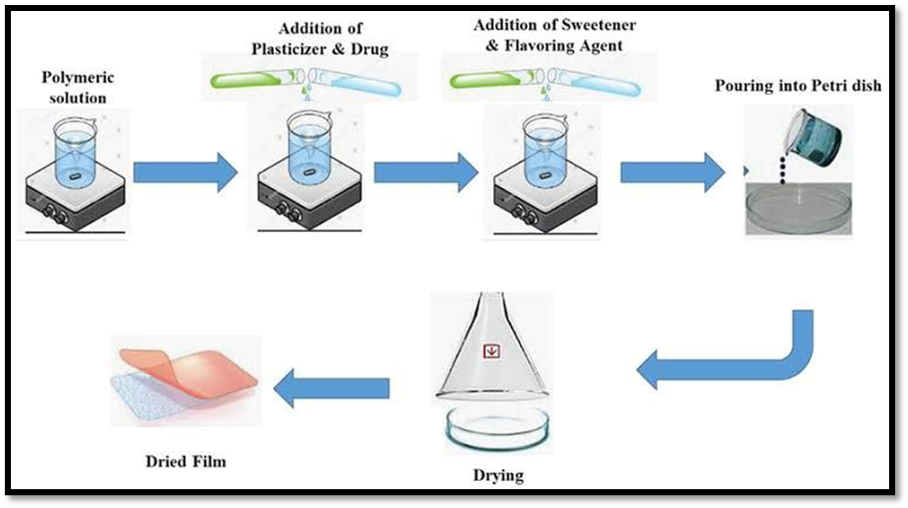
Figure no. 4 Solvent casting method
2. Hot - Melt Extrusion: In the hot-melt extrusion process, the carpet material is first blended with a solid carrier to form granules. After drying, these granules are fed into an extruder where they remain for approximately 3 to 4 minutes at a screw speed of around 15 rpm. The optimal processing temperature is maintained at 100°C. The resulting extrudate is then passed through two heated rollers to form a film. [10]
3. Semi-solid casting method: In the semi-solid casting method, a solution of a water-soluble film-forming polymer (like CMC, Polyvinyl alcohol) is first prepared, then this is mixed with a solution of an acid-insoluble polymer such as cellulose acetate phthalate or cellulose acetate butyrate, which is previously dissolved in ammonium or sodium hydroxide. Then the formation of a gel-like mass, an appropriate amount of plasticizer is added. The resulting gel is then cast into films or ribbons using heat-controlled drums, ensuring uniform thickness typically ranging from 0.015 to 0.05 inches. For optimal film properties, the ratio between the acid- insoluble polymer and the film-forming polymer is 1:4 [19]
4. Solid Dispersion Extrusion Method: Solid dispersion involves dispersing one or more active pharmaceutical ingredients (APIs) in a solid state within hydrophilic amorphous polymers to enhance drug solubility and bioavailability. The drug is first dissolved in a suitable solvent and then mixed into a polyethylene glycol (PEG) melt, which has a low melting point (below 70°C). The resulting mixture is then processed into thin films using extrusion dies. [25]
5. Rolling method the rolling method is a film-forming technique used in the production of mouth-dissolving films. In this process, a medicated solution, prepared using a water-and-alcohol-based solvent, is coated onto a carrier material. Once the film dries on rollers, it is cut into the desired shapes. To prepare the formulation, water-soluble hydrocolloids are first dissolved separately in water to form a uniform and viscous base. Simultaneously, the active pharmaceutical ingredient (API) and other excipients are dissolved in a small amount of water using a high-shear processor, ensuring proper dispersion before being combined with the base solution for film casting. [26]
Evaluation parameters of mouth Dissolving Film:
1) Look or Appearance –The appearance of a mouth-dissolving film is assessed by observing its color uniformity, surface smoothness, and transparency. A high-quality film should be free from cracks, air bubbles, and visible spots. Additionally, its thickness and flexibility are important visual and physical indicators of proper formulation and film integrity. [28]
2) Thickness test: The thickness of a film is measured using an electronic micrometer. Readings are taken at five points—one at the center and one at each corner—and the average thickness is calculated. Films showing visible defects like air bubbles, nicks, or tears, or those with thick variations exceeding 5%, are excluded from further analysis. [29]
3) Dryness test / tack test: The dryness or tack test is used to assess whether a film sticks to another surface, such as paper, when pressed between two strips. The strength of this adhesion is referred to as tack. Proper drying of the film is essential for handling and packaging. These are also suitable for evaluating oral fast-dissolving films. Modern equipment is now available to perform these tests more accurately and efficiently. [30]
4) Tensile Strength – Tensile strength measures how much force a film can handle before it breaks. It is calculated by dividing the load at breakage by the cross-sectional area (thickness × width) of the film strip. This helps determine the strength and durability of the mouth-dissolving film (MDF). [31]
Formula Tensile Strength = Load at Breakage / (Film Thickness × Film Width)
5) Percent elongation: When a film is subjected to stress, it stretches — a process referred to as strain. Strain measures how much the film deforms relative to its original size. Generally, increasing the plasticizer content in a film improves its ability to elongate. [32]
The percentage of elongation is calculated by using following formula:
Formula: Percent (%) Elongation = (L × 100) / L?
Where: L = Increase in length
L? = Original length of the film
6) Tear resistance: Tear resistance refers to the maximum force needed to tear or burst the film. This value, known as burst strength, is typically measured at the point where the film starts to tear and is expressed in Newton’s (N) or Pound Force (lbf). It indicates the mechanical strength and durability of the film during handling. [22]
7) Young’s modulus: Young’s modulus—also known as the elastic modulus—measures a film’s stiffness by comparing how much stress is applied to how much it deforms (strain) in its elastic (non-permanent) region. It’s calculated from the slope of the stress–strain curve, typically using the same tensile testing setup used for tensile strength. [33]
8) Folding Endurance: Folding endurance is a measure of a film’s flexibility and mechanical strength. It is determined by repeatedly folding a section of the film at the same point until it breaks. The number of folds it withstands before breaking indicates its folding endurance. Typically, films show a folding endurance between 100 and 150 folds. [34]
9) Swelling Property: The swelling behavior of the film is tested using simulated saliva. A pre-weighed film is placed in a pre-weighed stainless steel wire mesh and submerged in the simulated salivary solution. The film’s weight is recorded at regular intervals until no further increase is observed. The degree of swelling is calculated by using: [30]
Formula: (Swelling Index} = (Wt. – W0) / W0
Where, W? = Weight of the film at time t
W? = Initial weight of the film
This method helps assess the film’s ability to absorb moisture.
10) Transparency: Film transparency is evaluated using a UV spectrophotometer. The film is cut into a rectangular shape and placed in the spectrophotometer cell. Transparency is measured at a wavelength of 600 nm using the formula: [35]
Formula:
Transparency = log T 600 / b = - E C
Were, T??? = Transmittance at 600 nm
b = Film thickness (mm)
C = Concentration
ε = Absorption coefficient, this method helps determine the optical clarity of the film.
Packaging and Storage of mouth dissolving Film (MDF): The packaging of MDF is essential to properly maintain the stability, effectiveness, and integrity of mouth dissolving films. The mouth-dissolving films are more sensitive to moisture, light, and physical damage to drugs.
Packaging types:
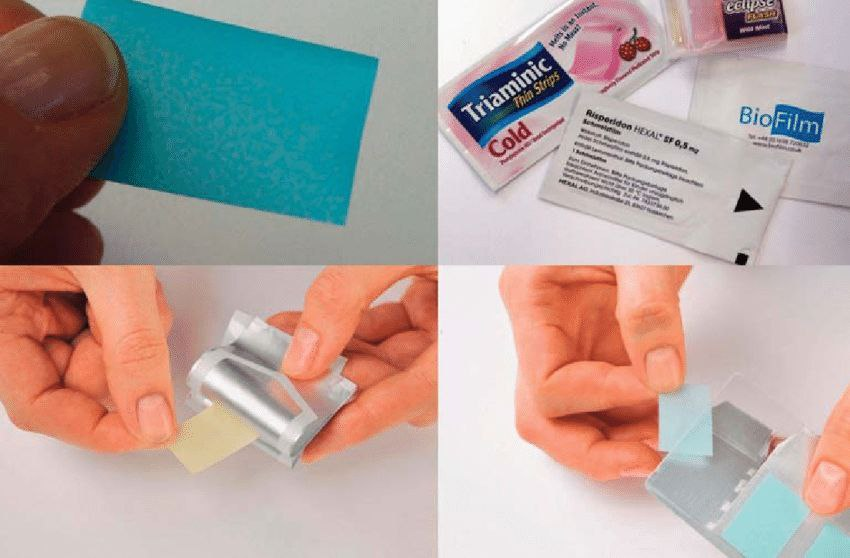
Figure: Packaging of MDFs
Application of mouth-dissolving Film:
1) Pediatric and geriatric use: Ideal for children and the elderly who have difficulty swallowing tablets and Capsules.
2) Psychiatric or neurologic use: It is Beneficial for patients with dysphagia and mental health disorders.
3) MDF is used in emergency medications like Asthma, Angina, and Migraine, etc.
4) It is used in Nutraceutical Applications: Delivery Day of vitamins, minerals and Supplements (e.g. Vitamin D, B12, Melatonin).
5) Biodegradable Vitamins Delivery: Films can be incorporated into smart packaging that delivers an Active compound. In contact with Saliva.
7) Rapid drug delivery: Used for quick onset of action in emergencies like allergies, pain, nausea.
9) Used in patients with nausea or vomiting: Helpful when swallowing water or tablets is difficult.
Marketed products: Mouth Dissolving Films (MDFs) are thin, fast-dissolving strips that incorporate Active Pharmaceutical Ingredients (APIs) directly into the film matrix. These films are designed for rapid drug release upon contact with saliva. They are used in the treatment of a wide range of diseases and medical conditions.
Mouth Dissolving Films (MDFs) can be used to treat a variety of disease conditions — especially those requiring quick onset, easy administration, or better patient compliance.
Diseases & Conditions Treated with Mouth Dissolving Films:
1) Gastrointestinal Disorder: Nausea & Vomiting in these cases, Ondansetron, Domperidone, Metoclopramide, etc.
2) Pain Management: Headache, Migraine, Acute pain, Dental pain, so use of these drugs, i.e. Ibuprofen, Diclofenac, Paracetamol, Tramadol.
3) Nutritional Deficiencies: Vitamin/mineral deficiency, i.e. Vitamin B12, D3, Iron, Folic acid, etc.
Marketed products of MDF:
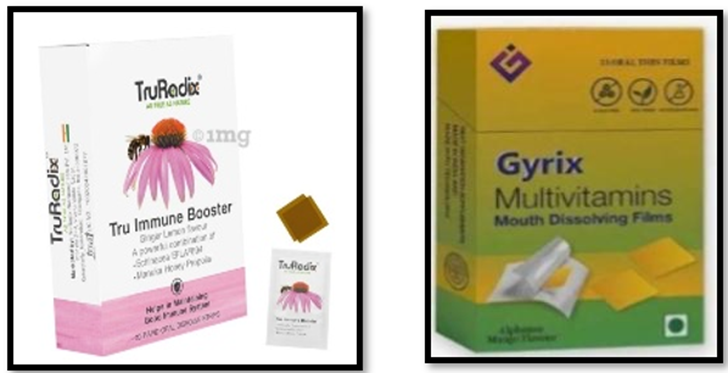
a) Immune Booster
b) Multi vitamins MDF:
1) It boosts immunity.
2) Increase energy in the body.
3) Treat Vitamin Deficiency. (Like Vitamin D3 and increase energy of Cellular Health.)
5) Promotes overall Health.
CONCLUSIONS:
Mouth Dissolving Films (MDFs) are an advanced form of oral drug delivery designed to dissolve quickly in the mouth, making them ideal for patients who have trouble swallowing tablets or capsules. To ensure their quality and effectiveness, MDFs are tested for several factors such as disintegration time, weight variation, thickness, surface pH, tensile strength, folding endurance, drug content, and drug release. These tests help confirm that the films are safe, uniform, and work properly. Following regulatory guidelines is important for their approval and market use. Developing MDFs also involves challenges like maintaining dose uniformity, fast disintegration, and stability, which require careful formulation and quality control. Continuous research and innovation in this field aim to improve patient comfort, treatment results, and overall healthcare benefits.
The main motto of this topic is to overcome patient problems, especially in pediatric and elder patients to swallow solid dosages form like tablets and capsules and improve the bioavailability’s and patients’ compliance.
REFERENCES


Prachi Mandave*, Shrawasti Ramteke, Mayuri Balpande, Nikita Dhore, Brief Review on Mouth Dissolving Film, Int. J. of Pharm. Sci., 2025, Vol 3, Issue 11, 2339-2351 https://doi.org/10.5281/zenodo.17617754
 10.5281/zenodo.17617754
