
P.R Patli Institute of Pharmacy, Talegaon (S.P), Wardha
To ensure the precision, accuracy, and reliability of pharmaceutical analysis, analytical instrument calibration and qualification are essential processes. The UV-1900i spectrophotometer, which is made by Shimadzu Corporation, was calibrated and qualified in this study in order to assess how well it performed when used to analyze sustained release beads. Standard reference materials were used to calibrate the UV spectrophotometer for resolution, stray light, wavelength accuracy, and absorbance accuracy. In order to ensure compliance with regulatory standards, qualification activities were carried out to confirm that the instrument performs in accordance with predetermined specifications. The study highlights how accurate calibration and qualification improve analytical data' reliability, which is crucial for the development and quality assurance of sustained release dosage forms.
Calibration is essential in pharmaceutical analysis to guarantee that analytical tools like pH meters, balances, UV spectrophotometers, and HPLC produce precise and repeatable results [1,2]. Because faulty instruments can produce incorrect results that impact drug quality, safety, and compliance, it is an essential requirement under Good Laboratory Practices (GLP) and regulatory requirements. In order to preserve the integrity of analytical data, calibration is therefore both a quality assurance process and a legal necessity in the pharmaceutical industry [3].
One of the most common analytical tools for pharmaceutical quality assurance, research, and development is the UV-visible spectrophotometer. It works on the basis of the Beer-Lambert rule, which links absorbance to concentration, and measures how much visible (400–800 nm) and ultraviolet (200–400 nm) light is absorbed by molecules. UV spectrophotometry is frequently used for drug assay, dissolution studies, impurity detection, and kinetic investigations due to its sensitivity, ease of use, and accuracy [4].
The UV spectrophotometer must be calibrated in order to guarantee the accuracy of analytical results. The process of checking and adjusting an instrument's accuracy in relation to pharmacopeial or approved standards is known as calibration [5]. It involves studying important performance parameters like resolution, baseline stability, stray light, wavelength accuracy, and absorbance accuracy. Reference standards including potassium dichromate, holmium oxide, and toluene in hexane are frequently used for this purpose.
UV spectrophotometers must be calibrated on a regular basis by regulatory bodies and pharmacopeias (such as USP, IP, BP, and EP) in order to preserve data integrity, verify methods, and adhere to Good Laboratory Practices (GLP). In pharmaceutical analysis, accurate, repeatable, and legally acceptable results are guaranteed by proper calibration [6,7].
In order to guarantee precision as well as reliability of results, calibration is the act of comparing the measurement values provided by an instrument or piece of equipment with a recognized standard under certain conditions and modifying the instrument as needed. It helps in figuring out whether an instrument is operating within reasonable limits.
Advanced pharmaceutical dosage forms known sustained release beads are made to release a medication over an extended period of time at a specific frequency. Maintaining a steady therapeutic medication concentration in the bloodstream, reducing the frequency of dose, and improving patient compliance is the main objective of using sustained release formulations [8].
Usually, polymers that regulate the drug's diffusion or rate of degradation are used to create these beads. They can be added to pills, capsules [9,10]. Depending on the kind of polymer and formulation, the method of drug release from sustained release beads could involve erosion, diffusion, or a combination of both [11].
For drugs with short biological half-lives, when frequent dosage is unfavorable or unpleasant, this method is very helpful. Sustained release beads decrease side effects and variations in plasma doses while increasing therapeutic efficacy by offering controlled and uniform release properties [12].
PRINCIPLE OF UV-VIS SPECTROSCOPY
When radiation causes an electronic transition in a molecule's or ion's structure, the molecule or ion will exhibit absorption in the visible or ultraviolet spectrum. As a result, when a sample absorbs light in the visible or ultraviolet spectrum, the electronic state of the molecules within the sample changes. Electrons will be promoted from their ground state orbital to a higher energy orbital, such as an excited state orbital or an anti-bonding orbital, by the energy provided by the light. Three different kinds of ground state orbitals could be at motion [13, 14].
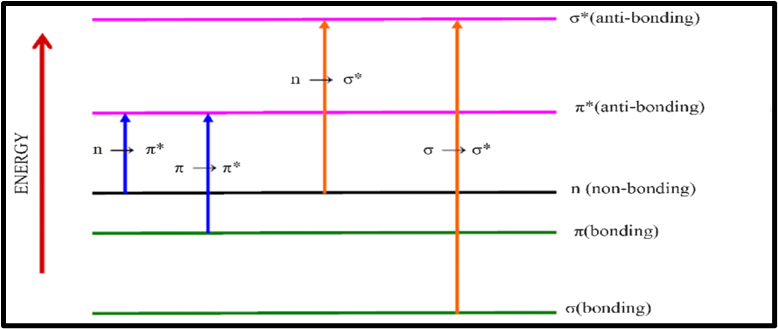
Fig 1:- Electron Transition Graphically Represented
INSTRUMENTATION OF UV SPECTROPHOTOMETER
The instrumentation of a UV spectrophotometer involves several key components that work together to measure the absorbance or transmittance of a sample in the ultraviolet (200–400 nm) region.
COMPONENTS

Fig 2:-Instrumentation of UV Spectrophotometer
QUALIFICATION OF UV SPECTROPHOTOMETER
Qualification-The process of ensuring that a particular system, location, or piece of equipment can meet the established acceptance standards in order to validate its claims is known as qualification. There are four components to the qualification procedure in total: The four qualifications are as follows
QUALIFICATION FOR DESIGN

Fig 3:-Design Qualification
The steps to follow for passing as well as recording design reviews to demonstrate that every area of quality has been taken into account from the beginning of the design phase is known as design qualification or DQ. Making sure that every requirement for the finished systems has been precisely stated from the beginning is the goal. The Design Qualification (DQ) outlines the supplier's deliberate choices as well as the functional and operational requirements for the device. DQ should make sure that instruments fulfill user needs and can be successfully implemented for the intended application by making sure they have all the required functionality and performance standards [16,17].
QUALIFICATION FOR INSTALLATION

Fig 4:-Installation Qualification
The procedure known as installation qualification (IQ) involves examining the installation, to guarantee that the parts adhere to the authorised standard and are appropriately installed, as well as to observe how that Data is kept on file. The goal is to guarantee that every feature (static properties) of the apparatus or facility are installed accurately and in accordance with the original blueprint. Every component of the apparatus is recognised and confirmed with the component listing provided by the manufacturer. The conditions of the workplace are recorded and examined to make sure they are appropriate for the equipment's operation. Installation qualification confirms that the instrument is delivered as intended, That the device has been correctly mounted at the designated location as well as that the place of installation is appropriate for usage and functionality of every measuring device [18].
QUALIFICATION FOR OPERATIONAL

Fig 5:-Operation Qualification
The process of evaluating individual and combined systems to make sure they satisfy predetermined performance standards and to verify how test results are recorded is known as operational qualification, or OQ. Ensuring that every dynamic property adheres to the original design is the goal. Every function of the instrument is examined to make sure it complies with the manufacturer's requirements.
QUALIFICATION OF PERFORMANCE

Fig 6:-Performance Qualification
Practice competence, a different term for perform competence, is the method of analysing a to make sure because are distinct & interconnected structures operate to consistently fulfil predetermined. The goal is guaranteeing given requirements can be met consistently over an extended period of time [19].
MATERIALS AND METHODS
MATERIALS
Instrument :- UV Visible Spectrophotometer
Apparatus:- Volumetric Flasks (100 ml), Beakers
Chemicals:- Potassium dichromate, Sulphuric acid, Potassium chloride, Distilled water
METHODS
1. CONTROL OF ABSORBANCE
A (1% 1cm) = Absorbance X 10000 / Weight of Potassium dichromate in mg
|
Sr No. |
Wavelength (nm) |
Maximum Tolerance |
|
1 |
235 |
122.9 to 126.2 |
|
2 |
257 |
142.8 to 145.7 |
|
3 |
313 |
47.0 to 50.3 |
|
4 |
350 |
104.9 to 108.2 |
|
5 |
430 |
15.7 to 16.1 |
2. LIMIT OF STRAY LIGHT
RESULT
1. Control of Absorbance
A (1%,1cm)= Absorbance x 10000 / weight of pottassium dichromate (60mg)
|
Sr. No. |
Wavelength (nm) |
Absorbance |
A (1%,1cm) |
|
1 |
235 |
0.735 |
122.5 |
|
2 |
257 |
0.873 |
145.5 |
|
3 |
313 |
0.280 |
46.66 |
|
4 |
350 |
0.642 |
107.00 |
All absorptivity values are within the acceptable range
2. Limit of Stray Light
|
Sr No. |
Wavelength(nm) |
Absorbance |
|
1 |
198 |
2.290 |
|
2 |
200 |
2.466 |
|
3 |
201 |
2.573 |
|
4 |
202 |
2.532 |
All absorbance value are grreater than 2.0, indicating that the instrument passes the limit of stray light test. The UV visible spectrophotometer is calibrated
DISCUSSION
The calibration results indicate that the UV–Visible spectrophotometer is performing correctly. The specific absorbance values obtained for potassium dichromate at all tested wavelengths fall within acceptable limits, confirming accurate absorbance measurement and proper optical alignment. Additionally, the stray light test shows absorbance values above 2.0 at the critical low-wavelength range, indicating minimal stray radiation and reliable instrument optics. Overall, the instrument meets the required performance criteria and is suitable for routine analytical use and is calibrated.
CONCLUSION
The UV-Visible spectrophotometer is an essential analytical instrument used to determine the absorbance and concentration of substances accurately. It operates based on Beer-Lambert's law, which relates absorbance to concentration and path length. Regular calibration of the UV-Visible spectrophotometer ensures the instrument provides precise and reliable results by maintaining wavelength and absorbance accuracy. The instrument plays a vital role in pharmaceutical quality control, chemical analysis, and research laboratories, where accurate quantitative and qualitative determinations are required. The UV spectrophotometer used is calibrated.
REFERENCE





Samarth Salunke, Saloni Bhunte, Saniya Shaha, Saniya Yawale, Trusha Gurnule, Calibration and Qualification Report of Equipment Used in Sustained Released Bead- UV Spectrophotometer, Int. J. of Pharm. Sci., 2025, Vol 3, Issue 11, 3189-3196. https://doi.org/10.5281/zenodo.17663221
 10.5281/zenodo.17663221
