
Department of Pharmacology, Moulana College of Pharmacy, Perinthalmanna 679321, KL, India (M.A.T).
The use of cosmetics has become an integral part of daily life across all age groups and cultures, offering both aesthetic appeal and psychosocial benefits. However, frequent exposure to multiple products increases the risk of adverse effects, including skin reactions such as allergic or irritant contact dermatitis, acne, and phototoxicity, as well as systemic effects affecting respiratory, endocrine, and neurological health. Regulatory frameworks differ widely, with the European Union implementing comprehensive pre- and post-market safety measures, while other regions rely primarily on voluntary reporting. Strategies to reduce adverse outcomes include development of hypoallergenic or micro-encapsulated formulations, consumer education on safe usage, digital reporting systems, and enhanced transparency from manufacturers. Innovations in personalized cosmetics, microbiome-friendly products, and nanotechnology-based delivery systems highlight the growing complexity of cosmetic safety. This review provides a global overview of usage patterns, associated risks, and evidence-based strategies to enhance consumer protection and ensure safer cosmetic practices worldwide..
Cosmetics have been used since at least 7000 years ago; the ancient Egyptians lined their eyes with kohl, the Chinese painted their nails, and the Mesopotamians employed henna for purposes other than appearance, such as ceremonies, prestige, and even health [1]. As these traditions travelled along old trade routes, they shaped local ideas about beauty. Think of the Greeks and Romans, who used lead-based ceruse to whiten their skin, or the Mayans before Columbus, who coloured their lips with pigments from cochineal insects [2].These formulations were then globalized by colonial trade, and mass production and the shift from artisanal to chemically complex products were made possible by the Industrial Revolution. Contemporary consumption is characterized by hyper-segmentation and rapid innovation. In 2023, global retail sales shot past $571 billion. Asia–Pacific alone grabbed 42% of that money, and countries like India, Indonesia, and Vietnam are growing fast double digits every year [3]. Daily use surveys reveal that women in high-income countries apply a median of 16 personal-care products each day, packed with 168 different chemical ingredients. Men aren’t far behind—on average, they’re using 8 products a day now. That’s up 80% since 2015 [4]. Social-media–driven “skin-cycling” and “K-beauty” multi-step regimens further accelerate frequency of exposure and ingredient layering.Economically, the sector employs 6.2 million workers along its value chain and contributes US $1.3 trillion (1.5 % of global GDP) when upstream chemical supply and downstream retail services are included [5]. The personal-care segment is also an innovation engine: 21 % of all new chemical entities registered under REACH between 2019 and 2023 were cosmetic ingredients, underscoring the industry’s role in driving petrochemical and biotech demand [6].Public-health implications are substantial. The World Health Organization estimates that 4.5 million disability-adjusted life-years (DALYs) annually are attributable to dermatologic disease, of which 9–14 % are linked to cosmetic exposures [7]. Fragrance alone is the second most common cause of allergic contact dermatitis in Europe, with a population-weighted prevalence of 2.7 % and direct annual health-care costs exceeding €1.2 billion [8]. Vulnerable groups including children, pregnant individuals, and populations with high melanin content exhibit differential penetration kinetics and altered sensitization risk, amplifying health inequities [9]. Regulatory heterogeneity exacerbates these risks. While the EU bans or restricts 1682 cosmetic ingredients under Regulation (EC) No 1223/2009, the United States prohibits only 11 through the Federal Food, Drug, and Cosmetic Act of 1938 [10]. Such asymmetry enables “formulation dumping,” whereby non-compliant variants are marketed in jurisdictions with laxer oversight, complicating post-market surveillance and recall coordination [11].Consumer-safety concerns have intensified with the proliferation of “clean beauty,” “dermatologist-tested,” and “preservative-free” claims that may confer a false sense of security. A 2022 longitudinal cohort of 2300 U.S. adults found that products labelled “natural” had a 1.7-fold higher incidence of reported adverse events, often attributable to botanical allergens or microbiological contamination in the absence of adequate preservatives [12].This comprehensive review aims to: (i) map global cosmetic-use patterns by various geographic region, demographic stratum, and product category; (ii) quantify the incidence, spectrum, and severity of associated adverse reactions using harmonized cosmetovigilance databases; (iii) identify emerging chemical and microbial hazards; and (iv) critically evaluate evidence-based mitigation strategies spanning regulatory reform, industry reformulation, clinician education, and consumer engagement. By integrating market analytics, epidemiologic surveillance, and toxicologic evidence, we seek to provide an actionable framework for minimizing cosmetic-related morbidity while sustaining the economic and psychosocial benefits of personal-care innovation.
2. METHODOLOGY
2.1 Search strategy
A structured comprehensive search strategy was adopted by Snyder, 2019, to map the global evidence base on cosmetic use, adverse reactions, and cosmetovigilance [13]. Search terms included combinations of cosmetics, cosmetic safety, cosmetovigilance, adverse cosmetic reactions, contact dermatitis, fragrance allergy, preservatives, paraphenylenediamine, regulatory frameworks, and consumer exposure. Key sources comprised PubMed/MEDLINE, Scopus, Web of Science, Embase, and Google Scholar, along with grey literature from the WHO, European Commission, U.S. FDA, and national cosmetovigilance portals. Reference lists of relevant articles were also screened.
2.2 Inclusion criteria
Studies or reports addressing cosmetic exposure, adverse reactions, or cosmetovigilance systems. Peer-reviewed articles, reviews, regulatory reports, and surveillance studies available in English and full text.
2.3 Exclusion criteria
The Studies unrelated to cosmetic safety or surveillance, Editorials, conference abstracts, and duplicate publications, Pharmaceutical or medical-device safety studies without cosmetic relevance are excluded.
3. Global Patterns of Cosmetic Use
3.1 Regional Variations in Cosmetic Use
Dermatologist and multipurpose cosmeceutical brands drive North America's highest yearly per-capita spending of $396 [14]. Western Europe lags behind at $279, although it exhibits more pronounced "free-from" trends 25% of French customers avoid specific products, compared to 8% in the US [15]. With a compound annual growth rate (CAGR) of 7.8%, Asia-Pacific leads the world in absolute sales ($215 billion in 2023). Multi-step procedures are preferred by East Asians; South Korean women apply a median of 11 products each day, including essences with ≥20% humectants. Niacinamide (≥4% in 62% of Thai face creams) is a whitening chemical that Southeast Asians prioritise [16].Patterns in Latin America are polarising: 40% of rural households use single multifunctional bars for skin, hair, and laundry due to cost, despite Brazil leading the world in scent sales per capita [17]. With halal-certified debuts at 38% in Gulf Cooperation Council nations, the Middle East and Africa are growing at the quickest rate (CAGR 9.1%). More than 80% of women in Morocco and Sudan continue to wear kohl and henna as part of their culture [18]. Preferences are influenced by cultural conventions; Scandinavians choose simple "lagom" formulae (less than 15 ingredients, biodegradable), whereas West Africans choose Fair-Trade shea butter and UV-blocking parasol hats [19]. Both urbanisation (10% urban rise coincides with 2.3% increase) and women's income (1% rise improves prestige sales 1.7% in emerging countries) enhance expenditure [20].
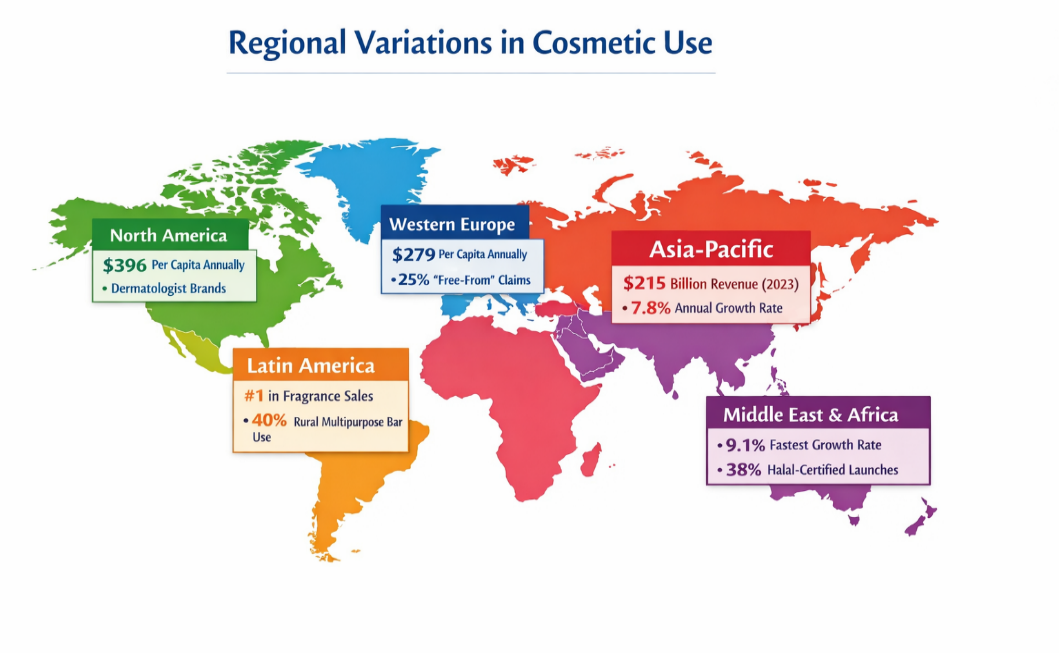
Fig 01. Global Patterns of Cosmetic Use
3.2 Demographics of Cosmetic Users
Age: Adolescents (12–17 years old) and adults (30–45 years old) show bimodal peaks in global cohorts. Due to pressure from social media, 72% of 14–16-year-old girls who participated in the 42,000 International Global Burden of Beauty survey wore foundation every day. Adults between the ages of 30 and 45 spend $312 annually on anti-aging products like retinol. Through "pro-age" and skin-barrier products, those over 65 grow at the fastest rate (CAGR 11%) [21].
Gender: Men's grooming has increased (CAGR 9.1% since 2018), although women account for 82% of spending. The average cost of BB creams and pencils for South Korean men is $244 per person, which is three times the OECD average [22]. Gender-neutral packaging is promoted by non-binary and trans users; 38% of Gen Z choose foundation hues that are ≥40, compared to 12% of Boomers [23].
Ethnicity/Race: Melanin-rich groups exhibit distinctive behaviors: African Americans spend 22% of their budgets on scalp/hair care (edge control, relaxers), compared to 8% for Caucasians [24]. Due to the risk of melasma, 48% of US Hispanic women use sunscreen every day [25]. Due to colorism, 61% of Fitzpatrick III women in India use fairness creams every night, compared to 19% of Fitzpatrick V women [26].
3.3. Types of Cosmetics Commonly Used
The skincare products are still a widely used category of cosmetics, which is dominated by moisturizers and influenced by local customs like the regular use of SPF in Europe and the desire for shea butter in some regions of sub-Saharan Africa. Product options have also been impacted by the pandemic, with niacinamide-based formulations experiencing rapid increase because to skin problems associated with masks. In addition to the post-mask revival of matte lipsticks in the Middle East and Africa and the rising desire for "clean" mineral products in high-end markets, color cosmetics are highly popular among young women in North America and East Asia. Although conditioning methods differ depending on the temperature and water quality, practically everyone uses hair care products. However, safety concerns have led to a decrease in the usage of chemical relaxers in favor of sulfate-free alternatives.The fragrances continue to generate substantial revenue, with strong consumption in the Middle East and increasing interest in subtle, unisex “skin-scent” profiles in Western countries. These trends and regional differences are summarized in Table 1 [27–30].
Table 1: Types of Cosmetics Commonly Used by regional pattern.
|
Cosmetic Category |
Global Trends and Market Data |
Regional Usage Patterns |
Emerging Trends |
Reference |
|
Skincare |
Moisturizers dominate the market (USD 48 billion, 2023). |
Daily SPF use is high in Europe (78%), whereas shea butter is preferred in sub-Saharan Africa (65%) over sunscreen (12%). |
Post-pandemic “maskne” led to a surge in niacinamide serums (CAGR 54%, 2020–2023). |
[27] |
|
Color Cosmetics |
Foundations show >70% penetration among women aged 18–34 years in North America and East Asia. |
Matte lipstick use increased by 38% in the Middle East and Africa after mask mandates. |
“Clean” mineral cosmetics (<10 ingredients) account for 25% of premium sales in North America. |
[28] |
|
Hair Care |
Shampoos are near-universal (>95% usage). |
Conditioning is daily in humid regions such as the Philippines but weekly in hard-water regions of Europe. |
US relaxer use declined by 18% (2018–2023), while sulfate-free co-washes increased by 22%. |
[29] |
|
Fragrances |
Global fragrance revenue reached USD 64 billion. |
Middle Eastern consumers purchase 1.7 bottles per capita (global average: 0.6), favoring oud extraits (≥20% oil). |
Western unisex “skin-scents” (e.g., iso-e-super, ambroxan) grew by 30%, reflecting demand for subtle, comforting fragrances. |
[30] |
4. COMMON ADVERSE REACTIONS TO COSMETICS
4.1 Cutaneous reactions
Contact dermatitis remains the dominant morbidity, accounting for 60–80 % of cosmetovigilance reports worldwide [31]. Regional patch-test positivity rates for fragrance mix I for allergic contact dermatitis (ACD) are 8.7% in Europe, 6.4% in North America, and 4.9% in Asia, whereas methylisothiazolinone (MI) positivity increased from 1.5% in 2009 to 11.2% in 2019 prior to EU concentration regulations [32]. Irritant contact dermatitis (ICD) is more common but underreported. even in healthy skin, cumulative insult from anionic surfactants (sodium lauryl sulphate > 10%) in body washes can increase transepidermal water loss (TEWL) by 40% within 14 days [33]. Populations that use heavy, occlusive hair greases are more likely to develop acneiform or pomade acne; within six weeks of applying petrolatum-based pomade, 37% of African-American teenage girls developed forehead acne compared to 7% of controls [34]. Occlusive foundations and dimethicone-rich primers functioned as additional comedogenic drivers, and "maskne" recorded during COVID-19 showed a 38% rise in papulopustular lesions [35]. Furanocoumarin-rich botanicals are increasingly associated with photosensitivity and phototoxic occurrences. At UV-A levels as low as 5 J cm?², or 15 minutes of Mediterranean noon sun, citrus essential oils (lemon, lime, bergamot) containing 5-methoxypsoralen (5-MOP) at concentrations > 0.002% caused phototoxic erythema [36]. In anti-aging day creams, retinyl palmitate and oxybenzone increased the phototoxic index (PI) by 2.3 times when compared to the vehicle control [37].
4.2 Systemic reactions
Respiratory outcomes are exemplified by hairdresser-associated asthma. A 12-year French surveillance cohort documented occupational asthma prevalence of 18.5 per 10 000 among hairstylists, with ammonium persulfate hair bleach responsible for 62 % of cases; mean latent period was 30 months, and 27 % experienced life-threatening exacerbations [38]. Spray propellants (isobutane, propane) emitted respirable particles < 4 µm that reached alveolar regions, eliciting dose-dependent bronchial hyper-responsiveness in atopic volunteers at 200 µg m?³ [39].Endocrine disruption is supported by multiple biomonitoring studies. Urinary concentrations of parabens and benzophenone-3 (BP-3) were positively associated with decreased serum testosterone in adolescent boys (β = −5.3 ng dL?¹ per log-unit BP-3, p = 0.008) [40]. A prospective cohort of 501 pregnant women revealed that those in the highest quartile of triclosan exposure (> 1 600 µg creatinine) had 0.21 ng mL?¹ lower maternal thyroxine (T4), increasing odds of subclinical hypothyroidism (OR 1.8, 95 % CI 1.1–3.0) [41].Neurological effects, though less common, are documented for formaldehyde-releasers. Chronic inhalation of formaldehyde from hair-straightening solutions (mean 0.9 ppm) impaired olfactory function (threshold increase 22 %) and induced mild cognitive dysfunction (MoCA score decline ≥ 2 points) in salon workers after 5 years of exposure [42]. Case reports link oxybenzone to transient neurotoxic symptoms (headache, somnolence) after whole-body application of SPF 50 sunscreen, with peak plasma levels of 258 ng mL?¹ exceeding the FDA systemic exposure threshold [43].
Table 2: Common adverse reactions to cosmetics:
|
Category |
Effect |
Findings |
Associated Ingredients |
Reference |
|
Cutaneous Reactions |
Contact dermatitis |
Accounts for 60–80% of cosmetovigilance reports. ACD patch-test positivity: Europe 8.7%, North America 6.4%, Asia 4.9% (fragrance mix I). MI positivity: 1.5% (2009) → 11.2% (2019) |
Fragrance mix I, methylisothiazolinone (MI) |
[31-32] |
|
Irritant contact dermatitis (ICD) |
More prevalent but under-reported; SLS ≥ 10% in body washes ↑ TEWL by 40% in 14 days |
Anionic surfactants (sodium lauryl sulfate) |
[33] |
|
|
Acneiform / Pomade acne |
37% of African-American adolescents developed forehead acne with petrolatum-based pomade vs 7% controls; “Maskne” ↑ 38% papulopustular lesions during COVID-19 |
Heavy hair greases, occlusive foundations, dimethicone-rich primers |
[34-35] |
|
|
Photosensitivity / Phototoxicity |
Citrus oils with 5-MOP ≥ 0.002% induced erythema at UV-A 5 J/cm²; Retinyl palmitate + oxybenzone ↑ PI 2.3-fold |
Citrus essential oils (lemon, lime, bergamot), retinyl palmitate, oxybenzone |
[36-37] |
|
|
Systemic Reactions |
Respiratory |
Hairdresser asthma prevalence: 18.5/10,000; ammonium persulfate responsible for 62% cases; spray propellants (<4 µm) caused dose-dependent bronchial hyper-responsiveness |
Ammonium persulfate, isobutane, propane |
[38-39] |
|
Endocrine disruption |
Parabens & BP-3 ↓ serum testosterone in boys; triclosan >1600 µg/g creatinine ↓ maternal T4, ↑ subclinical hypothyroidism OR 1.8 |
Parabens, benzophenone-3 (BP-3), triclosan |
[40-41] |
|
|
Neurological |
Chronic formaldehyde inhalation impaired olfactory function (+22% threshold) and cognitive function (MoCA ↓ ≥2); oxybenzone linked to transient neurotoxic symptoms (headache, somnolence) |
Formaldehyde releasers, oxybenzone |
[42-43] |
|
|
Specific Ingredients Associated with Reactions |
Common allergens |
Top NACDG 2022 allergens: fragrance mix I (11.5%), MI (9.4%), formaldehyde (7.8%), propolis (6.2%), PPD (5.9%); emerging: decyl glucoside 3.1% |
Fragrance mix I, MI, formaldehyde, propolis, PPD, decyl glucoside |
[44], [45] |
|
Preservatives |
IPBC caused airborne dermatitis 0.7% at 0.02% leave-on; phenoxyethanol induced urticaria 1.9% in infants; short-chain parabens restricted (sum ≤ 0.8%) due to estrogenic activity |
IPBC, phenoxyethanol, methyl-/ethyl-parabens |
[46] |
|
|
Fragrances / Sensitizers |
HICC banned EU 2021 (2.3% prevalence); Lilial prohibited (category 1B toxicity), yet 14% detected online; oxidized limonene hydroperoxides ≥0.5% elicited reactions in 5.2% eczema patients |
HICC, Lilial, oxidized limonene |
[47], [48] |
4.3 Specific ingredients associated with adverse reactions
Common allergens: The North American Contact Dermatitis Group (NACDG) 2022 surveillance identified the top five cosmetic allergens as fragrance mix I (11.5 %), methylisothiazolinone (9.4 %), formaldehyde (7.8 %), propolis (6.2 %), and para-phenylenediamine (PPD) (5.9 %) [44]. Decyl glucoside, a non-ionic surfactant produced from coconuts, is an emerging sensitiser that is now producing 3.1% positivity rates in patch-test clinics, particularly in "natural" body washes [45].
Preservatives: In addition to methylisothiazolinone, phenoxyethanol caused immediate-type urticaria in 1.9% of patch-tested infants exposed via wet wipes, and iodopropynyl butylcarbamate (IPBC) caused airborne contact dermatitis in 0.7% of exposed consumers at 0.02% leave-on concentration [46]. Although methyl and ethyl short-chain parabens are rarely allergenic, they are restricted by EU Regulation 2024/1541 (sum < 0.8%) because of their cumulative estrogenic action.
Fragrances and sensitizing agents: After sensitisation prevalence reached 2.3%, the EU prohibited Hydroxyisohexyl 3-cyclohexene carboxaldehyde (HICC) in 2021, however it is still allowed in several non-EU markets. Lilial (butylphenyl methylpropional) is now prohibited at any level because of reproductive toxicity (category 1B); yet a 2023 market survey detected lilial in 14 % of perfumes purchased online from third-party vendors [47]. 5.2% of eczema patients responded favourably to oxidised limonene (hydroperoxides ≥ 0.5%), highlighting the necessity of antioxidant stabilisation and expiration date labelling [48].
5. STRATEGIES FOR MITIGATION OF ADVERSE REACTIONS
5.1 Regulatory approaches
The global convergence remains limited. OECD-validated non-animal assays like KeratinoSensTM for skin sensitisation are driven by the EU Regulation (EC) No 1223/2009, which requires a comprehensive safety report (CPSR) that includes toxicological dossiers on all ingredients ≥ 0.001% in leave-on products and prohibits animal testing for finished cosmetics [49]. While the U.S. FDA operates under the 1938 Federal Food, Drug, and Cosmetic Act and depends on voluntary industry-submitted Cosmetic Product Registration (CPR) without pre-market approval, the ASEAN Cosmetic Directive (ACD) reflects EU norms. Brazil’s ANVISA RDC 07/2015 requires Good Manufacturing Practice (GMP) certification and notification within 15 days of market launch; non-compliance fines reach USD 40 000 per SKU [50]. Quantitative Risk Assessment (QRA) for fragrance allergens is now included in pre-market safety evaluation. Based on consumer habit data (95th percentile use = 17.7 g day?¹ body lotion) and aggregate exposure across product categories, IFRA QRA2 determines allowable exposure limits; lilial and HICC were prohibited when aggregate Margin of Exposure (MOE) dropped below 100 [51]. National cosmetovigilance centers oversee post-market surveillance. In 2023, 414 cosmetic alerts were registered by the EU's Rapid Alert System for Non-Food Products (RAPEX); 62% of these were related to chemical burns or allergies, and 78% came from internet sales [52]. When compared to passive physician reporting, Korea's "Smart Cosmetic Safety 2.0" app increases adverse-event capture by 3.4 times by allowing users to take pictures of their reactions and automatically upload geotagged reports [53].
5.2 Formulation strategies
Hypoallergenic design makes use of "free-from" lists that go beyond legal requirements. According to post-launch observation, the incidence of ACD decreased from 0.7% to 0.09% among 11,000 users under L'Oréal's "Allergen-Reduced" procedure, which removes 26 scent allergens with EU labels and 46 additional sensitisers [54]. Synergistic blends (e.g., 0.5% phenethyl alcohol + 0.3% caprylyl glycol) are used in preservative substitution to achieve > 3 log CFU mL?¹ reduction in challenge tests while keeping an acceptable dermatologic index [55].
Natural/organic formulations are not inherently safer; according to Consumer Reports, limonene hydroperoxides were present in 21% of "natural" moisturisers that were tested. Super-critical CO2 extraction to eliminate oxidised terpenes and micro-encapsulation of essential oils in β-cyclodextrin, which reduces sensitisation potential five times in murine local lymph node assays, are examples of mitigation [56].
5.3 Consumer education and awareness
A Randomized trials conducted by Smith V, 2023 demonstrate that a 5-minute pharmacist-led patch-test instruction lowers ACD incidence by 48 % over 6 months [57]. Adherence to the American Academy of Dermatology's "Apply with Care" campaign, which calls for behind-ear testing for leave-on face cosmetics every night for seven days, increased from 12% to 39% when QR codes that link to educational videos were incorporated into the package [58]. Proper storage reduces preservative degradation; UV-opaque airless dispensers-maintained methylisothiazolinone efficacy (≥ 3 log reduction) for 12 weeks at 40 °C, versus 6 weeks in clear jars [59]. When influencers uploaded response selfies with #ReportIt, recognition efforts like the UK's "It Could Be Your Make-up" program saw a 2.3-fold rise in Yellow Card adverse-event reports [60].
5.4 Industry initiatives
Since 1976, the Cosmetic Ingredient Review (CIR) Expert Panel operates a voluntary program has evaluated 3,847 compounds, of which 15% are restricted or prohibited. Glyceryl caprylate, a multipurpose preservative-emollient with no sensitisation reactions in over 5,000 patch-tested volunteers, was developed through industry-funded research and development [61].
Procter & Gamble's "Smart Label" specifies incidental components > 0.01% and fragrance allergies ≥ 0.001%; complete ingredient disclosure is available online. AI toxicity prediction is used by digital R&D platforms. Givaudan's "Carto" system screened 2500 novel aroma compounds, removing 18% with projected LLNA EC3 < 9% prior to synthesis, resulting in a 30% reduction in development time [62].
6. FUTURE DIRECTIONS AND CHALLENGES
6.1 Emerging trends in cosmetic science
Genomic data-driven personalised cosmetics are becoming more and more popular. In order to produce custom serums with allele-specific antioxidant ratios, companies like GeneU® analyse single-nucleotide polymorphisms (SNPs) in genes coding for matrix metalloproteinase-1 (MMP-1) and glutathione S-transferase (GST); a 12-week split-face trial revealed an 18% greater reduction in wrinkles compared to off-the-shelf equivalents [63]. Direct-to-consumer epigenetic kits (e.g., SkinDNA™) further integrate lifestyle metadata (UV exposure, diet) into machine-learning algorithms predicting retinoid tolerance, although validation cohorts remain < 1 000 participants and regulatory oversight is limited.Nanotechnology lets us deliver active ingredients right through the stratum corneum, exactly where they're needed. While decreasing systemic absorption below 0.1 ng mL?¹, solid lipid nanoparticles (SLN) loaded with 0.05% retinol boosted viable-epidermis deposition 3.6 times [64]. Transparent SPF 50 protection is offered by titania and zinc-oxide nanoparticles (≤ 100 nm), but photocatalytic ROS generation raised concerns; silica-shell encapsulation reduced ROS yield by 92% without compromising SPF, although long-term cutaneous destiny data are still missing [65].Microbiome-friendly cosmetics aim to maintain commensal diversity. In atopic volunteers, topical administration of heat-killed Lactobacillus plantarum (10? CFU g?¹) enhanced skin moisture (+14%) and decreased TEWL (−11%), along with an elevation in Cutibacterium acnes phylotype Ia abundance linked to skin health [66]. Probiotic viability in water-in-oil emulsions decreases by two log units over 12 weeks at 25 °C, requiring micro-encapsulation or spore-based formulations. However, the notion of a "healthy" skin microbiome is still population-specific.
6.2 Gaps in current knowledge and research needs
Chronic cosmetic use's long-term effects are mostly unknown. In a 2024 prospective cohort that tracked 4,800 American women for 15 years, baseline urinary paraben and BP-3 concentrations in the highest quintile were linked to incident hypertension (HR 1.6, 95% CI 1.1–2.3); however, cosmetic use patterns were only self-reported at baseline, making dynamic exposure assessment impossible [67]. Cumulative exposure to multiple ingredients generates “cocktail effects” that current single-chemical risk assessments overlook. Aggregate exposure modelling by the Dutch National Institute for Public Health estimated that simultaneous use of leave-on skincare, sunscreen, and perfume can increase systemic exposure to benzophenone-3 by 4.7-fold compared with single-product use, yet toxicokinetic interaction data remain sparse [68].The cosmetics and environmental stressors are not well studied. Within two hours of solar-simulated exposure, photopollution (blue light 400–500 nm) can oxidise avobenzone, creating aryl ketones that reduce epidermal vitamins C and E by 30%. It is unclear if this increases the risk of photo-aging or sensitisation [69]. Similarly, silicone-based primers are adsorbed by airborne polycyclic aromatic hydrocarbons (PAHs), which may increase the percutaneous absorption of hydrophobic UV filters. This is an area that needs real-world biomonitoring.
6.3 Potential improvements in safety assessment
Next-generation in vitro assays incorporate organ-on-a-chip technology. In a 3D-human-skin-on-chip microfluidic model, keratinocytes, fibroblasts, and dendritic cells accurately predicted sensitisation potency (LLNA EC3) and properly recognised benzoic acid as a false-positive in KeratinoSens™ [70]. Combining high-throughput transcriptomics (RNA-seq) with ToxCast bioactivity signatures allows for read-through for untested chemicals; a Bayesian model applied to 1,400 cosmetic products decreased animal use by 65% while retaining a 5% false-negative rate [71].Microdosing and systems toxicology are examples of human safety studies that have been refined. A phase-0 microdose research using 2 µg kg?¹ deuterium-labelled butylparaben showed quick conjugation (t½ = 3.2 h), indicating read-across to short-chain parabens. However, ethical restrictions limit such investigations to single-dose kinetics [72].Blockchain-secured supply-chain logs that link purchase receipts with smartphone-reported adverse occurrences help to integrate real-world post-market data. A trial by L'Oréal, 2024 and IBM achieved 87% data verifiability and enabled probabilistic signal detection (ROR 025 ≥ 2) within 30 days of product launch, compared to 180 days with traditional spontaneous reporting [73]. Regulatory adoption of such decentralized evidence streams remains a key constraint.
CONCLUSION
Cosmetic use today is almost universal, shaped by cultural expectations, urban lifestyles, and changing work patterns, particularly among women. While the industry has grown into a multi-billion-dollar global market, this expansion has brought clear safety challenges. A notable proportion of users experience adverse reactions, most commonly contact dermatitis, with fragrances, preservatives, and hair-dye ingredients remaining the main culprits. Although serious systemic effects are less common, they do occur, especially with long-term or occupational exposure, reminding us that cosmetics are not entirely risk-free.Encouragingly, regulatory actions and improved product reformulation have already reduced the burden of some major allergens, and advances in labelling transparency and digital reporting systems have strengthened post-marketing surveillance. However, large gaps remain. Differences in regulatory standards across countries, widespread under-reporting by consumers, and the continued circulation of high-risk formulations in less regulated markets limit the overall effectiveness of current safeguards.From a public health and policy perspective, stronger global alignment of cosmetic regulations, better reporting systems, and routine inclusion of cosmetic exposure in clinical assessments are urgently needed. At the same time, consumers can play an active role by using fewer products, testing new cosmetics before regular use, and reporting any adverse reactions. Industry, too, must move beyond minimum compliance by prioritizing safer formulations, openly sharing safety data, and investing in greener alternatives.Looking ahead, innovations such as personalized formulations, non-animal testing platforms, microbiome-friendly preservatives, and smarter supply-chain monitoring could reshape cosmetic safety. Yet, real progress will depend on long-term research, transparent data sharing, and sustained collaboration between scientists, clinicians, regulators, and consumers. Only through such coordinated efforts can the benefits of cosmetic science be fully realized while keeping population-level health risks to a minimum.
REFERENCES

Murshida Sherin A. T., Shafna T., Rinsha Farvi T., Rashid K., Cosmetic Safety and Consumer Health: A Comprehensive Review of Global Use Patterns and Adverse Effects, Int. J. of Pharm. Sci., 2026, Vol 4, Issue 2, 566-579. https://doi.org/10.5281/zenodo.18484746
 10.5281/zenodo.18484746
