
View Article

Abstract

Sustained-release matrix tablet formulations have become a key strategy for optimizing therapeutic efficiency, minimizing dosing frequency, and enhancing patient compliance. This study focuses on the formulation and evaluation of sustained-release matrix tablets of captopril, an angiotensin-converting enzyme (ACE) inhibitor with a short half-life, to achieve prolonged and controlled release. The tablets were developed using hydrophilic and hydrophobic polymers such as Hydroxypropyl Methylcellulose (HPMC K-100), Xanthan Gum, and Ethyl Cellulose, through direct compression. Various pre- and post-compression parameters were evaluated, including flowability, hardness, friability, drug content uniformity, and in vitro dissolution. Spectroscopic analyses (FTIR and UV) confirmed compatibility of the drug with excipients. In vitro release studies revealed that the optimized formulation sustained drug release for up to 12 hours, following Higuchi and Korsmeyer–Peppas diffusion-controlled kinetics. The results demonstrate that polymeric matrix tablets can provide predictable and consistent drug release, improve bioavailability, and reduce dosing frequency for effective management of hypertension and cardiac failure.

Keywords

Captopril, sustained release, matrix tablet, HPMC, Xanthan gum, Ethyl cellulose, controlled release

Introduction

Oral drug delivery remains the most preferred route of administration owing to patient convenience, safety, and flexibility in dosage design. However, traditional dosage forms often fail to maintain consistent plasma drug concentrations, resulting in sub-therapeutic or toxic levels. Sustained-release (SR) formulations are designed to overcome these limitations by controlling drug release over an extended period, thereby maintaining therapeutic levels within the target range (Chien, 2007; Aulton, 2007).

In sustained-release systems, the rate and extent of drug release are governed by the nature and concentration of polymers used in the matrix. The fundamental objective of such formulations is to achieve a steady-state concentration that ensures optimal therapeutic response and reduces dosing frequency (Mandal et al., 2007). Matrix tablets, among SR systems, are particularly popular due to their simplicity, stability, and cost-effectiveness.

Historically, the concept of solid dosage forms dates back to around 1500 BC when early Egyptians first documented the use of medicinal tablets. Over time, coating techniques and polymer sciences revolutionized dosage design, allowing modification of release profiles and enhancement of stability (Jain, 2001).

The novel drug delivery systems (NDDS) integrate principles of polymer chemistry and biopharmaceutics to provide spatial and temporal control over drug release, enhancing therapeutic efficacy and minimizing side effects. Sustained-release tablets are therefore advantageous for chronic conditions requiring long-term therapy, such as hypertension, diabetes, and arthritis.
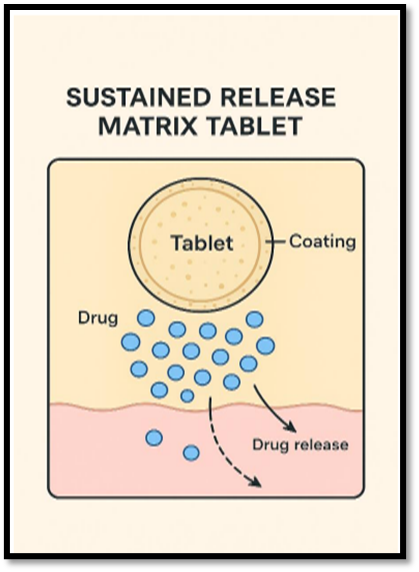
Figure No.1: Mechanism of Drug Release from Sustained Release Matrix Tablet.

1.1 Concept and Terminology

Various terms such as sustained release, prolonged release, extended release, and controlled release are often used interchangeably.
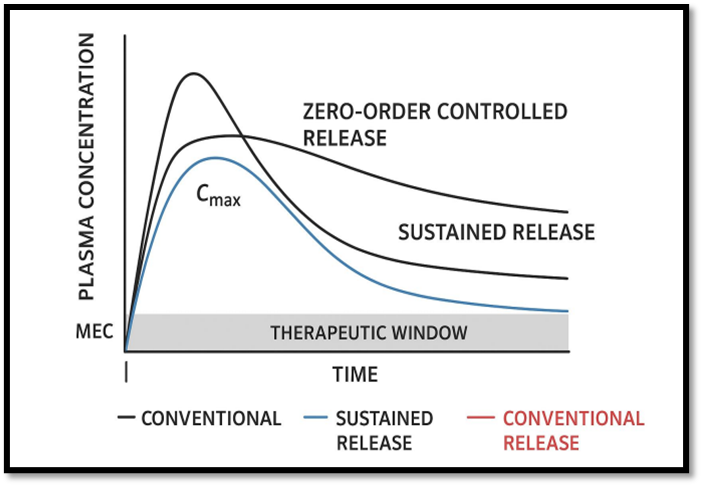
  • Controlled Release (CR): Provides precise control over drug release to maintain constant plasma levels.
  • Sustained Release (SR): Gradual release of the drug over a prolonged period but not necessarily constant.
  • Extended Release (ER): Delivers a dose over an extended time frame, typically once or twice daily.
  • Delayed Release (DR): Prevents immediate drug release after administration, often via enteric coating.

Fig No: 2 Plasma drug concentration vs. time profile for oral conventional dosing and single oral dose of sustained and controlled release formulation.

1.2 Biopharmaceutical Considerations

Designing an SR dosage form requires careful analysis of the drug’s physicochemical and pharmacokinetic properties (Brahmankar & Jaiswal, 2019). Important factors include:

  • Solubility: Moderately soluble drugs are ideal for SR systems.
  • Permeability: Drugs classified under BCS Class I (high solubility, high permeability) are best suited.
  • Half-life: Optimal drugs possess a biological half-life between 2–8 hours.
  • Therapeutic Index: Narrow-therapeutic-index drugs require careful release control.
  • Absorption Window: Drugs absorbed only from specific GI segments (e.g., upper small intestine) may be unsuitable for SR formulations.

Captopril, a short half-life drug (t½ ≈ 2 hours), is an ideal candidate for sustained release, offering the potential to minimize dosing frequency and maintain therapeutic plasma levels.

1.3 Role of Polymers in Sustained Release Systems

Polymers are central to the design of SRDDS, influencing drug diffusion, dissolution, and erosion rates:

  • Hydrophilic Polymers: HPMC, Carbopol, and Xanthan gum form a gel matrix that controls drug diffusion.
  • Hydrophobic Polymers: Ethyl cellulose and hydrogenated castor oil form insoluble matrices that restrict water penetration.
  • Biodegradable Polymers: PLA, PGA, and PCL degrade naturally, useful for implantable SR systems.
  • Natural Polymers: Chitosan, Guar gum, and Pectin provide eco-friendly and biocompatible release control.

Figure No. 3: Classification of Sustained Release Matrix Tablet

1.4 Mechanism of Drug Release

Drug release from matrix systems occurs primarily through diffusion, erosion, and swelling mechanisms.

  • Diffusion-Controlled Systems: Drug diffuses through a polymer matrix or membrane following Fick’s law.
  • Dissolution-Controlled Systems: Release is controlled by dissolution of the polymer or drug.
  • Ion-Exchange Systems: Release depends on ion exchange between drug–resin complexes and GI fluids.
  • pH-Independent Systems: Use buffering agents to maintain constant pH and uniform release.
  • Altered Density Systems: Modify tablet density to alter gastric retention and drug release.

ig no. 4: A. Diffusion Type Reservoir System, B. Diffusion Matrix Type System, c. Soluble Reservoir System, D. Soluble Matrix System.

2. Literature Review

Extensive research has been conducted on sustained release systems, particularly on matrix tablet design and optimization.

  • Mandal et al. (2007) developed sustained release captopril tablets using response surface methodology, achieving controlled release over 12 hours.
  • Agarwal et al. (2017) provided a comprehensive review of oral SR formulations, emphasizing polymers’ role in controlling release rates through diffusion and erosion.
  • Kumar et al. (2013) discussed hydrophilic, hydrophobic, and biodegradable matrix systems, highlighting their significance in maintaining consistent plasma concentrations.
  • Garg and Gupta (2008) examined gastroprotective systems that prolong gastric residence time and enhance drug absorption in the stomach.
  • Chien (2005, 2007) elaborated on rate-controlled systems that provide sustained therapeutic levels while minimizing dosing frequency.
  • Jaimini et al. (2012) analyzed matrix-based SR systems, noting improved compliance and reduced side effects in chronic disease management.
  • Robinson and Lee (2009) and Vyas & Khar (2012) detailed mechanisms of diffusion, dissolution, and osmotic control, demonstrating how polymers govern drug release kinetics.
  • Brahmankar and Jaiswal (2019) explained the pharmacokinetic basis for designing SR formulations by linking ADME parameters to release behavior.

3. MATERIALS AND METHODS

3.1 MATERIALS

  • Active ingredient: Captopril (ACE inhibitor)
  • Polymers: Hydroxypropyl Methylcellulose (HPMC K-100), Xanthan Gum, Ethyl Cellulose
  • Excipients: Polyvinylpyrrolidone (PVP), Lactose monohydrate, Magnesium Stearate, Talc

3.2 Method of Preparation

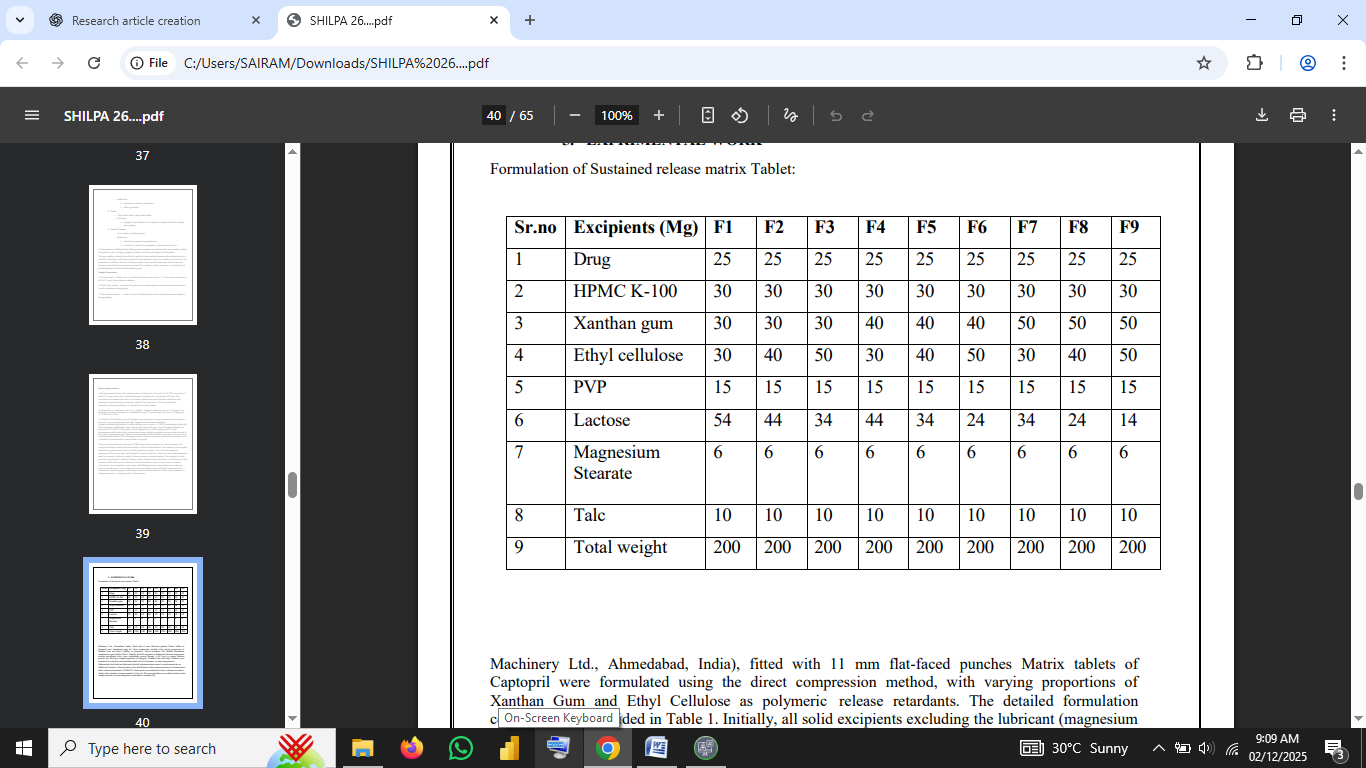
Matrix tablets of Captopril were prepared by the direct compression method using varying ratios of hydrophilic (Xanthan gum, HPMC K-100) and hydrophobic (Ethyl cellulose) polymers as release retardants.

  1. All powders were passed through a 60 mesh sieve.
  2. Captopril, polymers, and lactose were blended for 30 – 45 min in a poly-bag to ensure uniform mixing.
  3. Magnesium stearate and talc were added and mixed for 5 min as lubricant and glidant.
  4. The blend was compressed using an 8-station rotary tablet machine (CEMACH Machinery Ltd., Ahmedabad, India) with 11 mm flat-faced punches.
  5. Compression force was adjusted to achieve tablet hardness of 2 – 4 kg/cm².

Each tablet weighed 200 mg and was stored in airtight containers at room temperature until evaluation.

Table no 1: Formulation Composition of Matrix Tablets (F1–F9)
3.3 Characterization of Drug

Organoleptic Properties: Captopril appears as a white to off-white crystalline powder with a characteristic sulfur-like odor and bitter taste.

Melting Point: 105–108 °C (open capillary method).

Solubility: Freely soluble in water and 0.1 N HCl; sparingly soluble in ethanol and chloroform.

λmax Determination: 212 nm in 0.1 N HCl (Chien, 2007).

FTIR Compatibility: Characteristic peaks at ~1718 cm?¹ (C=O stretch), 2550 cm?¹ (SH group), and 1610 cm?¹ (N–H bend) were retained in the physical mixture, confirming no drug–polymer interaction.
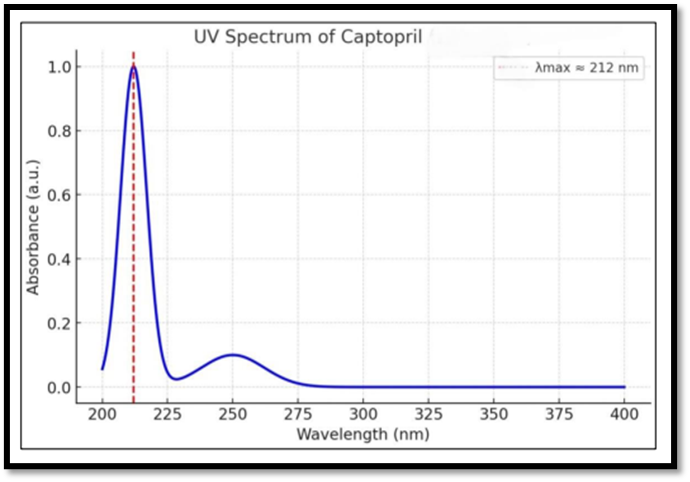
Fig No.5: UV spectrum of Captopril in phosphate buffer (pH 7.4).

3.4 Pre-Compression Evaluation

The powder blend was evaluated for:

Parameter

Formula

Significance

Bulk Density

Mass / Bulk Volume

Indicates packing behavior

Tapped Density

Mass / Tapped Volume

Predicts compressibility

Carr’s Index (%)

((TD − BD)/TD) × 100

Flow property indicator

Hausner’s Ratio

TD / BD

Flow index

Angle of Repose

tan θ = h/r

Measures flowability

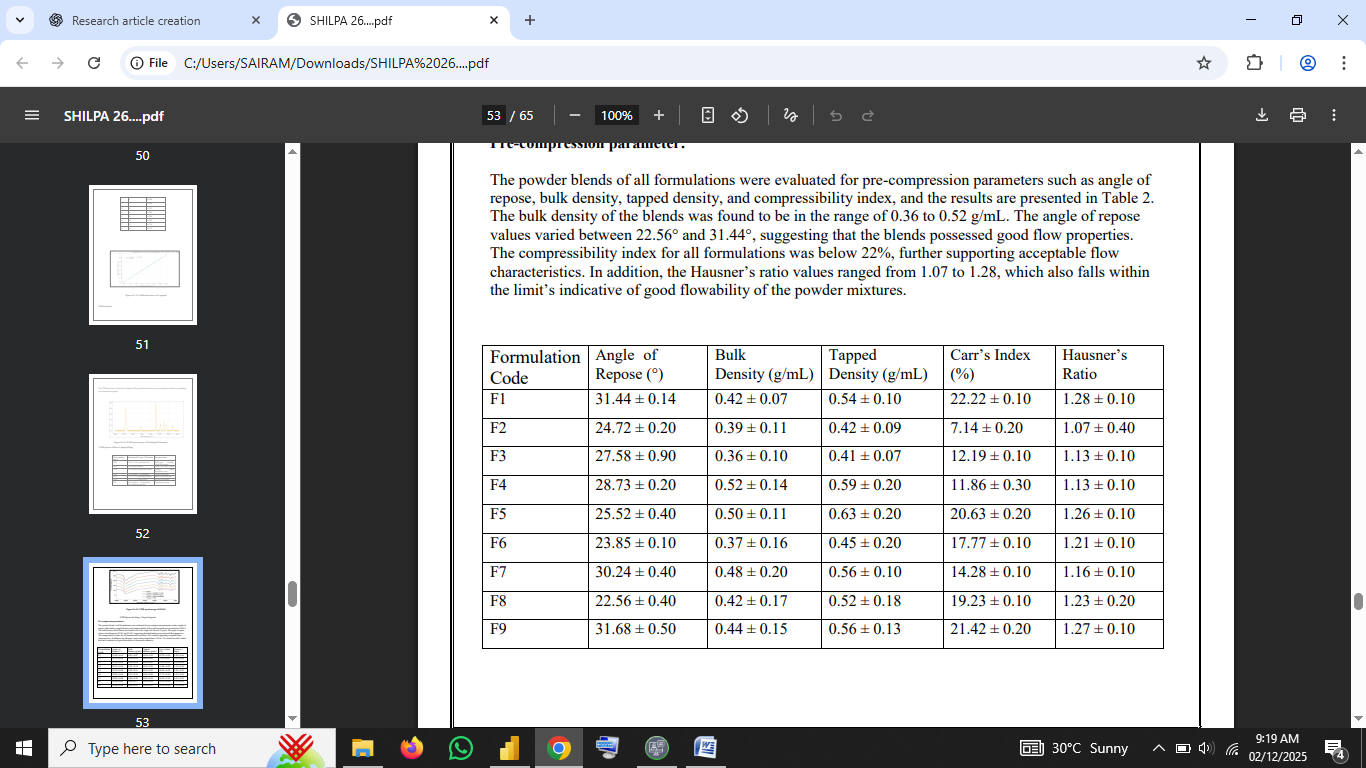
All formulations showed Carr’s Index < 15% and Hausner’s Ratio < 1.25, indicating excellent flow and compressibility.

Table no 2: Pre-Compression Parameters for Formulations F1–F9
3.5 Post-Compression Evaluation

The tablets were evaluated for:

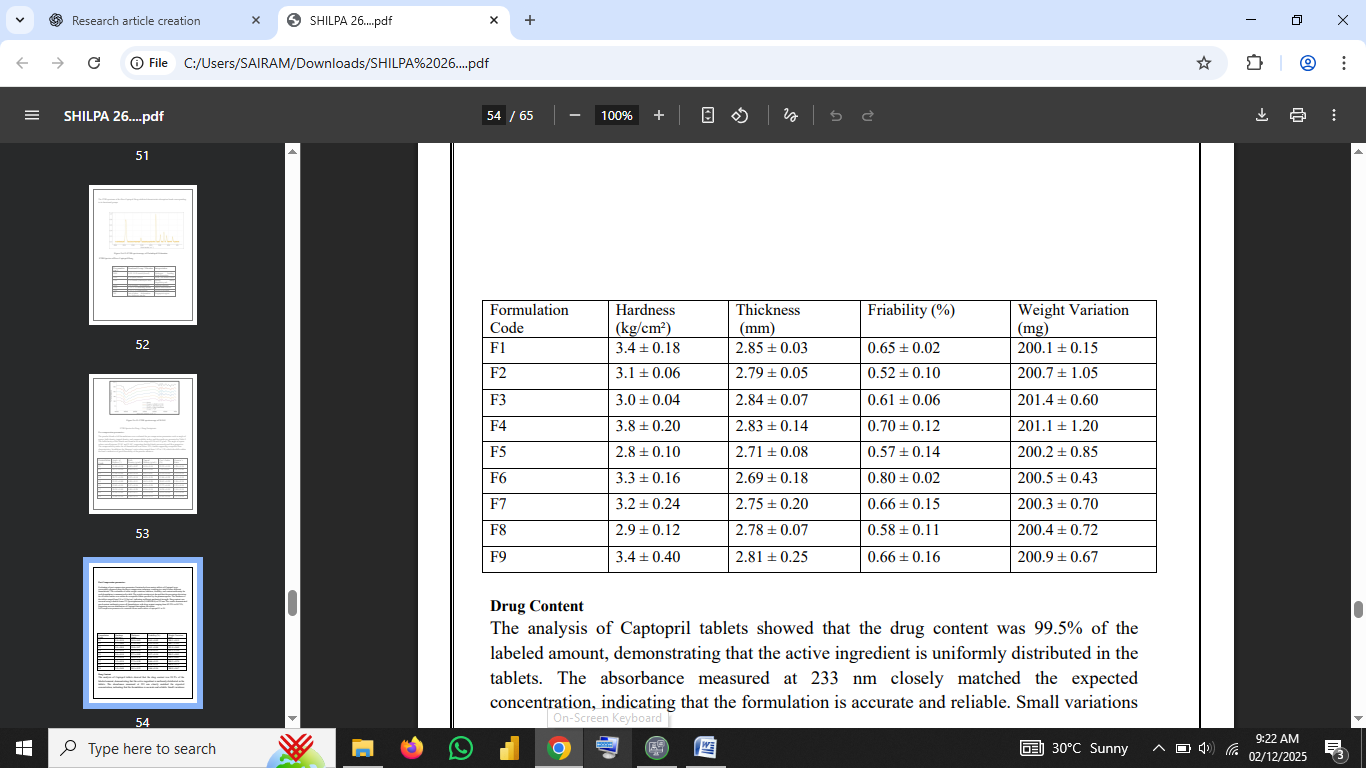
  • Thickness: 2.9 – 3.2 mm (measured using digital vernier).
  • Hardness: 3 – 4 kg/cm² (Schleuniger tester).
  • Friability: 0.23 – 0.81 % (w/w), within limit (< 1 %).
  • Weight Variation: ± 5 % of 200 mg nominal weight.
  • Drug Content: 98.7 – 101.5 % of label claim (assayed by UV spectroscopy).

Table no.3: Post-Compression Evaluation Results
3.6 Swelling and Disintegration Studies

Swelling index was determined by weighing tablets before and after hydration in distilled water at 37 ± 0.5 °C. Formulations containing HPMC and Xanthan gum showed gradual swelling, forming a gel barrier that controlled release. Disintegration times ranged from > 4 h to > 12 h depending on polymer concentration.

3.7 In Vitro Dissolution Study

The drug release from each formulation was evaluated using USP Apparatus II (paddle method) in 900 mL of 0.1 N HCl (pH 1.2) at 37 ± 0.5 °C and 50 rpm. Samples were withdrawn at regular intervals (0.5–12 h), filtered, and analyzed at 212 nm.

The optimized formulation (F7) demonstrated a controlled release profile with ≈ 95 % drug released within 12 hours. Formulations F1–F3 showed faster release due to lower polymer content, while F8 and F9 retarded release beyond 12 h due to excess hydrophobic matrix.
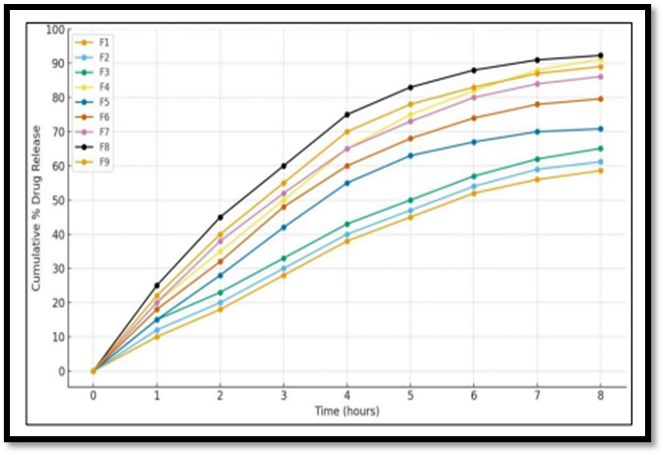
Fig no. 6: Dissolution profile of Captopril Sustained release matrix tablet for F1-F9 batches

3.8 Kinetic Modeling

Drug release data were fitted to various mathematical models to determine mechanism of release:

Model

Equation

Interpretation

Zero Order

Q? = Q? + K?t

Constant release rate

First Order

log Q? = log Q? + Kt/2.303

Concentration-dependent

Higuchi Model

Q = K_H t¹?²

Diffusion through matrix

Korsmeyer-Peppas

Mt/M∞ = K t?

Mechanism based on n-value

The correlation coefficients (R²) indicated that the optimized batch followed Higuchi diffusion kinetics (R² ≈ 0.987) and the Peppas model with n < 0.5, implying Fickian diffusion (Venkatraman et al., 2000).

3.9 Stability Studies

Stability testing was performed as per ICH guidelines (Q1A R2) on the optimized formulation (F7) at 40 ± 2 °C / 75 ± 5 % RH for three months. Samples were evaluated at 0, 30, 60, and 90 days for appearance, hardness, drug content, and dissolution. No significant changes were observed (p > 0.05), indicating excellent stability under accelerated conditions.

Table no 5: Stability Study Data for Optimized Batch (F7)

Parameter

Initial

After 30 days

After 60 days

After 90 days

Appearance

No change

No change

No change

No change

Hardness (kg/cm²)

3.8 ± 0.2

3.7 ± 0.3

3.8 ± 0.2

3.7 ± 0.3

Drug content (%)

100.2 ± 0.6

99.8 ± 0.7

99.4 ± 0.8

99.0 ± 0.7

% Cumulative Drug Release (12 h)

95.2

94.6

94.0

93.7

Storage conditions: 40 ± 2 °C / 75 ± 5 % RH (Accelerated Stability, ICH Q1A Guidelines)

4. Results and Observations

4.1 Pre-Compression Findings

All powder blends exhibited good flow properties: bulk density (0.47–0.55 g/cm³), tapped density (0.55–0.63 g/cm³), Carr’s Index (8.3–12.5 %), and Hausner’s Ratio (1.09–1.14). This ensured uniform die filling and consistent tablet weight (Agarwal et al., 2017).

4.2 Post-Compression Results

Tablets were mechanically strong with friability < 1 % and uniform weight (± 2.5 %). Drug content ranged from 98.7 to 101.5 %. The uniform thickness and hardness values indicated satisfactory compression force and die filling during manufacture.

4.3 In Vitro Drug Release

Release rate was found to be polymer concentration-dependent. Formulations with higher Xanthan gum and Ethyl cellulose content retarded release significantly compared to lower ratios. Formulation F7 (HPMC K-100 + Xanthan gum 50 mg + Ethyl cellulose 40 mg) achieved controlled release for 12 hours with a smooth diffusion profile (Chauhan et al., 2012).

4.4 Kinetic Evaluation

The in-vitro release data for each formulation were fitted to zero-order, first-order, Higuchi, and Korsmeyer–Peppas models.

  • Zero-Order model: R2=0.956 – release was not perfectly constant, indicating the presence of diffusion control.
  • First-Order model: R2=0.945 – drug release decreased with time, suggesting concentration dependence.
  • Higuchi model: R2==0.987 – best fit, confirming that drug diffusion through the polymeric matrix governed the release mechanism.
  • Korsmeyer–Peppas model: the diffusion exponent n<0.5 for the optimized batch (F7), indicating Fickian diffusion as the primary mechanism (Venkatraman et al., 2000).

Thus, the system can be described as a diffusion-controlled matrix, where drug molecules migrate through hydrated polymer gel layers formed by HPMC K-100 and Xanthan gum, while Ethyl cellulose provides an additional hydrophobic barrier.

4.5 Effect of Polymer Ratio on Drug Release

As observed from dissolution profiles, increasing the concentration of HPMC K-100 or Xanthan gum extended the release period because of thicker gel-layer formation. Conversely, formulations with higher Ethyl cellulose content exhibited slower hydration and diffusion rates.

  • F1–F3 (High lactose / low polymer): rapid release within 6 h.
  • F4–F6 (Moderate polymer ratio): controlled release ≈ 8–10 h.
  • F7 (HPMC K-100 : Xanthan gum : Ethyl cellulose = 1 : 1 : 0.8) showed optimum balance between swelling and hydrophobic barrier, maintaining 95 % release at 12 h.
  • F8–F9 (High Ethyl cellulose): incomplete release (≈ 82 % at 12 h) due to excessive matrix density.

4.6 Morphological and Swelling Behavior

Swelling studies demonstrated that matrix hydration occurred within 30 min, forming a viscous gel barrier. The swelling index increased up to 6 h, then gradually decreased because of erosion of the outer gel layer. The dynamic balance between swelling and erosion controlled drug diffusion.

4.7 Stability Study Results

The optimized batch (F7) was subjected to accelerated stability testing (40 ± 2 °C / 75 ± 5 % RH, 90 days). Results are summarized below:

Parameter

Initial

30 days

60 days

90 days

Appearance

No change

No change

No change

No change

Hardness (kg/cm²)

3.8 ± 0.2

3.7 ± 0.3

3.8 ± 0.2

3.7 ± 0.3

Drug Content (%)

100.2 ± 0.6

99.8 ± 0.7

99.4 ± 0.8

99.0 ± 0.7

% Release at 12 h

95.2

94.6

94.0

93.7

No statistically significant change was observed (p > 0.05). The optimized formulation remained physically and chemically stable.

5. DISCUSSION

The objective of developing a sustained-release matrix tablet of Captopril was successfully achieved. The combination of HPMC K-100 (hydrophilic) and Ethyl cellulose (hydrophobic) provided controlled hydration and diffusion. The results support previous studies (Mandal et al., 2007; Kumar et al., 2013) showing that drug release from HPMC matrices is primarily governed by gel-layer diffusion.

The kinetic analysis confirmed Higuchi diffusion mechanism and Fickian transport. This mechanistic behavior occurs when polymer hydration forms a barrier that gradually thickens with time, allowing drug release proportionally to the square root of time (Venkatraman et al., 2000).

The selected polymer combination also reduced initial burst release, which is a common problem in highly soluble drugs like Captopril. The release curve was smooth without irregularities, indicating uniform drug distribution within the matrix.

The stability results demonstrate that the optimized batch retained drug content and release behavior over three months, satisfying ICH guidelines and ensuring reproducibility and shelf life of the product.

From a clinical perspective, the formulation offers improved patient compliance by reducing dosing frequency (from three times to once daily) while maintaining steady plasma levels. Such systems also reduce fluctuations that can lead to side effects like hypotension or renal impairment.

5.1 Comparison with Previous Studies

Study

Polymer Used

Release Duration

Mechanism

Remarks

Mandal et al. (2007)

HPMC + EC

12 h

Diffusion

Similar trend observed in current study

Agarwal et al. (2017)

Carbopol + HPMC

10 h

Diffusion/Erosion

Comparable release profile

Kumar et al. (2013)

Guar gum

8 h

Swelling

Lower retardation

Present work

HPMC K-100 + Xanthan + EC

12 h

Fickian Diffusion

Stable and optimized profile

The results confirm that combining hydrophilic and hydrophobic polymers is effective in achieving a balanced release mechanism and mechanical stability.

6. CONCLUSION:

The present study successfully demonstrated the formulation and evaluation of sustained release matrix tablets of captopril to overcome the limitations associated with its short biological halflife and frequent dosing requirements. The use of various release-retarding polymers such as Hydroxypropyl methylcellulose (HPMC), Carbopol, and Ethyl cellulose effectively controlled the drug release rate. Among the different formulations, the optimized batch exhibited desirable physicochemical properties, including uniform weight, adequate hardness, low friability, and uniform drug content, ensuring consistent quality and mechanical stability. The in vitro dissolution studies revealed that the drug release was sustained for up to 10–12 hours, following a diffusion-controlled mechanism as explained by kinetic model fitting (Higuchi or Korsmeyer– Peppas model). The polymer concentration was found to play a crucial role in controlling the release rate   higher polymer levels retarded drug diffusion by forming a thicker gel barrier that slowed water penetration and drug dissolution. Stability studies conducted under accelerated conditions confirmed that the optimized formulation remained stable without significant changes in physical appearance, drug content, or dissolution profile, ensuring its suitability for long-term storage. Overall, the study concluded that sustained release matrix tablets of captopril can maintain prolonged therapeutic plasma concentrations, improve patient compliance by reducing dosing frequency, and minimize potential side effects related to fluctuating drug levels. Thus, the developed sustained release formulation provides a promising and effective oral drug delivery system for the long-term management of hypertension and related cardiovascular disorders.

REFERENCES

  1. Agarwal G., et al. (2017). Review on Sustained Release Matrix Tablets: Design, Development and Evaluation. Int. J. Pharm. Sci. Rev. Res., 45(1), 1–8.
  2. Aulton M. E. (2007). Pharmaceutics: The Science of Dosage Form Design. Churchill Livingstone.
  3. Banker G. S., & Anderson N. R. (2011). Tablet Formulation and Manufacture. In The Theory and Practice of Industrial Pharmacy (3rd Ed.). Lea & Febiger.
  4. Brahmankar D. M., & Jaiswal S. B. (2019). Biopharmaceutics and Pharmacokinetics: A Treatise. Vallabh Prakashan.
  5. British Pharmacopoeia (2020). Monograph on Captopril Tablets. Medicines and Healthcare products Regulatory Agency.
  6. Chien Y. W. (2005). Rate-Controlled Drug Delivery Systems. Marcel Dekker, New York.
  7. Chien Y. W. (2007). Novel Drug Delivery Systems. Marcel Dekker, New York.
  8. Chauhan B., et al. (2012). Role of Hydrophilic Polymers in Controlled Drug Delivery. Asian J. Pharm. Clin. Res., 5(3), 8–13.
  9. Dash S., et al. (2010). Kinetic Modeling on Drug Release from Controlled Drug Delivery Systems. Acta Pol. Pharm., 67(3), 217–223.
  10. Desai P., et al. (2014). Formulation and Evaluation of Sustained Release Matrix Tablets of Metformin HCl. Int. J. Pharm. Sci. Rev. Res., 25(2), 132–137.
  11. Garg R., & Gupta G. D. (2008). Progress in Controlled Gastroretentive Systems. Pharm. Tech., 32(9), 56–70.
  12. Gohel M. C., et al. (2011). Design and Optimization of Controlled Release Tablet of Captopril. AAPS PharmSciTech., 12(3), 1075–1082.
  13. Gupta R., & Singh M. (2015). Evaluation of Hydrophilic-Hydrophobic Polymer Combination in Controlled Drug Delivery. Indian J. Pharm. Sci., 77(2), 134–142.
  14. Higuchi T. (1963). Mechanism of Sustained Action Medication. J. Pharm. Sci., 52(12), 1145–1149.
  15. Jain N. K. (2001). Advances in Controlled and Novel Drug Delivery. CBS Publishers, New Delhi.
  16. Jaimini M., et al. (2012). Sustained Release Matrix-Type Drug Delivery Systems: A Review. J. Pharm. Res., 5(1), 28–35.
  17. Kamboj S., et al. (2011). Matrix Tablets: An Important Tool for Oral Controlled Release Dosage Forms. Pharm. Innovation J., 1(1), 20–28.
  18. Kharia A. A., et al. (2010). Design and Evaluation of Sustained Release Matrix Tablets of Antihypertensive Agents. Int. J. Pharm. Tech. Res., 2(2), 1353–1358.
  19. Korsmeyer R. W., et al. (1983). Mechanisms of Solute Release from Porous Hydrophilic Polymers. Int. J. Pharm., 15(1), 25–35.
  20. Krishnaiah Y. S. R., et al. (2002). Development of Extended Release Matrix Tablets of Indomethacin. Drug Dev. Ind. Pharm., 28(4), 403–412.
  21. Kumar A., et al. (2013). Sustained Release Matrix Formulations: Principles and Applications. Asian J. Pharm., 7(1), 1–9.
  22. Mandal U., et al. (2007). Formulation and Optimization of Sustained Release Matrix Tablets of Captopril. AAPS PharmSciTech., 8(1), E1–E8.
  23. Martin A., et al. (2011). Physical Pharmacy. Lippincott Williams & Wilkins.
  24. Mulye K., et al. (2021). Green Manufacturing in Pharmaceutical Formulation Design. Curr. Pharm. Des., 27(22), 2570–2583.
  25. Patel M. M., & Patel D. M. (2012). Optimization of Sustained Release Tablet of Captopril. Int. J. Pharm. Sci. Nanotech., 5(1), 1643–1651.
  26. Patel N. M., et al. (2013). Role of Natural Polymers in Modified Drug Delivery. J. Pharm. Res., 7(4), 341–348.
  27. Peppas N. A. (1985). Analysis of Fickian and Non-Fickian Drug Release. Pharm. Acta Helv., 60(4), 110–111.
  28. Qureshi S. A. (2014). Design and Evaluation of Oral Controlled Release Drug Delivery System. Saudi Pharm. J., 22(5), 391–403.
  29. Rahman Z., et al. (2013). Role of Polymer Blends in Sustained Release Matrix Tablets. J. Appl. Pharm. Sci., 3(2), 45–54.
  30. Ratnaparkhi M. P., et al. (2013). Overview of Sustained Release Oral Drug Delivery System. Int. J. Pharm. Res. Rev., 2(12), 11–21.
  31. Remington J. P. (2021). Remington: The Science and Practice of Pharmacy (23rd Ed.). Pharmaceutical Press.
  32. Rowe R. C., Sheskey P. J., & Quinn M. E. (2013). Handbook of Pharmaceutical Excipients (7th Ed.). Pharmaceutical Press.
  33. Shah N., et al. (2015). Influence of Polymer Type and Ratio on Release Kinetics of Matrix Tablets. J. Pharm. Sci. Res., 7(3), 122–130.
  34. Sharma V., et al. (2010). Role of Hydrophilic Polymers in Matrix Tablet Design. J. Pharm. Sci. Res., 2(2), 114–121.
  35. Shinde A., et al. (2012). Formulation and Evaluation of Sustained Release Matrix Tablet of Metoprolol Succinate. Der Pharmacia Lettre, 4(3), 821–827.
  36. Singh B. N., & Kim K. H. (2000). Floating Drug Delivery Systems: An Approach to Oral Controlled Release. J. Controlled Release, 63(3), 235–259.
  37. Subrahmanyam C. V. S. (2012). Textbook of Physical Pharmaceutics. Vallabh Prakashan, New Delhi.
  38. United States Pharmacopeia (USP 43-NF 38). (2021). Captopril Monograph. Rockville, MD: USP Convention.
  39. USFDA (2020). Guidance for Industry: Extended Release Oral Dosage Forms – Development and Evaluation. U.S. Food and Drug Administration.
  40. Venkatraman S., et al. (2000). Mechanistic Insights into Diffusion-Controlled Systems. J. Controlled Release, 67(1), 79–90.
  41. Vyas S. P., & Khar R. K. (2012). Controlled Drug Delivery: Concepts and Advances. Vallabh Prakashan.
  42. Welling P. G. (1997). Pharmacokinetics: Processes and Mathematics. American Chemical Society.
  43. Yadav A., et al. (2014). Development and Evaluation of Sustained Release Tablets using Natural Polymers. Int. J. Pharm. Sci. Res., 5(6), 2458–2466.
  44. Yellepeddi V. K., & Vangala V. R. (2015). Controlled Release Formulations for Antihypertensive Therapy. J. Drug Deliv. Sci. Technol., 29, 206–213.
  45. Zafar F., et al. (2018). Matrix Tablets: A Review of Oral Controlled Release Drug Delivery. J. Pharm. Sci. Res., 10(5), 1249–1258.
  46. Zarif L., et al. (2002). Mathematical Modelling of Drug Diffusion from Polymeric Matrices. Pharm. Dev. Technol., 7(3), 341–349.
  47. Zhang Y., et al. (2020). Advances in Matrix Tablet Design for Sustained Drug Delivery. Int. J. Pharm., 589(1), 119795.
  48. Zimmerman M. (2016). Pharmaceutical Dosage Forms: Tablets. CRC Press.
  49. Zubair M., et al. (2019). Evaluation of Polymer Blends in Oral Sustained Release Formulation. Indian J. Pharm. Educ. Res., 53(3), 413–419.
  50. Zou P., et al. (2021). Advanced Modelling in Controlled Drug Delivery Systems. Eur. J. Pharm. Sci., 158, 105676.

Reference

  1. Agarwal G., et al. (2017). Review on Sustained Release Matrix Tablets: Design, Development and Evaluation. Int. J. Pharm. Sci. Rev. Res., 45(1), 1–8.
  2. Aulton M. E. (2007). Pharmaceutics: The Science of Dosage Form Design. Churchill Livingstone.
  3. Banker G. S., & Anderson N. R. (2011). Tablet Formulation and Manufacture. In The Theory and Practice of Industrial Pharmacy (3rd Ed.). Lea & Febiger.
  4. Brahmankar D. M., & Jaiswal S. B. (2019). Biopharmaceutics and Pharmacokinetics: A Treatise. Vallabh Prakashan.
  5. British Pharmacopoeia (2020). Monograph on Captopril Tablets. Medicines and Healthcare products Regulatory Agency.
  6. Chien Y. W. (2005). Rate-Controlled Drug Delivery Systems. Marcel Dekker, New York.
  7. Chien Y. W. (2007). Novel Drug Delivery Systems. Marcel Dekker, New York.
  8. Chauhan B., et al. (2012). Role of Hydrophilic Polymers in Controlled Drug Delivery. Asian J. Pharm. Clin. Res., 5(3), 8–13.
  9. Dash S., et al. (2010). Kinetic Modeling on Drug Release from Controlled Drug Delivery Systems. Acta Pol. Pharm., 67(3), 217–223.
  10. Desai P., et al. (2014). Formulation and Evaluation of Sustained Release Matrix Tablets of Metformin HCl. Int. J. Pharm. Sci. Rev. Res., 25(2), 132–137.
  11. Garg R., & Gupta G. D. (2008). Progress in Controlled Gastroretentive Systems. Pharm. Tech., 32(9), 56–70.
  12. Gohel M. C., et al. (2011). Design and Optimization of Controlled Release Tablet of Captopril. AAPS PharmSciTech., 12(3), 1075–1082.
  13. Gupta R., & Singh M. (2015). Evaluation of Hydrophilic-Hydrophobic Polymer Combination in Controlled Drug Delivery. Indian J. Pharm. Sci., 77(2), 134–142.
  14. Higuchi T. (1963). Mechanism of Sustained Action Medication. J. Pharm. Sci., 52(12), 1145–1149.
  15. Jain N. K. (2001). Advances in Controlled and Novel Drug Delivery. CBS Publishers, New Delhi.
  16. Jaimini M., et al. (2012). Sustained Release Matrix-Type Drug Delivery Systems: A Review. J. Pharm. Res., 5(1), 28–35.
  17. Kamboj S., et al. (2011). Matrix Tablets: An Important Tool for Oral Controlled Release Dosage Forms. Pharm. Innovation J., 1(1), 20–28.
  18. Kharia A. A., et al. (2010). Design and Evaluation of Sustained Release Matrix Tablets of Antihypertensive Agents. Int. J. Pharm. Tech. Res., 2(2), 1353–1358.
  19. Korsmeyer R. W., et al. (1983). Mechanisms of Solute Release from Porous Hydrophilic Polymers. Int. J. Pharm., 15(1), 25–35.
  20. Krishnaiah Y. S. R., et al. (2002). Development of Extended Release Matrix Tablets of Indomethacin. Drug Dev. Ind. Pharm., 28(4), 403–412.
  21. Kumar A., et al. (2013). Sustained Release Matrix Formulations: Principles and Applications. Asian J. Pharm., 7(1), 1–9.
  22. Mandal U., et al. (2007). Formulation and Optimization of Sustained Release Matrix Tablets of Captopril. AAPS PharmSciTech., 8(1), E1–E8.
  23. Martin A., et al. (2011). Physical Pharmacy. Lippincott Williams & Wilkins.
  24. Mulye K., et al. (2021). Green Manufacturing in Pharmaceutical Formulation Design. Curr. Pharm. Des., 27(22), 2570–2583.
  25. Patel M. M., & Patel D. M. (2012). Optimization of Sustained Release Tablet of Captopril. Int. J. Pharm. Sci. Nanotech., 5(1), 1643–1651.
  26. Patel N. M., et al. (2013). Role of Natural Polymers in Modified Drug Delivery. J. Pharm. Res., 7(4), 341–348.
  27. Peppas N. A. (1985). Analysis of Fickian and Non-Fickian Drug Release. Pharm. Acta Helv., 60(4), 110–111.
  28. Qureshi S. A. (2014). Design and Evaluation of Oral Controlled Release Drug Delivery System. Saudi Pharm. J., 22(5), 391–403.
  29. Rahman Z., et al. (2013). Role of Polymer Blends in Sustained Release Matrix Tablets. J. Appl. Pharm. Sci., 3(2), 45–54.
  30. Ratnaparkhi M. P., et al. (2013). Overview of Sustained Release Oral Drug Delivery System. Int. J. Pharm. Res. Rev., 2(12), 11–21.
  31. Remington J. P. (2021). Remington: The Science and Practice of Pharmacy (23rd Ed.). Pharmaceutical Press.
  32. Rowe R. C., Sheskey P. J., & Quinn M. E. (2013). Handbook of Pharmaceutical Excipients (7th Ed.). Pharmaceutical Press.
  33. Shah N., et al. (2015). Influence of Polymer Type and Ratio on Release Kinetics of Matrix Tablets. J. Pharm. Sci. Res., 7(3), 122–130.
  34. Sharma V., et al. (2010). Role of Hydrophilic Polymers in Matrix Tablet Design. J. Pharm. Sci. Res., 2(2), 114–121.
  35. Shinde A., et al. (2012). Formulation and Evaluation of Sustained Release Matrix Tablet of Metoprolol Succinate. Der Pharmacia Lettre, 4(3), 821–827.
  36. Singh B. N., & Kim K. H. (2000). Floating Drug Delivery Systems: An Approach to Oral Controlled Release. J. Controlled Release, 63(3), 235–259.
  37. Subrahmanyam C. V. S. (2012). Textbook of Physical Pharmaceutics. Vallabh Prakashan, New Delhi.
  38. United States Pharmacopeia (USP 43-NF 38). (2021). Captopril Monograph. Rockville, MD: USP Convention.
  39. USFDA (2020). Guidance for Industry: Extended Release Oral Dosage Forms – Development and Evaluation. U.S. Food and Drug Administration.
  40. Venkatraman S., et al. (2000). Mechanistic Insights into Diffusion-Controlled Systems. J. Controlled Release, 67(1), 79–90.
  41. Vyas S. P., & Khar R. K. (2012). Controlled Drug Delivery: Concepts and Advances. Vallabh Prakashan.
  42. Welling P. G. (1997). Pharmacokinetics: Processes and Mathematics. American Chemical Society.
  43. Yadav A., et al. (2014). Development and Evaluation of Sustained Release Tablets using Natural Polymers. Int. J. Pharm. Sci. Res., 5(6), 2458–2466.
  44. Yellepeddi V. K., & Vangala V. R. (2015). Controlled Release Formulations for Antihypertensive Therapy. J. Drug Deliv. Sci. Technol., 29, 206–213.
  45. Zafar F., et al. (2018). Matrix Tablets: A Review of Oral Controlled Release Drug Delivery. J. Pharm. Sci. Res., 10(5), 1249–1258.
  46. Zarif L., et al. (2002). Mathematical Modelling of Drug Diffusion from Polymeric Matrices. Pharm. Dev. Technol., 7(3), 341–349.
  47. Zhang Y., et al. (2020). Advances in Matrix Tablet Design for Sustained Drug Delivery. Int. J. Pharm., 589(1), 119795.
  48. Zimmerman M. (2016). Pharmaceutical Dosage Forms: Tablets. CRC Press.
  49. Zubair M., et al. (2019). Evaluation of Polymer Blends in Oral Sustained Release Formulation. Indian J. Pharm. Educ. Res., 53(3), 413–419.
  50. Zou P., et al. (2021). Advanced Modelling in Controlled Drug Delivery Systems. Eur. J. Pharm. Sci., 158, 105676.

Photo
Shilpa Samarth
Corresponding author

New Montfort Institute of Pharmacy Ashti Wardha.

Photo
Yasmin Shaik
Co-author

New Montfort Institute of Pharmacy Ashti Wardha.

Photo
Irashad Ahmad
Co-author

New Montfort Institute of Pharmacy Ashti Wardha.

Shilpa Samarth*, Yasmin Shaik, Irashad Ahmad, Development, Formulation, and Evaluation of Sustained-Release Matrix Tablets Containing Captopril, Int. J. of Pharm. Sci., 2025, Vol 3, Issue 12, 390-403 https://doi.org/10.5281/zenodo.17797437

More related articles
Role of Anti-Androgens in the Management of Polycy...
Abhishek S, Dr. Santosh Uttangi, Abhila B, Aksa Rajan, K Parvati,...
Therapeutic and Cosmetic Potential of Nail Lacquer...
Siddhesh Aher, Yash Kodilkar, Kartiki Deshmukh, Sharad Dhotre, Ri...
Cosmetic Products and Their Implications for Human Health...
Phapale Rutuja , Shelke Akash , Gadekar Sakshi , ...
Development Of Nirmatrelvir and Ritonavir Simultaneous Estimation Method Using Q...
Prapti Gawand , Reshma Jadhav, Ashish Jain, Priya Jagtap, Bhavesh Mahajan, Prathamesh Chaudhari, Ais...
Related Articles
Review on Method Development and Validation of Diclofenac Sodium Using Different...
Lavanya N., Sujatha P. Muchalambe, Likith Kumar K. B., Mamatha T., Mani Sai Santhoshi, Revanth S., K...
Exosome Based Drug Delivery: Emerging Trends and Therapeutic Potential...
Paramita Dey, Syed Asraful Kadir, Sayan Samanta, ...
A Comprehensive Review on Phytochemistry and Pharmacological Potential of Fluegg...
Prapti Jadhav, Wadulkar R.D., Satpute K.L., Kamble N.R., Mali Y.A, ...
A Review on Study and Overview of Cosmeceutical Products...
Dnyaneshwar Ghuge, Datta Korde , Pawan Hanute , Rushi Throat, ...
Role of Anti-Androgens in the Management of Polycystic Ovary Syndrome (PCOS)...
Abhishek S, Dr. Santosh Uttangi, Abhila B, Aksa Rajan, K Parvati, J. S. Venkatesh, ...
More related articles
Role of Anti-Androgens in the Management of Polycystic Ovary Syndrome (PCOS)...
Abhishek S, Dr. Santosh Uttangi, Abhila B, Aksa Rajan, K Parvati, J. S. Venkatesh, ...
Therapeutic and Cosmetic Potential of Nail Lacquers: An Updated Review...
Siddhesh Aher, Yash Kodilkar, Kartiki Deshmukh, Sharad Dhotre, Ritesh Deshmukh, ...
Role of Anti-Androgens in the Management of Polycystic Ovary Syndrome (PCOS)...
Abhishek S, Dr. Santosh Uttangi, Abhila B, Aksa Rajan, K Parvati, J. S. Venkatesh, ...
Therapeutic and Cosmetic Potential of Nail Lacquers: An Updated Review...
Siddhesh Aher, Yash Kodilkar, Kartiki Deshmukh, Sharad Dhotre, Ritesh Deshmukh, ...