View Article

Abstract

Solid perfumes are emerging as a sustainable alternative to conventional liquid fragrances due to their portability, eco-friendly nature, and use of natural ingredients. In this study, a solid perfume was formulated using a simple, natural blend of beeswax, coconut oil, citronella oil, and lemongrass oil. The preparation involved melting beeswax and coconut oil together, incorporating the essential oils, and allowing the mixture to solidify into a uniform, wax-based fragrance product. The finished formulation underwent several evaluation tests to determine its quality, stability, and performance. Organoleptic and homogeneity assessments confirmed that the solid perfume possessed a pleasant aroma, uniform texture, and visually consistent appearance. Spreadability tests demonstrated that the product could be applied smoothly onto the skin without leaving a greasy residue. The formulation showed a pH of approximately 5, indicating skin compatibility. Chemical evaluation revealed an acid value of 3.3 mg KOH/g, an ester value of 94.87 mg KOH/g, and a saponification value of 98.17 mg KOH/g, suggesting good stability and appropriate composition of the oils and waxes used. Overall, the results indicate that the developed solid perfume is eco-friendly, skin-safe, stable, and effective as a natural fragrance product.

Keywords

Solid perfume, Citronella oil, Lemon grass oil, Coconut oil, Beeswax, Aroma therapy

Introduction

Cosmetics:

The Drug and Cosmetics Act defines it as anything that is meant to be rubbed, poured, sprinkled, sprayed, injected into, or applied in any other way to the human body or any portion of it in order to clean, beautify, promote attractiveness, or change the appearance.(1)

Perfume:

The Latin term "perfumum," which means "through smoke," is where the word perfume originates. Perfumes are used to cover up body odor, improve people's mood, and treat mental and physical issues. (2)

Solid Perfume:

Unlike conventional liquid perfumes, solid perfumes are made on a solid foundation, like Vaseline or beeswax, which makes it simple to melt for scent blending and solidify at room temperature.

Usually, solid perfumes are applied by rubbing a tiny bit with a cotton swab or finger over the body's pulse points, like the neck or wrists. Because of the combination of waxes, oils, and other substances used in their manufacture, solid wax fragrances offer longer aroma retention on the skin than traditional liquid perfumes. (3)

DIFFERENCE BETWEEN SOLID PERFUME AND LIQUID PERFUME

SOLID PERFUME

LIQUID PERFUME

Solid perfume is skin friendly, does not harm to skin.

Liquid perfume contains alcohol which acts as a skin irritant.

It consists of waxes as a base so it acts as a long lasting.

It consists of alcohol as a base so it gets evaporate after sometime of spraying.

Solid perfume does not leak, so it can be carried from one place to another place.

Liquid perfume has chance of leakage while carry from one place to another place.

It is non-toxic to health.

It is toxic to the health. (4)

All the materials used for this project are from natural sources. Three main ingredients are used to make solid perfume:

  • Beeswax
  • Carrier oils
  • Essential oils

Bees wax: One substance that serves as a basis is beeswax. It transforms carrier oils from liquid to solid. By holding on to essential oil-based fragrances for a longer period of time, it also functions as a barrier. It came from a honeycomb. It has a distinctive solid, non-crystalline, yellow or light brown appearance and is insoluble in water. Lactones, pollen pigment, 15% free arotic acid, 80% myricyl palmitate, and myricyl stearate make up its chemical composition.(5)

Carrier oil: Coconut oil

Coconut oil is a clear, thin liquid in warmer areas and a white, solid fat below about 25 degrees Celsius. It is utilized as cooking oil and in the production of detergents and cosmetics. Health authorities advise restricting its usage as food because of its high saturated fat content.(6)

Essential oils: The term "natural essential oils" refers to volatile, odoriferous oils extracted from plants that are found in unique glands or cells found in different parts of the plant, such as the roots, bark, leaves, fruits, and flowers. These oils represent the characteristic flavor or aroma of that particular plant.

Citronella oil: Citronella grass (Cymbopogon nardus) was extracted to produce the oil. The topical and subtopical regions of Asia are home to this plant. Citronella essential oil is necessary for the food sector, insect repellant, and aromatherapy. Citronellol, citronellal, and geraniol, which have anti-fungal, anti-microbial, anti-inflammatory, anti-parasite, and antibacterial properties, make up the major makeup. (7)

Lemongrass oil : Lemongrass oil is a fragrance ingredient found in detergents, soaps, and cosmetics. Additionally, it is utilized as a tissue toner in aromatherapy, as well as a carminative, insect repellant, analgesic, anti-septic, anti-spasmodic, and anti-convulsant.

Therefore, the present study aims to develop and evaluate a stable, skin friendly and long lasting herbal solid perfume using beeswax, coconut oil and natural essential oils as fragrance sources.(8)

MATERIALS AND METHODOLOGY

Table 1: List of chemicals used for solid perfume

Serial no.

Materials

Supplier

1

Bees wax

Kle Ayurvedic Aushadhalay

2

Coconut oil

Kle Ayurvedic Aushadhalay

3

Lemongrass oil

Kle Ayurvedic Aushadhalay

4

Citronella oil

Kle Ayurvedic Aushadhalay

Table 2: Formulation of Herbal Solid Perfume

Sr. No

Ingredients

Quantity

Category

1

Bees wax

10g

Base

2

Coconut oil

2ml

Carrier oil

3

Lemongrass oil

5ml

Fragrance

4

Citronella oil

3ml

Fragrance

METHODOLOGY

Solid perfume was prepared by using Hot pour method.
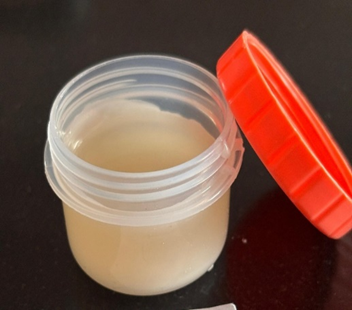
  • 10 gram of beeswax and 2ml of coconut oil were taken in a beaker of 100ml
  • Melt the wax with coconut oil, heat the mixture on a water bath maintained at a temperature below 100 degree Celsius
  • Once this mixture has liquified remove it from heat.
  • Stir in the required quantity of essential oils like citronella oil and lemon grass oil one by one into this melted beeswax
  • Pour the liquid into your container, set the lid on top of the container
  • This will help to prevent condensation inside the container, while minimizing the chance of microbial contamination of the product
  • Allow the perfume to cool and solidify completely at cool temperature
  • Apply the perfume by rubbing a finger on the product to liquify it, then rub your finger on the area you want to be scented(9)

Solid Perfume

EVALUATION PARAMETERS

        1. Organoleptic assessment:-
  • Color
  • Odor
  • Appearance
  • Texture

2. Chemical assessment:-

a) Saponification value

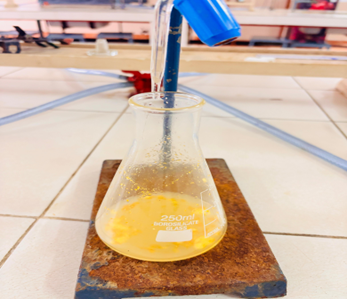
It is defined as the number of milligrams of KOH required to hydrolyze 1gram of wax. It is expressed as mg KOH/g.

Procedure:-

  1. Accurately weigh the sample under examination.
  2. Transfer it into a 200 ml borosilicate glass flask fitted with a reflux condenser.
  3. Add 25.0 ml of 0.5 M ethanolic potassium hydroxide to the flask.
  4. Add a little pumice powder.
  5. Boil the mixture under reflux on a water bath for 30 minutes.
  6. Add 1 ml of phenolphthalein solution to the mixture.
  7. Titrate immediately with 0.5 M hydrochloric acid (record as a ml).
  8. Perform a blank determination (without the test substance) and record the titrated value as b ml.

SAPONIFICATION VALUE = 56.1 × (B − S) × N × W (1)

Where;

  • B = volume in ml of the standard hydrochloric acid required for the blank,
  • S = volume in ml of standard hydrochloric acid required for the wax,
  • N = normality of standard hydrochloric acid,
  • M = mass in gms of the wax taken for the test.(10)
  1. Acid value :-

It is defined as the number of milligrams of KOH required to neutralize 1gram of the wax. Itis expressed as mg KOH/g.

Procedure :-

  1. Sample Preparation: Weigh accurately about 1 to 10 g of the perfume sample (depending on its expected acid value) into a conical flask.
  2. Dissolution : Add 50 ml of neutralized ethanol to the flask. Warm gently (if necessary) to ensure complete dissolution or dispersion of the perfume in ethanol.
  3. Indicator Addition : Add 2-3 drops of phenolphthalein indicator.
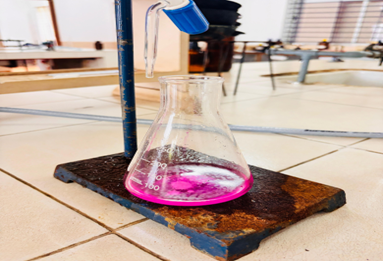
  4. Titration : Titrate the mixture with standard 0.1 N alcoholic KOH solution from the burette Continue titration until a permanent pale pink color persists for at least 30 seconds.
  5. Blank Determination : Perform a blank titration using the same procedure but without the perfume sample to account for any acidity in the ethanol or reagents.

ACID VALUE = 56.1 × V × N × W (2)(10)

Where;

  • V = volume in ml of standard potassium hydroxide solution used.   
  • N = normality of standard potassium hydroxide solution.
  • M = mass in grams of the wax taken for the test.
  1. Ester value :-

It is defined as the difference between the acid value and saponification value.

Ester Value = Saponification Value – Acid Value.(10)

3. Physical assessment :-

  1. Homogeneity :-

The formulations were tested for homogeneity by touch and visual appearance.(11)

  1. pH :-

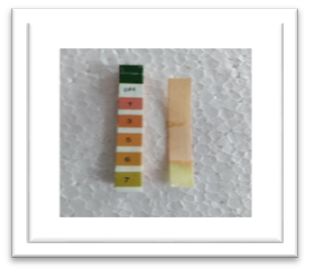
pH standard for topical preparation in contact with skin was about 4-8. The pH value was expected not to be too acidic because it can cause irritation and not too alkaline because it can cause scaly skin. The resulting solid perfume was tested using universal pH paper and had pH value of 5. This pH value was considered safe for topical preparation for human skin application.(11)

  1. Melting point :-

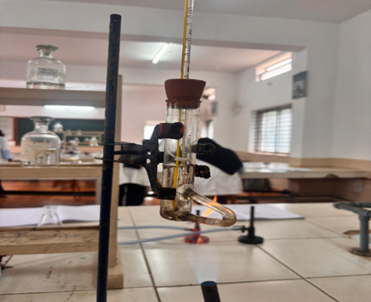
Take melting point of solid perfume. Solid perfume sample of 2 gram was placed into glass tube. This tube was dipped into a plate full of water which was heated on the water bath. The temperature at which material forms a liquid drop was considered its melting point.(11)

  1. Spreadability :-

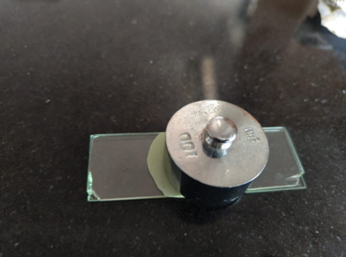
Spreadability of formulations was determined by an apparatus suggested by Multimer et al.which was fabricated in laboratory and used for study. (12)

Procedure:

  • 2g of solid perfume was placed between two glass slides
  • A 200 g weight was placed on the slides for 5 minutes to compress the sample to a uniform thickness
  • A 60 g weight was added to the pan
  • The time (in seconds) required to separate the two slides was taken as a measure of spreadability.

It was calculated using the formula

S = m.l / t

Where, 

  • s – spreadability in g.cm / sec
  • m- weight tied on upper side(60g)
  • l – length of glass slideMG
  • t – time in seconds

RESULTS

Table 3. Results of solid perfume

Sr no

Parameters

Results

1

Appearance

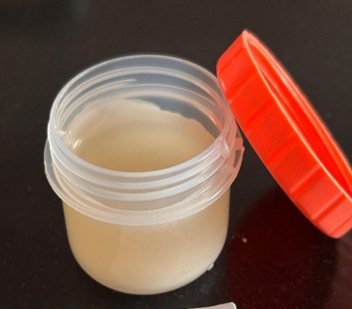
Off-white

2

pH

5

3

Spreadability

Good

4

Saponification value

98.17mgKOH/gm

5

Acid value

3.3mgKOH/gm

6

Ester value

94.87mgKOH/mg

7

Melting point

65°C

  1. Appearancee
  1. pH Determination
  1. Spreadability
  1. Saponification value

5. Acid value

6. Melting point

DISCUSSION

  • Solid perfume containing natural ingredients was developed and evaluated using various parameters
  • Solid perfume was prepared by using beeswax, coconut oil and essential oils like citronella and lemongrass oil
  • The developed formulation was evaluated for parameters like appearance, pH, spreadability, saponification value, acid value, ester value and melting point
  • So the results obtained of the developed solid perfume was found to be satisfactory.

CONCLUSION

We made a prompt attempt to develop herbal solid perfume using bees wax, coconut oil, essential oils like citronella and lemongrass oil.

The prepared formulation were evaluated successfully

From the result it was concluded that the results obtained were found to be satisfactory

The incorporation of lemongrass and citronella essential oils imparted refreshing fragrance

Overall this natural solid perfume is eco-friendly, safe for skin and a sustainable alternative to synthetic perfumes.

ACKNOWLEDGEMENT

The authors would like to thank KRET’s Rani Chennamma College of Pharmacy, Belagavi, for providing necessary facilities and support for this research work. We would also like to acknowledge Kle Ayurvedic Aushadhalay for providing the materials for this research work.

REFERENCE

  1. Sindhura DK, Jain V. Challenges in formulating herbal cosmetics. Int J Pharm Pharm Sci. 2018;10(11):1-5.
  2. Gawande AS, Bajad NE, Deshmukh S, Kadam A, Nirgunkar G. Review on formulation, evaluation and comparative study of herbal solid perfume stick. Int J Adv Res Sci Commun Technol. 2023 Dec;3(3):340. doi:10.48175/IJARSCT-14342.
  3. Shinde A, Kale A, Wagh S, Kalatre V, Wagh A, Kale N, Sanap G. Formulation of essential oil based solid perfume. World J Pharm Med Res. 2025; ISSN 2455-3301.
  4. Hatwar P, Dandge P, Jagtap P, Gaikwad S, Jadhav P, Sonawane V, Sanap G. Formulation and evaluation of solid perfume. World J Pharm Res. 2024;13(13):1338-60. ISSN 2277-7105.
  5. Shindhe, P.S., Killedar, R.S., Laxmikant, S.D.,Santosh, Y.M. andMadiwalar, M., Evaluation ofwound healing activity of Jatyadi Ointment andJatyadi Taila in the management of clean wound(Shuddha Vrana) A randomised controlled trial.Annals Ayurveda Med, 2020; 9: 98-107.
  6. A comprehensive review on the techniques forcoconut oil extraction and its application.Bioprocess and biosystems engineering, 44(9):1807-1818.
  7. Wany A, Jha S, Nigam VK, Pandey DM. Chemical analysis and therapeutic uses of citronella oil from Cymbopogon winterianus: a short review. Int J Adv Res.
  8. Hatwar P, Dandge P, Jagtap P, Gaikwad S, Jadhav P, Sonawane V, Sanap G. Formulation and evaluation of Solid Perfume.
  9. Shinde AG, Bhonde P, Sanap G. Review on formulation of essential oil-based solid perfume. J Emerg Technol Innov Res. 202397Dec;10(12).
  10. Varun Arora, Pragati Arora, Sapan K. Shah, Arvind R, Umarkar Pharamaceutical Organic Chemistry ISBN 97815-43342-83-3 Edition 2018 11(14).
  11. Hatwar P, Dandge P, Jagtap P, Gaikwad S, Jadhav P, Sonawane V, Sanap G. Formulation and evaluation of solid perfume. World J Pharm Res. 2024;13(13):1338-60.
  12. Satpute KL and Dr. Kalyankar TM. Development of herbal cream for the treatment of acne.J Pharmacogn Phytochem.2019;8(3): 2618-24.

Reference

  1. Sindhura DK, Jain V. Challenges in formulating herbal cosmetics. Int J Pharm Pharm Sci. 2018;10(11):1-5.
  2. Gawande AS, Bajad NE, Deshmukh S, Kadam A, Nirgunkar G. Review on formulation, evaluation and comparative study of herbal solid perfume stick. Int J Adv Res Sci Commun Technol. 2023 Dec;3(3):340. doi:10.48175/IJARSCT-14342.
  3. Shinde A, Kale A, Wagh S, Kalatre V, Wagh A, Kale N, Sanap G. Formulation of essential oil based solid perfume. World J Pharm Med Res. 2025; ISSN 2455-3301.
  4. Hatwar P, Dandge P, Jagtap P, Gaikwad S, Jadhav P, Sonawane V, Sanap G. Formulation and evaluation of solid perfume. World J Pharm Res. 2024;13(13):1338-60. ISSN 2277-7105.
  5. Shindhe, P.S., Killedar, R.S., Laxmikant, S.D.,Santosh, Y.M. andMadiwalar, M., Evaluation ofwound healing activity of Jatyadi Ointment andJatyadi Taila in the management of clean wound(Shuddha Vrana) A randomised controlled trial.Annals Ayurveda Med, 2020; 9: 98-107.
  6. A comprehensive review on the techniques forcoconut oil extraction and its application.Bioprocess and biosystems engineering, 44(9):1807-1818.
  7. Wany A, Jha S, Nigam VK, Pandey DM. Chemical analysis and therapeutic uses of citronella oil from Cymbopogon winterianus: a short review. Int J Adv Res.
  8. Hatwar P, Dandge P, Jagtap P, Gaikwad S, Jadhav P, Sonawane V, Sanap G. Formulation and evaluation of Solid Perfume.
  9. Shinde AG, Bhonde P, Sanap G. Review on formulation of essential oil-based solid perfume. J Emerg Technol Innov Res. 202397Dec;10(12).
  10. Varun Arora, Pragati Arora, Sapan K. Shah, Arvind R, Umarkar Pharamaceutical Organic Chemistry ISBN 97815-43342-83-3 Edition 2018 11(14).
  11. Hatwar P, Dandge P, Jagtap P, Gaikwad S, Jadhav P, Sonawane V, Sanap G. Formulation and evaluation of solid perfume. World J Pharm Res. 2024;13(13):1338-60.
  12. Satpute KL and Dr. Kalyankar TM. Development of herbal cream for the treatment of acne.J Pharmacogn Phytochem.2019;8(3): 2618-24.

Photo
Seema Paragannavar
Corresponding author

Department of Pharmaceutics, Assistant Professor, Rani Chennamma College of Pharmacy, Belagavi-10, Karnataka, India

Photo
Shreya Umarane
Co-author

Rani Chennamma College of Pharmacy, Belagavi-10, Karnataka, India

Photo
Anjali Chougule
Co-author

Rani Chennamma College of Pharmacy, Belagavi-10, Karnataka, India

Photo
Laxmi sarwad
Co-author

Rani Chennamma College of Pharmacy, Belagavi-10, Karnataka, India

Photo
Abhishek Malawade
Co-author

Rani Chennamma College of Pharmacy, Belagavi-10, Karnataka, India

Photo
Kumar Talwar
Co-author

Rani Chennamma College of Pharmacy, Belagavi-10, Karnataka, India

Seema Paragannavar, Shreya Umarane, Anjali Chougule, Laxmi Sarawad, Abhishek Malawade, Kumar Talwar, Development and Characterization of A Natural Solid Perfume Containing Essential Oils for its Aromatherapy, Int. J. of Pharm. Sci., 2025, Vol 3, Issue 11, 4831-4837. https://doi.org/10.5281/zenodo.17761660

More related articles
Revolutionizing Insulin Delivery: Emerging Trends ...
Unnati Patel, Dhanvi Patel, Mona A. Gupta, Dr. Nisha Patel, Sandh...
Efficacy of Siravedha and Eranda Taila orally in V...
Dr. Mataprasad Sharma, Dr. Aruna Sonekar, Dr. Rajendra Sonekar, ...
Analytical Review of Empagliflozin: A Sodium-Gluco...
Ritik Ahire, Nikita Sonawane, Mayur Chavan, Vinod Chaure, Ravindr...
Bioanalytical Method Development And Validation Of Anti-Obesity Drug In Biologic...
Omkar Bidkar , V. M. Waghulkar, M. D. Game, M. P. Jadhao, S. G. Jawarkar, ...
Various Dental problems and herbs involved in their treatment ...
Pavithra Devi, Swati jana, Tejashwini N., Tharun K., Thyagaraj, Trisha lokesh, Admaa M. Paarakh , ...
Related Articles
Review of Oral Medicine and Radiology Practices Across International Borders...
Dr. Adhila S., Dr. Afrah Sadiqa S. S., Dr. Ammu. E. G., Dr. Gayathri. P. S., Dr. Priya Ramani, Dr. V...
Electrospun Nanofibers: Advancements in Fabrication Techniques and Applications...
Tanaya Bhoir, Abhijit Kanavaje, Anjali Gupta, Priyanka Yadav, Vipul Sansare, ...
Basic Pathophysiology of Hemorrhoids and Their Clinical Management...
Komal Daud, Ashwini Bhivsane , Dr.Gajanan Sanap, ...
Review Article A Comprehensive Review on Quercetin-Loaded Nanoemulsions...
Deepti Andheriya Modi , Laxminarayan Patidar , ...
Revolutionizing Insulin Delivery: Emerging Trends and Technology ...
Unnati Patel, Dhanvi Patel, Mona A. Gupta, Dr. Nisha Patel, Sandhya Bodhe, ...
More related articles
Revolutionizing Insulin Delivery: Emerging Trends and Technology ...
Unnati Patel, Dhanvi Patel, Mona A. Gupta, Dr. Nisha Patel, Sandhya Bodhe, ...
Efficacy of Siravedha and Eranda Taila orally in Vatakantak with special referen...
Dr. Mataprasad Sharma, Dr. Aruna Sonekar, Dr. Rajendra Sonekar, ...
Analytical Review of Empagliflozin: A Sodium-Glucose Cotransporter 2 (SGLT-2) In...
Ritik Ahire, Nikita Sonawane, Mayur Chavan, Vinod Chaure, Ravindra Patil, ...
Revolutionizing Insulin Delivery: Emerging Trends and Technology ...
Unnati Patel, Dhanvi Patel, Mona A. Gupta, Dr. Nisha Patel, Sandhya Bodhe, ...
Efficacy of Siravedha and Eranda Taila orally in Vatakantak with special referen...
Dr. Mataprasad Sharma, Dr. Aruna Sonekar, Dr. Rajendra Sonekar, ...
Analytical Review of Empagliflozin: A Sodium-Glucose Cotransporter 2 (SGLT-2) In...
Ritik Ahire, Nikita Sonawane, Mayur Chavan, Vinod Chaure, Ravindra Patil, ...