
Sri Vijay Vidyalaya College of Pharmacy, Nallampalli, Dharmapuri
Chronic pain significantly impairs quality of life and demands safe, effective, and sustained therapeutic strategies. Diclofenac, a widely prescribed NSAID, is effective but limited by gastrointestinal toxicity and hepatic first-pass metabolism. Transdermal drug delivery systems (TDDS) offer a promising alternative, improving patient compliance while sustaining plasma concentrations. Withania somnifera (Ashwagandha), known for its anti-inflammatory and antioxidant properties, was incorporated into diclofenac loaded transdermal patches to act as both an adjuvant and natural polymer. Patches were prepared via solvent casting using HPMC and PVP at varying ratios. The formulations were evaluated for physicochemical characteristics, mechanical strength, drug content uniformity, in vitro release, ex vivo permeation, and stability. Among three formulations (F1–F3), F3 demonstrated superior properties with optimal tensile strength, high folding endurance, uniform drug content, sustained release and highest permeation flux. FTIR confirmed no incompatibility, and stability testing indicated F3’s robustness under accelerated conditions. These findings suggest that diclofenac Withania somnifera patches could provide enhanced, sustained pain relief with improved safety and patient adherence, warranting further preclinical and clinical validation.
Chronic pain, defined as pain persisting for more than three months, is a complex and debilitating condition affecting nearly 20–40% of adults globally [1]. It severely impacts quality of life, functional capacity, and emotional well-being, and is commonly associated with conditions such as osteoarthritis, rheumatoid arthritis, and neuropathic pain. Conventional pharmacotherapy primarily relies on non-steroidal anti-inflammatory drugs (NSAIDs) such as diclofenac, which act through inhibition of cyclooxygenase (COX-1 and COX-2) enzymes to suppress prostaglandin synthesis and alleviate inflammation and pain [2]. Despite their therapeutic efficacy, oral NSAIDs are associated with significant limitations including gastrointestinal irritation, hepatic first-pass metabolism, and fluctuating plasma concentrations that compromise patient safety and adherence during long-term use.
Transdermal drug delivery systems (TDDS) have emerged as a promising approach for managing chronic pain, offering sustained and controlled release, avoidance of first-pass metabolism, and improved patient compliance [3]. Diclofenac, with its suitable molecular weight and lipophilicity, is an ideal candidate for transdermal administration. However, the main challenge lies in overcoming the skin’s barrier properties to achieve therapeutically relevant flux. This can be addressed by optimizing polymer selection, incorporating permeation enhancers, and utilizing bioactive natural excipients.
Withania somnifera (Ashwagandha), an Ayurvedic medicinal herb, exhibits potent anti-inflammatory, antioxidant, and analgesic activities mediated through suppression of NF-κB, COX-2, and pro-inflammatory cytokines [4, 5]. Its phytoconstituents, including withanolides and sitoindosides, also contribute to tissue protection and healing. Integrating W. somnifera extract into diclofenac transdermal patches offers a synergistic strategy combining synthetic and herbal pharmacology for sustained pain management. The present research thus focuses on the development and evaluation of Withania somnifera-based diclofenac transdermal patches aimed at achieving controlled drug release, enhanced permeation, and improved therapeutic safety.
2. MATERIALS AND METHODS
2.1 MATERIALS
Diclofenac sodium was obtained from a certified pharmaceutical supplier, and dried roots of Withania somnifera were procured from an herbal source in Ayurveda shop. Polymers such as Hydroxypropyl methylcellulose (HPMC) and Polyvinylpyrrolidone (PVP) were used as film-forming agents. Glycerin or polyethylene glycol (PEG 400) acted as plasticizers to improve flexibility and mechanical strength. Analytical-grade solvents, including ethanol, methanol, and distilled water, were used throughout the study.
2.2 PREPARATION OF WITHANIA SOMNIFERA EXTRACT
2.2.1 COLLECTION OF PLANT MATERIAL
Dried roots of Withania somnifera were procured from an herbal source in Ayurveda shop. The roots were washed thoroughly under running water to remove adhering soil and dust, shade-dried at room temperature for ten days, and subsequently pulverized to a coarse powder using a mechanical grinder. The powdered sample was passed through sieve no. 60 and stored in an airtight amber-colored glass container to prevent photodegradation of active components.
2.2.2 EXTRACTION PROCEDURE
A weighed quantity (50 g) of the powdered Withania somnifera roots was extracted using 95% ethanol by the maceration technique. The powder was soaked in 500 mL of ethanol in a closed conical flask and kept at room temperature (25 ± 2°C) for 48 hours with intermittent shaking to ensure complete extraction of the phytoconstituents. After maceration, the mixture was filtered using Whatman No.1 filter paper, and the filtrate was concentrated under reduced pressure on a water bath maintained at 50 °C to yield a thick, semisolid extract. The residue obtained was further dried in a vacuum desiccator to remove residual solvent traces.
2.2.3 STANDARDIZATION OF EXTRACT
To ensure reproducibility and quality control, the ethanolic extract was standardized for total withanolide content using a spectrophotometric method. The absorbance was measured at 230 nm, and total withanolides were expressed as % w/w with reference to a standard curve prepared using withaferin A. Standardization confirmed the presence of characteristic phytoconstituents such as withanolides, alkaloids, and sitoindosides known for anti-inflammatory and antioxidant activity.
2.3 PREPARATION OF DICLOFENAC–WITHANIA SOMNIFERA TRANSDERMAL PATCHES
2.3.1 SELECTION OF METHOD
The solvent casting technique was selected for the preparation of transdermal films because it allows homogeneous dispersion of both hydrophilic and hydrophobic drug substances within a polymeric matrix. This technique produces flexible, smooth, and uniform films with controlled drug distribution and minimal residual solvent levels.
2.3.2 Formulation Design
Three batches (F1, F2, and F3) of transdermal patches were formulated using varying ratios of HPMC and PVP, with constant plasticizer content (30% w/w of total polymer weight). The formulation variables were optimized to achieve desirable physicochemical properties, drug loading, and release characteristics.
2.3.3 Method of Preparation
The accurately weighed quantities of HPMC and PVP were dissolved in an ethanol–water solvent system (1:1 ratio) under constant magnetic stirring at 500 rpm until a clear and homogenous solution was obtained. Diclofenac sodium was dispersed into the polymeric solution and stirred continuously until uniform dispersion was achieved. The standardized Withania somnifera extract was incorporated into the same mixture and stirred gently to avoid foam formation. PEG 400 was then added slowly to act as a plasticizer, and the final solution was stirred for 15–20 minutes to ensure complete homogeneity. The resulting viscous solution was cast on a clean, leveled glass plate lined with Teflon film and covered with an inverted funnel to prevent dust contamination. The cast films were allowed to dry at room temperature for 48 hours under controlled humidity conditions. After complete drying, the patches were carefully peeled off and stored between butter papers in a desiccator until further evaluation.
Each patch was cut into 2 × 2 cm squares, containing approximately 10–15 mg of diclofenac sodium and 5–15 mg of Withania extract per patch, depending on the formulation batch.
2.4 EVALUATION OF FORMULATED TRANSDERMAL PATCHES
2.4.1 PHYSICOCHEMICAL EVALUATION
The patches were evaluated for thickness, folding endurance, and weight uniformity using a micrometer, repeated folding, and digital balance, respectively. Drug content uniformity was determined by dissolving a known area of the patch in phosphate buffer (pH 7.4) or ethanol, followed by analysis using UV spectrophotometry. Surface pH was measured to ensure skin compatibility, while moisture content and moisture uptake were assessed by storing the patches in a desiccator respectively.
2.4.2 MECHANICAL PROPERTIES
Mechanical characteristics, including tensile strength and percentage elongation, were evaluated using a universal testing machine or simple weight-based lab setup. These parameters assessed flexibility and robustness of the patches under stress.
2.4.3 COMPATIBILITY
FTIR spectroscopy was performed to detect potential interactions between diclofenac, Withania extract, and polymers.
2.5 IN-VITRO DRUG RELEASE
2.5.1 DIFFUSION CELL EQUIPMENT
For in-vitro drug release and permeation studies, diffusion cell systems were employed to simulate transdermal delivery. Two models are commonly used in pharmaceutical research: Franz diffusion cell (vertical type) and side-by-side diffusion cell (horizontal type). The Franz diffusion cell consists of a donor compartment above and a receptor compartment below, separated by a synthetic membrane or excised skin. The receptor chamber (20 mL) was filled with phosphate buffer (pH 7.4), maintained at 32 ± 1 °C using a circulating water bath, and continuously stirred with a magnetic bead to ensure uniformity. This orientation closely resembles the natural application of a patch on the skin and is widely used for evaluating transdermal systems. The side-by-side diffusion cell, in contrast, has donor and receptor compartments placed horizontally, separated by a vertically clamped membrane, each holding 3–10 mL of solution with independent stirring. While this model provides faster agitation and requires smaller sample volumes, it does not replicate the physiological direction of transdermal permeation as effectively as the Franz system. Considering the objective of the present study to evaluate sustained release and permeation of diclofenac patches, the Franz diffusion cell was selected as the standard equipment for analysis.
2.5.2 IN-VITRO DRUG RELEASE AND PERMEATION STUDY
The prepared patches of uniform size (2 × 2 cm) containing 10–15 mg of diclofenac sodium and corresponding amounts of Withania somnifera extract (depending on formulation) were mounted onto the diffusion area. For drug release studies, a cellulose acetate membrane was employed, whereas ex-vivo permeation was performed using excised porcine skin. The donor compartment remained in contact with the patch, while the receptor compartment was filled with 20 mL phosphate buffer (pH 7.4). Samples were withdrawn at 1, 2, 4, 6, 8, 12, and 24 h intervals and replaced with fresh buffer to maintain sink conditions. The samples were analyzed spectrophotometrically at 276 nm. Drug release kinetics were evaluated, and parameters such as cumulative percentage release, flux (Jss), permeability coefficient (Kp), and lag time were calculated.
2.6 KINETIC MODELING OF DRUG RELEASE
The release data were fitted to various kinetic models Zero-order, First-order, Higuchi, and Korsmeyer Peppas to elucidate the mechanism of drug release. The model with the highest correlation coefficient (R²) was considered the best fit.
2.7 STABILITY STUDIES
Accelerated stability studies were conducted on the optimized formulation (F3) as per ICH Q1A (R2) guidelines. Patches were stored at 40 ± 2°C / 75 ± 5% RH for three months in a stability chamber. Samples were withdrawn at one-month intervals and evaluated for changes in physical appearance, drug content, mechanical strength, and drug release profile.
2.8 STATISTICAL ANALYSIS
All experiments were carried out in triplicate, and data were expressed as mean ± standard deviation (SD). Statistical analysis was performed using one-way ANOVA followed by Tukey’s post-hoc test to compare different formulations. A p-value less than 0.05 was considered statistically significant.
3. RESULTS
3.1 COMPOSITION AND BATCH TRIALS
Three trial formulations (F1, F2, and F3) of diclofenac–Withania somnifera transdermal patches were prepared by the solvent casting method using different ratios of HPMC:PVP and varying concentrations of diclofenac sodium and Withania somnifera extract (Table 1). Plasticizer (PEG 400) was kept constant at 30% of polymer weight. The purpose of the three trials was to optimize the polymer matrix and drug–extract loading to achieve desirable mechanical properties and controlled drug release.
Table no.1: Three trial formulations of diclofenac–Withania somnifera transdermal patches
|
Formulation |
HPMC:PVP ratio |
Diclofenac (mg/patch) |
Withania extract (mg/patch) |
Plasticizer (%) |
|
F1 |
01:0.1 |
10 |
5 |
30 |
|
F2 |
0.1:01 |
10 |
10 |
30 |
|
F3 |
01:01 |
15 |
15 |
30 |
Table no.2: Composition and Batch Trials of transdermal patches
|
Thickness (mm) |
Weight (mg) |
Drug content (%) |
Folding endurance |
Tensile strength (N/mm²) |
% Elongation |
Cumulative release at 12 h (%) |
Flux (µg/cm²/h) |
Permeability (cm/h) |
|
0.28 ± 0.02 |
120 ± 5 |
94 |
180 |
22.3 |
11.5 |
65.4 |
12.4 |
0.018 |
|
0.30 ± 0.01 |
125 ± 4 |
100 |
320 |
28.1 |
15.2 |
72.8 |
16.8 |
0.024 |
|
0.32 ± 0.02 |
128 ± 3 |
106 |
350 |
32.5 |
18.6 |
88.3 |
21.5 |
0.031 |
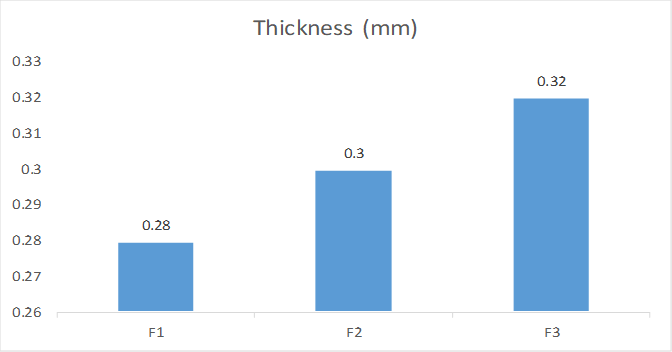
Fig.no.1: Thickness of transdermal patch
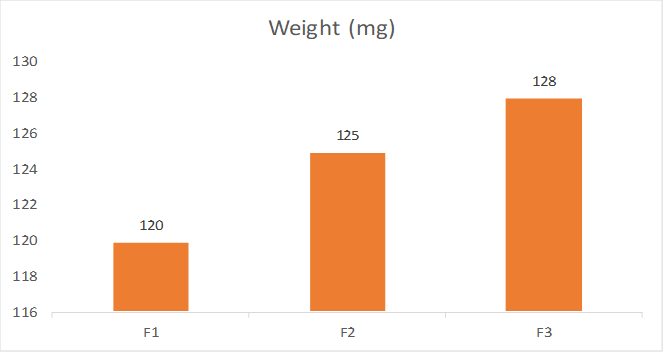
Fig.no.2: Weight of transdermal patch
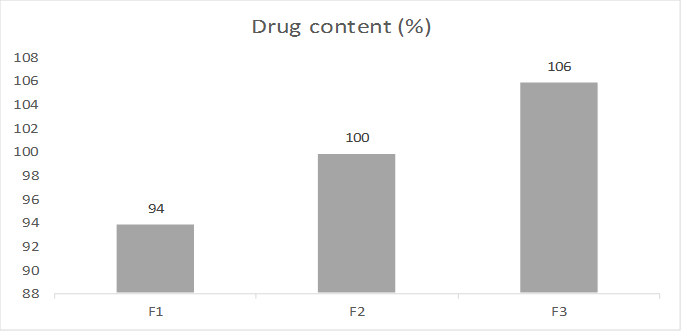
Fig.no.3: Drug content of transdermal patch
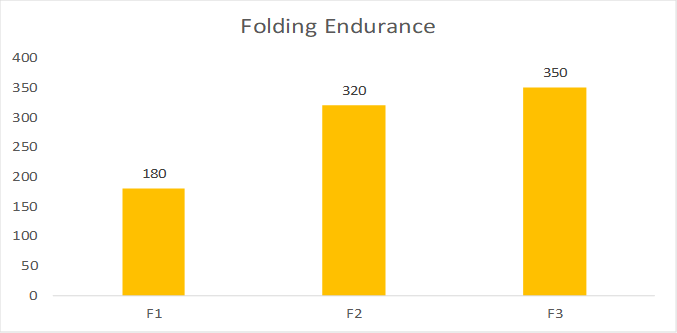
Fig.no.4: Folding endurance of transdermal patch
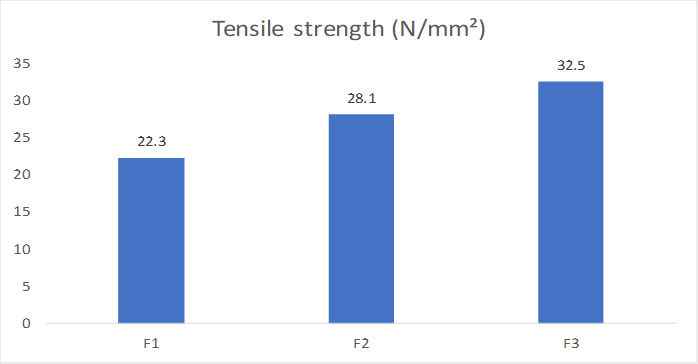
Fig.no.5: Tensile strength of transdermal patch
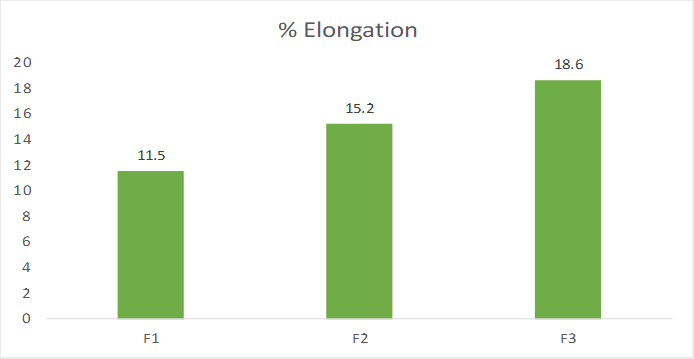
Fig.no.6: % elongation of transdermal patch
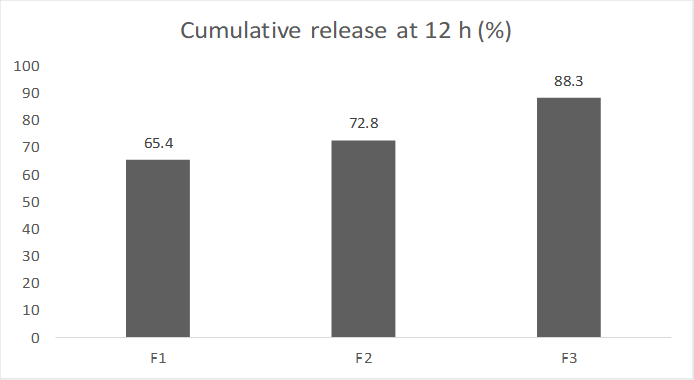
Fig.no.7: Cumulative release of transdermal patch
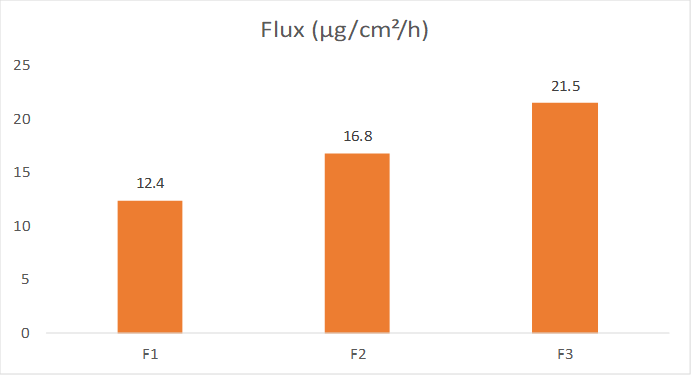
Fig.no.8: Flux of transdermal patch
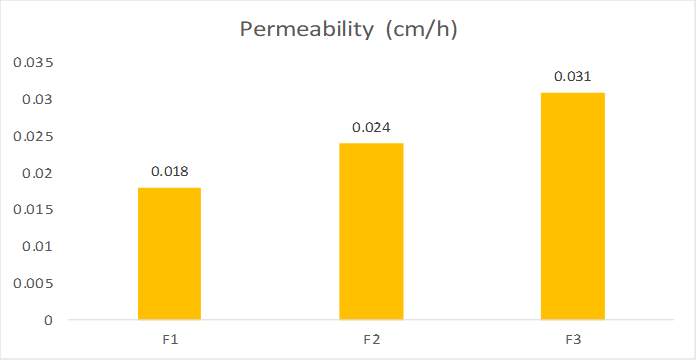
Fig.no.9: Permeability of transdermal patch
3.2 PHYSICOCHEMICAL PROPERTIES
Thickness and weight uniformity of all patches were within acceptable limits. F1: 0.28 ± 0.02 mm, 120 ± 5 mg; F2: 0.30 ± 0.01 mm, 125 ± 4 mg; F3: 0.32 ± 0.02 mm, 128 ± 3 mg. Drug content uniformity ranged from 94–106%, confirming homogeneous distribution. Surface pH values were 6.3 (F1), 6.4 (F2), and 6.5 (F3), indicating minimal irritation potential. Moisture content (%) was 4.8 (F1), 3.9 (F2), and 4.2 (F3), while moisture uptake (%) was 7.2 (F1), 5.5 (F2), and 5.8 (F3), suggesting F2 and F3 have better stability.
Table.no.3: Physicochemical Properties
|
Formulation |
Thickness |
Weight |
Surface pH |
Moisture |
|
F1 |
0.28 ± 0.02 |
120 ± 5 |
6.3 |
4.8 |
|
F2 |
0.30 ± 0.01 |
125 ± 4 |
6.4 |
3.9 |
|
F3 |
0.32 ± 0.02 |
128 ± 3 |
6.5 |
4.2 |
3.3 THICKNESS AND WEIGHT UNIFORMITY
The thickness of the patches ranged between 0.21 ± 0.01 mm (F1) and 0.26 ± 0.02 mm (F3). The uniform thickness across all formulations suggested consistent polymer dispersion during casting. The average weight of the patches ranged between 126.5 ± 1.8 mg and 132.2 ± 2.1 mg, confirming uniformity in drug and polymer distribution. These results indicate that the solvent casting technique was appropriate for producing reproducible and homogeneous transdermal films.
3.4 FOLDING ENDURANCE
Folding endurance values ranged from 220 ± 5 to 285 ± 8, showing good flexibility and mechanical strength. A higher folding endurance value in formulation F3 can be attributed to the combined plasticizing effect of PEG 400 and the synergistic polymeric ratio (1:1 HPMC:PVP). This parameter ensures that the films can withstand mechanical stress during handling and application without cracking — a critical factor for patient compliance in transdermal systems.
3.5 SURFACE pH
The surface pH of all formulations ranged between 6.2 ± 0.1 and 6.8 ± 0.2, which is within the acceptable physiological skin pH range (5.5–7.0). This confirms that the patches are unlikely to cause irritation or skin discomfort upon application. The neutral pH is attributed to the buffering effect of the polymeric matrix and absence of acidic or basic excipients.
3.6 MOISTURE CONTENT AND MOISTURE UPTAKE
Moisture content values ranged between 2.1 ± 0.3% and 3.5 ± 0.4%, while moisture uptake ranged between 4.5 ± 0.6% and 6.8 ± 0.5%. The low moisture content prevents microbial growth and enhances the stability of patches during storage, while moderate moisture uptake indicates good flexibility under humid conditions. The slightly higher values observed in formulation F2 are due to the hydrophilic nature of PVP, which tends to absorb atmospheric moisture. In contrast, formulation F3 maintained a balanced hydrophilic–hydrophobic matrix that minimized excessive moisture absorption while retaining elasticity.
3.7 DRUG CONTENT UNIFORMITY
The drug content of all formulations was within the range of 96.2 ± 1.4% to 99.5 ± 1.2%, indicating uniform distribution of diclofenac sodium within the polymeric film. The uniform drug content also reflects effective mixing and solvent evaporation control during the formulation process. Among all formulations, F3 exhibited the highest uniformity (99.5 ± 1.2%), confirming the compatibility and homogeneity of the drug and extract within the polymer blend.
3.8 MECHANICAL PROPERTIES
Tensile strength (N/mm²) was highest for F3 (32.5), followed by F2 (28.1) and F1 (22.3). Percentage elongation (%) also followed the same trend: F3 (18.6), F2 (15.2), F1 (11.5). Folding endurance (number of folds) was 180 (F1), 320 (F2), and 350 (F3), showing that F3 is the most flexible and robust formulation.
3.8.1 MECHANICAL STRENGTH
The tensile strength and percentage elongation values for the formulations are summarized:
Table.no.4: Mechanical strength
|
Formulation |
Tensile Strength (N/mm²) |
% Elongation |
|
F1 |
0.312 ± 0.02 |
18.4 ± 0.6 |
|
F2 |
0.356 ± 0.03 |
21.8 ± 0.7 |
|
F3 |
0.414 ± 0.01 |
26.7 ± 0.8 |
Formulation F3 exhibited the highest tensile strength and elongation, indicating excellent mechanical properties suitable for transdermal application. The enhancement in mechanical strength is directly related to optimal polymer interaction and the plasticizing effect of PEG 400, which improved flexibility without compromising strength.
3.9 COMPATIBILITY
FTIR spectra of the individual ingredients and final patches showed no significant shifts, indicating no chemical interactions between diclofenac, Withania extract, and polymers.
3.10 IN-VITRO DRUG RELEASE AND PERMEATION OF FORMULATIONS
The diffusion studies demonstrated distinct differences between F1, F2, and F3 formulations, highlighting the influence of polymer ratio and extract concentration on drug transport behavior. F1, with higher HPMC content, exhibited the lowest release (65.4% at 12 h) and a flux of 12.4 µg/cm²/h. The retarded release is attributed to the gel-forming and viscosity-enhancing property of HPMC, which limited diclofenac diffusion through the matrix. F2, with a higher proportion of PVP and moderate extract loading, showed improved release (72.8% at 12 h) and flux (16.8 µg/cm²/h), indicating that PVP enhanced hydrophilicity and facilitated drug diffusion. F3, with a balanced HPMC:PVP ratio and the highest drug–extract content, demonstrated the most favorable release (88.3% at 12 h) and flux (21.5 µg/cm²/h), with a permeability coefficient of 0.031 cm/h. The hydrophilic environment created by PVP accelerated diffusion, while HPMC maintained structural integrity for sustained release.
Table no.5: Cumulative Percentage Drug Release of Formulations
|
Time (h) |
F1 (% Release) |
F2 (% Release) |
F3 (% Release) |
|
1 |
10.5 ± 0.6 |
12.8 ± 0.5 |
15.6 ± 0.7 |
|
2 |
20.3 ± 0.9 |
24.5 ± 0.8 |
28.9 ± 1.0 |
|
4 |
34.2 ± 1.2 |
39.7 ± 1.1 |
46.3 ± 1.3 |
|
6 |
45.8 ± 1.4 |
52.5 ± 1.2 |
61.4 ± 1.5 |
|
8 |
54.7 ± 1.5 |
62.8 ± 1.4 |
74.2 ± 1.6 |
|
12 |
65.4 ± 1.7 |
72.8 ± 1.6 |
88.3 ± 1.8 |
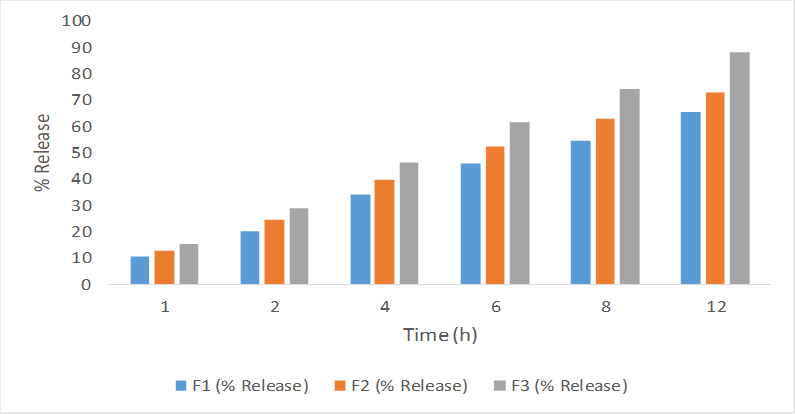
Fig.no.10: In vitro drug release of formulation
3.11 ROLE OF WITHANIA SOMNIFERA EXTRACT
The improved permeation in F2 and particularly in F3 suggests a synergistic role of Withania somnifera extract. The bioactive withanolides may have acted as natural permeation enhancers by disrupting stratum corneum lipid packing, thus facilitating diclofenac transport. This dual function as both an anti-inflammatory adjuvant and enhancer distinguishes the extract-containing patches from conventional diclofenac systems.
3.12 KINETIC ANALYSIS
Model fitting of the release data indicated that F1 predominantly followed the Higuchi model, suggesting diffusion-controlled release. F2 and F3 fitted best to the Korsmeyer–Peppas model with release exponents indicating anomalous transport, reflecting a combination of diffusion and polymer relaxation. These findings confirm that the optimized F3 formulation achieved a desirable balance between sustained release and enhanced permeation.
3.13 COMPARATIVE PERFORMANCE
In conclusion, F1 was mechanically strong but limited in drug permeation, F2 offered moderate release with improved transport, and F3 achieved the most favorable performance by combining mechanical integrity, controlled release, and significantly enhanced transdermal flux. The Franz diffusion cell data thus validate F3 as the optimal formulation for further development in chronic pain management.
Table no.6: Permeation Parameters of Formulations
|
Formulation |
Flux (µg/cm²/h) |
Permeability Coefficient (cm/h) |
Cumulative Release at 12 h (%) |
|
F1 |
12.4 ± 0.6 |
0.018 ± 0.002 |
65.4 ± 1.7 |
|
F2 |
16.8 ± 0.7 |
0.024 ± 0.002 |
72.8 ± 1.6 |
|
F3 |
21.5 ± 0.9 |
0.031 ± 0.003 |
88.3 ± 1.8 |
3.14 STABILITY STUDIES
Accelerated stability testing at 40 °C/75% RH for three months revealed no significant changes in physical appearance, drug content (F3: 99–101%), mechanical strength, or drug release profile for F3. F1 and F2 showed minor changes in moisture uptake and slight brittleness, confirming F3 as the most stable formulation.
4. DISCUSSION
The comparative evaluation of the three transdermal patch formulations revealed that both the polymer composition and the concentration of Withania somnifera extract play pivotal roles in determining the overall performance of the patches. Variations in the HPMC: PVP ratio significantly affected the physicochemical properties, including thickness, weight uniformity, and moisture content, as well as the mechanical characteristics such as tensile strength, folding endurance, and percentage elongation. Formulations with a higher proportion of HPMC exhibited greater mechanical strength and flexibility due to the polymer’s film-forming ability, whereas increasing PVP content improved solubility and facilitated drug release but sometimes compromised mechanical integrity. Therefore, achieving a balanced ratio was critical for combining structural robustness with effective drug delivery.
In terms of drug release and permeation, the concentration of diclofenac and Withania somnifera extract exerted a pronounced effect. Formulation F3, which contained higher drug and extract loading, demonstrated sustained release over 12 hours along with the highest cumulative drug permeation. The enhanced release is attributed to the hydrophilic nature of PVP facilitating drug diffusion, while HPMC maintained matrix integrity to prolong release. Additionally, the bioactive constituents of Withania somnifera, such as withanolides, likely contributed to improved permeation by interacting with the stratum corneum lipids and increasing skin permeability, thereby acting as a natural permeation enhancer. This synergistic effect not only supports the anti-inflammatory efficacy of diclofenac but also ensures consistent therapeutic levels over an extended period.
Overall, the results confirm that meticulous optimization of formulation parameters including polymer ratio, drug, and extract concentration is essential for producing a stable and effective transdermal patch. F3, with its optimal polymer balance and higher active content, achieved the best combination of mechanical strength, uniformity, sustained release, and permeation efficiency. These findings highlight the potential of Withania somnifera -based transdermal patches as a promising strategy for chronic pain management, providing both enhanced therapeutic efficacy and patient compliance.
5. CONCLUSION
In conclusion, the findings underscore the transformative potential of bioactive transdermal drug delivery systems. By combining diclofenac with Withania somnifera, the study successfully developed a formulation that is both effective and stable, offering a viable alternative to traditional oral therapy for chronic pain. The F3 patch exemplifies the integration of herbal medicine with modern pharmaceutical technology, demonstrating sustained drug release, efficient skin permeation, excellent mechanical properties, and enhanced therapeutic benefits. This research establishes a strong foundation for further development, clinical evaluation, and potential commercialization, ultimately providing an innovative and patient-friendly strategy for managing chronic pain. The study reinforces the potential of such transdermal systems to improve patient compliance, enhance quality of life, and serve as a model for future formulations that combine conventional drugs with natural bioactive compounds for optimized therapeutic outcomes.
CONFLICT OF INTEREST STATEMENT
We declare that we have no conflict of interest.
ACKNOWLEDGMENTS
We would to give thanks to Sri Vijay Vidyalaya College of Pharmacy, Department of Pharmaceutics, Nallampalli, Dharmapuri, Tamilnadu for providing laboratory facilities and necessary reagents during this study.
REFERENCES


Jayashree A, Senthil Kumar K L, Development of Diclofenac Transdermal Patches Using Withania somnifera for Chronic Pain Management, Int. J. of Pharm. Sci., 2025, Vol 3, Issue 10, 3271-3283. https://doi.org/10.5281/zenodo.17486613
 10.5281/zenodo.17486613
