
Viswanadha Institute of Pharmaceutical Sciences, Visakhapatnam, Andhra Pradesh.
The Aim of the present work is to formulate, evaluate and compare the quality performance, drug release profile, and cost-effectiveness of formulated, branded, and generic Linagliptin SR tablets. Post- compression tests were conducted to assess quality as well as physicochemical equivalence of Formulated, Branded and Generic Linagliptin tablets. The study confirmed that the formulated, generic and branded Linagliptin tablets complied with the official specification for weight variation, hardness, friability, disintegration and dissolution. No significant difference was observed in the content of active drug and parameters of the branded and generic products. This establishes the Quality of generics is same as for their branded version. The differences observed in value regarding the cost of these two versions of drug though the manufacturing cost of the generic is less as compared to branded but it has lucrative profit margin to its sales. Dissolution studies revealed that drug release percentages for the generic, branded, and formulated Linagliptin SR tablets were 74%, 78%, and 70%. Further analysis showed that Linagliptin follows zero-order kinetics, indicating a consistent and controlled drug release over time. Additionally, the Korsmeyer-Peppas model confirmed that the drug release mechanism follows Fickian diffusion, suggesting a diffusion-controlled release pattern. FTIR studies demonstrated no significant interactions between the drug and excipients in the formulations. This confirms the stability of Linagliptin in the presence of selected excipients, reducing the risk of any potential incompatibility that could affect drug efficacy or safety. On the basis of cost effectiveness, we found that generic formulation is cost effective when compared to branded and formulated. The result indicated that the formulated, generic and branded tablets fulfilled the required official specification and thus assures that generic drugs are also bioequivalent to ethical drugs if all the quality control parameters are being maintained.
Today India is known as world’s pharmacy due to the giant production facilities in the country. It approximately caters 20% of global generic drug supply. Indian pharmaceutical sector may grow to US $100 billion in near future. Pharmaceuticals export from India stood at US $16.3 billion in FY20. As of November 2020, India exported pharmaceuticals worth US $15.86 billion in FY21. Pharmaceutical exports from India stood at US $16.28 billion in FY20. There are two general terms used to describe medicinal products.
MATERIALS AND METHOD
Different brands of Generic and branded Linagliptin Tablets.
Different Samples of Linagliptin Tablets
Table No.1: Materials and Manufacturers:
|
S. No. |
Ingredients And Reagents |
Manufacturer / Suppliers |
|
1. |
linagliptin |
Gifted by pharmaceutical company |
|
2. |
Eudragit E-100 |
Gifted by pharmaceutical company |
|
3. |
Starch |
Thermo Fisher Scientific IndiaPvt.Ltd. |
|
4. |
Talc |
Labogens Pvt.ltd. |
|
5. |
Magnesium stearate |
Numex Chemical Products(India) |
Table No.2: Formulation of Linagliptin Tablets
|
S. No |
Ingredients |
Quality |
Category |
|
1 |
Linagliptin |
50mg |
Anti-diabetic drug |
|
2 |
Eudragit E-100 |
1000mg |
|
|
3 |
Starch |
1500mg |
Binder |
|
4 |
Talc |
20 mg |
Glidant |
|
5 |
Magnesium stearate |
30mg |
Lubricant |
RESULTS & DISCUSSION
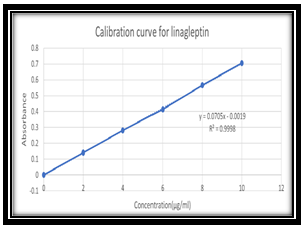
Table No.3: Calibration curve for Linagliptin
|
S.no |
Concentration |
Absorbance |
|
1. 2. 3. 4. 5. 6. |
0 2 4 6 8 10 |
0 0.14 0.28 0.398 0.565 0.705 |
DRUG SOLUBILITY
Table No.4: Different solvents (aqueous and organic) were used to test the API sample's solubility.
|
S. No. |
Solvent |
Solubility |
|
1 |
Water |
Very slightly soluble |
|
2 |
ethanol |
Sparingly soluble |
|
3 |
methanol |
Soluble |
|
4 |
PH7.4 buffer |
Soluble |
Table No.5: Formulation Of Linagliptin Tablet
|
S. No |
Polymers |
Quantity |
|
1 |
Linagliptin |
50mg |
|
2 |
Eudragit E-100 |
1000mg |
|
3 |
Starch |
1500mg |
|
4 |
Talc |
20 mg |
|
5 |
Magnesium stearate |
30mg |
FTIR STUDIES
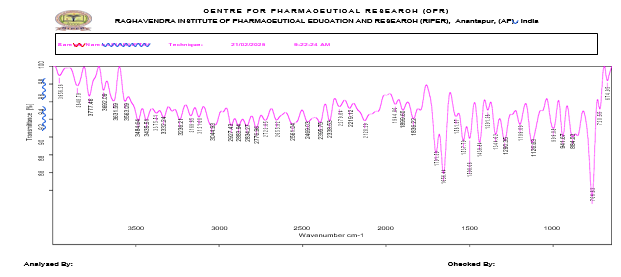
FTIR Spectrum of Linagliptin
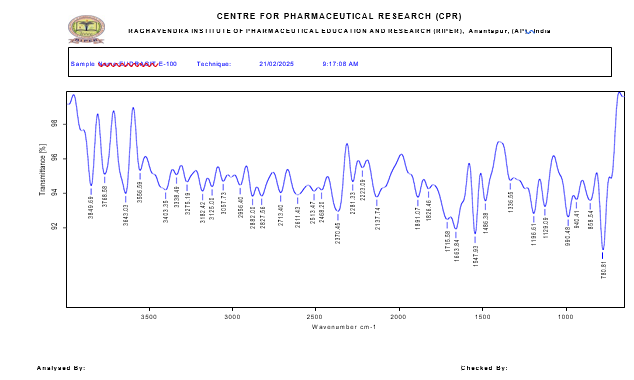
FTIR Spectrum of Eudragit E-100
FTIR Spectrum of Starch
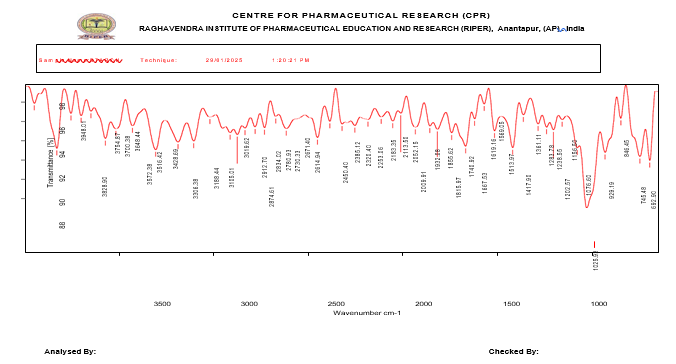
FTIR Spectrum of Formulation (Linagliptin, Eudragit E-100 And Starch)
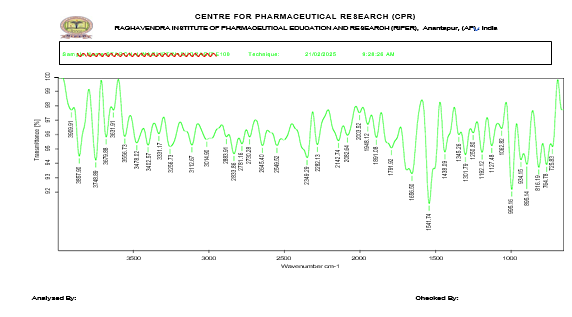
FTIR spectra’s was indicated no interaction between linagliptin & excipients used in the formulation.
Post Compressional Studies of Linagliptin Tablets
Table No.6: Post compression parameters of Linagliptin tablets
|
Sno |
Drugs |
Weight variation |
Friability (%) |
Hardness (Kg/cm2) |
Disintegration (Min) |
|
Branded tablets |
|||||
|
1.
|
B1 |
4.477±5.472 |
0.298 |
10 |
21 |
|
Generics tablets |
|
|
|
|
|
2. |
G1 G2 G3 G4 G5 G6
|
4.477±5.472 3.773±5.660 7.14±4.76 8.433±9.638 7.78 ±10.17 15.6± 8.43 |
0.120 0.166 0.133 0.191 0.149 0.154 |
8 7 9 5 6 8 |
22 24 22 21 26 23 |
|
3. |
Formulated tablet |
13.38±5.2 |
0.046 |
10 |
22 |
RESULT: The results which is shown in table complied with official standard values, all the values are within acceptable limits.
B1-Dynaglipt-L
G1- linaprex-5
G2-linares-E
G3-linapride
G4-Trajenta-5
G5- Ondero-5
G6- linaworth-5
Table no.7: Dissolution data of Generic Linagliptin tablets
|
S. No |
Time (Mins) |
%Amount of Drug release |
|||||
|
G1 |
G2 |
G3 |
G4 |
G5 |
G6 |
||
|
1. |
30 |
6.5 |
6.4 |
6.6 |
6.8 |
6.9 |
6.5 |
|
2. |
60 |
15.4 |
15.0 |
15.2 |
15.6 |
15.4 |
15.3 |
|
3. |
120 |
22 |
21 |
22.5 |
21.3 |
21.6 |
22 |
|
4. |
180 |
34 |
33 |
32.4 |
33.6 |
333.8 |
32.8 |
|
5. |
240 |
42 |
41 |
40 |
42.5 |
42 |
41.5 |
|
6 |
300 |
51 |
50 |
50.8 |
50 |
51 |
52 |
|
7. |
360 |
61.5 |
61 |
60 |
60.3 |
60.1 |
60.3 |
|
8 |
420 |
71 |
70 |
71 |
72 |
71.5 |
72 |
|
9. |
480 |
74 |
73 |
72 |
73 |
72 |
71 |
Table No.8: Dissolution data of Branded Linagliptin tablets
|
S.no |
Time (mins) |
%Amount of drug release |
|
1 |
30 |
7.2 |
|
2 |
60 |
18 |
|
3 |
120 |
25 |
|
4 |
180 |
38 |
|
5 |
240 |
45 |
|
6 |
300 |
54 |
|
7 |
360 |
62 |
|
8 |
420 |
70 |
|
9 |
480 |
78 |
Table no.9: Dissolution data of Formulated Linagliptin Table
|
S.no |
Time (mins) |
%Amount of drug release |
|
1 |
30 |
5.8 |
|
2 |
60 |
10.1 |
|
3 |
120 |
21 |
|
4 |
180 |
32 |
|
5 |
240 |
45 |
|
6 |
300 |
52 |
|
7 |
360 |
60 |
|
8 |
420 |
64 |
|
9 |
480 |
70 |
Table No.10: Amount Of Drug Release from Generic Branded Formulated
|
S.no |
Tablet |
Amount of drug release |
|
1. |
Formulated |
70% |
|
2. |
Generic |
74% |
|
3. |
Branded |
78% |
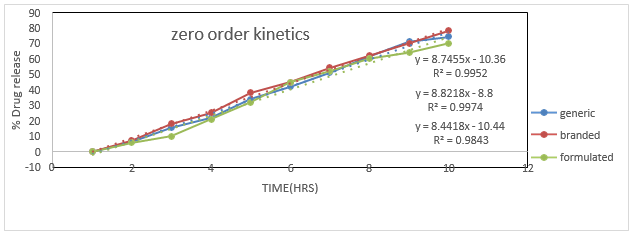
Zero order plots of Linagliptin tablets (Formulated, Branded, Generic Tablets)
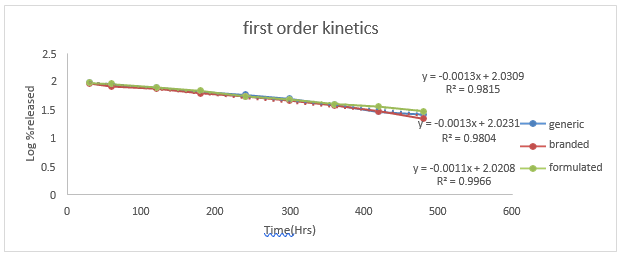
First order plots of Linagliptin tablets (Formulated, Branded, Generic Tablets)
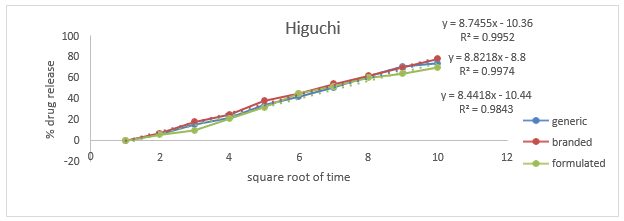
Higuchi model of Linagliptin tablets (Formulated, Branded, Generic Tablets)
Korsmeyer-Peppas model of Linagliptin tablets (Formulated, Branded, Generic Tablets)
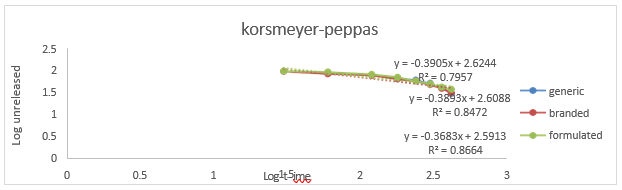
Table No.11: Correlation coefficient values
|
S. No |
Tablets |
Correlation coefficient values |
||
|
Zero order release |
First order release |
Higuchi |
||
|
1. |
Formulated |
0.9843 |
0.996 |
0.9873 |
|
2. |
Generic |
0.9952 |
0.9815 |
0.9952 |
|
3. |
Branded |
0.9974 |
0.9804 |
0.9974 |
Table No.12: N values of Korsmeyerpeppas Graph
|
N values of korsmeyerpeppas graph |
||
|
Formulated |
Generic |
branded |
|
0.3905 |
0.3893 |
0.3683 |
DISCUSSION
The present study aimed to evaluate and compare the quality performance, drug release profile, and cost-effectiveness of formulated, branded, and generic Linagliptin SR tablets.post- compression tests were conducted to assess the physical and mechanical properties of the tablets, all of which complied with official pharmacopoeia specifications, indicating satisfactory formulation quality.Dissolution studies revealed that drug release percentages for the generic, branded, and formulated Linagliptin SR tablets were 74%, 78%, and 70%.Further analysis showed that Linagliptin follows zero-order kinetics, indicating a consistent and controlled drug release over time.Additionally, the Korsmeyer-Peppas model confirmed that the drug release mechanism follows Fickian diffusion, suggesting a diffusion-controlled release pattern.FTIR studies demonstrated no significant interactions between the drug and excipients in the formulations. This confirms the stability of Linagliptin in the presence of selected excipients, reducing the risk of any potential incompatibility that could affect drug efficacy or safety.On the basis of cost effectiveness, we found that generic formulation are cost effective when compared to branded and formulated.The result indicated that the formulated, generic and branded tablets fulfilled The required official specification and thus assures that generic drugs are also bioequivalent to ethical drugs if all the quality control parameters are being maintained.
SUMMARY AND CONCLUSION
This study evaluated the quality, physicochemical properties, and drug release behaviour of formulated, branded, and generic Linagliptin tablets. All formulations were found to comply with official standards for weight variation, hardness, friability, disintegration, and dissolution, indicating consistent manufacturing quality. Drug content analysis showed no significant differences between the branded and generic products, confirming that generic Linagliptin tablets maintain quality comparable to their branded counterparts. FTIR compatibility studies revealed no interaction between Linagliptin and the excipients used, ensuring stability of the formulations. Drug release kinetics demonstrated zero-order release, while the Korsmeyer–Peppas model indicated Fickian diffusion as the primary release mechanism. The percentage drug release was observed as: branded – 78%, generic – 74%, formulated – 70%, showing acceptable performance for all versions. Cost analysis highlighted that generic formulations are more cost-effective due to lower production costs and higher profit margins, whereas the formulated SR tablet can be further optimized to reduce cost and improve release characteristics. Overall, the findings confirm that generic drugs can be bioequivalent to branded drugs when proper quality control standards are maintained, and that formulation optimization can enhance performance of in-house SR products.Future work should focus on refining the formulated Linagliptin SR tablet to improve its drug release profile and further close the gap with branded alternatives.
ACKNOWLEDGEMENT
I take this privilege and pleasure to acknowledge the contribution of many individuals who have been inspirational and supportive throughout my work undertaken and endowed me with most precious knowledge to see success in my attempt. My work bears the imprint of all those people First of all I express my sincere thanks and heartfelt indebtedness to respected Dr. Nagamani Bolla, Professor, Department of Pharmaceutics, Viswanadha Institute of Pharmaceutical Sciences, Visakhapatnam. There have been able to look at things in a better way providing me with an in-depth understanding encouragement and moral support leads to complete my dissertation work successfully. I sincerely thankful to our principal Dr. P. Uma Devi, for providing me the most valued suggestions to carry out this dissertation work successfully.
REFERENCES


Suvarna Kasi, R. Malliswari, Dr. B. Nagamani, K. Bhavana, G. Sai Lakshmi, R. Lalitha, B. Nikhil Sai, K. Bharathi, A. Ramya, Evaluation and Comparative Study of Formulated, Branded & Generic Linagliptin Tablets; An Analysis of Quality Performance and Cost Effectiveness, Int. J. of Pharm. Sci., 2025, Vol 3, Issue 11, 4850-4858 https://doi.org/10.5281/zenodo.17762266
 10.5281/zenodo.17762266
