
View Article

Abstract

Breast cancer continues to be a leading cause of mortality among women worldwide. Conventional chemotherapy often causes systemic toxicity and limited efficacy. Advances in nanotechnology have enabled the development of nanobots, microscopic devices capable of targeted navigation and drug delivery at tumor sites. These nanocarriers improve drug accumulation, reduce side effects, and can monitor therapeutic response. This article explores the transformative role of nanobots in precision oncology, focusing on their composition, manufacturing, evaluation, applications, commercialized examples, and recent developments in breast cancer treatment.

Keywords

Breast cancer, nanotechnology, nanobots, Targeted drug delivery.

Introduction

Breast cancer is a major global health challenge. Traditional chemotherapy lacks specificity, causing adverse effects and inconsistent outcomes. Nanotechnology offers innovative solutions for targeted drug delivery, enhancing therapeutic efficiency and safety. Among these, nanobots engineered nanoscale devices can navigate the body, deliver drugs precisely, and potentially provide real-time monitoring of therapy, representing a major advance in oncology. [1,2]

TYPES AND APPLICATION OF NANOBOTS IN BREAST CANCER THERAPY. [Table.1]

Table 1. Types and application of Nanobots in Breast Cancer Therapy

Nanobot Type / Nanocarrier

Composition

Mechanism

Application

Liposomal Nanobots [3]

Lipid bilayer + Drug

(e.g., doxorubicin)

Encapsulation for prolonged circulation, EPR-based tumor targeting

Breast cancer, ovarian cancer

Albumin-Bound Nanoparticles [4]

Albumin + Drug (e.g., paclitaxel)

Solubility enhancement, tumor uptake

Metastatic breast cancer

Protein-Bound Magnetic Nanobots [5]

Magnetic core + Protein + Drug

Guided by magnetic fields to tumor site

Targeted drug delivery

pH-Responsive Nanobots [6]

Polymeric or lipid shell + Drug

Release drugs selectively in acidic tumor microenvironment

Minimizes systemic toxicity

HER2-Targeted Nanobots [7]

Nanoparticle + HER2 antibody + Drug

Active targeting to HER2+ cells

HER2+ breast cancer

DRUG SELECTION CRITERIA

  1. Solubility: Nanocarrier formulation is preferred for poorly soluble drugs.
  2. Stability: Drugs must remain stable within the nanobot until reaching tumor sites.
  3. Target Specificity: Functionalization with antibodies or ligands ensures tumor-specific delivery.
  4. Therapeutic Index: Drugs with narrow therapeutic windows benefit from targeted Nano delivery.
  5. Compatibility with Stimuli-Responsive Release: Ensures efficacy under controlled release conditions.[8]

COMPOSITION [Figure .1]

Nanobots are typically composed of:
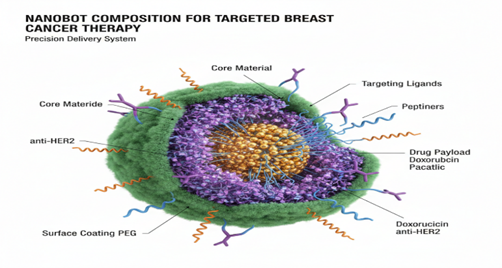
  • Core Material: Metallic (gold, iron oxide) or polymeric nanoparticles.
  • Drug Payload: Chemotherapeutic agents such as paclitaxel or doxorubicin.
  • Targeting Ligands: Antibodies, peptides, or aptamers for tumor-specific binding.
  • Surface Coating: Polyethylene glycol (PEG) or proteins to enhance biocompatibility and circulation.
  • Functional Elements: Magnetic or pH-responsive components for navigation and controlled release.[9]

Figure 1: Nanobot Composition for targeted breast cancer therapy

MANUFACTURING

  1. Synthesis of Core Nanoparticles: Metallic or polymeric cores are prepared using chemical reduction, self-assembly, or emulsion methods.
  2. Drug Loading: Drugs are encapsulated within liposomes, polymeric matrices, or bound to the surface.
  3. Functionalization: Targeting ligands or stimuli-responsive moieties are attached.
  4. Sterilization and Quality Control: Ensures stability, uniformity, and biocompatibility.[10, 11]

Pathway of Nanobot Drug Delivery [Figure 2.]

The pathway of nanobot-mediated drug delivery involves systemic administration, circulation, tumor accumulation via the enhanced permeability and retention (EPR) effect, receptor-mediated binding, internalization, stimuli-responsive drug release, and clearance. This sequence ensures targeted therapeutic delivery with minimal systemic toxicity [12]
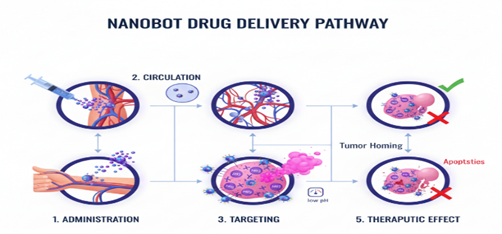
Figure 2: Flowchart of nanobot drug delivery pathway from injection to clearance.

EVALUATION
  • In Vitro: Cytotoxicity assays against cancer cell lines, drug release profiling, targeting efficiency.
  • In Vivo: Tumor accumulation, biodistribution, pharmacokinetics, and therapeutic efficacy in animal models.
  • Safety Assessment: Biocompatibility, immunogenicity, and systemic toxicity evaluation.
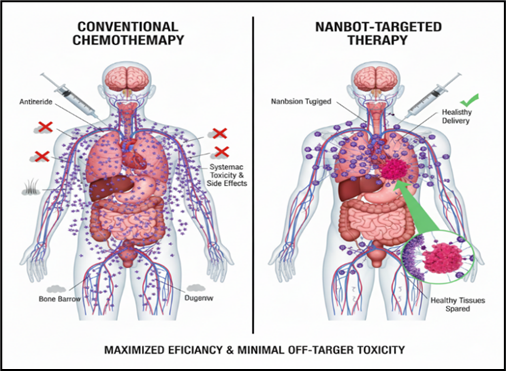
  • Preclinical evaluation involves in vitro cytotoxicity assays, drug release profiling, and receptor-binding efficiency studies. In vivo studies assess biodistribution, pharmacokinetics, and therapeutic efficacy. Safety is a critical aspect, requiring biocompatibility and immunogenicity analysis. [Figure 3.]

Figure 3.: Comparative outcomes of conventional chemotherapy vs. nanobot-based therapy. [13][14]

RESULTS AND DISCUSSION
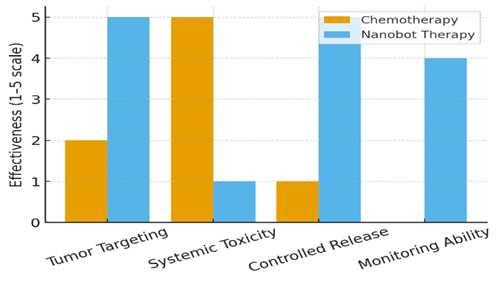
  • Efficacy: [Figure 4.] Nanobots demonstrate higher tumor uptake and reduced off-target toxicity compared to conventional chemotherapy.
  • Controlled Release: Stimuli-responsive nanobots release drugs specifically in tumor microenvironments (e.g., acidic pH), enhancing precision.
  • Theragnostic: Real-time monitoring of drug delivery and tumor response enables personalized therapy.
  • Challenges: Scale-up manufacturing, regulatory approvals, and ensuring long-term biocompatibility remain key hurdles.

Fig 4: chemotherapy vs nanobot therapy [15]

MARKETED EXAMPLE [Table.2]

Table.2: Marketed example

Drug

Type

Clinical Use

Doxil

Liposomal doxorubicin

Breast cancer, ovarian cancer

Abraxane

Albumin-bound paclitaxel

Metastatic breast cancer

These drugs demonstrate the clinical translation of nanocarrier-based delivery, reducing systemic toxicity and enhancing therapeutic efficacy.[16]

RECENT ADVANCES

  • Protein-Bound Magnetic Nanobots: Guided by magnetic fields to improve tumor targeting. [1]
  • pH-Responsive Nanobots: Release drugs selectively in acidic tumor environments.[12]
  • HER2-Targeted Nanobots: Functionalized with antibodies for precision therapy.
  • Integration with AI: Predictive algorithms optimize targeting and dosing, paving the way for personalized nanomedicine. [15]

CONCLUSION

Nanobots and nanocarrier-based systems represent a transformative approach in breast cancer therapy. By enabling precision-targeted delivery, reducing systemic toxicity, and offering potential theragnostic capabilities, they are poised to revolutionize oncology. Marketed examples like Doxil® and Abraxane® demonstrate real-world applicability, while ongoing research on magnetic, pH-responsive, and antibody-functionalized nanobots highlights the future of personalized, patient-centered cancer treatment. Continued advances in design, evaluation, and regulatory approval will be crucial for clinical translation.

REFERENCES

  1. Naikwadi, N.; Paul, M.; Wavhale, R. Self-propelling, protein-bound magnetic nanobots for efficient in vitro drug delivery in triple-negative breast cancer cells. Sci. Rep. 2024, 14 (1), 83393-5i.
  2. Cai Y.; Yang Q.; Wang J.; et al. Stimuli-Responsive nanobots for precision oncology. Nat. Nanotechnol. 2019, 14 (12), 1084–1094.
  3. Barenholz Y. Doxil®—the first FDA-approved nano-drug: lessons learned. J. Control. Release 2012, 160 (2), 117–134.
  4. Gradishar W. J. Albumin-bound paclitaxel: a next-generation taxane. Expert Opin. Pharmacother. 2006, 7 (8), 1041–1053.
  5. Alexiou C.; et al. Targeted tumor therapy with “magnetic drug targeting”: therapeutic efficacy of ferrofluid bound mitoxantrone. Neoplasia 2000, 2 (3), 280–286.
  6. Gao W.; et al. pH-responsive nanoparticles for drug delivery. J. Nanobiotechnol. 2022, 20 (1), 284.
  7. Park J. W.; et al. Anti-HER2 immunoliposomes for targeted therapy of HER2-overexpressing breast cancer. ACS Chem. Biol. 2008, 3 (6), 373–382.
  8. Gharatape, A.; et al. Recent advances in polymeric and lipid stimuli-responsive nanocarriers for cell-based cancer immunotherapy. Nanomedicine (Lond.) 2024, 19 (30), 2655–2678.
  9. Kong, X.; Gao, P.; Hwang, K. C. Advances of medical nanorobots for future cancer treatments. J. Hematol. Oncol. 2023, 16 (1), 1–13.
  10. Patra, J. K.; Das, G.; Fraceto, L. F.; Campos, E. V. R.; Rodriguez-Torres, M. del P.; Acosta-Torres, L. S.; et al. Nano based drug delivery systems: recent developments and future prospects. J. Nanobiotechnol. 2018, 16 (1), 71.
  11. Danaei, M.; Dehghankhold, M.; Ataei, S.; Hasanzadeh Davarani, F.; Javanmard, R.; Dokhani, A.; et al. Impact of particle size and polydispersity index on the clinical applications of lipidic nanocarrier systems. Pharmaceutics 2018, 10 (2), 57.
  12. Yao, Y.; Saw, P. E.; Nie, Y.; Wong, P.; Jiang, L.; Ye, X.; et al. Multifunctional sharp pH-responsive nanoparticles for targeted drug delivery and effective breast cancer therapy. J. Mater. Chem. B 2019, 7 (4), 576–585.
  13. Hruba?, M.; Ro¨sslein, M.; D’Arcy, P.; Baldi, G.; Suter, M. J. F. Understanding the correlation between in vitro and in vivo immunotoxicity tests for nanomedicines. J. Control. Release 2018, 282, 34–42.
  14. Ibrahim, N. N.; Ali, F. M.; Ahmed, S. A. Nanorobotics: Revolutionizing Cancer Treatment And Early Diagnosis With Precision Technology. Int. J. Pharm. Sci. 2025, 15 (3), 1243–1252.
  15. Kong, X.; Gao, P.; Hwang, K. C. Advances of medical nanorobots for future cancer treatments. J. Hematol. Oncol. 2023, 16 (1), 1–13.
  16. Panigrahi, L.; Samal, P.; Sahoo, S. R.; Sahoo, B. Nanoparticle-mediated diagnosis, treatment, and prevention of breast cancer. Nanoscale Adv. 2024, 6 (5), 1234–1256.

Reference

  1. Naikwadi, N.; Paul, M.; Wavhale, R. Self-propelling, protein-bound magnetic nanobots for efficient in vitro drug delivery in triple-negative breast cancer cells. Sci. Rep. 2024, 14 (1), 83393-5i.
  2. Cai Y.; Yang Q.; Wang J.; et al. Stimuli-Responsive nanobots for precision oncology. Nat. Nanotechnol. 2019, 14 (12), 1084–1094.
  3. Barenholz Y. Doxil®—the first FDA-approved nano-drug: lessons learned. J. Control. Release 2012, 160 (2), 117–134.
  4. Gradishar W. J. Albumin-bound paclitaxel: a next-generation taxane. Expert Opin. Pharmacother. 2006, 7 (8), 1041–1053.
  5. Alexiou C.; et al. Targeted tumor therapy with “magnetic drug targeting”: therapeutic efficacy of ferrofluid bound mitoxantrone. Neoplasia 2000, 2 (3), 280–286.
  6. Gao W.; et al. pH-responsive nanoparticles for drug delivery. J. Nanobiotechnol. 2022, 20 (1), 284.
  7. Park J. W.; et al. Anti-HER2 immunoliposomes for targeted therapy of HER2-overexpressing breast cancer. ACS Chem. Biol. 2008, 3 (6), 373–382.
  8. Gharatape, A.; et al. Recent advances in polymeric and lipid stimuli-responsive nanocarriers for cell-based cancer immunotherapy. Nanomedicine (Lond.) 2024, 19 (30), 2655–2678.
  9. Kong, X.; Gao, P.; Hwang, K. C. Advances of medical nanorobots for future cancer treatments. J. Hematol. Oncol. 2023, 16 (1), 1–13.
  10. Patra, J. K.; Das, G.; Fraceto, L. F.; Campos, E. V. R.; Rodriguez-Torres, M. del P.; Acosta-Torres, L. S.; et al. Nano based drug delivery systems: recent developments and future prospects. J. Nanobiotechnol. 2018, 16 (1), 71.
  11. Danaei, M.; Dehghankhold, M.; Ataei, S.; Hasanzadeh Davarani, F.; Javanmard, R.; Dokhani, A.; et al. Impact of particle size and polydispersity index on the clinical applications of lipidic nanocarrier systems. Pharmaceutics 2018, 10 (2), 57.
  12. Yao, Y.; Saw, P. E.; Nie, Y.; Wong, P.; Jiang, L.; Ye, X.; et al. Multifunctional sharp pH-responsive nanoparticles for targeted drug delivery and effective breast cancer therapy. J. Mater. Chem. B 2019, 7 (4), 576–585.
  13. Hruba?, M.; Ro¨sslein, M.; D’Arcy, P.; Baldi, G.; Suter, M. J. F. Understanding the correlation between in vitro and in vivo immunotoxicity tests for nanomedicines. J. Control. Release 2018, 282, 34–42.
  14. Ibrahim, N. N.; Ali, F. M.; Ahmed, S. A. Nanorobotics: Revolutionizing Cancer Treatment And Early Diagnosis With Precision Technology. Int. J. Pharm. Sci. 2025, 15 (3), 1243–1252.
  15. Kong, X.; Gao, P.; Hwang, K. C. Advances of medical nanorobots for future cancer treatments. J. Hematol. Oncol. 2023, 16 (1), 1–13.
  16. Panigrahi, L.; Samal, P.; Sahoo, S. R.; Sahoo, B. Nanoparticle-mediated diagnosis, treatment, and prevention of breast cancer. Nanoscale Adv. 2024, 6 (5), 1234–1256.

Photo
Yeole S. R.
Corresponding author

S N D College of Pharmacy, Yeola, Maharashtra, India

Photo
Ambekar R. V.
Co-author

RJS College of Pharmacy, Kokamthan, Kopargaon.

Photo
Pathan S. M.
Co-author

Sanjivani Institute of Pharmacy and Research

Photo
Narang A. P.
Co-author

Sanjivani Institute of Pharmacy and Research

Photo
Pangavhane R. M.
Co-author

S N D College of Pharmacy, Yeola, Maharashtra, India

Yeole S. R., Ambekar R. V., Pathan S. M., Narang A. P., Pangavhane R. M., Nanobots in Targeted Drug Delivery: Revolutionizing Breast Cancer Therapy with Precision, Int. J. of Pharm. Sci., 2026, Vol 4, Issue 3, 1729-1734. https://doi.org/10.5281/zenodo.19058908

More related articles
Pro-Drug Development ...
Sheela Thorat, Sunita Patil, Shubhangi Mali, ...
Spectral Insights: Bathochromic Shifts in Visible ...
Krishna Chopde , Dr. Vandana Patil , Amruta Jadhav , Nilay Shinde...
Therapeutic Potential of REV-ERB Circadian Transcr...
Amit Sharma, Dr. Sayyed Mateen, Aafreen Qureshi, Vikas Gupta, ...
Related Articles
Simultaneous Estimation of Ciprofloxacin hydrochloride and Dexamethasone sodium ...
Pooja Dhaigude , Shailesh Patwekar, Vaibhav Walale , Yuvraj Navkhande , ...
Pro-Drug Development ...
Sheela Thorat, Sunita Patil, Shubhangi Mali, ...
More related articles
Pro-Drug Development ...
Sheela Thorat, Sunita Patil, Shubhangi Mali, ...
Spectral Insights: Bathochromic Shifts in Visible Spectra of Nicotinamide with N...
Krishna Chopde , Dr. Vandana Patil , Amruta Jadhav , Nilay Shinde , ...
Therapeutic Potential of REV-ERB Circadian Transcription Factors in Cardiac Func...
Amit Sharma, Dr. Sayyed Mateen, Aafreen Qureshi, Vikas Gupta, ...
Pro-Drug Development ...
Sheela Thorat, Sunita Patil, Shubhangi Mali, ...
Spectral Insights: Bathochromic Shifts in Visible Spectra of Nicotinamide with N...
Krishna Chopde , Dr. Vandana Patil , Amruta Jadhav , Nilay Shinde , ...
Therapeutic Potential of REV-ERB Circadian Transcription Factors in Cardiac Func...
Amit Sharma, Dr. Sayyed Mateen, Aafreen Qureshi, Vikas Gupta, ...
