View Article

Abstract

Fast-dissolving film is an accurate and accepted oral dosage form that bypasses the hepatic system and results in a therapeutic response. It is preferred by pharmaceutical industries for its acceptance by both industry and patients, especially among pediatric and elderly patients. This dosage form is cost-effective and meets consumer demand, which allows it to be used as a replacement for over-the-counter (OTC), generic, and brand-name medications. When placed in the oral cavity, fast-dissolving film immediately absorbs moisture, adheres to the application site, and then break down to release the drug. Thus, fast-dissolving films offer significant advantages over other solid oral dosage forms. This review provides an overview of the polymers commonly used in drugs classified under BCS Class I to BCS Class IV, as well as factors that influence drug absorption. Solubility and permeability are the main factors that limit the effectiveness of oral fast-dissolving films for drugs in BCS Class II and BCS Class III. It also includes a brief description of the various technologies used in the formulation of oral films, along with the manufacturing process, evaluation methods, and pharmaceutical applications.

Keywords

Fast dissolving film, Patient Compliance, Solubility, Permeability, Polymer

Introduction

Among all dosage forms, oral administration is the most practical and preferred method. Because oral drug delivery systems are non-invasive and versatile, they accommodate a wide range of medications, and over 70% of pharmaceuticals are available in this form1. Dysphagia is a common issue affecting all age groups, leading many people—particularly the elderly and children—to avoid taking solid oral dosage forms due to the risk of choking. In the early 19th century, fast-dissolving tablets (FDTs) were developed to address these swallowing challenges. This led to the development of fast-dissolving films (FDFs). Due to their unique properties, fast-dissolving dosage forms have gained increasing importance. These dosage forms dissolve and disintegrate rapidly and can be administered without water, making them especially useful for the elderly and children. Fast-dissolving films (FDFs) are now commonly used in personal care, food, and medicine delivery industries, along with breath strips 2. Fast-dissolving films can help overcome some of the issues associated with fast-dissolving tablets. The shape, size, and thickness of fast-dissolving films are similar to a thin postage stamp. When applied to the tongue or oral mucosal tissue, saliva quickly moistens the film, causing it to hydrate and adhere to the site of application. The film then dissolves rapidly, releasing the drug for oromucosal absorption. Fast-dissolving drug delivery systems (FDDS) are suitable for drugs that undergo significant first-pass metabolism and can be used to improve bioavailability by reducing the frequency of doses to achieve higher plasma concentrations. This helps reduce side effects and improves cost-effectiveness 3.

ADVANTAGES 4

  1. It is convenient for people who have trouble swallowing pills or capsules because no water is needed for delivery.
  2. Patients who are ill or uncooperative should use it.
  3. Because films are in solid dose form, they stay stable for a longer period of time.
  4. Bypassing first-pass hepatic metabolism, which is typical in conventional dose forms, the medication is absorbed straight from the film formulation into the circulation.
  5. The speedy commencement of action caused by the film's rapid breakdown improves the active pharmaceutical ingredient's (API) safety and efficacy.

DISADVANTAGES[5]

  1. Drugs that become unstable at buccal pH cannot be administered using this method.
  2. Drugs that irritate the mucosa cannot be given via this route.
  3. Medications that require a low dose can only be administered this way.
  4. Taste masking is necessary because most medications have a bitter taste.

FORMULATION COMPONENTS OF FAST DISSOLVING FILM

Table 1: Formulation Table [3]

Sr. No.

Components

Concentration

1.

API

1-25%

2.

Film-Forming Polymer

45%

3.

Surfactant

Q.S

4.

Plasticizer

0-20%

5.

Sweetening Agent

3-6%

6.

Flavoring Agent

Q.S

7.

Coloring Agent

Q.S

8.

Vehicles

Q.S

9.

Saliva Stimulating Agent

Q.S

METHODS OF PREPARATIONS FOR THE FILM

These dosage forms are made using a variety of techniques, including casting, spraying, and extrusion 6.

Method of preparation of fast-dissolving films fast-dissolving films can be prepared by:

    1. Solvent casting method
    2. Semisolid casting method
    3. Hot melt extrusion
    4. Solid dispersion extrusion
    5. Rolling method.

1) Solvent casting method

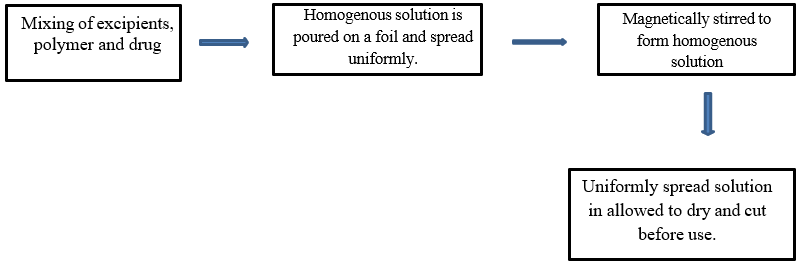
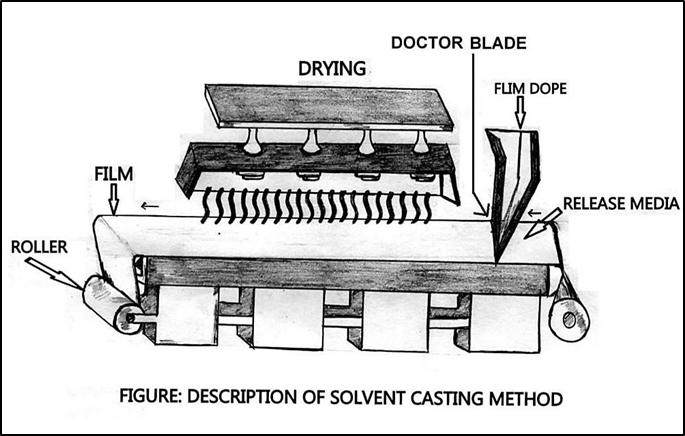
In this method, a water-soluble polymer is first dissolved in water at 1,000 rpm and heated to 60°C. All other excipients such as color, aroma, and sweeteners are dissolved separately. The two solutions are mixed thoroughly at 1,000 rpm. The solution is then mixed with the API dissolved in an appropriate solvent. Air is removed from the vacuum cleaner. The resulting solution is poured onto a thin film and dried, then cut into small pieces 7.

Advantages

  1. Better clarity and thickness uniformity compared to extrusion.
  2. The film has a nice shine and is free from imperfections like die lines.
  3. The film has superior physical properties and is more flexible.
  4. Although different thicknesses can be achieved to suit API loading and dissolving requirements, the recommended final thickness is typically 12–100 micrometers.

Disadvantages

  1. The polymer must be water or a volatile solvent-soluble.
  2. It should be possible to generate a stable solution with a suitable minimum solid content and viscosity.
  3. It must be feasible to create a homogeneous mixture of excipients, polymer, and drug.

Fig.1. Solvent casting method

2) Semisolid casting method

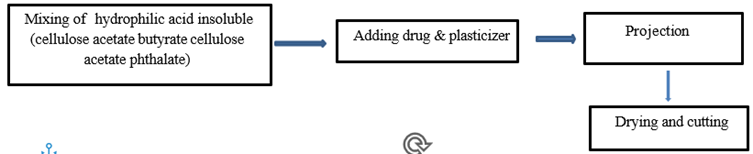
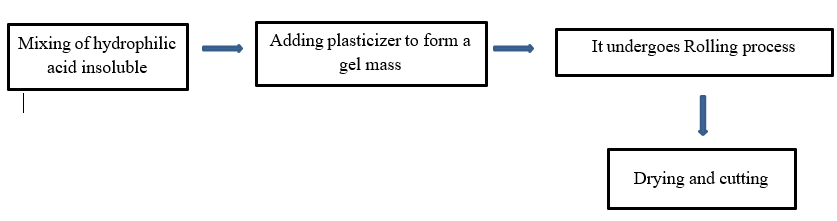
In the semisolid casting method, a solution of a water-soluble film-forming polymer is first prepared. This solution is then added to a solution containing an acid-insoluble polymer (e.g., cellulose acetate phthalate, cellulose acetate butyrate), which is prepared in ammonium or sodium hydroxide. An appropriate amount of plasticizer is then added to form a gel mass. Finally, the gel mass is cast into films or ribbons using heat-controlled drums. The thickness of the film is approximately 0.015–0.05 inches. The ratio of the acid-insoluble polymer to the film-forming polymer should be 1:4 8–9.
Advantages

    • Suitable for acid-insoluble polymers: This method is well-suited for films containing polymers like cellulose acetate phthalate or cellulose acetate butyrate, which require sodium or ammonium hydroxide for dissolution to form a gel mass.
    • Precise dosing: The method allows for accurate control over the dose of the active pharmaceutical ingredient (API) in each film.
    • Potential for continuous operation (with heat-controlled drums): The process can be adapted for continuous manufacturing using heat-controlled drums, which can improve efficiency and potentially lower costs in high-volume production.

Disadvantages

  • Polymer solubility requirement: The process requires the primary polymer to be soluble in a volatile solvent or water, limiting the range of applicable polymers.
  • Requires specific conditions for film formation: The process necessitates the formation of a homogeneous film and its successful release from the casting support.
  • Limited to certain drug types/doses: The size and thickness of the films can limit the amount of API that can be incorporated, meaning that only low to moderate doses of the drug can typically be used.

3) Hot melt extrusion

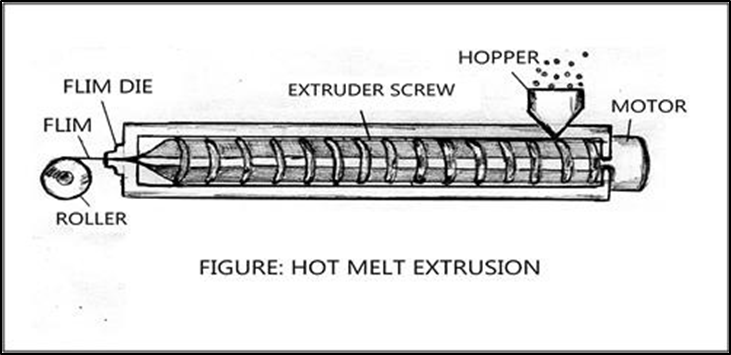
Granules, sustained-release tablets, and transdermal and transmucosal drug delivery systems are frequently made via hot melt extrusion. The medicine and carriers are initially combined in solid form using the hot melt extrusion process. The mixture is then melted by the extruder's heaters. Ultimately, the dies shape the melt into films. Polymers with low molecular weight or viscosity, like pullulan PI.20 or HPMC E5, are typically preferred when creating RDFs. The desired physical qualities can also be obtained by combining different grades of polymers. A film with great drug solubility and strong mechanical strength is created by combining polymers with different viscosities. There are several processes in the pharmaceutical industry's wafer manufacturing process 10,11.

Usually, steering speed and temperature control are used to prepare the mass first. The temperature, air circulation, and line speed are once more regulated as the wafers are coated and dried in a drying tunnel. The wafers are then slitted, punched, pouched, and sealed in the final stage. Oral wafers can also be produced by spraying or extrusion, especially hot-melt extrusion.

Advantages

    • Fewer processing units
    • Improved content uniformity
    • Anhydrous process

Disadvantages:

    • The thermal process can lead to stability issues for the drug or polymer
    • The flow properties of the polymer are crucial for the process
    • There are limited options for available polymers

Fig.2. Hot Melt Extrusion

4) Solid dispersion extrusion

The distribution of one or more APIs in a solid state in an inert carrier using techniques like hot melt extrusion (HME) in the presence of amorphous hydrophilic polymers is referred to as "solid dispersion." Using this method, the medication is extruded with immiscible components to create solid dispersions. Finally, dies are used to form these dispersions into films 12 .

5) Rolling method.

In the rolling process, the chemical solution and film-forming polymer solution are thoroughly mixed, and the resulting solution is applied to the roller.The solutions or suspensions must have specific rheological properties. The film is dried on the rollers and cut into the desired shape and size 13 .

PHARMACEUTICAL APPLICATION OF ORAL FILM 14:

i) Allergic Reaction

Fast-dissolving films are commonly used to treat allergic reactions due to their rapid and effective response.

ii) CNS Disorder

Oral films are beneficial for treating central nervous system (CNS) disorders due to their quick and efficient action.

iii) Topical Application

The films are used topically as analgesics or antimicrobial agents for wound treatment and healing.

iv) Gastro Retentive Dosage Form

These are used to treat gastrointestinal tract (GIT) disorders.

v) Vaccine

Fast-dissolving films can be used to deliver vaccines for the treatment of various diseases, such as the Rotavirus Vaccine.

EVALUATION PARAMETERS

i) Organoleptic Evaluation

The prepared films are analyzed for their physical properties 15.

ii) Morphology Study

The morphology of the prepared film is examined using scanning electron microscopy at a fixed magnification 16.

iii) Weight Variation

A one square inch piece of film was cut from five different locations on the cast film. The weight of each film strip was measured, and the variation in weight was calculated 17.

iv) Thickness of the Film

The thickness of the film was measured using a screw gauge at various positions along the film. The average thickness was then determined 18 .

v) Tensile Strength

The tensile strength of the film was measured using a digital tensile tester, which includes two load cell grips. One grip was fixed, while the other was movable. A test film of specific dimensions, 3 inches by 10 mm, was placed between the two grips. Force was gradually applied until the film broke 19 .

vi) Percentage Elongation

Percentage elongation was determined using a Hounsfield universal testing machine, which also consists of two load cell grips. The lower grip was fixed, and the upper grip was movable. A test film of the same dimensions (3 inches by 10 mm) was placed between the grips. Force was applied gradually until the film broke. Readings were recorded from the instrument 20 .

vii) Folding Endurance

Folding endurance is defined as the number of times a film can be folded at the same plane before it breaks or develops visible cracks. This test provides insight into the film's brittleness. A small strip measuring 4 square cm was folded repeatedly at the same plane until cracks appeared 21.

viii) Disintegration Time

The disintegration test was conducted using a disintegration test apparatus. A one square inch film was placed in a basket, which was raised and lowered to simulate movement at a rate of thirty times per minute. The time taken for the film to completely disintegrate, leaving no trace above the gauze, was recorded. The test was performed in triplicate 22.

ix) Mouth Dissolving Time

The mouth dissolving time was determined by placing the film manually into a beaker containing 50 ml of 6.8 pH phosphate buffer. The time required for the film to dissolve completely was noted 23.

x) Content Uniformity

The films were tested for content uniformity. A one square inch piece of film was cut and placed in a 100 ml volumetric flask. It was dissolved in methanol, and the volume was adjusted to 100 ml with methanol. The solution was diluted appropriately, and the absorbance was measured at 285 nm 24.

xi) In-Vitro Dissolution Studies

The dissolution profile of the mouth dissolving films was compared with that of the pure drug. The dissolution study was conducted using a USP Type II (paddle) apparatus with 500 ml of 0.1 N HCl containing 0.5% w/v sodium lauryl sulphate as the dissolution medium, maintained at 37 ± 0.5°C. The medium was stirred at 100 rpm for one hour. Samples were collected at 15-minute intervals and replaced with fresh medium. The samples were diluted with methanol and analyzed for drug content at 285 nm 25.

CONCLUSION

The present review concludes that due to issues with dysphagia and the need for emergency treatment, fast oral dissolving films are commonly used. These films improve patient compliance and are easy to administer. Drugs that fall under BCS II and BCS III face challenges in manufacturing due to the rate-limiting step of absorption, even for low-dose drugs. These challenges can be addressed with the use of appropriate polymers. Among various manufacturing methods, solvent casting is the most widely used technique. Other techniques such as wafering, foamburst, and microporation are also employed in the formulation of oral films.  

REFERENCES

  1. Dixit, RP, Puthli, SP, “Oral strip technology: overview and future potential,” J Control Release, 2009 Oct 15, 139(2):94-107.
  2. Patel, R, Prajapati, S, Raval, A, “Fast dissolving films (FDFs) as a newer venture in fast dissolving dosage forms,” International Journal of Drug Development and Research, 2010, 2(2), 232-236.
  3. Patil SL, Mahaparale PR, Shivnikar MA, Tiwari SS, Pawar KV, Sane PN, “Fast dissolving oral films: An innovative drug delivery system,” International Journal of Chem Tech Research, 2015, 2(3):482-496.
  4. Raymond C Rowe, Paul J Sheskey, Marian E Quinn, “Handbook of Pharmaceutical Excipients, 6th Edition, Pharmaceutical Press Publishing Company, Great Britain. 2009, 181-182.
  5. Nibha KP, Pancholi SS, “An overview on: Sublingual route for systemic drug delivery,” Int J. Res. Pharm. Biomed. Sci, 2012, 3(9)13-23.
  6. Kushwaha V, Akhtar J, Usmani S, Singh SP. “A review on fast dissolving formulation technologies,” World J Pharm Pharm Sci, 2015,4(5)74-85.
  7. M Nishimura; K Matsuura; T Tsukioka; H Yamashita; N Inagaki; T Sugiyama; Y Itoh, “In vitro and in vivo characteristics of prochlorperazine oral disintegrating film,” Int J Pharm, 2009, 23, 368(1):98-102.
  8. M Bhattarai, AK Gupta, “Fast Dissolving Oral Films: A Novel Trend to Oral Drug Delivery System” Sunsari Tech College J, 2016, 2(1):58-68.
  9. RR Thakur; DS Rathore; S Narwal, “ORALLY DISINTEGRATING PREPARATIONS: RECENT ADVANCEMENT IN FORMULATION AND TECHNOLOGY,” J Drug Delivery Therapeutics, 2012, 2(3).
  10. Arya, A, Chandra, A, Sharma, V, Pathak, K., “Fast dissolving films: an innovative drug delivery system and dosage form,” Int J ChemTech, 2010:576-83.
  11. Frey, P., “Film strips and pharmaceuticals,” pharma. mfg. & package, Sourcer, 2006, 92-93.
  12. Gavaskar, B, Kumar, SV, Sharan, G, Rao, Y.M, “overview on fast dissolving films,” Int J Pharmacy &Pharm Sci, 2010, 2(3), 29-33.
  13. Zhang, H, Zhang, J, Streisand, JB., “Oral mucosal drug delivery: clinical pharmacokinetics and therapeutic applications,” ClinPharmacokinet, 2002, 41(9): 661-80.
  14. Suresh B., D. Halloran, L. James., “Quick Dissolving Films: A Novel Approach to Drug Delivery,” Drug Development Technology, 2006: 1- 7.
  15. Ghodake PP, Karande KM, Osmani RA, Bhosale RR, Harkare BR, Kale BB, “Mouth dissolving films: An innovative vehicle oral drug delivery,” Int J Pharma, Res Rev, 2013: 41-7.
  16. Anand V, Kataria M, Kukkar V, Saharan V, Choudhury PK, “The latest trends in the taste assessment of pharmaceuticals,” Drug Discov Today, 2007, 57-65.
  17. Buchi N, Nalluri B, Sravani V, Saisri Anusha, Sribramhini R, Maheswari K M. “Development and evaluation of mouth dissolving films of sumatriptan succinate for better therapeutic efficacy,” J App Pharm Sci, 2013, 161.
  18. Smriti T, “Mouth dissolving films: A review,” Int J Pharm Bio Sci, 2013, 899-908.
  19. Bhyan B, Jangra S, Kaur M, Singh H, “Orally fast dissolving films: Innovations in formulation and technology,” Int J Pharm Sci, Rev Res, 2011, 50.
  20. Nair AB, Kumria R, Harsha S, Attimarad M, Al-Dhubiab BE, Alhaider IA, “In-vitro techniques to evaluate buccal films,,” J Control Release, 2013, 10-21.
  21. Ali MS, Vijendar C, Kumar SD, Krishnaveni J, “Formulation and evaluation of fast dissolving oral films of diazepam, J Pharm, 2016, 1- 5.
  22. Kumar GV, Krishna RV, William GJ, Konde A, “Formulation and evaluation of buccal films of salbutamol sulphate,” Indian J Pharm Sci, 2005, 160.
  23. Venkata A, Shireesh MR, Kiran P, “A review on oral thin fast dissolving films; recent trends of dosage form for quick release,” Int J Pharm Bio Sci, 2014, 54-67.
  24. Pandit JK, Balamurugan K, Choudary PK, Balasubtamaniam J, “Systemic absorption of propranolol hydrochloride from bucco adhesive films,” Indian J Pharm Sci, 2001, 63,473-480.
  25. Kalyan S, Bansal M, “Recent trends in the development of oral dissolving film,” Int J PharmTech Res, 2012, 25-33.

Reference

  1. Dixit, RP, Puthli, SP, “Oral strip technology: overview and future potential,” J Control Release, 2009 Oct 15, 139(2):94-107.
  2. Patel, R, Prajapati, S, Raval, A, “Fast dissolving films (FDFs) as a newer venture in fast dissolving dosage forms,” International Journal of Drug Development and Research, 2010, 2(2), 232-236.
  3. Patil SL, Mahaparale PR, Shivnikar MA, Tiwari SS, Pawar KV, Sane PN, “Fast dissolving oral films: An innovative drug delivery system,” International Journal of Chem Tech Research, 2015, 2(3):482-496.
  4. Raymond C Rowe, Paul J Sheskey, Marian E Quinn, “Handbook of Pharmaceutical Excipients, 6th Edition, Pharmaceutical Press Publishing Company, Great Britain. 2009, 181-182.
  5. Nibha KP, Pancholi SS, “An overview on: Sublingual route for systemic drug delivery,” Int J. Res. Pharm. Biomed. Sci, 2012, 3(9)13-23.
  6. Kushwaha V, Akhtar J, Usmani S, Singh SP. “A review on fast dissolving formulation technologies,” World J Pharm Pharm Sci, 2015,4(5)74-85.
  7. M Nishimura; K Matsuura; T Tsukioka; H Yamashita; N Inagaki; T Sugiyama; Y Itoh, “In vitro and in vivo characteristics of prochlorperazine oral disintegrating film,” Int J Pharm, 2009, 23, 368(1):98-102.
  8. M Bhattarai, AK Gupta, “Fast Dissolving Oral Films: A Novel Trend to Oral Drug Delivery System” Sunsari Tech College J, 2016, 2(1):58-68.
  9. RR Thakur; DS Rathore; S Narwal, “ORALLY DISINTEGRATING PREPARATIONS: RECENT ADVANCEMENT IN FORMULATION AND TECHNOLOGY,” J Drug Delivery Therapeutics, 2012, 2(3).
  10. Arya, A, Chandra, A, Sharma, V, Pathak, K., “Fast dissolving films: an innovative drug delivery system and dosage form,” Int J ChemTech, 2010:576-83.
  11. Frey, P., “Film strips and pharmaceuticals,” pharma. mfg. & package, Sourcer, 2006, 92-93.
  12. Gavaskar, B, Kumar, SV, Sharan, G, Rao, Y.M, “overview on fast dissolving films,” Int J Pharmacy &Pharm Sci, 2010, 2(3), 29-33.
  13. Zhang, H, Zhang, J, Streisand, JB., “Oral mucosal drug delivery: clinical pharmacokinetics and therapeutic applications,” ClinPharmacokinet, 2002, 41(9): 661-80.
  14. Suresh B., D. Halloran, L. James., “Quick Dissolving Films: A Novel Approach to Drug Delivery,” Drug Development Technology, 2006: 1- 7.
  15. Ghodake PP, Karande KM, Osmani RA, Bhosale RR, Harkare BR, Kale BB, “Mouth dissolving films: An innovative vehicle oral drug delivery,” Int J Pharma, Res Rev, 2013: 41-7.
  16. Anand V, Kataria M, Kukkar V, Saharan V, Choudhury PK, “The latest trends in the taste assessment of pharmaceuticals,” Drug Discov Today, 2007, 57-65.
  17. Buchi N, Nalluri B, Sravani V, Saisri Anusha, Sribramhini R, Maheswari K M. “Development and evaluation of mouth dissolving films of sumatriptan succinate for better therapeutic efficacy,” J App Pharm Sci, 2013, 161.
  18. Smriti T, “Mouth dissolving films: A review,” Int J Pharm Bio Sci, 2013, 899-908.
  19. Bhyan B, Jangra S, Kaur M, Singh H, “Orally fast dissolving films: Innovations in formulation and technology,” Int J Pharm Sci, Rev Res, 2011, 50.
  20. Nair AB, Kumria R, Harsha S, Attimarad M, Al-Dhubiab BE, Alhaider IA, “In-vitro techniques to evaluate buccal films,,” J Control Release, 2013, 10-21.
  21. Ali MS, Vijendar C, Kumar SD, Krishnaveni J, “Formulation and evaluation of fast dissolving oral films of diazepam, J Pharm, 2016, 1- 5.
  22. Kumar GV, Krishna RV, William GJ, Konde A, “Formulation and evaluation of buccal films of salbutamol sulphate,” Indian J Pharm Sci, 2005, 160.
  23. Venkata A, Shireesh MR, Kiran P, “A review on oral thin fast dissolving films; recent trends of dosage form for quick release,” Int J Pharm Bio Sci, 2014, 54-67.
  24. Pandit JK, Balamurugan K, Choudary PK, Balasubtamaniam J, “Systemic absorption of propranolol hydrochloride from bucco adhesive films,” Indian J Pharm Sci, 2001, 63,473-480.
  25. Kalyan S, Bansal M, “Recent trends in the development of oral dissolving film,” Int J PharmTech Res, 2012, 25-33.

Photo
Dhruv Shah
Corresponding author

Sigma institute of Pharmacy, Sigma University, Bakrol, Vadodara-390019

Photo
Ria Patel
Co-author

Sigma institute of Pharmacy, Sigma University, Bakrol, Vadodara-390019

Photo
Dr. Priyanaka Patil
Co-author

Sigma institute of Pharmacy, Sigma University, Bakrol, Vadodara-390019

Dhruv Shah, Ria Patel, Dr. Priyanaka Patil, Fast Dissolving Film as an Alternative to Conventional Oral Dosage Forms, Int. J. of Pharm. Sci., 2026, Vol 4, Issue 1, 1069-1076. https://doi.org/10.5281/zenodo.18213394

More related articles
An Overview: Orodispersible Film [ODF]: A Morden A...
Rutuja Ghotekar, Satyam Deore, Kanchan Jagtap, ...
Extraction and Formulation of Buccal Film Using Ja...
Sujatha, Sahana B R, Roshini P, Reshma, Sakshi R, Rakshitha M, ...
Formulation And Evaluation of Film Forming Gel Loa...
Jayashree Halluru , Dr. Sangeetha S. S., ...
Brief Review on Mouth Dissolving Film...
Prachi Mandave , Nikita Dhore, Shrawasti Ramteke, Mayuri Balpande, ...
Evaluation Of the Therapeutic Efficacy of Curcumin and Diclofenac in Wound Heali...
Anu Jindal, Anjali, Pranab Moudgil, Jaswinder Singh, Rajmeet Singh, Shaveta Bhardwaj, Jasvir Kaur, ...
NanoEmulsion-Infused Buccal Films: A Hybrid Drug Delivery Platform For Overcomin...
Drashti Patel, Dhwanit Darji, Jay Maske, Rakesh Melaja, Jaini Patel, ...
Related Articles
Synergistic Multi-Herb Approaches for Reversing Microbial Biofilms in Chronic In...
Shruti Bijwe, Shreeya Hambarde, Mayuri Randive, Khushi Raikwad, Arpita Bhajipale, Nishant Awandekar,...
Oral Dispersible Films (ODFs)...
Shubham Patel, Kavita Rana, Dr. Priyanka Patil, ...
A Review on Mouth Dissolving Film...
Samidha Sonkamble, Tejaswini Asawe, ...
More related articles
Extraction and Formulation of Buccal Film Using Jackfruit Seed Starch...
Sujatha, Sahana B R, Roshini P, Reshma, Sakshi R, Rakshitha M, ...