

We use cookies to ensure our website works properly and to personalise your experience. Cookies policy
Aryan College of Pharmacy, Kotnoor(D) Layout, Kalaburgi-585102, Karnataka, India
The primary goal of this invention was to develop and evaluate flax suppositories. To administer its herbal content to internal sites, suppositories are placed directly into the rectum. A suppository comprises flax as a main active ingredient, administered through the rectal route, used as a laxative, treatment of haemorrhoids and bacterial infections of the anus. Constipation is one of the most widespread chronic gastro intestinal disease in the world it is treated or managed using laxatives. For the formulation of the present invention, the suppository preferably comprises flax in an inert base, which may comprise any suitable inert pharmaceutical carrier. The base may optionally be any suitable inert base that is solid at room temperature. The flax may optionally comprise the liquid or gel form or a dry extract of the juice, or any other form of flax, all of which are collectively termed “flax extract”. It includes properties like anti-inflammatory, anti-oxidant and laxative effects, attributed to its high content of lignans, omega-3 fatty acids and mucilage. In order to prevent its reported gastro-intestinal irritation and to give children a quick onset of effect, the current study set out to develop and assess the rectal suppositories containing flax seed extract as a new dosage Form. Glycero-gelatin base, it is a mixture of glycerin and water which is made stiff by the addition of gelatin. The base may be used for preparing all type of suppositories. The suppositories prepared from glycero-gelatin base are translucent. which tend to dissolve or disperse slowly in the body cavity and release the medicament.
Suppositories are a medicated semi - solid dosage forms intended for insertion into the body cavities. They evolved as a more convenient alternative form of drug delivery from liquid enema formulations. In fact, the term suppositorium has its origin in the Latin word supponere, meaning ‘substitute’ (to place under). While commonly perceived to be for rectal administration only, suppositories are also appropriate for vaginal administration. Pessaries are often used to describe vaginal suppositories. The Latin term pessarium derived from the Greek word pesos, which means ‘oval stone’ was used to describe the shape.
Suppositories are ovoid or conical medicated solids intended for insertion into one of the several orifices of the body, excluding the oral cavity. where they melt, soften or dissolve and exert local or systemic effects. These are often used for local or systemic effects in the rectum, vagina, and, to a lesser extent, the urethra. It has a rapid onset of action than the oral route since the medicine is absorbed directly into the bloodstream through the rectal mucosa (avoids the first-pass metabolism). It is a convenient way to administer medications that cause vomiting, irritate the GI tract, or are destroyed by the stomach's acidic ph.
Drugs can be administered as suppositories for both local and systemic effects. The composition of the drug, its concentration, and the rate of absorption all affect its activity1.
DRUG PROFILE OF FLAXSEED:

Fig 1
Flaxseed (linum usitatissimmum) is also known as linseed and this term used interchangeably. Flaxseed is often used to describe the flax when consume by months while the linseed denotes when it is used specifically for industrial applications8.
It is properly known as Alsi, jawas, Akse Beja in Indian languages. The Latin name of flaxseed is linum usitatissimmum, which means “very useful”8.
Flaxseed was first introduced in united state by colonists, primarily to produced Fiber for clothing. Flaxseed was used for the fabrication for cloths and papers, while flaxseed oil and its sub products are used in animal feed formulation8.
Flaxseed are obtained from Blue Flowering annual herb and belongs to Linaceace Family. Flax plants grow from 12 to 40 inches high8.
The plant has a slender and fibrous stem and its bright blue flowers are up to 3cm in diameter8.
The flower has five petals and from a five-celled ball that can contain up to 10 seeds. Flowering continues until plant growth stops. The spherical fruit capsules contain two seeds in each of five compartments8.
Fiber flax varieties are tall, unbranched plants that are grown at very high density to, maximize the fibre production8.
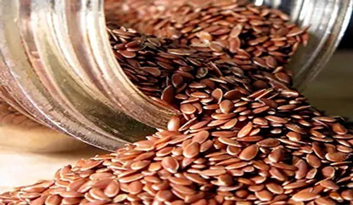
Fig 2
The whole flaxseed is flat and oval with pointed tips and contains a seed coat are true hull (also called Testa), a thin endosperm, to embryos and an embryo axis. It has smooth glossy surface. It various in colour from dark brown to yellow. The texture of flaxseed is crisp and chewy possing a pleasant nutty taste. Distinct varieties namely Shella and Sweta, Garima, sharda, Rashmi, shikha, Padmini, etc8.
MATERIALS AND METHODS
The following are the list of the materials and equipment used in developing the formulation:
Table 1: List of the materials used:
|
Sr. No |
Material |
Source |
|
1 |
Flaxseed |
Local source |
|
2 |
Gelatine |
Thermos fisher |
|
3 |
Glycerine |
Oxford orange of laboratory chemicals |
|
4 |
Water |
Local source |
|
5 |
Liquid paraffin |
By molychem, Mumbai |
|
6 |
Methyl paraben |
Thermo fisher |
Table 2: List of the equipment’s used:
|
Sr. No. |
Name of the Instruments |
Manufacturer |
|
1 |
Electronic weighing balance |
Indosati |
|
2 |
Molds |
Indosati |
|
3 |
Friability tester |
Indosati |
|
4 |
Hardness tester |
Indosati |
|
5 |
Dissolution testing apparatus |
Indosati |
|
6 |
UV visible spectrophotometer |
Indosati |
|
7 |
Disintegration test apparatus |
Indosati |
Materials
Method of isolation
All of the flaxseeds used in the extraction were acquired from a local store. For extraction, it was important to use a mechanical flaxseed preparation technique. firstly, crushing the seeds would result in the extraction of other substances, such as proteins, which are primarily found in the endosperm, lowering the quality of the mucilage extract, therefore the extraction from the whole seed was suitable. It is also not a good idea to extract mucilage from the meal after the oil has been extracted since this will result in protein extraction. As a consequence, flaxseed mucilage extraction from the entire seed was successful. Flaxseed mucilage was extracted using distilled water in an aqueous method.10gm Weighed the flaxseeds and put them in distilled water. Heat this mixture and then filter the resulting gel/extract with a clean muslin cloth2.
Take a required quantity of flaxseeds and crush with the help of motor and pestle then take that crushed flaxseeds into the China dish and add the required amount of distilled water.
Heat the above content, often with continuous stirring at around 80-90°C until it maximizes the mucilage release. Filter the swollen mass through a muslin cloth or similar material to separate the liquid mucilage from the solid seed residue.
Temperature: Around 80 ± 2°C has been shown to yield the maximum amount of mucilage.

Fig 3 :- The heated flaxseed mixture is poured through a muslin cloth
To separate the thick mucilage gel from the solid seed residues
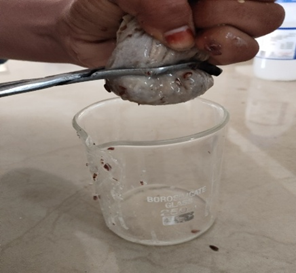
Fig 4 : The mucilage rich gel is being squeezed out from the flaxseed mixture using a muslin cloth to ensure maximum yield.
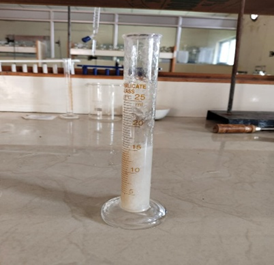
Fig 5 : The final extracted flaxseed gel collected in a measuring cylinder, appearing as a thick, translucent liquid.
Preparation of suppositories
For the suppository base, glycerinated gelatine bases were prepared2.
|
INGREDIENTS |
USE |
|
Flaxseed gel |
Mild Laxative |
|
Gelatine |
Base |
|
Glycerine |
Base |
|
Purified water |
Base |
|
Methyl paraben |
Preservative |
CODE AND COMPOSITION OF FORMULATIONS:
Table 3: Formulations
|
Formulation code |
Flaxseed gel (mg) |
Gelatine (mg) |
Glycerine (mg) |
Purified water (mg) |
Methyl paraben (mg) |
|
F1 |
500 |
1500 |
100 |
1000 |
100 |
|
F2 |
500 |
1400 |
200 |
800 |
100 |
|
F3 |
500 |
1400 |
500 |
500 |
100 |
|
F4 |
500 |
1300 |
100 |
1000 |
100 |
|
F5 |
500 |
1200 |
800 |
400 |
100 |
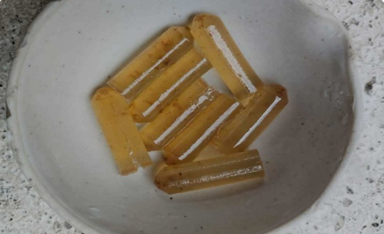
F1
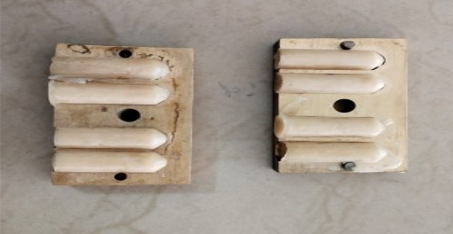
F2
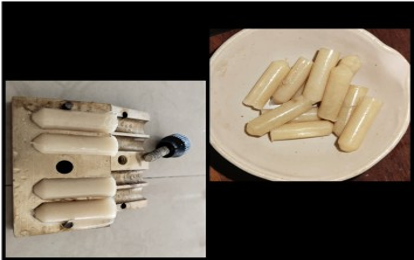
F3
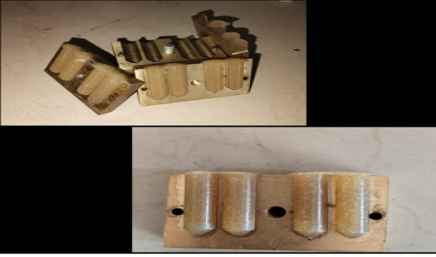
F4
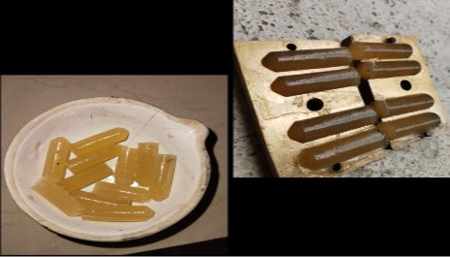
F5
Fig 6: Formulated suppositories
RESULT AND DISCUSSION:
Table 4: Visual characterization of the formulations
|
Parameters |
F1 |
F2 |
F3 |
F4 |
F5 |
|
Fissuring |
NO |
NO |
NO |
NO |
NO |
|
Pitting |
NO |
NO |
NO |
NO |
NO |
|
Fat blooming |
NO |
NO |
NO |
NO |
NO |
|
Exudation |
NO |
NO |
NO |
NO |
NO |
|
Migration of active ingredients |
NO |
NO |
NO |
NO |
NO |
Table 5: Physical evaluation of the formulations
|
Formulation code |
Colour |
Odour |
Texture |
Melting point (0 c) |
Softening (0 c) |
Hardness (kg) |
|
F1 |
Golden yellow |
Flaxseed gel smell |
Smoothy |
35 |
30 |
4 |
|
F2 |
Creamy white |
Flaxseed gel smell |
Smoothy |
43 |
30 |
4.2 |
|
F3 |
Golden yellow |
Flaxseed gel smell |
Smoothy |
40 |
30 |
4.9 |
|
F4 |
Creamy white |
Flaxseed gel smell |
Smoothy |
35 |
30 |
3.8 |
|
F5 |
Light golden yellow |
Flaxseed gel smell |
Smoothy |
36 |
30 |
4.3 |
Table 6: Physical evaluation of the formulations
|
Formulation code |
Length (cm) |
Width (cm) |
Friability (%) |
Weight variation(gm) |
Hardness (kg/cm2) |
Disintegration Time(min/sec) |
|
F1 |
3 |
1 |
0.4 |
2.26 |
4 |
2:8 |
|
F2 |
3 |
1 |
0.6 |
2.17 |
4.2 |
2:30 |
|
F3 |
3 |
1 |
0.3 |
2.39 |
4.9 |
3:2 |
|
F4 |
3 |
1 |
0.3 |
2.19 |
3.8 |
0:38 |
|
F5 |
3 |
1 |
0.4 |
2.26 |
4.3 |
2:16 |
Table7: Percentage of drug release
|
Time |
F1 |
F2 |
F3 |
F4 |
F5 |
|
% |
% |
% |
% |
% |
|
|
5 |
31.67 |
0.74 |
19.36 |
5.05 |
5.58 |
|
10 |
63.44 |
1.26 |
44.71 |
14.1 |
15.57 |
|
15 |
99.00 |
1.68 |
78.17 |
29.25 |
29.98 |
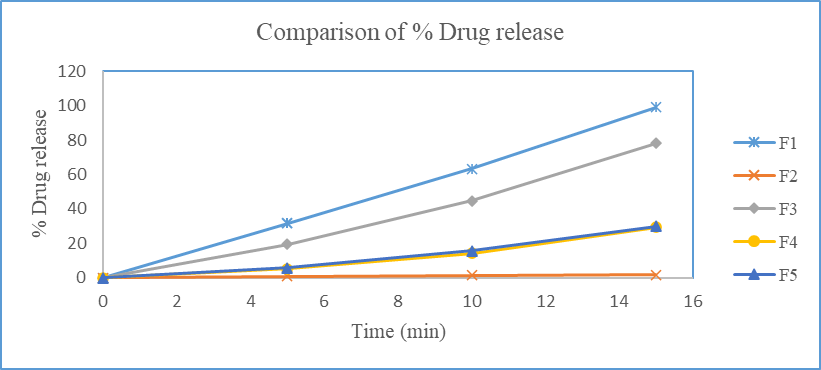
Fig 7 Comparative dissolution graph
Fig 7. shows the in-vitro drug release profile of several suppositories’ formulations. The suppositories melted in the dissolving media kept at 37 0 C according to the dissolution study. Dissolution results of formulation from F1 and F3 shows promising results of drug release, Formulation trial 1 show better results when compared to F3 i.e 99% drug release at 15 min.
DISCUSSION
Flaxseeds are medicinal seeds obtain from Linum usitatissimum (Linn.) having various medicinal activities like laxative, antidiarrheal, helps in cardiac diseases, cancer, arthritis, osteoporosis, autoimmune and neurological disorders. But present invention focuses on the laxative property of the suppositories. The combination of bulk forming laxative and osmotic laxative forms a better treatment for constipation.
The flaxseed suppositories had been made and tested with the positive results. All the batches were uniform in structure, of good strength, and had a quick melting rate at a body temperature. The tested samples allowed the active substance to be released
By more than 50% within 15 minutes, Such a rapid release of the drug , together with natural laxative properties of flaxseed, provides the suppositories with the possibility of quick alleviation of the symptoms of constipation and haemorrhoids. The base of glycerinated gelatin was very suitable for the production of herbal suppositories.
The table 5,6,7 shows the data for the suppositories that were evaluated for the properties such as Appearance, Length, Width, Weight Variation, Melting time, Hardness, Friability, Disintegration test, Dissolution test.
All physical parameters of formulation from F1 to F5 results were found satisfactory like weight variation, hardness, disintegration time. Dissolution results of formulation from F1 and F3 shows promising results of drug release, Formulation trial 1 show better results when compared to F3 i.e. 99% drug release at 15 min.
Among all the five formulations f1 shows satisfactory results within 15 minutes. As this formula is having gelatin and water ration is more when compared to other formulation. Based on this preliminary research study further extended research activity may be carried out to prepare the flaxseed suppositories to develop a stable, safe product.
FUTURE SCOPE
Target Treatment: A product like suppositories is perfect for small local problem, eg. Haemorrhoids, vaginal infections, and prostrate health by delivering the herbs right at the sight
Natural Alternative: The patient demand for healthcare products that are plant-based, and free of chemicals is the leading factor of the market growth.
Bypassing Digestion: The product is perfect for the patients who are not able to sallow pills as are nauseous since the absorption takes place through rectal/vaginal membranes
CHALLENGES
Standardization and Quality: It is the quite hard to achieve the potency of an herbal extract and its effects of each batch to the same.
Scientific Evidence: There are not many clinical trials that are large-scale and safety and effectiveness as a conclusion for suppositories for specified diseases.
Regulatory Hurdles: The laws that govern herbal medicines are sometimes quite ambiguous or strict, and this makes approval and marketing a complicated process.
Patient Acceptance: The patient group that suffers culturally and personally from the suppository route of discomfort in administration may be limited in its use.
CONCLUSION
Suppositories are the valuable dosage form alternative to oral administration particularly in cases of when patient can’t swallow pills. A study with flaxseed (A natural plant) to make a suppository. They mixed flaxseed with glycerine to create a solid form that melts inside the body. It worked really excellent the suppository melted quickly and released the medicine properly. This shows that natural ingredients like flaxseed can be turned into modern medicines that are easy to use and work fast. This demonstrate that natural ingredients successfully incorporated into modern pharmaceutical formulations. So, suppositories are useful, and using plants like flaxseed in them is a smart idea.
Flax suppositories were formulated by heat moulding method and were tested for physical evaluation, weight variation, disintegration, melting point, strength, and in-vitro dissolution studies. All test showed satisfactory results, based on the dissolution result of the all five formulations, F1 shows better result comparatively other formulation. it can be concluded that glycerinated gelatine may be used as a substrate for the immediate release of flax suppositories because it is easily soluble in an aqueous solution, disintegrate quickly, and has a faster rate of release. Their antioxidant and anti-inflammatory activities, combined with their ability to alleviate rectal discomfort and promote bowel regularity, affirm the therapeutic potential of flaxseed extract. These suppositories represent a promising advancement in integrating herbal medicine with modern pharmaceutical technology. It can be concluded that rectal suppositories containing flax seed extract can be prepared by moulding method by using glycerol-gelatine bases used to formulate the suppositories with same concentration of flax seed as laxative. Among all the five formulations F1 showed better in disintegration time, and dissolution rate.
REFERENCE


Bheemanna Munnur, Bhagyashri Kalu, Sangmanath B, Amit Kumar Tiwari, Formulation and Evaluation of Flaxseed Extract Suppositories, Int. J. of Pharm. Sci., 2025, Vol 3, Issue 11, 4669-4676. https://doi.org/10.5281/zenodo.17750820
 10.5281/zenodo.17750820