

We use cookies to ensure our website works properly and to personalise your experience. Cookies policy
Hindustan College of Pharmacy, Chenappady, Kanjirappally
The present study focuses on the formulation and evaluation of herbal paper soap prepared using extracts of Punica granatum (pomegranate) and Curcuma longa (turmeric). The aim of the study is to develop an eco-friendly, portable, and skin cleansing product that combines the natural antibacterial and antioxidant properties of herbal ingredients. The paper soap was formulated by incorporating pomegranate peel extract and turmeric extract into a biodegradable, water-soluble paper base along with suitable surfactant and stabilizer. The prepared herbal paper soap was evaluated for various parameters such as pH, foam retention, moisture content, stability study. The results showed that the formulated soap possessed a balanced pH suitable for skin, good foaming properties, and effective cleansing action. The herbal extracts enhanced the antibacterial efficiency and provided additional skin-nourishing and antioxidant benefits. The study concludes that the combination of Punica granatum and Curcuma longa extracts can be successfully used in the preparation of herbal paper soap, offering a natural, safe, and sustainable alternative to synthetic cleansing products.
Herbal paper soap is a lightweight, biodegradable made up of thin sheets of paper mixed with soap solution which incorporated with herbal ingredients that dissolve in water and produce adequate foam.(1) Paper soap is innovation in the field of modern toiletries and alternative to traditional soaps and synthetic products.(2) Because,it is a portable and a pocket-sized product for cleaning hands. This herbal soap basically consists of pomegranate peel extract and turmeric extract. They provide anti-bacterial, anti-aging, antioxidant, antiseptic effect. The herbal ingredients provide additional therapeutic benefits rather than cleansing action. The pomegranate peel contains the highest concentration of phenolic compounds which provide anti -bacterial activity and also the traces of curcumin contribute anti-inflammatory and wound healing properties.
AIM
The aim of the project work is to formulate and evaluate the herbal paper soap containing Punica granatum and Curcuma longa for the cleansing property.
OBJECTIVES
REVIEW LITERATURE
MATERIALS AND METHODS
Ingredients: Pomegranate peel extract, Turmeric extract, KOH, Glycerine, Castor oil, Coconut oil, NaCl, Citric acid, orange oil, Distilled water.
Collection: Pomegranate and turmeric were collected from local market, Kanjirappally
Equipment: The equipments were soxlet apparatus, hot air oven, digital pH meter.
Preparation of pomegranate peel extraction: The pomegranate peel was thoroughly washed with distilled water. The pomegranate peel was sun-dried for 3–4 days to preserve its natural richness, then finely ground into a soft, fragrant powder ready for formulation. Dried pomegranate peels were coarsely grinded. The weighed sample was dropped in the Soxhlet extractor apparatus. The extraction proceed for 8 hours using ethanol as the solvent.(4)
Preparation of turmeric extract: Take fleshy rhizomes of turmeric. The rhizomes of turmeric were dried in oven at 105°C for 3 hr. Dried rhizome were grinded and obtained uniform powder. The turmeric powder was stored in refrigerator to prevent moisture uptake.(5) 10 g turmeric powder was weighed and kept in the Soxhlet apparatus which was gradually filled with acetone as the extraction solvent. The extraction was carried out at 60 °C within 8 h. After the extraction, the acetone was separated from the extract by solvent evaporation method.(6)
Preparation of soap solution:
Table No:1 Ingredients of herbal paper soap
|
Sr. No |
INGREDIENTS |
QUANTITY |
|
|
Pomegranate peel extract |
3.5ml |
|
|
Turmeric extract |
2ml |
|
|
KOH |
15 g |
|
|
Glycerine |
30ml |
|
|
Coconut oil |
8ml |
|
|
Castor oil |
4 ml |
|
|
NaCl |
16gm |
|
|
Cellulose paper |
15 sheets |
|
|
Citric acid |
3ml |
|
|
Distlled water |
300ml |
|
|
Orange oil |
3 ml |
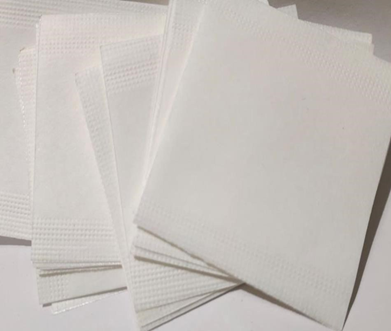
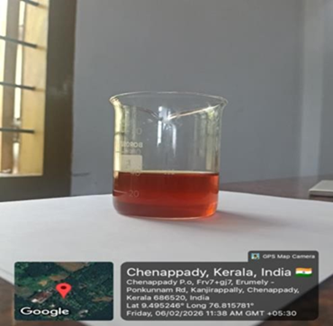
Fig .No.1: Cellulose Paper Fig .No.2: Formulated liquid soap
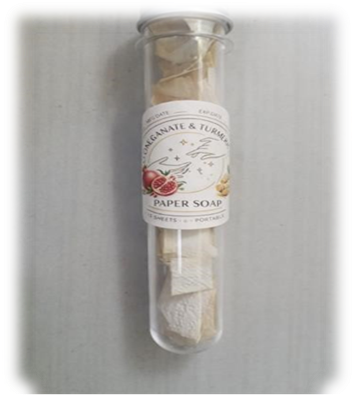
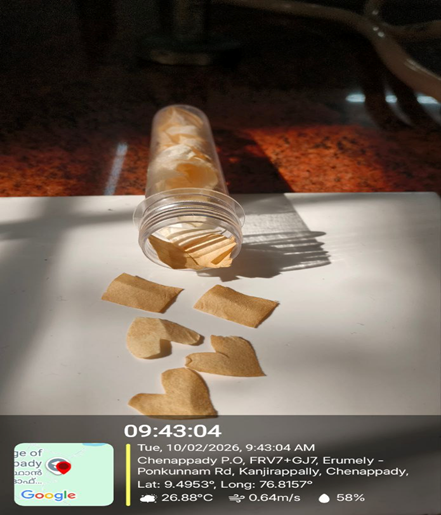
Fig. No.3: Herbal Paper Soap Fig.no.4: Herbal paper soap
RESULTS
1. Physical appearance:
Table No :2 Physical appearance
|
Formulation |
Color |
Oduor |
Texture |
Consistency |
Grade |
|
F1 |
Orange |
Pleasant |
Smooth |
Solid |
Good |
2. pH:
The pH of the paper soap was found to be in the range of 6.29. As the skin have an acidic pH range of about 4.1 to 6.7, this pH of the formulation is suitable for skin.
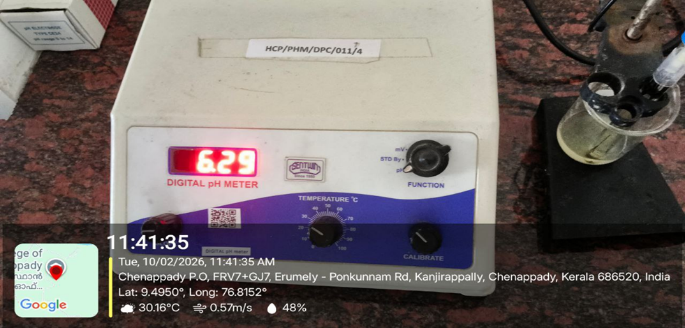
Fig. No.5: Image representing the pH value of the sample
3. Foam height:
The foam height of the paper soap was found to be good, indicating adequate foaming ability. On shaking the soap solution, a stable foam column was formed, showing that the formulation possesses acceptable cleansing properties. Foam height observed was around 7.5 cm, which is suitable for hand cleansing purpose.
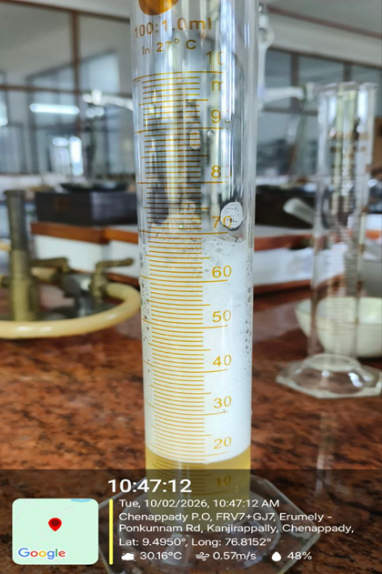
Fig.No.6: Picture showing the Foam height
4. Foam retention:
The foam produced by the paper soap remained stable for a considerable period. There was only a slight decrease in foam volume after 10 minutes, indicating good foam stability. Foam retention was satisfactory, showing good stability of the formulation.
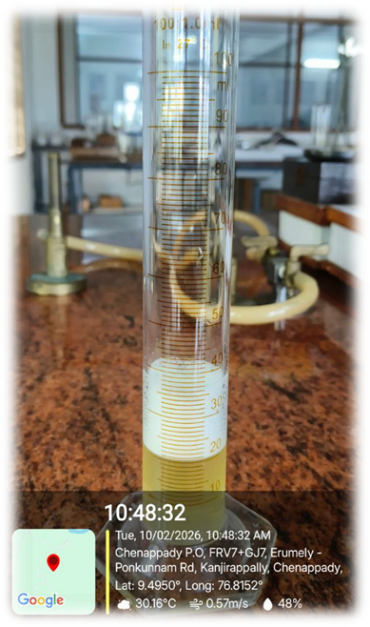
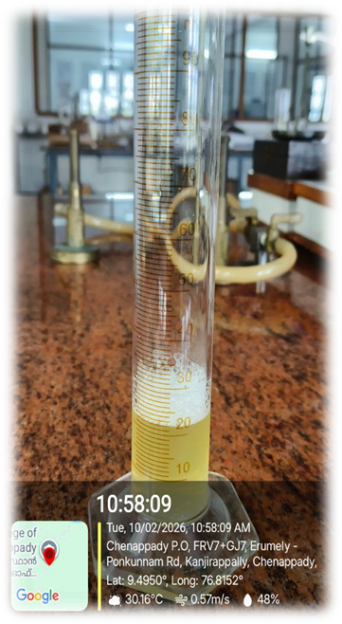
Fig.No.7: figure showing the Foam retention
5. Total Moisture Content:
The total moisture content of the prepared paper soap was determined to assess its dryness and shelf stability. The formulation showed low moisture content, indicating good drying and reduced risk of microbial growth. Total moisture content was found 3.3% which is within acceptable limits for paper soap.
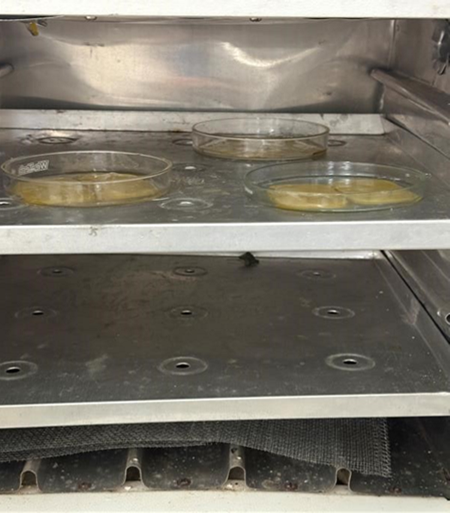
Fig.No.8: Image showing the moisture content
6. Solubility test:
The quality control test is performed to determine the time taken by the paper soap to dissolve completely and leaving without any residue. The high quality paper dissolves within seconds 60 sec or less without any residue. the paper dissolve within 5 sec, which indicate the paper has good quality and dissolves quickly.
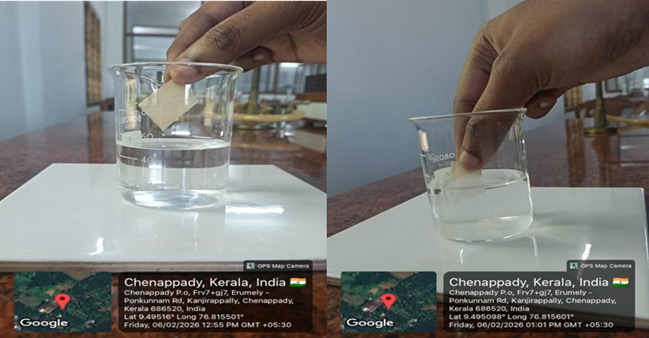
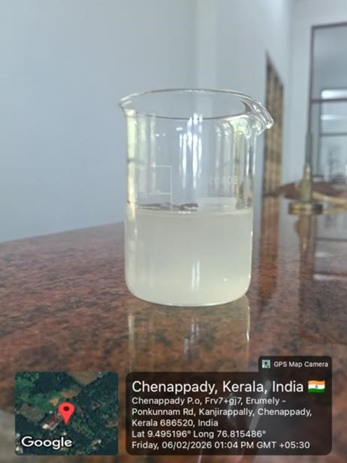
Fig.No.9: Picture showing the Determination of Solubility
Table No :3 Determination of paper solubility
|
Water soluble paper |
Time taken to solubilize(sec) |
|
Sample |
5 sec |
7. Spreadability
The spreadability of soap solution was observed as better spreadability on paper.
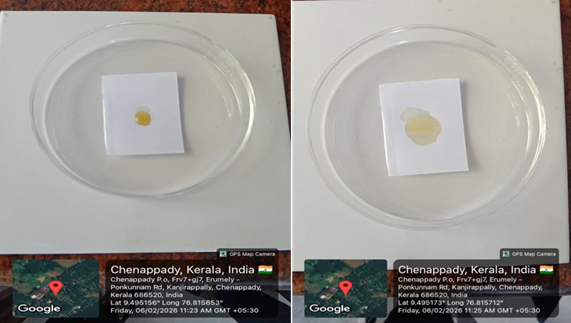
Fig.No.10: Determination of Paper spreadability
Table No:4 Determination of paper spreadability
|
Water soluble paper |
Spreadability (cm) |
|
Sample |
1.9cm |
8. Washability:
The test was performed to determine how easily the light weight, water soluble cellulose paper breaks down, produce foam and dissolve without remain any residue. This ensures the cleansing action and ability of paper soap to remove dirt and germs.
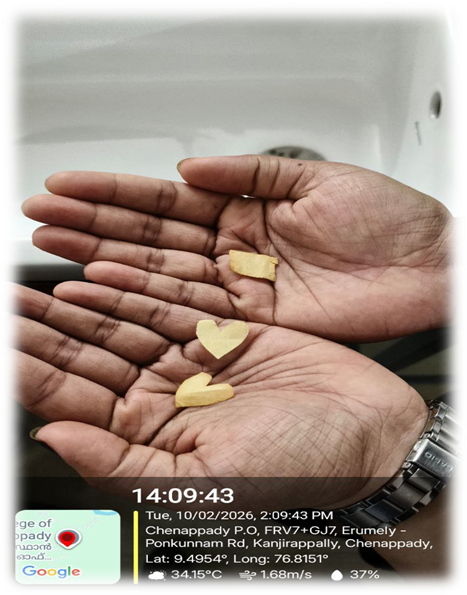
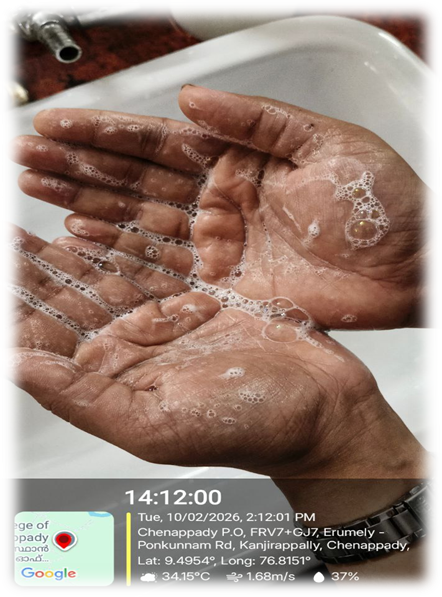
Fig No.11: Image showing the Determination of washability
9. Phytochemical Screening of Pomegranate Peel Extract
Table No:6 Phytochemical screening of pomegranate peel extract
|
Chemical test |
Experiment |
Observation |
Inference |
|
Test for tannins: Lead acetate test |
Take 1 ml of extract of, few drops of 1% lead acetate is added to the mixture is shaken well. |
Yellowish precipitate is produced 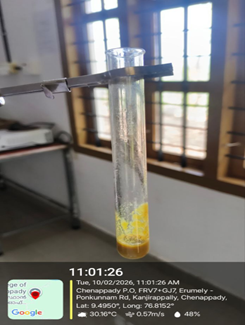
|
Presence of Tannins |
|
Foam test |
To few ml of extract ,add 20 ml distilled water and allowed to continuous shaken for 10 minute. |
Foam is produced. 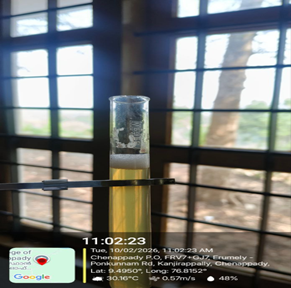
|
Presence of saponins |
|
Million’s test |
To few ml of extract, few drops of millions reagent is added. |
White precipitate is produced. 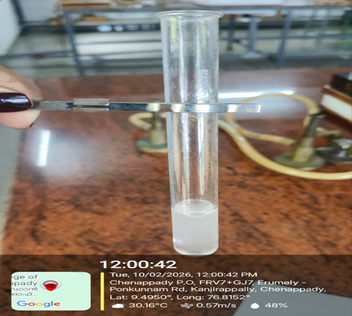
|
Presence of protein |
|
Test for phenol |
To 2 ml of extract,3 ml of ethanol and a pinch of ferric chloride is added |
Greenish yellow colour is produced. 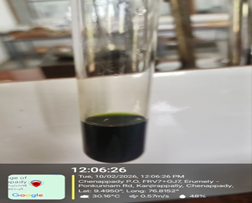
|
Presence of phenol |
10. Phytochemical screening of turmeric extract
Table No:7 Phytochemical screening of Turmeric extract
|
Test |
Experiment |
Observation |
Inference |
|
Mayer’s test |
To 1 ml or 2 ml filtrate ,few drops of mayer’s reagent are added to the sides of test tube. |
creamy or white precipitate is produced. 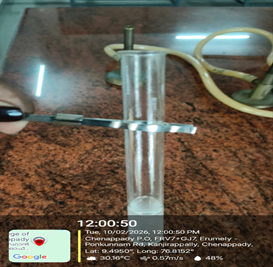
|
Presence of alkaloids |
|
Test for glycosides |
To 2 ml of test solution, added with equal quantity of fehling’s solution A and B and heat the solution. |
Brick red precipitate is produced 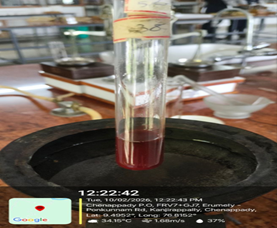
|
Presence of glycosides |
|
Test for tannins |
The solution is mixed with drops of ferric chloride solution |
Blue colour is observed 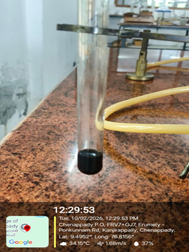
|
Presence of gallotannins |
11. Stability Test:
The stability study was carried out by storing the paper soap at room temperature and refrigerator for a specified period. During the study, the formulation was observed for changes in color, odour, texture, and physical appearance.
Table No: 8 Stability test.
|
Sr.no |
Temperature |
Stability |
|
1 |
Room temperature (37?) |
Stable |
|
2 |
Refrigerator (1-4?) |
stable |
DISCUSSION
The project work was the formulation and evaluation of herbal paper soap from Punica granatum and Curcuma longa. The herbal paper soap was evaluated for pH, foam height, foam retention, moisture content, and stability. The formulated paper soap (F1) showed a uniform yellowish colour with a pleasant fragrance, indicating good aesthetic quality and acceptability. It gives a smooth texture. Overall, the formulation was graded as good based on its satisfactory physical appearance. The pH of the formulated paper soap was found to be 6.29, which lies within the normal acidic pH range of human skin (4.1–6.7). This shows that the formulation is skin-friendly and does not cause significant irritation or dryness. The foam height of the formulated paper soap was observed to be approximately 7.5 cm, denoting good foaming ability. Formation of a stable foam upon shaking suggests the presence of effective surfactants. This level of foam is suitable for hand-washing applications and signifies satisfactory cleansing properties of the formulation. The foam retention study suggests that the foam produced by the paper soap remained stable with only a slight reduction in volume after 10 minutes. This reflects good foam stability and the ability of the formulation to retain foam for a sufficient duration. Satisfactory foam retention suggests that the paper soap can provide effective cleansing during use. The total moisture content of the formulated paper soap was found to be 3.3%, imply adequate drying of the formulation. Low moisture content reduces the risk of microbial growth and improves shelf stability. The observed value suggesting good product stability during storage. The quality control test revealed that the formulated paper soap dissolved completely within 5 seconds without leaving any residue. Rapid dissolution within 60 seconds is considered a characteristic of high-quality paper soap, and the observed result denote excellent solubility. This confirms that the formulation has good quality and is suitable for quick and convenient use. The spreadability of the water-soluble paper soap was found to be 1.9 cm, signifies adequate spreading ability upon contact with water. Good spreadability ensures uniform distribution of the soap solution over the skin. The stability study of the paper soap showed no noticeable changes in color, odour, texture, or physical appearance during storage at both room temperature (37 °C) and refrigerator conditions (1–4 °C). The formulation remained stable under accelerated temperature conditions, indicating good physical stability. These results suggest that the paper soap can withstand varying storage temperatures without loss of quality. The herbal paper soap is evaluated for various phytochemical constituents such as alkaloids, tannins,phenols.. etc The test confirms the chemical constituents with positive result with the incorporation of pomegranate and turmeric extract. Overall, the results confirmed that the herbal paper soap is safe, effective, and suitable for regular hand-washing purposes.
CONCLUSION
From this result, it can be concluded that paper soap can be successfully formulated using a liquid soap base using herbal extract. The incorporation of Punica granatum peel extract enhanced the antimicrobial and antioxidant potential of due to the presence of bioactive compounds such as ellagic acid, gallic acid, and punicalagin. Curcuma longa extract, rich in curcumin, provided additional anti-inflammatory, antibacterial, and wound-healing properties, which further improved the therapeutic value of the paper soap.
The formulation showed better evaluation results in terms of foam height, foam retention, moisture content, stability study. The study confirms that herbal paper soap can be effective and safer alternative to traditional soap with reduced risk of cross contamination.
Hence, the formulated herbal paper soap using pomegranate peel extract and turmeric extract is considered safe, effective, stable and eco-friendly and effective alternative to conventional soaps for personal hygiene.
ACKNOWLEDGEMENT
The authors express sincere gratitude to the Management of Hindustan College of Pharmacy, Chenappady, for providing necessary facilities and infrastructure to conduct this research. The authors thank Ms. Dr. Subimol. S, M. Pharm, PhD, Associate Professor, Department of Pharmaceutics, for guidance and support throughout the study. The authors also acknowledge Dr. Shiny George, Principal, for encouragement and academic support. The authors are thankful to all faculty members of the Department of Pharmaceutics for their valuable suggestions and assistance during the experimental work conducted in 2025.
REFERENCES

Afsa Philip, Aryananda P Reji, Ashifa S, Chithramol V.V, Subimol S, Formulation and Evaluation of Herbal Paper Soap from Punica Granatum and Curcuma Longa, Int. J. of Pharm. Sci., 2026, Vol 4, Issue 2, 2323-2333. https://doi.org/10.5281/zenodo.18650965
 10.5281/zenodo.18650965