

We use cookies to ensure our website works properly and to personalise your experience. Cookies policy
New Montfort Institute of Pharmacy, Ashti, Wardha
Captopril, a potent angiotensin-converting enzyme (ACE) inhibitor, is widely prescribed for the management of hypertension and heart failure. However, its short biological half-life of about 1.5–2 hours and rapid systemic clearance necessitate multiple daily administrations to maintain therapeutic plasma concentrations. This frequent dosing results in poor patient adherence and fluctuating drug levels, ultimately reducing therapeutic effectiveness. Sustained release (SR) matrix tablets have emerged as a promising approach to overcome these limitations by providing controlled and prolonged drug release, maintaining steady plasma concentrations, and improving patient compliance. This review article provides a comprehensive account of the formulation and evaluation of sustained release matrix tablets of Captopril. It emphasizes formulation strategies employing hydrophilic and hydrophobic polymers such as hydroxypropyl methylcellulose (HPMC K4M and K15M), Carbopol 934, ethyl cellulose, and sodium alginate. The review details preformulation studies, formulation techniques like direct compression and wet granulation, evaluation parameters including physicochemical characterization, in vitro dissolution, and release kinetic studies. Mathematical modeling using zero-order, first-order, Higuchi, and Korsmeyer–Peppas equations is discussed to elucidate the mechanism of drug release. Optimized formulations demonstrated extended release profiles of up to 12–24 hours, following predominantly diffusion-controlled kinetics. Overall, sustained release matrix tablets of Captopril represent an effective strategy for enhancing antihypertensive therapy by reducing dosing frequency and improving bioavailability.
Hypertension is a prevalent chronic cardiovascular condition affecting millions globally, contributing significantly to morbidity and mortality due to complications such as coronary artery disease, stroke, and renal impairment (World Health Organization, 2023). Among the various therapeutic approaches, angiotensin-converting enzyme (ACE) inhibitors play a pivotal role in the management of hypertension and related cardiovascular disorders by inhibiting the conversion of angiotensin I to angiotensin II, a potent vasoconstrictor responsible for increased blood pressure (Kumar et al., 2020).
Captopril, the first orally active ACE inhibitor, remains a cornerstone in antihypertensive therapy due to its rapid onset of action and proven efficacy. However, its short plasma half-life of approximately two hours necessitates frequent dosing typically two to three times daily to maintain therapeutic levels (Sweetman, 2022). Such multiple dosing can lead to poor patient compliance, erratic plasma concentrations, and potential side effects.
To address these challenges, sustained release (SR) dosage forms are designed to release the active ingredient gradually over an extended period, maintaining consistent plasma drug concentrations and minimizing dosing frequency (Banker & Rhodes, 2015). Matrix tablets, where the drug is uniformly dispersed within a polymeric matrix that modulates the release rate, represent one of the simplest and most reliable sustained release systems (Costa & Lobo, 2001).
The present review aims to discuss the design, formulation, and evaluation of sustained release matrix tablets of Captopril, focusing on the use of both hydrophilic and hydrophobic polymers to achieve controlled drug release for improved therapeutic outcomes.
2. Drug Profile: Captopril
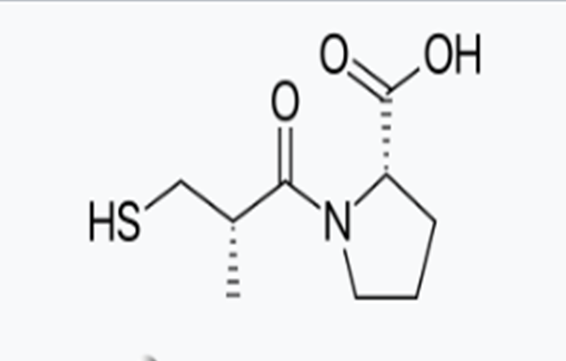
Fig no.1: Molecular structure of Captopril
3. Rationale for Sustained Release Matrix Tablet
Immediate-release formulations of Captopril require frequent dosing due to its short half-life and rapid elimination. Such regimens not only burden the patient but may also result in subtherapeutic levels during dosing intervals. Sustained release matrix tablets are designed to maintain consistent plasma concentrations for extended periods, improving adherence and minimizing side effects (Nair et al., 2019).
Advantages of sustained release matrix systems include:
The matrix system provides controlled release through mechanisms such as diffusion, erosion, or a combination of both. Hydrophilic polymers like HPMC swell upon hydration, forming a gel barrier that modulates drug release, whereas hydrophobic polymers like ethyl cellulose slow water penetration and retard release rates (Patel et al., 2021).
4. Materials and Excipients Used
The development of sustained release tablets involves the strategic selection of excipients that can control drug release and maintain physical stability.
Active ingredient: Captopril
Polymers: Hydroxypropyl methylcellulose (HPMC K4M, HPMC K15M), Carbopol 934, Ethyl Cellulose, Sodium Alginate
Fillers: Microcrystalline Cellulose (MCC) for compressibility
Lubricants: Magnesium Stearate and Talc for improving flow and preventing sticking
Solvents: Ethanol and Distilled Water for granulation when required
The polymers were chosen based on viscosity, swelling behavior, and compatibility with Captopril. HPMC of higher viscosity grades (K15M) tends to form thicker gels, prolonging drug release, while lower viscosity grades (K4M) permit faster hydration and diffusion. The incorporation of Carbopol or sodium alginate further modifies the release rate through synergistic swelling or ionic interactions with the medium (Banker & Rhodes, 2015).
5. Formulation Design and Methodology
The formulation of sustained release matrix tablets of Captopril involves several systematic stages, from preformulation studies to compression. The following section provides an expanded discussion of each step.
5.1. Preformulation Studies
Before formulation, the drug and excipients undergo physicochemical characterization to ensure stability, compatibility, and suitable processing properties.
1. Organoleptic and physical properties: Captopril is a white crystalline powder with a slight sulfurous odor and a bitter taste.
2. Solubility studies: It is freely soluble in water and methanol, slightly soluble in ethanol, and practically insoluble in chloroform, which supports the selection of hydrophilic polymers for release control.
3. Melting point determination: Conducted using a melting point apparatus, Captopril melts at approximately 104–108°C, confirming its purity and identity.
4. Compatibility studies: Fourier-transform infrared spectroscopy (FTIR) and differential scanning calorimetry (DSC) are conducted to assess any interactions between Captopril and the selected excipients. FTIR spectra typically show characteristic peaks for the carboxylic acid and sulfhydryl groups, with no additional peaks or shifts observed in the mixture, indicating compatibility.
5. Flow properties: The blend’s compressibility and flow are determined through angle of repose, bulk density, tapped density, Carr’s index, and Hausner ratio. Values of Carr’s index below 15% and Hausner ratios below 1.25 indicate good flow characteristics suitable for direct compression.
5.2. Tablet Formulation
The sustained release matrix tablets of Captopril can be prepared using direct compression or wet granulation methods.
In the direct compression method, all ingredients are weighed accurately and sieved to ensure uniform particle size. Captopril is blended with the required quantities of polymer (such as HPMC K4M, HPMC K15M, or Carbopol 934) and filler (MCC) in a double-cone blender to achieve homogeneity. Lubricants such as magnesium stearate and talc are added in the final mixing stage to enhance flowability and prevent sticking during compression. The homogeneous blend is then compressed into tablets using a rotary tablet press equipped with flat-faced punches.
In contrast, the wet granulation method involves mixing the drug with excipients followed by the addition of a suitable binder solution (commonly polyvinylpyrrolidone (PVP) K30 in ethanol-water mixture) to form a damp mass. The wet mass is sieved to produce granules, which are dried at 40°C until a constant weight is achieved. The dried granules are rescreened, lubricated, and compressed into tablets.
The concentration and ratio of polymers play a crucial role in determining the release rate. Formulations incorporating both HPMC K4M and K15M in varying ratios (e.g., 1:1, 1:2, or 2:1) have shown that increasing the proportion of higher viscosity polymer significantly prolongs drug release. Carbopol and sodium alginate, when used in combination, enhance the gel strength and control the hydration rate, thereby reducing burst release.
Each batch of tablets is carefully designed to assess the influence of polymer type and concentration on release kinetics. Optimized formulations typically maintain physical integrity and provide sustained release over 12 hours while ensuring acceptable hardness, friability, and drug content.

Fig no 2: Schematic illustration of matrix tablet formulation steps—mixing, granulation, and compression process.
6. Evaluation of Formulated Tablets
The prepared tablets undergo both pre-compression and post-compression evaluations to ensure compliance with pharmacopoeial specifications and performance standards.
6.1. Pre-compression Parameters
The powder blend is analyzed for bulk density, tapped density, compressibility index, Hausner’s ratio, and angle of repose. These parameters confirm that the blend exhibits good flow and compressibility, ensuring uniform die filling and weight consistency.
6.2. Post-compression Parameters
After compression, tablets are evaluated for physical and chemical properties such as:
6.3. In Vitro Dissolution Studies
Dissolution studies are performed using a USP Type II (paddle) apparatus containing 900 mL phosphate buffer (pH 6.8) at 37 ± 0.5°C with a paddle speed of 50 rpm. Samples are withdrawn at predetermined intervals (hourly up to 12 or 24 hours), filtered, and analyzed spectrophotometrically at 212 nm.
The cumulative percentage of Captopril released is plotted against time. Formulations containing higher concentrations of HPMC K15M or Carbopol exhibit extended-release profiles due to the formation of a thick gel barrier.
6.4. Release Kinetic Studies
The release data are fitted into various kinetic models to determine the mechanism of drug release:
Optimized formulations generally follow zero-order kinetics with a Korsmeyer–Peppas release exponent (n) between 0.6 and 0.8, indicating anomalous (non-Fickian) diffusion.
7. Stability Studies
Stability testing is a crucial aspect of pharmaceutical development that ensures the safety, efficacy, and quality of a dosage form throughout its intended shelf life. For sustained release matrix tablets, stability studies are particularly important because polymer hydration, matrix integrity, and drug–polymer interactions can influence long-term performance.
The optimized formulations of Captopril sustained release tablets were subjected to accelerated stability studies according to ICH Q1A (R2) guidelines. Tablets were packed in tightly sealed aluminum–polyethylene laminated pouches to prevent moisture absorption and stored under controlled conditions of 40 ± 2 °C and 75 ± 5% relative humidity for three months in a stability chamber. Samples were withdrawn at 0, 30, 60, and 90 days for evaluation.
Parameters Evaluated
Discussion of Stability Results
The stability outcomes demonstrated that the optimized matrix tablets retained their physical appearance, mechanical strength, and drug release characteristics under accelerated conditions. The hydrophilic polymers (HPMC K4M and K15M) exhibited excellent stability, forming a consistent gel layer even after prolonged storage. Carbopol 934 and ethyl cellulose also provided adequate protection against humidity, preventing premature matrix degradation.
These findings confirmed that the developed sustained release formulation of Captopril possesses sufficient stability for long-term storage, supporting its suitability for scale-up and commercial production. Based on the ICH guidelines and extrapolation of accelerated data, a tentative shelf life of 24 months at room temperature can be projected for the final product.
Furthermore, the absence of any significant changes in dissolution behavior suggests that the polymer–drug ratio and compression parameters were appropriately optimized to resist environmental stress. Such stability performance aligns with previously reported formulations employing similar polymer systems (Rajput & Patel, 2020; Nair et al., 2019).
CONCLUSION
The present review comprehensively discusses the formulation and evaluation of sustained release matrix tablets of Captopril, an approach aimed at improving the therapeutic performance and patient compliance of this short half-life antihypertensive drug. The systematic development process—encompassing preformulation characterization, polymer selection, formulation optimization, and extensive evaluation—demonstrated that the sustained release strategy is highly effective for drugs like Captopril that require frequent dosing in their conventional form.
The use of hydrophilic polymers, particularly HPMC K4M and K15M, either individually or in combination, was found to effectively control drug release through swelling and gel-layer formation. The incorporation of Carbopol 934, ethyl cellulose, or sodium alginate provided additional modulation of release kinetics by modifying matrix porosity and hydration rates. Optimized formulations achieved a near zero-order release pattern over 12 hours, ensuring prolonged plasma concentration without dose dumping.
Evaluation studies confirmed excellent tablet uniformity, mechanical strength, and reproducible dissolution profiles. The release kinetics fitted well into the Higuchi and Korsmeyer–Peppas models, indicating a non-Fickian (anomalous) diffusion mechanism involving both diffusion and erosion. Stability testing under ICH conditions confirmed the robustness of the formulation, showing no significant changes in drug content, mechanical properties, or release characteristics.
From a therapeutic perspective, sustained release matrix tablets of Captopril offer several benefits:
The findings underscore the practicality and efficiency of matrix-based sustained release formulations as a cost-effective and scalable technology for antihypertensive therapy.
Looking forward, future work should focus on in vivo pharmacokinetic and pharmacodynamic studies to establish an in vitro–in vivo correlation (IVIVC) and confirm clinical efficacy. The integration of Quality by Design (QbD) principles, 3D-printing technologies, and advanced nanocomposite polymers can further enhance the precision and reliability of release modulation.
In conclusion, sustained release matrix tablets of Captopril represent a scientifically validated, stable, and patient-friendly dosage form capable of providing consistent blood pressure control with minimal dosing frequency, thereby improving the quality of life for patients with chronic hypertension.
REFERENCE

Shilpa Gangurde, Irshad Ahamad, Formulation and Evaluation of Sustained Release Matrix Tablet of Captopril, Int. J. of Pharm. Sci., 2025, Vol 3, Issue 11, 4565-4575. https://doi.org/10.5281/zenodo.17747601
 10.5281/zenodo.17747601