
Ratnam Institute of Pharmacy, Nellore, Andhra Pradesh.
Heart failure (HF) is a progressive and multifactorial clinical syndrome that reminds as a leading cause of morbidity, mortality and healthcare worldwide. Heart failure is broadly categorized into heart failure with reduced ejection fraction (HFrEF) and heart failure with preserved ejection fraction (HFpEF) based on left ventricular ejection fraction (LVEF). These two phenotypes shares clinical features but differs in underlying mechanisms, patient characteristics, outcomes, therapeutic response. While HFrEF has been associated with poor survival, recent improvements in guideline directed medical therapy have altered its clinical trajectory. In contrast HFpEF has emerged as an increasingly prevalent phenotype, and particularly among elderly patients with multiple comorbidities and continuous to pose diagnostic and therapeutic challenges. This review includes the literatures published between 2019 to 2025 to provide a comparative evaluation of morbidity, mortality, patient profiles and therapeutic outcomes in both the phenotypes. The data indicates that patients with HFpEF experience morbidity comparative or greater than those with HFrEF, largely driven by current hospitalizations and systemic comorbid conditions. Although mortality remains higher in HFrEF, emerging evidence suggests a narrowing mortality gap between two phenotypes due to improved HFrEF survival and increasing recognization of non-cardiovascular mortality in HFpEF. Therapeutic advances have established this is modifying HFrEF, whereas management of HFpEF remains largely centered on controlling the symptoms and comorbidity management. This review highlights critical differences and overlaps between HFpEF and HFrEF and underscores the need for phenotype specific strategies to optimize patient outcomes in healthcare.
The cardiovascular system is a complex , dynamic in the way that it achieves its basic function which is to transport blood throughout the body. cardiovascular system consists of heart , which is a multifaceted that is not only center for pumping aspects but also as secondary endocrine gland.
1. THE HEART
Heart is a muscular vital organ that functions as the central pump of the circulatory system, ensuring the continuous flow of blood throughout body. Heart is protected by the rib cage and rests on the diaphragm, enclosed within double-layered sac called the pericardium, which reduces friction during its rhythmic contractions. Structurally, heart consist of 4 chambers that are right atrium and right ventricle, which handle deoxygenated blood returning from body. the left atrium and left ventricle, which manage oxygen-rich blood from lungs. The right atrium receives blood from superior and inferior vena cava, passing it to right ventricle, which pumps it to lungs via pulmonary artery. Oxygenated blood then enters left atrium through pulmonary veins, moves into left ventricle and is forcefully pumped into the aorta to supply the entire body. To maintain one-way circulation, the heart contains four valves: the tricuspid, pulmonary, mitral, and aortic valves. Its wall is composed of three layers—the endocardium, myocardium, and epicardium—each serving a specific role in protection and contraction. Working tirelessly, heart beat records around 100,000 times daily, delivering oxygen and nutrients while removing waste products, making it indispensable for sustaining life1.
2. HEART FAILURE
Heart failure a common cardiovascular disorder which is characterized by heart inability to deliver adequate cardiac output to meet systemic metabolic demands or as a consequence of reduced cardiac pump function2. Despite advances in cardiovascular medicine, it is associated with more hospitalization rates, impaired life quality and premature death worldwide. Heart failure a heterogeneous syndrome that is classified according to left ventricular ejection fraction (LVEF) into heart failure with reduced ejection fraction (HFrEF) and heart failure with preserved ejection fraction (HFpEF)2.
2.1 CLASSIFICATION:
Heart failure is classified on the bases of left ventricular function of heart, that the disfunction or abnormalities of left ventricle represents the type of heart failure.
Table1: Classification Of Heart Failure.
|
Feature |
Heart Failure with Reduced Ejection Fraction |
Heart Failure With Preserved Ejection Fraction |
Heart Failure with Mid-Range Ejection Fraction |
Heart Failure with Improved Ejection Fraction |
|
LV EF |
≤ 40% |
≤ 50% |
41–49% |
Previously ≤40%, now >40% |
|
Primary problem |
Systolic dysfunction (poor contraction) |
Diastolic dysfunction (poor relaxation/ filling) |
Mixed systolic + diastolic |
Recovery of systolic function |
|
LV size |
Dilated
|
Normal or concentric hypertrophy |
Variable |
Often improved from prior dilation |
|
Common causes |
Ischemic heart disease, MI, dilated cardiomyopathy |
Hypertension, aging, obesity, diabetes, AF |
Same as HFrEF/HFpEF overlap |
GDMT response, revascularization, reverse remodeling |
|
Typical patients |
Younger, more often male |
Older, more often female |
Intermediate characteristics |
characteristics Prior HFrEF patients |
Heart Failure is classified based on left ventricular ejection fraction (LVEF) of heart into :
The left ventricular ejection fraction is measured by 2D Echo or echocardiography3.
2.2 STAGES OF HEART FAILURE3:
Heart failure is classified into four progressive stages (A–D) by the American Heart Association and American College of Cardiology. Stage A means risk without structural disease, while Stage D represents advanced heart failure with severe symptoms.
Stage A – At Risk
Individuals are at risk developing HF but not have structural heart disease or symptoms. Common factors that increases the risk includes hypertension, diabetes, obesity, and family history. The focus here is on prevention by changing lifestyle and medical management of underlying conditions.
Risk factors in this stage include:
Stage B – Structural Changes Without Symptoms
At this stage, it represents structural heart disease, such as previous heart damage, valve disease, or reduced ejection fraction, but patients do not show symptoms. Early treatment with medications like ACE inhibitors or beta-blockers is often recommended to slow progression.
Stage C – Symptomatic Heart Failure
Patients have heart disease structurally along with current or past symptoms such as breathlessness, fatigue, or swelling. This is the stage where heart failure becomes clinically evident.
Stage D – Advanced Heart Failure
This is the severe stage, where symptoms persist even at rest despite optimal treatment. Patients often require advanced therapies such as heart transplant, mechanical support devices, or palliative care.
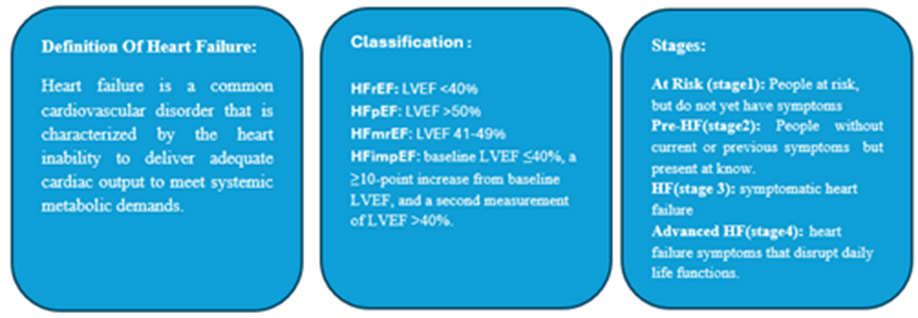
Figure 1 : Overview Of Heart Failure.
2.3 EPIDEMIOLOGY :
Heart failure has subjected to intrest since it was designated as a new epidemic in 1997. HF has been firstly described as emerging epidemic but at present because of ageing population the HF patients still continues to rise. However, the heart failure cases are evolving although frequency of cases has steadied and also reducing in some populations4.
The incidence relatively observed in young, possibly increase in obesity. Similarly the evidence shows that patients with HF may be on risk in developing countries that struggling from communicable diseases associated with a western type lifestyle4.
2.4 GLOBAL BURDEN:
Heart failure is associated with considerable morbidity and mortality, along with reduced physical capacity, diminished life quality and substantial healthcare costs. Globally, more than 64 million individuals are affected. The prevalence of HF among adults is estimated to be between 1% and 3%. People aged over 70 years account for approximately 62.2% of all cases. In older age groups, women show a higher prevalence, whereas men are more commonly affected at younger ages. Although women represent about half of the population with HF, the age?standardized prevalence is greater among men.
2.5 PATIENT CHARECTERSTICS :
HEART FAILURE WITH REDUCED EJECTION FRACTION:
Patients are typically younger, predominantly male, and often have a history of myocardial infarction, ischemic heart disease, or dilated cardiomyopathy. Additional risk factors are smoking, alcohol use, and genetic cardiomyopathies. Structural changes such as left ventricular dilation and eccentric hypertrophy are common7-8.
HEART FAILURE WITH PRESERVED EJECTION FRACTION :
Patients are usually older and more likely to be female. Hypertension is most prevalent risk factor, frequently accompanied by obesity, T2DM, atrial fibrillation, CKD, and anemia¹¹. HFpEF is increasingly recognized as a systemic syndrome rather than a purely cardiac disorder, with significant involvement of vascular, renal, pulmonary, and skeletal muscle systems9.
Table 2: comparative data of patient characteristics between HFrEF and HFpEF.
|
Characteristic |
HFrEF |
HFpEF |
|
Typical age group |
Middle-aged to elderly |
Elderly |
|
Gender predominance |
Male |
Female |
|
Aetiology |
Ischemic heart disease, cardiomyopathy |
Hypertension, metabolic syndrome |
|
Ventricular function |
Reduced systolic function |
Preserved systolic, impaired diastolic |
|
Comorbidity burden |
Moderate |
High |
|
Atrial fibrillation prevalence |
Moderate |
High |
2.6 RISK FACTORS:
Risk factors and lifestyle habits that can increase your chance of HF. Most people suffers with heart failure may have any other heart condition first10.
Having one or more of these risk factors highly increases risk of HF :
Table 3:Risk Factors For Heart Failure3,10
|
Risk Factor |
What it is / Mechanism |
How it Contributes to Heart Failure (Key Points) |
|
Coronary Artery Disease (CAD) |
Cholesterol and fatty deposits narrow coronary arteries (atherosclerosis), reducing blood supply to heart muscle. |
Causes angina; complete blockage can lead to myocardial infarction (heart attack). CAD can also contribute to hypertension, and long-term high BP can lead to HF. |
|
High Blood Pressure (Hypertension) |
Increased pressure in blood vessels forces the heart to pump harder. |
Long-term workload causes cardiac remodeling, chamber enlargement, and weakening → leads to HF. |
|
Type 2 Diabetes Mellitus |
Diabetes promotes insulin resistance, endothelial dysfunction, and accelerated atherosclerosis. |
Increases HF risk independently and is often associated with hypertension and dyslipidemia. Raises risk for both HFrEF and HFpEF. |
|
Metabolic Syndrome |
Cluster of metabolic abnormalities (≥3 risk factors). |
Defined by ≥3 of: abdominal obesity, high triglycerides, low HDL, high BP, and high fasting glucose. These metabolic factors increase HF development risk. |
|
Thyroid Problems |
Thyroid hormones affect heart rate, contractility and fluid balance. |
Hyperthyroidism: persistent tachycardia and thickening heart muscle. Hypothyroidism: bradycardia, fluid retention, and diastolic dysfunction. |
|
Aging |
Age-related stiffening and weakening of heart muscle. |
Risk increases significantly after 65 years; older adults are more likely to develop HF. |
|
Smoking |
Promotes vascular damage and atherosclerosis. |
Increases HF risk by worsening CAD and contributing to hypertension and vascular disease. |
|
Obesity / Overweight |
Increases cardiac workload and metabolic burden. |
Strongly linked with hypertension, diabetes, dyslipidemia, and structural cardiac changes → increases HF risk. |
|
Alcohol or Drug Abuse |
Causes direct toxic effects on the myocardium and may affect rhythm. |
Can weaken heart muscle and lead to cardiomyopathy → increases HF risk. |
|
Certain Radiation and Chemotherapy |
Some therapies cause cardiotoxic effects. |
May damage heart muscle, reduce cardiac function, and increase HF risk. |
2.7 PATHOPHYSIOLOGY:
Risk factors like ischemic Heart disease, Mi, Cardiomyopathy, Myocarditis
↓
Myocardial injury.
↓
Loss of functional cardiomyocytes.
↓
Reduced myocardial contractility.
↓
Reduced stroke volume and cardiac output.
↓
Activation of compensatory mechanisms.
↓
Increase heart rate, vasoconstriction, retention of sodium and water.
↓
Increased preload and afterload.
↓
Adverse ventricular remodelling like lv dilation, wall thinning, fibrosis.
↓
Progressive systolic dysfunction.
↓
Clinical manifestations like dyspnea, fatigue, edema that leads to complications such as arrhythmias, sudden cardiac death, pump function.
Risk factors such as aging, hypertension, obesity, diabetes, CKD, AF.
↓
Chronic systemic inflammation.
↓
Endothelial dysfunction.
↓
Coronary microvascular dysfunction.
↓
Myocardial fibrosis and increased ventricular stiffness.
↓
Impaired ventricular relaxation (diastolic dysfunction).
↓
Increased left ventricular filling pressure.
↓
Pulmonary congestion during exertion.
↓
Preserved systolic function (normal ejection fraction).
↓
Exercise intolerance and HF symptoms like dyspnea, fatigue.
↓
Frequent decompensation triggered by comorbidities.
2.8 CLINICAL PRESENTATION AND DIAGNOSIS
While HFrEF and HFpEF share a common clinical presentation marked by fatigue, peripheral edema, orthopnea, and dyspnea upon exertion their diagnostic pathways require combination of biomarker analysis, imaging, and physical examination.
Echocardiography remains the primary diagnostic tool for evaluating LVEF, heart chamber size, and diastolic performance. Additionally, natriuretic peptides serve as vital markers for both diagnosis and prognosis. However, it is important to note that peptide concentrations may be comparatively lower in HFpEF cases, often due to the influence of obesity or the presence of concentric remodeling22-24.
2.9 MORBIDITY PATTERNS
In HF, morbidity is characterized by diminished functional capacity, a lower life quality, and frequent readmissions to the hospital17. Patients with HFpEF often face higher rates of hospitalization than those with HFrEF, a trend primarily attributed to the presence of non-cardiac comorbidities. Conversely, morbidity in HFrEF is more directly linked to the progression of pump failure, the occurrence of arrhythmias, and risk of sudden cardiac death26-27.
Table 4: comparison of morbidity patterns in HFrEF VS HFpEF.
|
Parameter |
HFrEF |
HFpEF |
|
Hospitalization frequency |
High |
Very high |
|
Primary cause of admission |
Pump failure, arrhythmias |
Comorbidities, overload of volume |
|
Excess intolerance |
Severe |
Moderate to severe |
|
Quality of life impairment |
Significant |
Significant |
|
Length of hospital stay |
Moderate |
Often prolonged |
|
Readmission |
High |
Very high |
Historically, heart failure with reduced ejection fraction was linked to a higher rate of cardiovascular mortality compared to heart failure with preserved ejection fraction28 . Nevertheless, contemporary data indicate an upward trend in survival rates for patients with reduced ejection fraction, alongside a growing awareness of non-cardiovascular deaths within this group29. Conversely, individuals with HFpEF exhibit a higher likelihood of succumbing to non-cardiac conditions, including stroke, infections, and renal failure30.
Table 5: mortality characteristics in HFrEF VS HFpEF.
|
Aspect |
HFrEF |
HFpEF |
|
Overall mortality |
High |
Moderate to high |
|
Cardiovascular mortality |
Predominant |
Lower |
|
Non cardiovascular mortality |
Lower |
High |
|
Sudden cardiac death |
Common |
Less common |
|
cases over last decade |
Declining |
Relatively unchanged |
2.11 THERAPEUTIC MANAGEMENT
Clinical guidelines for managing HFrEF now advocate for a "four-pillar" foundational strategy. This approach—consisting of beta-blockers, mineralocorticoid receptor antagonists (MRAs), sodium-glucose cotransporter 2 (SGLT2) inhibitors, and angiotensin receptor-neprilysin inhibitors (ARNIs)—has been shown to markedly decrease both mortality rates and hospital admissions31-34.
The treatment of HFpEF primarily emphasizes symptom relief, rigorous blood pressure management, and the effective treatment of underlying comorbidities. A significant therapeutic milestone has been reached with recent clinical trials demonstrating that SGLT2 inhibitors effectively lower the risk of hospital admissions44.
Shift Toward Patient-Centered Care: Due to high frequency of non-cardiovascular comorbidities and various competing causes of mortality, the clinical approach to HFpEF is shifting. Modern management increasingly prioritizes a patient-centered strategy—addressing the individual’s overall health profile—rather than focusing exclusively on cardiac-specific interventions36.
Current research is increasingly prioritizing phenotype-specific treatments, the discovery of novel biomarkers, and the implementation of precision medicine to manage the diverse nature of HFpEF and further refine HFrEF outcomes45.
Innovative therapeutic approaches are now targeting previously overlooked pathways that drives progression of heart failure. For HFrEF, new agents such as the cardiac myosin activator like omecamtiv mecarbil are designed to improve heart muscle contractility. Crucially, this is achieved without raising myocardial oxygen demand or intracellular calcium levels, presenting a promising option for treating advanced stages of the disease45.
In context of HFpEF, scientific investigation has shifted toward addressing systemic inflammation, myocardial fibrosis, metabolic imbalances, and endothelial impairment44. Current clinical studies are exploring several promising avenues, including:
CONCLUSION
Although they share overlapping clinical features, HFrEF and HFpEF represent distinct heart failure phenotypes with fundamental differences in their epidemiological profiles, underlying pathophysiology, and mortality rates. Their responses to medical interventions also vary significantly. While innovative therapies have revolutionized the prognosis for those with HFrEF, HFpEF continues to be major clinical challenge where many therapeutic needs remain unmet. To effectively manage the increasing global impact of this disease, it is vital to maintain a focus on ongoing research and the development of management strategies tailored to these specific phenotypes.
REFERENCES


Aluri Venkata Rama Krishna Sai Charan, Chetana Lalasa Singamsetty, Kavya Vakicharla, Jyothika Yerranagu, Dr. M. Bhargavi, Dr. Y. Prapurna Chandra, Heart Failure with Reduced Versus Preserved Ejection Fraction: A Comprehensive Review on Morbidity, Mortality, Patient Characteristics and Therapeutic Outcomes, Int. J. of Pharm. Sci., 2026, Vol 4, Issue 2, 3505-3516. https://doi.org/10.5281/zenodo.18723601
 10.5281/zenodo.18723601
