
Mount Zion College of Pharmaceutical Sciences and Research, Adoor
Ethosome based formulations represent an advanced transdermal drug delivery system designed to enhance skin penetration and therapeutic efficacy. In this study, an ethosomal cream containing papain, a proteolytic enzyme, and curcumin, a natural anti-inflammatory and anti-oxidant compound, was developed for the management of psoriasis. Papain facilitates the removal of hyperkeratotic plaques, while curcumin modulates inflammatory pathways and oxidative stress associated with psoriatic lesions. The ethosomal carrier improves the permeation of these bioactive agents through the stratum corneum, ensuring targeted delivery to affected skin layers. The cream was characterized for physicochemical properties, stability, entrapment efficiency results demonstrated enhanced drug penetration, sustained release, and potential synergistic effects of papain and curcumin, suggesting that the ethosomal cream could serve as a promising non-invasive therapeutic approach for psoriasis with improved efficacy and reduced systemic side effects.
The new pharmaceutical forms with optimized properties, such as reduced particle size, enhanced permeability parameters, and targeted site delivery, is referred to as novel drug delivery system (NDDS). When compared to their performance in conventional dosage forms, NDDS can increase the efficacy of biotherapeutic agents. It enhances therapeutic efficacy and improves patient compliance. These systems utilize innovative carriers such as nanoparticle, liposomes, ethosomes, and niosomes to achieve sustained release, improved stability, and site-specific action.
Newer lipid vesicular carriers are called ethosomes. Ethosomes are non-invasive drug delivery methods that facilitate deeper drug molecular penetration into the skin or circulation. They contain a significant quantity of alcohol. These nanocarriers carry medicinal substances with a variety of physicochemical characteristics through the skin and into the dermis deeper layers. They have several applications as drug carriers to improve the dermal and transdermal drug delivery of several drugs. They are soft, flexible vesicles designed to more effectively transport active substances. Phospholipids, water, and alcohol in comparatively larger concentrations make up the majority of ethosomes. Both fat-soluble and water-soluble medications are better absorbed thanks to their bilayer structure, which contains both fat and water. Higher ethanol concentrations (30–45%) offer stability, allowing the drug to permeate deeper and outer layers of the skin, increasing absorption via the skin.
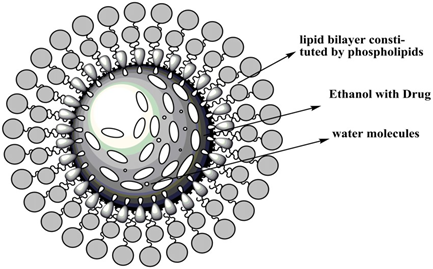
Figure no. 1: Structure of ethosome
The skin is the largest organ in the body, covering its entire external surface. It also known as cutaneous membrane or the integumentary system. Skin protects our body from germs and regulates body temperature. Nerves in the skin help us to feel sensation like hot and cold. The skin has 3 layers—the epidermis, dermis, and hypodermis.
Psoriasis, a chronic recurrent skin condition. It is distinguished by the existence of inflammatory skin lesions, such as of itchy, reddish, scaly plaques. Patients physical and mental well-being may be severely impacted by this illness. The most prevalent clinical form of psoriasis is plaque psoriasis, which appears as distinct lesions with underlying erythema and silvery scales. These lesions are typically found in places like as the lumbar area, scalp, knees, and elbows. But psoriasis can affect any area of the body, including the genitalia, nails, palms, and soles of the feet. When psoriasis is mild to severe, topical treatments which are applied directly to skin lesions are frequently utilized.
Topical delivery can be defined as the application of a drug containing formulation to the skin to directly treat cutaneous disorders for local or systemic effects. Creams, ointments, gels, patches, and sprays are examples of topical drug delivery systems that are intended to maximize medication absorption and penetration into the targeted tissues. Local skin infections are frequently treated with these methods. Formulations come in a variety of forms, including liquid, semi-solid, and solid. Creams are preferred as topical formulations due to their ease of application, good spreadability, and prolonged residence time. Incorporation of ethosomes into cream bases further enhances drug permeation, drug stability, and controlled release.
For mild-to-moderate cases of psoriasis, herbal medicine can be used as an auxiliary or supplemental therapy. Papaya contains papain (proteolytic enzyme) it reduces inflammation, exfoliating dead skin cells, reduces cell proliferation. These have anti-inflammatory, antioxidant, and antiproliferative qualities that help to reduce redness, scaling, and itching. Incorporating papaya extract into a ethosomal cream offers a enhanced skin penetration and therapeutic effectiveness in the treatment of psoriasis.
MATERIALS AND EXCIPIENTS
All materials and excipients used in the study were of analytical grade and were obtained from standard commercial supplements. Soya lecithin were obtained from Amitex Agro Product Pvt. Ltd., Papaya were sourced from Native of Natural, Ahmedabad, Gujarat, India., Propylene glycol, Bees wax white, Cetyl alcohol, Ethanol were obtained from Isochem laboratories, Stearic acid were sourced from Nice chemicals(P) LTD.
FORMULATION OF ETHOSOMAL HERBAL CREAM FOR PSORIASIS
The formulation of ethosome was prepared using hot method. Preparation of ethosome and cream is further demonstrated.
Extraction of papain from papaya powder
Weigh a quantity of powder and transfer it into a conical flask and add 100ml of distilled water.
Stir well using a glass rod. Cover the conical flask and allow the mixture to stand for 12-24 hours. Keep it low temperature to prevent enzyme denaturation. Stir occasionally. After maceration, filter the mixture using a filter paper. Collect the filtrate in a conical flask. The filtrate obtained contains crude papain enzyme.
Table no. 1 Tests for papain
|
Sr. No |
Experiment |
Observation |
Inference |
|
1.
2. |
Proteolytic Activity: Take 2-3ml of gelatin solution in a test tube. Add a small amount of papain solution. Incubate at 370C for 10-15 min. Add a few drops of trichloroacetic acid to precipitate undigested protein. Biuret Test: Add 1-2ml of papain solution to a test tube. Add a few drops of biuret Reagent. |
The solution remains clear
Appearance of violet colour |
Presence of papain
Confirms the protein nature of papain |
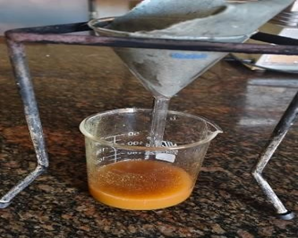
Figure no. 2: Extraction of papain
Method of preparation of ethosome
Hot method: The drug is combined with ethanol and propylene glycol using a hot process. A Phospholipid the dispersion is created in water at a temperature of 40OC. This dispersion is combined with previously prepared mixture. Following this, the final mixture is heated to 30OC, after which size reduction is accomplished through sonication or extrusion.
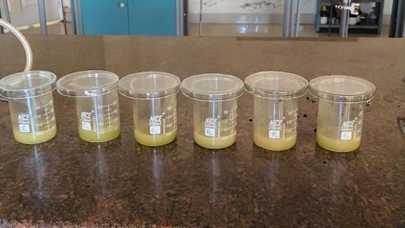
Figure no.3: Formulations of ethosome
Table no. 2 Formulation of ethosome
|
Sr. No |
Ingredients |
Weight taken |
|||||
|
F1 |
F2 |
F3 |
F4 |
F5 |
F6 |
||
|
1. |
Soya lecithin (mg) |
0.2 |
0.3 |
0.4 |
0.5 |
0.6 |
0.8 |
|
2. |
Ethanol (ml) |
31 |
31 |
31 |
31 |
31 |
31 |
|
3. |
Propylene glycol (ml) |
1 |
1 |
1 |
1 |
1 |
1 |
|
4. |
Drug (g) |
1 |
1 |
1 |
1 |
1 |
1 |
|
5. |
Distilled water |
17 |
17 |
17 |
17 |
17 |
17 |
Method of preparation of herbal cream
Table no. 3 List of oil phase and aqueous phase
|
Part A (Oil Phase) |
Part B (Aqueous Phase) |
|
Stearic Acid |
Curcumin |
|
Beeswax |
Triethanolamine |
|
Cetyl Alcohol |
Propylene Glycol |
|
Mineral oil |
Glycerine |
|
|
Sodium benzoate |
|
Methyl paraben |
|
|
Propyl paraben |
Oil in water (O/W) emulsion- based cream was formulated. The emulsifier and other oil soluble components (Part A) were dissolved in oil phase and heated to 75oC. The preservatives and other water-soluble components (Part A) were dissolved in aqueous phase and heated to 75oC. After heating, the oil phase was added in portions to the aqueous phase with continuous stirring.
Table no.4: Formulation of cream
|
Sr. No |
Ingredients |
F1 |
F2 |
F3 |
F4 |
|
1 |
Curcumin |
1g |
1g |
1g |
1g |
|
2 |
Triethanolamine |
1g |
1g |
2g |
2g |
|
3 |
Propylene glycol |
2ml |
2ml |
2ml |
2ml |
|
4 |
Glycerin |
1.5ml |
2ml |
3ml |
3.3ml |
|
5 |
Beeswax |
2g |
2.2g |
2.5g |
2.3g |
|
6 |
Cetyl alcohol |
3.2g |
3.3g |
3.5g |
3.5g |
|
7 |
Stearic acid |
5g |
5.3g |
5.5g |
5g |
|
8 |
Methyl paraben |
qs |
qs |
qs |
qs |
|
9 |
Distilled water |
qs |
qs |
qs |
qs |
EVALUATION
Evaluation of Ethosome
The vesicular size of the ethosomal system can be assessed using dynamic light scattering (DLS), with sizes ranging from nanometers to microns, influenced by the formulation's composition. For instance, ethosomes made with 30% ethanol and 2% phospholipid (PL) demonstrated a narrow particle size distribution, averaging 153 ± 4 nm. As the ethanol concentration decreased from 20% to 45%, vesicle size increased, with the largest particles at 20% ethanol and the smallest at 45% ethanol. The relationship between vesicle size and phospholipid content was evaluated for ethosomes containing 30% ethanol and PL concentrations from 0.5% to 4%. It was observed that ethosome size shows limited dependence on phospholipid concentration. An increase in phospholipid concentration from 0.5% to 4% led to a twofold increase in ethosome size, from 118 ± 2 nm to 249 ± 24 nm
Zeta potential was measured using a zetasizer. The measurements were conducted on the same sample used for size analysis. Zeta potential reflects the level of repulsion between similarly charged particles in a dispersion system.
The entrapment efficiency of the ethosomal formulations was determined using an indirect method. The formulations were centrifuged at 5,000 rpm and 4°C for 30 minutes to separate unentrapped drug. The supernatant was collected, and the vesicles were washed with double distilled water and centrifuged again. The combined supernatants were diluted with ethanol, filtered, and analysed using a UV-visible spectrophotometer.
Entrapment efficiency (EE %) = (Amount of entrapped drug ÷ Total amount of drug added) x 100
Evaluation of cream
RESULT AND DISCUSSION
Particle size
Particle size was determined by using particle size analyser. The formulation (F5) is best among rest of the formulation due to optimal particle size 482.4nm and uniform vesicle distribution, indicating stable ethosome formulation. A decrease in particle size enhances stability, skin penetration, and drug release, whereas an increase in particle size may lead to vesicle aggregation, reduced uniformity and poor formulation stability. Therefore, the balanced particle size observed in formulation (F5) was represented in Figure no. 4
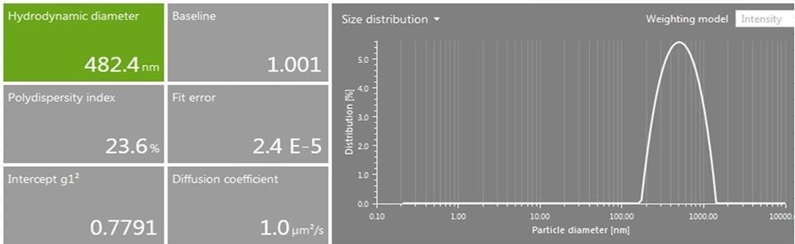
Figure no. 4: Particle size of Ethosome (F5)
Zeta potential
Zeta potential of F5 show adequate negative zeta potential value (-20.8), indicating sufficient electrostatic repulsion between vesicles and thus better physical stability compared to the other formulations. Zeta potential of the formulation (F5) was represented in Figure no. 5
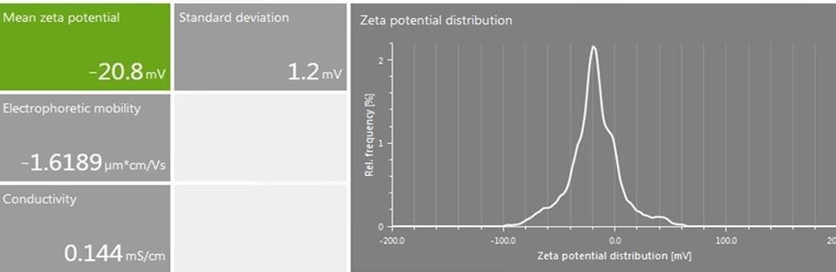
Figure no. 5: Zeta potential of ethosome (F5)
Entrapment efficiency
Entrapment efficiency of the formulation (F5) was found to be 91%
Table no.5: Entrapment efficiency of the formulations
|
Formulations |
Entrapment efficiency(%) |
|
F1 |
89 |
|
F2 |
85 |
|
F3 |
77 |
|
F4 |
80 |
|
F5 |
91 |
|
F6 |
82 |
Organoleptic properties
The organoleptic evaluation showed that the prepared ethosomal cream possessed an acceptable colour, odour, appearance and texture. F3 formulation indicate good consumer acceptability, compatibility of the formulation.
pH
The pH of the formulations was determined by using digital pH meter. The pH of the ethosomal cream (F3) is in range of 4-6 which is compatible to the skin. A bar diagram Figure no. 6 was plotted by taking formulation on x-axis and pH value on y- axis with the data obtained from the Table no: 6
Table no. 6 pH of ethosomal cream
|
Formulation |
pH |
|
F1 |
3.2 |
|
F2 |
3.5 |
|
F3 |
4.8 |
|
F4 |
4 |
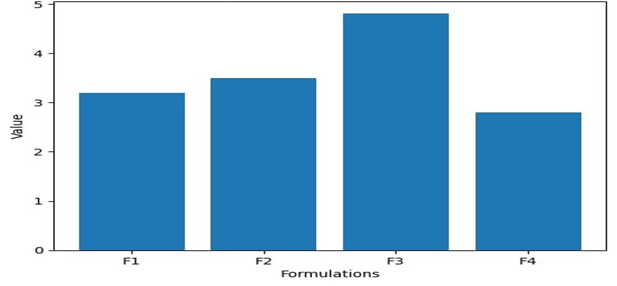
Figure no.6: pH of different formulation
Viscosity
The formulation (F3) was considered better than the other formulation. It exhibited optimum viscosity ensures good spreadability, ease of application and adequate retention at the site of application. Viscosity of the formulation was demonstrated in Figure no. 7.
Table no. 7: Viscosity of the cream
|
Formulation |
Viscosity(cp) |
|
F1 |
39476 |
|
F2 |
36422 |
|
F3 |
56894 |
|
F4 |
27665 |
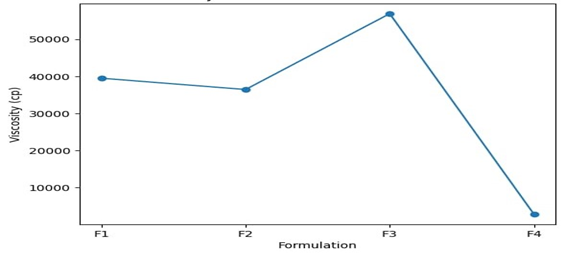
Figure no.7: Viscosity of different formulations
Homogenity
The formulation (F3) was found to have good homogeneity, others (F1, F2, F4) have satisfactory.
Spreadability
The spreadability study revealed that all ethosomal cream formulations (F1, F2, F4) exhibited satisfactory spreadability, indicating ease of application, with formulation F3 showing comparatively higher spreadability due to its optimum viscosity and uniform cream consistency.
Table no.8: Spreadability of ethosomal cream
|
Formulation |
Spreadability (g.cm/sec) |
|
F1 |
4 |
|
F2 |
4.4 |
|
F3 |
5.7 |
|
F4 |
4.1 |
Washability
The washability test demonstrated that all ethosomal cream formulations were easily washable with water, indicating good patient compliance and the absence of excessive greasiness, which is desirable for topical application.
Irritancy
The irritancy study showed that none of the ethosomal cream formulations produced irritation at the site of application, indicating that the formulations were non-irritant and safe for topical use.
CONCLUSION
The ethosomal cream formulation demonstrates significant potential as an effective topical therapy for psoriasis by enhancing drug penetration through the stratum corneum via ethanol enriched lipid vesicles, leading to improved drug deposition at the target site, better therapeutic efficacy, reduced drug concentration and dosing frequency, and minimized local and systemic side effects compared with conventional topical therapies. Among the formulations evaluated, F3 was identified as the most suitable cream base due to its optimal consistency, spreadability, and stability, making it appropriate for topical application, while E5 emerged as the best ethosomal formulation with desirable vesicle characteristics, high entrapment efficiency, and effective drug release and permeation properties; incorporation of the optimized E5 ethosomes into the F3 cream base resulted in a stable and effective ethosomal cream formulation, overall representing a promising and patient-compliant approach for psoriasis management.
REFERENCES






R. Rifana Fathima, Jeena Sara Reji, Ashna N, Ashly Elizabeth Biju, Noora N, Dr. Bhageerathy A, Herbal Ethosomal Cream for Psoriasis, Int. J. of Pharm. Sci., 2026, Vol 4, Issue 2, 1334-1342. https://doi.org/10.5281/zenodo.18551440
 10.5281/zenodo.18551440
