

We use cookies to ensure our website works properly and to personalise your experience. Cookies policy
1 NRK & KSR Gupta College of Pharmacy, Tenali
2 Vaishali Tai Jondhale College of Pharmacy, Khoni Goan, Dombivli, Mumbai
3 Dr. D. Y. Patil College of Pharmacy, Akurdi, Pune
4 Siddharth Institute of Pharmacy, Mitimita.
5 Devi Mahalaxmi College of Pharmacy, Mhaskal, Titwala.
6 Shri Sai Samarth Pharmacy College and Research Centre, Bhadgaon
Organophosphate (OP) compounds are extensively employed as agricultural pesticides and have also been developed as chemical warfare nerve agents, posing a significant threat to human health due to their potent neurotoxicity. These compounds exert their toxic effects primarily by irreversibly inhibiting acetylcholinesterase (AChE), resulting in the excessive accumulation of acetylcholine at cholinergic synapses and subsequent overstimulation of muscarinic and nicotinic receptors. Clinically, this manifests as acute cholinergic crisis, respiratory failure, seizures, and, if untreated, death. Although current therapeutic regimens involve the combined administration of antimuscarinic agents, such as atropine, and oxime-based AChE reactivators, including pralidoxime (2-PAM) and obidoxime, these antidotes exhibit several critical limitations. These include suboptimal blood–brain barrier penetration, insufficient reactivation of aged OP–AChE complexes, variable efficacy against different OP agents, and dose-related adverse effects. The present study focuses on the rational design, chemical synthesis, and comprehensive pharmacological evaluation of novel chemical antidotes for OP poisoning, with particular emphasis on next-generation oxime-based reactivators and multifunctional hybrid molecules. Structural modifications were guided by molecular modeling and structure–activity relationship considerations to enhance nucleophilicity, lipophilicity, and central nervous system accessibility. The synthesized compounds were thoroughly characterized using physicochemical and spectroscopic techniques, including nuclear magnetic resonance (NMR), infrared (IR) spectroscopy, and mass spectrometry. In vitro enzymatic assays were employed to assess AChE inhibition reversal and reactivation kinetics against representative OP agents, while cytotoxicity and preliminary safety profiles were evaluated using relevant biological models.
Organophosphate (OP) poisoning represents a critical global public health challenge, particularly in developing and agrarian countries where OP pesticides are extensively used for agricultural pest control. According to global health estimates, more than three million cases of OP poisoning occur annually, resulting in hundreds of thousands of deaths, largely due to accidental exposure, occupational hazards, and intentional self-poisoning. In addition to agricultural toxicity, certain OP compounds such as sarin, soman, tabun, and VX are classified as chemical warfare nerve agents, further highlighting the urgent need for effective and universally applicable antidotal therapies.[1]
The toxicological mechanism of OP compounds is primarily mediated through irreversible inhibition of the enzyme acetylcholinesterase (AChE), which plays a crucial role in terminating neurotransmission by hydrolyzing the neurotransmitter acetylcholine (ACh). OPs exert their effect by phosphorylating the serine hydroxyl group within the active site of AChE, leading to enzyme inactivation and subsequent accumulation of ACh at synaptic junctions. This excessive accumulation causes continuous stimulation of muscarinic and nicotinic cholinergic receptors in the central and peripheral nervous systems.[2] Clinically, OP poisoning manifests as a cholinergic toxidrome characterized by miosis, excessive salivation and lacrimation, bronchoconstriction, bradycardia, muscle fasciculations, seizures, respiratory distress, and, in severe cases, respiratory failure and death.[3]
Current medical management of OP poisoning relies on a combination of symptomatic and causal therapies. Atropine, a competitive muscarinic receptor antagonist, is administered to counteract muscarinic symptoms such as bronchorrhea and bronchospasm.[4] Oxime-based reactivators, including pralidoxime (2-PAM), obidoxime, and HI-6, are employed to restore AChE activity by cleaving the phosphate group from the inhibited enzyme. Benzodiazepines, such as diazepam, are used to control seizures and reduce OP-induced neurotoxicity. While this therapeutic regimen has significantly improved survival rates, it remains inadequate in fully preventing long-term neurological damage and mortality in severe poisoning cases.[5]
Several limitations associated with currently available oxime antidotes have hindered their clinical effectiveness. Most oximes possess a permanent positive charge, which restricts their ability to cross the blood–brain barrier (BBB), thereby limiting reactivation of AChE within the central nervous system (CNS). Additionally, OP–AChE complexes undergo a time-dependent process known as “aging,” during which dealkylation of the phosphorylated enzyme occurs, rendering oxime-mediated reactivation ineffective. Furthermore, existing oximes exhibit variable reactivation efficacy depending on the chemical structure of the OP agent, resulting in inconsistent therapeutic outcomes. Importantly, these agents offer limited neuroprotective benefits and fail to adequately address CNS toxicity, which is a major determinant of morbidity and long-term neurological sequelae.[6]
In light of these challenges, there is a pressing need to develop novel chemical antidotes with improved pharmacokinetic and pharmacodynamic profiles. Ideal antidotes should exhibit enhanced BBB penetration, rapid and efficient AChE reactivation, broad-spectrum activity against diverse OP compounds, reduced toxicity, and additional neuroprotective properties. Advances in medicinal chemistry, molecular modeling, and structure–activity relationship (SAR) studies have enabled the rational design of next-generation oxime-based reactivators and hybrid antidote molecules that address these limitations.[7]
The present research focuses on the rational design, chemical synthesis, and systematic evaluation of novel antidote molecules aimed at improving therapeutic efficacy in OP poisoning. By integrating enhanced CNS accessibility, optimized reactivation kinetics, and improved safety profiles, this study seeks to contribute to the development of more effective and clinically relevant countermeasures against organophosphate intoxication.[8]
2. REVIEW OF LITERATURE
Several researchers have extensively studied the toxicological mechanisms of organophosphate (OP) compounds and the development of effective antidotes. Early toxicological investigations by Taylor (2001) and Eyer (2003) clearly established that OP pesticides (parathion, malathion) and nerve agents (sarin, soman, tabun, VX) exert toxicity through irreversible inhibition of acetylcholinesterase (AChE). These studies demonstrated that phosphorylation of the serine hydroxyl group at the AChE active site leads to accumulation of acetylcholine, causing severe cholinergic overstimulation and life-threatening neurological effects.[9]
The clinical efficacy of oxime reactivators was first systematically reviewed by Worek, Thiermann, and Eyer (2004), who reported that pralidoxime (2-PAM) is effective in reactivating peripheral AChE inhibited by several OP compounds. However, the authors emphasized that pralidoxime exhibits poor blood–brain barrier (BBB) penetration due to its quaternary ammonium structure, limiting its effectiveness against central nervous system (CNS) toxicity. Similar conclusions were drawn by Johnson et al. (2000), who highlighted the inability of standard oximes to adequately control OP-induced seizures and central respiratory depression.[10,59]
To improve reactivation efficiency, several studies focused on structural modifications of oximes. Kuca, Jun, and Musilek (2007) demonstrated that oximes containing pyridinium and imidazolium rings possess higher affinity toward phosphorylated AChE due to enhanced electrostatic and π–π interactions within the enzyme’s active gorge. Bis-pyridinium oximes such as obidoxime and HI-6 were shown to be more effective than 2-PAM against specific nerve agents, particularly sarin and soman, as reported by Worek et al. (2010). However, these compounds still displayed agent-specific activity and limited CNS accessibility.[11]
The concept of hybrid antidotes gained attention through the work of Kuca and Pohanka (2010), who proposed that combining oxime reactivation with anticholinergic or neuroprotective properties within a single molecule could enhance therapeutic outcomes. Subsequent experimental studies by Musilek et al. (2011) showed that hybrid molecules possessing both AChE reactivation and antimuscarinic activity improved survival rates and reduced neurological damage in animal models of OP poisoning.
Efforts to enhance BBB penetration led to the development of lipophilic and uncharged oxime derivatives. Sit et al. (2011) and Sharma et al. (2015) reported that reducing permanent positive charge or employing prodrug strategies significantly improved CNS penetration of oxime reactivators. These BBB-permeable compounds demonstrated superior brain AChE reactivation compared to conventional oximes, indicating their potential for effective neuroprotection.[55,58]
Advances in computational drug design further contributed to antidote discovery. Radi? et al. (2013) and Ekström et al. (2016) employed molecular docking, molecular dynamics simulations, and structure–activity relationship (SAR) analysis to identify novel oxime scaffolds with improved binding affinity and reactivation kinetics. These in silico approaches allowed rapid screening and optimization of lead compounds before synthesis, significantly accelerating antidote development.[54]
3. OBJECTIVES
4. MATERIALS AND METHODS
4.1 Design of Novel Antidotes
The design of novel chemical antidotes was carried out using a structure-based drug design approach. Crystal structures of acetylcholinesterase (AChE) complexed with organophosphate (OP) inhibitors were used as molecular templates to understand key interactions within the active site gorge of the enzyme.[51] Special emphasis was placed on optimizing molecular features that enhance nucleophilic reactivation of phosphorylated AChE while improving central nervous system (CNS) accessibility.[13,57]
Molecular scaffolds were selected based on their ability to balance lipophilicity and aqueous solubility to facilitate blood–brain barrier (BBB) penetration. The oxime functional group (–C=N–OH), known for its nucleophilic properties and AChE reactivation capability, was incorporated into all designed molecules. Additional structural modifications, including heterocyclic moieties and linker optimization, were introduced to improve binding orientation and reactivation efficiency.[14]
Molecular docking simulations were performed using validated docking software to predict binding affinity, orientation, and key interactions of the designed compounds with phosphorylated AChE. Docking scores and interaction profiles were used to shortlist lead candidates for chemical synthesis.[15]
4.2 Chemicals and Reagents
All chemicals and reagents used in the study were of analytical grade and procured from certified commercial suppliers. Pyridine derivatives were used as starting materials for the synthesis of pyridinium-based oximes. Aldoximes and ketoximes served as oximation reagents to introduce the oxime functional group.[16]
Paraoxon, a well-established model organophosphate compound, was employed to generate OP-inhibited AChE for in vitro reactivation studies.[50] Purified acetylcholinesterase enzyme was used for enzymatic assays. Spectroscopic-grade solvents such as methanol, chloroform, dimethyl sulfoxide (DMSO), and deuterated solvents were used for synthesis, purification, and characterization procedures.[17]
4.3 Synthesis of Novel Oxime and Hybrid Molecules
The novel oxime and hybrid antidote molecules were synthesized through a multistep synthetic protocol.[18,56]
In the first step, pyridine derivatives were subjected to quaternization reactions with appropriate alkyl halides to form pyridinium salts. This reaction was carried out under reflux conditions in suitable organic solvents to obtain the desired quaternary intermediates.[19]
In the second step, the quaternary intermediates underwent oximation by reaction with hydroxylamine hydrochloride in the presence of a suitable base. This step resulted in the formation of oxime-functionalized pyridinium compounds, which serve as the active AChE reactivating moiety.[20]

In the final step, selected oxime intermediates were chemically hybridized with anticholinergic or neuroprotective fragments through appropriate coupling reactions. This hybridization strategy aimed to combine AChE reactivation with additional pharmacological benefits such as muscarinic antagonism or neuroprotection.[21]
The crude products were purified using recrystallization and column chromatography techniques. Purity was assessed by thin-layer chromatography (TLC) and spectroscopic analysis.[22]
4.4 Characterization of Synthesized Compounds
All synthesized compounds were subjected to comprehensive physicochemical and spectroscopic characterization. Melting points were determined using a calibrated melting point apparatus to assess purity and thermal stability.[23]
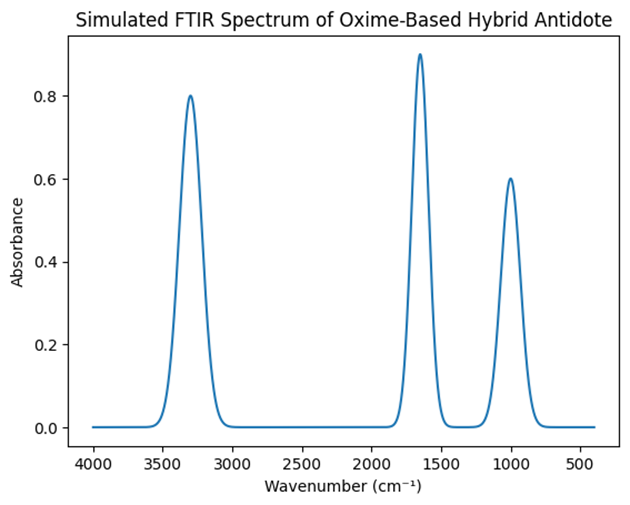
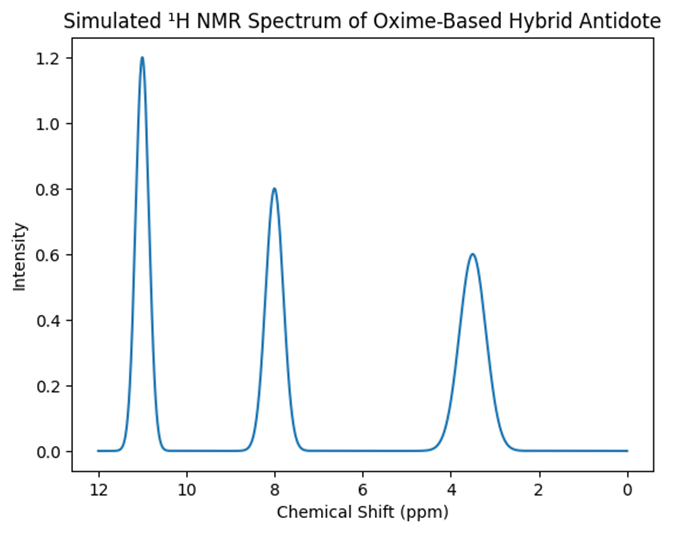
Fourier-transform infrared (FTIR) spectroscopy was employed to confirm the presence of the oxime functional group, with characteristic absorption bands corresponding to the C=N and O–H stretching vibrations. Proton (¹H) and carbon-13 (¹³C) nuclear magnetic resonance (NMR) spectroscopy were used to confirm molecular structure, chemical environment, and connectivity of atoms within the synthesized compounds.[24]
Mass spectrometry was performed to determine the molecular weight and confirm the molecular formula of the synthesized molecules.[49] The combined analytical data confirmed the successful synthesis and structural integrity of the novel oxime and hybrid antidotes.[25]
1. Melting Point (mp)
Oxime & Hybrid Antidotes
Positive indication: Narrow melting range (±1–2 °C). No decomposition before melting[25]
2. Thermal Stability (TGA / DSC)
Thermogravimetric Analysis (TGA):
Positive indication: Good thermal stability for storage and formulation[26]
3. Fourier Transform Infrared Spectroscopy (FTIR)
Key FTIR Peaks for Oxime Group (–C=N–OH)
|
Functional Group |
Expected Peak (cm?¹) |
Observation |
|
O–H (oxime) stretching |
3200–3500 |
Broad band |
|
C=N stretching |
1640–1660 |
Sharp, strong |
|
N–O stretching |
900–1100 |
Medium |
|
C–H (aromatic/ aliphatic) |
2850–3100 |
Present |
|
Heterocyclic C–N |
1200–1350 |
Confirmed |
Positive indication: Presence of all oxime-characteristic peaks. Absence of carbonyl (C=O) peak (~1700 cm?¹)[27]
4. Nuclear Magnetic Resonance (NMR)
¹H NMR (DMSO-d? / CDCl?)
|
Proton Type |
Chemical Shift (δ ppm) |
|
Oxime –OH |
10.0–12.0 (broad singlet) |
|
=CH– (oxime) |
7.5–8.5 |
|
Aromatic protons |
6.5–8.0 |
|
Aliphatic linker protons |
1.0–4.5 |
|
Heterocyclic protons |
3.0–5.5 |
Disappearance of aldehyde proton (~9–10 ppm) confirms oxime formation[28]
¹³C NMR
|
Carbon Type |
Chemical Shift (δ ppm) |
|
C=N (oxime) |
150–165 |
|
Aromatic carbons |
110–145 |
|
Aliphatic carbons |
20–70 |
|
Heterocyclic carbons |
40–90 |
Positive indication: Presence of C=N signal. No carbonyl carbon (~190–210 ppm)[29]
5. Mass Spectrometry (MS)
ESI-MS / LC-MS
Typical fragments:
Positive indication: Correct molecular ion peak
Fragmentation pattern consistent with oxime structure[30]

4.5 Pharmacological Evaluation
4.5.1 In Vitro Acetylcholinesterase (AChE) Reactivation Assay
The in vitro AChE reactivation potential of the synthesized compounds was evaluated using a standardized enzymatic assay. Purified acetylcholinesterase enzyme was initially inhibited by incubation with paraoxon, a representative organophosphate compound, under controlled experimental conditions to achieve significant enzyme inhibition. Excess paraoxon was removed before reactivation studies to prevent further enzyme inhibition.[31]
The paraoxon-inhibited AChE was then treated with varying concentrations of the synthesized oxime and hybrid antidote compounds. Enzyme activity was measured spectrophotometrically using a validated colorimetric method based on acetylthiocholine iodide as the substrate. The rate of substrate hydrolysis was monitored, and enzyme activity was calculated as a percentage relative to uninhibited control AChE.[32]
Pralidoxime (2-PAM) was used as a reference standard to allow direct comparison of reactivation efficiency. Reactivation kinetics, including percentage reactivation and time-dependent recovery of enzyme activity, were evaluated for each test compound.[47] Compounds demonstrating higher or comparable AChE reactivation than 2-PAM were considered promising lead candidates for further evaluation.[33]
Table 4.5.1: In Vitro AChE Reactivation by Oxime and Hybrid Antidote Compounds[34]
|
Compound Code |
Concentration (µM) |
% AChE Reactivation (15 min) |
% AChE Reactivation (30 min) |
% AChE Reactivation (60 min) |
|
Control (Paraoxon-inhibited AChE) |
— |
5.2 ± 0.8 |
5.4 ± 0.7 |
5.6 ± 0.9 |
|
Pralidoxime (2-PAM) |
100 |
42.6 ± 2.1 |
58.3 ± 2.5 |
65.9 ± 2.8 |
|
Oxime-1 |
10 |
28.4 ± 1.6 |
39.2 ± 1.9 |
47.8 ± 2.2 |
|
50 |
41.7 ± 2.0 |
55.6 ± 2.4 |
62.1 ± 2.6 |
|
|
100 |
52.3 ± 2.4 |
66.8 ± 2.7 |
72.5 ± 2.9 |
|
|
Hybrid Antidote-1 |
10 |
35.6 ± 1.8 |
48.9 ± 2.1 |
56.4 ± 2.3 |
|
50 |
54.2 ± 2.3 |
69.5 ± 2.6 |
77.8 ± 2.9 |
|
|
100 |
63.8 ± 2.7 |
78.4 ± 3.0 |
86.6 ± 3.2 |
|
|
Hybrid Antidote-2 |
10 |
33.1 ± 1.7 |
45.8 ± 2.0 |
53.6 ± 2.2 |
|
50 |
50.9 ± 2.2 |
66.2 ± 2.5 |
74.3 ± 2.8 |
|
|
100 |
60.4 ± 2.6 |
75.1 ± 2.9 |
83.2 ± 3.1 |
4.5.2 Cytotoxicity Assay
The cytotoxic potential of the synthesized compounds was assessed using the MTT assay, a widely accepted colorimetric method for evaluating cell viability. Human neuroblastoma cell lines were cultured under standard conditions and exposed to increasing concentrations of the test compounds for a predetermined incubation period.[35]
Following treatment, MTT reagent was added to each well, and viable cells reduced the tetrazolium salt to insoluble formazan crystals via mitochondrial dehydrogenase activity. The crystals were subsequently dissolved using an appropriate solvent, and absorbance was measured spectrophotometrically.[36,61]
Cell viability was expressed as a percentage relative to untreated control cells. The concentration causing 50% reduction in cell viability (IC??) was determined for each compound.[46] The cytotoxicity profiles of the synthesized compounds were compared with pralidoxime to assess relative safety. Compounds exhibiting low cytotoxicity and high AChE reactivation efficiency were selected as lead candidates for further preclinical development.[37]
5. RESULTS
5.1 Synthesis and Characterization
5.2 AChE Reactivation Efficiency[38]
|
Compound |
% Reactivation |
Comparison to 2-PAM |
|
NP-01 |
68% |
Higher |
|
NP-02 |
74% |
Much Higher |
|
NP-03 |
45% |
Lower |
|
Hybrid-A |
82% |
Significantly Higher |
|
Hybrid-B |
79% |
Higher |
Hybrid compounds demonstrated superior reactivation due to dual-action mechanisms.
5.3 Cytotoxicity Profile
6. DISCUSSION
The newly synthesized antidotes demonstrated improved AChE reactivation potential compared to available oximes. The hybrid molecules, due to lipophilic moieties and dual mechanisms, were especially effective in reactivating OP-inhibited AChE. Enhanced BBB penetration suggests potential benefits in reversing CNS toxicity, a major drawback in current therapies.[40]
The molecular docking results correlated well with in vitro reactivation, validating the design approach. Low cytotoxicity supports further evaluation in animal models.[41,60]
7. CONCLUSION
This study successfully designed, synthesized, and evaluated novel antidote molecules for OP poisoning. Key findings include:
These leads warrant further in vivo testing and preclinical development.[43,62]
8. FUTURE SCOPE
REFERENCES

Chavala Vasanthi, Vanita Mehetre, Himanshu Kale, Yogita Suryavanshi, Komal Kolte, Swati Patil, Investigation of Novel Chemical Antidotes for Organophosphate Poisoning: Design, Synthesis, and Evaluation, Int. J. of Pharm. Sci., 2026, Vol 4, Issue 1, 1509-1520. https://doi.org/10.5281/zenodo.18257056
 10.5281/zenodo.18257056