

We use cookies to ensure our website works properly and to personalise your experience. Cookies policy
Arunai College of Pharmacy, Tiruvannamalai, India
A simple, precise and accurate RP-HPLC method was developed and validated for the estimation of Metoprolol Succinate in pharmaceutical dosage form. Chromatographic separation was achieved on a column C18 (250 mm x 4.6 mm,5µm) using methanol and 0.1% v/v triethylamine in the ratio of (70:30) at a flow rate of 1.0?l , detection wavelength of 234nm and injection volume of 10 micro liter. The drug showed a retention time of 6.8 minutes and good linearity over the concentration range of 0.5, 0.75, 1, 1.25 and 1.5?g/ml with a regression coefficient of 0.999. Percentage recovery was 98-100% and percentage standard deviation was below less than 2%. LOD and LOQ indicated adequate sensitivity. The method complies with ICH guidelines and suitable for routine quality control analysis.
Metoprolol succinate is a selective β-adrenergic receptor blocker widely used in the management of various cardiovascular disorders. It is primarily indicated for the treatment of hypertension, angina pectoris, heart failure and for the prevention of myocardial infraction. By selectively inhibiting β1 receptors in the heart, metoprolol reduces heart rate, myocardial contractility and cardiac output thereby reducing blood pressure and decreasing the oxygen demand of the heart. Metoprolol succinate is well absorbed after oral administration and undergoes hepatic metabolism, mainly by cytochrome P450 enzyme. This drug is commonly prescribed in long term cardiovascular therapy.
DRUG PROFILE:
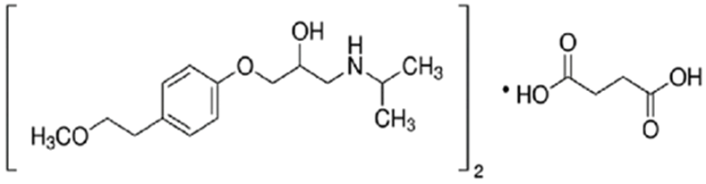
Figure.no:1 Chemical structure of Metoprolol succinate
IUPAC Name: ?4-(2-methoxy ethyl) phenoxy?-3-?1-methyl ethyl amino?-2-propane butanedioate.
Molecular formula: C34H56N2O10
Molecular weight: 652.82g/mol
Solubility: Methanol and Purified water
MECHANISM OF ACTION:
Metoprolol succinate is a cardio selective, β1-adrengeric receptor blocker that lowers heart rate, blood pressure and cardiac workload by competitively inhibiting catecholamine binding in the heart. As a long-acting extended-release formulation, it provides sustained 24-hours antagonism, reducing renin secretion and reducing oxygen demand making it effective for the hyper tension, angina and heart failure.
RP-HPLC METHOD
Chromatographic Condition
The isocratic mobile phase consisting of methanol and 0.1%Triethylamine in the ratio of (70:30), flowing through the column and constant flow rate of 1.0ml/min. The mobile phase was filtered through 0.45µm membrane filter and was degassed before used 30 mins. C18 Column (250 mm x 4.6 mm,5µ) as used as a stationary phase.
MATERIALS AND METHODS:
Drug Sample and Formulation used
Metoprolol Succinate bulk drug were Gifted By Madras Pharma, Chennai.
|
Brand Name |
Labeled Name |
Source |
|
ACLOMET – XL |
25mg |
M.R healthcare Pvt, Ltd |
Chemicals and Solvents used
All the Chemicals Used were of analytical Grade as well as HPLC grade procured from Great scientific Laboratory and Sumison Laboratory from Tiruvannamalai and Chennai.
The Chemical used for the Study were,
Apparatus and Glassware’s
Instruments
Instruments employed for the study were,
METHOD DEVELOPMENT:
Prepartion of Mobile Phase
Methanol and 0.1 % v/v of Triethylamine in milli-q water(60:40) was taken into a 1000 ml volumetric flask and mixed properly. Then, this mobile phase is sonicated for 15 min and used as the mobile phase by isocratic elution method.
Methanol and 0.1 % v/v of Triethylamine in milli-q water (70:30) was taken into a 1000 ml volumetric flask and mixed properly. Then, this mobile phase is sonicated for 15 min and used as the mobile phase by isocratic elution method.
Preparation of Standard Solution
Accurately weighed 25 mg of metoprolol succinate and transferred into 100 ml volumetric flask and dissolved with (methanol and 0.1 % v/v of Triethylamine Solution (70:30) ) are added and to adjusted the volume up to the mark of volumetric Flask. From this 1ml was taken and added into 10ml volumetric flask with mobile phase are added and to adjusted the volume upto the mark of the volumetric flask.
Initial Separation Condition: Trail 1
For Method Development of Metoprolol Succinate Using to conducted the First trial injections were performed with mobile phase of Methanol and 0.1 % v/v of Triethylamine in milli-q water (60:40) .
|
Stationary Phase |
C18 Column (250 mm x 4.6 mm,5µ) |
|
Mobile Phase (v/v) |
60:40 v/v |
|
Injection Volume (ml/min) |
10 micro litre |
|
Flow Rate (ml/min) |
1 ml/min |
|
Column Temperature |
25 °C |
|
Wavelength (nm) |
234nm |
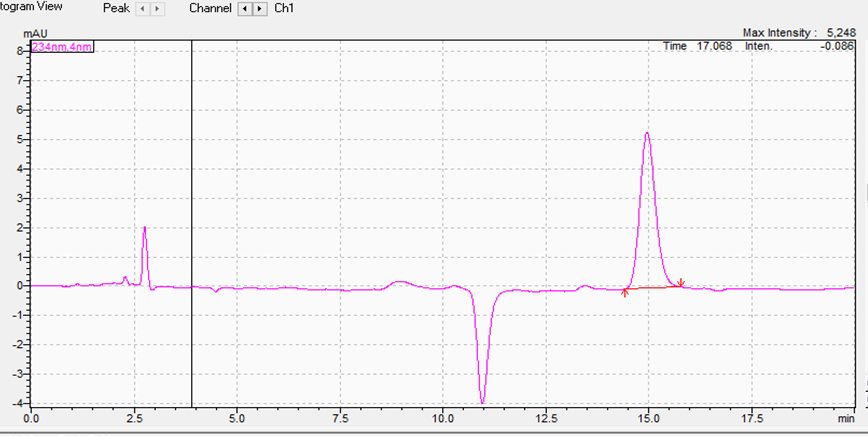
Chromatogram Of Trail 1
|
Sr. No |
Retention Time |
Area |
Height |
Theoretical Plate |
Tailing Factor |
|
1 |
14.966 |
141047 |
5316 |
7491 |
1.177 |
Metoprolol Succinate – Optimized Chromatogram:
We get Optimized Chromatogram with 70:30 ratios of mobile phases of Methanol and 0.1 % v/v of Triethylamine in milli-q water to identify the best chromatographic conditions.
|
Chromatographic Condition |
Description |
|
Stationary Phase |
C18 Column (250 mm x 4.6 mm,5µ) |
|
Mobile Phase(v/v) |
70:30 v/v |
|
Injection Volume (ml/min) |
10 micro liter |
|
Flow Rate (ml/min) |
1 ml/min |
|
Column Temperature |
25 °C |
|
Wavelength(nm) |
234n |
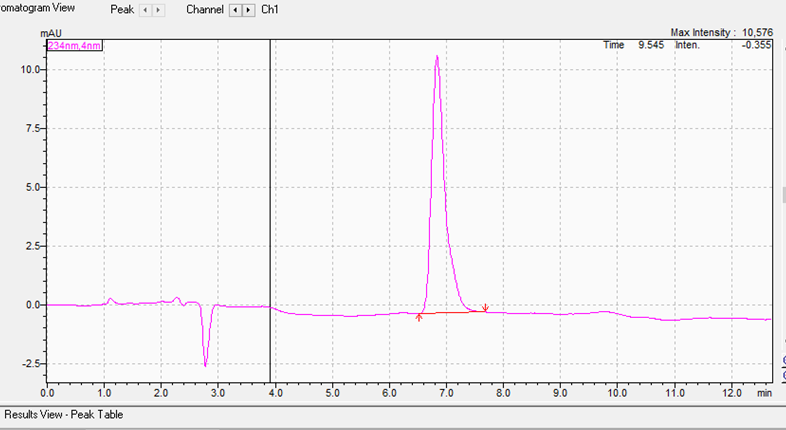
Optimized Chromatogram
|
Sr. No |
Retention Time |
Area |
Height |
Theoretical Plate |
Tailing Factor |
|
1 |
6.836 |
180226 |
10944 |
4866 |
1.535 |
VALIDATAION PARAMETERS:
A. Linearity
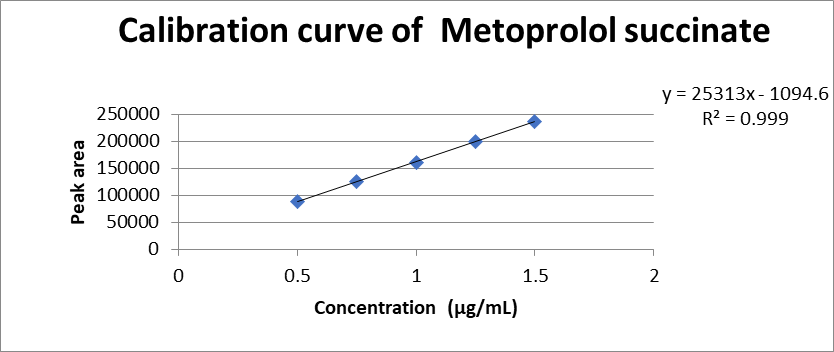
Linearity studies were carried out in the concentration range of 0.5μg/ml, 0.75μg/ml, 1μg/ml, 1.25μg/ml and 1.5μg/ml. The sample solution was made from the stock solution the readings were obtained by measuring the absorbance at 234 nm and presented in table and linearity curve.
|
Sr. No |
Concentration (Μg/Ml) |
Peak Area |
Correlation Coefficient |
Lod |
Loq |
Slope |
Intercept |
|
1. |
0.5 |
88270 |
0.999 |
4.55519 |
0.00013 |
25313 |
1094.6 |
|
2. |
0.75 |
124945 |
|||||
|
3. |
1 |
159642 |
|||||
|
4. |
1.25 |
199542 |
|||||
|
5. |
1.5 |
236187 |
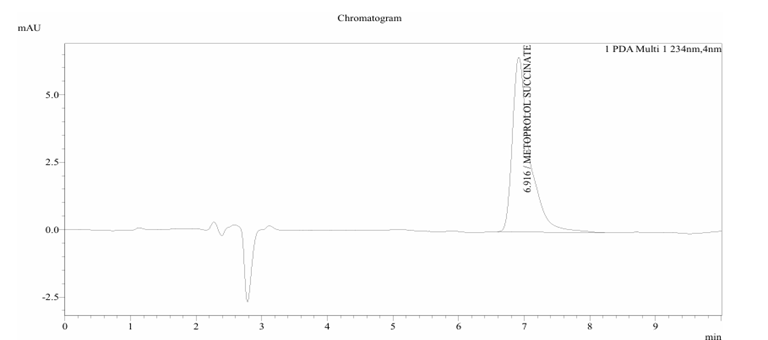
Linearity Chromatogram in 50%
|
Sr. No |
Retention Time |
Area |
Theoretical Plate |
Tailing Factor |
|
1 |
6.916 |
118696 |
4543 |
1.701 |
Linearity Chromatogram in 75%

|
Sr. No |
Retention Time |
Area |
Theoretical Plate |
Tailing Factor |
|
1 |
6.924 |
156838 |
4676 |
1.542 |
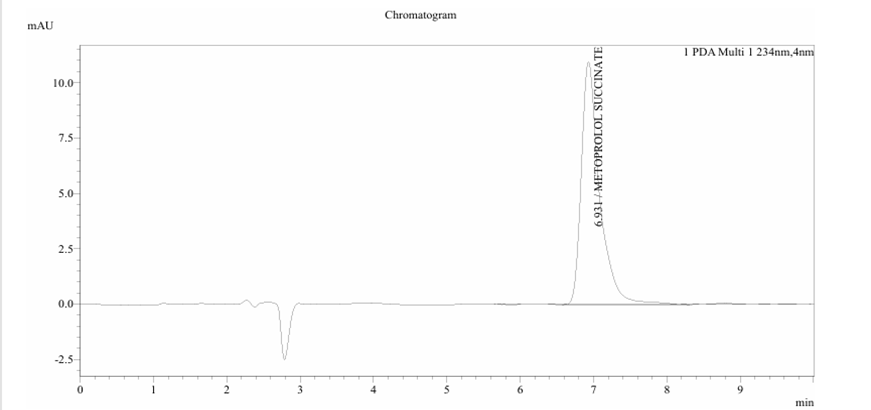
Linearity Chromatogram in 100%
|
SR. NO |
RETENTION TIME |
AREA |
THERIOTICAL PLATE |
TAILING FACTOR |
|
1 |
6.931 |
189540 |
4659 |
1.541 |
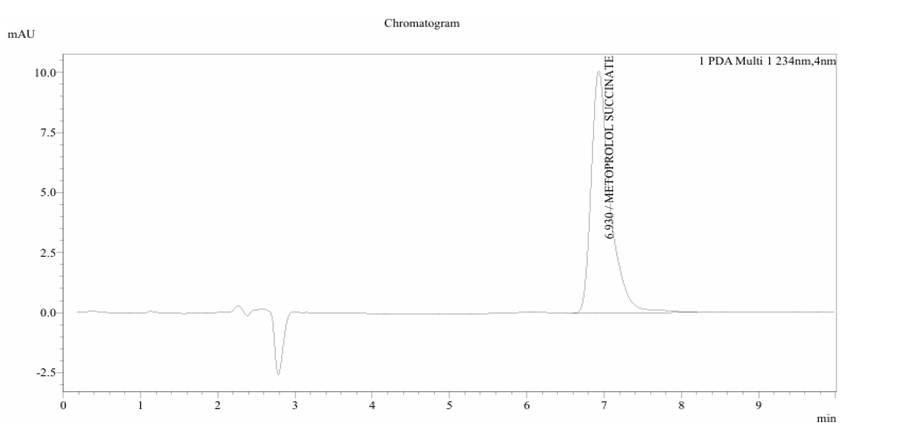
Linearity Chromatogram in 125%
|
Sr. No |
Retention Time |
Area |
Theoretical Plate |
Tailing Factor |
|
1 |
6.930 |
170930 |
4724 |
1.504 |
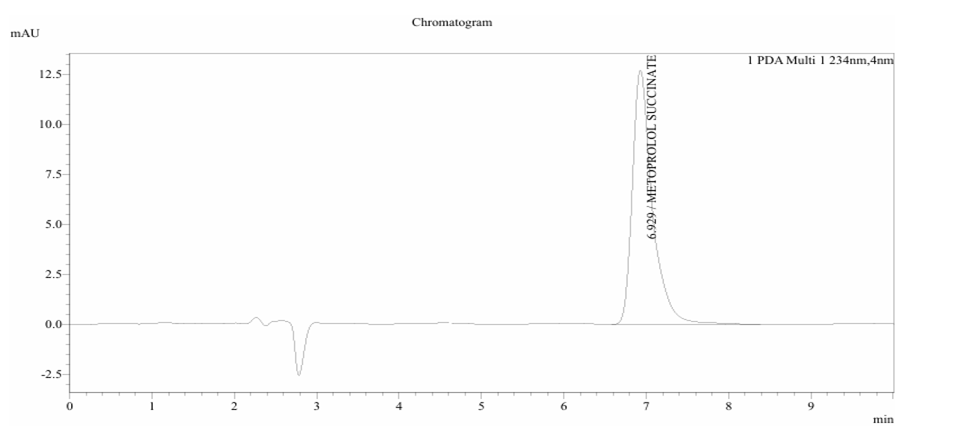
Linearity Chromatogram in 150%
|
Sr. No |
Retention Time |
Area |
Theoretical Plate |
Tailing Factor |
|
1 |
6.929 |
213622 |
4752 |
1.500 |
B. Accuracy
Accuracy of the method was evaluated by the standard addition technique at three concentration levels of 80%, 100%, and 120%. Known amount of standard drug solution were added to the pre - analyzed sample to be applied final concentration 20µg/ml, 25µg/ml and 30µg/ml. The solution were diluted with mobile phase composed of Methanol and 0.1%Triethylamine in Water. In the ratio of 70:30 and analyzed under optimized condition.
|
Sr. No |
% Concentration |
Average Area |
Amount Added (mg) |
% Recovery |
Mean Recovery |
SD |
% RSD |
|
1. |
80% |
150665 |
20 |
101.49 |
101.29 |
263.21 131.87 139.17 |
0.1747 0.0702 0.0627 |
|
2. |
100% |
187760 |
25 |
101.89 |
|||
|
3. |
120% |
221829 |
30 |
100.49 |
Accuracy Chromatogram in 80%
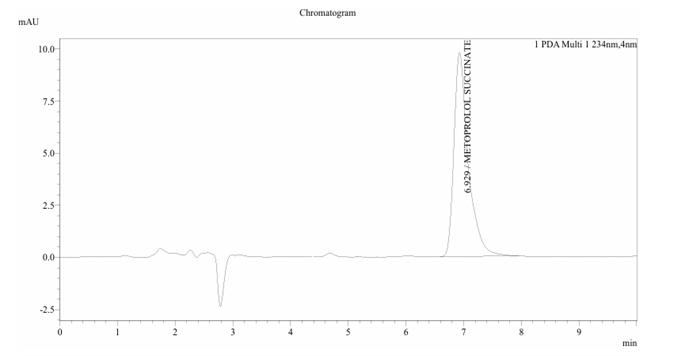
|
Retention Time |
Injection |
Area |
Theoretical plate |
Tailing factor |
|
6.929 |
1 |
150665 |
4703 |
1.558 |
Accuracy Chromatogram in 100%
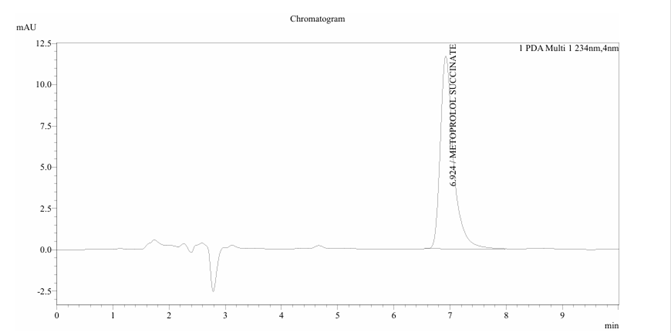
|
Retention Time |
Injection |
Area |
Theoretical plate |
Tailing factor |
|
6.924 |
2 |
187760 |
4955 |
1.477 |
Accuracy Chromatogram in 120%
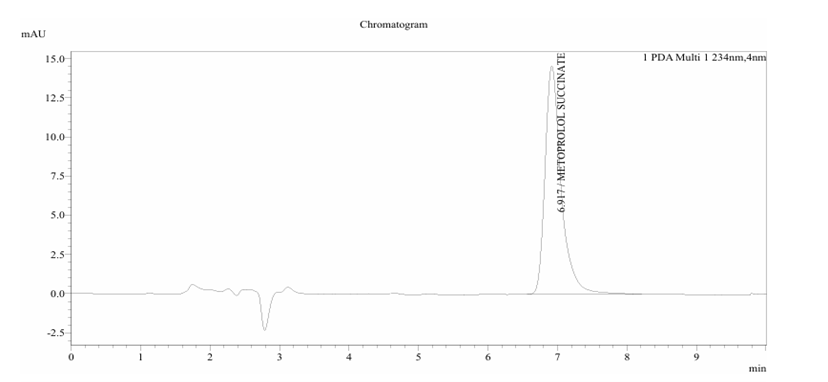
|
Retention Time |
Injection |
Area |
Theoretical plate |
Tailing factor |
|
6.917 |
3 |
221829 |
4988 |
1.443 |
The %RSD value less than 2% was found.
C. Precision
1ml of stock solution was pipetted out into 10ml volumetric flask diluted upto mobile phase with the mark. Mixed well and filtered through 0.45µm filter. Therefore, the concentration of the resultant solution was 25µg/ml. The solution was taken and injected for five times within the same day and the chromatogram was recorded. The peak area was measured to calculate the % Relative standard deviation value.
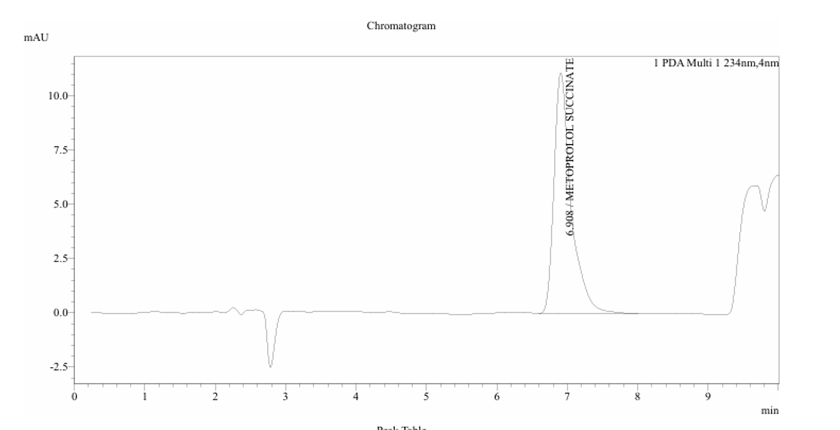
Chromatogram of Precision
Table: Interday Precision
|
Sr. No |
Peak Area |
Average |
SD |
%RSD |
|
1. |
186229 |
186557.3 |
249.54 |
0.1337 |
|
2. |
186347 |
|||
|
3. |
186542 |
|||
|
4. |
186721 |
|||
|
5. |
186920 |
|||
|
6. |
186585 |
Table: Intraday Precision
|
Sr. No |
Peak Area |
Average |
SD |
%RSD |
|
1. |
189229 |
186557.3 |
249.54 |
0.1337 |
|
2. |
189347 |
|||
|
3. |
189542 |
|||
|
4. |
189721 |
|||
|
5. |
189920 |
|||
|
6. |
189585 |
The %RSD Value less Than 2% was Found. So the method is highly precise and reproducible.
D. Robustness:
The robustness of the method was determined by introducing small changes in HPLC parameters such as changing in wavelength.
|
Sr. No |
Wavelength (Nm) |
Peak Area |
Average Area |
SD |
%RSD |
|
1 |
232 |
188371 |
186017.66 |
542.844 |
0.2873 |
|
2 |
234 |
180226 |
|||
|
3 |
236 |
189456 |
E. RUGGEDNESS:
The ruggedness of the proposed method was evaluated by applying the developed procedure assay of 25μg/ml of Metoprolol Succinate using the same instrument by two different analyst under the same optimized conditions at different days.
|
Sr. No |
Analyte |
Concentration (µg/ml) |
Peak Area |
SD |
%RSD |
|
1. |
ANALYTE-1 |
25 |
188012 |
466.750 |
0.24765 |
|
25 |
188452 |
||||
|
25 |
188945 |
||||
|
2. |
ANALYTE-2 |
25 |
190390 |
153.206 |
0.08047 |
|
25 |
190344 |
||||
|
25 |
190232 |
SUMMARY
Summary of Method Development:
Method Development Protocols Analytical method development is a systematic process used to establish a reliable, accurate, and reproducible procedure for the identification, quantification, and analysis of pharmaceutical substances. The primary objective is to develop a method that is specific, sensitive, precise, and robust, suitable for routine quality control and regulatory compliance. The protocol begins with a thorough understanding of the physicochemical properties of the drug substance, including solubility, pKa, polarity, and stability. Based on these properties, HPLC analytical For chromatographic methods, initial conditions such as stationary phase, mobile phase composition, pH, flow rate, and detection wavelength are optimized to achieve good resolution, symmetrical peaks, and acceptable retention time. Subsequently, method optimization is carried out by systematic variation of experimental parameters to enhance performance characteristics.
Summary of Validation Parameters:
Once optimized, the developed method is subjected to method validation in accordance with ICH guidelines (Q2(R1)), ensuring suitability for its intended purpose. Validation parameters include specificity, linearity, accuracy, precision, robustness, and ruggedness. Finally, system suitability testing and documentation are performed to confirm consistent performance. A well-developed and validated analytical method ensures reliable drug analysis, supports stability studies, and plays a crucial role in maintaining pharmaceutical product quality and regulatory acceptance.
|
Sr. No |
Validation Parameter |
Objective |
Procedure Summary |
Acceptance Criteria |
Results |
|
1 |
Linearity |
Proportional response |
5–6 concentration levels |
r² ≥ 0.998 |
0.999 |
|
2 |
Accuracy |
Closeness to true value |
Recovery at 80, 100, 120% |
98–102% |
101.29 |
|
3 |
Intraday Precision |
Reproducibility |
Different days/analysts |
%RSD ≤ 2 |
0.1152 |
|
4 |
Interday precision |
Reproducibility |
Within a days/analysts |
%RSD ≤ 2 |
0.1337 |
|
5 |
Robustness |
Method reliability |
Small deliberate variations |
No significant change |
No significant change |
|
6 |
Ruggedness |
Inter-lab precision |
Different instruments/analysts |
%RSD ≤ 2 |
Within the limit |
CONCLUSION:
In this project, an RP-HPLC method was developed and validated for the estimation of metoprolol succinate in bulk and tablet dosage form. The method was found to be simple, fast, accurate and precise. All validation parameters such as linearity, accuracy, precision and robustness were within acceptable limits. Therefore, this RP-HPLC method is suitable for routine quality control analysis of metoprolol succinate in pharmaceutical formulation.
REFERENCES


Murugesan S, Senthil Kumar S. K., Rajasri V, Rajeshkumar D, Reshma S, Rohini S, Sahana P, Method Development and Validation of Metoprolol Succinate by RP-HPLC Method, Int. J. of Pharm. Sci., 2026, Vol 4, Issue 2, 4534-4544. https://doi.org/10.5281/zenodo.18810817
 10.5281/zenodo.18810817