

We use cookies to ensure our website works properly and to personalise your experience. Cookies policy
Department of Pharmaceutical Science, SAGE University, Indore
The marine biosphere constitutes an extensive and largely untapped reservoir of marine-derived natural products (MNPs) with significant potential in the discovery and development of novel anticancer agents. Intensive investigations in this domain have facilitated substantial progress in the isolation, structural characterization, and clinical evaluation of bioactive marine compounds, thereby contributing to advancements in oncological therapeutics. Despite these achievements, the number of FDA-approved marine-origin anticancer drugs remains limited, primarily due to diverse challenges and translational barriers that hinder their clinical application. Recent developments highlight the potential of chitosan-based nanotechnological platforms as efficient marine-derived drug delivery systems (DDS), offering enhanced therapeutic efficacy and targeted cancer treatment. Moreover, the cyclic GMP–AMP synthase–stimulator of interferon genes (cGAS–STING) signaling pathway, a pivotal mediator of innate immune responses, remains inadequately explored in the context of anticancer therapy and represents a promising target for future research. Similarly, only a narrow spectrum of marine-derived bioactives has been reported to influence the Janus kinase/signal transducer and activator of transcription (JAK/STAT) signaling cascade, which governs key cellular processes including immune regulation, apoptosis, and oncogenesis. Ultimately, this review emphasizes the vast potential of marine natural products as a rich source of novel anticancer agents and advocates for sustained research and strategic utilization of marine resources to fulfill the unmet therapeutic demands in cancer management.
In the contemporary biomedical context, cancer constitutes a significant global public health burden and represents the second most prevalent cause of mortality worldwide, subsequent to cardiovascular disorders.1 It is noteworthy that neoplastic disorders are not contemporary pathologies but ancient medical conditions, as evidenced by their documentation in early Egyptian papyrus records.2 Broadly, cancer is a malignant disorder impacting millions of individuals worldwide, defined by dysregulated cellular proliferation that culminates in the development of aberrant tissue growths.3 The World Health Organization (WHO) indicates that approximately 16.7% of global mortality is attributable to cancer, highlighting its significance as a critical public health challenge.4
Epidemiological investigations have delineated a range of etiological factors associated with cancer development, encompassing tobacco exposure, environmental pollution, ethanol intake, genetic aberrations, occupational hazards, viral oncogenesis, ultraviolet irradiation, adiposity, dietary imbalances, and compromised immune function, among others.5,6 Although therapies such as chemotherapy, radiotherapy, targeted therapy, surgical intervention, hormone therapy, immunotherapy, and endocrine therapy have demonstrated efficacy in treating various cancer types, a substantial number of patients continue to succumb due to drug resistance, adverse effects of treatment, and compromised immune function..7 Consequently, innovative therapeutic approaches must be developed to inhibit cancer progression or attenuate its deleterious consequences, either as adjuncts to current treatment modalities or as standalone interventions..8.9
Marine biomes represent invaluable sources for the isolation of bioactive metabolites with prospective anticancer and pharmacological properties. Over several decades, systematic bioprospecting of marine environments has been undertaken to identify organisms capable of synthesizing compounds with therapeutic potential. This research spans a wide taxonomic spectrum, including mollusks, tunicates, macroalgae, mangroves, poriferans, opisthobranchs, microorganisms, higher chordates, and phylogenetically conserved taxa such as elasmobranchs.10 Notably, marine organisms have acquired the ability to biosynthesize diverse bioactive metabolites, many possessing cytotoxic activity, as an adaptive response to the extreme and variable conditions characteristic of marine environments. Furthermore, evolutionary selection has driven the emergence of these secondary metabolites, allowing marine taxa to persist and compensate for the lack of traditional physiological defense systems.11 Marine environments are consistently characterized by extreme physicochemical conditions, including high salinity, elevated hydrostatic pressure, hypoxic conditions limiting cellular respiration, restricted photic availability, and pronounced thermal variability. Marine-derived natural products (MNPs) and their corresponding anticancer compounds possess broad utility in oncological pharmacotherapy and adjunct cancer treatments. Furthermore, bioactive constituents obtained from these sources—including natural immunomodulatory agents, semi-synthetic derivatives, and structurally complex chemical entities—can be isolated, characterized, and leveraged through MNP-driven drug discovery and development strategies.12
The U.S. Food and Drug Administration (FDA) has authorized several marine-derived anticancer agents for clinical use. Cytarabine (Cytosar-U®) functions as a chemotherapeutic nucleoside analog for the management of acute myeloid leukemia (AML), acute lymphoblastic leukemia (ALL), chronic myelogenous leukemia (CML), and non-Hodgkin’s lymphoma (NHL). Trabectedin (Yondelis®), an antineoplastic compound, is indicated for advanced soft tissue sarcomas and has been investigated in clinical trials for breast, prostate, and pediatric sarcomas. Eribulin mesylate (Halaven®) is utilized in the treatment of metastatic breast carcinoma and liposarcoma. Brentuximab vedotin (Adcetris®), an antibody–drug conjugate (ADC), is employed for relapsed or refractory Hodgkin lymphoma (HL) and anaplastic large cell lymphoma (ALCL). Midostaurin (Rydapt®), a multi-targeted protein kinase inhibitor, is approved for therapy of AML, myelodysplastic syndromes (MDS), and systemic mastocytosis.13 Moreover, numerous bioactive compounds isolated from marine ecosystems are presently under clinical investigation for their anticancer efficacy. Distinct marine-derived metabolites are being evaluated across various clinical trials to assess their therapeutic potential. Progress in this critical domain of drug discovery has substantially improved human health outcomes and overall quality of life. Accordingly, the availability of safe and potent anticancer agents has conferred significant benefits to society.14
Innate immune signaling cascades, encompassing JAK/STAT pathways and cGAS–STING–mediated mechanisms, are integral to anticancer therapeutic strategies. Prior investigations have indicated that various anticancer agents exert substantial modulatory effects on these immunological pathways. Importantly, marine-derived bioactive compounds are being extensively investigated for their potential to engage and regulate innate immune responses in oncology.15 The cellular and molecular mechanisms underlying the effects of marine-derived anticancer agents on signal transduction and therapeutic efficacy are not yet fully elucidated. Accordingly, this review delineates the recent progress in the utilization of marine-derived compounds for cancer therapy and overall health modulation.
The study of logical frameworks is highly significant and warrants in-depth investigation. Accordingly, this review summarizes recent advancements in marine-derived anticancer agents, developments in nanotechnology, their role in modulating innate immunity, effects on cell signaling, and applications in cancer therapy. It comprehensively covers the mechanisms of action, pharmacological properties, and potential therapeutic applications of these compounds. Current challenges and limitations, as well as opportunities related to the detection, optimization, and development of marine-derived anticancer drugs, are addressed to facilitate enhanced drug discovery. Finally, this work discusses prospects for future research in this rapidly evolving and promising field, serving as a comprehensive reference for the diverse applications of marine-derived compounds in oncology.
METHODOLOGY
A systematic investigation of the chemical composition and anticancer properties of marine natural products was conducted utilizing scientific databases, including Google Scholar and SciFinder. In this review, the keywords “marine algae,” “marine soft corals,” “microalgae,” “marine bacteria,” and “marine fungi” were employed in conjunction with “in vivo” or “in vitro studies against cancer.” Furthermore, searches incorporated terms such as “clinical trials of marine-derived compounds for cancer” and “marketed marine anticancer agents” to compile relevant information.
CLASSIFICATION OF MARINE-DERIVED NATURAL PRODUCTS
The marine environment constitutes an extensive reservoir, with marine organisms serving as a pivotal source of novel anticancer agents, providing a structurally diverse repertoire of bioactive metabolites. Numerous marine-derived compounds are isolated and further subjected to chemical synthesis or structural modification to enhance their applicability in oncological therapeutics.16
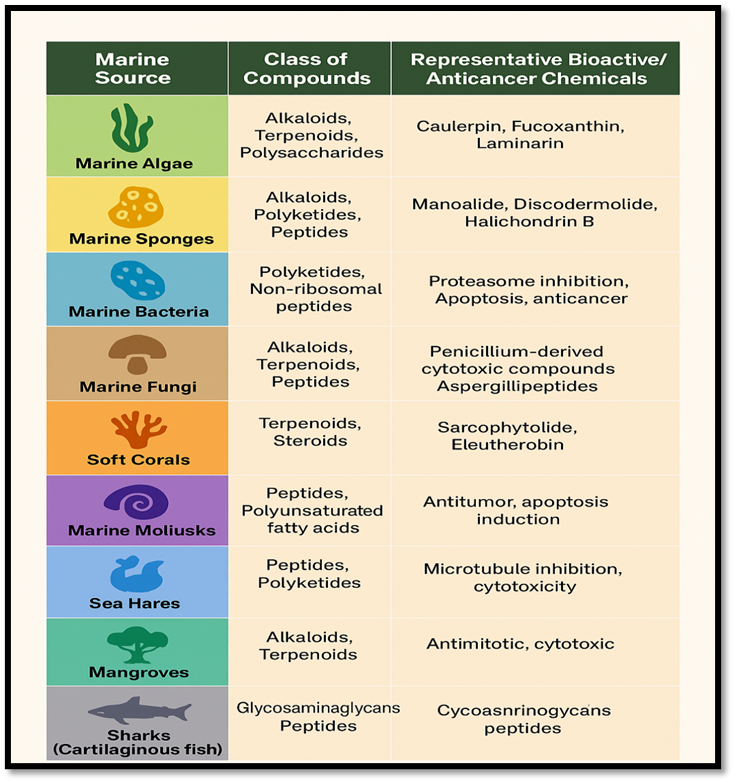
Despite their potential, marine sources remain largely untapped for the discovery of anticancer therapeutics. While several chemical classes have been characterized, the most notable marine natural products (MNPs) encompass structurally diverse alkaloids from marine algae, terpenoids with varied structural frameworks, peptides isolated from diverse marine organisms, polyketides with significant bioactivities, and high-molecular-weight polysaccharides (Table 1). These MNP classes are pivotal in the development of anticancer agents due to their pronounced biological activities against chronic and life-threatening malignancies.17
Marine-derived natural products as sources of anticancer agents
Marine natural products (MNPs) display extensive pharmacologically relevant bioactivities. Marine biota, including sponges, algae, corals, and notably marine-derived bacteria and fungi, synthesize novel secondary metabolites (SMs) characterized by structurally unique and diverse chemistries, which are pivotal in the discovery and development of anticancer therapeutics.18
Marine-derived structures that are vital for the development of anticancer agents originate from a diverse array of sources. These encompass prokaryotes, notably marine bacteria such as Lactobacilli and Noctiluca scintillans; algae (seaweeds) producing secondary metabolites with potent anticancer activities; mangroves, which contain bioactive anticancer compounds; and various other marine organisms that collectively cover more than 70% of the Earth's surface. Furthermore, the global diversity of marine microflora and microalgae is extensive, constituting approximately 90% of the oceanic biomass.19
Table.1. Classification, biological actives, and anticancer chemicals from various marine sources.
Marine bacteria
Marine microorganisms constitute a crucial reservoir of structurally diverse bioactive compounds, with significant potential to unveil novel therapeutic targets and lead compounds. Secondary metabolites synthesized by these marine microbes have contributed to the identification of several pharmacologically potent anticancer agents, including discodermolide, bryostatins, sarcodictyin, and eleutherobin. Additionally, the functional activity of probiotic microorganisms, such as Bifidobacteria and Lactobacilli, can be influenced by pathogenic microbes through the modulation of anticancer metabolite production.20 Lactobacilli have been demonstrated to provide nutritional benefits that potentially lower the incidence of colorectal cancer. The secondary metabolite macrolactin-A effectively suppresses the proliferation of B16-F10 murine melanoma cells. In addition, dibohemamines B and C, isolated from Streptomyces species, display significant cytotoxic activity against non-small cell lung cancer (NSCLC) cell lines.21
Elysia rufescens, a marine mollusk, produces the depsipeptide kahalalide F (KF), with its biosynthesis influenced by symbiotic microorganisms. KF demonstrates pronounced in vitro cytotoxicity against solid tumors, particularly in prostate cancer cell lines. Comprehensive in vivo evaluations further indicate its efficacy against colorectal and breast malignancies. Moreover, the indole-derived microbial anticancer agent trisindolal 38 exhibits significant cytotoxic activity against human breast cancer (MAXF401) and melanoma (MEXF462) cell lines.22
Marine actinomycetes constitute a significant source of anticancer agents with proteasome-targeting activity. Micromonospora marina, isolated from coraline, synthesizes bioactive compounds that inhibit RNA synthesis and display cytotoxicity against lung and colon cancer cell lines, as well as advanced skin malignancies. Notably, thiocoraline exerts pronounced antiproliferative effects in colon cancer progression through regulation of the p53 signaling pathway.23 Maxim et al. conducted a structure-based study on the sulfated O-specific polysaccharide (OPS) and O-deacylated lipopolysaccharide (DPS) from the marine bacterium Poseidonocella sedimentorum KMM 9023T to assess their in vitro anticancer potential. The findings revealed that KMM 9023T is non-cytotoxic toward normal cells and effectively suppresses colony formation in human cancer cell lines, including HT-29, MCF-7, and SK-MEL-5.24
Marine fungi
Marine fungi constitute a distinctive and prolific reservoir of novel anticancer agents, yet they remain comparatively underexplored relative to terrestrial fungi. Despite this, they are integral to the identification and development of anticancer therapeutics derived from marine natural products (MNPs).25 Marine fungi have been reported to produce anticancer compounds originating from diverse sources, including deep-sea sediments, algae, sponges, endophytic mangroves, and other marine fungal species.26,27 Several fungal isolates derived from diverse marine environments have been shown to possess cytotoxic and growth-inhibitory effects against multiple cancer cell lines. Notable deep-sea-associated fungi with anticancer potential include Simplicillium obclavatum, Acaromyces ingoldii, Acrostalagmus luteoalbus, Paecilomyces lilacinus, Aspergillus spp., and Penicillium spp.28 Fungi associated with algae that produce anticancer compounds include Paecilomyces variotii, Microsporum sp., and Aspergillus sp. Mangrove-derived endophytic fungi with identified anticancer metabolites comprise Pestalotiopsis microspore, Campylocarpon sp., Stemphylium globuliferum, Bionectria ochroleuca, Pestalotiopsis clavispora, Mucor irregularis, Rhytidhysteron rufulum, Acremonium strictum, Penicillium sp., Lasiodiplodia sp., Fusarium sp., Dothiorella sp., Phomopsis sp., and Nigrospora sp. Fungi derived from marine sediments include Neosartorya fischeri, Eutypella scoparia, Eutypella sp., Aspergillus sp., and Penicillium sp., while sponge-associated fungi comprise Arthrinium arundinis, Neosartorya laciniosa, Aspergillus sp., and Stachylidium sp.29
Numerous marine fungal isolates have been identified as producers of bioactive compounds with potential anticancer properties. Nevertheless, due to limitations in elucidating their anticancer activity, performing complete taxonomic classification, defining biological targets, and understanding mechanisms of action, none of these compounds have advanced to clinical development or commercialization. There is an increasing imperative to investigate the pharmaceutical potential of novel discoveries, especially those providing critical insights into emerging anticancer candidates from marine fungi. While comprehensive studies are required to overcome existing limitations in clinical efficacy, marine-derived compounds clearly offer a valuable platform for the development of therapeutic anticancer interventions.30
Marine algae
Evidence suggests that wewakazole B, a cyanobactin isolated from Moorea-derived cyanobacteria, demonstrates cytotoxic effects against human cancer cell lines.31 Odoamide, a structurally potent cytotoxin isolated from the Japanese Okeania species, exhibits significant anticancer activity against human cervical HeLa S3 tumor cells.32 Calothrix cells have been reported to inhibit the organized proliferation of human HeLa tumor cells in vitro. The potent anticancer agent Curacin-A, isolated from Lyngbya majuscula collected in Curaçao, demonstrates selective growth-inhibitory activity against breast cancer cell lines, as well as colon, renal, and other malignant tumor cells.33
Apratoxins, a cyanobacterial chemical class, display inhibitory activity against various malignant tumors at nanomolar concentrations. The parent compound, apratoxin A, isolated from the alga Lyngbya bouillonii, exhibits cytotoxic effects against adenocarcinoma cells. Similarly, the compound GSV 224 demonstrates strong cytotoxicity in human tumor cell lines and exhibits targeted activity against drug-resistant and refractory cancer cells. Furthermore, bioactive metabolites from three Gracilaria species and galaxamide analogs from Galaxaura lamentosa have been recognized as potent antitumor agents.34
The bioactive extract of Acanthophora spicifera, a red algal species, demonstrates significant antitumor activity against Ehrlich’s ascites carcinoma.35 Previous studies indicate that edible kelp, such as Palmaria palmata, exhibits pronounced anticancer properties and is effective in inhibiting tumor cell proliferation.36 Additionally, fucoidans have been shown in mice to possess antimetastatic, anticancer, antitumor, and fibrinolytic activities.37 The Condriamide-A compound from Chondria sp. demonstrates cytotoxic activity against human nasopharyngeal and colorectal cancer cells. Similarly, Caulerpenyne exhibits bioactive potential in human cancer cell lines, displaying anticancer properties. Additionally, Cystophora sp. has yielded two antitumor compounds, meroterpenes and usneoidone, with demonstrated anticancer activity.38 Sulfated polysaccharides isolated in a dose-dependent manner from the brown alga Ecklonia cava exhibit inhibitory effects on cancer cells in vitro.39 Daisuke et al. isolated yoshinone A, a novel polyketide from marine cyanobacteria, which inhibits 3T3-L1 cell proliferation during adipocyte differentiation while exhibiting significant cytotoxicity. Jehad et al. identified carmaphycins A (1) and B (2) from the Curaçao collection of the marine cyanobacterium Symploca sp., demonstrating potent activity against a range of cancer cell lines.40,41
Mangroves and other coastal plants
A total of seventeen mangrove species have been recognized as prospective candidates for the development of anticancer agents. The bioactive compound 1,2-dithiolane (Brugin), isolated from Bruguiera sexangula, demonstrates pronounced cytotoxic efficacy against Sarcoma-180 and Lewis lung carcinoma, primarily due to its alkaloidal and sulfide-based phytoconstituents. Moreover, tannin fractions obtained from phylogenetically related taxa exhibit potent antineoplastic activity against lung carcinoma models. In addition, a 2-benzoxazoline riboside derivative isolated from Acanthus ilicifolius has been documented to exert significant anticarcinogenic potential.42 Bioactive anticancer metabolites derived from the mangrove species Xylocarpus granatum (commonly known as the cannonball mangrove) predominantly consist of tetranortriterpenoids, a specialized subclass of terpenoids identified as xylogranatins A–D, which display potent cytotoxic and antiproliferative activities against a range of malignant tumor cell lines. Furthermore, limonoid analogs, including granaxylocarpins A and B, have been reported to exhibit marked cytostatic and cytotoxic properties toward P-388 murine leukemia models, underscoring their potential as promising anticancer lead compounds.43
Marine Sponges
Marine biota account for nearly 30% of all characterized natural products reported to date. The seminal identification of bioactive metabolites from marine sponges instigated considerable interest in the pursuit of marine-derived pharmacotherapeutics for clinical utilization. A paradigmatic instance involves the isolation and structural elucidation of the nucleosides spongothymidine and spongouridine from the Caribbean sponge Tethya crypta. These metabolites exhibited pronounced antiviral bioactivity, and subsequent chemical derivatization and synthetic refinement culminated in the development of cytosine arabinoside (Ara-C), a clinically validated antineoplastic chemotherapeutic agent.44
Soft Corals
The genus Sarcophyton constitutes one of the most extensively distributed taxa of alcyonacean soft corals inhabiting tropical and subtropical marine ecosystems. Approximately thirty species belonging to this genus have been systematically examined for their repertoire of bioactive secondary metabolites, notably polyunsaturated fatty acids such as arachidonic, eicosapentaenoic, and docosahexaenoic acids, which exhibit dose-dependent cytotoxicity toward brine shrimp larvae (LC?? = 96.7 ppm). Among the principal metabolic constituents of soft corals are cembranoid diterpenes, which may account for up to 5% of the organism’s dry weight. These metabolites are associated with a broad spectrum of biopharmacological activities, including ichthyotoxic, cytotoxic, anti-inflammatory, and antagonistic effects. Furthermore, in vitro cytotoxic evaluations have revealed that furano-cembranoids and decaryiol, isolated from Nephthea spp. and Sarcophyton cherbonnieri, exert pronounced antiproliferative activity against multiple tumor cell lines (gastric epithelial, breast, and hepatic) with GI?? values ranging from 0.15 to 8.6 µg mL?¹, mediated primarily through G?/M phase cell cycle arrest mechanisms.45
FDA approval and marketing of marine-derived anticancer drugs
Table.2. Marine-derived anticancer drugs approved or in clinical trials.
|
???? Drug Name |
????Source Organism |
???? Chemical Class |
??Mechanism of Action |
??????Clinical Status |
|
????Cytarabine (Ara-C) |
Tethya crypta (Caribbean sponge) |
Nucleoside analog |
Inhibits DNA polymerase; halts DNA synthesis and repair |
?FDA-Approved (Leukemia, Lymphoma) |
|
????Vidarabine (Ara-A) |
Tethya crypta |
Nucleoside analog |
Inhibits viral DNA polymerase; blocks DNA elongation |
????FDA-Approved (Antiviral precursor) |
|
????Trabectedin (ET-743, Yondelis®) |
Ecteinascidia turbinata (Tunicate) |
Tetrahydroisoquinoline alkaloid |
Binds DNA minor groove; disrupts transcription-coupled repair |
?FDA-Approved (Ovarian & Soft Tissue Sarcoma) |
|
????Eribulin mesylate (Halaven®) |
Halichondria okadai (Sponge) |
Macrocyclic ketone (Halichondrin B analog) |
Inhibits microtubule polymerization; causes mitotic arrest |
?FDA-Approved (Breast & Liposarcoma) |
|
????Brentuximab vedotin (Adcetris®) |
Dolabella auricularia (Sea hare; dolastatin analog) |
Antibody-drug conjugate (Peptide) |
Microtubule destabilization via MMAE payload; apoptosis induction |
?FDA-Approved (Hodgkin lymphoma, ALCL) |
|
????Plitidepsin (Aplidin®) |
Aplidium albicans (Tunicate) |
Cyclic depsipeptide |
Inhibits eEF1A2; induces oxidative stress and apoptosis |
??Approved in Australia; Phase III (Multiple Myeloma) |
|
????Lurbinectedin (Zepzelca®) |
Synthetic analog of Ecteinascidia turbinata compound |
Alkaloid |
DNA minor groove binding; inhibition of oncogenic transcription |
?FDA-Approved (Small Cell Lung Cancer) |
|
????Marizomib (Salinosporamide A) |
Salinispora tropica (Marine bacterium) |
β-lactone γ-lactam |
Irreversible proteasome inhibitor; triggers apoptosis |
????Phase III (Glioblastoma, Myeloma) |
|
????Elisidepsin (Irvalec®) |
Ecteinascidia turbinata derivative |
Depsipeptide |
Disrupts plasma membrane integrity; induces necrosis |
??Phase II (Solid Tumors) |
|
???? Dolastatin 10 |
Dolabella auricularia (Sea hare) |
Linear peptide |
Inhibits tubulin polymerization; induces apoptosis |
???? Precursor for ADCs (e.g., Adcetris®) |
|
????Aplidin (Dehydrodidemnin B) |
Aplidium albicans (Tunicate) |
Depsipeptide |
Induces oxidative stress and apoptosis via JNK activation |
??Approved in Australia; Phase III global trials |
|
????Zalypsis (PM00104) |
Synthetic analog of Ecteinascidia turbinata alkaloids |
Alkaloid |
Binds DNA; inhibits transcriptional activation |
????Phase II (Solid Tumors, Myeloma) |
Biologically Active Compounds Derived from Marine Organisms
Polyphenols
Polyphenols constitute a diverse group of secondary metabolites that are broadly categorized into phenolic acids, flavonoids, tannins, catechins, anthocyanidins, epigallocatechins, lignins, epicatechins, epigallates, and gallic acid derivatives. These polyphenolic entities are recognized for their capacity to suppress the mitotic index and downregulate intracellular protein expression crucial for neoplastic cell proliferation and colony formation. Notably, scutellarein 4′-methyl ether has exhibited pronounced anticancer efficacy in both in vitro and in vivo experimental models, primarily attributed to its cytotoxic mechanisms of action. In addition to their antineoplastic potential, phenolic constituents manifest a wide range of biopharmacological activities, including anti-inflammatory, antiviral, and antiplatelet aggregation effects. The edible marine red alga Palmaria palmata represents a significant reservoir of polyphenolic compounds with potent antioxidant and cytoprotective properties. Mechanistically, these polyphenols exert their effects through metabolic inhibition of xenobiotic-metabolizing enzymes, leading to perturbation of the mitotic machinery during the telophase stage, thereby inducing cell cycle disruption and mitotic arrest.46
Polysaccharides
Another significant category of bioactive metabolites extensively distributed among diverse marine taxa is polysaccharides, predominantly including alginates, agar, and carrageenans. The anticancer activity of these macromolecules is principally attributed to their ability to activate the innate immune response, thereby promoting the recruitment of macrophages and natural killer (NK) cells to neoplastic sites and stimulating the release of tumoricidal cytokines. A sulfated polysaccharide isolated from the filtrate of Pseudomonas spp. has been documented to induce apoptotic death in human leukemic U937 cells, whereas PI-88, a sulfated oligosaccharide, exhibited potent pro-apoptotic effects against pancreatic islet carcinoma cells. In addition, glycosaminoglycans, which possess characteristic internal sulfation, have been shown to trigger apoptosis in murine melanoma cells through transcriptional modulation.47
Alkaloids
Marine-origin alkaloids are systematically categorized into four major classes—indoles, halogenated indoles, phenylethylamines, and miscellaneous alkaloids with the predominant representatives belonging to the phenylethylamine and indole subclasses. Among these, two structurally distinct alkaloids, lophocladine A and lophocladine B, have been isolated from the red alga Lophocladia spp. Additionally, alkaloidal constituents such as acanthicifolin, brugine, and benzoquinones have been reported from Acanthus illicifolius, Bruguiera sexangula, and Kandelia candel, respectively. The alkaloid rhizophrine represents a major bioactive metabolite identified in the foliage of Rhizophora mucronata and R. stylosa, mangrove taxa predominantly inhabiting coastal and estuarine ecosystems of East Africa and the Indo-Pacific region. Collectively, these alkaloids have demonstrated potent antiproliferative and cytotoxic activities against a range of human cancer cell lines, emphasizing their relevance as promising marine-derived chemotherapeutic candidates for anticancer drug discovery.48
Peptides
A wide spectrum of bioactive peptides has been isolated from diverse marine floral species, with approximately 2,500 novel peptides exhibiting antiproliferative and cytotoxic properties identified over the past decade. These purified marine-derived peptides have demonstrated significant inhibitory activity against multiple human cancer cell lines, including pancreatic, breast, bladder, and pulmonary carcinomas.
Among these, Apratoxin A, a cyclic depsipeptide, has shown pronounced cytotoxic potential against HeLa cervical carcinoma cells, primarily through the induction of cell cycle arrest. Comparable mechanistic effects have been reported for Coibamide A, a cyclic depsipeptide isolated from Leptolyngbya sp., and Lyngbyabellin B, derived from Lyngbya majuscula. In addition, the linear pentapeptides Dolastatin 10 and Symplostatin 1, isolated from Symploca spp., exhibit potent cytotoxicity against human lung and breast cancer cell lines via Bcl-2 phosphorylation and caspase-3 activation, culminating in apoptotic cell death.
Moreover, several bioactive peptides obtained from Lyngbya spp. and Nostoc spp. exhibit antiproliferative efficacy mediated through microfilament disruption, inhibition of the secretory pathway, and other intracellular regulatory mechanisms. Two novel cyclodepsipeptides, Scopularide A and Scopularide B, isolated from the marine-derived fungus Scopulariopsis brevicaulis, have demonstrated marked growth-inhibitory effects against pancreatic and colorectal carcinoma cell lines.
Furthermore, Sansalvamide A, a structurally distinctive cyclic depsipeptide isolated from marine fungi, has displayed broad-spectrum cytotoxic activity against pancreatic, colorectal, breast, and prostate carcinomas, as well as melanoma, thereby representing a promising lead compound for anticancer drug development. Although its precise molecular mechanism remains incompletely elucidated, recent investigations indicate that Sansalvamide A interacts with heat shock protein 90 (HSP90) by binding to its N-middle domain, resulting in allosteric inhibition of HSP90–client protein complex formation—a process crucial for oncoprotein stabilization and tumor progression.
Marine-Derived Antibiotics Exhibiting Anticancer Bioactivity
Toxins that originally evolved as biochemical defense strategies to suppress competing microbial species possess a wide range of physiological and molecular effects, rendering them valuable structural templates for anticancer drug discovery. The molecular targets of these secondary metabolites frequently correspond to signal transduction components that are evolutionarily conserved across multiple biological taxa, highlighting their potential for therapeutic exploitation. Among the principal classes of chemotherapeutic agents, antitumor antibiotics hold a distinguished position and include members of the anthracycline, actinomycin, and aureolic acid families. Clinically significant representatives within these categories, such as peptolides and dactinomycin, have demonstrated potent cytostatic and cytotoxic activities. Specifically, actinomycin D has been reported to downregulate critical metabolic enzymes implicated in glycolysis, glutaminolysis, and lipogenesis in glioma cells, thereby suggesting that multi-targeted modulation of tumor metabolic pathways may constitute a novel anti-glioma therapeutic mechanism. Furthermore, anthracyclines represent one of the most widely employed classes of antitumor antibiotics in contemporary clinical oncology. Their antineoplastic activity primarily arises from the inhibition of DNA topoisomerase II, resulting in DNA strand breakage, transcriptional interference, and consequent suppression of neoplastic cell proliferation.
Bryostatin 1, a well-characterized marine-derived antineoplastic compound, was initially isolated from the bryozoan Bugula neritina. This macrolide lactone has been demonstrated to induce ubiquitination and proteasomal degradation of the anti-apoptotic protein Bcl-2 in lymphoblastic leukemia cells, while concurrently enhancing the proliferation of hematopoietic progenitor cells within the bone marrow. Functionally, bryostatins act as potent modulators of protein kinase C (PKC), thereby regulating a spectrum of cellular processes including signal transduction, proliferation, differentiation, apoptosis, and survival.
Various mechanistic paradigms have been proposed for marine-origin antineoplastic compounds, encompassing cell cycle arrest, inhibition of translational machinery, and antiangiogenic modulation, as evidenced by bioactive metabolites such as Didemnin B and Aplidine. The cyclic depsipeptide Kahalalide F mediates its cytotoxic activity through specific interactions with membrane-associated proteins, leading to disruption of membrane integrity and perturbation of intracellular signaling cascades. Aplidine (Dehydrodidemnin B), presently undergoing Phase I–II clinical evaluation, exhibits potent antiproliferative efficacy characterized by delayed onset of neuromuscular toxicity, underscoring its favorable therapeutic index.
Marine-derived antiangiogenic metabolites, including Squalamine, Neovastat, and LAF389, have demonstrated substantial tumor growth inhibitory activities. Squalamine and LAF389 exert their pharmacological effects through inhibition of Na?/H? antiporters, leading to disruption of phospholipid bilayer dynamics, whereas Neovastat impedes vascular endothelial growth factor (VEGF)–receptor interaction, effectively abrogating angiogenic signaling pathways. Squalamine and Neovastat have progressed to Phase II and Phase III clinical investigations, respectively, while LAF389 has reached Phase I clinical assessment.
Additionally, Plinabulin (NPI-2358), a vascular-disrupting agent (VDA) derived from a marine fungal extract, is presently in Phase II clinical trials due to its robust activity against multidrug-resistant human cancer cell lines. Other notable marine-derived peptide analogs with clinical promise include Tasidotin and Synthadotin (ILX-651), both under Phase II evaluation, and Soblidotin (TZT-1027), a bacterial peptide of marine origin currently in Phase III trials.
CONCLUSION
The marine domain represents an exceptional reservoir for the discovery of novel anticancer agents, offering immense potential for identifying bioactive compounds that target diverse cellular pathways for clinical intervention. A wide range of marine natural products has demonstrated significant in vitro cytotoxic activity against various tumor cell lines, including renal, lung, prostate, bladder, melanoma, osteosarcoma, mammary, and lymphoid cancers. Moreover, numerous studies on the mechanisms of action of these marine-derived compounds, both in vitro and in vivo, indicate that their antitumor effects are primarily mediated through apoptosis, necrosis, and tumor cell lysis. Despite these promising outcomes, the limited availability of effective anticancer drugs underscores the need for continued exploration of marine bioresources. To overcome existing challenges, extensive multidisciplinary collaboration among scientists, chemists, biotechnologists, pharmacists, clinicians, and partnerships between academic institutions, research centers, and industries is imperative to accelerate the progress of marine pharmaceutical development. Furthermore, the integration of advanced analytical spectrometry with computational genomics, gene mining, and experimental therapeutics will be crucial in unveiling novel molecular entities. Whether used individually or in combination with existing chemotherapeutic agents, marine-derived compounds and their analogs hold immense potential to contribute valuable insights and lead structures for the development of next-generation anticancer therapeutics, ultimately improving human health outcomes. Numerous bioactive metabolites of marine origin have exhibited pronounced therapeutic potential by mitigating oxidative DNA lesions, triggering programmed cell death (apoptosis), modulating oncogenic signalling cascades, and enhancing macrophage activation in both preclinical and clinical investigations. The present review delineates the pharmacodynamic significance of marine-derived natural products in oncological therapeutics, with emphasis on their modulatory influence over pathophysiological mechanisms implicated in oxidative stress, inflammatory pathways, and cellular survival regulation. Additionally, the distinct structural diversity and pharmacophoric complexity of these marine secondary metabolites underscore their immense promise as a reservoir of novel chemotherapeutic scaffolds, offering profound insights into the unexploited chemical space of marine flora–derived anticancer leads.
REFERENCES


Ratikesh Wawarkar, Dr. Souravh Bais, Marine Natural Products: A Promising Source of Novel Anticancer Agents, Int. J. of Pharm. Sci., 2025, Vol 3, Issue 11, 1061-1075. https://doi.org/10.5281/zenodo.17551334
 10.5281/zenodo.17551334