
IVM’s Krishnarao Bhegade Institute of Pharmaceutical Education and Research, Talegaon Dabhade, Pune, Maharashtra, India 410507.
Parkinson’s disease is a progressive neurodegenerative disorder characterized by degeneration of dopaminergic neurons in the substantia nigra and reduction of dopamine levels in the striatum. Current pharmacological therapies mainly provide symptomatic relief and are associated with several adverse effects. Therefore, exploration of medicinal plants with neuroprotective potential has gained considerable attention. Cassia auriculata, a medicinal plant widely used in traditional systems of medicine, contains several bioactive phytoconstituents such as flavonoids, tannins, polyphenols, and alkaloids. These compounds are known to possess antioxidant and neuroprotective properties. Experimental studies using haloperidol-induced Parkinsonism models in rodents have demonstrated that ethanolic extracts of Cassia auriculata significantly reduce catalepsy, improve locomotor activity, and enhance motor coordination. Biochemical investigations also indicate that the plant extract reduces oxidative stress markers and improves antioxidant enzyme levels such as superoxide dismutase, catalase, and glutathione. This review summarizes the pharmacological significance, phytochemical composition, experimental evidence, and potential mechanisms of Cassia auriculata in the management of Parkinson’s disease. The available evidence suggests that the plant may serve as a promising natural therapeutic candidate for neuroprotection and management of Parkinsonian symptoms
Parkinson’s disease (PD) is one of the most common neurodegenerative disorders affecting millions of people worldwide. The disease is primarily characterized by degeneration of dopaminergic neurons in the substantia nigra pars compacta, resulting in reduced dopamine levels in the striatum. The depletion of dopamine leads to various motor symptoms including tremors, rigidity, bradykinesia, and postural instability. In addition to motor symptoms, patients may also experience non-motor manifestations such as cognitive impairment, depression, and sleep disturbances. Despite the availability of several pharmacological agents such as levodopa, dopamine agonists, and monoamine oxidase inhibitors, these treatments mainly provide symptomatic relief and do not halt disease progression. Long term use of conventional drugs can also result in adverse effects including dyskinesia and motor fluctuations.[1]
Consequently, the search for safer and more effective therapeutic agents has become a priority in neuropharmacological research. Medicinal plants have been used for centuries in traditional medicine and continue to provide valuable sources of pharmacologically active compounds.
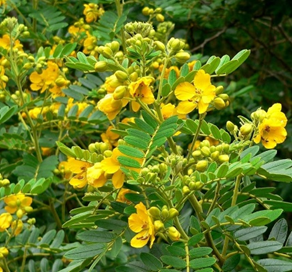
Cassia auriculata
Cassia auriculata, commonly known as Tanner’s Cassia or Avaram, is widely distributed in tropical regions and has been traditionally used for treating diabetes, inflammation, liver disorders, and infections. Recent experimental studies have suggested that the plant may also possess neuroprotective activity, particularly in models of Parkinsonism. This plant is said to contain a cardiac glucoside (sennapicrin) and sap, leaves and bark yield anthraquinones, while the latter contains tannins. The root is used in decoctions against fevers, diabetes, diseases of urinary system and constipation. The leaves have laxative properties. Tea made from dried flowers and flower buds is consumed by diabetes patients instead of regular tea. It is also believed to improve complexion. Powdered seeds are used against diabetes, they are also applied to the eye to treat chronic purulent conjunctivitis. In Africa, the bark and seeds are said to help against rheumatism, eye diseases, gonorrhea, diabetes, and gout.[2]
Plant Profile
|
Parameter |
Description |
|
Scientific Name |
Cassia auriculata |
|
Family |
Caesalpiniaceae |
|
Common Name |
Tanner’s Cassia |
|
Parts Used |
Leaves |
|
Phytochemicals |
Flavonoids, tannins, alkaloids, saponins, polyphenols |
Phytochemistry
The ethanolic extract contains:
• Flavonoids → antioxidant activity
• Polyphenols → free radical scavenging
• Alkaloids → neuroprotective effects
• Tannins & saponins → anti-inflammatory properties
Pathophysiology of Parkinson’s Disease
Parkinson’s disease results from complex interactions between genetic and environmental factors. The primary pathological feature of the disease is degeneration of dopaminergic neurons in the substantia nigra. The resulting decrease in dopamine disrupts the balance between excitatory and inhibitory neurotransmission within the basal ganglia. Oxidative stress is believed to play a significant role in the pathogenesis of Parkinson’s disease. Excessive production of reactive oxygen species can damage cellular components such as lipids, proteins, and DNA. Additionally, mitochondrial dysfunction, neuroinflammation, and abnormal protein aggregation contribute to neuronal degeneration.[3]
Medicinal Importance of Cassia Auriculata
Cassia auriculata belongs to the family Caesalpiniaceae and is widely used in traditional Ayurvedic and Siddha medicine. Different parts of the plant including leaves, flowers, and bark are used for therapeutic purposes. Phytochemical investigations have revealed the presence of flavonoids, polyphenols, tannins, saponins, and alkaloids. These phytoconstituents exhibit various pharmacological activities such as antioxidant, anti-inflammatory, antidiabetic, hepatoprotective, and antimicrobial effects. The strong antioxidant capacity of these compounds is particularly important in neurodegenerative diseases where oxidative stress contributes to neuronal damage.[4]
Experimental Models for Anti-Parkinson Activity
Experimental models play an essential role in evaluating potential anti-Parkinson agents. Haloperidol induced Parkinsonism is a widely used experimental model because haloperidol blocks dopamine receptors and produces symptoms similar to Parkinson’s disease. In animal studies, administration of haloperidol results in catalepsy, reduced locomotor activity, and impaired motor coordination. These behavioral changes provide measurable parameters to evaluate the effectiveness of test compounds. Ethanolic extracts of Cassia auriculata have been tested in such models and have shown significant improvements in motor function and behavioral parameters.[5]
Pharmacological Evidence
Studies investigating the neuroprotective activity of Cassia auriculata have reported promising findings. Treatment with ethanolic extracts of the plant significantly reduced haloperidol induced catalepsy in rodents. The extract also improved locomotor activity as observed in actophotometer tests and enhanced motor coordination in rotarod experiments. Biochemical analysis further demonstrated that the extract reduced lipid peroxidation and improved antioxidant defense mechanisms. Levels of antioxidant enzymes such as superoxide dismutase, catalase, and glutathione were restored toward normal values in treated animals. These findings indicate that the neuroprotective effects of the plant are largely mediated through its antioxidant properties.[6]
Cassia auriculata, commonly known as Tanner’s Cassia, is a medicinal plant widely used in traditional systems like Ayurveda due to its diverse pharmacological properties. These activities are mainly attributed to the presence of bioactive constituents such as flavonoids, tannins, alkaloids, saponins, and polyphenols, which contribute to its therapeutic potential across multiple disease conditions.[7]
1. Antioxidant activity
One of the most significant properties of Cassia auriculata is its antioxidant activity. The plant extract is rich in polyphenolic compounds that effectively scavenge free radicals and reduce oxidative stress. This antioxidant mechanism plays a crucial role in protecting cellular structures from damage and is particularly beneficial in chronic conditions such as neurodegenerative diseases, diabetes, and aging-related disorders.[8]
2. Neuroprotective or Anti Parkinson activity
The plant also exhibits notable neuroprotective or anti Parkinson activity. Experimental studies, especially those involving haloperidol-induced Parkinsonism models, have demonstrated that the ethanolic extract of Cassia auriculata can reduce catalepsy, improve locomotor activity, and enhance motor coordination.[9] These effects are largely due to its ability to modulate oxidative stress and support dopaminergic neurotransmission. The extract has been shown to decrease lipid peroxidation markers like TBARS while increasing endogenous antioxidants such as glutathione (GSH), superoxide dismutase (SOD), and catalase, thereby protecting neurons from degeneration.[10]
3. Anti diabetic activity
In addition to its neurological benefits, Cassia auriculata possesses strong antidiabetic activity. It helps in lowering blood glucose levels and improving insulin sensitivity, making it useful in the management of diabetes mellitus. The plant also supports glucose metabolism and may reduce complications associated with prolonged hyperglycemia.[11]
4. Anti -inflammatory activity
The anti-inflammatory property of Cassia auriculata further enhances its medicinal value. It works by inhibiting inflammatory mediators and reducing swelling and pain, which makes it beneficial in conditions such as arthritis and other inflammatory disorders. Alongside this, the plant shows analgesic effects by reducing pain perception through both central and peripheral mechanisms.[12]
5. Hepatoprotective Effect
Another important activity is its hepatoprotective effect. The extract protects liver cells against toxic substances and helps in maintaining normal liver function by reducing elevated liver enzymes. This makes it useful in preventing liver damage caused by drugs or toxins.[13]
6. Anti-microbial activity
Cassia auriculata also demonstrates antimicrobial activity against various bacterial and fungal pathogens, supporting its use in treating infections. Moreover, preliminary studies indicate its anticancer potential, where it exhibits cytotoxic effects against certain cancer cell lines and may inhibit tumor growth, although more detailed studies are required in this area.[14]
7. Anti-pyretic activity
The plant has also been reported to possess antipyretic activity, helping in the reduction of fever by acting on thermoregulatory centers. Its antiulcer effect is attributed to its ability to protect the gastric mucosa and reduce acid secretion, thereby preventing ulcer formation. Additionally, it promotes wound healing by enhancing tissue regeneration and collagen synthesis.[15]
8. Antihyperlipidimic
Furthermore, Cassia auriculata shows lipid-lowering activity, which helps in reducing cholesterol levels and improving overall lipid profile, thereby contributing to cardiovascular health.[16]
Overall, Cassia auriculata can be considered a multi-functional medicinal plant with a broad spectrum of pharmacological activities. Its strong antioxidant and neuroprotective properties, along with its metabolic and anti-inflammatory effects, make it a promising candidate for the development of herbal therapeutics for various chronic diseases.[17]
Possible Mechanisms of Neuroprotection
The neuroprotective effect of Cassia auriculata is believed to be mediated through multiple mechanisms. Antioxidant phytochemicals present in the plant help neutralize reactive oxygen species and reduce oxidative stress.[18] Additionally, the plant may enhance dopaminergic neurotransmission and improve neuronal survival. Flavonoids and polyphenols present in the extract may also exert anti-inflammatory effects, thereby protecting neurons from inflammatory damage. Together, these mechanisms contribute to the overall neuroprotective potential of the plant.[19]
BIOCHEMICAL ANALYSIS
Oxidative Stress Markers
|
Marker |
Effect of Haloperidol |
Effect of Extract |
|
TBARS |
Increased |
Decreased |
|
GSH |
Decreased |
Increased |
|
SOD |
Altered |
Normalized |
|
Catalase |
Reduced |
Increased |
DISCUSSION
The study demonstrates that Cassia auriculata exerts neuroprotective effects mainly through:
Antioxidant activity
Reduction of oxidative stress
Improvement of dopamine transmission
Haloperidol induces Parkinsonism by blocking dopamine receptors and increasing oxidative stress . The plant extract counteracts these effects effectively.[20]
CONCLUSION
Based on available experimental evidence, Cassia auriculata appears to possess significant neuroprotective potential in models of Parkinson’s disease. The plant extract improves behavioral parameters such as catalepsy, locomotor activity, and motor coordination while also reducing oxidative stress in brain tissues. Although these findings are promising, further studies including detailed pharmacological investigations and clinical trials are required to fully establish the therapeutic potential of this plant. Nevertheless, Cassia auriculata represents a promising natural source for the development of novel neuroprotective agents for the management of Parkinson’s disease.
ACKNOWLEDGEMENT
The authors express their heartfelt gratitude to Dr. Ganesh Phadtare, Head of the Department of Pharmacology at IVM's Krishnarao Bhegade Institute of Pharmaceutical Education and Research, Talegaon Dabhade, Pune, for his invaluable guidance and academic mentorship. They also sincerely appreciate the consistent encouragement and insightful discussion provided by Dr Sanjay Arote. The authors are thankful to IVM's Krishnarao Bhegade Institute of Pharmaceutical Education and Research for offering the essential infrastructure and facilities required for this work. Furthermore, they extend special thanks to all researchers and custodians of traditional knowledge whose contributions have significantly enriched the understanding of Cassia auriculata
REFERENCES
Poewe W, Seppi K, Tanner CM, Halliday GM, Brundin P, Volkmann J, et al. Parkinson disease. Nat Rev Dis Primers. 2017;3:17013


Anushka Kudle, Dr. Ganesh Phadtare, Dr. Sanjay Arote, Neuroprotective Potential of Cassia auriculata in Experimentally Induced Parkinsonism: A Review, Int. J. of Pharm. Sci., 2026, Vol 4, Issue 4, 2188-2193, https://doi.org/10.5281/zenodo.19566585
 10.5281/zenodo.19566585
