
Sigma Institute of Pharmacy, Sigma University, Vadodara, Gujarat, India 390019
A new solid oral dose form called Oral Dispersible Films (ODFs) is made to quickly dissolve in the mouth without the need for water. For dysphagic, elderly, and paediatric patients, they provide substantial benefits, including increased compliance and quick action. The formulation elements, excipients, production techniques, assessment criteria, uses, difficulties, and potential developments of ODFs are all included in this study.
Oral Dispersible Films (ODFs), also known as orodispersible films (ODFs), fast-dissolving films, or oral thin films (OTFs) in the literature, are a developing family of thin polymeric dosage forms that dissolve quickly in the mouth without the need for water. They are produced as single-layer or multilayer strips with the active pharmaceutical ingredient (API), film-forming polymer (s), plasticiser (s), sweeteners, flavours, and other functional excipients. Their usual thickness ranges from a few dozen to a few hundred micrometres.
ODFs fill in a number of gaps between liquid preparations (solutions, suspensions) and traditional solid dosage forms (tablets, capsules). They are especially appealing to patient populations who have trouble swallowing, such as children, the elderly, and mental patients; those who have limited fluid intake; and circumstances where discreet, on-the-go dosing is preferred. From a biopharmaceutical standpoint, thin films provide the possibility of quick drug release and, in some situations, enhanced buccal or sublingual absorption, which may avoid hepatic first pass metabolism and produce a quicker beginning of action.
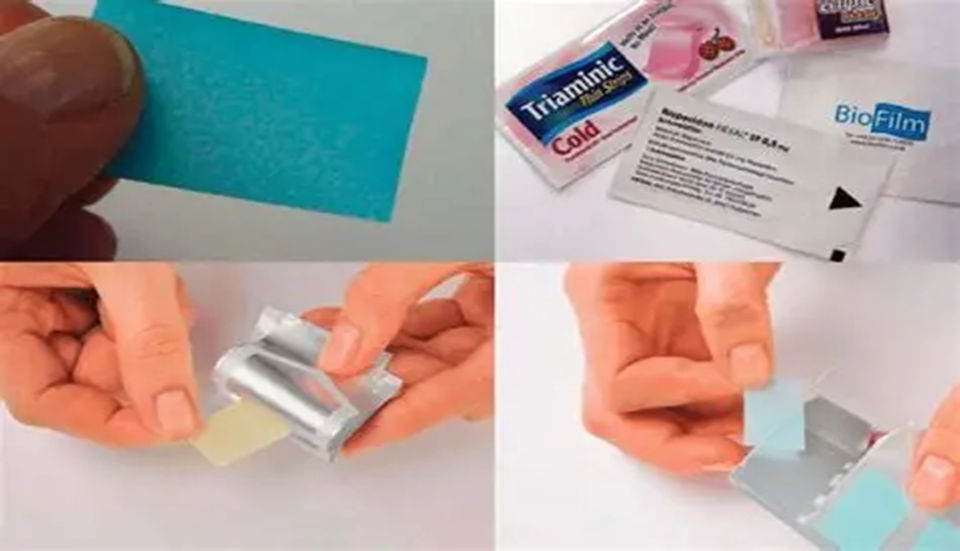
Fig.01. Oral Dispersible Films (ODFs)
Over the past ten years, ODFs have progressed from proof-of-concept research to practical applications. A number of nutraceuticals, over-the-counter items, and prescription medications have been developed as films, and publications describing new polymers, taste masking techniques, manufacturing scale-up, and quality control tools have steadily increased in the academic literature. Industrial production obstacles have been lowered by developments in polymer chemistry, solvent casting technology, and continuous manufacturing (such as roll-to-roll and hot melt extrusion). In order to improve drug loading, stability, and mucosal absorption, formulation scientists are progressively combining ODFs with contemporary supporting technologies, such as cyclodextrin complexes, mucoadhesive layers, and nanoparticle dispersions.
ODF development is significantly influenced by factors related to patient acceptance and regulations. Regulatory bodies need proof of consistent dosage, sufficient stability under specified humidity and temperature settings, repeatable disintegration, and acceptable organoleptic qualities (taste, mouthfeel). In order to guarantee commercial success, patient acceptability tests are frequently incorporated throughout early development. These studies measure criteria including mouth feel, flavour preference, and readiness to reuse.
Despite their great potential, ODFs have inherent limitations that influence formulation choices: many APIs have taste or stability issues, their practical drug loading is modest (small molecule APIs with low dose requirements are ideal), and the films are sensitive to moisture, requiring customised packaging solutions (blister packs, foil pouches) and suitable excipient selection.
The formulation techniques, excipient selection, production platforms, and analytical testing that guarantee strong ODF performance are all covered in detail in this study. Additionally, it emphasises current technical developments (such as customised 3D printed films, the use of nanocarriers, and nutraceutical ODFs) and points out significant obstacles that must be overcome before ODFs are widely used as a substitute for a wider variety of medications.
2. ADVANTAGES4
3. LIMITATIONS
4. EXCIPIENTS USED IN ODF FORMULATION5-7
4.1 Pharmaceutical Active Ingredients (APIs)
Because of the film's size restrictions, the drug dosage should preferably be modest. Usually, the drug content of the dried film falls between 5% and 30% w/w. smaller molecules that are highly lipophilic, less bitter, and soluble in water and saliva are ideal APIs.
The film's mechanical strength, rapid disintegration, and pleasant mouthfeel are provided by the film-forming agent (e.g., HPMC, Pullulan, PVA). Note: The rate of disintegration is slowed by higher polymer molecular weight.
Plasticisers, such as glycerol and PEGs, are essential for increasing the films' elongation, tensile strength, and flexibility.
Sweeteners (such as sucralose and aspartame) are necessary to mask the taste of bitter medications, which is crucial for patient compliance.
Acids added to the formulation to promote saliva production and speed up film disintegration are known as saliva-stimulating agents, such as citric acid.
To counteract a bad taste, flavouring agents (such as fruit essences and mints) are added; the concentration of these agents depends on the desired level of flavour.
Surfactants, such as Poloxamer 407 and sodium lauryl sulphate, function as solubilising, wetting, or dispersion agents to accelerate medication release and dissolution.
To improve the visual appeal, colouring agents (such titanium dioxide) are added, usually at amounts of no more than 1% w/w.
5. METHODS OF PREPARATION
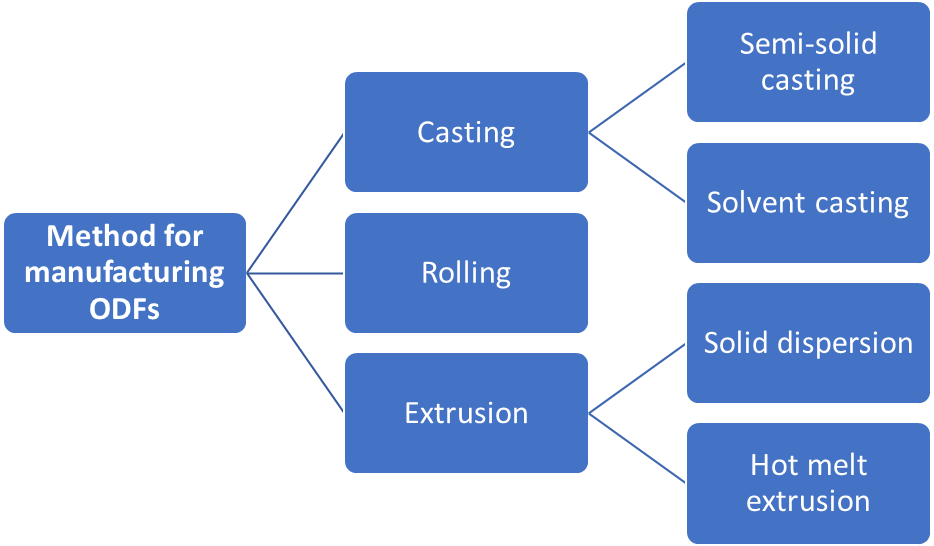
Tab.01 Method for manufacturing ODFs
5.1 Solvent Casting Method
The most widely used method. Steps include polymer dispersion, drug dissolution, mixing, deaeration, casting, drying, and cutting.
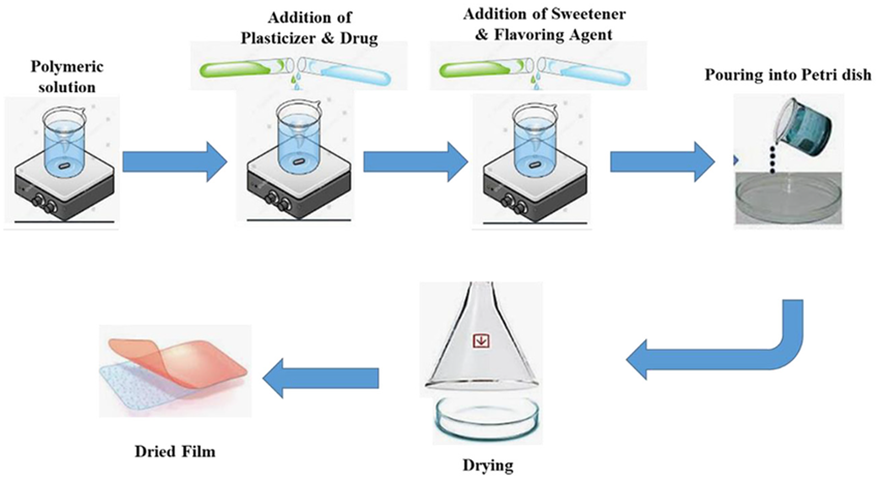
Fig.02. Solvent Casting Method
5.2 Hot-Melt Extrusion
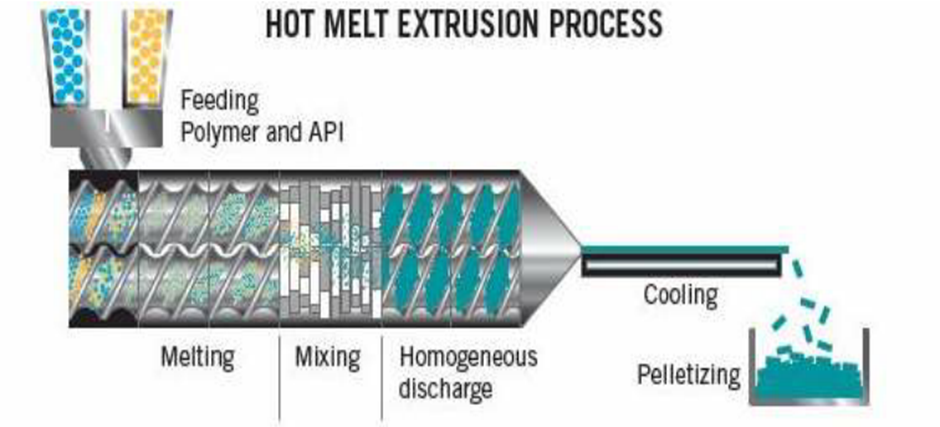
Fig. 03. Hot-Melt Extrusion method
5.3 Semisolid Casting
Useful for water-insoluble polymers.
5.4 Rolling Method
Continuous production through roller systems.
6. EVALUATION PARAMETERS
7. APPLICATIONS7
Present Situation of Oral Dispersible Films (2023–2025)14-15
The current state of Oral Dispersible Films (ODFs) is a result of significant advancements in technology, commercialisation, and research. ODFs have entered the mainstream pharmaceutical and nutraceutical sectors because to the growing need for patient-friendly and convenient dosage forms worldwide, particularly in paediatric, elderly, and dysphagic populations.
1. Increasing Demand in the Market
2. Trends in Industry and Commercialisation
3. Technological Advancements17
4. Regulatory Situation
5. Present Difficulties
6. Prospects for the Future (2025–2030)18
8. OBSTACLES AND PROSPECTS FOR THE FUTURE19
Improving stability; creating mucoadhesive and controlled-release ODFs; adding nanoparticles for targeted delivery; and using 3D printing to create customised films
9. CONCLUSION
ODFs are a promising, patient-friendly, and increasingly popular medication delivery method. It is anticipated that developments in materials and production techniques will increase their uses and enhance therapeutic results.
REFERENCES


Shubham Patel, Kavita Rana, Dr. Priyanka Patil, Oral Dispersible Films (ODFs), Int. J. of Pharm. Sci., 2026, Vol 4, Issue 1, 994-1000. https://doi.org/10.5281/zenodo.18207752
 10.5281/zenodo.18207752
