We use cookies to make sure that our website works properly, as well as some ‘optional’ cookies to personalise content and advertising, provide social media features and analyse how people use our site. Further information can be found in our Cookies policy
Vaccines are essential for preventing infectious diseases and form a crucial part of pharmacovigilance (PV). Vaccine pharmacovigilance focuses on the continuous detection, assessment, understanding, and prevention of adverse events following immunization (AEFIs). Post-marketing surveillance helps identify rare, unexpected, or delayed adverse reactions not observed during clinical trials. Global vaccine safety is maintained by the WHO, Uppsala Monitoring Centre (UMC), EudraVigilance, and VAERS, while in India, the AEFI surveillance system and the Pharmacovigilance Programme of India (PvPI) play key roles. Advances in artificial intelligence, digital reporting, and data analytics have improved the accuracy and sensitivity of safety monitoring. However, challenges such as underreporting, inconsistent data, and vaccine hesitancy persist. Strengthening vaccine pharmacovigilance requires proactive communication, global harmonization, and advanced data systems to ensure transparency, public trust, and effective long-term safety monitoring of vaccines.
Keywords
Pharmacovigilance, Vaccines, AEFI, Vaccine Safety, WHO, PvPI, Signal Detection, Risk Communication, Adverse Drug Reaction, Public Health
Introduction
One of the most successful public health initiatives, vaccines prevent millions of deaths each year by avoiding infectious illnesses as COVID-19, polio, measles, and hepatitis1. However, immunizations may have certain side effects, just like any other medical procedure. Pharmacovigilance has become a crucial part of immunisation programs across the world in order to guarantee their safety2-3.
Because of the special qualities of vaccines, they are given to sizable groups of healthy people with low risk tolerance, such as newborns and young children. Furthermore, rather than direct pharmaceutical effect, unpleasant events might be caused by the immunological response that the vaccination elicits. Consequently, vaccine pharmacovigilance need a customised strategy that incorporates strong causality evaluation techniques and specialized surveillance technologies4-5.
The public's view of vaccine safety and vaccination uptake have been impacted by adverse events following immunizations (AEFIs). Therefore, ongoing active and passive observation of AEFIs aids in the early detection of possible safety signals and the application of corrective actions6-7.
Global organizations including the European Medicines Agency (EMA), the Centres for Disease Control and Prevention (CDC), and the World Health Organization (WHO) have set up vast networks for monitoring vaccination safety. Adverse events connected to vaccines are gathered, examined, and assessed by the Pharmacovigilance Programme of India (PvPI) and the AEFI Surveillance System, which are in charge of vaccine pharmacovigilance in India8-9.
Data integration, artificial intelligence, and empirical evidence are currently transforming vaccine pharmacovigilance due to technology improvements.
In order to manage vaccine-related safety issues, modern techniques provide quick signal identification, effective reporting, and international cooperation. However, there are still problems including underreporting, false information, and healthcare providers' ignorance10.
Pharmacovigilance in vaccines is therefore not just a legal need but also a crucial ethical and scientific duty to guarantee the protection of the public's health. By encouraging openness, prompt reporting, and evidence-based communication, it closes the gap between scientific advancement and public trust11.
NEED AND SCOPE OF PHARMACOVIGILANCE IN VACCINES:
Public health protection: makes ensuring that AE associated with vaccines are identified early to protect people and communities12.
Safety in Healthy Populations: Even infrequent side effects need to be watched as vaccinations are given to healthy people. Finding delayed or uncommon side effects that are not visible in clinical trials is known as "detecting rare adverse events12."
Boosting Vaccine Confidence: Public confidence and vaccination compliance are increased when safety reporting is transparent13.
Regulatory Decision-Making: Offers proof for revising vaccination safety labelling, dose, or discontinuation13.
Vaccine quality monitoring: Assists in locating production flaws or lot-specific issues.
Support for Immunization Programs: Provides safe execution of national immunization policies14.
Global Health Security: Enables data exchange between nations to identify global safety indicators15.
Post-Marketing Surveillance: Uses real-world data to continue safety evaluation after clinical studies. Helps legislators create evidence-based vaccination safety rules through policy development15.
ADVERSE EVENTS FOLLOWING IMMUNIZATION (AEFI):
Any undesirable medical events that occur after a vaccination has been given and may or may not be directly related to the immunisation are known as adverse events following immunisation (AEFI) 16.
As it aids in detecting uncommon, severe, or unexpected events that can go undetected during clinical trials. In general, AEFIs fall into five categories: coincidental incidents, vaccination product-related, vaccine quality defect-related, immunisation error-related, and immunisation anxiety-related17.
Some AEFIs, including anaphylaxis, Guillain-Barre syndrome, or myocarditis, might be dangerous, although the majority are moderate and temporary, like fever, redness, or swelling. In order to determine causation, guarantee vaccination safety, and preserve public confidence in immunisation programs, accurate reporting and investigation of AEFIs are crucial.
Strong AEFI surveillance systems make it possible to identify signals early and take prompt regulatory action, which greatly enhances the overall effectiveness of international immunization campaigns18.
VACCINE PHARMACOVIGILANCE SYSTEMS (GLOBAL AND NATIONAL):
Vaccine pharmacovigilance systems are intended to track, assess, and guarantee the safety of vaccinations after they are put on the market. Because vaccinations are given to healthy populations, including fragile groups like newborns, children, and the elderly, where there are little tolerance for tolerating adverse effects, these systems are crucial19.
Global Systems
Several organizations coordinate vaccination safety monitoring on a global scale:
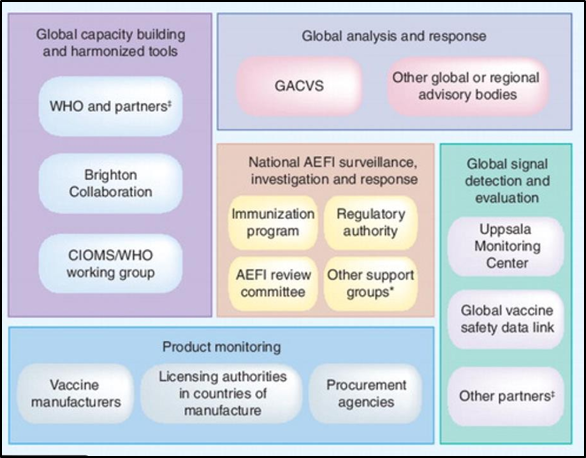
The Global Vaccine Safety Initiative (GVSI) of the World Health Organization (WHO) offers nations technical assistance, education, and direction for vaccine safety monitoring. It encourages uniform adverse event reporting and makes international data exchange easier20.
The WHO global database of Individual Case Safety Reports (ICSRs), VigiBase, is maintained by the Uppsala Monitoring Centre (UMC), enabling the discovery and assessment of uncommon addverse occurrences21.
The Vaccine Adverse Event Reporting System (VAERS), run by the Centres for Disease Control and Prevention (CDC), gathers unprompted reports of AEFIs in the US. The Vaccine Safety Datalink (VSD) and other active monitoring initiatives support this passive surveillance system21.
EudraVigilance, a program of the European Medicines Agency (EMA), supports regulatory decision-making for vaccines by monitoring adverse occurrences in Europe and facilitating quick safety signal detection22.
National Systems
Countries maintain their own pharmacovigilance programs to ensure vaccine safety at the local level:
India: AEFI Surveillance & Pharmacovigilance Programe of India (PvPI): This system is run by the Ministry of Health's Indian Pharmacopoeia Commission, gathers and assesses AEFI reports from medical facilities all around the nation. National committees monitor clusters, determine cause, and suggest remedial measures23.
Other Examples: A number of nations, including Canada's CAEFISS, Australia's AusVaxSafety, and Japan's PMDA vaccine safety monitoring system, maintain active and passive surveillance networks that are specific to their healthcare architecture24.
Fig.1: Global Capacity & Global Analysis
METHODS OF VACCINE SAFETY MONITORING:
In order to detect and assess adverse event occurrences, vaccine safety monitoring combines post- marketing research, epidemiological studies, and passive and active surveillance systems. The primary techniques consist of:
Passive Surveillance: Systems such as VAERS (USA) and PvPI-AEFI (India) depend on patients, care or healthcare professionals reporting on their own initiative. Large populations are covered and it is reasonably priced, however underreporting and missing data are frequent drawbacks.
Sentinel site and cohort event monitoring are examples of active surveillance, in which certain groups are closely monitored following immunisation in order to identify unfavorable outcomes. This approach can measure incidence rates and is more accurate25.
After receiving regulatory clearance, post-marketing (Phase IV) studies assess the safety and efficacy of vaccines and identify uncommon or postponed side effects that were missed during clinical trials26.
Case-Control and Cohort Studies: To ascertain correlations between vaccines and adverse outcomes, observational studies contrast populations that have received vaccinations with those who have not, or exposed groups with those that have not27.
Data mining and signal detection: From database VigiBase or EudraVigilance, sophisticated computational techniques such as Bayesian analysis and disproportionality metrics aid in the detection of early safety alerts28.
Field Investigations: Prompt evaluation of AEFI clusters at the regional or national level guarantees prompt action and cause determination29.
Studies on Real-World Evidence (RWE): Continuous monitoring of vaccination safety across a range of populations is made possible by the integration of insurance databases, mobile health applications, and electronic health records30.
CAUSALITY ASSESSMENT IN VACCINE PHARMACOVIGILANCE:
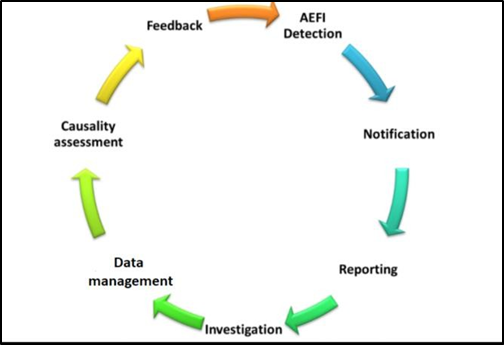
The methodical process of determining if a vaccination is to blame for an adverse event after immunisation (AEFI) is known as causation evaluation. It assists in distinguishing between incidents that are truly brought on by vaccination and those that are just coincidental. A systematic approach that takes into account biological plausibility, prior evidence, alternative hypotheses, and temporal relationship is advised by the World Health Organization (WHO). AEFIs are categorized as "consistent causal association," "indeterminate," "inconsistent causal association," and "unclassifiable" using tools like the WHO causality evaluation algorithm. Data from clinical trials, epidemiological research, and case reports are gathered for this procedure. Maintaining public confidence, directing regulatory measures, and assisting with risk-benefit analyses of vaccinations all depend on accurate causality assessment. It encourages open and honest contact with the public and healthcare providers30-32
Fig.2: Causality Assessment in Vaccine Pharmacovigilance
RISK COMMUNICATION AND PUBLIC PERCEPTION:
Successful risk communication is crucial to preserving public confidence and vaccination uptake.
Transparent Reporting: AEFI data should be communicated clearly to avoid misunderstandings and to foster trust32.
Resolving Vaccine Hesitancy: Active community involvement can allay concerns aboutadverse consequences32.
Training for Healthcare Professionals: healthcare professionals are better able to advise patients and promote the reporting of unfavorable incidents32.
Use of Media and Social Networks: Controlling public opinion requires accurate information to be disseminated via digital platforms, television, and newspapers.
Community Involvement: Public discussions and feedback channels encourage cooperation and confidence in vaccination initiatives33.
RECENT ADVANCES AND INNOVATIONS:
Vaccine pharmacovigilance has been greatly improved by modern technology:
Machine learning and artificial intelligence: sophisticated algorithms identify safety signs from massive databases in real-time, allowing for quick action.
Digital Reporting Tools: Patients and healthcare providers can directly report via internet platforms and mobile apps34.
Pharmacogenomics: Personalised risk assessment is made possible by the identification of genetic vulnerability to adverse events.
Block chain technology: vaccination safety data is recorded in a way that is safe, transparent, and impenetrable.
Global Collaboration Networks: Rapid identification and reaction to uncommon or new vaccine-related hazards are enhanced by shared worldwide databases35.
Big Data and Real-World Evidence: Monitoring across large populations is improved by integrating insurance claims, electronic health records, and population health data36.
CHALLENGES AND LIMITATIONS:
Vaccine pharmacovigilance still confronts a number of obstacles in spite of progress:
Underreporting: Because of a lack of knowledge or desire, many mild to moderate adverse events get unreported35.
Data Quality: Accurate causality evaluation is limited by reports that are inconsistent or incomplete35.
Limited Resources: It's possible that low- and middle-income nations lack the infrastructure and skilled workers necessary for thorough monitoring36.
Misinformation and Vaccine Hesitancy: Reporting and immunisation campaigns are hampered by public mistrust stoked by rumors or false information shared on social media.
Complex Causality: It's still challenging to distinguish vaccine-induced occurrences from unrelated or underlying issues.
Regulatory Fragmentation: Harmonized vaccine safety evaluation may be hampered by differences in international reporting standards and terminologies36.\
FUTURE PERSPECTIVES:
Global Harmonisation: Uniformity in reporting, categorizing, and determining causality among nations.
Advanced Analytics: Predictive modelling, AI, and machine learning are used to identify high-risk groups.
Integration of Digital Health Tools: Continuous safety data gathering using wearable technology and smartphone applications for real-time monitoring.
Improved Training and Capacity Building: Increasing the expertise in public health and healthcare professionals to raise the calibre of reporting.
Community Engagement: To increase openness and confidence, patients' and the community's involvement in vaccination safety monitoring is encouraged.
Proactive communication:refers to deliberate communication efforts that refute false information and encourage the use of evidence in decision-making.
Research and Innovation: Individualized risk assessment and genomic-based vaccination safety techniques37-41.
CONCLUSION:
Pharmacovigilance vaccines programme, which guarantees that immunisation continue to be safe, efficient, and regarded with confidence by the general public. Health authorities can detect uncommon, unanticipated, or delayed responses that would not be noticeable during pre-licensure clinical trials by systematically monitoring adverse events following immunizations (AEFIs). Technological developments like digital reporting systems, artificial intelligence, and the incorporation of real-world evidence have all improved vaccination safety monitoring. But issues including under reporting, variable data quality, vaccination reluctance, and a lack of international harmonisation continue to exist, underscoring the necessity of pharmacovigilance systems being continuously improved. Maintaining public trust in vaccinations requires proactive community involvement, transparent risk communication, and training for healthcare providers. In the future, combining digital health technologies, pharmacogenomics, and predictive analytics can improve personalised safety monitoring by facilitating early intervention and quick identification of high-risk groups. Pharmacovigilance will continue to protect public health by fostering evidence-based policies, standardizing reporting structures, and bolstering international cooperation.
REFERENCES
Aborigo, R. A., Welaga, P., Oduro, A., Shaum, A., Opare, J., Dodoo, A., et al. (2022). Optimising reporting of adverse events following immunisation by healthcare workers in Ghana: A qualitative study in four regions. PLoS ONE, 17(12), e0277197. https://doi.org/10.1371/journal.pone.0277197
Blau, E. F. (2023). Progress in immunization safety monitoring. Vaccine Safety Journal, 41(6), 1123-1131. https://doi.org/10.1016/j.vsj.2023.04.007
Chandler, R. E., et al. (2024). Collaboration within the global vaccine safety surveillance ecosystem during the COVID-19 pandemic: Lessons learnt and key recommendations from the COVAX Vaccine Safety Working Group. BMJ Global Health, 9(3), e014544. https://doi.org/10.1136/bmjgh-2023-014544
Chen, R. T., et al. (2015). Enhancing vaccine safety capacity globally. Vaccine, 33(43), 5861-5868. https://doi.org/10.1016/j.vaccine.2015.08.061
Hodel, K. V. S. (2024). Pharmacovigilance in vaccines: Importance, main aspects, perspectives, and challenges—a narrative review. Frontiers in Pharmacology, 15, 807. https://doi.org/10.3389/fphar.2024.000807
Mues, K. E., et al. (2025). A review of methodological and data considerations for vaccine pharmacovigilance. Vaccine, 43(1), 1-9. https://doi.org/10.1016/j.vaccine.2024.10.002
Piché-Renaud, P. P., et al. (2022). A narrative review of vaccine pharmacovigilance during mass vaccination campaigns. Vaccine 40 (50), 7178-7186. https://doi.org/10.1016/j.vaccine.2022.10.043
Salmon, D. A., et al. (2024). A path to a more robust vaccine safety program. Vaccine, 42(12), 1456-1464. https://doi.org/10.1016/j.vaccine.2024.01.012
ShamaeiZadeh, P. A., et al. (2024). Landscape review of active vaccine safety surveillance: Global trends and challenges. Vaccine, 42(30), 4201-4210. https://doi.org/10.1016/j.vaccine.2024.05.019
World Health Organization. (2023). Monitoring vaccine safety and adverse events following immunization. https://www.who.int/westernpacific/activities/monitoring-vaccine-safety-and- adverse-events-following-immunization
World Health Organization. (2023). Monitoring vaccine safety. https://www.who.int/groups/global-advisory-committee-on-vaccine- safety/topics/aefi/monitoring-vaccine-safety
World Health Organization. (2023). Tools and innovations in pharmacovigilance. https://www.who.int/teams/regulation-prequalification/regulation-and- safety/pharmacovigilance/guidance/operations/tools-innovations
World Health Organization. (2023). Pharmacovigilance: The science and activities relating to the detection, assessment, understanding, and prevention of adverse effects or any other drug- related problem. https://www.who.int/teams/regulation-prequalification/regulation-and- safety/pharmacovigilance
Centers for Disease Control and Prevention. (2024). Chapter 4: Vaccine safety. In Epidemiology and Prevention of Vaccine-Preventable Diseases (13th ed.). https://www.cdc.gov/vaccines/pubs/pinkbook/index.html
Centers for Disease Control and Prevention. (2024). Chapter 21: Surveillance for adverse events following immunization using the Vaccine Adverse Event Reporting System (VAERS). In Epidemiology and Prevention of Vaccine-Preventable Diseases (13th ed.). https://www.cdc.gov/vaccines/pubs/pinkbook/index.html
Public Health Ontario. (2022). Adverse events following immunization (AEFIs) for COVID- 19 in Ontario. https://www.publichealthontario.ca/-/media/documents/ncov/epi/covid-19-aefi- report.pdf
Rudolph, A., et al. (2022). Global safety monitoring of COVID-19 vaccines. SAGE Open Medicine, 10, 20420986221118972. https://doi.org/10.1177/20420986221118972
ShamaeiZadeh, P. A., et al. (2024). Active vaccine safety surveillance: Global trends and challenges in China. Health Data Science, 7(1), 9851067. https://doi.org/10.34133/2021/9851067
WHO Collaborating Centre for International Drug Monitoring. (2023). VigiBase: The WHO global individual case safety reports database. https://www.who-umc.org/vigibase/vigibase/
World Health Organization. (2023). Global vaccine safety initiative. https://www.who.int/vaccine_safety/initiative/en/
World Health Organization. (2023). Global Advisory Committee on Vaccine Safety. https://www.who.int/groups/global-advisory-committee-on-vaccine-safety • Council for International Organizations of Medical Sciences (CIOMS) & World Health Organization (WHO). (2012). Definition and application of terms for vaccine pharmacovigilance: Report of CIOMS Working Group on Vaccine Pharmacovigilance. CIOMS.
World Health Organization (WHO). (2016). Global manual on surveillance of adverse events following immunization: 2016 update. WHO Press.
World Health Organization (WHO). (2020). Vaccine safety basics: Learning manual. WHO Press.
World Health Organization (WHO). (2022). Guidance for the operationalisation of active vaccine safety surveillance in resource-limited settings. WHO Press.
Council of Europe. (2021). Guide for the safe and effective use of vaccines: Pharmacovigilance and risk management. European Directorate for the Quality of Medicines & HealthCare (EDQM).
European Medicines Agency (EMA). (2017). Guideline on good pharmacovigilance practices (GVP): Module XVI – Post-authorisation safety studies (Rev. 2). EMA.
Food and Drug Administration (FDA). (2011). Guidance for industry: Good pharmacovigilance practices and pharmacoepidemiologic assessment. U.S. Department of Health and Human Services.
Chen, R. T., Glasser, J. W., Rhodes, P. H., Davis, R. L., Barlow, W. E., Thompson, R. S., Black, S. B., Shinefield, H. R., Mullooly, J. P., Vadheim, C. M., Ward, J. I., & Marcy, S. M. (1997). The Vaccine Safety Datalink project: A new tool for improving vaccine safety monitoring in the United States. Pediatrics, 99(6), 765–773.
Baggs, J., Gee, J., Crosby, A., & Thompson, R. S. (2011). The Vaccine Safety Datalink: A model for monitoring immunization safety. Pediatrics, 127(Suppl 1), S45–S53.
Farrington, C. P., Nash, R., & Miller, E. (2004). Case series analysis of adverse events following vaccination. Statistics in Medicine, 23(23), 3465–3483.
Petersen, I., Douglas, I., & Whitaker, H. (2016). Self-controlled case series methods: An alternative to standard epidemiological study designs. The BMJ, 354, i4515.
Shimabukuro, T. T., Nguyen, M., & Martin, D. (2022). Passive vaccine safety surveillance in the US: A systematic review of the Vaccine Adverse Event Reporting System (VAERS) literature. Vaccine, 40(20), 2883–2890.
Lieu, T. A., Kulldorff, M., Martin, D., & Weintraub, E. S. (2007). Active surveillance for adverse events: The experience of the Vaccine Safety Datalink project. Pediatrics, 120(Suppl 1), S1–S7.
Bohlke, K., Davis, R. L., Marcy, S. M., Braun, M. M., DeStefano, F., & Black, S. B. (2003). Risk of anaphylaxis after vaccination of children and adolescents. Pediatrics, 112(4), 815–820.
Salmon, D. A., Moulton, L. H., Omer, S. B., & DeStefano, F. (2006). Competing definitions of vaccines and vaccine safety in the U.S. American Journal of Epidemiology, 163(11), 975– 983.
Pollard, A. J., & Bijker, E. M. (2021). A guide to vaccinology: From basic principles to new developments. Nature Reviews Immunology, 21(2), 83–100.
Black, S., Baggs, J., & Ball, R. (2011). Scientific evaluation of vaccine safety. Vaccine, 29(44), 7701–7706.
Riefkohl, A., Leeb, C., & Strik, M. (2020). Pharmacovigilance in the field of vaccines: A narrative review of global efforts and challenges. Vaccines, 8(3), 341.
MacMunn, A., Calvo, B., & Velo, G. (2017). Vaccine pharmacovigilance: Current issues and future directions. Drug Safety, 40(9), 743–755.
Bonhoeffer, J., & Gold, M. S. (2020). Key steps in vaccine safety assessment during and after licensure. Expert Review of Vaccines, 19(3), 273–284.
Kwong, J. C., Ducharme, R., Manuel, D. G., & Rosella, L. C. (2018). The global state of vaccine safety science and the challenges ahead. The Lancet Global Health, 6(4), e447–e456.
Reference
Aborigo, R. A., Welaga, P., Oduro, A., Shaum, A., Opare, J., Dodoo, A., et al. (2022). Optimising reporting of adverse events following immunisation by healthcare workers in Ghana: A qualitative study in four regions. PLoS ONE, 17(12), e0277197. https://doi.org/10.1371/journal.pone.0277197
Blau, E. F. (2023). Progress in immunization safety monitoring. Vaccine Safety Journal, 41(6), 1123-1131. https://doi.org/10.1016/j.vsj.2023.04.007
Chandler, R. E., et al. (2024). Collaboration within the global vaccine safety surveillance ecosystem during the COVID-19 pandemic: Lessons learnt and key recommendations from the COVAX Vaccine Safety Working Group. BMJ Global Health, 9(3), e014544. https://doi.org/10.1136/bmjgh-2023-014544
Chen, R. T., et al. (2015). Enhancing vaccine safety capacity globally. Vaccine, 33(43), 5861-5868. https://doi.org/10.1016/j.vaccine.2015.08.061
Hodel, K. V. S. (2024). Pharmacovigilance in vaccines: Importance, main aspects, perspectives, and challenges—a narrative review. Frontiers in Pharmacology, 15, 807. https://doi.org/10.3389/fphar.2024.000807
Mues, K. E., et al. (2025). A review of methodological and data considerations for vaccine pharmacovigilance. Vaccine, 43(1), 1-9. https://doi.org/10.1016/j.vaccine.2024.10.002
Piché-Renaud, P. P., et al. (2022). A narrative review of vaccine pharmacovigilance during mass vaccination campaigns. Vaccine 40 (50), 7178-7186. https://doi.org/10.1016/j.vaccine.2022.10.043
Salmon, D. A., et al. (2024). A path to a more robust vaccine safety program. Vaccine, 42(12), 1456-1464. https://doi.org/10.1016/j.vaccine.2024.01.012
ShamaeiZadeh, P. A., et al. (2024). Landscape review of active vaccine safety surveillance: Global trends and challenges. Vaccine, 42(30), 4201-4210. https://doi.org/10.1016/j.vaccine.2024.05.019
World Health Organization. (2023). Monitoring vaccine safety and adverse events following immunization. https://www.who.int/westernpacific/activities/monitoring-vaccine-safety-and- adverse-events-following-immunization
World Health Organization. (2023). Monitoring vaccine safety. https://www.who.int/groups/global-advisory-committee-on-vaccine- safety/topics/aefi/monitoring-vaccine-safety
World Health Organization. (2023). Tools and innovations in pharmacovigilance. https://www.who.int/teams/regulation-prequalification/regulation-and- safety/pharmacovigilance/guidance/operations/tools-innovations
World Health Organization. (2023). Pharmacovigilance: The science and activities relating to the detection, assessment, understanding, and prevention of adverse effects or any other drug- related problem. https://www.who.int/teams/regulation-prequalification/regulation-and- safety/pharmacovigilance
Centers for Disease Control and Prevention. (2024). Chapter 4: Vaccine safety. In Epidemiology and Prevention of Vaccine-Preventable Diseases (13th ed.). https://www.cdc.gov/vaccines/pubs/pinkbook/index.html
Centers for Disease Control and Prevention. (2024). Chapter 21: Surveillance for adverse events following immunization using the Vaccine Adverse Event Reporting System (VAERS). In Epidemiology and Prevention of Vaccine-Preventable Diseases (13th ed.). https://www.cdc.gov/vaccines/pubs/pinkbook/index.html
Public Health Ontario. (2022). Adverse events following immunization (AEFIs) for COVID- 19 in Ontario. https://www.publichealthontario.ca/-/media/documents/ncov/epi/covid-19-aefi- report.pdf
Rudolph, A., et al. (2022). Global safety monitoring of COVID-19 vaccines. SAGE Open Medicine, 10, 20420986221118972. https://doi.org/10.1177/20420986221118972
ShamaeiZadeh, P. A., et al. (2024). Active vaccine safety surveillance: Global trends and challenges in China. Health Data Science, 7(1), 9851067. https://doi.org/10.34133/2021/9851067
WHO Collaborating Centre for International Drug Monitoring. (2023). VigiBase: The WHO global individual case safety reports database. https://www.who-umc.org/vigibase/vigibase/
World Health Organization. (2023). Global vaccine safety initiative. https://www.who.int/vaccine_safety/initiative/en/
World Health Organization. (2023). Global Advisory Committee on Vaccine Safety. https://www.who.int/groups/global-advisory-committee-on-vaccine-safety • Council for International Organizations of Medical Sciences (CIOMS) & World Health Organization (WHO). (2012). Definition and application of terms for vaccine pharmacovigilance: Report of CIOMS Working Group on Vaccine Pharmacovigilance. CIOMS.
World Health Organization (WHO). (2016). Global manual on surveillance of adverse events following immunization: 2016 update. WHO Press.
World Health Organization (WHO). (2020). Vaccine safety basics: Learning manual. WHO Press.
World Health Organization (WHO). (2022). Guidance for the operationalisation of active vaccine safety surveillance in resource-limited settings. WHO Press.
Council of Europe. (2021). Guide for the safe and effective use of vaccines: Pharmacovigilance and risk management. European Directorate for the Quality of Medicines & HealthCare (EDQM).
European Medicines Agency (EMA). (2017). Guideline on good pharmacovigilance practices (GVP): Module XVI – Post-authorisation safety studies (Rev. 2). EMA.
Food and Drug Administration (FDA). (2011). Guidance for industry: Good pharmacovigilance practices and pharmacoepidemiologic assessment. U.S. Department of Health and Human Services.
Chen, R. T., Glasser, J. W., Rhodes, P. H., Davis, R. L., Barlow, W. E., Thompson, R. S., Black, S. B., Shinefield, H. R., Mullooly, J. P., Vadheim, C. M., Ward, J. I., & Marcy, S. M. (1997). The Vaccine Safety Datalink project: A new tool for improving vaccine safety monitoring in the United States. Pediatrics, 99(6), 765–773.
Baggs, J., Gee, J., Crosby, A., & Thompson, R. S. (2011). The Vaccine Safety Datalink: A model for monitoring immunization safety. Pediatrics, 127(Suppl 1), S45–S53.
Farrington, C. P., Nash, R., & Miller, E. (2004). Case series analysis of adverse events following vaccination. Statistics in Medicine, 23(23), 3465–3483.
Petersen, I., Douglas, I., & Whitaker, H. (2016). Self-controlled case series methods: An alternative to standard epidemiological study designs. The BMJ, 354, i4515.
Shimabukuro, T. T., Nguyen, M., & Martin, D. (2022). Passive vaccine safety surveillance in the US: A systematic review of the Vaccine Adverse Event Reporting System (VAERS) literature. Vaccine, 40(20), 2883–2890.
Lieu, T. A., Kulldorff, M., Martin, D., & Weintraub, E. S. (2007). Active surveillance for adverse events: The experience of the Vaccine Safety Datalink project. Pediatrics, 120(Suppl 1), S1–S7.
Bohlke, K., Davis, R. L., Marcy, S. M., Braun, M. M., DeStefano, F., & Black, S. B. (2003). Risk of anaphylaxis after vaccination of children and adolescents. Pediatrics, 112(4), 815–820.
Salmon, D. A., Moulton, L. H., Omer, S. B., & DeStefano, F. (2006). Competing definitions of vaccines and vaccine safety in the U.S. American Journal of Epidemiology, 163(11), 975– 983.
Pollard, A. J., & Bijker, E. M. (2021). A guide to vaccinology: From basic principles to new developments. Nature Reviews Immunology, 21(2), 83–100.
Black, S., Baggs, J., & Ball, R. (2011). Scientific evaluation of vaccine safety. Vaccine, 29(44), 7701–7706.
Riefkohl, A., Leeb, C., & Strik, M. (2020). Pharmacovigilance in the field of vaccines: A narrative review of global efforts and challenges. Vaccines, 8(3), 341.
MacMunn, A., Calvo, B., & Velo, G. (2017). Vaccine pharmacovigilance: Current issues and future directions. Drug Safety, 40(9), 743–755.
Bonhoeffer, J., & Gold, M. S. (2020). Key steps in vaccine safety assessment during and after licensure. Expert Review of Vaccines, 19(3), 273–284.
Kwong, J. C., Ducharme, R., Manuel, D. G., & Rosella, L. C. (2018). The global state of vaccine safety science and the challenges ahead. The Lancet Global Health, 6(4), e447–e456.
Aditya Panage
Corresponding author
Samarth College of Pharmacy, Belhe, Pune, Maharashtra, India, 412410






 10.5281/zenodo.17869018
