
1 Amity University of Mumbai
2 Biology and ESS Facilitator for IB DP, Adani International School
3,4,5,6 Department of Biological Sciences, VIVA College of Arts, Commerce and Science, Virar
Medicinal plants have long been recognized as valuable sources of bioactive compounds with therapeutic potential. The present study aimed to evaluate the phytochemical constituents and antimicrobial activity of selected medicinal plants traditionally used in the Rajkot region of Gujarat, India. Leaf extracts of Azadirachta indica, Ocimum sanctum, Tinospora cordifolia, and Withania somnifera were prepared using aqueous and methanolic solvents. Qualitative phytochemical screening revealed the presence of alkaloids, flavonoids, phenolics, tannins, saponins, and terpenoids in varying proportions. The antimicrobial activity of the extracts was assessed using the agar well diffusion method against selected bacterial (Escherichia coli, Staphylococcus aureus) and fungal (Candida albicans) strains. Methanolic extracts exhibited significantly higher antimicrobial activity compared to aqueous extracts, with maximum inhibition observed against Staphylococcus aureus. The findings suggest that medicinal plants from the Rajkot region possess promising antimicrobial potential, supporting their traditional use and highlighting their importance as sources of natural antimicrobial agents.
Medicinal plants have been an integral component of traditional healthcare systems since ancient times and continue to play a vital role in modern medicine. Natural products derived from plants represent one of the most significant sources of bioactive compounds, contributing substantially to the development of therapeutic agents used worldwide. Even today, the World Health Organization estimates that a large proportion of the global population relies on plant-based medicines for primary healthcare, particularly in developing countries where access to modern pharmaceuticals is limited. In recent decades, the emergence and rapid spread of antimicrobial resistance have become a major global health challenge. The excessive and indiscriminate use of synthetic antibiotics has resulted in the development of resistant microbial strains, reducing the effectiveness of conventional treatments. This alarming situation has intensified the search for alternative antimicrobial agents that are effective, safe, and environmentally sustainable. Medicinal plants offer a promising solution, as they contain a diverse array of secondary metabolites capable of inhibiting microbial growth through multiple mechanisms, thereby lowering the likelihood of resistance development. Phytochemicals such as alkaloids, flavonoids, phenolic compounds, tannins, saponins, glycosides, and terpenoids are widely recognized for their antimicrobial, antioxidant, anti-inflammatory, and immunomodulatory properties. These bioactive constituents act either individually or synergistically to exert therapeutic effects. Qualitative phytochemical screening serves as an important preliminary step in identifying these compounds and understanding the medicinal potential of plant species. Moreover, correlating phytochemical profiles with antimicrobial activity provides scientific validation for traditional medicinal practices.
India is recognized as one of the world’s richest repositories of medicinal plants, owing to its diverse climatic conditions, varied ecosystems, and long-standing tradition of herbal medicine systems such as Ayurveda, Siddha, and Unani. Gujarat, located in western India, is characterized by a wide range of ecological zones, including semi-arid regions that support the growth of numerous medicinal plant species with high therapeutic value. The Saurashtra region, particularly Rajkot district, is known for its ethnomedicinal heritage, where local communities extensively use indigenous plants for treating infectious diseases, skin disorders, gastrointestinal ailments, and inflammatory conditions. Despite the widespread traditional use of medicinal plants in the Rajkot region, scientific studies documenting their phytochemical composition and antimicrobial efficacy remain limited. Systematic evaluation of these plants is essential not only to validate traditional knowledge but also to identify potential candidates for the development of novel antimicrobial agents. Plants such as Azadirachta indica (Neem), Ocimum sanctum (Tulsi), Tinospora cordifolia (Giloy), and Withania somnifera (Ashwagandha) are commonly used in Indian traditional medicine and are known for their broad-spectrum pharmacological activities. However, comparative studies focusing on their phytochemical constituents and antimicrobial potential from a specific geographical region such as Rajkot are scarce. Geographical and environmental factors significantly influence the phytochemical composition of medicinal plants.
MATERIALS AND METHODS
Study Area and Experimental Design
The present investigation was conducted to evaluate the phytochemical constituents and antimicrobial activity of selected medicinal plants collected from the Rajkot district of Gujarat, India. Rajkot is situated in the semi-arid region of Saurashtra and experiences hot summers, moderate monsoons, and mild winters. The study followed an experimental laboratory-based design involving plant collection, extraction, qualitative phytochemical screening, and antimicrobial bioassays.
Collection and Authentication of Plant Material
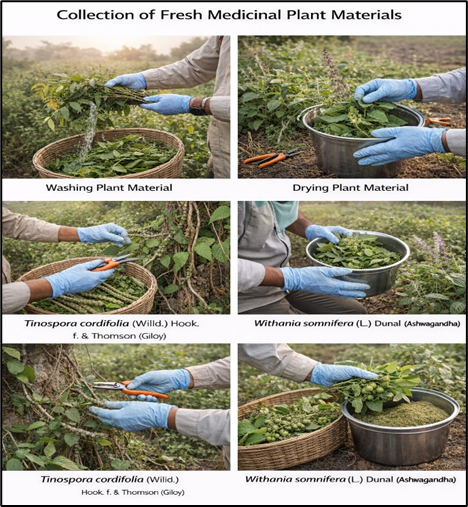
Fresh and disease-free plant materials were collected from different locations in and around Rajkot district during the early morning hours to minimize phytochemical degradation. The collected plant parts primarily included mature leaves of the selected medicinal plants.
The plant species selected for the study were:
All plant specimens were authenticated by a qualified taxonomist, and voucher specimens were deposited in the departmental herbarium for future reference.
Preparation of Plant Material
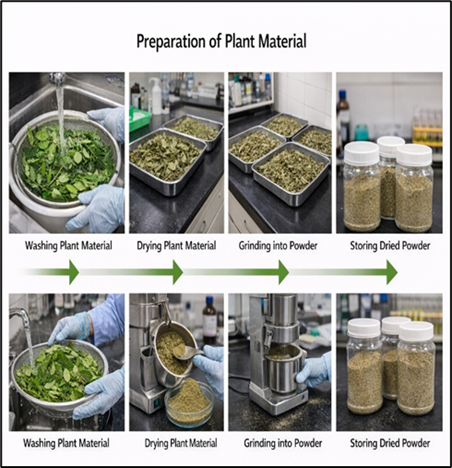
The collected plant materials were washed thoroughly under running tap water followed by rinsing with distilled water to remove adhering dust and contaminants. The plant materials were shade-dried at room temperature (28–30 °C) for 10–15 days until a constant weight was obtained. Dried samples were coarsely powdered using a sterile mechanical grinder and stored in airtight containers until extraction.
Preparation of Plant Extracts
Methanolic Extraction
Approximately 10 g of dried plant powder was subjected to Soxhlet extraction using 100 mL of analytical-grade methanol for 6–8 hours. The obtained extract was filtered using Whatman No. 1 filter paper and concentrated under reduced pressure using a rotary evaporator. The concentrated extract was stored at 4 °C until further analysis.
Aqueous Extraction
For aqueous extraction, 10 g of plant powder was boiled in 100 mL of distilled water for 30 minutes. The extract was allowed to cool, filtered, and concentrated. The dried extracts were stored in sterile containers at 4 °C.
Qualitative Phytochemical Screening
Qualitative phytochemical screening of methanolic and aqueous extracts was performed using standard chemical tests to detect the presence of major secondary metabolites. Each test was carried out in triplicate.
RESULTS
Phytochemical Screening
Table 1: Qualitative Phytochemical Analysis of Plant Extracts
|
Phytochemical |
A. indica |
O. sanctum |
T. cordifolia |
W. somnifera |
|
Alkaloids |
+ |
+ |
+ |
+ |
|
Flavonoids |
+ |
++ |
+ |
++ |
|
Phenolics |
++ |
++ |
+ |
++ |
|
Tannins |
+ |
+ |
– |
+ |
|
Saponins |
– |
+ |
+ |
– |
|
Terpenoids |
+ |
+ |
++ |
+ |
Key: (+ Present, ++ Strongly present, – Absent)
Antimicrobial Activity
Table 2: Zone of Inhibition (mm, Mean ± SD)
|
Plant |
E. coli |
S. aureus |
C. albicans |
|
A. indica |
13.2 ± 0.6 |
16.5 ± 0.8 |
12.1 ± 0.5 |
|
O. sanctum |
14.8 ± 0.7 |
18.3 ± 0.9 |
13.6 ± 0.6 |
|
T. cordifolia |
12.4 ± 0.5 |
15.2 ± 0.7 |
11.8 ± 0.4 |
|
W. somnifera |
13.9 ± 0.6 |
17.6 ± 0.8 |
14.2 ± 0.7 |
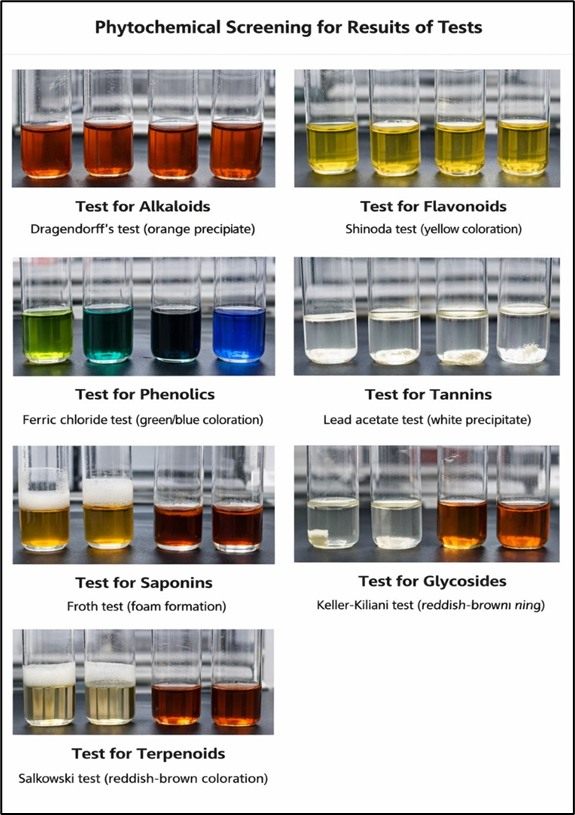
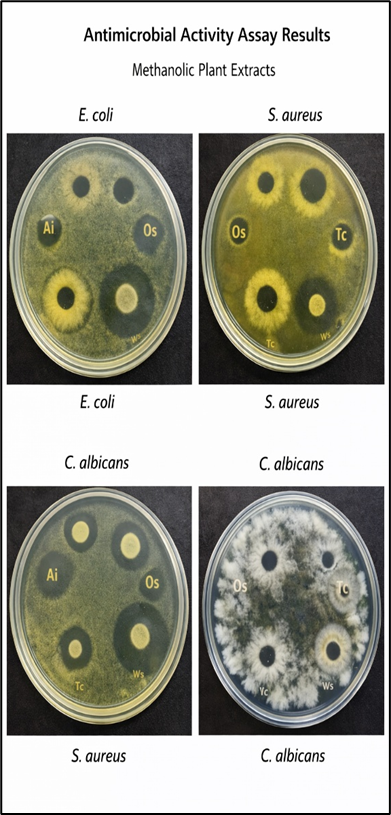
Images of Qualitative Phytochemical Analysis of Plant Extracts and Zone of Inhibition (mm, Mean ± SD)
DISCUSSION
The present study provides a comprehensive evaluation of the phytochemical composition and antimicrobial potential of selected medicinal plants collected from the Rajkot region of Gujarat. The findings clearly demonstrate that all investigated plant species possess a diverse range of secondary metabolites and exhibit varying degrees of antimicrobial activity against tested bacterial and fungal pathogens. These results strongly support the traditional medicinal use of these plants and reinforce their relevance in the search for alternative antimicrobial agents.
Qualitative phytochemical screening revealed the presence of alkaloids, flavonoids, phenolic compounds, tannins, saponins, glycosides, and terpenoids in both methanolic and aqueous extracts, although the intensity of these constituents varied among plant species. Methanolic extracts consistently showed a richer phytochemical profile compared to aqueous extracts. This observation may be attributed to the higher extraction efficiency of organic solvents for non-polar and moderately polar phytochemicals. Similar trends have been reported in earlier phytochemical investigations, where methanol was found to be a superior solvent for extracting bioactive compounds.
Flavonoids and phenolic compounds were detected prominently in Ocimum sanctum and Withania somnifera. These compounds are well known for their antimicrobial properties, primarily due to their ability to disrupt microbial cell membranes, inhibit nucleic acid synthesis, and interfere with energy metabolism. The presence of tannins in Azadirachta indica may further contribute to its antimicrobial activity by forming complexes with microbial proteins and enzymes, thereby inhibiting microbial growth. Saponins, detected in Tinospora cordifolia, are known to enhance membrane permeability, which may facilitate antimicrobial action.
The antimicrobial activity results indicated that methanolic extracts exhibited significantly higher zones of inhibition compared to aqueous extracts, suggesting a direct relationship between phytochemical concentration and antimicrobial efficacy. Among the tested microorganisms, Staphylococcus aureus showed the highest susceptibility, followed by Escherichia coli, while Candida albicans exhibited relatively lower sensitivity. The higher susceptibility of Gram-positive bacteria can be attributed to their simpler cell wall structure, which lacks the outer lipopolysaccharide membrane present in Gram-negative bacteria, thereby allowing easier penetration of bioactive compounds. The observed antifungal activity against Candida albicans indicates the presence of compounds capable of disrupting fungal cell wall integrity and metabolic processes. Although fungal strains generally exhibit higher resistance to plant extracts, the moderate inhibition observed in the present study highlights the therapeutic potential of these medicinal plants against fungal infections. Geographical factors play a crucial role in influencing phytochemical composition. The semi-arid climatic conditions of the Rajkot region may contribute to the accumulation of stress-induced secondary metabolites, enhancing the medicinal value of these plants. Environmental stress conditions such as high temperature and limited water availability are known to stimulate the synthesis of protective phytochemicals, which may explain the notable antimicrobial activity observed in the present study.
Overall, the findings of this study align well with previously reported antimicrobial studies on medicinal plants while also providing region-specific insights. The correlation between phytochemical presence and antimicrobial activity emphasizes the importance of phytochemical screening as a preliminary step in drug discovery. However, the study is limited to qualitative phytochemical analysis and in vitro antimicrobial assays. Further investigations involving quantitative analysis, compound isolation, and mechanistic studies are necessary to fully elucidate the therapeutic potential of these plants.
CONCLUSION
The present investigation systematically evaluated the phytochemical composition and antimicrobial activity of selected medicinal plants from the Rajkot region of Gujarat. The study revealed that all examined plant species contain a diverse range of bioactive phytochemicals, including alkaloids, flavonoids, phenolics, tannins, saponins, glycosides, and terpenoids, which are known to contribute to antimicrobial efficacy. Methanolic extracts exhibited superior antimicrobial activity compared to aqueous extracts, highlighting the influence of solvent selection on phytochemical extraction.
The significant inhibitory effects observed against bacterial and fungal pathogens, particularly Staphylococcus aureus, validate the traditional medicinal use of these plants and underscore their potential as sources of natural antimicrobial agents. The findings further suggest that medicinal plants growing in the semi-arid conditions of Rajkot possess enhanced phytochemical diversity and biological activity.
In conclusion, this study provides scientific evidence supporting the antimicrobial potential of selected medicinal plants and emphasizes their importance in addressing the growing challenge of antimicrobial resistance. The results lay a strong foundation for future research focused on the isolation, characterization, and pharmacological evaluation of active compounds. The integration of traditional knowledge with modern scientific approaches may facilitate the development of plant-based antimicrobial therapeutics and promote sustainable utilization of medicinal plant resources.
REFERENCES


Devesh Machhi, Deepak Chaudhary, Swara Mhatre, Mehek Agrawal, Annu Gupta, Nikita Dige, Phytochemical Screening and Antimicrobial Evaluation of Selected Medicinal Plants, Int. J. of Pharm. Sci., 2026, Vol 4, Issue 2, 2334-2341. https://doi.org/10.5281/zenodo.18651133
 10.5281/zenodo.18651133
