
Shree Mahavir Education Society’s Shree Mahavir Institute of Pharmacy, Gut No. 166, Mhasrul, Varvandi Rd, Nashik, 422003, Maharashtra, India
Acacia catechu (L.f.) Willd, commonly known as Khadira or Black Catechu, is a deciduous tree of the Fabaceae family with a profound history in traditional systems of medicine, including Ayurveda and Unani. Historically utilized for over 2,500 years, the plant is renowned for its therapeutic applications in treating dermatological disorders, gastrointestinal ailments, and oral hygiene issues. With the advent of modern chromatographic and spectroscopic technologies, the pharmacological potential of A. Catechu has been substantiated through the isolation of bioactive phytoconstituents such as catechins, taxifolin, quercetin, and kaempferol. This review aims to provide a critical analysis of the botanical description, phytochemical composition, and pharmacological activities of A. Catechu, including its antimicrobial, antioxidant, hepatoprotective, antidiabetic, and immunomodulatory properties. Furthermore, this paper synthesizes recent findings regarding its efficacy in treating non-healing ulcers and its potential cytotoxic effects on cancer cell lines. While the plant demonstrates a favorable safety profile, this review also highlights the necessity for further clinical trials to standardize dosage and validate its mechanism of action in human subjects.
The exploration of natural products for drug discovery has gained significant momentum due to their structural diversity and multi-target therapeutic potential [1]. Acacia catechu (L.f.) Willd., a member of the Fabaceae family (Subfamily: Mimosoideae), is a historically significant plant extensively utilized in Asian traditional medicine [2]. Known as Khadira in Sanskrit and Cutch tree in English, it holds a prominent place in Ayurvedic formulations for treating blood disorders (Raktapitta), skin diseases (Kustha), and oral inflammations [3].The plant’s exudate, often confused with Gum Arabic, and its heartwood extract (catechu) have been employed for roughly 2,500 years as emulsifiers, demulcents, and therapeutic agents in food and medicine [4]. While traditional texts extol its benefits, modern pharmacological research hasbegun to unravel the molecular mechanisms behind its activity. Recent studies have identified a plethora of phytochemicals in the heartwood and leaves that exhibit antimutagenic, anti-inflammatory, and antimicrobial activities [5]. This review consolidates existing research on A. Catechu, emphasizing its phytochemical profile, validated pharmacological properties, and areas warranting further scientific investigation.
?Botanical Description and Taxonomy
Acacia catechu is a moderate-sized deciduous tree, typically growing to a height of 12 meters. It possesses a crooked trunk, dark brown bark, and reddish-black heartwood, which is the primary source of the medicinal extract “Cutch” [6].
?Taxonomy:
?Kingdom: Plantae
?Order: Fabales
?Family: Fabaceae
?Subfamily: Mimosoideae
?Genus: Acacia
?Species: catechu
?The leaves are bipinnate, displaying 10–20 pairs of pinnae, while the branches are armed with pseudostipular spines [7]. The etymology of the genus name “Acacia” is derived from the Greek word Throns, meaning “a point or a barb,” referencing its spiny nature [8].
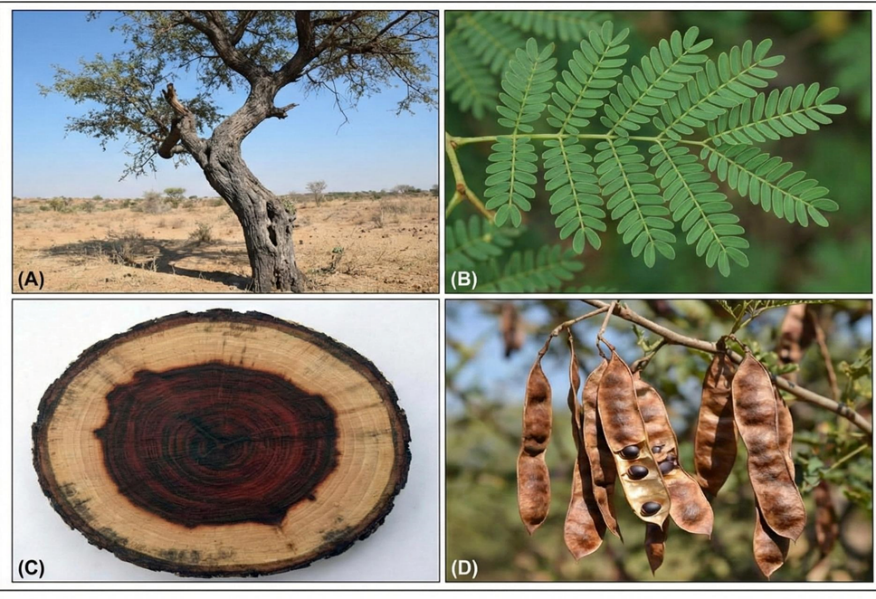
?Figure 1: Morphological features of Acacia catechu (L.f.) Willd. (A) Mature tree in natural habitat showing characteristic crooked trunk and dark bark. (B) Bipinnate compound leaves with numerous small leaflets (pinnae). (C) Cross-section of the stem showing the distinct reddish-black heartwood (Khair) used for medicinal extraction. (D) Legume pods containing seeds.
Phytochemical Constituents
The medicinal efficacy of A. Catechu is attributed to its rich diversity of secondary metabolites. The heartwood is particularly rich in catechins. Studies have quantified the catechin content in the heartwood at approximately 3.30% [9].
?Heartwood: Contains high concentrations of catechin, epicatechin, epigallocatechin, epicatechin gallate, rocatechin, rutin, and isorhamnetin. The main coloring agents are phloroglucinol and catechu-tannic acid [10].
?Leaves: Methanolic and hydroethanolic extracts of the leaves have yielded porphyrins, phytol, vitamin E acetate, quercetin, rutin, and kaempferol [11].
?Bark: Rich in ascorbic acid, riboflavin, thiamine, niacin, and carotenoids [11].
?Recent GC-MS and HPLC analyses have led to the isolation of novel phenolic compounds, including 5-hydroxy-2-[2-(4-hydroxyphenyl) acetyl]-3-methoxylbenzoic acid [12].
Table 1 : List of Major Phytochemicals isolated from Acacia catechu parts (Heartwood,Bark,Leaves)
|
Plant Part |
Bioactive Phytoconstituents |
Reference |
|
Heartwood |
Flavonoids: Catechin (3.30%), Epicatechin, Epigallocatechin, Epicatechin gallate, Rocatechin, Taxifolin. Phenolics & Acids: Phloroglucinol, Procatechuic acid, Catechu-tannic acid. Others: Quercetin, Rutin, Isorhamnetin. |
[9, 10, 13] |
|
Leaves |
Methanolic Extract: Camphor, Phytol. Hydroethanolic Extract: Vitamin E acetate, 2-ethyl-3-methyl-1-butene, Butylphosphonic acid, Di(4-methoxybenzene). Others: Ellagic acid, Quercetin, Rutin, Kaempferol. |
[11, 12] |
|
Bark |
Vitamins: Ascorbic acid (Vitamin C), Riboflavin (Vitamin B2), Thiamine (Vitamin B1), Niacin (Vitamin B3). Pigments: Carotenoids. |
[11, 16] |
|
Aqueous Extract |
Phenolic Acids: 5-hydroxy-2-[2-(4-hydroxyphenyl) acetyl] 3-methoxylbenzoic acid. Flavanes: (2S,3S)-3,7,8,30,40-pentahydroxyflavane. |
[12] |
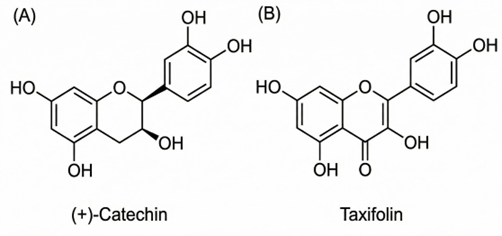
Figure 2: Chemical structures of major bioactive phytoconstituents. (A) (+)-Catechin (C15H14O6), a flavan-3-ol responsible for the potent antioxidant activity. (B) Taxifolin (Dihydroquercetin), a flavonoid abundant in the heartwood that contributes to antimicrobial efficacy.
?Pharmacological Activities
?Antimicrobial and Antifungal Activity
The rising resistance to synthetic antibiotics has directed attention toward A. Catechu as a potent antimicrobial agent. The heartwood extract, rich in taxifolin, has demonstrated significant antibacterial efficacy [13]. Methanolic extracts exhibit broad-spectrum activity against both Gram-positive and Gram-negative bacteria, including Salmonella typhi, Bacillus subtilis, Pseudomonas aeruginosa, and Escherichia coli [14].
?In terms of antifungal potential, ethanolic extracts of the heartwood have been evaluated against human pathogenic fungi. Utilizing the disc diffusion method, the extract showed dose-dependent inhibition (25–500 µg/disc) against Penicillium marneffei, Aspergillus fumigatus, Aspergillus niger, and Candida albicans, comparable in some instances to standard antifungals like Amphotericin B [15, 16].
?Antioxidant Activity
Oxidative stress is a precursor to numerous chronic diseases. A. Catechu acts as a powerful antioxidant primarily due to its flavonoid content. In DPPH radical scavenging assays and dot-blot assays, the heartwood and leaf extracts demonstrated significant free radical scavenging capacity, with catechins and rutin identified as the active principles responsible for this activity [17, 18]. Comparative analyses indicate that the antioxidant potential of A. Catechu is comparable to standard ascorbic acid in in vitro models [19].
?Hepatoprotective Activity
Liver dysfunction induced by toxins is a major global health concern. Research suggests that A. Catechu possesses hepatoprotective properties. In models of Carbon Tetrachloride (CCl4)-induced hepatotoxicity, administration of ethyl acetate extracts of A. Catechu significantly normalized liver enzyme levels, suggesting a protective effect on hepatocellular integrity [20]. This activity is likely mediated through the inhibition of lipid peroxidation and the enhancement of endogenous antioxidant enzymes [21].
?Antidiabetic and Hypoglycemic Activity
The management of diabetes mellitus using A. Catechu has been validated in animal models. In alloxan-induced diabetic albino rats, an ethyl acetate extract administered at 500 mg/kg/day for seven days resulted in a significant reduction in blood glucose levels [22]. Mechanism-based studies suggest that compounds such as myricetin, quercetin, and catechin-gallate inhibit insulin-stimulated glucose transporters, thereby modulating glucose uptake [23]. Furthermore, the extract promotes β-cell regeneration in the pancreas, contributing to its antihyperglycemic effect [22].
?Anti-inflammatory and Antinociceptive Activity
?Antidiarrheal Activity
In castor oil-induced diarrhea models in albino rats, the ethyl acetate extract of A. Catechu showed significant antidiarrheal activity. The astringent properties of the tannins present in the heartwood reduce intestinal motility and fluid secretion, providing a scientific basis for its traditional use in treating dysentery [23].
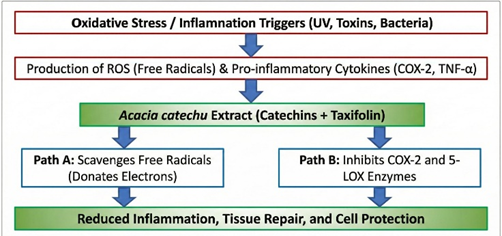
Figure 3: schematic representation of the pharmacological mechanism of action of Acacia catechu.
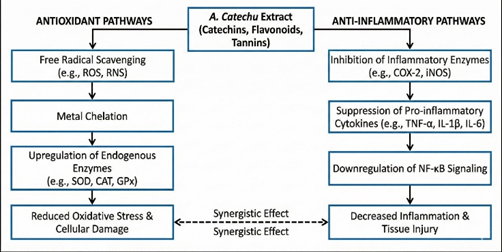
?[ Flowchart : illustrating the Mechanism of Action for Antioxidant and Anti-inflammatory pathways of A. Catechu]
Table 2: Summary of Pre-clinical and Pharmacological Studies on Acacia catechu
|
Activity |
Extract/Part Used |
Experimental Model |
Key Findings/Mechanism |
Reference |
|
Antimicrobial |
Heartwood (Ethanolic & Aqueous) |
In vitro disc diffusion |
Demonstrated significant inhibition zones against S. Typhi, E. Coli, and P. Aeruginosa. Taxifolin identified as a key antimicrobial agent. |
[13, 14] |
|
Antimycotic |
Heartwood (Ethanolic) |
In vitro fungal strains |
Showed dose-dependent activity (25-500 µg/disc) against Candida albicans and Aspergillus niger. Comparable to Amphotericin B. |
[15, 16] |
|
Hepatoprotective |
Ethyl Acetate Extract |
CCl4-induced hepatotoxicity in rats |
Normalized serum levels of AST, ALT, and ALP. Reduced lipid peroxidation and restored antioxidant enzyme levels in liver tissue. |
[19, 20] |
|
Antidiabetic |
Ethyl Acetate Extract |
Alloxan-induced diabetic rats |
Significant reduction in blood glucose at 500 mg/kg/day. Suggested mechanism involves β-cell regeneration and inhibition of glucose transporters. |
[21, 22] |
|
Antioxidant |
Leaf, Bark, Heartwood |
DPPH & Dot-blot assays |
High free radical scavenging activity attributed to catechin and rutin content. Protected plasmid DNA from strand scission. |
[17, 18] |
|
Cytotoxicity |
Heartwood Extract |
DMBA/TPA induced carcinoma in Balb/c mice |
Inhibited tumor incidence and burden. Showed cytotoxicity against human epithelial carcinoma cells. |
[30] |
|
Anti-ulcer |
Root Extract |
Pylorus ligation model |
Significantly reduced gastric volume and total acidity. Showed protection against gastric mucosal injury. |
[24] |
|
Anti-inflammatory |
Heartwood |
Carrageenan-induced paw edema |
Inhibited COX-2 pathway, reducing edema and leukocyte migration similar to standard NSAIDs. |
[23] |
|
Antilithiatic |
Seed Extract |
In vitro crystallization |
Inhibited calcium oxalate crystallization, suggesting potential in treating kidney stones. |
[31] |
Ethnomedicinal Uses and Therapeutic Applications
?Traditional Systems (Ayurveda and Unani)
In the Unani system of medicine, the powdered form of Kath (Catechu) is utilized for treating Qul?‘ (mouth ulcers), Wr?m-i-litha (gingivitis), and Litha D?miya (bleeding gums) [26].
?Oral Hygiene: A small piece of catechu held in the mouth acts as a lozenge for hoarseness, sore throat, and loss of voice.
?Wound Healing: It is applied as a dusting powder for Qur?h? (wounds) and combined with ointments for persistent ulcerations with foul discharge [27].
?Systemic Use: A decoction is used to clean cracked nipples in lactating mothers, and a mixture known as Katha-bol (myrrh and catechu) is given as a post-partum tonic [28].
?Advantages and Limitations
While A. Catechu offers numerous benefits, such as improving digestive health and treating skin irritations, it is not without limitations.
?Advantages: Potent anti-inflammatory, antioxidant, and antimicrobial properties; effective for oral and digestive health.
?Disadvantages: Excessive consumption may lead to acidity, kidney stones (due to oxalate or tannin accumulation), and drug interactions. High concentrations can cause dryness of the mouth and constipation due to high tannin content [29].
?Toxicology and Safety Profile
Safety assessment is critical for herbal formulations. A sub-acute toxicity study of A. Catechu seed extract in Wistar albino rats demonstrated a high margin of safety. No significant alterations in hematological or biochemical parameters were observed at therapeutic doses, indicating that the plant is generally safe for consumption within traditional dosage limits [30]. However, caution is advised regarding high-dose, long-term consumption due to potential potential cytotoxicity in specific cell lines [31].
?Future Perspectives
Current research has largely focused on in vitro and animal models. There is a pressing need for randomized clinical trials to validate the efficacy of A. Catechu in human subjects, particularly for metabolic disorders like diabetes and hyperlipidemia. Furthermore, the isolation of specific bioactive molecules could lead to the development of novel semi-synthetic drugs with improved bioavailability.
Patents and Commercial Applications
The commercial significance of Acacia catechu extends beyond traditional remedies, evidenced by numerous patents filed for its pharmaceutical and cosmetic applications.Oral Care Formulations: Patents have been filed for herbal toothpaste and mouthwash formulations containing A. Catechu extract, citing its potent astringent and anti-gingivitis properties. The high tannin content helps in tightening gum tissue and reducing bleeding.
?Dermatological Preparations: Due to its antioxidant profile, A. Catechu is a key ingredient in anti-aging creams and skin-whitening agents. The catechins inhibit collagenase and elastase enzymes, thereby preserving skin elasticity and reducing wrinkle formation.
?Veterinary Usage: Recent innovations include the use of A. Catechu in feed additives for livestock to improve gut health and reduce methane emissions, highlighting its environmental potential.
?CONCLUSION
Acacia catechu (L.f.) Willd remains a cornerstone of traditional medicine, substantiated by modern pharmacological research. Its diverse spectrum of activity—ranging from antimicrobial and antioxidant to hepatoprotective and antidiabetic effects—highlights its potential as a source of novel therapeutic agents. While current data is promising, future research must focus on standardizing extracts, elucidating precise molecular mechanisms, and conducting rigorous clinical trials to bridge the gap between traditional knowledge and modern clinical practice.
??REFERENCES



Rohan Sanap, Anagha Sarvadnya, Anil Jadhav, Phytopharmacological Review of Acacia catechu (L.f.) Willd, Int. J. of Pharm. Sci., 2026, Vol 4, Issue 2, 2290-2298. https://doi.org/10.5281/zenodo.18639993
 10.5281/zenodo.18639993
