
1Department of pharmacognosy Soniya education trust's college of pharmacy Dharwad
234Shri J G C H S college of pharmacy Ghataprabha
Pomegranate (Punica granatum L) has gained considerable scientific attention due to its exceptional phytochemical richness and broad spectrum of biological activities. This review critically examines the phytochemical composition, biological properties and antioxidant potential of pomegranate fruit, juice and molasses. An extensive survey of recent literature was carried out using major scientific databases to compile relevant studies. Pomegranate and its processed products are abundant in bioactive constituents, including polyphenols, flavonoids, hydrolysable tannins, anthocyanins, ellagic acid and punicalagins, which collectively contribute to their health promoting effects. Accumulating evidence from in-vitro and in-vivo investigations highlights diverse biological activities such as antioxidant, anti-inflammatory, antimicrobial, anticancer, cardioprotective, and antidiabetic effects. Pomegranate juices and molasses often demonstrate superior antioxidant capacity compared to the fresh fruit. The pronounced antioxidant potential plays a pivotal role in mitigating oxidative stress and associated chronic disorders. Overall, the significance of pomegranate derived products as promising functional foods and natural antioxidant sources, warranting further exploration for therapeutic and nutraceutical applications.
India has one of the richest traditional medicinal systems in the world. In India and several other countries, plants serve as important natural resources in healthcare systems. At present, India ranks first in pomegranate production and second in its export. (1) Pomegranate has been mentioned in the Bible, as well as in Buddhist, Chinese and Korean literature. It is one of the oldest cultivated plants, and its fruit has long been valued for its benefits to human health. Almost all parts of the pomegranate plant have been reported to contain numerous bioactive metabolites. (2)
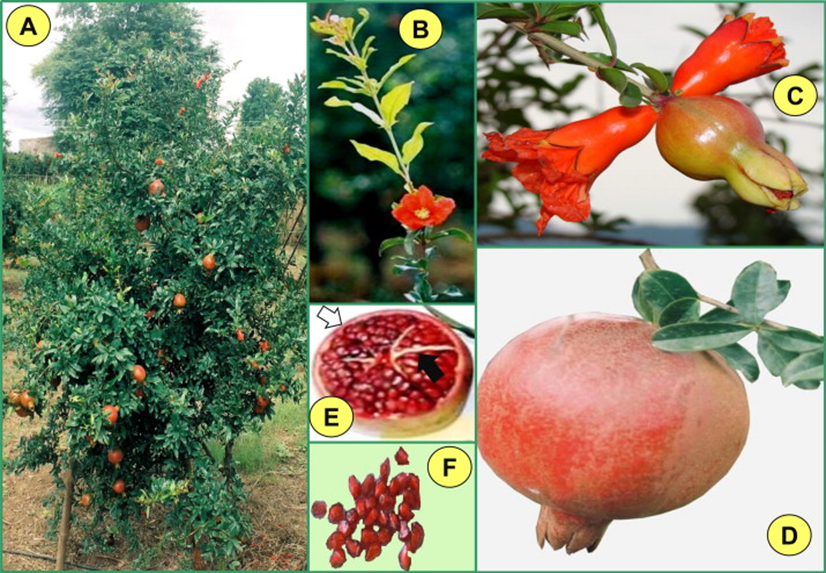
Fig. Punica granatum (3) [A] Plant habit, [B] Flowering stem, [C] Developing fruit, [D] Matured fruit split open [E] to reveal [F] seeds with aril
Punica granatum Linn. (Pomegranate) is a plant belonging to the family Punicaceae, and is locally called as Anar. It is a fruit of great antiquity that has been cultivated more than 5000 years ago in the Middle East of Egypt, India, Bangladesh, Shrilanka, North Africa, California and Arizona. (4) The name of the pomegranate plant comes from two Latin words Pomuum and Granatus. Pomum means apple and Grantus means grainy or seeds or seeded apple. (5) It has become an increasingly popular functional food and sources of nutraceuticals. Pomegranate peels are widely used as a traditional remedy across the world and are extensively exploited in traditional remedy across the world and are extensively exploited in traditional medicine due to their strong mordant properties. (6) Various parts of the pomegranate plant, including the bark, leaves, immature fruits, and fruit rind possess significant therapeutic potential. Several studies have investigated the role of pomegranate constituents in the prevention and treatment of cancer, cardiovascular diseases, diabetes, dental disorder, erectile dysfunction and skin allergies with particular emphasis on their antioxidant, anti-carcinogenic and anti-inflammatory properties. (7)
Various parts of the pomegranate fruit, including the peel, membrane and arils (juice sacs) are rich sources of diverse phenolic compounds such as flavonoids, anthocyanins and tannins. (8) These phytochemicals impact both medicinal bioactivities and the characteristic red colour to fruit. Even though previous studies have provided valuable insights into the phytochemical composition of various pomegranate components, there remains a need for further investigation, particularly in comparing total phenolic content, antioxidant activity and antimicrobial activity among different pomegranate cultivators. Edible pomegranate juice is rich in ellagic acid derivatives, such as punicalagins, as well as flavonoids, including quercetin and kaempferol. (9) Some plants have distinct families of phytocompounds, which are structurally similar to steroid hormone, 17β- oestradiol and compete with the endogenous hormone for binding to oestrogen receptor, thus reducing the hormonal effect of endogenous oestrogens. (10-12) These compounds are collectively termed phytoestrogens. Most dietary phytoestrogens occur in biologically inactive forms however on consumption, they undergo a series of enzymatic transformations in the gastro intestinal tract, leading to the formation of metabolites with structural similarity to endogenous oestrogens. (13) Owing to their potential efficacy in the prevention and management of perimenopausal and menopausal symptoms, phytoestrogens have attracted significant research and clinical interest as alternatives to hormone replacement therapy (HRT). (14) Several studies have focused on the prevention and treatment of cancer, cardiovascular diseases, diabetes, dental disorders, erectile dysfunction, and skin allergies to evaluate the antioxidant, anticarcinogenic and anti-inflammatory properties of pomegranate constituents. (7) The bioactive compounds of Punica grantum, including gallocatechins, delphinidin, cynanidin, gallic acid and sitosterol have been reported to possess significant therapeutic potential. Numerous phytochemical constituents are present in different parts of the pomegranate plant, making it pharmacologically valuable. (15) Studies on the peel extract of P. granatum have revealed to possess significant therapeutic potential. Numerous phytochemical constituents present in different parts of the pomegranate plant, making it pharmacologically valuable. Studies on the peel extract of P. grantum have revealed substantial amounts of polyphenols such as ellagitannins, ellagic acid and gallic acid. Furthermore, preliminary phytochemical screening of the aqueous peel extract showed positive results for tannins, flavonoids and alkaloids, indicating the presence of biologically active compounds that may justify its traditional medicinal use. (16)High molecular weight hydrolysable tannins present in pomegranate peel exhibit broad spectrum antibacterial activity against both gram positive and gram-negative bacteria. (17) Several studies have further confirmed the strong antibacterial effects of crude and purified pomegranate extracts against common food born pathogens such as Listeria monocytogenes and Staphylococcus aureus (18). In addition, the fungal activity of Punica granatum Candida albicans and other causative agents of candidiasis has been documented. (19) These antimicrobial properties are largely attributed to the direct action of ellagitannins and other polar polyphenolic compounds. Microbial infections, particularly those caused by bacterial pathogens, continue to pose major global health challenges, with prevalence varying across different geographic regions. (20)
Phytochemical Screening (21-22)
Punica granatum extracts were assessed by standard methods. It reveals a rich composition of bio active compounds, particularly phenolics, tannins (punicalagins, ellagic acids) flavonoids and alkaloids. These compounds demonstrate strong anti-oxidants, anti-bacterial and anti-fungal, largely driven by high tannin content.
Test for Tannins: - One ml of extract was One ml of the peel extract was added to 1 ml 5% ferric chloride. Formation of dark blue or greenish black indicates the presence of tannins.
Test for Saponins: - One ml of the extract was added to 1 ml distilled water and shaken in graduated cylinder for 15 min; lengthwise formation of 1 cm layer of foam indicates the presence of saponins.
Test for Quinones: - One ml of the extract was added to 1 ml conc. sulphuric acid. Formation of red colour indicates the presence of quinones.
Test for Flavonoids: - One ml of the extract was added to 1 ml 2N sodium hydroxide. Formation of yellow colour indicates the presence of flavonoids
Test for Alkaloids: One ml of the extract was added to 2 mL conc. HCl. Then, few drops of Mayer’s reagent was added. Presence of green colour or white precipitate indicates the presence of alkaloids.
Test for Glycosides: One ml of the extract was added to 3 ml chloroform and 10% ammonium solution. Formation of pink colour indicates the presence of glycosides.
Test for Cardiac Glycosides: One ml of the extract was added to 2 ml glacial acetic acid and few drops of 5% FeCl3. This was under layered with 1 ml of concentrated sulphuric acid. Formation of brown ring at interface indicates the presence of cardiac glycosides.
Test for Terpenoids: - One ml of the extract was added to 2 ml chloroform along with conc. sulphuric acid. Formation of red brown colour at the interface indicates the presence of terpenoids.
Test for Phenols: - One ml of the extract was added to 2 ml distilled water followed by few drops of 10% ferric chloride. Formation of blue/green colour indicates the presence of phenols.
Test for Steroids: One ml of the extract was added to 2 ml chloroform and 1 ml sulphuric acid. Formation of reddish-brown ring at interface indicates the presence of steroids.
Test for Coumarins: - One ml of the extract was added to 1 ml 10% NaOH. Formation of yellow colour indicates the presence of coumarins.
Test for Anthocyanin and Betacyanin: - One ml of the extract was added to 1 ml 2N sodium hydroxide and heated for 5 min at 100°C. Formation of bluish green indicates the presence of anthocyanin and formation of yellow colour indicates the presence of betacyanin.
BIOLOGICAL ACTIVITIES
Antibacterial Activities
The methanol, water and ethyl acetate extract of peel of Punica granatum were evaluated for their antimicrobial activity against bacteria Bacillus Coagulans, Bacillus subtilis, Escherichia coli Pseudomonas aeruginosa, salmonella, Enterobacter aerogens, Rhodotorula glutinis, Serratia Marcescens and Brucella Spp.(23,34) The extract of peel of plant is very helpful in inhibition of growth of streptococcus mutans which causes dental caries, It also inhibits salmonella typi, vibrio choler and Escherichia coli.(25,26) the methanolic extract (80%) of peel of pomegranate plant is very good inhibitor for many bacterial species. In one of the experiment the extract of peel was prepared by taking 5 grams of fine powder after dissolving it in diethyl ether, methanol and water. The extracts were kept in dark room at very low temperature. Agar diffusion method was used for screening of antibacterial activity. The inhibition of microbial growth was seen which showed the antibacterial effect of the extract.34 The antimicrobial activity of peel extracts helpful against 8 different strains of pathogenic bacterial infections and 5 types of beneficial bacteria like Lactobacilli, Bifido bacterium strains were determined. (27) The active molecules like gallic acid, flavonoids, anthocyanin and punicalin were found to be present in the peel of the plants. These chemical constituents have antibacterial action on cell signaling and growth. These can also help in food preservation, oral infections, and wound healing. (28,29) The minimum inhibitory concentration (MIC) values for most of the species were found to be 2.5 µg/ ml. The hydrolysable tannins, phenolic acids and flavonoids were found to be active against gram positive as well as gram negative bacteria. The MIC values of peel extract ranged between 0.625- 5 µg/ml. (30)
Antifungal activity:
The extract containing polyphenols from the fruits of Punica grantum were found to be active against phytopathogenic fungi. The extract of plant was evaluated for topical antifungal activity against various fungal strains like Trichophyton, candidosis, Microsporum, Candida albicans and Candida krusei. The extract has shown antifungal activity against the genus Microsporum at with MIC 125μg/ml and 250μg/ml. (31,32) The peel extract of plant was evaluated for antifungal activity against various fungi strains like Trichoderma reesei, Aspergillus niger, Rhizopus oryzae, Mucor indicus and Penicillium citrinum, in which a general pattern of dose dependency was observed i.e. the effect became more prominent with increasing concentration of tested samples. With methanolic extract, the best antifungal activity was observed against Aspergillus Niger and less activity was seen against Mucor indicus. The inhibition zone values for methanolic extract ranged between 8.0 to 23mm.Various compounds like quercetin, punicalagin, catechin, kaempferol, and castagalagin were reported from the peel extract of the plant. The synergetic interaction of these compounds increases the antifungal effect of the extract. (33) Tannins have been found to be the main component of peel extract of the plant. They have significant antifungal activity against Candida parapsilosis and Candida albicans. (34) In another study, ethanol extract was tested for its fungicidal activity against Candida krusei and Candida albicans. The study provided significant results for the activity. It was concluded that the antifungal activity may be due to presence of tannin components. The MIC for Candida species was observed to be 125µg/ml. (35)
Anthelmintic activity:
The aqueous, methanol and ethanolic extract of the plant were tested against Schistosoma mansoni, Aporrectodea caliginosa (earthworm) and Ascaridia galli. Albendazole suspension was taken as the standard. The methanolic extract caused paralysis as well as death of the worms at concentration of 300mg/ml. (36) The methanolic extract of the bark has shown potential effect against Schistosoma mansoni. (37) In another study, it has been seen that the aqueous extract of flowers of plant have shown good anthelmintic property. By increasing the concentration to 25mg/ml it was observed that paralysis and death of earthworms were achieved in less time as compared to 5mg/ml. Albendazole was taken as the standard drug. (38)
Cardiovascular effect:
In a study, the volunteers were given juice of the fruit 500ml on a daily basis. The results showed lowered the systolic and diastolic blood pressure of the volunteers. The flavonoids present in pomegranate were thought to be responsible for this effect as the flavonoids are good antioxidants.(39,40) In another study the polyphenols of the plant helped in inhibition of atherosclerosis in human as well as the mice.(41)
Cytotoxic Activity:
The cytotoxic activity of peel extract of the plant was tested by using MTT assay method. In this study, the doses up to 600µg/ml have indicator inhibitory effect on the growth of cancerous cells of prostate after 24 hours. Each extract was dissolved in respective solvent to obtain concentration of 50, 100, 200 and 300µg/ml, respectively. The results indicated death of prostate cancerous cell.(42) The anticancer effect of pomegranate in prostate, colon and other cancer has been attributed to the localization of the bioactive metabolites at higher levels in these organs. Pomegranate extract helps to treat prostate cancer by inhibiting NF-KB (nuclear factor kappa- B) signalling in vitro and in vivo models of prostate cancer.(43) The extract of fruit of plant Punica granatum was evaluated for its cytotoxic activity on different cancerous lines such as breast, prostate, and leukaemia. The extract helps to prevent the synthesis of oestrogen. The extract was found to be effective in breast cancer. The polyphenol present in juice of the plant helps to treat prostate cancer by inhibiting proliferation of cancerous cells.(44) Ellagic acid is used to treat various types of cancers like prostate cancer, colon cancer, leukaemia, breast cancer and bladder cancer. Both fruits and purified ellagic acid extract play important role in apoptosis, in vivo model and show anticancer activity.(45) In one of the studies, it was found that if a person takes up to 250 ml of juice, then it would be very beneficial for personal health. Ellagic acid helps to enhance apoptosis action on several pathways like P53, glycogen synthase kinase 3 beta (GSK- 3ß), caspase 3 and 8 and cytochrome c (cyt-c).(46) Polyphenols like punicalagin is one of the components which show the activity in cervical cells cancer, breast cancer and lung cancer. The peels of Punica granatum were also found to have activity against hepatic cancer.(47)In another research work using the ethyl acetate extract of the fruit peels, inhibition of cancerous cell growth was observed. The phytochemical analysis showed the presence of many secondary metabolites.(48)Pomegranate peel aqueous and ethanolic extract effectively and safely inhibit cell proliferation of liver and colon tumour cells. Pomegranate peel polyphenols cause chemo-prevention and selective toxicity against cancer cells. Both aqueous and ethanolic extracts promote tumour cell apoptosis and necrosis.(49)
Wound healing properties:
The antioxidant properties of pomegranate plant help in healing wounds. In one of the experiments, wounded guinea pigs were taken. The test group was treated with methanolic peel extract-based ointment. It helped in wound contraction and increase in collagen and granulation tissue. It enhances the activity of catalase. As a result, on 8th day in test group, wound was healed.(50,51) In another study, the hydro alcoholic extract of peel, arils and fruit of pomegranate were used to test wound healing property. The peel was found to be useful in the treatment of the wound and reduction in inflammation. The rats were used in the study after given them anaesthesia with thiopentone. The results were seen after 14th days and good action was observed in healing the wounds.(52)
Antiulcer Activity:
The methanolic extract (80%) of fruit peel at a dose of 50mg/kg helps to reduce the number of peptic ulcers in rats.(53,54) According to in vitro study, the peel is used to treat ulcers and Helicobacter pylori infection and lesions of gastric mucosa.(28) In another study, it has been seen that the seeds and peels of fruit of pomegranate showed antiulcer properties. This activity was due to reduction in secretion of acid. This extract is used to treat stress ulcers also.(55) In one of the studies, performed using rats, good antiulcer activity was seen against aspirin induced ulcers.(56,57)
Anti-inflammatory Effect:
In vitro studies have shown the results that pomegranate can reduce the Helicobacter pylori infection. The pericarp of the fruit was shown to have strong anti-inflammatory activity. An ulcer index can be reduced by using methanolic extract of pomegranate in ethanol induced ulcers in rats. (32) Various scientific researches have been done to show that methanolic extract of pomegranate and its parts has a significant role as anti-inflammatory agent. It showed its effect by reducing the production of nitric oxide, and PGE2. These inhibit the growth of proinflammatory proteins. (58) In another study, carrageenan induced paw edema model was used to study anti-inflammatory activity. The activity of pomegranate was compared to indomethacin (a common NSAID). The study concluded that pomegranate has good power to reduce the paw edema by more than 50%. (59)
Oral care:
The juice of fruit of pomegranate and hydroalcoholic extract is very effective against dental plaque and in bleeding gums. Dental plaque is a yellow colour film developed on the teeth naturally.(60) Clinical trials were conducted using Roosa agar media and it was seen that rinsing with juice helped to decrease the infection of teeth. It was very effective in reducing colonies of lactobacilli.(61) In another study, polyphenol rich extract of fruit helped in reduction of gingivitis by inhibiting cyclooxygenase1 enzyme (COX1) and cyclooxygenase2 enzyme (COX2). There are several side effects of using synthetic mouthwashes like dryness, discoloration of teeth and ulcers.(62) The gel prepared from the fruits was shown to inhibit Streptococcus mutans and some other bacteria on the surface of teeth. The gel is very effective at very low concentration. Simple mouthwash of the fruits helps in decreasing tooth infection and bleeding of gums.(63)
Antidiabetic activity:
Diabetes is one the familiar metabolic and life-threatening disease around the world. Antidiabetic effects are shown due to phenolic compounds present in fruits.(64) In Unani system of medicines, pomegranate is basically used for diabetes treatment. In one of the studies, ethanol extract of leaves has shown antidiabetic effect in alloxan induced diabetic rats.(65) In another study, the peels, seeds, and fruits extract of plant were found to be very effective in type II diabetes mellitus. It is a chronic disease. The presence of different biochemicals in pomegranate helps in decreasing the diabetes. Ellagic acid and punicic acid are two important chemical constituents. The plant extracts help in reducing the level of fasting blood sugar. According to Ayurveda and Unani system of medicines, the flowers of plant are used to treat diabetes. Aqueous ethanolic extract of the seeds helps to decrease glucose levels.(66) In seed oil of Punica granatum, punicic acid is present which is used for type II diabetes mellitus traditionally. It helps to reduce glucose homeostasis and inflammatory cytokines via peroxisome proliferation- activated receptor gamma agonist (PPAR- gamma).(67,68) In one of the studies, the aqueous extract of the peels of the fruits was shown to lower blood sugar levels. Increase was found in the insulin levels and beta cells. The mechanism of action was proposed to be the protection of the pancreas.(69) In another study, it was indicated that the proximal tubular reabsorption for glucose in the kidney is inhibited and this might be responsible for the antidiabetic effect of the extract.(70)
Antispasmodic effect:
The aqueous and hydro alcoholic extract of flowers of pomegranate plant was given to female Wistar rats at estrous phase. It helped in reduction in contraction of uterus. The sample extracts were pretreated with barium chloride and potassium chloride. A good antispasmodic effect of the plant was observed in the study. (71) In another study, the rind of plant pomegranate showed spasmolytic activity at very low concentration by inhibiting voltage gated calcium channel in rabbit jejunum. The safe dose for antispasmodic activity was found to be 100mg/kg. They used two types of receptors that are cholinergic receptors and histaminergic receptors. Pomegranate is also very useful in erectile dysfunction treatment. (72)
Anticonvulsant activity:
The ethanol extract of seeds of plant has shown significant antiepileptic activity. In one of the studies, two seizure models were used in mice to induced the convulsions pentylenetetrazol and strychnine induced. The results have indicated that the extract helps in reducing the duration of seizure in both the models. This activity was due to presence of saponins, alkaloids and flavonoids which are present in pomegranate seed. (73,74) Das and Sarma, in their study used ethanol extract which helped in inhibiting maximal electroshock induces seizures in rats. It acted upon calcium, sodium and potassium that cause facilitation. Basically, flavonoids are mainly responsible for antiepileptic action. (75)
Herbal mouth wash:
The pomegranate seed extract was tested for biofilm formation against the Streptococcus species. The results of the study concluded that it can be used for making herbal mouth wash which prevent biofilm formation by the microbes in the oral cavity. The chemical constituents present in the plant also help in preventing oral infections as well as dental caries. Phytosomes of pomegranate peels have been prepared by using phospholipids and these were found to have better bioavailability. These phytosomes contain the herbal product which can be absorbed better and utilized to produce the best results.(76)
CONCLUSION
Pomegranate and its products such as fruit, juice and molasses are rich in natural phytochemicals. These compounds are responsible for many health benefits. Pomegranate shows strong antioxidant activity which helps in reducing oxidative stress in the body. Juice and molasses often have higher antioxidant potential than the fresh fruit because the bioactive compounds are more concentrated. It also shows antibacterial, antifungal, anthelmintic, cardiovascular, cytotoxic, antiulcer, anti-inflammatory, antidiabetic, antispasmodic, anticonvulsant, wound healing properties. It is also used in herbal mouth wash. Because of these benefits, pomegranate can be considered a valuable functional food. Overall pomegranate has great potential in health promotion and disease prevention.
REFERENCES




Jyoti Godgeri, Geeta Patil, Madhura Anikhindi, Kaveri Kivati, Punica granatum L.: A Comprensive Review of Phytochemical Constituents and Biological Activities., Int. J. of Pharm. Sci., 2026, Vol 4, Issue 2, 1202-1214. https://doi.org/10.5281/zenodo.18534315
 10.5281/zenodo.18534315
