
Atlanta College of Liberal Arts and Sciences.
The Indian mining industry, a critical pillar of the nation's economy, faces persistent challenges, including operational inefficiencies, environmental degradation, security vulnerabilities, and communication limitations posed by rugged terrain. This paper proposes a comprehensive Smart Mining System tailored for Indian conditions, leveraging emerging technologies to address these issues. The solution is cantered on a robust 5G Fixed Wireless Access (FWA) network to overcome connectivity hurdles in remote locations, supported by Edge Micro Data Centers (MDCs) for low-latency, localized data processing. The system integrates a network of Internet of Things (IoT) devices for real-time monitoring of productivity, surveillance, and logistics. AI-driven decision-making and remote operation control are central to the proposed framework, enabling enhanced safety, predictive maintenance, and optimized resource allocation. The study analyzes the current technological landscape of key Indian mining corporations, including Singareni Collieries Company Limited (SCCL) and NMDC, and benchmarks their challenges against best practices from global leaders like Rio Tinto and BHP. The financial implications of the proposed system are evaluated, highlighting its potential to mitigate losses from theft, improve stockyard monitoring, and ensure environmental compliance. The findings demonstrate that this integrated technological approach offers a viable and scalable pathway for the Indian mining sector to achieve a new paradigm of operational excellence, safety, and sustainable growth.
The mining sector is a cornerstone of India's industrial and economic development, supplying essential raw materials for manufacturing, energy, and infrastructure. However, the industry is burdened by legacy challenges that impede its full potential. Traditional mining practices often suffer from low productivity, significant operational risks, and a high environmental footprint. Manual data collection and a lack of real-time insights lead to inefficient resource allocation and reactive problem-solving. Furthermore, the inherent remoteness and geological complexities of mining sites across India, from the coalfields of Telangana to the iron ore belts of Chhattisgarh, create unique connectivity and security challenges. Global leaders in the mining sector have, in recent years, embraced a new technological paradigm known as "smart mining." This approach leverages digital technologies to create a connected, data-driven, and highly automated operational environment. By integrating IoT, artificial intelligence (AI), and advanced communication networks, these companies have achieved remarkable improvements in safety, efficiency, and sustainability. This paper argues that adopting a similar, yet custom-tailored, smart mining framework is not only desirable but essential for the future competitiveness and environmental stewardship of the Indian mining industry. The following sections will first analyze the current state of Indian and global mining and then propose a specific, implementable solution.
2.0 Current Landscape of Indian Mining Corporations
The Indian mining sector is characterized by a mix of state-owned and private enterprises. This study focuses on two of the largest and most influential corporations: Singareni Collieries Company Limited (SCCL) and NMDC Limited.
2.1 Singareni Collieries Company Limited (SCCL)
SCCL, a major coal producer, has made strides in modernizing its operations. The company has adopted phased mechanization in its underground mines, utilizing Side Discharge Loaders (SDLs) and Load Haul Dumpers (LHDs). It has also embraced IT solutions, including proprietary software for its Integrated Mine Management System, and is transitioning to an Enterprise Resource Planning (ERP) system.
Challenges and Terrain:
Operational: SCCL faces challenges with coal quality variations due to complex geo-mining conditions. Water availability during lean seasons is a persistent issue, impacting both operations and local communities.
Terrain: Operating primarily in the Godavari Valley, SCCL's mines are located in regions with hilly terrain and proximity to major water bodies. These factors complicate physical logistics and require careful environmental management to prevent deforestation and soil erosion.
2.2 NMDC Limited
NMDC, India's largest producer of iron ore, has a strong focus on sustainable and scientific mining. The company has implemented advanced technological systems, including an ERP, real-time dashboards for management, and biometric authentication for workforce management. NMDC has also piloted the use of Unmanned Aircraft Systems (UAS) and drones for mineral exploration and surveying.
Challenges and Terrain:
Operational: NMDC's operations are impacted by market volatilities and regulatory challenges, including land acquisition and environmental clearances. The company also faces social and legal protests from local communities, particularly in regions like Bailadila, which can disrupt operations.
Terrain: NMDC's mines are in mineral-rich but environmentally sensitive regions of Chhattisgarh and Karnataka. The terrain is often rugged and forested, leading to challenges with deforestation, biodiversity loss, and water pollution from tailings. The remoteness of these sites also creates communication and logistical hurdles.
3.0 Global Smart Mining Leaders: A Comparative Study
To propose a globally competitive solution, it is essential to benchmark against industry leaders. This section analyzes the smart mining systems of Rio Tinto and BHP.
3.1 Rio Tinto
Rio Tinto is a pioneer in mining automation. Its Mine Automation System (MAS) aggregates data from autonomous drills, trucks, and trains, leveraging AI and machine learning for predictive maintenance and operational optimization. Rio Tinto's "Center of Excellence" uses proprietary software like RTVis™ for 3D visualization and real-time data integration. The benefits include a 15% increase in truck utilization, significant cost reduction, and enhanced safety by removing human operators from hazardous environments.
3.2 BHP
BHP's innovation program, "Think & Act Differently," focuses on solving complex mining challenges, particularly in deep underground environments. The company uses robotics, AI-driven vision systems, and advanced sensors to automate equipment and enhance situational awareness. Their focus on digital twins and thermal imaging allows for real-time monitoring of safety and operational efficiency in high-stress, high-temperature conditions.
3.3 Implementation Challenges
Despite their success, these global leaders faced significant hurdles:
System Integration: Integrating diverse technologies from multiple vendors into a single, cohesive platform was a major challenge.
Workforce Adaptation: The shift to automated operations required extensive upskilling and reskilling of the workforce.
Connectivity: Maintaining robust, high-speed, and low-latency communication networks across vast and remote sites was critical and often difficult.
4.0 The Proposed Smart Mining System for Indian Terrain
This section outlines a technology-agnostic yet robust smart mining framework designed to address the specific challenges of Indian mining corporations. The solution is built on a foundation of next-generation connectivity, localized data processing, and intelligent automation.
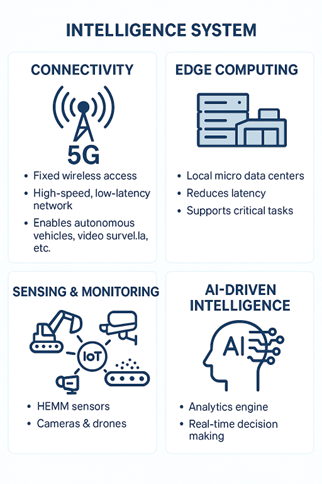
4.1 5G Fixed Wireless Access (FWA) for Connectivity
The rugged and remote nature of Indian mining sites makes traditional fiber-optic cabling unfeasible and satellite communication expensive and high-latency. 5G FWA provides a viable alternative.
Solution: 5G FWA leverages existing telecom infrastructure to deliver fiber-like speeds and low latency wirelessly. It can be deployed quickly and cost-effectively, providing reliable connectivity for real-time data transfer from a multitude of devices.
Benefit: This solves the primary connectivity challenge, enabling the seamless operation of autonomous vehicles, remote sensors, and live video surveillance.
4.2 Edge Micro Data Centres (MDCs) for Local Processing
Centralized cloud-based processing is often unsuitable for time-sensitive mining operations due to network latency. The proposed system includes Edge MDCs.
Solution: MDCs are compact, modular data centers deployed directly at the mine site. They enable local processing of data from IoT devices and sensors.
Benefit: This drastically reduces latency, allowing for immediate decision-making for critical tasks like autonomous vehicle navigation and collision avoidance. It also enhances data security by keeping sensitive operational information on-site and reduces bandwidth consumption by processing data locally before transmitting it to a central cloud.
4.3 IoT Devices for Comprehensive Monitoring
A dense network of IoT devices will form the nervous system of the smart mine.
Productivity: Sensors on Heavy Earth Moving Machinery (HEMM) monitor vibration, temperature, and fuel consumption to enable predictive maintenance and reduce unplanned downtime.
Surveillance: High-definition cameras and drones provide real-time visual monitoring of the site, from stockyards to production areas, linked to AI-driven analytics.
Logistics: RFID tags and GPS trackers on vehicles and materials provide real-time tracking, optimizing routes and managing inventory with precision.
Production Control: Sensors on conveyor belts and crushing equipment monitor material flow and quality, allowing for dynamic adjustments to improve yield and efficiency.
4.4 AI-Driven Decision-Making and Network Monitoring
AI is the brain of the smart mining system, transforming raw data into actionable intelligence.
Decision-Making: AI algorithms analyze data from all IoT touchpoints to provide real-time recommendations for optimizing blast patterns, fleet dispatch, and production schedules.
Network Monitoring: AI monitors the 5G network's performance, predicting potential bottlenecks and ensuring seamless connectivity. It also analyzes surveillance feeds to detect unauthorized entry, identify safety hazards, and prevent theft.
5.0 Remote Mining Operation Control
Remote operations are critical for enhancing safety and efficiency. A centralized Remote Operations Centre (ROC) will be established to monitor and control the entire mining site.
Technology: Remote-controlled machines, including continuous miners and drilling rigs, can be operated from the ROC, removing personnel from hazardous underground or unstable open-pit environments.
Best Practices: The ROC will feature a unified, ergonomic Human-Machine Interface (HMI) for operators, with predictive analytics tools to anticipate equipment failures. Robust cybersecurity protocols, including network segmentation and real-time threat monitoring, will be in place to protect the control systems from cyber-attacks.
6.0 Technical Solution Design
The proposed system is built on a foundation of three core technological pillars: a robust communication network, localized data processing, and a dense network of sensors. This design is intended to be technology-agnostic, allowing for flexibility and scalability.
Connectivity: A 5G Fixed Wireless Access (FWA) network is proposed to provide high-speed, low-latency wireless connectivity across remote and rugged mine sites. This addresses the challenges posed by traditional connectivity methods like fiber-optic cables (which are often unfeasible) and satellite communication (which can be expensive and high-latency). This network enables the seamless operation of autonomous vehicles, remote sensors, and live video surveillance.
Edge Computing: To overcome the latency issues associated with centralized, cloud-based processing, the system incorporates Edge Micro Data Centres (MDCs). These are compact, modular data centers deployed directly at the mine site to enable local processing of data from IoT devices and sensors. This drastically reduces latency for critical tasks like autonomous vehicle navigation and collision avoidance.
Sensing and Monitoring: A comprehensive network of Internet of Things (IoT) devices will serve as the system's "nervous system".
Productivity is monitored by sensors on Heavy Earth Moving Machinery (HEMM) that track vibration, temperature, and fuel consumption to enable predictive maintenance.
Surveillance is managed by high-definition cameras and drones linked to AI analytics for real-time visual monitoring.
Logistics are optimized using RFID tags and GPS trackers on vehicles and materials.
Production control is handled by sensors on conveyor belts and crushing equipment that monitor material flow and quality.
Automation and Intelligence: The system's "brain" is an AI-driven decision-making engine that transforms raw data into actionable intelligence. AI algorithms will provide real-time recommendations for optimizing blast patterns, fleet dispatch, and production schedules. AI also monitors the 5G network's performance and analyzes surveillance feeds to detect safety hazards, unauthorized entry, and theft.
7.0 System Architecture
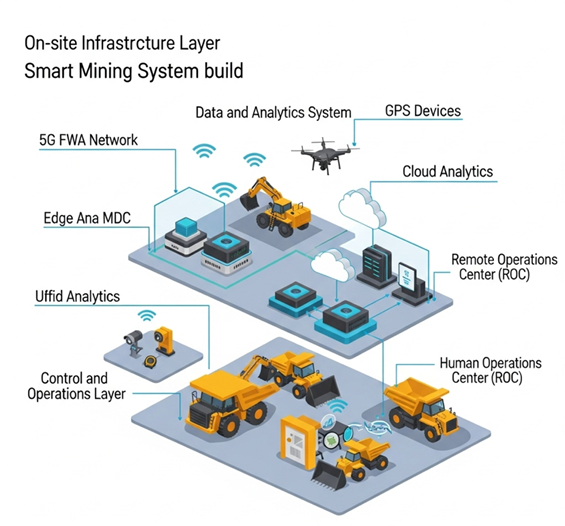
The architecture of the proposed Smart Mining System is a multi-layered, integrated framework designed for scalability and resilience.
1. On-site Infrastructure Layer: This is the physical layer located at the mine site. It includes all the hardware components that interact directly with the mining environment.
5G FWA Network: Provides wireless connectivity across the site.
Edge Micro Data Centres (MDCs): Houses the local processing power for real-time analytics and decision-making.
IoT Devices: A network of sensors, cameras, drones, RFID readers, and GPS trackers that collect data from HEMM, stockyards, and other operational areas.
2. Data and Analytics Layer: This layer is responsible for data ingestion, processing, and analysis. It is split between the on-site Edge MDCs and a centralized cloud platform.
Edge Analytics: The Edge MDCs perform real-time, low-latency data processing for critical applications like collision avoidance and equipment control.
Cloud Analytics: A central cloud platform aggregates data from all Edge MDCs for long-term analysis, reporting, and advanced AI-driven insights for overall operational optimization.
3. Control and Operations Layer: This layer is where human operators and AI interact with the system to monitor and control mining activities.
Remote Operations Center (ROC): A centralized command center where remote-controlled machines are operated.
AI-Driven Systems: The AI engine analyzes data and provides real-time recommendations and automated alerts.
Human-Machine Interface (HMI): A unified, ergonomic dashboard in the ROC that allows operators to visualize data and control machines.
4. Security Layer:
Cybersecurity protocols are integrated throughout the system to protect against cyber-attacks. This includes network segmentation and real-time threat monitoring.
8.0 Workflow of the Systems
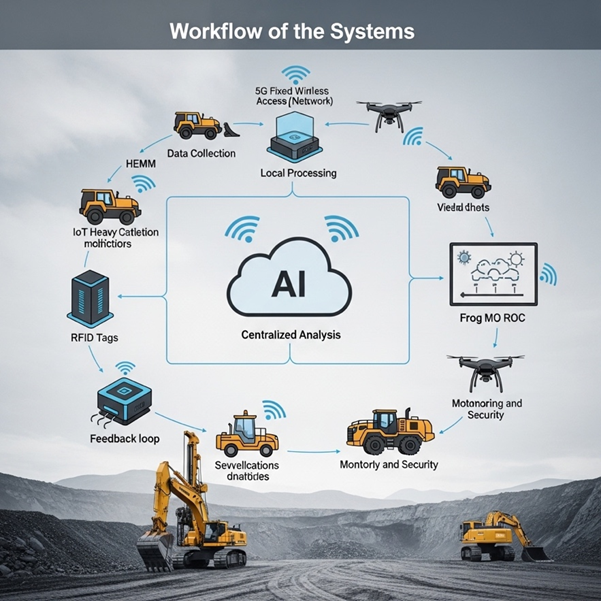
The workflow describes how the various components of the smart mining system interact to achieve operational goals.
Data Collection: IoT devices, sensors on HEMM, cameras, drones, and RFID tags continuously collect data from the mine site. This data includes operational metrics, environmental parameters, visual feeds, and logistical information.
Local Processing: The collected data is transmitted via the 5G FWA network to the nearest Edge Micro Data Center (MDC). The MDC processes time-sensitive data locally for immediate decision-making, such as real-time vehicle navigation and collision avoidance.
Centralized Analysis: The pre-processed data from the Edge MDCs is sent to a central cloud platform for a more comprehensive analysis. AI algorithms in the cloud analyze this aggregated data to identify long-term trends, optimize production schedules, and perform predictive maintenance.
Action and Control: The AI's recommendations and real-time insights are delivered to operators in the Remote Operations Center (ROC) through the Human-Machine Interface (HMI). Operators can then remotely control heavy machinery, such as continuous miners and drilling rigs, from the safety of the ROC.
Monitoring and Security: The AI system continuously monitors the performance of the 5G network and analyzes surveillance feeds for security threats, safety hazards, and theft. Automated alerts are triggered for any anomalies.
Feedback Loop: The system creates a continuous feedback loop where real-time data informs decisions, which in turn are executed and monitored, with the results being fed back into the system for further optimization. This dynamic process allows for a transition from reactive problem-solving to proactive, data-driven management.
9.0 Impact Analysis: Productivity, Financial, and Environmental
The proposed smart mining system is designed to deliver a transformative impact across three key dimensions.
9.1 Productivity and Technological Advancements
Efficiency: Real-time data and AI-driven insights will optimize every stage of the mining process, from exploration to processing, leading to higher resource recovery and reduced waste.
Uptime: Predictive maintenance will minimize equipment downtime by up to 20%, significantly increasing operational hours and overall production.
Innovation: The adoption of 5G, IoT, and AI will foster a culture of technological innovation, positioning the Indian mining sector as a global leader in digital transformation.
9.2 Financial Implications
Theft Mitigation: AI-powered surveillance and real-time inventory tracking will drastically reduce material theft, especially from stockyards and logistics routes.
Loss Reduction: Predictive maintenance will prevent costly equipment failures, while optimized fuel consumption and improved resource utilization will cut operational costs.
Stockyard Monitoring: Automated drones and satellite imagery will provide accurate, real-time inventory counts, eliminating manual errors and reducing financial losses associated with inaccurate stock management.
9.3 Environmental and Safety Implications
Environmental Stewardship: The system will enable precise monitoring of air and water quality, dust levels, and waste disposal, ensuring strict adherence to environmental regulations and reducing the risk of fines.
Safety: Removing personnel from hazardous environments and using real-time safety monitoring will significantly reduce the risk of accidents and fatalities, a major concern in Indian mining.
10.0 CONCLUSIONS AND RECOMMENDATIONS
The Indian mining industry is at a critical juncture. By embracing a modern smart mining framework, companies like SCCL and NMDC can overcome long-standing challenges and unlock new avenues for growth. The proposed system, built on 5G FWA, Edge MDCs, IoT, and AI, offers a practical and scalable blueprint for this transformation. We recommend that Indian mining corporations:
11.0 Study Done
This paper is a synthesis of a comprehensive study conducted via a mixed-method approach, primarily comprising a detailed literature review and case study analysis. The research methodology involved:
Literature Review: A thorough review of academic papers, industry reports, and official publications from both Indian and global mining sectors to understand the current state of technology, challenges, and best practices.
Case Study Analysis: Detailed examination of the operational models, technological adoptions, and specific challenges of key Indian corporations (SCCL, NMDC) and global leaders (Rio Tinto, BHP) to inform the proposed solution.
System Design: The proposed smart mining framework was designed by integrating findings from the literature review and case studies, focusing on a solution that is technologically feasible and strategically addresses the unique environmental and operational constraints of the Indian terrain.
12.0 Glossary
REFERENCES

Dr. Elduri Hari Pratap*, Smart Mining Systems for Indian Terrain: A Proposed Solution for Productivity, Sustainability, and Security, Int. J. of Pharm. Sci., 2025, Vol 3, Issue 8, 1239-1248. https://doi.org/10.5281/zenodo.16811494
 10.5281/zenodo.16811494
