

We use cookies to ensure our website works properly and to personalise your experience. Cookies policy
Rashtriya College of Pharmacy Hatnoor, Tq. Kannad Dist., Chh. Sambhajinagar -431103.
Organic synthesis is a fundamental branch of chemistry concerned with the construction of organic compounds through controlled chemical reactions. It plays a vital role in the development of pharmaceuticals, agrochemicals, polymers, and materials science. The discipline involves designing efficient synthetic routes to obtain target molecules from simpler precursors, emphasizing yield, selectivity, and sustainability. Modern organic synthesis integrates concepts such as green chemistry, catalysis, and computational design to enhance efficiency and minimize environmental impact. Advances in techniques like asymmetric synthesis, organometallic chemistry, and photoredox catalysis have expanded the scope of accessible molecules. Overall, organic synthesis serves as a cornerstone of chemical innovation, enabling the creation of new substances that address challenges in health, energy, and the organic Synthesis. The primary motivation that once induced chemists to undertake natural products synthesis no longer exists. Instead of target structure themselves, molecular function and activities now accupy centre stage. Thus, inhibitor with an affinity for all the important natural enzymes and raceptors have moved to the fore as potential synthesis target. New synthesis method are most likely to be encountered in the field of biological and organometallic chemistry. Enzymes, whole organizam and cell cultures for enantioseletive synthesis of specific substances have already been incorporated into the synthetic arsenal of both research laboratories and industry. In addition, designing appropriate analogues to transition state and intermediate should soon make it possible,With the aid of the mammalian immune system and gene technology to prepare catalytically active monoclonal antibodies for almost any reaction, Perhaps more important , Search process will increasingly come to be applied on an industrial scale.¹The discovery of true new reactions is likely to be limited to the realm of transition metals organic chemistry, Which will almost certainly provide us with additional “miracle reagent” In the year to come. As regard main group element, we can surely anticipate further stepwise improvement in experiment procedure and the broader application of special techniques, leading to undreamed off efficiency andselectively with respect to known procedure . The primary centre of attention for all synthetic method will continues to shift towards catalystic and enantioseletive variant, indeed, It will not be longer beypore such modification will be available with every standard reaction for converting achiral educts Into chiral product, analysis, spectroscopy, structural determination, theory and electronic data processing have all decom indispensable in organic synthesis. Only with the head of these tools will the method of organic chemistry permit selective synthesis of ever larger add more complex system on both the molecular and super molecular level.
Organic synthesis stands at the heart of modern chemistry, Representing the act and science of creating new molecules from simple starting material, It is a field where creativity meet precisions, We are the manipulation of atom and bond lead to the development of compound that can revolutionize medicine and material science and beyond. organic synthesis is define as the process of constructing complex organic molecule through a series of chemical reaction, with objective that may include efficiency, Yield maximization and the use of in environmentally benign reagent It involves strategic planning and the application of various tactic to achieve specific goals in the synthesis of target compounds.organic synthesis encompasses the construction of organic compound through chemical reactions. These compound, primarily based on carbon, hydrogen and order elements like oxygen, nitrogen, silver and phosphorus, from the basis of life and countless synthetic material, the discipline is rooted in fundamental organic chemistry principal such as bounding theory, stereochemistry and reaction mechanism. The goals of organic synthesis various widely from producing pharmaceuticals that combat disease to developing new material with unique properties. It involves designing pathwe that transform ridley available starting material into complex structure efficiently when selectively.³ Disc process require a deep understanding of how different functional group react under various condition and how to control this reaction to achieve the desired outcome.
Early 19th century organic compound where believed to be produces only by living organism. The history of which begin with friedrich wohler’s in 1828 synthesized urea from ammonium cyanate, disproving vitalism. Key developments include the synthesis of dial and other organic chemicals in the let 19th century, Leading to Industrial application, the 20th century synthesis of complex natural product like vitamins B12 and cholesterol.Advance in spectroscopy and computational chemistry further propelled the field, enabling the creation of advance material and pharmaceuticals, with figures like woodward and corey making seminal contribution.?the total organic synthesis of complex molecule demand a knowledge of reaction that that form Carbon carbon double bond, as well asdos that change one functional group into another. The largest number of chemical reaction uses in a synthesis involve the manipulation hope functional group.prior to 1914 the industrial production of organic chemicals in a united States was very limited both are number compound and quantity.petroleum refining was preliminary by distillation, there were no cracking process and no petrochemical plants. the synthesis of molecules rarely Successfully unless all except of chemical reactivity functional group interaction, information stereochemistry as well as understood.
All manufactured organic synthesis base items generated to help civilization are result of morden chemical synthesis. Modern chemical synthesis necessitates procedure that are well understood and well controlled, and generate product that pull bill economical, quality and safety goal while minimise the environmental effects. Organic chemistry is a constantly evolving discipline, various current trend r impacting the future of research and development in the area. Some of the most significant trends in organic chemistry include green chemistry.?
1. Organic synthesis:- This section provides a brief introduction to organic chemistry, and to PDDL, As the modelling language of the application domain.
We consider molecule as graphs android action as symbolic graph transformation. Each molecule is composed of bonded chemical atom . Chemical atom can form various types of bond ( Single bond, double bond, aromatic bond etc.) With each other, conditional upon their chemical valency, Which is a positive integral describing How mini bond a certain atom can make. For example, the valency of carbon atom is 4, And therefore, a carbon atom is capable far farming 4 single bond, or 2 double bond, or a triple bond and a single one. Hydrogen atom has valency of 1, Oxygen O has chemicalvalency of 2 , And this is why a Molecule of water H2O consists of 2 hydrogen and Single oxygen. Chemical reactivity of molecule is due to there constituent functional group, and molecules with similar property are categorised into 2 chemical classes.Some functional groups are alkyl, hydroxyl and ester functional group, which are the main group in alkane, alcohol and estar chemical class respectively. Alkyls is an acyclic tree of single bonded carbon and hydrogen atom, With hydrogen in leaves only, such that one of the carbon atom in the tree bridges it to another functional group via single bond.If the Bridget carbon bond with a hydrogen atom, an alkane is formed.? Alkyls have the generic formula of Cn H2n+1 and will be subsequently represented as R.?
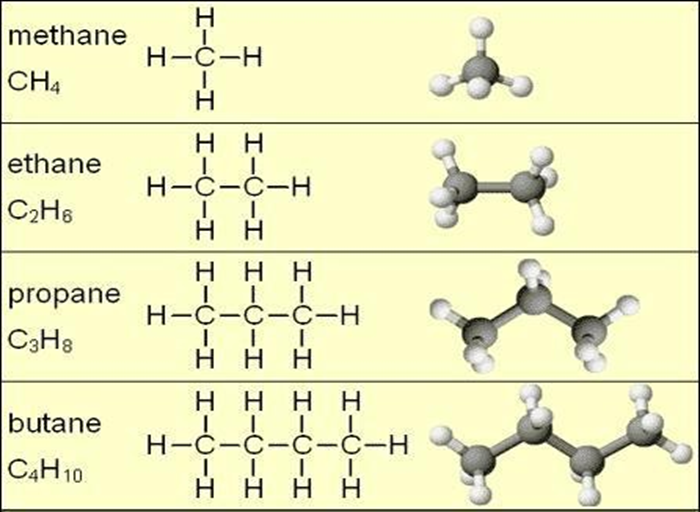
2. Types extraction:- Common extraction techniques in organic synthesis include 1) Liquid liquid extraction 2) Solid liquid extraction 3) Acid base extraction .
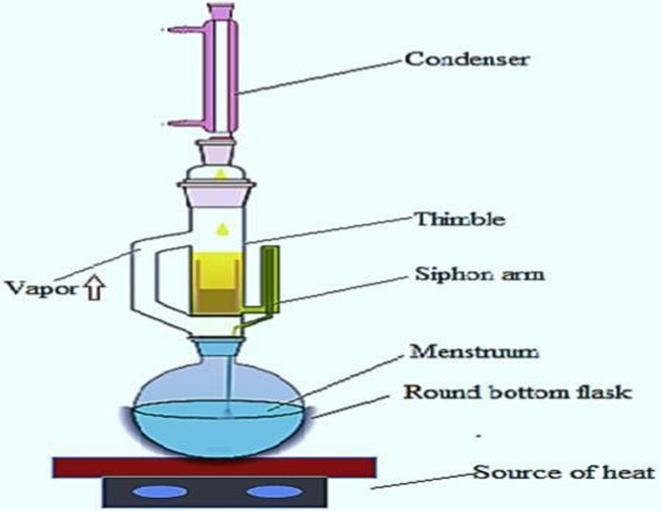
Extraction technique :- 1)Soxhlet extraction -is define as the process that a allows for the continuous recovery of analytes from a sample matrix using press solvent , inhancing extraction efficiency.
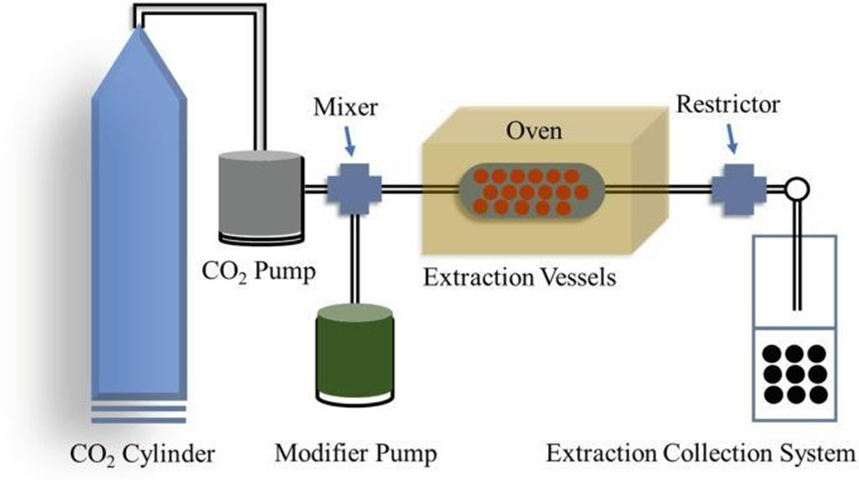
Supercritical Fluid Extraction - is the process of separating one component from another using supercritical fluid as the extracting solvent.
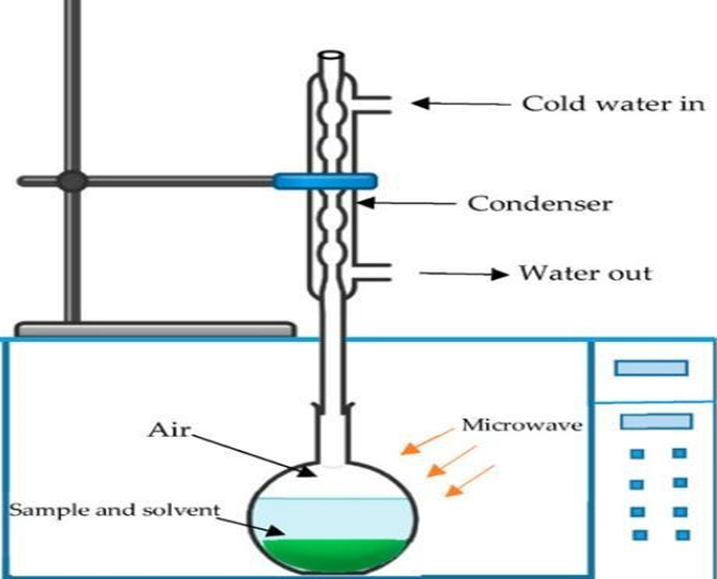
3) microwave assisted extraction - Is A Process of Using Microwave Energy to Heat Salvent in Contact with Sample in Order to Partition Analytes from The Sample Matrix into The Solvent. ¹?
Synthesis methodology :- Organic synthesis methodology refers to the systematic design and execution of reaction to create organic compound by building the carbon fremwork, introducing and transforming functional group, and controlling stereochemistry¹³.
Metal catalysed cycloaddition are chemical reaction that use a metal catalyst to join two or more molecules forming ring structure. ¹²
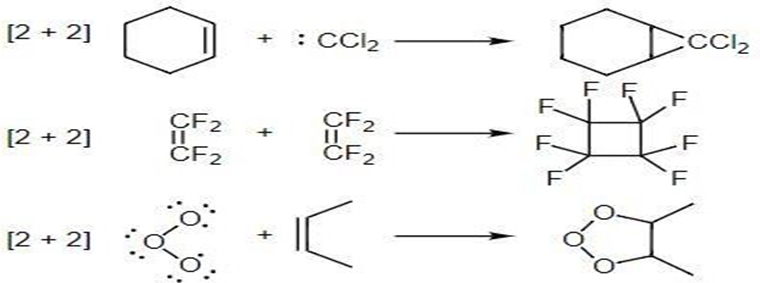
2. (2+2+2) cycloadditions reaction.

3. (4+2) cycloadditions reaction.

• C-H functionalization.
C-H functionalization is powerful synthetic organic chemistry technique that convert a relatively inert carbon hydrogen bond in two new bond with different atom or functional group.¹³

Multi component reaction.
A multi component reaction is a chemical reaction where three are more starting material combined in a single reaction vessels to form a single , more complex product that incorporate most of the atom from the reactant.¹?
Cross coupling reaction. A cross coupling reaction is a chemical reaction where to different molecular fragment are joined together, typically forming a new carbon carbon bond , with the help of metal catalyst. These versatile and powerful reaction are crucial for synthesizing complex organic molecule.¹?
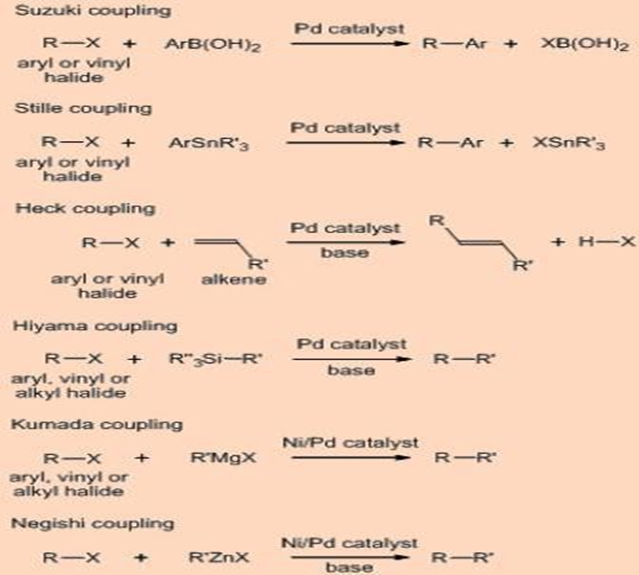
Total synthesis:- Total synthesis is the complete chemical synthesis of a complex organic molecule from simple starting material. This process is used to produce natural product vendor supply is limited or to create a new compound not found in nature. Total synthesis can be accomplished through linear or convergent approaches. And it plays a critical role in come farming molecule structure, discovering new synthetic method, and developing new medicine.
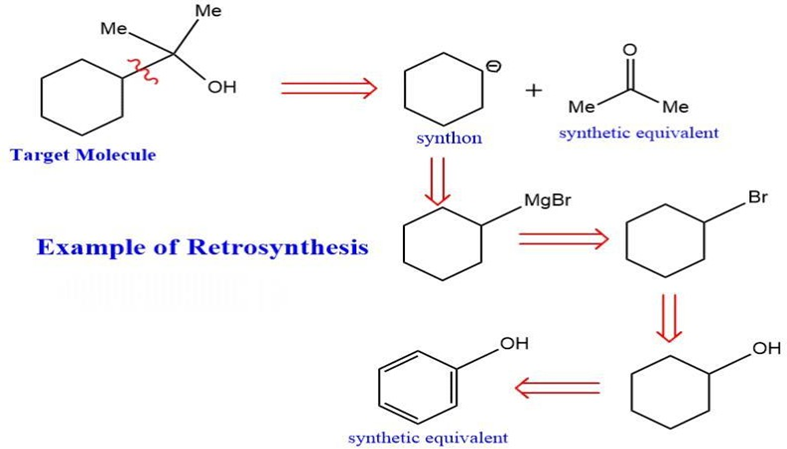
Retro synthesis – Is a method of working backward from target molecule to find a feasible synthesis route using a series of disconnection and functional group interconversion. It includes imagining breaking bond in the target molecule to break it down into smaller, simple precursor until you reach readily available starting material¹? .
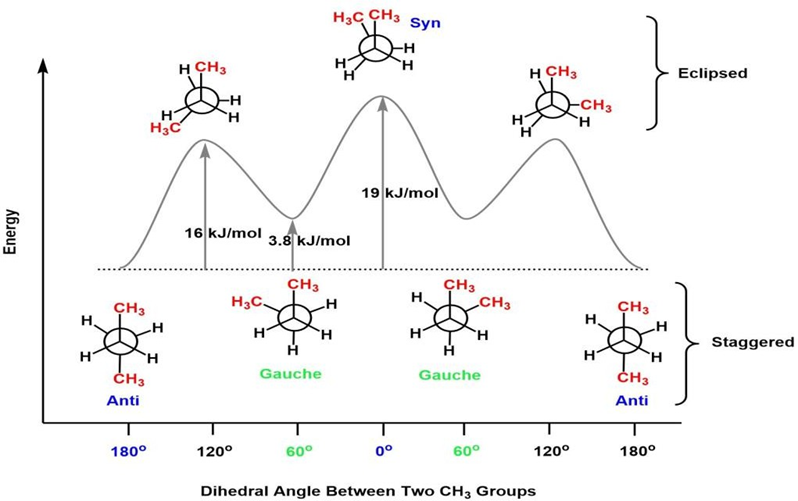
Conformation analysis – Is the study of how the difference shape molecule can adopt, call confirmation, relate to its stability and reactivity which is determined by the energy change that occurs during rotation around a single bond.
Functional group transformation – Functional group transformation is the process of converting one functional group into into another through chemical reaction in organic synthesis.
Positive catalyst mean that increases the rate of chemical reaction. For example - in the production of oxygen from potassium chloride manganese oxide act as a positive catalyst.¹?

2. Negative Catalyst
Negative catalyst that decreases the rate of chemical reaction . For example - production of sodium sulphate from the oxidation of sodium sulfide solution is hampered by the presence of ethyl alcohol.

3. Heterogeneous Catalyst
Heterogeneous catalyst mean the reacting substance involving reaction and catalyst employed in that reaction are not same state of matter. For example - oxidation of SO2 to SO3 in presence of Pt metal or V2S5 as catalyst in the contact process of the manufacture of sulphuric acid.

Combination between nitrogen and hydrogen to form ammonia in the presence of file divided ironin Hiber’s process .

4. Homogeneous Catalyst
The catalysis in which the catalyst employed in the reaction and the reactant are in the same state of matter that process is referred to as homogeneous catalysis. For example – in the decomposition of excited NO3,NO2 is use as catalyst.

5. Autocatalyst
In this catalysis one of the reactant and reactor act as a catalyst and increases the rate of formation of product, means there is no specific catalyst that is added. e.g oxidation of oxalic acid by potassium per magnet when permagnet is added to acidic solution oxidation of oxalate ion occurs. The reaction result in the formation of Mn²+ions and it autocatalyzer the reaction.
6. Electrocatalyst
Several type of metal containing catalyst are used in electrochemistry specially in fuel cell engineering. this catalyst have one main role which is to enhance the rate of the halfreation that occur in the fuel sale.
7. Biocatalyst
Biocatalyst is a substance that speed up the biological chemical reaction most commonly an enzyme ,without being consumed in the process.²?-²¹
Role of catalyst : -
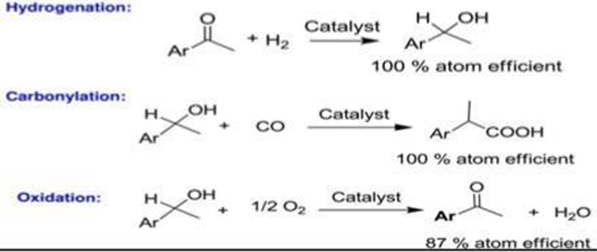
In the manufacturing of organic compound primarily waste material generated, fine chemical and pharmaceutical manufacturer is uncontrolled with antiquated stoichiomeric technology. ²²-²³
7. Stereochemistry: -The concept of chirality and absolute configuration is introduce early in undergraduate organic chemistry courses. For that reason, this section is intended as a review and it is assumed the reader has some familiarity with the concept. This section will discuss Stereoisomer. The discussion will begun with 2 chlorobutane and 1 chlorobutane, which have the same empirical formula, but are clearly different molecules.They are isomer, two or more molecules that have the same empirical formula. they are different molecules the term isomer does not adequately characterize the relationship of atom and groups in 2 chlorobutane and 1 chlorobutane. The term used to define the relationship between these two alkyl chloride is regioisomer . two or more molecules with the same empirical formula, but with a different attachment of the atoms.
Another type of isomerism occur when two molecules have the same empirical formula and also have the same connectivity of atom, but are different molecule. Such molecule differ only in the
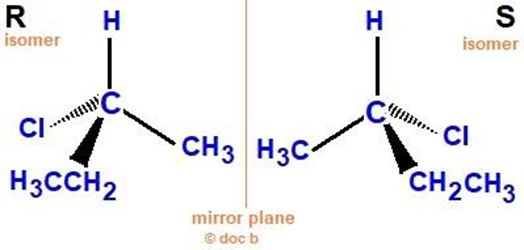
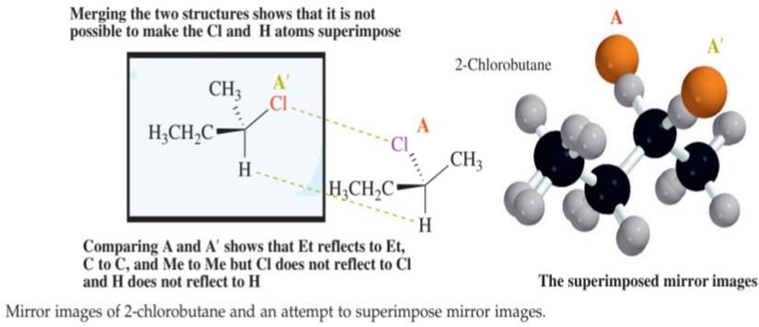
relative spatial position of the atom, and are called stereoisomer. the following section will discuss different type of stereoisomer and their characteristic properties absolute configuration in non-recemic molecule : When a carbon atom is bound to 4 different atom or group in a tetrahedral arrangement, that carbon is said to be stereogenic or chiral. Othor atom may be stereogenic, but the number and types of attached atoms or groups will vary with the valance of the atom. the focus will be exclusively on carbon. The C in 2- chlorobutane is a stereogenic centre. The C in 1- chlorobutane is not stereogenic, since that carbon has two identical atoms (H) attached to it. why is identification of C 2- chlorobutane as a stereogenic centre important? The answer paper when the mirror image of 2 chlorobutane is draw.?
8. Reaction:- Chemical reaction central to chemical engineering, where they are used for the synthesis of new compound natural raw materials . Reaction are important in chemistry because they are a fundamental tools for creating a new complex organic molecule.
1. Aldol condensation reaction .
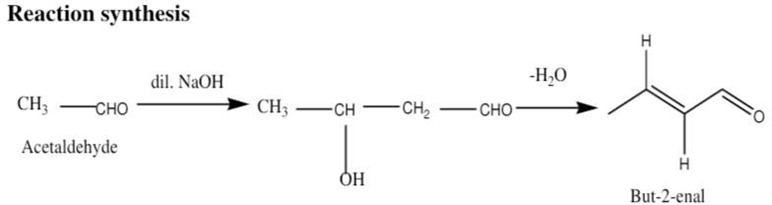
Aldol condensation reaction was introduced by Charles wurtz in the year 1872.²? under the condensation reaction in the presence of dilute alkali with two molecules of aldehyde or ketone which gate condensed to form beta hydroxy carbonyl compound .²? It is a versatile method to from carbon carbon bond which is frequently used in organic chemistry. the initial reaction product is beta hydroxy carbonyl compound.Then subsequently dehydration in the given step yield alpha, beta unsaturated carbonyl compound. This entire process is aldol condensation.²?
Use: it Use as a intermediate in manufacturing of following chemicals.
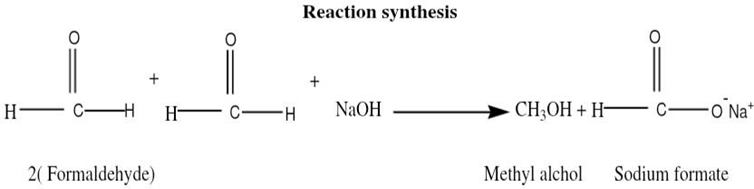
2. Cannizzaro Reaction.
Cannizzaro reaction was given by stanislao cannizzaro in the year 1853.²? These redox disproportionation i.e reduction of non enolizable of aldehyde containing no alpha hydrogen atom in the presence of concentrated base so NaoH or koh which yield methyl alcohol and sodium format. The aldehyde participants in the reaction should not have alpha hydrogen atom. so we take the reaction of formaldehyde or benzaldehyde. ²?
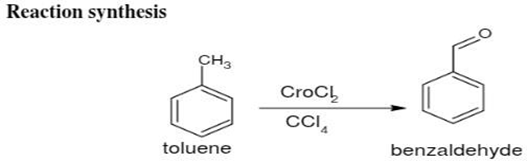
3. Etard reaction.
Etard reaction was given by Alexander Leon etard in the year (1852 to 1910) .²?-²? the etard reaction involved direct oxidation of toluene with chromyl chloride in carbon tetrachloride, it produce brown complex, further brown complex decomposed with water it is benzaldehyde.²?
Use in:-use in pharmaceutical industry for manufacturing of API like chloramphenicol, amoxicillin and epidrine.
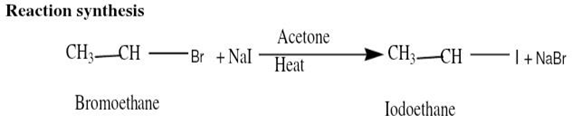
4. Finkelstein reaction.
Finkelstein reaction was given by Hans Finkelstein in the year 1910 during his doctors studies.³? in the reaction synthesis of alkyl halide from alkyl halied in finkelstein reaction. Under this exchange of chlorine and bromine in chloro or bromo alkene respectively with iodine. when sodium iodide heated with chloro or bromo alkane in the presence of acetone or methanol yields iodoalkane.²?
Use In Pharmaceutical Industry: -
1. It is used as a chemical reagent and in medical penetration aid that major cardiac blood output.
2. It is also used in organic synthesis and as a reagent.
3. It is used in drug for the treatment of goiter and plant growth hormone.
5. clemmensen reduction reaction.
This reaction named after Eric Christian clemmenson and first reported by park davis in 1913.³¹ under this reaction aldehyde and ketone when heated with zinc amalgam and concentrated HCL they get converted into corresponding hydrocarbon.²?
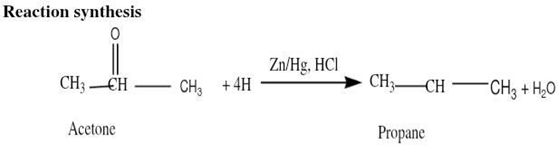
Use:- 1.Propen is used as a fuel source in industry and as aerosol propellant.
2.It is used as synthesis of organic chemicals for the manufacturing of ethylene which is used in manufacturing of ethylene oxide, alcohol, mustard gas,organics.
6. Balz-schieman reaction.
This reaction was named after the german scientist gunther schieman and gunther balz.³² Under this reaction group present in diazonium salt which can be replaced by adding fluoroboric acid to cold aquaous solution of diazonium salt and heating the diazonium tetra fluoroborate yield fluorobenzene.²?
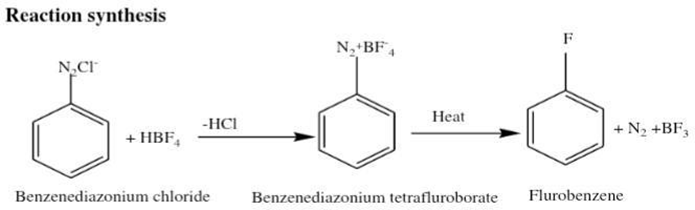
Use in pharmaceutical industry:-
1. chlorobenzene is used as reagen for Plastic or resin polymer
2. act as a solvent for highly reactive species.
3. On fluorination of fluorobenzene it yield 1 2diplura benzene.
7. Perkins reaction.
Perkins reaction was given by English chemist William Henry perkin in the year 1856³³.under this reaction an aromatic aldehyde is heated with an aliphatic acid anhydride in the presence of sodium salt of the acid to anhydride, the further condensation takes place to yield cinnamic acid. ²?
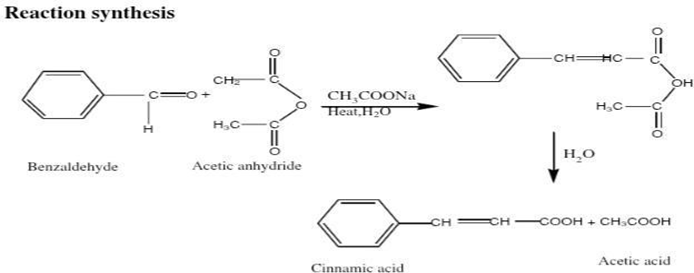
Use in pharmaceutical industry:- Used as a major product in ethyl cinnamate, methyl cinnemate, and benzyl cinnamate.³?
8. Crossed Cannizzaro’s Reaction.
A cross cannizzaro reaction is a redox reaction between two different aldehyde,where one is oxidised and other is a reduced. this is a different form of standard cannizzaros reaction, which involve a single aldehyde.³?
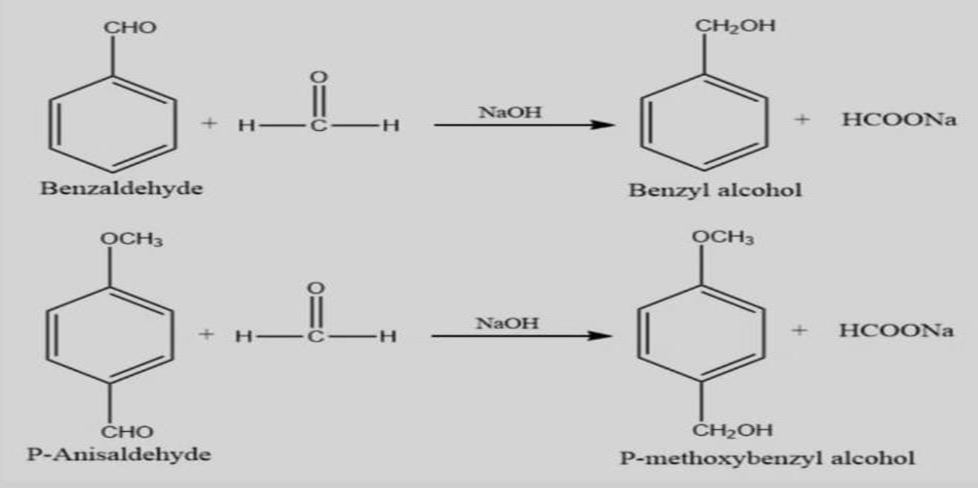
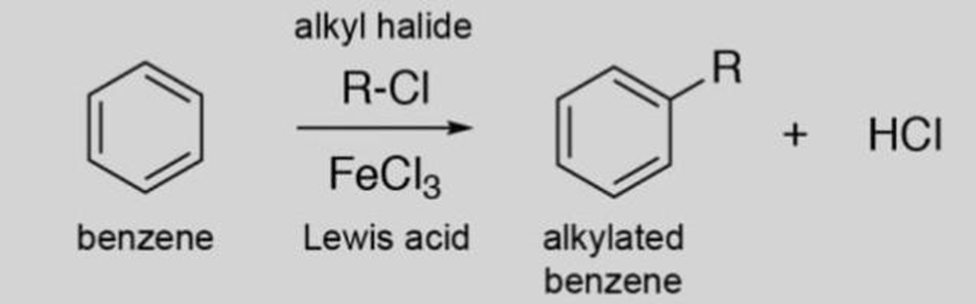
9. Friedel- Crafts Alkylation.
Is a type of electrophilic aromatic substitution reaction. A reaction in which an aromatic molecule react with an electrophilic where the electrophilic replace another substituents on the aromatic ring. In which benzene ring is modified with an alkyl substituent .³?
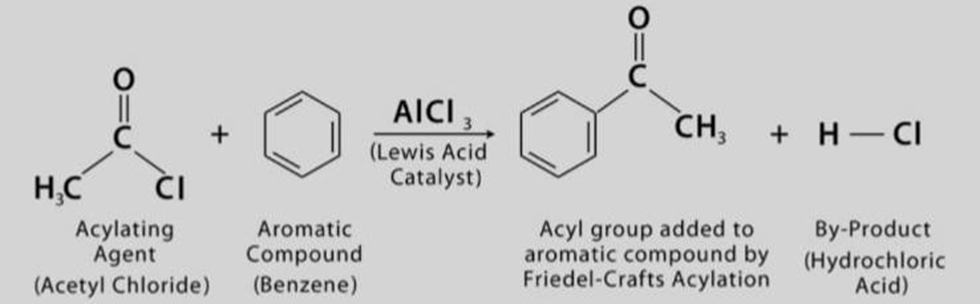
10. Friedal-crafts acylation.
It is electrophilic aromatic substitution where an aromatic ring react with an acyl chloride in presence of lewis acid catalyst to form an a aryl keton.³?
Derivatives :- Derivatives in organic synthesis is a compound formed by replacing one or more hydrogen atom or functional group in a parent molecule with a different atom or group of atom through of chemical reaction.
Formation of derivatives –
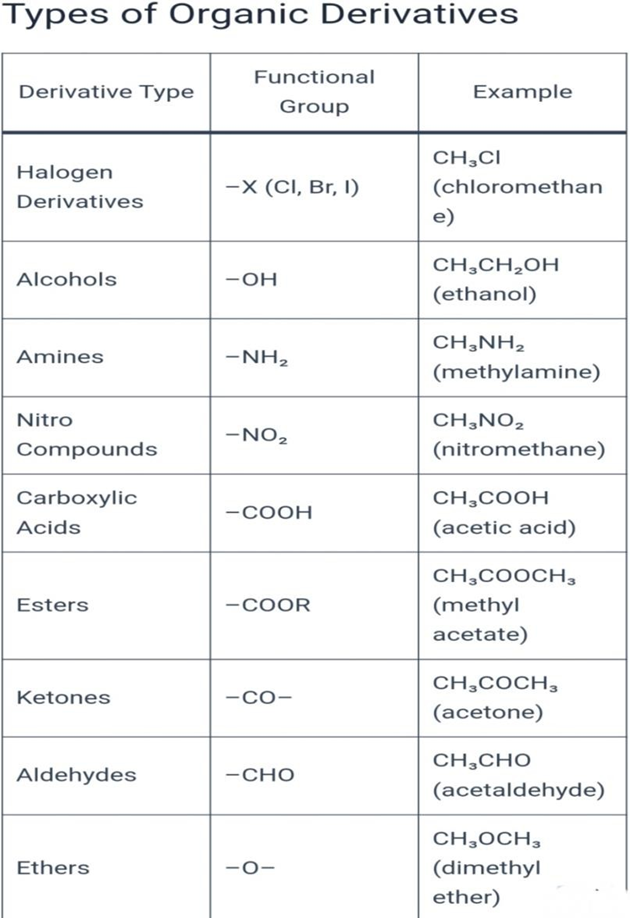
Example :–
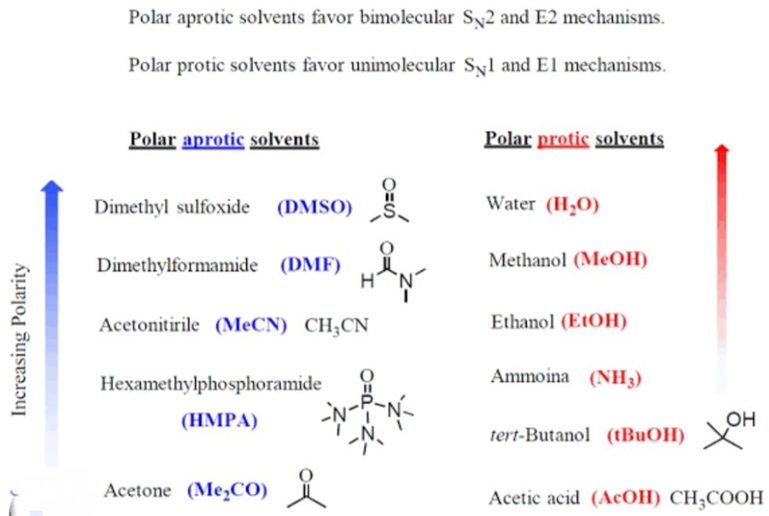
10. Solvents:- solvent are critical in organic synthesis as they provide medium for a reaction. Facilitated heat and mass transfer, and influence reaction kinetics , selectivity , and yield.
Roles of solvents in organic synthesis: -
11. Analytical technology :- These techniques help confirm the identity, purity, and structure of reaction product and monitoring the progress of the synthesis itself.
Technology use in organic synthesis :–
12. Applications of organic synthesis :-
CONCLUSION :- organic synthesis is a crucial field that create complex molecule from simple one, with significant benefits for health, material and other areas. It’s conclusion is that the fields importance is growing, with ongoing innovation driving solution to global challenges like diseases and climate change. Future development will focus on sustainability through greener methods like enzyme catalysis and photo catalysis, while addressing the complexity of synthesis remains a key challenges.
REFERENCES

Ram Ingle, Rutuja Waghchaure, The Review Article on Organic Synthesis, Int. J. of Pharm. Sci., 2025, Vol 3, Issue 12, 1095-1116 https://doi.org/10.5281/zenodo.17837416
 10.5281/zenodo.17837416