

We use cookies to ensure our website works properly and to personalise your experience. Cookies policy
Sigma Institute of Pharmacy, Sigma University, Bakrol, Vadodara, 390019
Topical film-forming sprays (TFFS) represent an advanced and patient-friendly drug delivery platform designed to enhance localized therapy through the formation of a thin, uniform, and adherent film upon application to the skin. These systems typically comprise volatile solvents, film-forming polymers, plasticizers, and active pharmaceutical ingredients, which rapidly evaporate after spraying to generate an invisible or transparent film at the site of administration. TFFS offer several advantages over conventional topical dosage forms, including improved drug residence time, controlled drug release, reduced dosing frequency, enhanced patient compliance, and minimized systemic exposure. This review provides a comprehensive overview of topical film-forming spray technology, emphasizing formulation components, mechanisms of film formation, and factors influencing drug release and skin permeation. Additionally, current evaluation methods, including in vitro, ex vivo assessment techniques, are discussed. The review also highlights recent advances, therapeutic applications in dermatological and wound-care conditions, regulatory considerations, and existing challenges such as skin irritation, film integrity, and scalability.
Skin drug delivery methods aim for the gold neighborhood effects and offer several advantages, such as avoiding first-pass digestion and the effects of low pH and catalysts in the gastrointestinal tract, as well as a large accessible surface area [4]. Topical drug delivery methods target systemic or local effects and have a number of benefits, such as a wide accessible surface area, avoidance of first-pass metabolism, and the impact of low pH and gastrointestinal tract enzymes. Drugs used topically are typically produced in a dosing method, such as a patch, gel, lotion, cream, ointment, or spray, to enhance therapeutic efficacy or pharmacokinetic characteristics.
Many advancements have been created in recent decades to produce effective and efficient spray preparations. One of them is a film-forming spray (FFS), which has been used in a variety of industries, including agriculture, food, cosmetics, and pharmaceuticals. In general, FFS is made up of polymers, enhancers, and active ingredients dissolved in organic solvents. Compared to other traditional topical preparations, a thin, non-sticky film can increase the drug's contact duration and permeability, resulting in continuous drug release. It can also prevent crystallization, increasing the amount of medication available to produce therapeutic effects [11].Sweating, clothing, movements, and susceptibility to being rapidly washed away upon contact with water are among the issues that have limited the effectiveness and duration of traditional topical formulations. For efficient treatment of local tissues, diseases, or wounds, the specific pharmacological component must remain at the treatment site for an appropriate period of time. Film-forming formulations represent a distinctive form of sustained-release dermatic products [9].
Topical film-forming sprays are drug delivery systems that, when applied to the skin, form a thin, adhering film. By applying therapeutic chemicals directly to the skin, these sprays provide localized treatment with little systemic absorption [19]. Cellulose derivatives, chitosan, polyvinyl pyrrolidine, polyvinyl alcohol polymethacrylate copolymers, and polyacrylate copolymers are examples of film-forming agents. Butanol, isopropanol, and ethanol are solvents in these formulations. Plasticizers such as glycerin, propylene glycol, and polyethylene glycol can be added to improve the films that are produced. By creating supersaturated systems immediately upon skin application, FFS removes instability [5].
Features of FFS[4]: In contrast to standard semi-strong arrangements, the film forming spray can be applied to the site with minimal consideration for shape and region and can be retained for a considerable amount of time. The figure(1) shows that FFS creates an almost transparent, fast-drying coating when applied and also illustrates how a non-crude, versatile, and successfully peelable film is formed after drying. The formed film forms an amazing bond with the skin, removing any impediment. Consequently, the likelihood of active chemicals getting into clothing or other individuals is reduced.
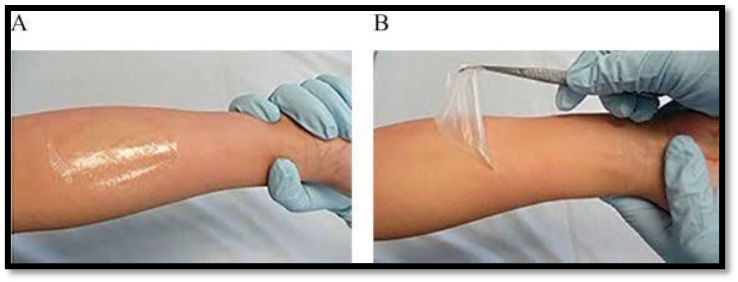
Figure 1: Formed film
Factors affecting Drug penetration in Dermal Delivery [5,7]
A. Physiological factors:
B. Physicochemical factors:
Advantages of Film Forming System. [3]
Disadvantages of Film Forming System. [3]
MECHANISM OF FFS [15,17,18,20]:
The film-forming system (FFS) is a novel approach that can be used as an alternative to conventional topical and transdermal formulations. It is defined as a non-solid dosage form that produces a film in situ, i.e., after application on the skin or any other body surface. These systems contain the drug and film-forming excipients in a vehicle that, upon contact with the skin, leaves behind a film of excipients along with the drug upon solvent evaporation.
FFS rapidly creates supersaturated systems upon skin application, thereby overcoming the issue of instability. Consequently, it enhances the penetration of drugs via the skin in comparison to alternative transdermal formulations.
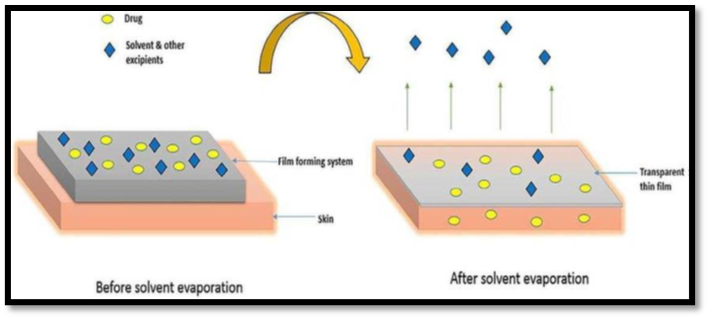
Figure 2: Film formation after application
To control systemic or local effects, drug dosages in a film-forming spray can also be modified according to the volume of solution per spray. Additionally, an FFS distributes medications evenly and effectively. Patient compliance can also be improved by ease of use. With water, the thin layer is easily removed. Compared to utilizing patches, ointments, gels, etc., which have a rough and sticky texture when applied, this thin and non-sticky film also improves patient comfort during activities. Additionally, the thin film makes it easier for moisture from the wound to penetrate and preserve equilibrium. As with patch preparations, improper wound humidity can lead to infection or discomfort. In formation of droplets, the film-forming solution is sprayed using any kind of sprayer. Each sprayer has different specifications and intended uses, but has specific potential in medical applications.
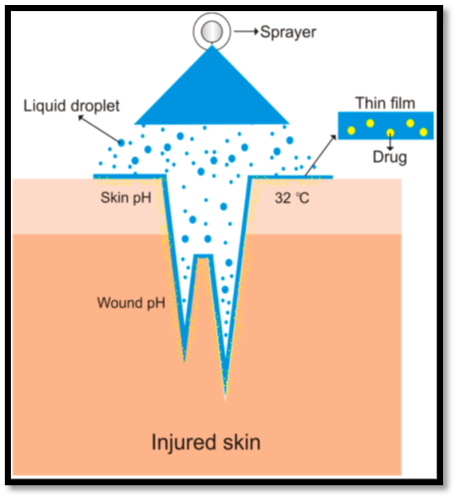
Figure 3: Penetration of spray to skin
Film-forming agents include cellulose derivatives, chitosan, polyvinyl pyrrolidine, polyvinyl alcohol polymethacrylate copolymers, and polyacrylate copolymers. These compositions contain butanol, isopropanol, and ethanol as solvents. To enhance the films that are created, plasticizers like glycerin, propylene glycol, and polyethylene glycol can be added. FFS eliminates instability by generating supersaturated systems right away after skin application. Consequently, in comparison to other transdermal administration forms, it enhances medication penetration via the skin. The modified version of Fick's law of diffusion explains the idea of supersaturation.
Fick's law of diffusion is given as:
J= DKCv/h
where,
This equation makes it evident that the drug's concentration and the pace at which it permeates the skin are proportionate.
FORMULATION ASPECTS [19] :
Film-Forming Properties: When applied to the affected skin, these sprays create a thin, homogeneous or uniform film. By extending the antifungal agent's contact time with the infection site, this film improves therapeutic efficacy.
Enhanced Adherence: These spray’s film-forming properties reduces the product wash-off and increase adhesion to uneven skin surfaces, ensuring ongoing antifungal agent delivery.
Reduced Systemic Absorption: Topical sprays decrease systemic absorption of the antifungal medication by directly targeting the application site, which lowers the possibility of systemic side effects.
FORMULATION COMPONENTS OF FFS [4]
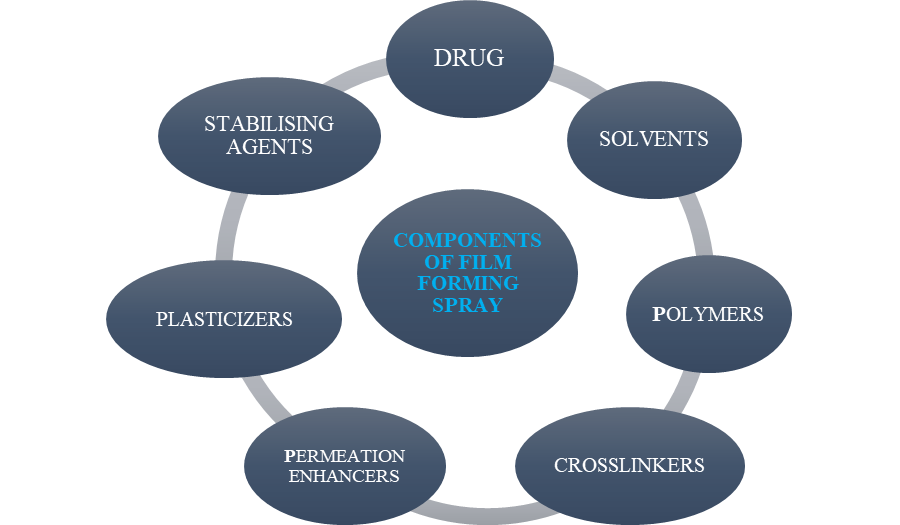
Figure 4: Formulation Components of FFS
A] Drug [9]
Regardless of the dose form, drugs must possess the necessary properties for transdermal application of the film-forming mechanism. The drugs that are appropriate for these systems are frequently strong, rapidly penetrate the skin, do not cause skin irritation, and are relatively stable against the enzymes present in the epidermis. The choice of preparation is influenced by the drug's molecular weight, lipophilicity, and solubility. An octanol-water partition coefficient (log P=1-3) and the solubility of pharmaceuticals in water and oil are ideal for successful skin penetration; the stratum corneum functions as a barrier to prevent medications from reaching the skin; skin permeability increases as lipophilicity increases. The release and absorption of active ingredients are also influenced by the type of polymer utilized in the FFS. The drug would be more lipophilic for quick penetration through skin barriers due to the creation of a skin reservoir, which would be more appropriate for attaining the sustained delivery profile.
Table.1: Ideal Properties of Drug for Transdermal Delivery[1]
|
Parameter |
Properties |
|
Dose |
<10 mg/day |
|
Half life |
10 h or less |
|
Molecular weight |
<500 Dalton |
|
Partition coefficient Log P (octanol/ water) |
BETWEEN 1 AND 3 |
|
Skin reaction |
Non irritating and non-sensitizing |
|
Oral bioavailability |
Low |
B] Solvents [5,9]
The solvents are crucial parts of FFS. It serves as a solubilizing agent for both polymers and drugs. Since solvent evaporates quickly, it is not a real component of the film forming on skin. Only solvents with a broad spectrum of medication and polymer solubility are utilized. Solvents used in FFS should be extremely volatile at skin surface temperature, leaving behind medication and polymer (form film) and allowing for quick drying. Even though there is just brief skin contact, the solvent has a direct effect on drug flux and permeation-enhancing qualities that can support drug transport over the skin. To create a smooth, uniformly thick coating, the solvent should be evenly applied to the skin. These requirements of solvent are not fulfilled by water, so volatile organic solvents which have a short drying time and better patient compliance such as ethanol, ethyl acetate, isopropanol etc. Types of solvents used are mentioned below:
1. Volatile Solvents
Purpose: These solvents evaporate quickly, helping to form a dry film rapidly after application. They help in controlling the drying time and the final texture of the film.
Examples: Ethanol, Isopropyl alcohol, Acetone.
2. Non-Volatile Solvents
Purpose: These solvents remain in the film after the volatile components have evaporated, contributing to the film’s flexibility, stability, and adhesive properties.
Examples: Polyethylene Glycol (PEG), Propylene Glycol (PG), Glycerin
3. Combination Vehicles
Purpose: Blending volatile and non-volatile solvents can optimize the film-forming process, balancing drying time, film flexibility, and drug release.
Examples: Ethanol and PEG, Ethanol and PG.
4. Specialty Vehicle
Purpose: These are used to address specific formulation needs or improve the performance of the film.
Examples: Silicone-Based Solvents
C] POLYMERS [11]
The effectiveness of FFS preparations is largely dependent on polymers. In addition to controlling drug release, polymers serve as the foundation for film formation. Additionally, polymers can stop molecules from changing and forming unexpected crystals. When choosing polymers, general factors to take into account include stability, biodegradability, ease of washing away by water, and non-irritating qualities. Natural or synthetic polymers with in situ gel or viscoelastic qualities can be employed in FFS.
Table.2: Properties of polymers used in FFS [1,9]
|
Polymers |
Properties |
|
Hydroxy propyl methyl cellulose (HPMC) |
White powder, odorless, tasteless. Soluble in water, but insoluble in diethyl ether, acetone and anhydrous alcohol. In cold water it will swells, acts as film forming aget, thickener, emulsifier, stabilizer and adhesion. |
|
Hydroxyl propyl cellulose (HPC)
|
White to slightly yellow colored powder, odorless and tasteless. Soluble in water below 40 ? and soluble in polar organic solvents. It forms flexible film in combination with other polymers. |
|
Poly vinyl pyrrolidine (PVP)
|
Soluble in water and other solvents. Adhesion and binding property. |
|
Poly vinyl alcohol (PVA)
|
White odorless, soluble in water. Excellent film forming and adhesive properties. |
|
Chitosan
|
Excellent film forming ability. Enhance release and permeation profiles. Control drug release. |
|
Eudragit |
Elastic, transparent, self-adhesion. Good adhesion to skin. |
|
Ethyl cellulose
|
Non-toxic, non-irritating, non-allergic material. Good film forming properties that form tough film |
|
Silicones Polydimethylsiloxane (PDMS) |
Water vapor permeable film Adequate substantivity and durable film40 |
D] CROSSLINKERS [11]
The use of crosslinkers can affect the elasticity, viscosity, solubility, glass transition, and film stiffness of the polymer. The use of NaCl as a crosslinker in gellan gum also affects the gel’s sensitivity to temperature, so that film formation is better and faster. NaCl also increases cell encapsulation in gellan gum.
E) PERMEATION ENHANCERS [8,11]
Eutectic mixtures are widely utilized to improve medication penetration. One of the most potent eutectic combinations is menthol and camphor. Since camphor and menthol combine to form a hydrophobic mixture, they can be used as penetration enhancers for drugs that are likewise hydrophobic. On the other hand, menthol and camphor may encourage pore formation and skin peeling. A combination of camphor and menthol is characterized by a warm sensation that progressively turns cold. In a Franz diffusion cell with nylon membranes, the eutectic combination of camphor and menthol greatly improves the penetration of the antifungals fluconazole, clotrimazole, and voriconazole. Because it has hydrophobic properties, camphor and menthol can increase drug permeation through interactions with the lipids of the stratum corneum.
F) PLASTICIZERS AND STABILIZING AGENTS [11]
In the film formation, the plasticiser maintains elasticity and prevents cracking of the film. Plasticisers can also maintain the stability of active substances and increase the permeation of drugs. Antifungal medication penetration is said to be enhanced by polyethylene glycol (PEG) and propylene glycol (PG). PG serves as a solubilizer in addition to being a plasticizer, which is helpful for delivering medications through the skin. The concentration must be taken into account because PG significantly affects the film-forming solution's viscosity. PG does not work well as a mixed solvent to stop testosterone from crystallizing when combined with ethanol and water. PG concentrations below 5% are beneficial in boosting medication penetration. Additionally, PEG 400 can double a film-forming solution's volume per spray.The amount per spray increases with increasing PEG 400 concentrations. The covered spray area also increases with increasing PEG 400 levels. This is associated with a decrease in vapour pressure due to the presence of PEG as a non-volatile solvent.
FILM-FORMING SPRAYERS:
A} Ordinal spray [4]
An ordinal shower uses a plastic or aluminum compartment with a plunge tube width of 1.2 mm and a 0.3 mm aperture instead of a splashing system that is very innovative. The standard quantity of film-shaping arrangement that can be sprayed is 0.11-0.35 g or mL, or 78.69 to 87.390. The leakage rate of a typical splash compartment is between 0.01 and 0.03%. An ordinal shower might be flat or vertical.It has been asserted that the 3 K® Level Splash Spout (Ursatec, St. Wendel, Germany) can keep the film-shaping liquid sterile during stockpiling and use. The splash power of the ordinal shower likewise changes relying upon the kind and grouping of the polymer used. The ordinal's splash force shifts in view of the polymer utilized and its sort and concentration. Concentrate arrangements should likewise be possible utilizing the ordinal spray.
B} Metered dosed spray [2]
One spraying device with a variable spray output is the metered dose spray (MDS). Usually, this device is utilized to deliver drugs to the systemic compartment through the transdermal or transmucosal pathways. When assessing a film-forming spray, the spray volume must be considered because it is connected to the medication dosage. The capacity of the bottle, the homogeneity of particle dispersion, and the location of the container during use all affect how much MDS may be sprayed. It is usually possible to spray 90 to 102 mL of FFS. The average spray angle for MDS is 83.51°. The average leakage rate in an MDS container is between 0.01 and 0.02%.
C} Electrostatic spray [4]
In the rural pesticide application field, electrostatic shower (ES) is broadly utilized. ES can improve affidavit effectiveness, drop arrangement speed, cover age consistency, and diminish float loss. The thickness, surface strain, and electrical resistivity of the arrangement all influence performance. On the off chance that the conductivity of an answer isn't somewhere in the range of 108 and 105 S/m, it can't be showered with ES. The beads shaped by ES range in size from 4-26 m in distance across, with a typical breadth of 6.3-12 m.
D} Ultrasonic spray [8]
Ultrasonic spraying film-forming solutions has great promise. The resultant droplet can get close to the nanoscale and possesses thin-film characteristics. The ultrasonic spray nozzle consistently produces droplets with a diameter of less than 10 m at both low and high pressures. The nozzle has a diameter of 0.5 mm, and the ultrasonic spray's droplet diameter ranges from 1 to 10 m. The resonance frequency of the electrode in use is 10 MHz. An ultrasonic spray can be used to create layer-by-layer (LBL) coated films with more homogeneous particle sizes for medical purposes. Each type of sprayer has specifications that match specific polymers. Numerous synthetic and natural polymers have been used in the FFS system.
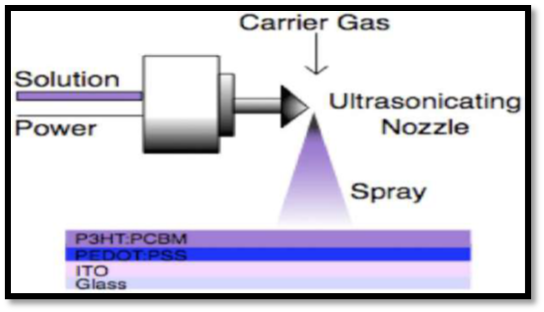
Figure 5: Ultrasonic spray
METHODS OF MANUFACTURING TOPICAL ANTIFUNGAL FFS [19] :
1. Preparation of Antifungal Solution:
a) Weighing and Mixing: Accurate weighing and mixing of the active ingredient, solvent system, and other excipients are performed in a controlled environment.
b) Solvent Adjustment: Heating the solvent mixture gently may be necessary to aid in dissolving the active ingredient completely and achieving a homogeneous solution.
2. Addition of Film-Formers:
a) Polymeric Solution Preparation: A separate polymeric solution is prepared by dissolving the chosen film-forming polymers in a suitable solvent until a clear solution is obtained.
b) Combining Solutions: The antifungal solution is gradually combined with the polymeric solution while ensuring thorough mixing to achieve a uniform dispersion of all components.
3. Spray Formation:
a) Homogenization: The combined solution undergoes homogenization using high-shear mixing equipment or a homogenizer to break down any aggregates and achieve a smooth, homogeneous mixture suitable for spraying.
b) Viscosity Adjustment: Viscosity modifiers, such as glycerin, may be added to adjust the viscosity of the formulation, ensuring optimal sprayability and proper film formation upon application.
4. Packaging and Sterilization:
a)Filling: The prepared formulation is filled into sterilized containers or bottles using aseptic techniques to maintain product sterility and integrity.
b) Sterilization (if needed): Final products may undergo sterilization through filtration or autoclaving to ensure microbial safety, depending on regulatory requirements.
5. Quality Control:
a) Testing and Analysis: Rigorous quality control tests are conducted on the final product, including assays for active ingredient content, pH determination, viscosity measurement, and microbial limit testing.
b) Stability Studies: Stability studies are performed to assess the formulation's physical, chemical, and microbial stability under various storage conditions over a defined period.
6. Packaging and Labeling:
a) Packaging: The final product is packaged in suitable containers with appropriate labeling that includes information on the active ingredient, concentration, usage instructions, and storage conditions.
b) Batch Documentation: Comprehensive batch documentation is maintained, detailing the manufacturing process, quality control results, and any deviations encountered during production.
EVALUATION TESTS [1-6,9,11,12,15,17] :
1. Appearance
The FFS was studied for physical characteristics such as colour, odour, and appearance by visual inspection and testing.
2. Film formation
The films are formed in a Petri dish or on a removed pig ear skin. Film-formation is examined and rated as full and uniform, incomplete or non-uniform, with or without precipitation of the film-forming polymer. The cosmetic characteristics of the film are mentioned in terms of transparent or opaque, sticky, or dry, and peelable, or non-peelable.
3. Film flexibility
Film flexibility is measured based on cracking and skin fixation, and this is done by stretching the skin in 2-3 directions. The film is categorized as flexible if there is no cracking or skin fixation and non-flexible if there is cracking and skin fixation.
4.pH
The pH value is measured and adjusted to improve the stability of the active substance or make it suitable for the area of application. For skin pH ranging from 4–6, the pH of diabetic wounds ranges from 6.5–8, whereas faster healing time for burns occurs below pH 7.32. The pH adjustment of the preparation aims to prevent irritation and changes in the physiological condition of the wound in the healing process. Besides, the pH value of the dosage can also affect drug permeation through the skin based on the degree of ionisation.
5. Viscosity
Brookfield viscometer (DV-II, LV model, Brookfield, WI, USA) was utilized to gauge the thickness by utilizing little volume connector with a bottle expressed water coat and ULA-S00 shaft. A sum of 20 mL of the example was taken in a ULA chamber and the shaft was pivoted at 10 rpm speed at 25 1 ?C. The examples were equilibrated for 10 min before the estimation; besides, the instrument was outfitted with a temperature control unit. A normal of three readings was taken for every one of the details.
6. Evaporation time:
The evaporation period is also known as the drying time. By measuring the film's evaporation, one may ascertain how quickly the film forms when the solution is sprayed. To find the drying period, the cleaned petri dish was sprayed with the modified batch film-forming fluid. After a predetermined amount of time, a glass slide was placed stress-free on the film. If there is no longer any discernible moisture on the glass slide, the film is considered dry. The rate of film formation is determined by the drying time. After three iterations of this procedure, the average evaporation time was determined.
7. Spray angle:
The solution (d) was sprayed horizontally onto a white sheet that was held 10 cm distant. On the paper, the circumference of the circle was measured three times from various perspectives. The diameter is used to calculate the radius (r). The spray angle (θ) can be obtained using formula,
Spray angle (θ) = tan -1 (L/r)
Where,
8. Spray pattern:
By passing the spray through the TS onto white paper, the spray pattern was evaluated. To aid in visibility, 1% methyl orange was dissolved in each formulation. At a distance of 2.5 to 3.0 cm from the plate, the paper was clipped to the ship and sprayed with the mixture. The diameters of the spots created by spray testing were measured and observed. Each reading was averaged after this was done three times.
9. Average weight per dose:
The containers' initial weight was noted. The containers were weighed once again after five successive deliveries were sprayed and foamed. The average weight per dose was calculated by dividing the difference between the containers' original and final weights by the number of deliveries.
Average weight per dose (W)=Initial weight(W0)- Final weight(W1) /Number of deliveries.
10. Bio adhesive Strength of the Film :
Attaching a film to the mouse skin's surface (2 x 5 cm) allows for the measurement of the film's bio adhesive strength. Next, 0.5 mL of distilled water is applied to the skin to hydrate it. For five minutes, the film is permitted to come into contact with the surface of the tissue. The overall force (F) required to separate the film from the skin's surface is noted. The film's unit area (A) is used to compute the bioadhesive strength (FB).
FB = F/A
11. Leak test:
This test assessed the pump seal's effectiveness and its capacity to hold the product's contents. For three days, the filled container sunder test was kept upright at 30 degrees, and the contents were weighed both before and after the three days to make sure everything was in order. the formulation leaking out of the container.
12. Stability studies:
Changes in particle size, chemical and three-dimensional structures, levels, and therapeutic action of active compounds following storage under various conditions are characteristics that are frequently investigated. Thermal analysis is sometimes used to determine whether or not metastable active compounds recrystallize. The medication can be kept in its original crystalline form by using an anti-nucleate polymer. The drug concentration per spray and its metered-dose spray pattern will be retested in a number of studies. Ensuring the dosage during the storage period is crucial.
13. In vitro diffusion study:
The in vitro diffusion experiments are used to forecast the drug's in vivo penetration properties. The drug's release profile from the film-forming mechanism is ascertained using a Franz diffusion cell. The diffusion membrane (such as cellophane or egg membrane) is linked between the donor and receiver compartments, which comprise the cell. The diffusion medium is contained in the receptor compartment, while the donor compartment is open to the environment. Sampling is made possible by the sampling arm in the receptor compartment. The donor compartment is filled with a predetermined amount of the drug-containing film-forming formulation. Samples are gathered and examined using an appropriate spectroscopic technique for medication release.
14. Ex vivo permeation study:
Ex-vivo permeation studies are conducted to investigate how the protective properties of the skin affect the developing film-forming mechanism. A Franz diffusion cell or a Keshary–Chien diffusion cell are used to accomplish this goal. In these tests, a section of rat skin is placed between the diffusion cell's two compartments, with the dermal layer beneath it facing the receiver compartment and the stratum corneum, the outermost layer of the epidermis, facing the donor compartment. The film-forming mixture is then applied to the skin's surface, where it forms a thin film as it dries. The receiving section is loaded with phosphate-buffered saline at a pH of 7.4, with the temperature rigorously controlled at 37 ± 0.5 degrees Celsius. At designated time intervals, samples (portions) are obtained, and their constituents are scrutinized utilizing a suitable spectroscopic technique. These trials aid researchers in evaluating the interaction of the evolved film with the skin's protective layer and its impact on the passage of substances.
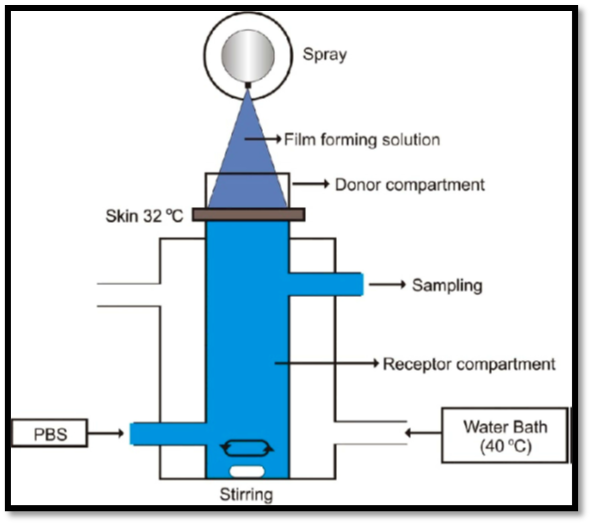
Figure 6: Keshary- Chien diffusion cell
APPLICATION [3,5] :
i) Initially, the fields of surgery and wound care were the primary applications of film-forming techniques. Gels or film-forming solutions have been used as tissue glue to close surgical incisions.
ii) It can be utilized for non-medical purposes, like delivering active substances in cosmetics like lotions and ointments using silicone film-forming technologies.
iii) It can be used as a transparent peel-off mask to cure acne, hydrate the skin, and other conditions.
iv) Film-forming sprays can be applied to textiles to create water-resistant or stain-resistant layers. This helps protect textiles from spills, stains, and other environmental factors.
v) The food sector uses film-forming sprays on packaging materials to build barriers against moisture, oxygen, and other elements that can influence food quality and shelf life.
vi) Some film-forming sprays are made to transfer drugs straight to the skin or mucous membranes, enabling the localized treatment of ailments including chronic skin problems or fungal infections.
vii) Wounds are treated with film-forming sprays to create a barrier that prevents infection, keeps contaminants out, and expedites healing. These sprays usually contain biocompatible polymers or other materials that form a flexible, permeable film.
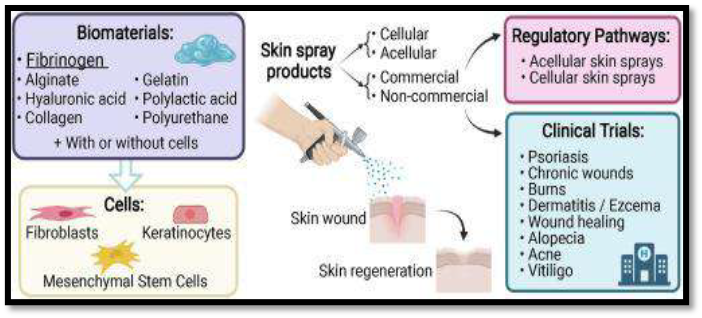
Figure 7: Effectiveness of skin spray and Application pathway
MARKETED PRODUCTS OF FILM FORMING SYSTEMS [5] :
Table.3: Marketed products of FFS
|
Trade name |
Manufacturer |
Polymer |
Applications |
|
Cavilon® |
3MTM Health Care |
Acrylate terpolymer & polyphenylmethylsiloxane |
Skin protector from irritation |
|
OpSite® |
Smith & Nephew Healthcare Acrylic polymer |
Acrylic polymer |
Wound cover and protector |
|
Cutimed® PROTECT |
Essity |
Unknown |
Wound cover and protector |
|
SKIN-PREP* Protective Dressing |
Smith & Nephew Healthcare |
Unknown |
Wound cover and protector No-Sting Skin Barrier Film Spray |
|
No-Sting Skin Barrier Film Spra |
Safe n’ SimpleTM |
Diglycol/ CHDM/ isophthalates/ SIP copolymer |
Sensitive-skin protector |
|
Sensi-Care® |
ConvaTec |
Siloxane copolymers |
Adhesive-releaser |
CONCLUSION :
The film-forming system provides a novel platform to deliver drugs both topically and transdermally to the skin. It stands as a groundbreaking foundation for dispensing medications to the skin, providing a versatile strategy for conveying drugs through both surface application and skin absorption. These film-forming systems are simple and offer the advantages of transparency, non-greasiness, reduced skin irritation, wipe-off resistance, longer dwell time, greater dosing flexibility, enhanced dosage adjustability, increased compliance among patients, and a visually appealing design. Consequently, there are relatively few products available in the market. Further research is essential to substantiate the viability of the film-forming system as a transdermal drug delivery method. However, the initial findings are promising and support the continued development of this innovative technology for delivering drugs topically.
REFERENCES


Shaheen Vohra, Ria Patel, Dr. Priyanka Patil, Topical Film-Forming Sprays: An Emerging Approach in Dermal Therapy, Int. J. of Pharm. Sci., 2026, Vol 4, Issue 1, 1481-1494. https://doi.org/10.5281/zenodo.18256854
 10.5281/zenodo.18256854