
1,2,3,4,5,6,7 Laddhad College of Pharmacy, Yelgaon, Buldhana, Maharashtra 443001
8 Mauli Institute of Pharmacy & Research Centre, Washim
3D printing (additive manufacturing) is an emerging technology in pharmaceutical sciences that enables the creation of precise, patient-specific drug dosage forms not possible through traditional methods. This review highlights the principles, applications, and future potential of various 3D printing techniques including FDM, SLS, BJ, SLA, and SSE—in drug formulation and advanced drug delivery. The first FDA-approved 3D-printed drug, Spritam® (levetiracetam), established the clinical feasibility of this technology and inspired extensive research into customizable dosage forms with modified dose strength, drug combinations, geometry, and release patterns. The review also discusses the scientific motivation for adopting 3DP, especially for polypharmacy, pediatric and geriatric populations, and drugs requiring precise dosing. Additionally, the project outlines the aims, objectives, methodology, and conceptual framework for studying the scope and limitations of 3DP in personalized medicine. Overall, the summary emphasizes the advantages, regulatory hurdles, and promising future of 3D printing as a transformative tool in next-generation pharmaceutical manufacturing.
3D printing, also known as additive manufacturing, is an advanced technology that is rapidly transforming pharmaceutical science by enabling the creation of customized drug dosage forms, complex drug-delivery systems, and patient-specific therapies. Unlike traditional manufacturing methods such as tablet compression, encapsulation, and granulation, 3D printing builds dosage forms layer by layer using a digital design. This method allows precise control over the size, shape, internal structure, porosity, and drug-release characteristics of the final product. It offers a level of personalization and flexibility that conventional pharmaceutical processes cannot provide. The introduction of Spritam®, the first FDA-approved 3D-printed drug, demonstrated the practical applicability of the technology and opened new possibilities for individualized treatment, particularly in fields like neurology, oncology, pediatrics, and geriatrics.[1]
The origins of 3D printing can be traced back to the work of Hideo Kodama from the Nagoya Municipal Industrial Research Institute, who first demonstrated the creation of a three-dimensional plastic model using a photo-hardening polymer technique. A major advancement occurred in 1984, when Charles Hull, the co-founder of 3D Systems, invented stereolithography (SLA) a groundbreaking process that laid the foundation for modern additive manufacturing technologies.[2]
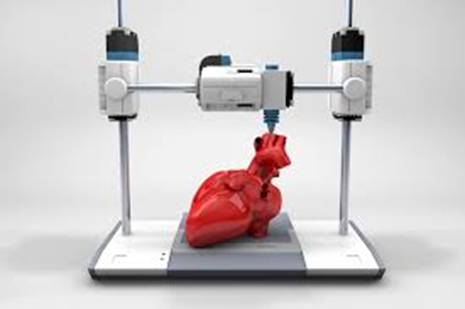
Fig no 1: design of heart in 3DP
The basic principle of 3D printing involves converting a computer-aided design (CAD) model into a physical object by depositing materials sequentially in thin layers. Various printing techniques are used in pharmaceuticals depending on the drug properties, stability, and desired release profile. Binder jetting is one such technique where a liquid binder is dropped onto powder layers to form solid structures. This method produces highly porous tablets that dissolve quickly, making it suitable for high-dose fast-dissolving medications. Fused deposition modelling (FDM) is another widely used technique where thermoplastic polymers containing the drug are heated and extruded through a nozzle to form layers. This enables the manufacture of sustained-release, controlled-release, and delayed-release formulations. Stereolithography uses laser or UV light to cure liquid photopolymers and create extremely precise structures, which is useful for implants and microneedles.[3]
Selective laser sintering (SLS) solidifies powder materials using laser energy and does not require support structures, making it ideal for flexible dosage forms. Semi-solid extrusion, which extrudes gels or pastes at mild temperatures, is suitable for heat-sensitive drugs and biologics. One of the most significant advantages of 3D printing is its ability to create personalized medicines. Patients differ widely in age, weight, metabolism, organ function, and genetic profile, and these variations often require individualized dosing that conventional mass manufacturing cannot easily match. With 3D printing, dosage strength can be adjusted precisely for each patient without reformulating the entire product, which is especially beneficial in pediatric and geriatric populations. The ability to design various geometries such as honeycomb, mesh, multilayer, or hollow structures—also makes it possible to modulate drug release by altering the tablet’s architecture rather than its composition. This structural control opens exciting opportunities for precision drug-delivery systems, including pulsatile release, dual-release, or multi-phase drug delivery. Furthermore, 3D printing can incorporate multiple drugs with different release profiles into a single tablet, forming “polypills” that reduce pill burden and improve medication adherence, particularly in chronic diseases like cardiovascular disorders and diabetes.[4]
Another major application of 3D printing is in the development of implantable drug-delivery devices. Customized implants can be produced to fit a patient’s anatomy exactly and release drugs at a controlled rate for weeks or months. This is particularly useful in chemotherapy, orthopedic treatments, and hormone therapy. Additionally, 3D-printed microneedle arrays are being explored for painless transdermal drug delivery and vaccine administration. In tissue engineering, 3D printing allows the creation of porous scaffolds that mimic natural tissues and support cell growth. These scaffolds can be loaded with growth factors, antibiotics, or regenerative agents to promote healing in bone, skin, or cartilage injuries. The potential to eventually print functional organs makes 3D printing one of the most revolutionary technologies in biomedical science. Despite its advantages, 3D printing in pharmaceuticals also faces several challenges. One of the major limitations is the restricted availability of pharmaceutical-grade printable materials. Polymers such as polyvinyl alcohol (PVA), polyethylene glycol (PEG), polylactic acid (PLA), and hydroxypropyl methylcellulose (HPMC) are commonly used, but each has limitations regarding mechanical strength, drug compatibility, and thermal stability. Heat-sensitive drugs cannot withstand the high temperatures used in FDM printing, while photopolymer-based techniques may raise concerns about the toxicity of unreacted monomers. Another challenge is the slow production speed of 3D printing, which makes it less suitable for large-scale industrial manufacturing. Regulatory guidelines are also still evolving, and ensuring batch-to-batch uniformity, stability, and quality control for individually printed dosage forms remains complex. Additionally, the cost of advanced printers, software, and trained personnel represents a barrier for many pharmaceutical settings. Nevertheless, the future potential of 3D printing in pharmaceutical science is extremely promising. Research is ongoing to develop new printable excipients, enhance drug-loading capacity, and improve printability of biological molecules such as peptides, vaccines, and monoclonal antibodies. As digital healthcare advances, the idea of hospital-based or pharmacy-based on- demand printing of medicines may soon become a reality. This would enable doctors to prescribe customized doses that pharmacists print instantly according to the patient’s exact requirement.[5]
In developing countries, 3D printing may help reduce wastage and enable production of small batches of rare or orphan drugs. The integration of artificial intelligence and machine learning with 3D printing is expected to optimize drug-release designs and predict ideal tablet structures. With continued research and regulatory development, 3D printing may transform pharmaceutical manufacturing from a high-volume industrial process into a precise, patient- centric, digitally controlled system.[6]
, 3D printing represents a revolutionary shift in pharmaceutical science, offering unmatched flexibility in designing and producing drug-delivery systems. Its ability to create personalized dosage forms, complex release profiles, multidrug polypills, implants, and tissue scaffolds makes it a powerful tool for advancing patient-specific therapy. Although challenges remain in terms of material availability, regulatory acceptance, and large-scale manufacturing, the ongoing research and increasing clinical interest indicate a bright future for this technology. As healthcare moves toward precision and individualized treatment, 3D printing is expected to play a central and transformative role in shaping the next generation of pharmaceutical products.[7]
Table No 1 : Objectives of the Study on 3D Printing in Pharmaceuticals
|
Sr. No. |
Objective |
Description |
|
1 |
Understanding 3D Printing Technologies |
To study and compare different 3D printing techniques such as FDM, SLS, SLA, BJ, and SSE. |
|
2 |
Identifying Suitable Polymers & Excipients |
To evaluate polymers and formulation components compatible with various 3D printing methods. |
|
3 |
Designing Patient-Specific Dosage Forms |
To explore strategies for customized, dose-flexible, and patient-centric drug delivery systems. |
|
4 |
Analyzing Advantages Over Conventional Methods |
To assess improvements in precision, personalization, and formulation flexibility offered by 3DP. |
|
5 |
Exploring Future & Regulatory Perspectives |
To examine emerging innovations, challenges, and regulatory frameworks for 3D-printed medicines. |
Table no 2: Rationale for the Study on 3D Printing in Pharmaceuticals
|
Sr. No. |
Rationale Point |
Description |
|
1 |
Growing demand for personalized therapy |
Increasing need for patient-specific formulations tailored to individual treatment requirements. |
|
2 |
Need for flexible dosing in special populations |
Essential for pediatrics, geriatrics, and patients with unique or frequently adjusted dose requirements. |
|
3 |
Ability to design precise drug-release profiles |
3DP enables controlled, rapid, sustained, or multi-phase release as required. |
|
4 |
Potential to reduce side effects |
Targeted and optimized delivery can minimize adverse effects and improve treatment outcomes. |
|
5 |
Useful for rare diseases |
Economically supports small-batch or single-dose manufacturing where mass production is costly. |
|
6 |
Scope for point-of-care manufacturing |
Allows hospitals and clinics to produce personalized medicines on demand. |
|
7 |
Alignment with precision medicine |
Supports future healthcare models focused on individualized and optimized therapy. |
Literature study
Recent literature highlights significant advancements in 3D printing technologies for pharmaceutical applications. Wang et al. (2023) provide a comprehensive review of major 3D printing techniques—such as Fused Deposition Modeling (FDM), Semi-Solid Extrusion (SSE), Melt Extrusion Deposition (MED), Binder Jet 3D Printing (BJ-3DP), and Stereolithography (SLA) and compare their technical characteristics, pre-processing requirements, printing mechanisms, post-processing steps, and respective advantages and limitations. Their work also emphasizes the expanding applications of 3DP in fabricating tablets, implants, customized dosage forms, and complex drug-release systems, while addressing regulatory and manufacturing challenges that limit broader clinical adoption. Complementing this, vaibhav Shikare et al. (2025) delivered a systematic review outlining technological progress and emerging trends in pharmaceutical 3D printing. Their study highlights innovations in material design, precision dosing, and patient-specific formulations, reinforcing the role of 3DP as a transformative tool in next-generation drug delivery. Together, these reviews demonstrate how rapidly 3D printing is evolving and underscore its potential to revolutionize personalized medicine and pharmaceutical manufacturing.
Advantages of 3D-Printed Pharmaceuticals:[7]
Table no. 3: Materials Used in Pharmaceutical 3D Printing and Their Applications
|
Material Type |
Examples |
Key Properties |
Pharmaceutical Applications |
|
Thermoplastic Polymers |
PVA, PLA, HPMC, HPC, PCL, Eudragit® |
Can be melted and solidified; good mechanical strength; processable into filaments |
Used mainly in FDM for tablets, implants, and modified-release systems |
|
Polyvinyl Alcohol (PVA) |
— |
Water-soluble, biocompatible |
Immediate-release tablets, support structures in printing |
|
Polylactic Acid (PLA) |
— |
Biodegradable, high strength, slow degradation rate |
Sustained-release systems, implants, long-term devices |
|
HPMC & HPC |
— |
Water-soluble, swellable, film-forming |
Controlled and sustained-release oral dosage forms |
|
Polycaprolactone (PCL) |
— |
Semi-crystalline, slow-degrading, biocompatible, low melting point |
Long-term implantable drug-delivery devices |
|
Eudragit® Polymers |
L, S, RS, RL grades |
pH-dependent or time-controlled release |
Enteric coating, colon-targeted delivery, modified-release tablets |
|
Hydrogels & Bioinks |
Alginate, gelatin, chitosan, PEG derivatives |
Water-based, cross-linkable, suitable for low-temperature processing |
Bioprinting, tissue scaffolds, thermolabile drug formulations |
|
Powder-Based Materials |
APIs blended with binders and polymers |
Flowable, suitable for layer-by-layer deposition |
Binder jetting for porous tablets or fast-disintegrating structures |
|
Photopolymer Resins |
PEGDA, methacrylate-based resins |
Photosensitive, polymerize under UV/laser light |
SLA printing for precise, complex geometries |
Comparative study of drug release profiles from 3D printed and conventional tablets.[8]
1. Release Rate and Kinetics
2. Customization and Dose Flexibility
3. Geometry and Surface Area
4. Material and Process Influence
Evaluate Advantages, challenges, and regulatory issue [10]
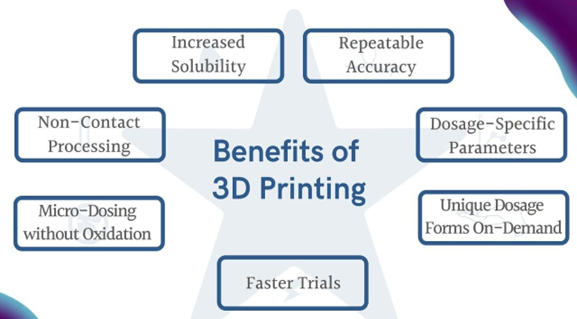
Fig. no. 2 Benefits of 3d printing
The Advantages of 3D Printing:
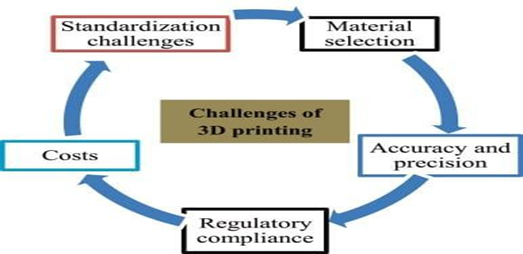
Fig. no. 3 Challenges :
Regulatory issues :
Summarizes applications in personalized medicine, polypills, implant Personalized Medicine [11,12]
Polypills
Implants
FUTURE SCOPE :
New possibilities in 3D printing may open up whole new opportunities for pharmaceutical research & Bio-technology applications. In new future 3D printing approach will be utilized in many ways such as fabricate and engineer various novel dosage forms, achieved optimised drug release profiles, development of new excipients, avoid incompatibilities between multiple drugs, drug dosage forms, supporting delivery, limits degradation of biological molecules or helping to research cures. Printing could added a whole new dimensions of possibilities to personalized medicines. On demand printing of drug product can be implemented for drugs with limited shelf life or for patient specific medication, offering, and an alternative to traditional compounding pharmacies. In future it may lead to the innovation in garage biology. As the technology is still so new, there’s a lack of regulation, safety, and security concern of 3D printing. So, these problems can be overcome in early future.
CONCLUSION:
3D printing has become a useful and potential tool for the pharmaceutical sector, leading to personalized medicine focused on the patients’ needs. 3D Printing technology is emerging as a new horizon for advanced drug delivery with built-in flexibility that is well suited for personalized/customized medication.3D Printing technology will revolutionize the pharmaceutical manufacturing style and formulation techniques.
In the near future 3D printing approach will be utilized to fabricate and engineer various novel dosage forms. Although commercial production of such novel dosage forms is still challenging; developing personalized medication, optimized drug release from dosage form, compacting or avoiding drug-drug incompatibilities, protection of biomolecules during manufacture, construction of multiple drug dosage form and multiple release dosage forms will be taken to a new era through 3D printing technology.
REFERENCES








Pooja Muthal, Gaurav Bankar, Mrunali Kalmegh, Payal Rathod, Om Tayade, Aniruddh Gaikwad, Avanti Girdekar, Vaibhav Shikare, 3D Printing in Pharmaceutical Science, Int. J. of Pharm. Sci., 2025, Vol 3, Issue 12, 2344-2352. https://doi.org/10.5281/zenodo.17923601
 10.5281/zenodo.17923601
