
B.K. Patil Institute of Pharmacy, Taloja, Maharashtra, India.
The present study was aimed at the formulation and evaluation of a Parijat (Nyctanthes arbor-tristis) herbal tablet using natural disintegrants to improve tablet disintegration and dissolution characteristics. Parijat is a well-known medicinal plant possessing anti-inflammatory, antipyretic, analgesic, and immunomodulatory activities, making it suitable for solid oral dosage form development. In the present work, Parijat leaf powder/extract was formulated into tablets by the direct compression method, employing natural disintegrants such as starch, mucilage, and plant-based gums as alternatives to synthetic disintegrants. Pre-compression parameters including angle of repose, bulk density, tapped density, Carr’s index, and Hausner’s ratio were evaluated to assess flow properties of the powder blend. The prepared tablets were evaluated for weight variation, hardness, thickness, friability, disintegration time, and in-vitro dissolution studies according to pharmacopeial standards. The results indicated that formulations containing natural disintegrants showed acceptable mechanical strength, low friability, and rapid disintegration compared to conventional formulations. The study concludes that natural disintegrants are effective, safe, economical, and ecofriendly alternatives for the formulation of Parijat herbal tablets and can be successfully used to enhance patient compliance and therapeutic efficacy
Rheumatoid arthritis (RA) is a systemic auto-immune disease characterized by inflammatory arthritis and extra-articular involvement. It is a chronic inflammatory disorder caused in many cases by the interaction between genes and environmental factors that primarily involve synovial joints. It typically starts in small peripheral joints, is usually symmetric and progresses to involve proximal joints if left untreated.
Joint over time leads to the destruction of the joint with loss of cartilage and bone erosion. RA with a symptom duration of fewer than six months is defined as early RA, when the symptoms have been present for more than six months, it is defined as established RA.
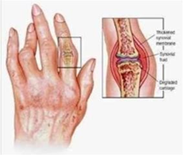
Fig. 1 Rheumatoid arthritis (RA)
Rheumatoid arthritis (RA) is an auto-immune disorder that primarily affects the joints, causing inflammation, pain, stiffness and swelling. It can also affect the other organ in the body. RA occurs when the immune system mistakenly attacks the body's own tissue, particularly the synovium, which lines the joints. Overtime this inflammation can lead to joint damage and deformities. It is a long-term disease, progressive and disabling auto- immune disease.
Types of Rheumatoid Arthritis:
1.Sero-Positive RA
2.Sero-Negative RA
3.Juvenile Idiopathic RA
Etiology: -
1.The cause of rheumatoid arthritis is unknown.
2.It is believed that the tendency to develop may be genetically inherited(hereditary)
3.Smoking tobacco increases the risk of developing rheumatoid arthritis.
4.Environmental influences, such as infections or trauma, are thought to trigger the development of RA.
5.Genetic markers, such as human leukocytes antigen DR4(HLA-DR4), have been associated with triggering the inflammatory process in RA.
Parijat (Nyctanthes Arbor Tristis)
Nyctanthes arbor tristis is one of the most useful traditional medicinal plants in India. It is distributed widely in sub-Himalayan regions and Southwards to Godavari. Each part of the plant has important medicinal properties and is commercially exploitable. It is now considered a valuable source of several unique products for the medicines against various diseases and for the development of some industrial products. The present review is to focus on the potential Phyto-chemicals and pharmacological activity of plant N. Arbortristis. Various parts of the plant like seeds, leaves, flower, bark and fruits have been investigated for their significant pharmacological activity. The plant is used as an herbal remedy for treating various infectious and non-infectious diseases.
Liquorice
Liquorice (Glycyrrhiza glabra L.) belongs to the family – Fabaceae. The name Glycyrrhiza is of Greek origin which means “sweet wood” In Indian medicine Herbal medicine. It is referred to as Mulethi, Malahatti or Yastimadhu. liquorice was extensively subjected to scientific investigations. Liquorice has about 50-100 times sweetness than sucrose in dilute aqueous solution. The major constituents of liquorice are triterpenoids and flavonoids.
Mango Peel Pectin
Mangifera indica contains 16%-20% tannin, namely protocatechuic acid, cynic acid. And catechin, it also contains Mangi ferine, alanine, shikimic acid, astringent and resinous gum. It is used as vermifuges and astringents used in the treatment of rheumatism. Pectin is a heteropolysaccharide formed by D-galacturonic acid. Mango peel pectin can be used as a natural disintegrant,
Fenugreek Mucilage
Trigonella foenum-graecum L. referred as fenugreek, is an herb with medicinal and nutraceutical values which have been described from ancient times in the Indian medicine system. Fenugreek seed mucilage has been explored as a natural disintegrant agent in tablet formulations. They are mucoadhesive polysaccharides and have adhesive properties. This property makes fenugreek mucilage a promising candidate for dosage preparation to enhance disintegration and improve drug absorption.
Several researchers have studied Rheumatoid Arthritis and alternative management approaches:
1.Botanical Description and Phytochemistry: -
(Kirtikar & Basu,1935), Nyctanthes arbor-tristis belongs to the family Oleaceae. The leaves are opposite, ovate, rough, and bitter in taste Phytochemical studies reported the presence of several bioactive constituents such as Tannins, Alkaloids, Saponins. These constituents are mainly responsible for the plant’s anti-inflammatory, analgesic, immunomodulatory, and antioxidant activities
2.Pharmacological Activities of Parijat: -
(Saxena et al., 1984), Several experimental and clinical studies have demonstrated the pharmacological potential of Parijat leaves. Ant-inflammatory and Analgesic activity: Leaf extracts showed significant reduction in inflammation and pain, supporting its traditional use in arthritis. Antipyretic activity: Purser leaf decoction has beno reported to reduce lever partoutarty in malanal and viral levers.
3.Rationale for Herbal Tablet Formulation: -
(Rathore ,2007), Traditional dosage forms like decoctions and powders have limitations such as unpleasant taste. Poor stability, bulky dose, and lack of dose uniformity. Therefore, converting Parijat leaf extract or powder into tablet dosage form is scientifically justified.
4.Use of Natural Disintegrants in Herbal Tablets: -
(Gupta, 2010), Recent literature emphasizes the use of natural disintegrants to replace synthetic excipients. Natural disintegrants are biodegradable, non-toxic, economical, and eco-friendly, commonly reported natural disintegrants include
Parijat leaf powder, Mango peel pectin, Fenugreek (Trigonella foenum-graecum) mucilage.
Aim & Objective
Aim:
Formulation and Evaluation of Parijat Herbal Tablets Using Natural Disintegrants.
Objectives:
Methodology of Literature Review
Literature Selection and Data Collection
The present work was conducted as a literature-based review. Data related to herbal oral formulations used for the management of Rheumatoid Arthritis were collected from published research articles, review papers, and clinical studies available in scientific databases. Relevant literature focusing on phytoconstituents, natural disintegrants, formulation requirements, mechanisms of action, and reported efficacy of oral herbal systems was systematically analyzed. Only peer-reviewed sources were considered to ensure reliability and scientific validity.
Requirements for Herbal Oral Systems
Review studies reported that the preparation of herbal oral formulations for anti-inflammatory activity requires specific materials, including Phytoconstituent (Parijat), Natural Disintegrant (Mango Peel Pectin, Liquorice, Fenugreek), binding agents, processing aids, and suitable packaging components. The literature emphasized that proper standardization of phytoconstituent, and inclusion of natural disintegrant and binding agents are critical for achieving stable and consistent oral systems. Additionally, adequate processing equipment, quality control measures, and suitable storage conditions were identified as essential to ensure safety, stability, and effectiveness of oral herbal preparations. The major herbal ingredients reported in the literature for Rheumatoid Arthritis management are summarized in Table 1.
Table 1. Ingredients used in Oral Herbal Formulation
|
Sr. No. |
Herbal Ingredient |
Major Active Constituents |
Pharmacological Action |
Mechanism of Action |
|
1 |
Parijat |
Tannins, Phenolic Acids, Alkaloids |
Analgesic, Anti-inflammatory, Antioxidant |
Inhibition of inflammatory mediators |
|
2 |
Mango Peel Pectin |
Galacturonic acid, Polysaccharides, Flavonoids |
Antioxidant, Prebiotic, Anti-inflammatory |
Swelling Action, Stabilization of herbal extract |
|
3 |
Liquorice |
Glycyrrhizin, Saponins, Sterols |
Anti-inflammatory, Antioxidant, Expectorant action |
Cortisol metabolism inhibition, Mucus Secretion Stimulation |
|
4 |
Fenugreek |
Galactomannan, Manose, Galactose |
Anti-inflammatory, Antioxidant, Laxative |
Binding of Bile acids, Antioxidant mechanism |
|
5 |
Methylcellulose |
β-D-glucopyranose |
Bulk forming, Laxative |
Water Absorption, Gel Formation |
|
6 |
Magnesium Stearate |
Stearate ions, Fatty acid Components |
Glidant, Anti-adherent action |
Reduction of friction, Improved powder flow |
|
7 |
Lactose |
D-glucose, D-galactose |
Diluent, Mild Laxative effect |
Dilution of active ingredient, Improved compressibility |
|
8 |
HPMC |
Hydroxypropyl group |
Thickening agent |
Controlled drug diffusion, Polymer Erosion |
|
9 |
Sodium Alginate |
β-D-mannuronic acid, α-L-guluronic acid |
Thickening agent, Stabilizing agent, Gelling agent |
Calcium ion cross linking |
Reported Methodology for Preparation of Herbal Period Pain Relief Topical Systems
The direct compression method is commonly used for commercial manufacture of sublingual tablets. It is a simple and cost-effective process, as it employs ingredients that can be mixed well and do not require further granulation steps prior to lubrication and compression. Sublingual tablets manufactured by the direct compression method exhibit good mechanical strength and acceptably fast disintegration.
The directly compressible sublingual tablet formulation contains directly compressible soluble excipients, a super disintegrant, and lubricant. It may also contain microcrystalline cellulose, dry binder, buffers, surface-active agents, sweeteners, and flavors. Sugar-based excipients are widely used as bulking agents because of their high aqueous solubility, sweetness, pleasant feeling in the mouth, and good taste-masking. Nearly all sublingual formulations incorporate some saccharide-based material (60). The choice of a suitable disintegrant and its amount are critical for achieving a fast disintegration and dissolution rate.
Table 2. Formulation Table conventional Tablet
|
Sr no. |
Ingredients |
Uses / Role |
|
1 |
Nyctanthes arbortristis |
Anti- rheumatoid arthritis |
|
2 |
Methyl cellulose |
Disintegrate |
|
3 |
Magnesium stearate |
Lubricant |
|
4 |
Talc |
Lubricant |
|
5 |
Lactose |
Diluent |
|
6 |
HPMC |
Binder |
Table 3. Formulation Table for Tablet Containing Mango Disintegrant
|
Sr.no. |
Ingredients |
Uses/ Role |
|
1 |
Nyctanthes arborists |
Anti- rheumatoid arthritis |
|
2 |
Mango peel |
Disintegrate |
|
3 |
Liquorice/ cinnamon |
Sweetener |
|
4 |
Magnesium stearate |
Lubricant |
|
5 |
Talc |
Lubricant |
|
6 |
Sodium alginate |
Stabilizer |
|
7 |
HPMC |
Binder |
Table 4. Formulation Table for Tablet Containing Fenugreek Seed Disintegrant
|
Sr.no. |
Ingredients |
Uses/ Role |
|
1 |
Nyctanthes arbortristis |
Anti- rheumatoid arthritis |
|
2 |
Fenugreek Seed mucilage |
Disintegrate |
|
3 |
Liquorice/ cinnamon |
Sweetener |
|
4 |
Magnesium stearate |
Lubricant |
|
5 |
Talc |
Lubricant |
|
6 |
Sodium alginate |
Stabilizer |
|
7 |
HPMC |
Binder |
RESULTS AND EVALUATION TESTS:
1.Friability Test: - Friability is the tested for a tablet to see whether the tablet is stable to abrasion or not, it tested by using Roche friabilator. This is made up of a plastic drum fixed with a machine which rotated at 25 rpm for 100 revolutions. And then the twenty tablets which were weighed prior to the test are taken out of the drum and cleaned with a cloth and weighed once again, the weight variation must not be less than 0.5 to 1.0% for a conventional tablet.
2.Disintegration Test: - Disintegration is the first physical change observed for a drug when it enters into the body his to see simulate the disintegration of the tablet in the body the disintegration test is performed. As per USP the disintegration apparatus consists of 6 glass tubes with a 10-number mesh at the bottom, each tube is 3 inch long. This arrangement of 6 tubes is placed in a medium simulated to the disintegration environment.
3.Hardness Test: - The hardness of the tablet is important for drug products that have bioavailability problem or that are sensitive to altered dissolution release profiles. Hardness is sometimes termed the tablet crushing strength. The tablets must be hard enough to withstand mechanical stress During packaging, shipment, and handling by the consumer.
4.Weight Variation Test :- Weight variation test is performed to check that the manufactured tablets have an uniform weight per USP 20 tablets are weighed at a time and the average weight is taken Now the average weight is compared to the individual weight of the tablet for a tablet to pass the test not more than 2 tablets should lie out of the specified percentage and if no tablet differs by more than two times the percentage limit.
5.Dissolution Test: - The rate and extent of drug release form the tablet is estimated by dissolution test Different types of apparatus are used to study the dissolution test of the tablet. As per IP apparatus "A" (paddle) and apparatus "B" (basket) are used. called basket dissolution apparatus and paddle dissolution apparat
6.Content Uniformity: - Uniformity of Content is a pharmaceutical analysis. parameter for the quality control of capsules or tablets. Multiple capsules or tablets are selected at random and a suitable analytical method is applied to assay the individual content of the active ingredient in each capsule or tablet.
DISCUSSION
Parijat (Nyctanthes arbor-rites) is a well-known medicinal plant used in traditional systems of medicine for its anti-inflammatory, antipyretic, analgesic, and immunomodulatory properties the development of Parijat herbal tablets aims to provide a convenient, stable, and patient Handly oral dosage form while reteaming the therapeutic efficacy of the plant extract or powdered drug
The formulation involves the use of Parijat leaf extract or dried powdered leaves as the active ingredient Suitable excipients such as diluents (lactose, macrocrystalline cellulose), binders (gum acacia, starch paste), lubricants (magnesium stearate), and glidants (talc) are selected Natural disintegrants are incorporated to enhance tablet disintegration and dissolution while mistaking the herbal nature of the formulation.
Commonly used natural disintegrants include starch, mucilage of Plantago ovata (isabgol), fenugreek mucilage, gum karaya, gum tragacanth, and banana powder These natural materials are biodegradable, non-toxic, cost effective, and improve patient acceptability Tablets are generally prepared by wet granulation or direct compression methods The prepared tablets are evaluated to ensure quality, safety, and efficacy Pre compression parameters such as bulk density, tapped density, angle of repose. Can's index, and Hanet's ratio are studied to assess flow properties of the granules or powder blend.
Post-compression evaluation includes tablet thickness, hardness, friability, weight variation, and drug content uniformity Special emphasis is given to disintegration time, as the performance of natural disintegrate directly influences rapid tablet breakdown. In vitro dissolution studies are conducted to evaluate drug release behavior Stability studies may also be carried out to assess the effect of storage conditions on tablet quality
The use of natural disintegrants in Parijat herbal tablet formulation offers an effective and eco-friendly alternative to synthetic excipients. Proper formulation and systematic evaluation ensure good tablet quality, rapid disintegrations, and optimal drug release, making Parijat herbal tablets a promising dosage form for traditional herbal therapy.
CONCLUSION
Parijat (Night Jasmine) tablet formulated with natural disintegrants like Mango peel pectin and Fenugreek mucilage disintegrate significantly faster than traditional tablets, with time measured in seconds rather than minutes.
The Herbal Tablet using Mango peel pectin and Fenugreek mucilage as disintegrants were prepared and compared with the conventional tablet by comparing Disintegration Time.
Faster disintegration leads to quicker drug release and dissolution, which can improve the absorption and bioavailability of the herbal active ingredients.
The Disintegration Time of tablets using mango as a disintegrant was found to be 38 seconds while the disintegration time for fenugreek was 14 seconds; as compared to conventional tablets with highest disintegration time is 4 minutes 18 seconds.
The Parijat tablets using natural disintegrants exhibited acceptable hardness, friability and uniformity of weight, confirming their stability and mechanical strength.
Enhances herbal formulations that offers better dissolution and solubility of parijat medicinal properties, such as its anti- inflammatory and analgesic benefits for arthritis.
By improving the dissolution of Parijat active compounds this formulation can increase their availability for the body to absorb and utilize, potentially improving therapeutic outcomes.
Increases patient compliance, safer alternatives to conventional treatments.
ACKNOWLEDGEMENT
The authors express sincere gratitude to the Principal and faculty members of the Department of Pharmacy for their valuable guidance, encouragement, and continuous support in the preparation of this review article.
REFERENCES
www.rjpponline.org vol. 17, Issue-02; April-June 2025.
https://www.researchgate.net/publication/228513735_Mango_peel_pectin_as_superdisintegrating_agent
www.rjpponline.org vol. 17, Issue-02; April-June 2025.
https://www.researchgate.net/publication/228513735_Mango_peel_pectin_as_superdisintegrating_agent


Ujjwala Doltade, Gyandevi Naik, Chaitrali. Nalawade, Harshal Ovhal, Rohit Pagare, Ayan Naikwadi, A Review on Formulation and Evaluation of Parijat Herbal Tablets Using Natural Disintegrants, Int. J. of Pharm. Sci., 2026, Vol 4, Issue 4, 2237-2244, https://doi.org/10.5281/zenodo.19589606
 10.5281/zenodo.19589606
