

We use cookies to ensure our website works properly and to personalise your experience. Cookies policy
Dr. Naikwadi College of Pharmacy Jamgaon, Sinnar, Nashik, Maharashtra-422113 India.
Withania coagulans dunal, sometimes called Paneer dodi or a paneer phool, is a significant medicinal herb widely utilized in an acient medical systems. Its medicinal potential is widely acknowleged, especially in the treatment of diabetes mellitus (DM). Withanolides, alkaloids, flavonoids,and phenolic compounds are among the various bioactive ingredient such a found in the fruits, leaves, roots, and stems of this plant. Its anti-hyperglycemic, hypoglycemic, anti-Oxidant, ant-inflammatory, anti-bacterial, hepatoprotective properties have been documented in scientific research. Fruits are particularly well-known for their ability to reduce blood sugar level. Withania coagulans dunal has nutritional and functional food potential, in addition to its significance. The morphology, phytochemistry, nutritional profile, and pharmacological characteristics of withania coagulans are summarized in this paper, which is also emphasizes the plants potential for future medicinal applications.
Herbal remedies are valuable natural gift, and their market expanding. The world health organization (WHO) has determined that more than 80% of the world population uses plant-based health care products in their daily routines because of their constructive effect and comparatively fewer negative effects compared to synthetic drugs. For over 3,000 years, india has used Withania coagulans dunal, a member of the solanaceae family, as an important role on ayurvedic medicinal plant. Other names for it include vegetable rennet, paneer ke phool, paneer dodi, Indian cheesemaker, and Indian rennet.[1]
This plant has several regional names, including ‘Akri’ or ‘puni-ke-bij’ in hindi, ‘Tukhme kaknaje- hindi’ in persian, ‘spiubajja in afghan, ‘Khamjira’ in Panjabi and ‘panirband’ or ‘punir-jafota’ in sindhi.[2] Paneer dodi is used for treating type 2 diabetes.The term “dodi” refers to the milk coagulants produced by the paneer dodi plant. Elevated blood sugar levels are hallmark of diabetes mellitus, a group of metabolic disease caused by either inadequate insulin production or inadequate cell response.[3]
It has been demonstrated that the hot aqueous extract of Withania coagulans dunal fruits possess hepatoprotective, anti-inflammatory, and anti-hyperglycemic properties.[4]
Studies that have domanstrated its efficacy against a range of illenesses, including cancer, diabetes, cardiovascular diseases, and microbial infection, underscoring its potential as therapeutic agent. The bioactive element of Withania coagulans dunal that for essential for its pharmacological activity wathanolides, steroidal lactone with variety of biological actions. Dried fruits are used to treat variety of gas and intestinal blockage causing abdominal pain. The leaves are used as a vegetables and animal feed for sheep and camels in pakisthan. Seeds are used to relieve muscle soreness, reduce inflammation, and treat conjunctivitis in traditional medicine. In the ormera hills, people apply smoke from the plant to their teeth aching.[5]
1.1.1 Vernacular Name [6]
1.1.2 Taxonomical classification [7]
1.1.3 Synonym [7]
1.1.4 Botanical Name [7]
1.2 Morphology
Withania coagulans dunal is a perennial shrub or small tree that typically grows up to 2-3 meters in height.[8]
Furrows are present, slightly hairy stem Lamina - Oval to oblong, 16 cm in length, 0.3–2.6 cm in width, margin smooth, thick apex Obtuse, more than one leaf arises from one-point, base oblique, mid-rib wavy. Cylindrical, 0.5-0.16cm length, hair curved.[9]
1.2.1 Flowers
The flowers are yellow figure. 1, 0.7–0.9 cm in length 0.4-0.5 cm in width, oblong to lanceolate, pubescent, with green sepals that are densely hairy, ovate, and completely adnate except at the tips. Petals 5, yellow margin serrulate, apex obtuse, 0.8-1.2 cm long, 0.3-0.4 cm wide. Stamens 5, filament thin and straight, 0.4-0.5 cm long. Ovary 2-loculed, fruit berry enclosed in an enlarged calyx, and dehiscent regularly. Anthers Are elongated, 0.3-0.4 cm long, ribs prominent, rarely hairy.[10]
1.2.2 Fruit
berry, globose, 1.5-1 cm long, 0.7-1 cm Width, Sepals covers the fruit and ended into Crown-like structure.[10]
1.2.3 Seeds
Oval to rounded, yellowish brown, 41- 59 in number, 0.1-0.3cm long, 0.2-0.3cm wide, dotted.[10]
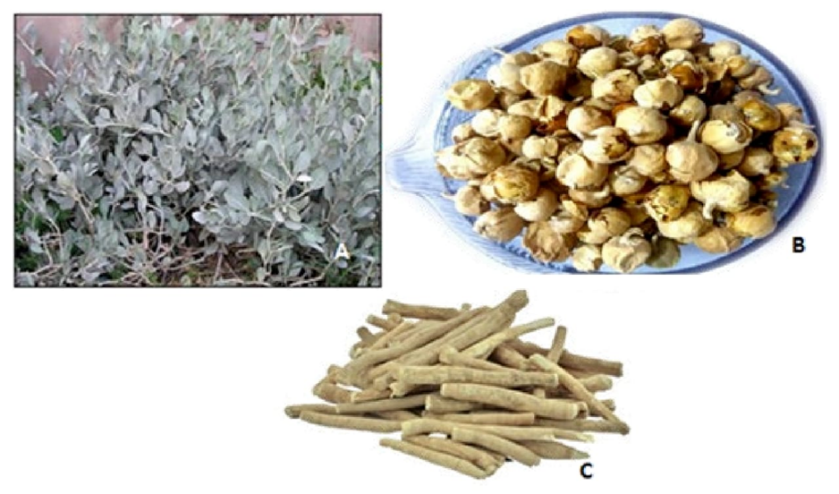
Fig no. 1 (A) Leaves (B) Fruits (C) Stem
2. CHEMICAL CONSTUTIENT:
Berries include alkaloid compounds, free amino acids, fatty oil, essential oil, and the milk-coagulating enzyme esterase. The essential oil exhibits anthelmintic action and was effective against Micrococcus pyogenes var. aureus. The plant has yielded withanolides, withacoagin, coagulant, and withasomidienone. in addition to withaferin and other withanolides. β-hydroxy-2,3-dihydrwithanolide E is taken out of Significant hepatoprotective effects were shown by the plant. Hydrocortisone has an anti-inflammatory effect. The ethanolic extract exhibits antifungal properties.[11]
3. PHYTOCHEMISTRY
Withania species have been studied extensively by several researchers, leading to the identification, characterization, and isolation of bioactive compounds in specific parts of a plant. It includes several steroidal lactones, tannins, flavonoids, and alkaloids.[12]
A new phytoconstituents were identified from air dried Withania coagulans Dunal fruit extracted with methanol and their structures were based on their chemical.[13]
Various constituents of Withania coagulans were estimated in three different extracts: methanolic, hydroalcoholic, and chloroform. It was reported that total phenolic content (55.9 mg/g), total tannins (76.6 mg/g), total flavonoids (0.88 mg/g), and total flavanol (0.25 mg/g) were higher in the methanolic extract as compared to hydroalcoholic and chloroformic.[14]
4. NUTRITIONAL PROFILE
Withania coagulans Dunal is a well-known herb with ethnopharmacological properties. It has been used as an herbal remedy and is widely available in Afghanistan, Pakistan, and Iran. In addition to East India, Withania coagulans dunal contains both macro and micronutrients. It contains small amounts of fat, protein, carbohydrates, fiber, and water. Studies have also shown a greater concentration of magnesium (more than Alhagi maurorum, Berberi’s lyceum, and Tecomella undulate), calcium (higher than Chenopodium album, Dature alba, and A. maurorum, B. lyceum, and T. undulate), potassium (higher than B. lyceum and T. undulate), and iron (higher Compared to D. alba, B. lyceum, and T. undulata) in Withania coagulans dunal. Ash makes up roots, (1.92%), protein (2.95%), fat (5.5%), fiber (5.76%), and carbs (75.71%). The leaves were composed of fiber, protein (2.95%), lipids (5%), carbohydrates (65.31%), and ash (3.26%). (11.76%). Additionally, fruit includes lipids (5%), carbohydrates (60.14%), ash (4.21%), and 4.65% protein.[15]
5. PHARMACOLOGICAL PROPERTIES
5.1 Antihyperglycemic Activity
Withania coagulans, a safe and effective alternative treatment for diabetes, exhibits hypoglycemic activity. Withania coagulans dunal showed hypoglycemic action in rats administered streptozotocin. Significant decreases in symptoms and indicators Were observed, and the type of diabetes mellitus attained euglycemia. A withanolide known as Coagulanolide, which is extracted from the fruits of Withania coagulans dunal, has antihyperglycemic effects on rats. The median effective dosage of isolated coagulanolide from Withania coagulans fruits was Demonstrated that in rats with diabetes induced by streptozotocin, about 25 mg/kg is equivalent to One common drug used to treat diabetes is metformin. The four-week treatment regimen for Withania coagulans Dried fruit extract significantly decreased hyperglycemia in rats with streptozotocin-induced diabetes that resembled glipizide12.[16]
5.2 Hypoglycemic Activity
Both the aqueous and chloroform extracts of the fruit reduced blood glucose by 55%. Blood sugar decreased by 52%. Coagulin L, extracted from Withania coagulans dunal fruits, was found to contain about 25 mg/kg in rats with diabetes caused by streptozotocin. This amount is like metformin, a common medication used to treat diabetes.[17]
5.3 Hepatoprotective activity
It has been demonstrated that this plant’s fruit aqueous extract possesses hepatoprotective properties. 3-b-hydroxy-2,3-dihydrowithanolide F has been investigated for it hepatoprotective activity because steroidal compounds (glucocorticoids) with anti-inflammatory properties are employed in various hepatic illnesses. It has demonstrated hepatoprotective properties against Hepatotoxicity caused by CCl? in adult albino rats of both sexes (150–200 g) at 10 mg/kg intraperitoneally. The shielding effect was evaluated by looking at pentobarbitone (30 mg/kg; i.p.) – induced hypnosis, the measurement of serum glutamic Serum glutamic acid and oxaloacetic transaminase (SGOT) levels of pyruvic transaminase (SGPT), as well as histological analysis of hepatic tissues following hematoxylin and eosin staining. Concurrent care for the rats the liver was considerably protected by 10 mg/kg withanolide. (P < 0.05) [18]
5.4 Anti-inflammatory activities
Numerous researchers have thoroughly examined the anti-inflammatory properties of W. coagulans and withania somnifera. the aqueous extract W. coagulans fruits have strong anti-inflammatory properties. 10 mg kg?¹ of activity in inflammatory subacute models, granuloma development and formalin induced rats with arthritis. The withania somnifera has effective anti-inflammatory properties. Action in comparison to the popular anti-inflammatory medication of hydrocortisone.[12]
CONCLUSION
Withania coagulans dunal, commonly known as Paneer Dodi, is an important Ayurvedic medicinal plant that is used in a variety of herbal remedies. Among the many parts of the plant that exhibit a range of biological activity are the roots, leaves, and berries.The abundance of various phytochemicals, such as free amino acids and esterases, is responsible for the plant's therapeutic benefits.Numerous studies have demonstrated the significant medicinal properties of Withania coagulans, including hepatoprotective, anti-inflammatory, and antihyperglycemic effects. These findings validate its traditional use in Ayurveda and show its potential as a natural medicinal agent for the treatment of various illnesses.
REFERENCES


Chetan Jadhav, Manisha Kale, Jayshri Bagul, A Review on Withania coagulans Dunal Plant (Paneer Phool), Int. J. of Pharm. Sci., 2026, Vol 4, Issue 1, 300-305. https://doi.org/10.5281/zenodo.18139993
 10.5281/zenodo.18139993