

We use cookies to ensure our website works properly and to personalise your experience. Cookies policy
Srinath College of Pharmacy, Aurangabad, Maharashtra, India
Developing and validating analytical methods is a crucial step in drug discovery. Even if a drug is effective, it cannot be approved for use without reliable testing methods to confirm its quality and safety. This review discusses both traditional and modern techniques used to analyze drugs in their raw materials and finished forms. It also examines approaches for assessing drug stability when combined with other ingredients and during storage over time. It also covers methods used to measure drug concentrations in biological samples.In addition, it emphasizes the importance of stability-indicating assay methods (SIAMs) for ensuring drug safety. Research and development, quality control, and quality assurance departments are all involved in the continuous and interdependent task of developing and validating analytical methods. The primary goal of developing and validating analytical methods is to demonstrate their accuracy, specificity, precision, and robustness for drug moiety analysis in the pharmaceutical industry. Developing analytical methodologies has emerged as a crucial research endeavour. The development of analytical instruments has led to recent advancements in analytical techniques. For active pharmaceutical ingredients (API), excipients, drug products, degradation products and related substances, residual solvents, etc., analytical techniques are generated and verified. The process of demonstrating that an analytical technique is suitable for the intended use is known as method validation, and it is frequently a crucial prerequisite for analytical purposes. The quality, consistency, and dependability of analytical data are determined by the methodology validation results. The concept, standards, procedures, approach, and significance of developing and validating analytical methods were the main topics of the review.
In analytical chemistry, we study drugs to separate, measure, and find out how much of a chemical is in them. These chemicals can come from nature or be made in a lab. Drugs are usually made of one or more of these chemicals Analytical chemistry has two main parts:
For example, analyzing a wide range of compounds or products is important in drug analysis, as it directly impacts human health. Today, a large number of drugs are being introduced into the market, and the demand for these drugs continues to grow rapidly. New drugs may be entirely novel or modified versions of existing medications. These drugs are often developed with reference to existing marketed products and the standards described in pharmacopoeias.
Pharmacopoeias play a crucial role in drug development, providing guidelines for the creation of therapeutically effective medicines suitable for release into the market. However, in some cases, especially during the development of new drugs, the analytical profiles may not yet be included in pharmacopoeias. Therefore, it becomes necessary to develop appropriate and reliable analytical methods for such new drugs.1In the field of analytical chemistry, the analysis of pharmaceutical substances plays a crucial role in the separation, identification, and quantitative determination of chemical constituents originating from both natural and synthetic sources. Such substances generally comprise one or more active chemical components. It encompasses the practical application of chemical knowledge, emphasizing the distinctive perspectives and methodologies that analytical chemists contribute to the discipline. Furthermore, it involves the refinement of existing analytical techniques, their extension to novel sample matrices, and the development of innovative methods for quantifying chemical phenomena, rather than merely carrying out routine analyses on conventional samples, a process generally referred to as chemical analysis.2
2. Analytical Techniques for Method Development
Spectroscopic Techniques
In analytical chemistry the quantitative and qualitative determination of drug the various techniques were used with their accuracy for method development.
Choice of Analytical Method
The chosen analytical method should possess all the essential attributes, with particular emphasis on minimizing the time required for analysis. Ideally, the technique must be rapid, cost-effective, and comply with pharmacopoeial standards of accuracy. In addition, the method should be precise, reliable, and carefully selected to ensure consistency with regulatory requirements.?
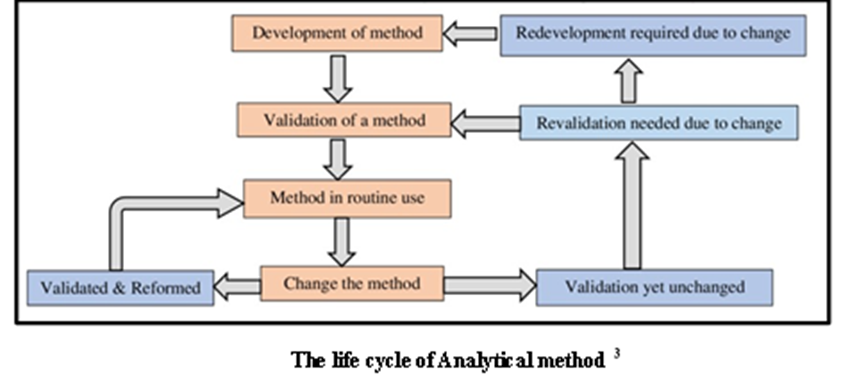
The life cycle of Analytical Method 3
Reference Standard Method
Reference standards form the foundation for evaluating both processes and product performance, serving as benchmarks to ensure drug safety for patient use. They are required not only for active ingredients in dosage forms but also for impurities, degradation products, starting materials, process intermediates, and excipients.
3. Spectroscopic Techniques
The development of spectroscopic techniques has become a crucial process. In our pharmacopoeias, this method relies on the natural absorption of ultraviolet (UV) radiation and other chemical reactions. Spectroscopy is fundamentally about measuring quantities, and it operates based on properties such as transmission and wavelength. This approach offers significant benefits, including saving time and reducing labor costs. It is also known for its high precision and accuracy. In the field of pharmaceutical analysis, this method is specifically used to examine dosage forms, a practice that has become increasingly common in pharmaceutical companies.
3.1 UV-Visible Spectroscopy
The ultraviolet-visible spectroscopy method is based on the interaction of energy and radiation with matter, leading to the excitation of electrons. In uv-vis-spectroscopy electron excitation occurs when molecules absorb light energy. The technique operates within a wavelength range of 200–800 nm, enabling the determination of sample wavelength and absorbance.
Absorption occurs primarily in the presence of conjugated π electron systems, where electornic transition are facilitated by the delocalization of electrons.
3.2 FTIR Spectroscopy
Fourier- transform infrared (FTIR) spectroscopy involves the absorption of infrared radiation which excites atoms and molecules by causing vibration within them. FTIR it is the modern technique of spectroscopy. This technique enables the identification of functional group and characteristic peaks associated with a molecule. Such analysis assists scientists in developing and refining new analytical method. Emission of the spectra of solid, liquid or gases. The generated spectrum serves as a unique molecular signature, allowing for the identification of functional groups, structural characterization, and compound analysis.
3.3 Flurescence Spectroscopy
Flurescence spectroscopy it is a powerful analytical method for examining the fluorescent characteristics of a substance. In this technique, molecules are illuminated with light of a specific wavelength, prompting them to absorb energy and move to a higher electronic state. When these molecules return to their ground state, they release light of a longer wavelength, known as fluorescence, which is then measured and analyzed.
This approaches offers valuable insights into the molecular structure, surrounding environment, and interaction of fluorescent compound. Owing to it’sexceptional sensitivity selectivity and non- destructive nature, fluorescence spectroscopy find broad application in chemical analysis, biochemical research, environmental testing, and medical diagnostics.
3.4 MIOIRS (Mixed Isotope Operando Infrared Spectroscopy)
Mixed Isotope Operando Infrared Spectroscopy is a cutting-edge method developed to investigate catalytic reactions under real-time operating conditions. In this technique, a continuous flow of isotopically labeled molecules (such as ^12CO? and ^13CO?) is passed over an active catalyst. This process reduces or eliminates vibrational coupling between adsorbed species, a common factor that complicates data interpretation in conventional infrared spectroscopy. As a result, MIOIRS provides clearer vibrational spectra, enabling a deeper understanding of reaction pathways and catalyst surface dynamics.
In contrast to SSITKA (Steady-State Isotopic Transient Kinetic Analysis), which introduces isotope mixtures only during short transient phases, MIOIRS sustains the isotope blend throughout the measurement. This constant environment allows for finer control and more accurate observation of vibrational coupling, revealing detailed information about surface structures, interactions between adsorbates, and catalytic intermediates.
3.5 LIBS (Laser-Induced Breakdown Spectroscopy)
Laser-Induced Breakdown Spectroscopy is an analytical technique used for rapid elemental analysis of solids, liquids, and gases. In LIBS, a high-energy laser pulse is focused onto the surface of a sample, creating a micro plasma. The plasma emits light as it cools, and this emission is collected and analyzed spectroscopically. Each element produces characteristic spectral lines, allowing qualitative and quantitative determination of the sample’s elemental composition.
LIBS is valued for its speed, minimal sample preparation, ability to analyze in situ, and applicability to a wide range of materials, including metals, soils, biological samples, and even hazardous or remote targets.
4. Chromatographic Technique
Chromatography is among the most widely applied separation and analytical tools in pharmaceutical and chemical sciences. It facilitates the isolation, identification, and quantification of complex mixtures of compounds. The underlying principle involves the differential distribution of analytes between a stationary phase and a mobile phase.
Chromatography is fundamentally a surface phenomenon in which solute molecules become adsorbed onto the stationary phase. The interaction occurs through van der Waals forces and steric effects, allowing the solute to associate with the adsorbent. Since adsorption sites are primarily located on the external surface of the stationary phase, finely divided particles are generally employed to maximize surface area and enhance efficiency. Chromatography can be broadly classified into two types: preparative and analytical. Preparative chromatography is primarily employed for the separation and purification of one or more specific components for subsequent use. In contrast, analytical chromatography generally utilizes smaller sample sizes and is focused on determining the relative proportions of analytes within a mixture. The importance of chromatography is underscored by its extensive application across numerous industries for a wide range of purposes5.Chromatography is classified into two main types: preparative and analytical.
5. UPLC (Ultra-Performance Liquid Chromatography)
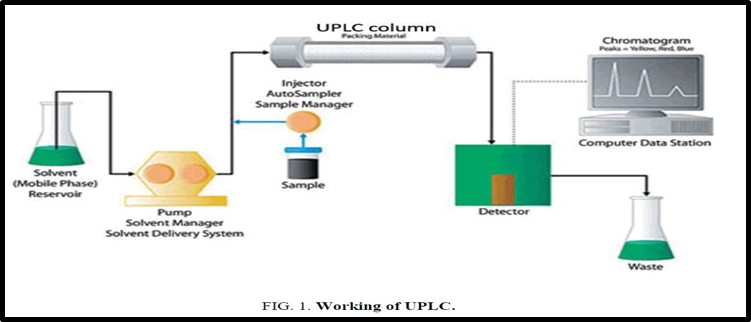
The evolution of analytical techniques in pharmaceutical research has led to significant progress in drug development and bioanalysis. Ultra-performance liquid chromatography (UPLC) is a major advancement in separation science. It provides improved analytical capabilities compared to traditional high-performance liquid chromatography (HPLC).6 The shift from in vitro studies to detailed analytical evaluations requires strong methods that can produce reliable and consistent results .7,8 UPLC uses new column technology and improved instruments to achieve better chromatographic performance. Using sub-2-micron particle sizes and higher operating pressures leads to better resolution, sensitivity, and significantly shorter analysis times 9. UPLC is a vital tool in pharmaceutical analysis, especially during drug development after in vitro studies. This technique allows for quick measurement of active pharmaceutical ingredients, related substances, and degradation products10. Chromatography is a non-destructive method that uses a porous medium and solvents to separate a mixture of components into their constituent parts. Prior to 2004, the most popular method for breaking down a mixture of components into their constituent parts was high-performance liquid chromatography. However, because of certain limitations, a new technique known as "Ultra Performance Liquid Chromatography (UPLC)" has been developed by scientists. It is very effective and sophisticated, and it also overcomes some of the limitations of HPLC11.The basic principle of UPLC and HPLC is the same. It relies on the mode of separation, which includes adsorption, partition, exclusion, and ion-exchange, depending on the type of chromatographic sorbent. The UPLC relies on using a stationary phase made up of particles smaller than 2µm, whereas HPLC columns usually contain particles between 3 and 5 µm 12.
6. Instrumentations
The basic instruments are used in UPLC:
6.1 Sample Injection
In UPLC, introducing a sample is important. Traditional injection valves, whether automated or manual, are not built to handle extreme pressure. To guard the column against drastic pressure changes, the injection method should be pulse-free. Additionally, the swept volume of the device must be small to minimize possible band spreading. A fast injection cycle time is necessary to make the most of the speed provided by UPLC. This requires a high sample capacity. We also need low volume injections with minimal carryover to boost sensitivity. Additionally, there are direct injection methods for biological samples.13
6.2 UPLC Columns
The UPLC columns consist of small particles that are less than 2µm in size. The particles are bonded in the matrix because the bonded stationary phase is necessary for providing retention and selectivity. There are four bonded stationary phase columns made by ACQUITY available in the market, which can be used with the UPLC technique.
The system is often organized with TUV, ELS, PDA, and FLR detectors, or a mix of them.
It is a 2 channel absorbance detector. The detector is controlled by Empower or Mass Lynx software for each LC/MS and LC application.
It is an optical detector that absorbs UV-Visible light and operates between 190-500nm.
This detector is controlled by Empower or Mass Lynx software and includes a flow-type nebulizer optimized for UPLC system performance.
It is a multi-channel, multi-wavelength detector with an excitation wavelength that ranges from 200 to 890 nm and an emission wavelength that ranges from 210 to 900 nm. It also offers 3D scanning capability for easier method development.
Methodological Advance:
Advanced particle technologies that significantly improve separation efficiency are incorporated into modern UPLC columns. Su-2 particles with puovale uncinated surface sora and enhanced mass transfer properties. Core-shell particles create band broadening and improve columns efficiency by framing a solid cove surrounded by a porous outer layer. Hybed organe organic particle development maintains separation performance over a wider pH range while demonstrating unproven columa stability under high pressure conditions.
Complex mixtures are best separated from in vitro systems using sophisticated gradient elution techniques. Compounds with comparable physicochemical characteristics can be resolved using multi-step gradients. Techniques for temperature-assisted separation improve selectivity even more and cut down on analysis time.15
Sustainable mobile phase compositions have been developed as a result of environmental considerations. Green chemistry principles are in line with the use of bio-based solvents and less organic solvent. New aqueous mobile phase modifiers reduce their negative effects on the environment while improving separation.16
7. Bioanalytical Method Validation
A. Validation Parameters
i. Specificity and Selectivity
The initial phase in developing a method is to determine the target analytes' specificity in intricate biological matrices. Reliable analyte identification is ensured by interference testing with blank matrix samples. Selectivity for difficult separations is improved by using orthogonal separation mechanisms.17
ii. Linearity and Range
Appropriate concentration ranges that represent anticipated analyte levels are used in calibration techniques. Correlation coefficients and residual plots are evaluated as part of the statistical analysis of linearity. For quantitative applications, the dynamic range includes at least three orders of magnitude.18
iii. Precision and Accuracy
Analysis of quality control samples at various concentration levels is necessary for a methodical assessment of accuracy. Both intra-day and inter-day variability studies are included in the evaluation of method precision. Under various experimental circumstances, robustness testing guarantees method reliability.19
iv. Matrix Effect
Matrix factor determination and post-column infusion studies are necessary for a thorough assessment of matrix effect .Response variations caused by the matrix are compensated for by the use of stable isotope-labeled internal standards .20
v. Stability Studies
A variety of handling and storage circumstances that are pertinent to sample analysis are included in stability assessment. Analyte stability under specified storage conditions is assessed by long-term stability studies. Throughout the analytical procedure, sample integrity is guaranteed by post-preparative stability and freeze-thaw stability.21
Table 1. Validation Parameters and Acceptance Criteria
|
Parameter |
Acceptance Criteria |
Test Level |
Number of Replicates |
|
Specificity |
No Interference |
N/A |
Minimum 6 |
|
Linearity |
R² ≥ 0.999 |
6–8 Levels |
3 per Level |
|
Accuracy |
98–102% |
3 Levels |
6 per Level |
|
Precision (%RSD) |
≤ 2.0% |
3 Levels |
6 per Level |
|
LOQ |
S/N ≥ 10 |
N/A |
6 |
B. Technological Advancements
i. Artificial Intelligence
Algorithms for machine learning improve method development and optimization. The accuracy of metabolite identification is increased by automated data processing. Instrument performance is maximised by predictive maintenance systems.22
ii. Miniaturization
Microfluidic UPLC systems provide lower solvent and sample consumption. Improved separation efficiency at the microscale is made possible by innovative column designs. Fieldbased applications are advanced through integration with portable mass spectrometers.23
iii. Sustainable Practices
The creation of environmentally friendly UPLC techniques is motivated by environmental factors. Waste production and solvent consumption are decreased by novel stationary phases.
Different mobile phase compositions reduce their negative effects on the environment.
Table 2. Emerging Trends in UPLC
|
Technology |
Innovation |
Benefits |
|
AI Integration |
Automated method development |
Reduced optimization time |
|
Microfluidics |
Chip-based separations |
Minimal sample volume |
|
Green Chemistry |
Bio-based solvents |
Environmental sustainability |
|
Smart Diagnostics |
IoT Integration |
Remote monitoring |
|
Multi-Dimensional |
2D-UPLC |
Enhanced resolution |
CONCLUSION
The development and validation of analytical methods are essential to guaranteeing the efficacy, safety, and quality of pharmaceutical products. The need for precise, quick, and extremely sensitive analytical methods keeps rising as contemporary medicine compositions becoming increasingly complicated. In addition to cutting-edge instruments like UPLC, LC– MS/MS, FTIR, LIBS, and developing isotopic and microfluidic technologies, this study emphasizes the significance of traditional spectroscopic and chromatographic techniques. In addition to supporting bioanalysis, stability testing, and impurity profiling, these methods allow for accurate quantification that is necessary for regulatory compliance.
A significant movement toward sustainable, effective, and automated analytical workflows is also seen in the use of Quality by Design (QbD) green chemical techniques, artificial intelligence, and miniaturized analytical equipment.
REFERENCES





Dhiraj Kardile, Prashant Jadhav, Prasad Kalaskar, Aditi Kardile, Rupali Karke, Formulation, Analytical Method Development and Validation, Int. J. of Pharm. Sci., 2026, Vol 4, Issue 4, 1322-1331. https://doi.org/10.5281/zenodo.19475742
 10.5281/zenodo.19475742