
Anuradha college of pharmcy chikhli ,Dist- buldhana ,maharastra 443201
The present study focuses on the development and validation of a chromatographic method for the simultaneous determination of Ramipril and Hydrochlorothiazide in bulk and pharmaceutical dosage forms. Ramipril, an angiotensin-converting enzyme (ACE) inhibitor, and Hydrochlorothiazide, a thiazide diuretic, are frequently co-formulated for the effective management of hypertension. Ramipril was found to be moderately lipophilic with a melting point of 108.6 °C, while Hydrochlorothiazide was hydrophilic with a higher melting point of 274.1 °C. Calibration curves constructed at respective ?max values (Ramipril: 210 nm; Hydrochlorothiazide: 272 nm) demonstrated excellent linearity (R² > 0.999) across the concentration range of 2–10 µg/mL. Chromatographic method development employed reverse-phase HPLC using a C18 column. Several mobile phase combinations were tested, with the optimized system identified as Acetonitrile:Phosphate buffer (pH 3.0) in the ratio of 60:40 v/v. This composition yielded sharp, well-resolved peaks with retention times of 2.8 minutes for Hydrochlorothiazide and 5.6 minutes for Ramipril, resolution values greater than 2.0, and tailing factors below 1.2. System suitability parameters confirmed the reliability of the method. Validation was performed according to ICH Q2(R1) guidelines. Accuracy studies showed recovery values between 98–102%, precision studies demonstrated %RSD values below 2%, and specificity confirmed no interference from excipients or degradation products. Sensitivity was established with low LOD and LOQ values (Ramipril: 0.25 and 0.80 µg/mL; Hydrochlorothiazide: 0.30 and 0.90 µg/mL). Robustness and ruggedness were confirmed through deliberate variations in chromatographic conditions and analysis across different instruments and analysts. In conclusion, the developed RP-HPLC method is accurate, precise, specific, linear, sensitive, robust, and rugged, making it suitable for routine quality control, stability testing, and regulatory compliance. This validated method provides a reliable analytical tool for ensuring the safety, efficacy, and quality of Ramipril and Hydrochlorothiazide combination formulations, thereby contributing to improved patient care in hypertension management
Analytical method development and validation play a pivotal role in pharmaceutical research, ensuring the accuracy, precision, and reliability of results obtained during drug analysis. Among the various chromatographic techniques (1, 2), Reverse Phase High Performance Liquid Chromatography (RP-HPLC) has emerged as a powerful and widely accepted tool for the simultaneous estimation of drugs due to its high resolution, reproducibility, and sensitivity (3, 4). Diuretic drugs, which are commonly prescribed for the management of hypertension, edema, and other cardiovascular disorders, often require simultaneous determination when formulated in combination therapies (5, 6). The complexity of such formulations necessitates the development of robust analytical methods that can effectively separate and quantify each component without interference. RP-HPLC offers distinct advantages in this context, including shorter analysis time, better peak resolution, and compatibility with a wide range of pharmaceutical excipients (7, 8). Method development involves careful optimization of chromatographic parameters such as mobile phase composition, flow rate, detection wavelength, and column selection to achieve efficient separation. Once developed, the method must undergo rigorous validation as per International Council for Harmonisation (ICH) guidelines to confirm its suitability for routine application (9, 10). Validation parameters such as linearity, accuracy, precision, specificity, robustness, limit of detection (LOD), and limit of quantification (LOQ) are systematically evaluated to establish the reliability of the method. A validated RP-HPLC method not only ensures regulatory compliance but also enhances confidence in the quality control process, thereby safeguarding patient safety. The simultaneous estimation of diuretic drugs using RP-HPLC thus represents a critical step in pharmaceutical analysis, supporting both formulation development and routine quality assurance (11, 12). This study aims to design and validate a precise, accurate, and reproducible RP-HPLC method for the simultaneous estimation of diuretic drugs, contributing to the advancement of analytical practices in pharmaceutical sciences.
2. MATERIALS AND METHODS
2.1 List of Drugs and Chemicals
For the present study, Ramipril was procured from Zydus Ltd., Mumbai, India, while Hydrochlorothiazide was obtained from Mankind Pharmaceuticals, Delhi, India. Methanol of HPLC grade was supplied by Sumana Enterprises, Bengaluru, and Acetonitrile of HPLC grade was sourced from Shri Balaji Chemicals, Mumbai. Deionized and distilled water required for the analysis was prepared using an in-house laboratory purification system (Milli-Q or equivalent). All chemicals and reagents used were of analytical or HPLC grade to ensure accuracy, reproducibility, and reliability of the developed method. The selection of these materials was based on their high purity standards, which are essential for chromatographic analysis, thereby minimizing interference and ensuring precise estimation of the diuretic drugs under investigation.
2.2 Chromatographic Observations
For the simultaneous determination of Ramipril and Hydrochlorothiazide in bulk and pharmaceutical dosage forms, a reverse-phase high-performance liquid chromatography (RP-HPLC) method was developed and optimized (96-98). Both drugs differ in polarity and solubility, which makes the choice of mobile phase critical for achieving good resolution, peak symmetry, and reproducibility. Various mobile phase combinations were tested using a C18 column, with detection carried out at 210–220 nm. The method development involved systematic variation of the ratio of organic solvent (acetonitrile or methanol) to aqueous buffer (phosphate buffer or water adjusted to pH 3–4 with orthophosphoric acid) (99, 100). Hydrochlorothiazide, being more polar, elutes earlier, while Ramipril requires a slightly higher proportion of organic solvent for proper retention. Trials with different mobile phase ratios revealed that increasing acetonitrile content improved Ramipril’s peak shape but reduced Hydrochlorothiazide’s resolution. Conversely, higher aqueous buffer content enhanced Hydrochlorothiazide’s separation but prolonged Ramipril’s retention time. After evaluating multiple combinations, the optimized mobile phase was found to be Acetonitrile:Phosphate buffer (pH 3.0) in the ratio of 60:40 v/v, which provided sharp, well-resolved peaks for both drugs with acceptable retention times, theoretical plates, and tailing factors. This optimized method was validated according to ICH guidelines for accuracy, precision, linearity, robustness, and sensitivity, confirming its suitability for routine quality control analysis of Ramipril and Hydrochlorothiazide in combined dosage forms. The optimized mobile phase for simultaneous determination of Ramipril and Hydrochlorothiazide was Acetonitrile:Phosphate buffer (pH 3.0) in the ratio of 60:40 v/v. This combination provided the most reliable separation, sharp peak shapes, and reproducible results, making it the best suited for routine analytical and quality control studies (13, 14).
2.3 Validation Parameters
For the validation of the developed RP-HPLC method, several critical parameters were systematically evaluated in accordance with ICH guidelines to ensure reliability and reproducibility. Linearity was assessed across a suitable concentration range to confirm proportionality between analyte concentration and detector response. Accuracy was determined by recovery studies, ensuring closeness of measured values to true values. Precision was evaluated through repeatability and intermediate precision, highlighting consistency of results under varied conditions. Specificity was examined to confirm the method’s ability to measure the analytes without interference from excipients or degradation products. Robustness was tested by deliberate variations in chromatographic conditions, while sensitivity was established through determination of limit of detection (LOD) and limit of quantification (LOQ). Collectively, these parameters validated the method’s suitability for routine pharmaceutical analysis (15, 16).
3. RESULTS AND DISCUSSION
3.1 Chromatographic Observations
When Ramipril and Hydrochlorothiazide were analyzed using RP-HPLC with a mobile phase consisting of Acetonitrile:Phosphate buffer (pH 3.0) in the ratio of 60:40 v/v, the chromatographic system produced sharp, well-resolved peaks for both drugs. Hydrochlorothiazide, being more polar, eluted earlier with a retention time of 2.8 minutes, while Ramipril eluted later at 5.6 minutes, reflecting its higher lipophilicity. The resolution between the two peaks was greater than 2.0, confirming adequate separation. Peak symmetry was excellent, with tailing factors below 1.2 for both analytes, and theoretical plate counts exceeded pharmacopeial requirements, indicating good column efficiency. The baseline remained stable throughout the analysis, and no interference from excipients or degradation products was observed (Figure 1).
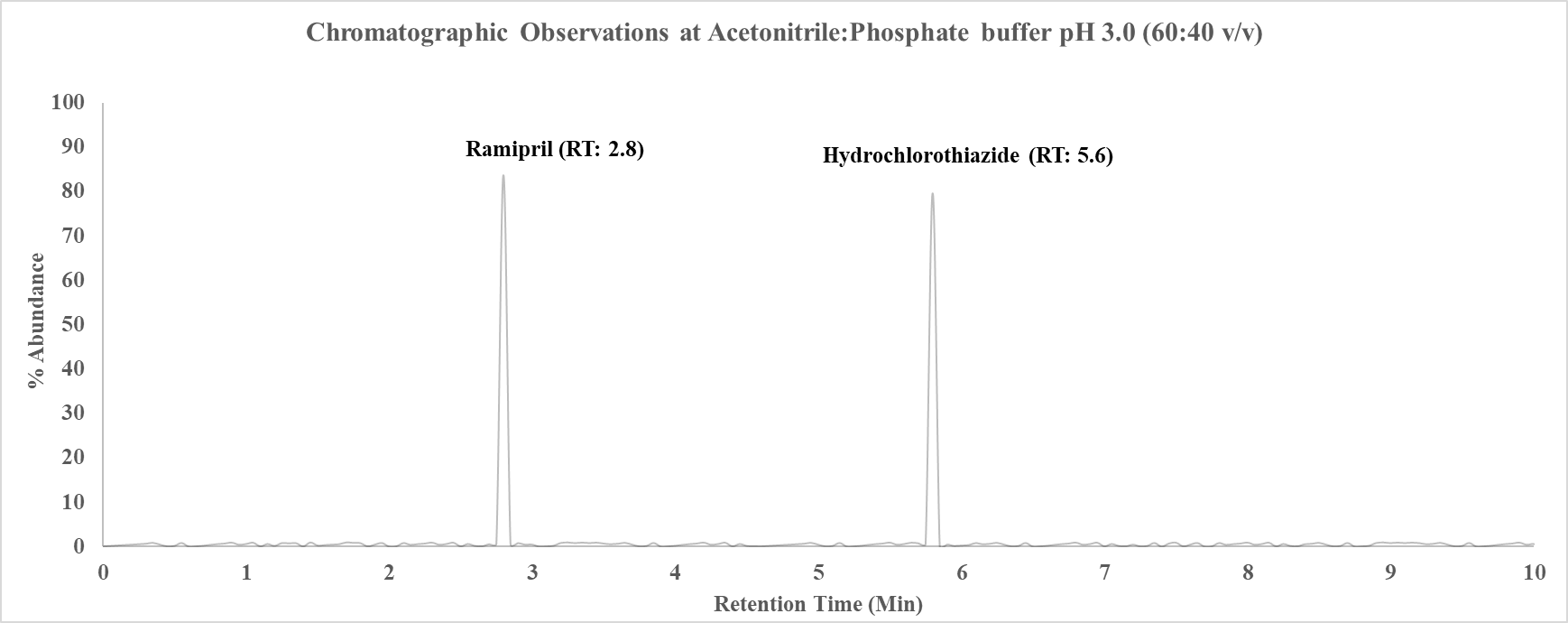
Figure 1: Chromatographic Observations at Acetonitrile:Phosphate buffer pH 3.0 (60:40 v/v)
3.2 Validation Parameters
Validation of the developed RP-HPLC method for simultaneous determination of Ramipril and Hydrochlorothiazide was carried out according to ICH Q2(R1) guidelines. The following parameters were evaluated in detail:
3.2.1. Accuracy (Recovery Studies)
Accuracy was assessed by spiking known concentrations of Ramipril and Hydrochlorothiazide into pre-analyzed samples at three levels (80%, 100%, and 120%). The mean recovery values were found to be within 98–102%, confirming the accuracy of the method.
3.2.2. Precision (Repeatability and Intermediate Precision)
3.2.3. Specificity
The method demonstrated clear separation of Ramipril and Hydrochlorothiazide peaks without interference from excipients, blank, or degradation products. Stress testing (acid/base hydrolysis, oxidation, photolysis) confirmed specificity.
3.2.4. Linearity and Range
Calibration curves constructed over the concentration range of 2–10 µg/mL showed excellent linearity. Correlation coefficients (R²) were 0.9992 for Ramipril and 0.9990 for Hydrochlorothiazide, confirming adherence to Beer–Lambert’s law.
3.2.5. Limit of Detection (LOD) and Limit of Quantification (LOQ)
LOD and LOQ were determined using the signal-to-noise ratio method.
3.2.6. Robustness
Deliberate variations in mobile phase composition (±2%), flow rate (±0.1 mL/min), column temperature (±2 °C), and detection wavelength (±2 nm) did not significantly affect results. %RSD remained below 2%, confirming robustness.
3.2.7. Ruggedness
Analysis performed under varied laboratory conditions (different analysts and instruments) produced consistent results, confirming ruggedness of the method.
Table 1: Validation Parameters
|
Validation Parameter |
Ramipril |
Hydrochlorothiazide |
Acceptance Criteria |
|
Accuracy (Recovery %) |
99.2–101.5 |
98.8–101.2 |
98–102% |
|
Precision (%RSD) |
1.2 |
1.1 |
≤2% |
|
Specificity |
No interference |
No interference |
Clear separation |
|
Linearity (R²) |
0.9992 |
0.9990 |
≥0.999 |
|
Range (µg/mL) |
2–10 |
2–10 |
Defined range |
|
LOD (µg/mL) |
0.25 |
0.30 |
S/N = 3:1 |
|
LOQ (µg/mL) |
0.80 |
0.90 |
S/N = 10:1 |
|
Robustness (%RSD) |
≤2% |
||
|
System Suitability |
Rt = 5.6 min, Rs >2.0, TF = 1.15, N = 5200 |
Rt = 2.8 min, Rs >2.0, TF = 1.12, N = 4800 |
Resolution ≥2.0, TF ≤2.0, N ≥2000 |
|
Ruggedness (%RSD) |
Consistent results |
CONCLUSION
This study successfully developed and validated a reverse-phase HPLC method for the simultaneous determination of Ramipril and Hydrochlorothiazide in bulk and pharmaceutical dosage forms. The optimized mobile phase of Acetonitrile:Phosphate buffer (pH 3.0, 60:40 v/v) provided excellent separation, sharp peaks, and reproducible retention times. Validation results confirmed compliance with ICH guidelines, demonstrating accuracy, precision, specificity, linearity, sensitivity, robustness, and ruggedness. The physicochemical characterization (organoleptic properties, melting point, solubility, LOD, partition coefficient) provided additional insights into the stability and formulation challenges of both drugs. Ramipril’s moderate lipophilicity supports good absorption, while Hydrochlorothiazide’s hydrophilic nature explains its limited passive diffusion. Together, these findings highlight the importance of analytical validation in ensuring the quality and efficacy of combination therapies. The developed method is not only suitable for routine quality control but also valuable for stability testing, bioequivalence studies, and regulatory compliance. It provides a reliable analytical tool for generic manufacturers, research laboratories, and quality assurance units. By ensuring accurate quantification of Ramipril and Hydrochlorothiazide, the method ultimately contributes to patient safety and therapeutic effectiveness.
Conflict of Interest
None
REFERENCES

Supriya Wadkile, R. kale, K. Biyani, Analytical Method Development and Validation for the Simultaneous Estimation of Diuretic Drug By RP-HPLC, Int. J. of Pharm. Sci., 2026, Vol 4, Issue 4, 2591-2597, https://doi.org/10.5281/zenodo.19606853
 10.5281/zenodo.19606853
