View Article

Abstract

Controlled Drug Delivery Systems (CDDS) are advanced pharmaceutical formulations designed to release drugs at a predetermined rate for a specific period, maintaining optimal therapeutic levels in the body. The active pharmaceutical ingredient can be released to produce the intended therapeutic effect thanks to the drug delivery mechanism. In addition to having poor bioavailability and fluctuating plasma drug levels, conventional drug delivery methods (tablets, capsules, syrups, ointments, etc.) cannot provide sustained release. The entire therapy process could be ineffective without an effective delivery system. In addition, controlled drug delivery systems must deliver the medication at a precise target spot at a predetermined controlled pace in order to maximize safety and efficacy. Controlled drug delivery involves administering the medication locally or systemically for a predetermined amount of time at a predetermined pace.

Keywords

Controlled drug delivery systems, drug release mechanism, Tablet

Introduction

Drugs can be administered through various routes; however, of all the routes of administration, oral route of administration is the most convenient for administering and for dosage adjustments. Convenience of use and ease of industrial preparation are key factor in their growth in popularity.(1)

When a polymer and an active ingredient or medication are mixed so that the release from the bulk material is pre-planned, this is known as controlled drug delivery. The maintenance of drug levels within a range, the requirement for fewer doses, the best possible use of the medicine in question, and improved patient compliance are all examples of controlled drug delivery systems.

The potential drawbacks of these benefits, such as the potential toxicity or non-biocompatibility of the materials used, undesired degradation byproduct, the need for surgery to implant or remove the system, the possibility of patient discomfort from the delivery device, and the higher cost of controlled release systems in comparison to conventional pharmaceutical formulations, cannot be disregarded.

Inertness, biocompatibility, mechanical strength, patient comfort, high drug loading capacity, safety from unintentional release, ease of administration and removal, and ease of fabrication and sterilization are all desirable qualities in a drug delivery system.(2)

Controlled drug delivery systems (3)

Medication is administered using this method, which keeps the drug's concentration in the blood and tissue stable for a long time. Pharmacokinetics (PK)Curves show a drug’s plasma concentration as a function of time for both traditional and regulated administration modalities. For multiple doses with oral tablets or injections, a typical bolus PK occurs in a traditional delivery system when the drug level varies above and below the minimal effective concentration. Conversely, the controlled delivery method exhibits zero-order PK after a single dose of a medication delivered under control using a particular formulation or apparatus. The therapeutic window is continuously maintained for medication levels.

Advantages and Disadvantages of controlled release preparation

Advantages

  1. Keeping the medication level within the intended range
  2. Delivery of "difficult" medications: water soluble medications are released slowly, while poorly soluble medications are released quickly.
  3. Lowers the frequency of dosing
  4. Preventing or minimizing adverse effects
  5. A decrease in the overall cost of healthcare
  6. Enhanced effectiveness of the therapy
  7. A decrease in negative side effects and an increase in patient adherence
  8. Lessens medication level fluctuations
  9. Removes excessive or insufficient dosage
  10. Enhanced adherence to treatment
  11. Use less medication overall
  12. Reduces or gets rid of systemic or local side effects
  13. Minimal drug buildup after long-term use
  14. Quickly cures or manages the disease
  15. Increases a drug's bioavailability

Disadvantages

  1. A greater degree of variation in dose units
  2. Issues with stability
  3. In certain situations, poor systemic availability
  4. A higher price
  5. A quicker rate of tolerance development
  6. More patient counseling and education are required
  7. Erratic and frequently yield subpar in vitro–in vivo correlations

Clinical advantages of controlled  release dosage forms

    1. A decrease in the frequency of medication administration
    2. Increased adherence by patients
    3. Less variation in blood medication levels
    4. A decrease in overall drug use in comparison to traditional treatment
    5. Chronic therapy reduces drug buildup
    6. Decrease in systemic and local medication toxicity
    7. Some medications' increased bioavailability due to spatial control
    8. Cost-effective for patients and healthcare providers

Selection of Drug Candidates [10-12]

All the drugs cannot be formulated as their controlled release dosage forms. A drug must have the following characteristics for the formulation of controlled release dosage forms.

  1. Very short elimination half-life
  2. Very long elimination half-life
  3. Narrow therapeutic index
  4. Rate of absorption
  5. Mechanism of absorption
  6. First pass effect

Factor Influencing the Design and Performance of Controlled Drug Delivery System

  1. Biopharmaceutics characteristics of the drug
  1. The molecular weight of the drug
  2. The aqueous solubility of the drug
  3. Apparent partition coefficient
  4. Drug Pka and ionization physiological pH
  5. Drug stability
  6. Mechanism and site of absorption
  7. Route of administration.
  1. Pharmacokinetic characteristics of the drug
  1. Absorption rate
  2. Elimination half-life
  3. Rate of metabolism
  4. Dosage form index
  1. Pharmacodynamics characteristic of the drug
  1. Therapeutic range
  2. Therapeutic index
  3. Plasma–concentration-response relationship

The design of a pharmaceutical formulation depends on the physicochemical properties of the drug and its pharmacokinetic behaviour. In conventional dosage forms, drug absorption through the biological membrane is usually the rate-limiting step for bioavailability. In contrast, in controlled drug delivery systems, the rate-limiting step is the release of the drug from the dosage form.

TYPES OF CONTROLLED DRUG DELIVERY SYSTEMS [13-16]

Controlled drug delivery systems are broadly classified as follows:

    • Oral controlled release systems
    • Targeted delivery systems
    • Dental systems
    • Ocular systems
    • Transdermal systems
    • Vaginal & uterine systems
    • Injections & implants

ORAL CONTROLLED RELEASE DRUG DELIVERY SYSTEMS

Most oral controlled release systems produce a delayed release of the drug into the gastrointestinal tract by using either diffusion, dissolution, or a combination of both.

  1. DISSOLUTION CONTROLLED RELEASE

The stability and coating thickness affect the rate of dissolution. In theory, the easiest oral medications to make are sustained release ones that use dissolution as the rate-limiting step.

Slow soluble polymers or microencapsulation control the drug's rate of dissolution in materials. Following the dissolution of the coating, the medication will be accessible for dissolution. By altering the coat's composition and thickness, the medication release rate can be controlled. Products with diffusion control can be made as tablets or encapsulated for use in pellet dosage forms. Two types of dissolution-controlled products can be distinguished:

    1. Encapsulation Dissolution control
    2. Matrix Dissolution control

a) Encapsulation Dissolution control

This device approach involves covering individual particles (or granules) with drugs using a slow dissolving substance. The coated particles may directly be packed (or stored in capsules) into tablets. Microencapsulation controls the rate of dissolution of the drug (and hence the availability for absorption). The substance will be available for dissolution until the coating is dissolved.

The coat's composition and thickness can be changed to control the rate of medication release. Chewing these can degrade the covering. One advantage is that embedded pellets are less vulnerable to stomach emptying to initiate absorption. Compared to non-disintegrating tablets, pellets typically enter the small intestine more uniformly.

b) Matrix Dissolution control

The medicine is compressed using a slow dissolving carrier, which is a different technique in this device. This regulates the rate of drug release through the matrix’s porosity, the presence of hydrophobic additives, the moistening system, the particle surface and the penetration of the dissolution fluid.

B) DIFFUSION CONTROLLED RELEASE

Diffusion systems are characterized by the release rate of a drug being dependent on its diffusion through an inert membrane barrier. Usually, this barrier is an insoluble polymer.

Movement of drug molecule from a region of higher to one of lower concentration. It is major process for absorption which no energy required. There are basically two types of diffusion controlled systems which have been developed over the past two decades,

      1. Reservoir Devices.
      2. Matrix Devices
  1. Reservoir devices

This method involves enclosing a core medication with a water-insoluble polymer. The drug partitions into the membrane and exchanges with the particles (or tablet) surrounding the liquid. The active agent is released into the environment through the rate-limiting membrane. In these systems, the rate of drug distribution is comparatively constant.
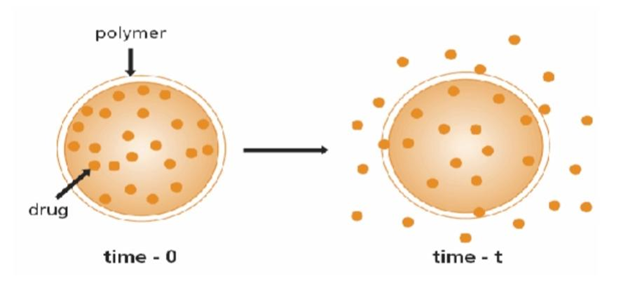
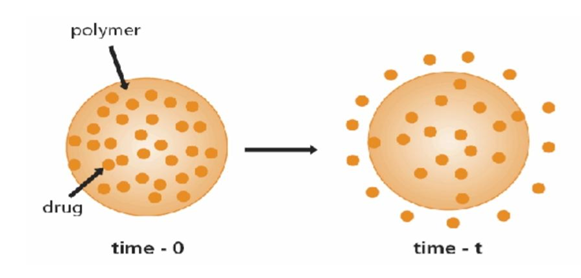
  1. Matrix devices

The homogeneous system, also known as a matrix system, disperses the medicine or active ingredient into a polymer matrix. An insoluble matrix disperses a solid medication in this system. The rate of drug diffusion determines the rate of drug release, but not the rate of solid dissolution.
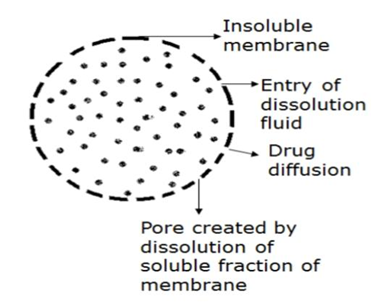
C) DIFFUSION AND DISSOLUTION CONTROLLED SYSTEMS

The main feature of this system is that the drug core is enclosed with a partially soluble membrane. Dissolution of part of the membrane allows for diffusion of the contained drug through pores in the polymer coat.
D) ION-EXCHANGE RESINS

Resins are water-insoluble materials containing anionic or cationic groups in repeating positions on the resin chain. The drug-charged resin is prepared by mixing the resin with a drug solution either by repeated exposure of the resin to the drug in a chromatographic column or by keeping the resin in contact with the drug solution for extended periods of time. The drug-resin is then washed to remove contaminant ions and dried to form particles or beads. When a high concentration of an appropriately charged ion is in contact with the ion-exchange group, the drug molecule is exchanged and diffuses out of the resin into the bulk solution.

They are mainly of two types: cation exchange and anion exchange resins.

        1. Cationic Drugs

A cationic drug forms a complex with an anionic ion-exchange resin e.g. a resin with a SO3 group. In the GI tract Hydronium ion (H) in the gastrointestinal fluid penetrates the system and activity the release of cationic drug from the drug resin complex.

H++ Resin - SO3 - Drug +→ Resin - SO3 -H+ + Drug+

        1. Anionic Drugs

 An anionic drug forms a complex with a cationic ion exchange resin, e.g. a resin with a [N (CH3)3+] group. In the GI tract, the Chloride ion (Cr) in the gastrointestinal fluid penetrates the system and activates the release of anionic drug from the drug resin complex.

Cl + Resin - [N (CH3)3+] - Drug → Resin- [N (CH3)3+] - Cl + Drug [17-19]

E) pH - INDEPENDENT FORMULATIONS-

The granules are designed for the oral controlled release of basic or acidic drugs at a rate that is independent  the pH in the GI tract. (Pederson, A.M, German patent). They are prepared by mixing a basic or acidic drug with one or more buffering agents, granulating with appropriate pharmaceutical excipients, and finally, coating with a gastrointestinal fluid permeable film-forming polymer. When the GI fluid permeates through the membrane, the buffering agents adjust the fluid inside to a suitable constant pH, thereby rendering a constant rate of drug release.

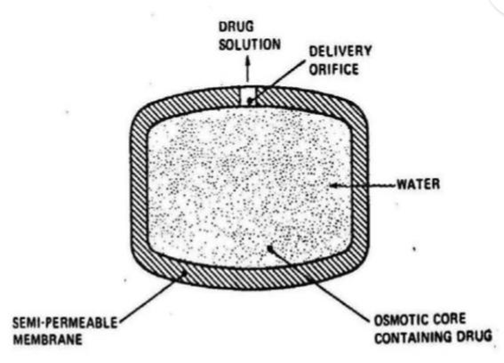
F) OSMOTICALLY CONTROLLED RELEASE-

In this type of drug delivery systems, osmotic pressure is the driving force that generates constant drug release. This system is fabricated by applying a semi permeable membrane around a core of an osmotically active drug or a core of an osmotically inactive drug in combination with an osmotically active salt. A delivery orifice is drilled in each system by laser or by a high-speed mechanical drill
Polymer

A polymer, also referred to as a macromolecule, is a large molecule composed of several repeating subunits. Both manufactured and natural polymers possess a variety of properties that make them commonplace and indispensable in everyday life. Examples of natural biopolymers are proteins and DNA, which are vital to the structure and operation of living things. Additionally, synthetic polymers such as polystyrene are also included in the category of polymers.

Polymers are a broad class of materials made up of many small molecules called monomers, which can be linked to form long chains and are therefore called macromolecules. [20]

Classification of Polymer:

Polymers are categorized into many categories based on various factors as stated in the below:
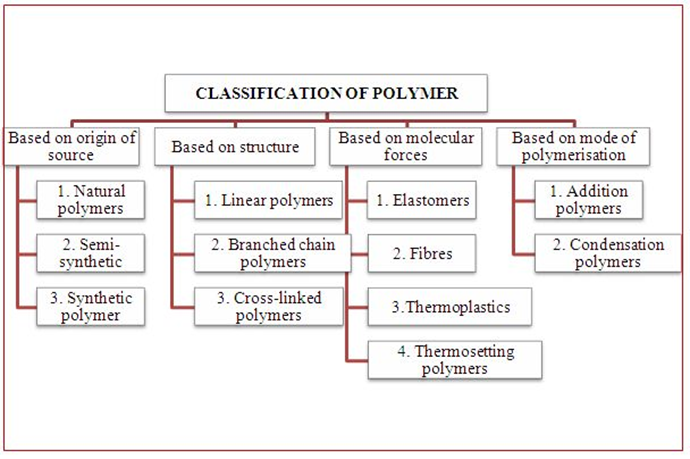
  1. Based on source
  1. Natural Polymers- Natural polymers are those which are derived from either plants or animals. We refer to them as animal and plant polymer. Ex: Cellulose, Jute, Silk, Wool, RNA, DNA, Natural rubber
  2. Semisynthetic Polymers- Semisynthetic fibers are polymers made from natural fibers that have gone through chemical processing to enhance certain physical characteristics, like as tensile strength and lustrus nature. Ex: Cupra ammonium silk, Viscous rayon
  3. Synthetic Polymers- Synthetic fibers are produced in lab through the polymerization of basic chemical components. Ex: Nylon, Orion, Polystyrene, PVC, Teflon
  1. Based on structure
  1. Linear polymers

In these polymer, monomers are interconnected to form an elongated, linear structure. These chains do not possess any additional branches or side chains.

Ex: Polyester, Polyethene

  1. Branched Polymers:

The straight long chain of molecules is accompanied by various side chain. Due to there irregular packing these molecules exhibit low density, tensile strength and melting point.

Ex: Polypropylene, Amylopectin, Glycogen

  1. Crosslinked Polymers.

The monomeric units are interconnected to form a three-dimensional framework in which cross link play a crucial role. These cross link contribute to the hardness, rigidity and brittleness of the network structure.

Ex: Bakelite, Formaldehyde resin, Vulcanized rubber.[21]

Advantages of Polymers:

The advantages of polymers are listed below:

      1. Easy and well understood processing method.
      2. Localised delivery of drug.
      3. Sustained delivery of drug.
      4. Decrease in dosing frequency.
      5. Reduce side effects.
      6. Improve patient compliance.
      7. Biodegradable and Biocompatible.

Disadvantages of Polymers:

The disadvantages of polymers are:

        1. Low tensile strength.
        2. Ductility and plasticity under load.
        3. Thermal sensitivity.
        4. Inferior mechanical characteristics.
        5. Elevated drug release shortly after intake.
        6. Displaying dose dumping phenomenon.[22] 

REFERENCES

  1. John C, Morten C. The Science of Dosage Form Design, Aulton: Modified release peroral dosage forms. Churchill Livingstone. 2002.
  2. Chandana N, Gopinath H, Bhowmik DE, Williamkeri I, Reddy T, Fernando MG. Modified release dosage forms. J Chem Pharm Sci. 2013;6(1):13-21.
  3. Park K. Controlled drug delivery systems: past forward and future back. Journal of Controlled Release. 2014 Sep 28;190:3-8.
  4. Malinowski HJ. Biopharmaceutics aspects of the regulatory review of oral controlled-release drug products. Drug Development and Industrial Pharmacy. 1983 Jan 1;9(7):1255-79.
  5. John C, Morten C. The Science of Dosage Form Design, Aulton: Modified release peroral dosage forms. Churchill Livingstone. 2002.
  6. Kamboj S, Gupta GD, Oberoy J. Matrix tablets: An important tool for oral controlled-release dosage forms. Pharmainfo. net. 2009;7(6):1-9.
  7. Kar RK, Mohapatra S, Barik BB. Design and characterization of controlled release matrix tablets of Zidovudine. Asian J Pharm Cli Res. 2009 Apr;2(2):5461.
  8. Rahul KS, Kadam VS, Shendarkar GR, Jadhav SB, Bharkad VB. Sustained release drug delivery system. Indian Journal of Research in Pharmacy and Biotechnology. 2015 May 1;3(3):246.
  9. Nidhi P, Anamika C, Twinkle S, Mehul S, Hitesh J, Umesh U. PHARMACEUTICAL SCIENCES.
  10. Lapidus H, Lordi NG. Studies on controlled release formulations. Journal of Pharmaceutical sciences. 1968;57:1292-301.
  11. Lachman L, Lieberman HA, Kanig JL. The theory and practice of industrial pharmacy. Philadelphia: Lea & Febiger; 1976.
  12. Gupta S, Jain DK, Raghuwanshi MB, Khan MA, Chandel HS, Pathak AK. Wound healing activity of polyherbal formulation on excision based wound model in mice.
  13. Theeuwes F. Evolution and design of ‘rate controlled'osmotic forms. Current Medical Research and Opinion. 1983 Jan 1;8(sup2):20-7.
  14. Salsa T, Veiga F, Pina ME. Oral controlled-release dosage forms. I. Cellulose ether polymers in hydrophilic matrices. Drug Development and Industrial Pharmacy. 1997 Jan 1;23(9):929-38.
  15. Maderuelo C, Zarzuelo A, Lanao JM. Critical factors in the release of drugs from sustained release hydrophilic matrices. Journal of controlled release. 2011 Aug 25;154(1):2-19.
  16. Mamidala RK, Ramana V, Sandeep G, Lingam M, Gannu R, Yamsani MR. Factors influencing the design and performance of oral sustained/controlled release dosage forms. Int. J. Pharm. Sci. and Nanotech. 2009 Nov 30;2(3):583-94.
  17. Boylan JC, Swarbrick J, editors. Encyclopedia of pharmaceutical technology. Marcel Dekker; 2001.
  18. Patel PN, Patel MM, Rathod DM, Patel JN, Modasiya MM. Sustain release drug delivery: a theoretical prospective. J Pharm Res. 2012 Aug;5:4165-8.
  19. Haranath C, Reddy CS, Sowmya C. An Overview on Sr Tablet and IT'S TECHNOLOGY. International Journal of Pharmaceutics and Drug Analysis.;2(9):740-7.
  20. Gopal TK, Sheela T, Chamundeeswari D, Umamaheswara C. Investigation of in-vitro anti-oxidant, anti-inflammatory and anti-arthritic activity of aerial parts of Securinega leucopyrus (Willd.) Muell. Indian Journal of Research in Pharmacy and Biotechnology. 2013 May 1;1(3):371-8.
  21. Forge A. The synthesis of cellulose microfibrils by particulate fractions released from Acetobacter xylinum by washing. Annals of botany. 1977 Mar 1;41(2):447-54.

Reference

  1. John C, Morten C. The Science of Dosage Form Design, Aulton: Modified release peroral dosage forms. Churchill Livingstone. 2002.
  2. Chandana N, Gopinath H, Bhowmik DE, Williamkeri I, Reddy T, Fernando MG. Modified release dosage forms. J Chem Pharm Sci. 2013;6(1):13-21.
  3. Park K. Controlled drug delivery systems: past forward and future back. Journal of Controlled Release. 2014 Sep 28;190:3-8.
  4. Malinowski HJ. Biopharmaceutics aspects of the regulatory review of oral controlled-release drug products. Drug Development and Industrial Pharmacy. 1983 Jan 1;9(7):1255-79.
  5. John C, Morten C. The Science of Dosage Form Design, Aulton: Modified release peroral dosage forms. Churchill Livingstone. 2002.
  6. Kamboj S, Gupta GD, Oberoy J. Matrix tablets: An important tool for oral controlled-release dosage forms. Pharmainfo. net. 2009;7(6):1-9.
  7. Kar RK, Mohapatra S, Barik BB. Design and characterization of controlled release matrix tablets of Zidovudine. Asian J Pharm Cli Res. 2009 Apr;2(2):5461.
  8. Rahul KS, Kadam VS, Shendarkar GR, Jadhav SB, Bharkad VB. Sustained release drug delivery system. Indian Journal of Research in Pharmacy and Biotechnology. 2015 May 1;3(3):246.
  9. Nidhi P, Anamika C, Twinkle S, Mehul S, Hitesh J, Umesh U. PHARMACEUTICAL SCIENCES.
  10. Lapidus H, Lordi NG. Studies on controlled release formulations. Journal of Pharmaceutical sciences. 1968;57:1292-301.
  11. Lachman L, Lieberman HA, Kanig JL. The theory and practice of industrial pharmacy. Philadelphia: Lea & Febiger; 1976.
  12. Gupta S, Jain DK, Raghuwanshi MB, Khan MA, Chandel HS, Pathak AK. Wound healing activity of polyherbal formulation on excision based wound model in mice.
  13. Theeuwes F. Evolution and design of ‘rate controlled'osmotic forms. Current Medical Research and Opinion. 1983 Jan 1;8(sup2):20-7.
  14. Salsa T, Veiga F, Pina ME. Oral controlled-release dosage forms. I. Cellulose ether polymers in hydrophilic matrices. Drug Development and Industrial Pharmacy. 1997 Jan 1;23(9):929-38.
  15. Maderuelo C, Zarzuelo A, Lanao JM. Critical factors in the release of drugs from sustained release hydrophilic matrices. Journal of controlled release. 2011 Aug 25;154(1):2-19.
  16. Mamidala RK, Ramana V, Sandeep G, Lingam M, Gannu R, Yamsani MR. Factors influencing the design and performance of oral sustained/controlled release dosage forms. Int. J. Pharm. Sci. and Nanotech. 2009 Nov 30;2(3):583-94.
  17. Boylan JC, Swarbrick J, editors. Encyclopedia of pharmaceutical technology. Marcel Dekker; 2001.
  18. Patel PN, Patel MM, Rathod DM, Patel JN, Modasiya MM. Sustain release drug delivery: a theoretical prospective. J Pharm Res. 2012 Aug;5:4165-8.
  19. Haranath C, Reddy CS, Sowmya C. An Overview on Sr Tablet and IT'S TECHNOLOGY. International Journal of Pharmaceutics and Drug Analysis.;2(9):740-7.
  20. Gopal TK, Sheela T, Chamundeeswari D, Umamaheswara C. Investigation of in-vitro anti-oxidant, anti-inflammatory and anti-arthritic activity of aerial parts of Securinega leucopyrus (Willd.) Muell. Indian Journal of Research in Pharmacy and Biotechnology. 2013 May 1;1(3):371-8.
  21. Forge A. The synthesis of cellulose microfibrils by particulate fractions released from Acetobacter xylinum by washing. Annals of botany. 1977 Mar 1;41(2):447-54.

Photo
Mayuri Darade
Corresponding author

K.V.N.N.S.P.S's Institute of Pharmaceutical Education and Research, Nashik

Photo
Akansha Suryavanshi
Co-author

K.V.N.N.S.P.S's Institute of Pharmaceutical Education and Research, Nashik

Mayuri Darade, Akansha Suryavanshi, Controlled Drug Delivery Systems, Int. J. of Pharm. Sci., 2026, Vol 4, Issue 2, 2356-2364. https://doi.org/10.5281/zenodo.18653609

More related articles
Recent Advances in Pharmacological Evaluation of N...
Vidya Dange, Swapnaja Kadam, Bhagyashree Dane, Manasvi Jarag, Yas...
Novel Strategies in Drug Delivery System: A Review...
Rupesh Kumar , Ritu udan, V.M. Barethiya, Dr. R.H. kasliwal, Dr. ...
A Critical Review on Floating Drug Delivery System...
Sarita More, Bharat Tekade, Shraddha Mali, Swapnil Phalak, ...
Related Articles
Drug-Drug Synergism: A Case of Risperidone-Valproic Acid Induced Parkinsonism ...
Arya M. S., Keziah Elizabeth Dona, Shaiju S. Dharan, ...
Cubosomes: A Potential Carrier for Drug Delivery...
Ramya Teja Medarametla, J. N. Suresh Kumar, A. Raja Kumar, A. Bindhu Sri, A. Shaik Kousar, R. Sravan...
Recent Advances in Pharmacological Evaluation of Novel Drug Delivery Systems...
Vidya Dange, Swapnaja Kadam, Bhagyashree Dane, Manasvi Jarag, Yash Patil, Dr. S. K. Mohite, ...
More related articles
Recent Advances in Pharmacological Evaluation of Novel Drug Delivery Systems...
Vidya Dange, Swapnaja Kadam, Bhagyashree Dane, Manasvi Jarag, Yash Patil, Dr. S. K. Mohite, ...
Novel Strategies in Drug Delivery System: A Review...
Rupesh Kumar , Ritu udan, V.M. Barethiya, Dr. R.H. kasliwal, Dr. K.P. Upadhye, ...
A Critical Review on Floating Drug Delivery System: Pharmacokinetics and Pharmac...
Sarita More, Bharat Tekade, Shraddha Mali, Swapnil Phalak, ...
Recent Advances in Pharmacological Evaluation of Novel Drug Delivery Systems...
Vidya Dange, Swapnaja Kadam, Bhagyashree Dane, Manasvi Jarag, Yash Patil, Dr. S. K. Mohite, ...
Novel Strategies in Drug Delivery System: A Review...
Rupesh Kumar , Ritu udan, V.M. Barethiya, Dr. R.H. kasliwal, Dr. K.P. Upadhye, ...
A Critical Review on Floating Drug Delivery System: Pharmacokinetics and Pharmac...
Sarita More, Bharat Tekade, Shraddha Mali, Swapnil Phalak, ...