

We use cookies to ensure our website works properly and to personalise your experience. Cookies policy
Narasaraopeta Institute of Pharmaceutical Sciences, Narasaraopet, Andhra Pradesh 522601
Cubosomes are nanostructured liquid crystalline particles that are self-assemble from amphiphilic lipids in the presence of stabilizers. These nanoparticles have attracted considerable interest due to their distinctive structural, physicochemical, and biological properties. Their large internal surface area, biocompatibility, and ability to encapsulate both hydrophilic and lipophilic drugs make them ideal candidates for controlled and targeted drug delivery. Compared with conventional systems, cubosomes offer superior drug-loading capacity, sustained release, and site-specific delivery through oral, topical, ocular, and parenteral routes. This article reviews their structure, preparation methods, characterization, applications, and future prospects as next generation nanocarriers.
The concept of "cubosomes" was first coined by Larsson, highlighting their cubic molecular structure and their resemblance to liposomes. Cubosomes are nanostructured particles, usually in the submicron range characterized by their bicontinuous cubic liquid crystalline architecture. A distinctive feature of these liquid crystalline phases is their capacity to modulate membrane curvature. Cubosomes are self-assembled particles with a liquid crystalline structure, yet they exhibit solid-like rheological behavior. Notably, liquid crystals are often considered a fourth state of matter, distinct from solids, liquids, and gases.
Cubosomes are nanostructures composed of lipids, surfactants, and polymers, often involving amphiphilic molecules The term bicontinuous refers to the separation of two water-based regions by a surfactant bilayer membrane. Structurally cubosomes resemble liquid crystals, appearing viscous, optically uniform (isotropic), and solid like, with a cubic symmetry.
In recent years, these nanoparticles, which are between 10 and 500 nanometers in size, have become a major focus in drug delivery systems that use nanotechnology. In most formulations, the drug-to-polymer ratio is maintained around 1:1 or 1:2, though it can be adjusted based on specific formulation requirements. Cubosomes have been successfully used to carry and deliver different types of anticancer drugs One of the difficulties in making more cubosomes has been their high thickness and complicated structure. It's interesting that when water mixes with some surfactants, it can naturally form a cubic structure. The structure of cubosomes is like the original cubic phase, but they are much thinner and have a larger surface area compared to the parent phase.
Cubosomes are usually made when amphiphilic or surfactant type molecules come together on their own. They can be prepared using high energy dispersion techniques, with polymeric surfactants helping to stabilize the colloidal system. These formulations typically release their drug either through diffusion or absorption. In contrast to several liquid crystalline systems that break down into micelles upon dilution, cubosomes remain structurally stable even at high levels of dilution because the lipids forming the cubic phase exhibit minimal water solubility. Owing to this stability, cubosomes serve as promising carriers for controlled drug delivery, enabling a sustained and site-specific release of therapeutic agents. This method helps make the treatment more effective, causes fewer side effects, requires less frequent doses, makes it easier for patients to follow the treatment plan, and ultimately reduces the total cost of care.
Once loaded with drug molecules including large biomolecules cubosomes are capable of targeted delivery, often acting as penetration enhancers, especially for transdermal or topical applications. Being part of the broader vesicular drug delivery system, cubosomes have been studied since the 1980s, with increasing relevance in nanomedicine.
Cubic phase systems exist in three main forms bulk cubic gel phase, cubosomes, and precursor based cubic systems. Cubosomes are considered effective carriers for a variety of active agents such as peptides, proteins, nucleic acids, low molecular weight drugs, and amino acids. Compared to liposomes, they often offer superior stability. These transparent and water-stable cubic crystals are often binary systems, making them suitable for many formulations.
Cubosomes are now being explored for delivering antibiotics, analgesics, enzymes, anti- muscarinic drugs, and peptides, owing to their twisted lipid bilayer structure and an impressive surface area of about 400 m²/g. They generally exhibit particle sizes within the range of 10 to 50 nanometers. They offer several benefits compared to other delivery methods, such as better stability, the ability to carry more drug, controlled release of the medication, and the right size for the particles. The drug moves through the internal channels of the cubic structure inside the cubosomes.
In cubosome formulations, polymers serve a dual purpose by enhancing structural stability and supporting regulated drug release. Frequently utilized examples include block copolymers and polyethylene glycol (PEG), the latter of which can be further functionalized for protein conjugation. Major companies like Nivea, L’Oréal, and Procter & Gamble are actively researching cosmeceutical applications of cubosomes. More recently, researchers have expanded cubosome applications into areas such as cancer therapy, cosmetic formulations, topical treatments, and advanced drug delivery systems, though only a limited number of anticancer drug formulations using cubosomes are currently available.
Advantages of cubosomes:1,3
Limitations of Cubosomes:2,3
Structure of Cubosomes:1
Cubosomes have an inner honeycomb-like shape with a structure defined. It exhibits a stable viscosity with small spots similar to the shape of the pores below all points. The internal cubosomes consist of spectacular waterways separated by the use of giant interfacial walls. Cubosomes are made up of nanoparticles made up of liquid crystal phases. These molecules are formed by amphiphilic interactions and exhibit crystallographic
Lipids used in Cubosomes Preparation:
The two main lipids used in making cubosomes are GMO (Glyceryl Monooleate) and Phytantriol (PHYT). GMO is a man-made lipid made mostly from monooleate, which is a type of glyceride formed from oleic acid and other fatty acids. Since it's an amphiphilic molecule, GMO has a part that likes water (hydrophilic head with hydroxyl groups that can form bonds with water) and a part that doesn't like water (hydrophobic tail made of long carbon chains). This makes it possible for GMO to form different types of liquid crystal structures. Research by Lutton shows that monoglycerides with carbon chains ranging from 12 to 22 atoms are especially good at forming cubic phases. Phytantriol, which has a phytanyl chain, also changes its structure based on how much water is present. Chemically, PHYT is called 3.7.11.15-tetramethyl-1,2,3 hexadecanetriol and is often used in cosmetics. It's considered a good alternative to GMO because it's very stable. Even though GMO and PHYT have different structures and physical characteristics, both change their form in similar ways when there's more water or higher temperatures, as shown by X-ray studies. As moisture increases, the phase changes usually go like this: inverse micellar → lamellar → Q230 → Q22. At high temperatures, around 44°C, the cubic phase can turn into a hexagonal structure. Cubosomes stay stable when based on PHYT, which is important for their formation. Because of their stable liquid crystal structure, systems made with PHYT are good for slowly releasing drugs over time.
Stabilizers used in Cubosomes Formulation:
To keep the cubosomes stable, surfactants are included when making them. A widely used stabilizer is Poloxamer 407, also called P407. It is a type of tri-block copolymer made up of polyethylene oxide (PEO) and polypropylene oxide (PPO) parts, arranged in the order PEO99–PPO67–PEO99.
In the cubosome system, PPO segments can insert themselves into the lipid bilayer or stay on the surface of the cubosome, whereas PEO chains usually interact with the surrounding aqueous medium. This structure prevents aggregation and improves the dispersion stability of cubosomes in suspension. The amount of Poloxamer 407 (P407) used in cubosome formulations depends on the type of substance being dispersed. Usually, P407 is used in amounts up to 20% by weight, while the combined amount of monoglyceride and polymer in the dispersion typically ranges between 2.5% and 10% by weight.
A study conducted by Worle and their team looked into how different levels of P407 affect the properties of cubosomes. Their results showed that higher mirrors of P407 improve to produce smaller particles, but often lead to the formation of vesicle-like structures than desirable nanostructured cubic particles. The interaction of P407 with the lipid phase also differs based on the lipid used: in PHYT-based systems, P407 tends to adsorb on the surface, whereas in GMO based systems It is incorporated into an internal cubic matrix.
Wadste-Hindrichsen and their team did more research to look at how water-mixing solvents such as propylene glycol, polyethylene glycol 400, and 2-methyl-2,4-pentanediol affect PHYT-based cubosome systems. Their research revealed that MPD lead to the formation of a sponge like phase, while PG and PEG400 promoted the appearance of cubic, lamellar, and disordered liquid crystalline phases. This variation in phase behavior was primarily attributed to two key differences between PHYT and GMO. PHYT is more hydrophobic than GMO. Branched hydrocarbon chains in PHYTs have reduced flexibility and affect self-collection and structural organization. In addition, the internal morphology and structure of cubosomes made from both GMO and PHYT, stabilized using P407, were studied in the presence of β-casein, offering deeper insights into how those lipid structures behave beneath various formula conditions.
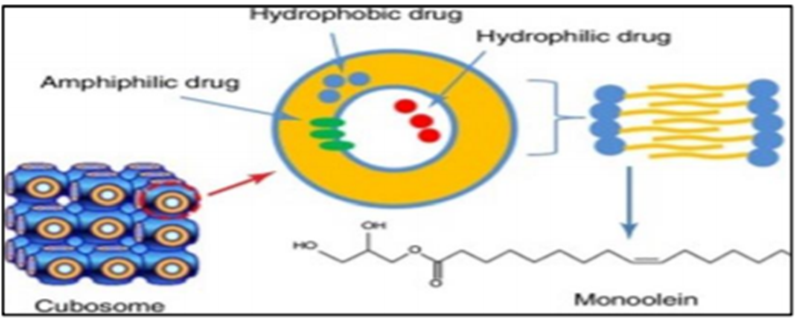
Mechanism of Drug Release from Cubosomes2,3
Drug release from the cubosome mainly happens through diffusion. This process is driven by the difference in drug concentration between the cubosome and the surrounding liquid. It usually follows the principles described by Higuchi's or Fick's diffusion models. The speed at which the drug is released depends on several factors. These include how well the drug dissolves, how easily it moves through the cubosome, and how it distributes between the cubosome and the surrounding liquid. Other factors are the internal structure of the cubic phase, like the size and arrangement of pores, the curvature of the surface, and the environmental conditions such as temperature, pH, and salt concentration. Research using water-soluble model drugs has shown that diffusion is the main way the drug is released. Among different types of nanostructures, drugs tend to come out of the cubic phase more quickly than from the reversed hexagonal phase. In vivo studies using radioactive 14C-glucose showed that the way drugs are released in animal models is very similar to what happens in lab tests. This confirms that the structure of the cubosome and the properties of the lipid can be used to control the release of water-soluble drugs. However, releasing hydrophobic drugs is more difficult because these drugs stay in the hydrophobic parts of the cubosome. Experiments comparing drug release in distilled water (pH 6.5) and in a simulated stomach environment (0.1 M HCl) showed that the acidic condition greatly increased the release rate. Also, studies found that cubosome formulations of Silymarin led to higher levels of the drug in the blood compared to Legal on a regular capsule, suggesting that these formulations improve the drug's absorption in the body.
Theories of Cubosomes 1,2
1. Fontell & Drew Theory:
Ternary mixtures made up of amphiphiles, oil, and water—especially those with specific monoglycerides—can form cubic phases. Monoglycerides are partially polar lipids that aren't very soluble in water and behave in aqueous systems similarly to non-ionic surfactants. According to Lutton’s research, monoglycerides with hydrocarbon chains ranging from C-12 to C-22 tend to form cubic phases, with monoolein—an unsaturated C-18 monoglyceride—showing the most significant cubic phase region.
2. Gustafson et al. Theory:
Cubosomes appear as single crystalline particles made up of unilamellar vesicles and dispersed lamellar liquid crystalline phases. As the ratio of polymer to monoolein increases, the size of the resulting vesicles also grows. When bulk cubic phases are subjected to ultrasonication, they mainly form vesicles, which then gradually turn into cubosomes through membrane fusion. This transformation is marked by metastability, a common feature in cubosome systems, due to the slow diffusion processes needed to build a highly viscous crystalline structure. Creating cubosomes from the majority cubic shape requires a lot of energy. The vesicles also play a role in the colloidal stability of cubosomes.
3. Schwarz, Jacob & Anderson Theory:
Cubic phases are typically found between lamellar and hexagonal liquid crystalline structures, especially in non-ionic surfactant systems. Among these, the monoolein-water system is known for forming a wide range of cubic structures across various compositions and temperatures. The molecular arrangement of surfactants explains this behavior, as monoolein has a hydrophilic head and a hydrophobic tail, which encourages the formation of reversed (inverse) cubic phases that are oriented toward the aqueous environment. These cubic structures can be described using principles of differential geometry, especially periodic minimal surfaces, which are similar to soap films. In this system, the kind of minimal surface formed depends on the amount of water present. D-type surfaces form at higher water levels, while G-type surfaces appear at lower levels. P-type surfaces may also form, but they usually require a third component like caseins or amphiphilic block copolymers. The presence of these cubic phases can be confirmed using X-ray scattering methods. Cubosomes are typically visualized using transmission electron microscopy (TEM) and freeze-fracture electron microscopy.
System Forming Cubosomes:4
Cubosomes may be shaped in certain binary or ternary systems, supplied there's enough miscibility among the cubic section and the encircling solvent. Effective colloidal stabilization of cubosomes is typically achieved using surfactants like Poloxamer 407, which helps prevent aggregation and coalescence. During the fragmentation of bulk cubic phases, cubosomes develop openings in their bilayer structure. These openings can be sealed with bilayer “caps” that protect the exposed hydrocarbon chains from contact with water, thereby enhancing structural and colloidal stability for better stability, cubosomes can be coated with solid crystalline bilayers. These coatings provide stronger structural support compared to lamellar liquid crystalline layers, which create more rigid outer surfaces. Another approach involves using coatings from sponge phases, which have also been suggested as an effective way to stabilize cubosomes. Ternary phase diagrams show the different types of systems that can support the formation of cubosomes. A promising molecule for making cubosomes is phytantriol, which is known for its ability to form stable cubic structures.
Types of Cubosome Precursors4,5
Liquid Cubosome Precursor:
In this type, debris is created through a process called nucleation, followed by a sudden increase due to saturation. This is made by dissolving monoolein in any of the hydrotopes. It avoids the need for a high-energy process and also reduces the need for handling solid materials. It makes it easier to scale up the preparation of cubosomes. These are usually used in handwashes and mouthwashes.
Powdered Cubosome Precursor:
These are made from dehydrated and polymer-coated surfactants. Cubosomes are formed when the precursor powders are hydrated. The lipids used here are sticky and waxy solids. This method works well with a spray drying process, making it suitable for large-scale production.
Preparation of Cubosomes3,5
Cubosomes are mainly prepared using two classic methods and bottom-up approaches, with the latest technologies helping to improve scalability and consistency.
In this method, a large cubic phase gel is first made by mixing a lipid like monoolein or phytantriol with water. This very thick gel is then broken into smaller pieces using mechanical or energy-based methods like high pressure, probe sonication, or homogenization, such as nanoparticle micro fluidization. To prevent the particles from clumping together, a stabilizer (like Pluronic F127) is added, which keeps the mixture stable. This method is well known but requires a lot of energy.
Also called the solvent dilution or hydrotropic method, this involves dissolving the lipid in a volatile solvent or mixing it with a hydrotropic agent. When water is slowly added, the cubic phase comes together on its own, forming cubosomes with the help of a stabilizer. This method uses less energy and offers better control over the size of the particles, but it needs careful handling of the solvent and optimization of the process.
Evaluation and Characterization of Cubosomes4,6
This simple method involves looking at the cubosomes to check their physical traits such as shape, clarity, color, uniformity, and whether there are any visible particles or clumps.
TEM is a strong technique that lets you see the shape and structure of cubosome particles in great detail. It creates images using electrons, which allow for clear visualization of the particle shapes. Compared to traditional electron microscopy, TEM offers better images and reduces issues like structural distortion or poor contrast, especially with soft materials like cubosomes.
Measuring zeta potential helps understand how stable the cubosome dispersion is a higher zeta potential value means there is more electrostatic repulsion between the particles, which makes them less likely to stick together, thus improving stability.
The viscosity of the cubosome dispersion is checked using a Rotational Brookfield Viscometer. This helps assess how the formulation flows and feels.
Particle size, polydispersity index (PDI), and zeta potential are usually measured using dynamic light scattering (DLS). This is done with a zetasizer. The sample is diluted—often 100 times with water—and analyzed at 25°C with 300 Hz light scattering. This method provides information on the average size of the particles and how they are distributed.
This method helps to observe the surface features of cubosomes and tell the difference between isotropic and anisotropic structures. It’s also useful in identifying changes in cubic phases and detecting the presence of other mesophases, such as layered or hexagonal structures.
DSC is used to study the thermal behavior of cubosomal formulations. It helps identify endothermic and exothermic events, which provide information about phase changes and the overall thermodynamic properties of the system.
SAXS is used to examine the internal nanostructure of cubosomes. it provides detailed information on how molecules are arranged, the sizes of pores, and the spacing between partially ordered structures, especially those in the 5 to 25 nm range. This technique is effective in understanding the three-dimensional structural organization of the formulation.
This is measured using ultrafiltration methods.The formulation is spun in a centrifuge and filtered to separate unentrapped drug. The amount of free drug is then analyzed using spectrophotometry, and the amount of entrapped drug is calculated by subtracting the free drug from the total.
The ability of cubosomes to load drugs is evaluated using ultrafiltration or gel permeation chromatography. The final measurement of drug content is typically done with High-Performance Liquid Chromatography (HPLC).
The release of the drug from the cubosomes is studied using a pressure ultrafiltration setup, such as a micron pressure cell with a Millipore membrane. This helps in determining how the drug is released over time.
Differentiation of drugs with/ without cubosomes: 1,7
|
Parameter |
Drugs with Cubosomes |
Drugs without Cubosomes |
|
Solubility & Bioavailability |
Enhanced solubility and higher oral bioavailability due to nanostructured lipid carriers |
Poor solubility leads to low and variable bioavailability |
|
Drug Stability |
Protects peptides, proteins, and labile drugs from degradation |
Drugs more susceptible to enzymatic/chemical degradation |
|
Drug Release |
Provides controlled and sustained release |
Often shows rapid release, requiring frequent dosing |
|
Targeted Delivery |
Can be functionalized for site-specific delivery (e.g., tumours, brain) |
Non-specific distribution, causing systemic side effects |
|
Toxicity & Biocompatibility |
Lipid-based, biocompatible, and less toxic at lower doses |
Higher doses often required, increasing risk of systemic toxicity |
|
Versatility |
Suitable for hydrophilic, hydrophobic, and amphiphilic drugs |
Limited to certain types of drugs depending on solubility |
Different routes of administration of cubosomes:4,5
|
Routes of administration |
Description |
Applications |
Advantages |
Challenges |
|
Oral |
Ingested through a mouth |
Poorly water -soluble drugs peptides |
Noninvasive, rectal patient compliances, enhances bioavailability. |
GI degradation, limited absorption |
|
Intravenous |
Injected into blood stream |
Anti -cancer drugs, vaccines, antimicrobial |
Immediate effect, high bioavailability. |
Requires sterile conditions, risk of immune response. |
|
Topical /transdermal |
Applied in skin |
Anti-inflammatory drugs, cosmetics |
Avoids first-pass metabolism, localized action. |
Limited skin penetration |
|
Ocular |
Applied on eye |
Glaucoma, dry eye, infections. |
Increased retention time, targeted delivery. |
Eye irritation, poor permeability. |
|
Pulmonary |
Inhaled into lungs |
Asthma, TB, ling infections |
Fast action, large surface area. |
Particle size control, aerosol stability. |
|
Intranasal |
Delivery via nose |
CNS drugs, peptides, vaccines. |
Bypass blood brain barrier. |
Mucociliary clearance, small volumes. |
|
Rectal /vaginal |
Inserted into rectal or vagina |
Hormonal therapy, anti-inflammatory agents. |
Avoids first pass effect, local or systemic. |
Patient discomfort, limited usage. |
Drugs incorporated in cubosomes for sustained drug delivery6,7
|
Category |
Drugs |
Purpose / Outcome |
|
Anti-cancer |
Paclitaxel, Doxorubicin, Curcumin, Ellipticine |
Enhanced solubility, prolonged circulation, reduced toxicity |
|
Anti-inflammatory |
Indomethacin, Celecoxib, Flurbiprofen |
Sustained release, reduced gastric irritation, improved dissolution |
|
Antimicrobial |
Amphotericin B, Itraconazole, Ciprofloxacin, Ofloxacin |
Controlled release, reduced toxicity, ocular sustained delivery |
|
Cardiovascular |
Carvedilol, Valsartan, Atorvastatin |
Improved solubility, prolonged antihypertensive & lipid-lowering action |
|
Neurological |
Resveratrol, Donepezil, Carbamazepine |
Sustained neuroprotection, prolonged anticonvulsant effect |
|
Hormones/ Proteins |
Insulin, Testosterone, Erythropoietin |
Controlled transdermal/nasal/parenteral delivery, stability of biomolecules |
Different Nanocarrier Systems in Drug Delivery7
|
Category |
Nanocarrier Systems |
Key Features / Advantages |
|
Lipid-based |
Liposomes, Niosomes, Solid Lipid Nanoparticles (SLNs), Nanostructured Lipid Carriers (NLCs), Cubosomes |
Biocompatible, improve solubility, sustained/controlled release |
|
Polymeric |
Polymeric Nanoparticles (PLGA, PLA), Nano capsules, Nanospheres, Polymeric Micelles, Dendrimers |
Versatile, tunable release profiles, functionalize surface |
|
Inorganic |
Gold Nanoparticles, Mesoporous Silica Nanoparticles (MSNs), Iron Oxide Nanoparticles, Quantum Dots |
High stability, imaging + therapeutic functions (theranostics) |
|
Protein/ Peptide-based |
Albumin Nanoparticles, Gelatin Nanoparticles, Peptide-based nanocarriers |
Biodegradable, natural carriers, targeting ability |
|
Hybrid |
Lipid–Polymer Hybrid Nanoparticles, Exosomes/Extracellular Vesicles |
Combine advantages of lipids & polymers, biocompatibility and t |
Future Prospects of Cubosomes8
Cubosomes are a new kind of nanocarrier that shows a lot of promise for delivering drugs and being used in medical treatments. Even though there have been many important advances, they are not yet widely used in clinical settings. Looking ahead, there are several key areas that could shape their future:
In the future, cubosomes might be designed with special surface features like ligands, peptides, or antibodies that can specifically recognize and bind to certain disease markers. This could help deliver medicine more accurately to affected areas, making treatments more effective and less harmful to healthy tissues.
The unique structure of cubosomes allows them to safely hold delicate biomolecules such as nucleic acids, peptides, and proteins. Through continued improvements, they could be used reliably for delivering genetic material, mRNA vaccines, and enzyme-based treatments.
Scientists are working on creating cubosomes that can release drugs in response to specific signals in the body, like changes in pH, temperature, or the presence of certain enzymes. These "smart" systems could provide more controlled and targeted drug release at the right place and time.
One exciting possibility is combining imaging tools with cubosomes so they can be used for both diagnosing and treating diseases. This dual function could be very helpful in cancer treatment and personalized medicine.
Because of their ability to stick to surfaces and their compatibility with the body, cubosomes are well-suited for drug delivery through the eyes, skin, lungs, and mouth. This could be especially useful for drugs that are not stable or hard to dissolve in traditional methods.
A lot of research is also focused on making it easier and more affordable to produce cubosomes on a large scale. To move them into real-world use, there needs to be more work on ensuring stability, proper storage, and meeting regulatory standards.
As research in genetics and individualized medicine continues, cubosomes can be tailored to suit the specific needs of each patient. This could lead to more precise and effective treatments that are better suited to how different people respond to medicine.
REFERENCES

Ramya Teja Medarametla, J. N. Suresh Kumar, A. Raja Kumar, A. Bindhu Sri, A. Shaik Kousar, R. Sravanthi, D. Saida, Cubosomes: A Potential Carrier for Drug Delivery, Int. J. of Pharm. Sci., 2026, Vol 4, Issue 1, 1344-1354. https://doi.org/10.5281/zenodo.18245121
 10.5281/zenodo.18245121