
Arihant College of Pharmacy, Kedgaon, Ahilyanagar, 414005
Medicinal plants have been integral to human cultures for millennia and have played a central role in the development and expansion of societies. Medicinal plants have long been crucial to human civilizations, supporting both traditional and modern healthcare systems. An ethno-medicinal investigation was carried out to understand the medicinal plants (MPs) diversity and local healthcare practice among the people living in and around a conservation area of northern Bangladesh. The paper highlights current status of knowledge on Indian medicinal plant species used in organized systems of medicine, ethnomedicine and modern medicine. Medicinal plants have been integral to human cultures for millennia and have played a central role in the development and expansion of societies The conservation of high-altitude medicinal plants is of concern throughout the ala yan region, because they important for traditional health care and in large-scale collection for trade. Maintenance of medicinal plant diversity and cover-abundance is critically dependent on managing grazing and resource harvesting to maintain levels that are both ecologically and economically sustainable.
Medicinal plants have played significant roles in the lives of local peoples living in these regions by providing medicinal products. Medicinal plants are used for different purposes and in diverse uses of human beings. The use of medicinal plants is found in almost all cultures as a well spring of medicine. Medicinal plants have been used for a large number of years to treat wellbeing issue and to avoid illness including epidemics. People had the basic information of medicinal values and curing various illnesses of medicinal plants from a period of past time The "human fingerprint of medicinal plant species diversity" is the title of a recent scientific review by Shrestha et al., published in Current Biology, which can be found on ResearchGate. The study found that while overall vascular plant diversity is the main driver, factors like longer human occupancy times and migratory patterns correlate with higher medicinal plant diversity, creating biodiversity hotspots. This indicates that human activity, often associated with long-term settlement, has had a significant impact on the distribution of medicinal plants.
Key findings from reviews
Related concepts
The introduction to the "human fingerprint of medicinal plant species diversity" review explains that while abiotic and biotic factors shape plant diversity, human ecological and cultural practices uniquely influence medicinal plant distribution. It establishes that human activities are a significant, yet historically underexplored, force affecting the global diversity and distribution of these plants, which are crucial for both traditional and modern medicine.
1. Problem statement: The study addresses the gap in understanding how human influence affects medicinal plant diversity compared to overall plant diversity.
2. Key role of humans: The introduction highlights that human activities, including cultural practices, are not just an abiotic or biotic influence, but a distinct and significant driver of medicinal plant distribution.
3. Study scope: The review will investigate and compare the impact of human influence versus other factors on the diversity of 32,460 medicinal plant species and global vascular plant distributions.
4. Significance: The research is important because medicinal plants have played a vital role in human health for millennia, and understanding these influences is crucial for conservation efforts in the face of threats like overexploitation, industrialization, and climate change.
Highlights
DISCUSSION
Uncovering substantial regional variation in medicinal plant diversity:
We conducted a comprehensive analysis of global medicinal (n = 32,460) and vascular plant species (n = 357,008), mapping their diversities across 369 botanical countries (spatial units defined by the World Geographical Scheme for Recording Plant
Global distribution of medicinal plant species.
The map illustrates medicinal plant species diversity, with darker shades representing higher diversity and lighter shades indicating lower diversity levels. The inset depicts the latitudinal trend, highlighting the highest species diversity in tropical regions, consistent with the latitudinal diversity gradient. The black solid line represents a locally weighted scatterplot smoothing (LOWESS) regression. The map is presented using an Eckert IV projection.
Effect of elevated ozone levels:
Changes in O3 concentrations can alter the production of secondary chemicals in plants. Plant physiological stress imposed by augmented O3 levels may stimulate the induction of metabolic pathways (e.g., salicylic acid and jasmonic acid pathways) involved in the production of secondary (Van der J.C. Leun and F. Daniels, 2002).
Effect of Ultraviolet radiation:
These radiations can cause molecular and cellular damage; for example, it can damage proteins, DNA and other biopolymers. (Bidart-Bouzat MG and Imeh Nathaniel A, 2008) Further more, this type of radiation can affect plant growth and development and result in changes in vegetative or reproductive biomass, height, leaf characteristics, and flowering time (J.F. Bornman and A.H. Tera mura, 1993)
Heavy Metal Contaminations in Soil and Water Bodies:
Atmosphere, water and soil are constantly polluted with toxic chemicals and heavy metals due to active of industries, mining and motorization along with widespread use of pesticides and fertilizers. These toxic pollutants and heavy metals from the different sources are getting deposited in the plants growing in the polluted areas, which afterward enter the human general food chain via plant parts and its extracts.
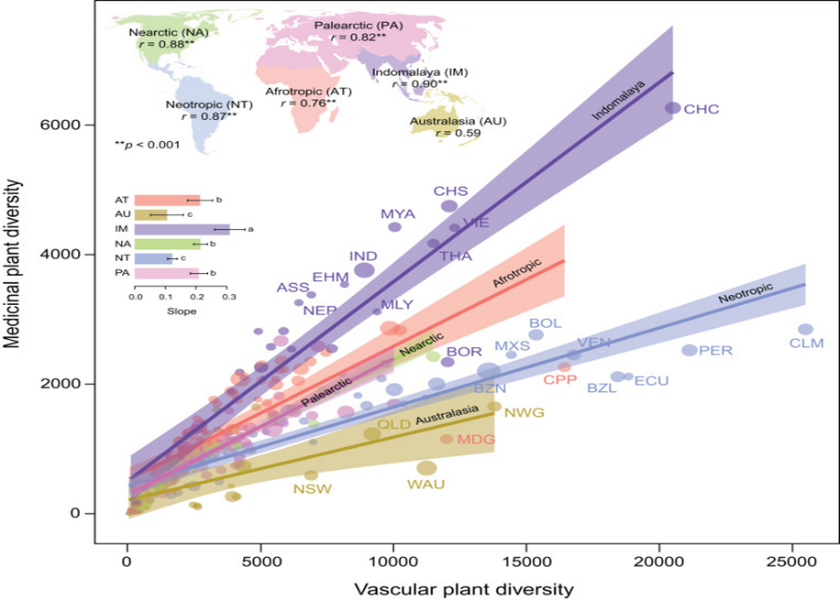
Comparative analysis of vascular and medicinal plant diversity across biogeographic realms:
Each dot’s size reflects the area of six color-coded phytogeographic regions, with larger dots indicating larger areas of botanical countries. The three-letter codes next to each dot represent botanical countries defined by the World Geographical Scheme for Recording Plant Distributions. Pearson’s correlation coefficients (r) for the relationship between vascular and medicinal plant diversities are displayed for each realm. The bar on the left illustrates the slopes and 95% confidence intervals of this relationship across the six realms. Bars with different letters (a, b, and c) indicate significant differences (p 0.05), determined using Bonferroni correction for pairwise comparisons.
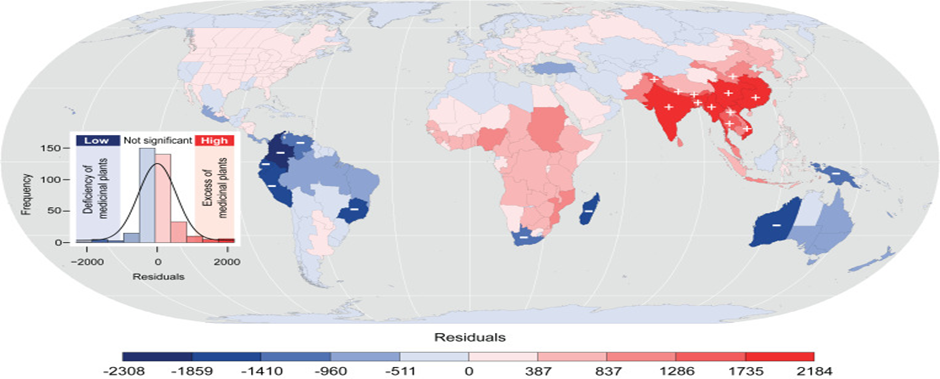
Residual analysis of medicinal versus vascular plant diversity:
The map displays residuals from the linear regression comparing medicinal plant diversity to vascular plant diversity. Red indicates positive residuals, suggesting a surplus of medicinal plants relative to vascular plants, whereas blue indicates negative residuals, reflecting a deficiency. Botanical countries with significantly higher or lower medicinal plant diversity than expected (p < 0.05) are marked with plus (+) and minus (−) signs, respectively. The map uses an Eckert IV projection.
Longer human occupancy corresponds with higher medicinal plant diversity:
We also explored the relationship between medicinal plant diversity and potential climatic and anthropogenic predictors using a linear mixed-effects model. This model included seven fixed-effect predictors and treated the phytogeographic region as a random effect to account for variation across regions. Beyond the known climatic predictors of plant diversity, we included language diversity.
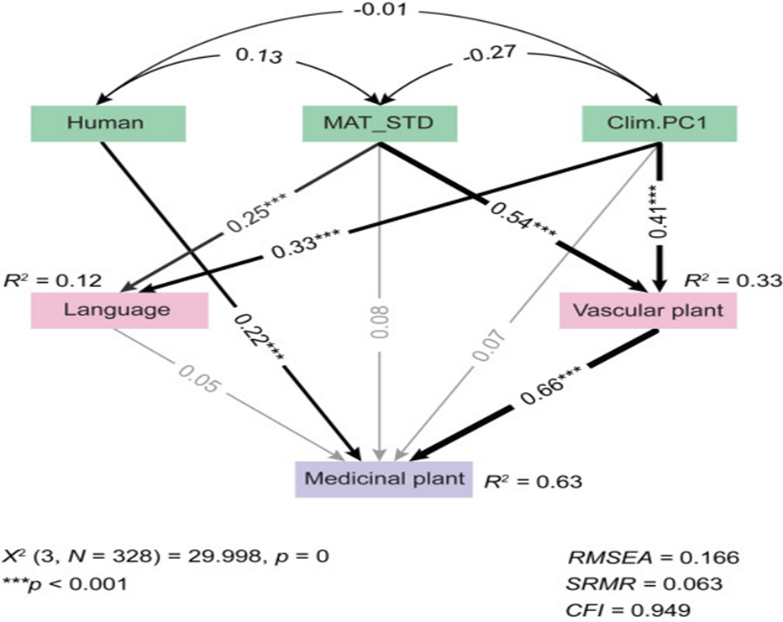
Path model depicting influences on medicinal plant diversity:
This model illustrates the relationships among climate, environmental heterogeneity, earliest human occupancy, language diversity, and vascular plant diversity in explaining medicinal plant diversity. Standardized path coefficients are indicated along the paths. Variables include Human: time of first modern human occupancy, MAT_STD: standard deviation of mean annual temperature (proxy of environmental heterogeneity), and Clim.PC1: first principal component of 19 bioclimatic variables. Fit indices provided are RMSEA: root mean square error of approximation, SRMR: standardized root mean square residual, and CFI: comparative fit index.
Limited impact of language diversity on medicinal plant diversity:
Although our mixed-effects model identified a significant global effect of language diversity on medicinal plant diversity, our path model did not support a direct relationship between these two variables at the same scale. This discrepancy highlights the structural differences between these models. Canonical medicine systems like Ayurveda25 and Traditional Chinese Medicine,26 which collect extensive accumulated traditional knowledge, may increase the number of recorded uses of medicinal plant species in their associated regions. By contrast, colonial influences and modernization may have contributed to geographically uneven erosion or non-documentation of this knowledge,27 highlighting the need to better preserve and explore traditional ethnobotanical practices.
Limited impact of language diversity on medicinal plant diversity:
Although our mixed-effects model identified a significant global effect of language diversity on medicinal plant diversity (Figure S3A), our path model did not support a direct relationship between these two variables at the same scale (Figure 4). This discrepancy highlights the structural differences between these models. Linear models focus on direct interactions, capturing the apparent significance of language diversity without accounting for complex intermediaries. By contrast, path models explore intricate interdependencies, incorporating indirect effects via mediating variables like climate, which may influence both language diversity and medicinal plant diversity.
Biodiversity-rich areas often foster diverse cultures with unique languages, as diverse ecological resources support both biological and cultural diversity. These environmental conditions may drive both biological and cultural evolution, allowing species and languages to flourish. Our path model identifies this dependency, suggesting that there are likely more complex dynamics between medicinal plants and language diversity. The patterns observed in our study, based on this dataset, represent our current understanding while also partially being affected by disparities in research and documentation efforts. For example, some megadiverse regions, such as New Guinea, Madagascar, and Cape Province, appear to host relatively few recorded medicinal plants, perhaps reflecting limited ethnobotanical documentation rather than true scarcity. Canonical medicine systems like Ayurveda25 and Traditional Chinese Medicine,26 which collect extensive accumulated traditional knowledge, may increase the number of recorded uses of medicinal plant species in their associated regions.
METHOD DETAILS:
Species distribution data and diversity maps
The WCVP is a global consensus on all known species of vascular plants and is based on exhaustive nomenclatural data from the International Plant Names Index. We excluded records flagged as ‘introduced’ and ‘location_ doubtful’, retaining only the native distributions for each species. This process yielded a final dataset including 1,202,335 records containing native distribution information for 357,008 species of vascular plants. With data from more than 300 sources, including botanical databases, pharmacopoeias, medicinal plant monographs, and other references, the MPNS is one of the most comprehensive resources providing authoritative information on over 35,000 medicinal plants worldwide. Our list of medicinal plants obtained from MPNS included 35,210 taxa. After merging ranks below the species level and replacing synonyms with accepted names, our list included 32,460 species of medicinal plants.
Environmental data
The first two principal components together accounted for about 77% of the total variation. The first component was primarily correlated with precipitation variables, whereas the second component was mainly associated with temperature variables.
Language diversity
Global language diversity was obtained from two data sources:
WALS is publicly available and offers interactive data exploration tools, making it an invaluable resource for linguists, researchers, and scholars interested in language diversity. The database is compiled from published descriptive materials contributed by many linguistic experts and is an important tool for linguistic typology and language evolution research. We obtained the language data from the existing version of the WALS database, which included distribution information on 2,662 languages.
Both these sources provide geographical coordinate data. To align with the spatial resolution of our medicinal plant diversity data, we transformed the coordinate data into a gridded format.
Quantification and statistical analysis:
Data analyses including diversity mapping, spatial correlation, ANOVA, pairwise comparisons, linear mixed-effects modelling , path analyses, and sensitivity analyses were performed using R version. Details of statistical analyses are given in method details
MATERIAL AND METHODS
Plant material
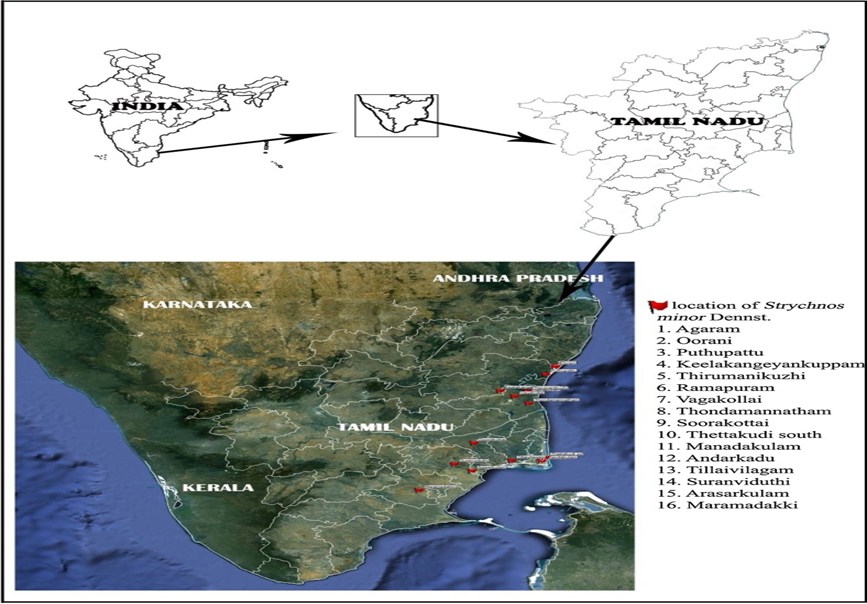
Young leaves of S. minor were collected from the different locality of Coromandel Coast of Tamil Nadu (Fig.1). The plant materials were separately placed in sealable polythene bags and authenticated. The samples were transported to the laboratory and then separately in the deep freezer at −20 °C for until for DNA extraction.
Geographical distribution of Strychnos minor collected from Coromandel east coasts of Tamil Nadu, India.
Chemical and Reagents:
An extracting buffer containing 3% CTAB (w/v), Tris HCl pH 8.0 (1.0 M); EDTA pH 8.0 (0.5 M); Nacl (1.4 M), 2% PVP (w/v) and 0.2% mercapto ethanol was prepared. Ribonuclease A (10 μg/ml), Chloroform: Isoamyl alcohol (24:1), Phenol: Chloroform: Isoamyl alcohol (25:24:1 v/v/v), TE buffer (Tris HCl 100 mM, EDTA 20 mM, pH 8.0) and Ethanol (70%) are the additional required solutions.
Isolation of genomic DNA:
Genomic DNA isolation using CTAB and slightly changed this method by adding 0.2% PVP to the CTAB extraction buffer to prevent co-isolation of polysaccharides and phenolics. The leaves were frozen in liquid nitrogen and it was carefully ground with clean mortar and pestle.
DNA purification:
DNA solution was treated with 10 μl of RNase was added and then incubated at 37 °C for 1 h, an equal volume of phenol: chloroform: Isoamyl alcohol (25:24:1) was added and mixed well for 5 min.
Purity of DNA:
The yield of DNA was estimated by using UV-visible spectrophotometer (ELICO-SL-159) at 260 nm. DNA concentrations were calculated by the following formula; Concentration of DNA = O.D at 260 nm 50 Dilution. The purity of the DNA was determined by the ratio of absorbance 260 and 280 nm respectively
RAPD analysis:
RAPD molecular fingerprint using DNA isolated from the different locality of S. minor, oligonucleotide from Operon primer was used for PCR amplification to standardize the condition.
Data analysis:
RAPD markers for comparing the similarity of S. minor on different locality Jaccard’s coefficient [14] was used and data scored for their absence ‘0' or presence ‘1' of bands for each primer and banding patterns of genotypes for a genotype-specific band, specific primer was identified and poor bands were discarded.
Future directions for research and conservation
Benefits of the human fingerprint
Application to human impact on plant diversity
Application to chemical fingerprinting for quality control
Challenges
Limitations
CONCLUSION
Our analysis identifies a likely pivotal role of human ecology in shaping global medicinal plant diversity. Although vascular plant diversity remains the primary correlate of medicinal plant diversity, our findings reveal that human occupancy time also significantly and directly influences medicinal plant diversity. This suggests that longer human occupancy fosters accumulated traditional knowledge, the use of local plants for medicine, and the emergence of local expertise, resulting in increased medicinal plant diversity. These insights are vital for fostering ecologically effective and culturally inclusive conservation strategies and leveraging the untapped potential of medicinal plants in addressing future healthcare challenges.
For identification of fingerprints for medicinally important industrial plant, 60 random de camers were used to amplify scorable loci and highly polymorphic loci were further used to construct phylogenetic tree. Specific loci were identified linked to accessions/species of industrially important plants. human ecological dimensions, particularly the duration of human occupancy in a region, are critical drivers of medicinal plant diversity patterns globally. While overall vascular plant diversity is the primary predictor of medicinal plant diversity, the length of time humans has inhabited a region significantly influences the number of documented medicinal plant species beyond what is explained by botanical factors alone.
REFERENCES





Tulika Karale, V. R. Avhad, Arti Chothe, Prajakta Lawand, Rohini Haral, The Human Fingerprint of Medicinal Plant Species Diversity, Int. J. of Pharm. Sci., 2025, Vol 3, Issue 12, 3430-3441. https://doi.org/10.5281/zenodo.18033287
 10.5281/zenodo.18033287
