
Department of Pharmaceutics, Mar Dioscorus College of Pharmacy, Alathara, Thiruvananthapuram
This study focused on formulating and evaluating a gel facewash incorporating microparticles made from pineapple and kiwi peel extracts. Rich in antioxidants, vitamins, and flavonoids, these extracts offer anti-aging, anti-inflammatory, and antibacterial benefits. Microparticles were prepared from the extracts and added to a gel base. The facewash showed good spreadability, grittiness, foaming, pH, viscosity, and antioxidant activity. It also exhibited anti-acne effects against Staphylococcus aureus. Among five formulations, F4 was found to be optimal, highlighting its potential for commercial skincare use while promoting fruit waste utilization.
India’s herbal drug industry has a rich legacy that dates back thousands of years, rooted in traditional Indian medicine, which is considered one of the world's oldest healthcare systems Emphasizing natural remedies, minerals, and herbs, this system has long used plant-based ingredients to treat illnesses and maintain health. In recent years, there has been a growing shift toward herbal cosmetics such as face washes, soaps, and conditioners due to their minimal side effects and skin-friendly properties [1]. The skin, being the largest organ of the body, requires products that focus on cleansing, protection, and hydration. Among these, facewash products play a key role in removing dirt, excess oil, and hydrating the skin. With rising consumer interest in natural skincare, ingredients like pineapple and kiwi peel extracts rich in antioxidants, vitamins, and enzymes are increasingly being explored for their exfoliating, antibacterial, and moisturizing benefits [3].
Microparticles have emerged as innovative delivery systems in cosmetics, offering controlled release and enhanced penetration of active ingredients. Ranging in size from 1 to 100 micrometers, these particles are composed of organic materials or polymers and are widely used across fields such as medicine, diagnostics, and skincare. In facial cleansers, microparticles not only improve texture but also serve as exfoliants that remove dead skin cells, unclog pores, and enhance skin radiance [7].
Exfoliation in face washes helps to remove dead skin cells, unclog pores, reduce blackheads, and improve skin texture, resulting in smoother, brighter skin. Using mild abrasives or acids like salicylic or glycolic acid, exfoliation can also boost collagen production and enhance the effectiveness of other skincare products. Acne vulgaris, a chronic skin condition marked by inflammation, redness, and pain, is often caused by excess sebum, reduced skin cell turnover, and bacteria like Cutibacterium acnes and Staphylococcus aureus. Factors such as hormones, genetics, certain medications, and inappropriate skincare can worsen acne, potentially leading to scarring and emotional distress if left untreated [5].
MATERIALS AND METHODS
The following materials used in the workwere Sodium alginate, Triethanolamine, Propylene glycol, Hydroxy propyl methyl cellulose, Calcium chloride, Sodium chloride, Methyl paraben, Sodium lauryl Sulfate, Lactic acid, Pineapple peel and Kiwi peel.
Formulation of microparticle incorporated GEL face wash
Collection of Plant Materials
Pineapple peel:
Ripened pineapples were bought from the market. Pineapple was washed and then peeled off. They were then washed twice once with tap water and then with distilled water to remove dirt and soil particles. Peels were allowed to dry at room temperature for a period of 24hrs, then it was dried at 40°c in an oven for 24hrs. The dried pieces were grounded with ordinary grinder to powder. The finely powdered drug was sieved and stored in air tight container.
Kiwi peel:
For the present studies, kiwi fruits were purchased from the market. It is washed thoroughly under tap water and took the peel using sharp knife. These peels were dried in oven at 40°c for 3 days. The dried peel were finely ground with hand driven mixers to get fine powders of herbal materials. The finely powdered drug was sieved and stored in air tight containers.
Preparation of Pineapple and Kiwi peel extract
The extraction was performed by maceration method. 10gm grounded powder of peel was dissolved in 100ml of ethanol and allowed to soak for 3-4 days at room temperature. After 3days the extract was filtered using standard Whatman filter paper in a conical flask.The collected extract was evaporated at 40°c and crude extract was obtained.
Preparation of sample
Pineapple:
The concentrated filtrate contains a concentration of 10 mg/ml. Dilutions are carried out to make 50 mg/ml concentration.
Kiwi:
The concentrated filtrate contains a concentration of 10 mg/ml. Dilutions are performed inorder to make it to 600 µg/ml.
Preparation of microparticles
The microparticles were prepared by ionotropic gelation technique. Weigh 0.5ml of pineapple peel extract, 1ml of kiwi peel extract and mix with 5% W/V of sodium alginate solution in a magnetic stirrer to form a homogeneous polymer. The resulting solution was sonicated for 30 min to remove any air bubbles. For the formulation of microparticles, the mixture is added drop wise from a needle of 22G in diameter from a height of about 5 cm to 10% W/V of calcium chloride (CaCl2) solution stirred at 30 rpm. The added droplets will remain in the calcium chloride solution for 30 minutes and produce rigid micro-particles by continuous stirring.
Method of preparation of microparticle incorporated GELFACE WASH
In a beaker, added sufficient quantity of distilled water and gradually sprinkled HPMC while stirring continuously to avoid lumps. Allowed it to hydrate completely, then added propylene glycol. Mixed thoroughly until uniform. Addedmethyl paraben in another beaker and mixed well until it get dissolved. Added this solution to the former one. Mixed this with sodium lauryl sulphate. Added triethanolamine slowly while checking the pH [5-5.5]. Added sodium chloride solution gradually to achieve the desired viscosity and added rose oil and lactic acid. Added 1ml of both the extracts and mix it, then added the prepared microparticles to the formulated gel.
Formulation design of microparticle incorporated GEL FACEWASH
Five formulations were prepared and the formulation design is as shown below:
Table no 1. Formulation chart of gel facewash
|
Sl. No. |
Ingredients |
F1 |
F2 |
F3 |
F4 |
F5 |
|
1 |
HPMC (g) |
1 |
2 |
3 |
4 |
5 |
|
2 |
SLS (g) |
1 |
1 |
1 |
1 |
1 |
|
3 |
Lactic acid (ml) |
1 |
1 |
1 |
1 |
1 |
|
4 |
Propylene glycol (ml) |
3.5 |
3.5 |
3.5 |
3.5 |
3.5 |
|
5 |
Triethanolamine (g) |
0.5 |
0.5 |
0.5 |
0.5 |
0.5 |
|
6 |
Methyl paraben (g) |
0.2 |
0.2 |
0.2 |
0.2 |
0.2 |
|
7 |
Rose oil (ml) |
0.05 |
0.05 |
0.05 |
0.05 |
0.05 |
|
8 |
Sodium chloride (g) |
0.2 |
0.2 |
0.2 |
0.2 |
0.2 |
|
9 |
Pineapple peel extract (ml) |
1 |
1 |
1 |
1 |
1 |
|
10 |
Kiwi peel extract (ml) |
1 |
1 |
1 |
1 |
1 |
|
11 |
Distilled water (30ml) |
q.s. |
q.s. |
q.s. |
q.s. |
q.s. |
EVALUATION
Following evaluation tests were carried out on gel facewash,
Evaluation test for microparticle – Scanning electron microscopy:
For the evaluation of surface morphology of microparticle, the sample was analyzed in Scanning electron microscopy.
Organoleptic evaluation
Visual inspection was carried out to assess the colour, distinct odour, and semisolid consistency of the facewash formulation. The colour was observed directly, and the scent was evaluated by smelling the product.
pH
The pH of the facewash gel was measured using a digital pH meter at room temperature, calibrated with standard buffer solutions of pH 4, 7, and 9 before each use. For the test, 0.5 g of the gel was mixed with 50 ml of distilled water in a beaker.
Viscosity
The measurements of viscosity of prepared gels were carried out using Brookfield Viscometer at 100rpm
Washability
All the formulations were easily removable by washing with tap water.
Foamability test
To evaluate foaming ability, 1 ml of the facewash formulation was placed in a 100 ml graduated cylinder. Distilled water was added to reach a total volume of 50 ml. The cylinder was then closed and shaken vigorously for 10 seconds to generate foam. After 1 minute, the foam volume was recorded to assess initial foam formation. The cylinder was left undisturbed for 10 minutes, and the foam volume was measured again. The difference in foam volume over time indicated the stability and effectiveness of the formulation's foaming capacity.
Grittiness
The product was checked for the presence of any gritty particles.
Spreadability Test
Spreadability was measured by the time (in seconds) it took for two glass slides to separate when a gel sample was placed between them under a certain load. Two glass slides of standard size were used, with 0.2 g of gel placed on one slide. The second slide was placed on top to sandwich the gel, covering a 6.0 cm length. A 100 g weight was then placed on the top slide to uniformly press the gel into a thin layer. After removing the weight and scraping off excess gel, the time taken for the upper slide to slide and separate due to the load was recorded. Spreadability was calculated using the formula Si = d² × π / 4, where d is the diameter of the spreading area.
Determination of Anti-microbial activity
Cup-plate Method
The inoculum S. aureus culture is prepared in nutrient agar broth medium. Placed a sterile disc saturated with the formulated facewash and a marketed one asceptically by using forceps in the petridish. The disc was allowed to diffuse and after sometime, the plates were incubated at 370C for 24 hours. After 24 hours the petridish were observed for ZOI and the diameter of zone of inhibition is measured in millimeters
Invitro antioxidant activity
(a) Determination of 1,1-diphenyl-2-picrylhydrazyl(DPPH) free radical scavenging activity
The DPPH assay was used to evaluate the antioxidant activity of the facewash formulations. This method is based on the reduction of the purple-colored DPPH radical to a yellow-colored non-radical form (DPPH-H) when it reacts with antioxidant compounds, and the change is measured at 517 nm using a spectrophotometer. For the sample, 0.01 ml of the facewash was dissolved in ethanol, filtered, and diluted to 10 ml. A standard solution was prepared using ascorbic acid, which was serially diluted. In the procedure, 3 ml of 0.004% DPPH solution was mixed with 0.5 ml of the sample, incubated in the dark for 30 minutes, and absorbance was measured. Ethanol served as the blank, and the DPPH solution as the control. Antioxidant activity was calculated using the formula DPPH scavenging activity (%) = [(A control – A test) / A control] × 100.
(b) Ferric reducing antioxidant power (FRAP) assay
This assay measures antioxidant activity by evaluating the sample’s ability to reduce ferric (Fe³?) ions to ferrous (Fe²?) ions, forming a blue-colored complex detected at 593 nm. Facewash formulations were diluted to different concentrations. Each sample was mixed with phosphate buffer and potassium ferrocyanide, then incubated at 50°C for 20 minutes. After adding trichloroacetic acid and centrifuging, a portion of the mixture was combined with distilled water and ferric chloride. The intensity of the blue color formed indicates the antioxidant strength. Ascorbic acid was used as a standard, and distilled water as a blank.
RESULTS AND DISCUSSION
Evaluation test for microparticle
Scanning electron microscopy (SEM)
The morphology of the microparticle was determined by SEM at different magnifications.
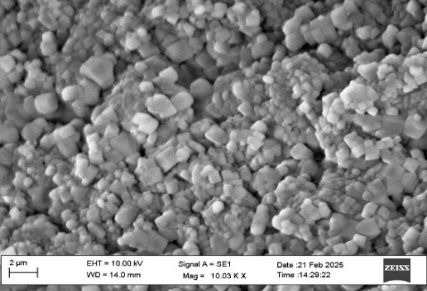
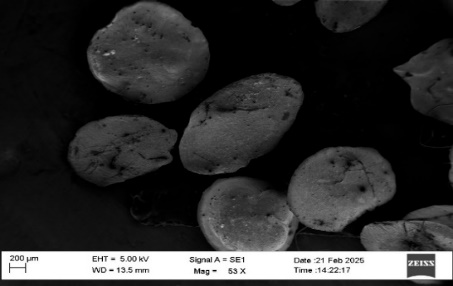
Fig no.1. SEM
The SEM images showed that the microparticle were of irregular shape with a few depression.
Preparation of microparticle incorporated gel facewash.
Five formulation of gel face wash F1, F2, F3, F4, F5 were prepared
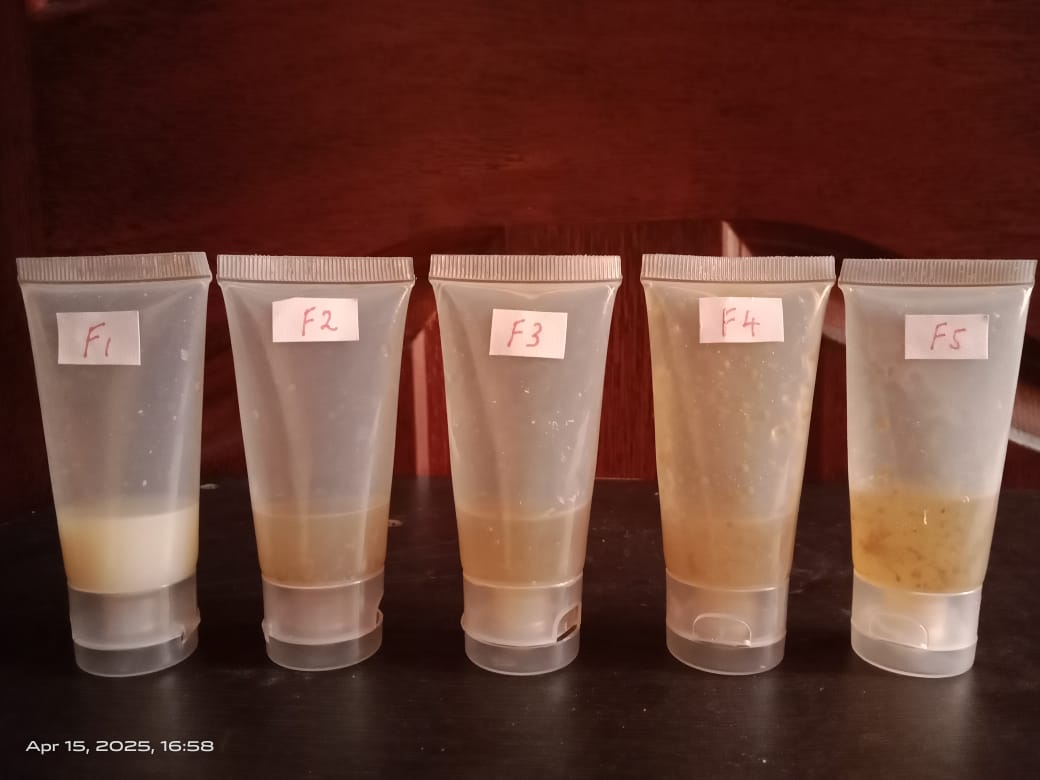
Fig no.2. Preparation of microparticle incorporated gel face wash
Organoleptic evaluation
The results of organoleptic evaluations are shown
Table no. 2. Organoleptic Evaluation
|
Formulations |
Colour |
Odour |
Consistency |
|
F1 |
Light yellow |
Characteristic |
Gel |
|
F2 |
Light yellow |
Characteristic |
Gel |
|
F3 |
Light yellow |
Characteristic |
Gel |
|
F4 |
Light yellow |
Characteristic |
Gel |
|
F5 |
Light yellow |
Characteristic |
Gel |
The formulations F1, F2, F3, F4 and F5 were observed as light yellowish in colour.
pH
The pH of all five formulations were recorded by digital pH meter and the results were shown in table no 3.
Table no 3. Evaluation of pH
|
Formulations |
pH |
|
F1 |
5.24 |
|
F2 |
6.35 |
|
F3 |
6.06 |
|
F4 |
5.32 |
|
F5 |
6.05 |
The pH of all prepared formulations was in the range of 5.24 - 6.35 which was within the range of ideal skin pH 5-7.
Viscosity
Brookfield viscometer was used to measure the viscosity of each of the five microparticle incorporated facewash gel formulations. The result of viscosities are shown in table no.4.
Table no. 4. Evaluation of Viscosity
|
Formulations |
Viscosity (cps) |
|
F1 |
1132 |
|
F2 |
1386 |
|
F3 |
2250 |
|
F4 |
5099 |
|
F5 |
5525 |
The viscosity of all the prepared formulations was found to be in the range of 1100-5600 cps at 100 rpm
Washability
All the formulations were easily removable by washing with tap water.
Foaming ability
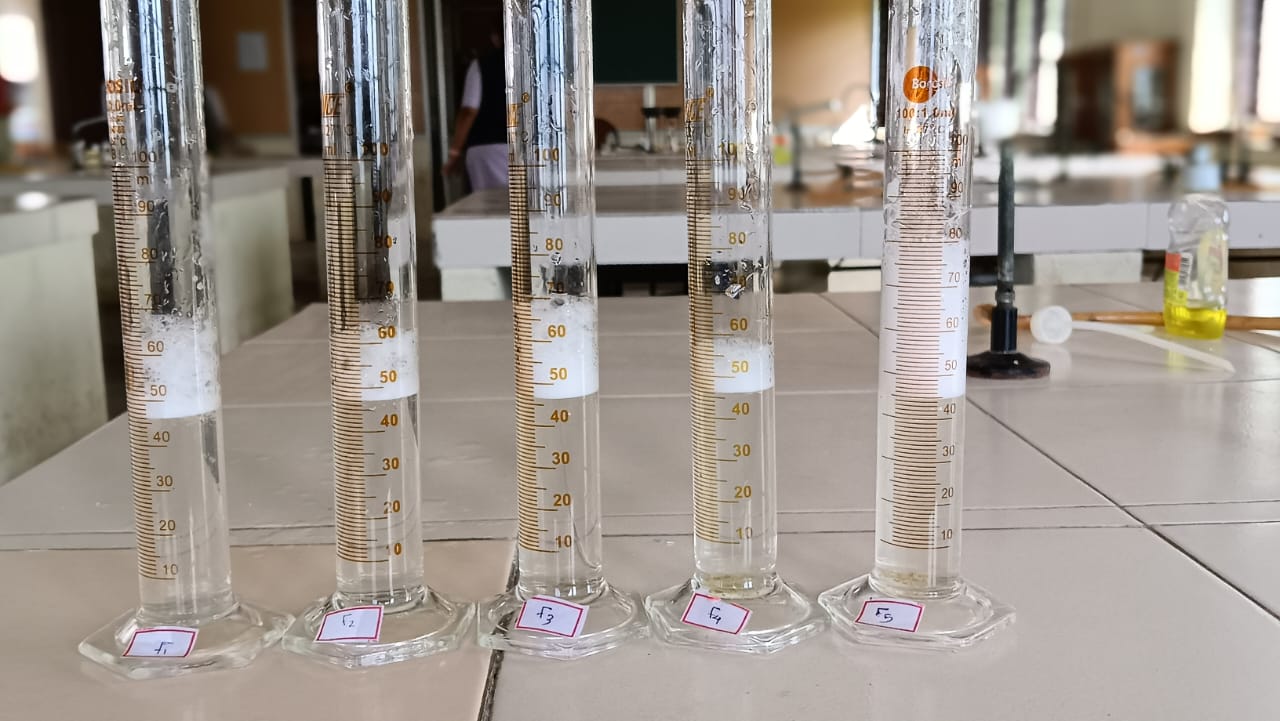
Fig no .3. Foamability
Table no. 5. Evaluation of foaming ability
|
Formulations |
Foaming ability |
|
F1 |
65ml after 1 minute and 54 ml after 10 minute |
|
F2 |
63ml after 1 minute and 53ml after 10 minute |
|
F3 |
69ml after 1 minute and 56ml after 10 minute |
|
F4 |
58ml after 1 minute and 50ml after 10 minute |
|
F5 |
80ml after 1minute and 72ml after 10minute |
All the formulations were found to be foamable.
Grittiness
The particles in these formulations help to remove dead skin cells and impurities from the skin's surface; a fine texture is suitable for sensitive or delicate skin. The grittiness of prepared formulations was noted, and all formulations have grittiness.
Spreadability
Spreadability plays considerable role in patient compliance and ensures uniform application of face wash gel. The values of Spreadability indicate that the face wash gel is easily spreadable by small amount of shear.

Fig no. 4. Spreadability of formulations
Table no. 6. Spreadability studies
|
Formulations |
Diameter(cm) |
Time(sec) |
Spreadability(mm^2) |
|
F1 |
5.0 |
300 |
1962.5 |
|
F2 |
4.3 |
300 |
1452.1 |
|
F3 |
3.8 |
300 |
1134.1 |
|
F4 |
3.5 |
300 |
962.1 |
|
F5 |
3.0 |
300 |
706.8 |
Spreadablity of the formulations is shown in table no 6.7. Formulations are spreadable and F1 has higher spreadability.
Antimicrobial activity
Optimized formulation F4 was selected and subjected to microbial study by using cup plate method and zone of inhibition was determined.

Fig no .5. Zone of inhibition
Table no.7. Zone of inhibition
|
Formulation |
Zone of inhibition (mm) |
|
F4 |
13 |
|
Himalaya antibacterial facewash gel |
15 |
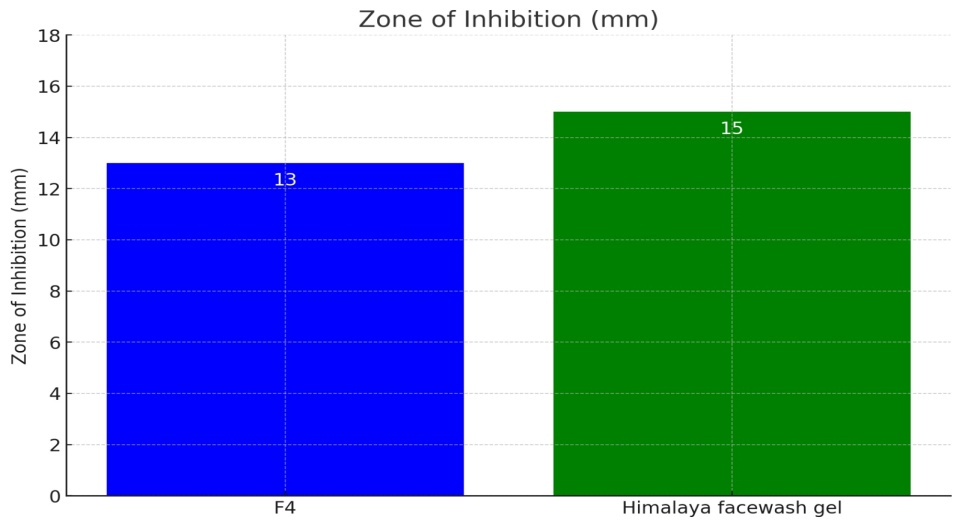
The antimicrobial test demonstrated significant activity against acne causing bacteria (Staphylococcus aureus) and found that the zone of inhibition for the formulation F4 is close to that of marketed formulation. The zone of inhibition for the formulation was found to be 13 mm which is almost close to zone of inhibition of standard formulation.
Invitroantioxidant activity
(a) Determination of 1,1-diphenyl-2-picrylhydrazyl(DPPH) free radical scavenging activity
Table no. 8. DPPH scavenging activity of standard
|
Standard concentration (µg/ml) |
Absorbance |
Percentage inhibition (%) |
|
10 |
0.160 |
87.30 |
|
20 |
0.050 |
96.02 |
|
30 |
0.076 |
96.35 |
|
40 |
0.044 |
96.45 |
|
50 |
0.028 |
96.47 |
Table no. 9. DPPH scavenging activity of formulation
|
Formulation concentration (µg/ml) |
Absorbance |
Percentage inhibition (%) |
|
F1 |
0.362 |
76 |
|
F2 |
0.268 |
83.6 |
|
F3 |
0.156 |
80.2 |
|
F4 |
0.194 |
88.6 |
|
F5 |
0.231 |
79.2 |

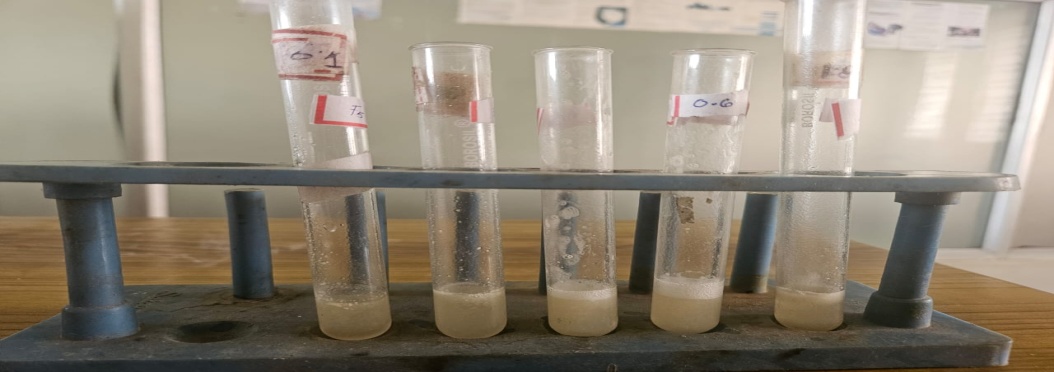
Fig no.7. DPPH assay Graph
Antioxidant assay by DPPH radical scavenging activity was carried out for standard (ascorbic acid) and all 5 formulations. Percentage inhibition was calculated and result indicates F4 have highest antioxidant activity among all the formulations. F4 has antioxidant activity nearer to the standard. Hence F4 shows antioxidant property.
(b) Ferric reducing antioxidant power (FRAP) assay
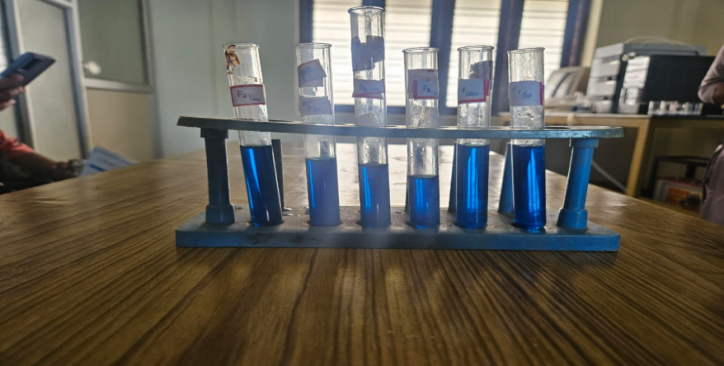
Figure no.9. FRAP Assay
Table no.10. FRAP assay of standard
|
Standard Concentration (µg/ml) |
Percentage Inhibition (%) |
|
20 |
69.15 |
|
40 |
74.28 |
|
60 |
79.71 |
|
80 |
84.01 |
|
100 |
98.36 |
Table no. 11. FRAP assay of the formulation
|
Formulation concentration(50 μg/ml) |
Percentage inhibition(% ) |
Formulation concentration(100 μg/ml) |
Percentage inhibition(% ) |
|
F1 |
74.23 |
F1 |
85.57 |
|
F2 |
79.43 |
F2 |
88.23 |
|
F3 |
81.36 |
F3 |
90.32 |
|
F4 |
85.53 |
F4 |
92.14 |
|
F5 |
83.87 |
F5 |
90.57 |

Figure no.10. FRAP assay graph of standard and formulations
FRAP assay was carried out for all the formulations, standard and the percentage inhibition was calculated. From the result the F4 formulation have a greater percentage inhibition. Hence shows significant antioxidant activity.
CONCLUSION
The study focused on utilizing the bioactive compounds in pineapple and kiwi peels, known for their antioxidant, exfoliating, and anti-inflammatory properties. The facewash formulation was prepared by incorporating microparticles that encapsulated these plant extracts. Five formulations from F1 to F5 were developed, evaluated for their organoleptic properties, pH, viscosity, spreadability and antimicrobial activity. Invitroantioxidantactivity were tested by DPPH method and FRAP assay.
All the formulations are easily spreadable and washable. They had good foaming ability. The pH of the prepared formulations is acceptable and in the range of 5.24 to 6.35 which are acceptable. The viscosity of the formulation are acceptable in the range of 1100–5600 cps. All the formulation shows antioxidant activity. F4 shows significant antioxidant activity.
The antimicrobial test demonstrated significant activity against acne causing bacteria (Staphylococcus aureus) and found that the zone of inhibition for the formulation F4 is close to that of marketed formulation. From the results it can be concluded that all the formulations were safe and good and formulation F4 is the best one.
It is expected that the microparticles incorporated gel face wash with pineapple & Kiwi peel extracts will be an effective, natural skin care product with enhanced benefits.
ACKNOWLEDGEMENT
The authors are thankful to MAR DIOSCROUS COLLEGE OF PHARMACY management, Thiruvananthapuram, for providing all facilities for the present investigation.
REFERENCES


Dr. Sheri P. S., Aafiya S., Dilna Chacko, Jasmine T., Parvana P. S., Vishnavi Thampi B. M., Development And Evaluation Of Microparticle Incorporated Gel Face Wash Using Pineapple And Kiwipeel Extract, Int. J. of Pharm. Sci., 2025, Vol 3, Issue 5, 2171-2182. https://doi.org/10.5281/zenodo.15395082
 10.5281/zenodo.15395082
