
Fabtech College of Pharmacy, Sangola, Solapur, Maharashtra- 413307
Dragon fruit, commonly known as pitaya and belonging to the Hylocereus genus, has gained attention for its diverse bioactive compounds and health-promoting properties. Rich in antioxidants, vitamins, and minerals, this tropical fruit exhibits notable free-radical scavenging and anti-inflammatory activities, contributing to overall wellness and disease prevention. Recent studies highlight its potential in supporting cardiovascular, metabolic, and immune health. Furthermore, innovative delivery systems have been explored to enhance its bioavailability and therapeutic efficacy. This review provides a comprehensive analysis of the phytochemical composition, pharmacological activities, and emerging applications of dragon fruit, emphasizing its role as a functional food with significant health benefits.
Modern lifestyle changes have contributed to a steady rise in non-communicable chronic diseases. Among these, Heart and blood vessel-related disorders are the foremost contributors to mortality worldwide, A balanced meal plan rich in fresh produce is crucial for preventing illnesses, as sufficient intake can help lower the chances of excessive weight gain, high blood sugar, heart and blood vessel disorders, and more certain cancers.[1,2,3,4].Throughout time, various edible plants have shown a connection to lowering the risk of chronic lifestyle-related illnesses, the red cactus fruit stands out as a promising example [5,6].The red cactus fruit, also called the red cactus pear, is a resilient plant type that is part of the cactus plant family, the Hylocereus genus. Its striking bright red exterior with overlapping green scales gives it its well-known name. It is also referred to as evening-blooming cereus, berry cactus, and Depending on the variety, these fruits differ in size, shape, thorn presence, texture of the outer layer, flesh coloration, reflecting a considerable degree of genetic diversity [5,6,7].Health-promoting effects of the red cactus fruit are associated with its rich content of biologically active substances, which exhibit various functional activities, including blood sugar regulation, inflammation-reducing properties, and free radical–scavenging effects. anticancer, antimicrobial activities. Owing to these beneficial properties, dragon fruit consumption has increased across different parts of the world [7,8].This fruit is gaining popularity in several countries and is commonly eaten fresh or incorporated into products like beverages, jams, and confectioneries. Additionally, its pigments are valuable as natural coloring compounds used in the food and drug industries [9]. Three major Hylocereus species are mainly cultivated based on the color Fruit characteristics vary among species in terms of skin and flesh coloration: the red Fruit appearance varies by species in terms of skin and flesh color: the red cactus fruit with white flesh corresponds to the common white-fleshed Hylocereus variety, the pink-fleshed red cactus corresponds to a Hylocereus type formerly known as H. polyrhizus, and the yellow-skinned cactus with white flesh represents the large-fruited Hylocereus type [6,10].
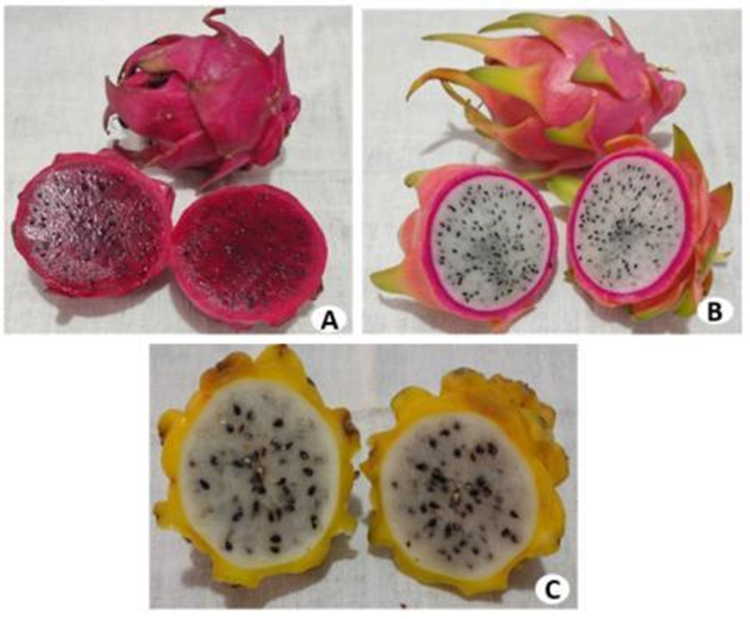
(Fig.1) Shown here are the fruits of the red-fleshed pitaya (A) white-fleshed pitaya (B) yellow-fleshed pitaya ©.
Taxonomy
The systematic classification of dragon fruit is presented in Table 1 (11)
|
Plant group |
Plants |
|
Plant category |
Seed promoting plant |
|
Plant type |
Divotyledonae |
|
Plant sequence |
Cactus order |
|
Plant lineage |
Cactus family |
|
Plant group name |
Selenicereus |
|
Species |
Red-fleshed variety , White-fleshed variety, Yellow-fleshed variety . |
DISCUSSION
Bioactive Compounds of Hylocereus Species
Dragon fruit contains a broad collection of naturally produced plant chemicals, which fall into groups such as phenol-origin constituents, flavonoid-type derivatives, sterol-linked compounds, fat-associated constituents, and vitamin-E analogues. Both the edible core and the outer skin provide an array of health-supportive components, including vitamin C, several tocopherol variants, and B-complex factors like B1, B3, and B2, along with essential minerals such as the Mg element, the K element, the Ca element, and a phosphate-related component. Several other noteworthy molecules—including betacyanin colorants, beta-carotene, lycopene, p-coumaric acid–related forms, protocatechuic derivatives, vanillic analogues, gallic-type constituents, syringic compounds, and 4-OH benzoate—have also been identified within this fruit. [6,12,13,14,].Chemical analysis of H. undatus pulp extracted using various solvents revealed distinct phytochemical profiles. (15))
Healthy Benefits of Hylocereus Species
Since ancient times, the Mayan civilization has regarded dragon fruit as a medicinal food, utilizing its fruits and flowers for various therapeutic purposes such as reducing blood sugar levels, disinfecting wounds, promoting urine excretion, as well as helping manage conditions such as intestinal infections and abnormal growths. This plant was also valued for its healing properties. In addition, its flowers and seeds have traditionally been consumed as beverages to relieve gastritis, serve as mild laxatives, and support kidney function.
Free Radical–Scavenging Actions of Dragon Fruit Varieties
Studies have revealed the antioxidant capacity of pitaya extracts. Studies involving pre-diabetic and normocholesterolemic individuals revealed a reduction in total antioxidant status after consuming red pitaya [16,17]. According to Harahap and Amelia [18], supplementation with the fruit extract helped reduce oxidative damage in animals subjected to physical activity. Similarly, other investigations found that pulp extract from the fruit lessened oxidative injury in rats with streptozotocin-induced diabetes [19]. Furthermore, a study [20] found that intake of red-fleshed pitaya reduced lipid peroxidation levels in hyperglycemic animal models. suggesting that it helps alleviate oxidative stress associated with diabetes.
Primary free radical–scavenging actions related to dragon fruit varieties as well as the impact on well-being. ↑—rise; ↓—reduction.
Anti-Swelling Impact.
In addition to its strong antioxidant activity, dragon fruit also displays noteworthy anti-inflammatory potential. Studies indicate that the pulp may help regulate inflammation, potentially through multiple biochemical mechanisms, including inflammatory lipid mediators, bioactive lipid mediators, and acetylcholine-mediated pathways (21).The study [22] also reported that red-fleshed dragon fruit and white-fleshed dragon fruit preparations display inflammation-reducing, free radical–scavenging, and antibacterial effects, with the water-based preparation of red-fleshed dragon fruit exhibiting the strongest efficacy when compared with alcohol-based as well as acetate solvent fractions. The aqueous extract provided stronger protective effects against inflammation and oxidative stress.Moreover, a study [23] revealed metallic nano-sized particles produced using red-fleshed dragon polyrhizus, showing modulation of the inflammatory response, antidiabetic, cognitive decline–protective, cell growth–inhibiting effects.
Key swelling response–modulating effects of dragon fruit varieties as well as effects associated with well-being. ↓—reduction.
Tumor-suppressing activity
Several studies have demonstrated that dragon fruit possesses significant anti-cancer potential. Divakaran et al. [24] investigated its ability to mediate nanoparticle formation and noted that these nanoparticles effectively reduced the multiplication of human mammary adenocarcinoma cells.In addition, the authors of [25] observed that short-chain carbohydrates obtained from dragon fruit undergo microbial conversion, promoting beneficial gut bacteria such as Lactobacillus while lowering populations of Bacteroides and Clostridium. This microbial activity also produces lactic, acetic, propionate, and butyrate—bioactive metabolites known to suppress the growth of colon-derived epithelial cells (Caco-2), thereby contributing to a reduced risk of colon cancer. A previous investigation [26] revealed that the methanolic preparation of the dragon fruit species showed marked cytotoxicity toward a cultured hepatic carcinoma cell line, underscoring its promise as an anticancer candidate.
Furthermore, the researchers [27] evaluated the growth-limiting potential of red dragon fruit on mouse-origin melanoma cells (B16F10) and reported that the fruit’s outer skin exerted a more intense inhibitory impact than the flesh. Their findings suggest that both the skin and pulp are abundant in polyphenols and antioxidant constituents, although the external layer possesses stronger melanoma-suppressing ability.Dragon fruit plants exhibit the strongest tumor-suppressing activity
Key tumor-fighting activities of dragon fruit plants. ↑—rise; ↓—fall.
Blood Sugar–Lowering Benefits
The study found that giving rats with non-insulin-dependent diabetes a combination of crimson pitaya along with a standard diabetes drug significantly lowered their blood sugar while improving the function of the body’s sugar-control hormone. The researchers suggested that crimson pitaya could serve as a natural alternative to the medication because it helps the hormone work better, reduces resistance to it, as well as lowers markers of oxidative stress such as malondialdehyde. In addition, regular consumption of crimson pitaya showed a blood sugar–reducing effect in rodents with high blood fats, which may help prevent hormone resistance [28].
Regulation of blood fats
Consumption of crimson-fleshed dragon fruit has been shown to improve lipid profiles in rodents with elevated blood lipid levels, potentially reducing the likelihood of cardiovascular disorders [68].A previous study [29] assessed the effects of consuming crimson-fleshed dragon fruit peel in adult laboratory rats with diabetes and high blood lipid levels, but no significant changes were observed in their lipid profiles.In another study [30], the effects of powdered outer layer of crimson dragon fruit administered to mature laboratory rodents were examined. The findings demonstrated reduced levels of blood fats and overall lipid content, along with a decrease in low-density “bad” lipid fraction and an increase in high-density “good” lipid fraction. The authors concluded that the peel may help improve blood lipid profiles in rodents with elevated lipid levels.
Heart health benefits provided by this cactus species. ↑—rising; ↓—falling; high-density - good lipid fraction; low-density -bad lipid fraction
Pharmacological Activities (Summary)
Dragon fruit exhibits a wide range of pharmacological effects due to its rich composition with biologically active substances. According to Bais (2025), it shows significant free radicals–scavenging, swelling-reducing, blood sugar–modulating, as well as tumor-inhibiting activities. These health-promoting effects are largely linked to phenolic compounds, flavonoids, betacyanins, along with other natural antioxidants found in both the pulp and peel. The combined action of these phytochemicals helps neutralize free radicals, regulate blood sugar levels, and protect cells from damage. Therefore, dragon fruit serves as a promising natural ingredient for developing nutraceuticals alongside therapeutic agents.(Bais, 2025).(31)
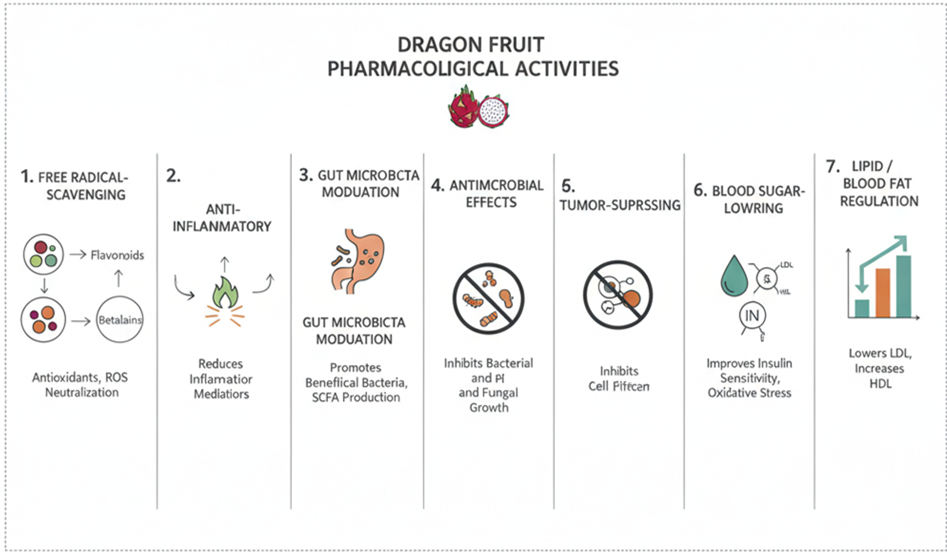
Formulations and Marketed Products of Dragon Fruit.
Dragon fruit (Hylocereus spp.) has been developed into several value-added products to increase its commercial potential. Common marketed forms include juices, jams, jellies, wines, and ready-to-serve beverages. The fruit is also processed into freeze-dried powders, candies, and chips for longer shelf life and convenience. Additionally, it is incorporated into ice creams, yogurts, and bakery products to enhance color and nutritional value. Cosmetic formulations using peel extracts and nutraceutical supplements containing dragon fruit powder are also available.
Future Perspectives Regarding This Fruit
This tropical fruit has strong global potential. Its ability to thrive in harsh conditions and deliver fast advantages makes it promising for future food and wellness applications.
Every section of this species—such as the stems, blossoms, edible parts -- contains significant levels of bioactive substances with recognized health benefits. These bioactive substances, such as those contributing to the reduction of hypertension, have attracted interest from the pharmaceutical industry for extraction and utilization.Several studies suggest this fruit’s functional properties contribute to reducing the risk of chronic health conditions.A high concentration of antioxidant bioactive substance in the pitaya peel enhances its pharmacological and nutritional significance by improving antioxidant capacity. Although pitaya exhibits desirable traits typical of tropical fruits, its commercial recognition remains limited, despite having strong potential in both domestic and international markets. Currently, pitaya-based products are not widely available, emphasizing the need for extensive research to improve their market development and commercial value [32].Furthermore, because dragon fruit requires relatively low nitrogen input compared to other fruit crops, it is well suited for organic cultivation using locally available organic fertilizers and composts. Therefore, considering its adaptability and current underutilization, dragon fruit possesses the potential to become an important fruit crop in the near future [33]. The advancement of herbal technology has opened new possibilities for improving the pharmacological reliability of natural plant-based formulations. According to Bais et al. (2023) (34) modern herbal technology focuses on enhancing the quality, stability, and therapeutic efficacy of herbal products through standardized extraction methods and innovative delivery systems. Applying these principles to dragon fruit could help in developing novel formulations with improved bioavailability and consistent biological activity. Furthermore, Bais et al. (2022) (35) emphasized the importance of establishing strict quality control parameters and standardization protocols for herbal drug formulations. Integrating these quality aspects into dragon fruit research will ensure reproducibility, safety, and efficacy in future nutraceutical and pharmaceutical applications. Therefore, adopting these approaches can transform dragon fruit into a scientifically validated and industrially valuable natural resource. In addition to quality improvement and standardization, the incorporation of novel delivery technologies can further enhance the pharmacological performance of dragon fruit bioactives. As reported by Lendave et al. (2025) (36) liposomal and nanocarrier-based drug delivery systems can improve the stability, controlled release, and bioavailability of herbal compounds. These technologies can be applied to dragon fruit extracts to develop value-added formulations with enhanced antioxidant and metabolic benefits.
CONCLUSIONS
Research shows that pitaya may help the body stay balanced, maintain normal blood sugar or fat levels, reduce swelling, while resisting harmful germs or abnormal cell growth.Eating this fruit regularly may help the body stay healthy by reducing cell damage or swelling, which could support the management of blood sugar or fat levels, heart problems, or serious growths in the body. Due to its valuable nutrients, pitaya has notable economic importance. Its outer layer, containing pigments that give the fruit its color, provides a coloring option, while its fiber serves as a substitute for oily ingredients in desserts or other food items. Furthermore, its potential uses within the food, cosmetic, pharmaceutical sectors include the creation of eco-friendly packaging materials, edible films, photoprotective formulations, natural meat additives, beer production, along with cytotoxic compounds that are useful in cancer therapy. Although this tropical fruit contains a high amount of health-promoting molecules, their absorption in the body remains limited. Therefore, innovative delivery systems—such as tiny metallic carriers—could be explored to improve the targeted delivery of these beneficial compounds .Overall, evidence from current studies highlights dragon fruit’s substantial potential to promote human health, as it can help mitigate metabolic disease risk factors and exhibit cytotoxic effects against cancer cells. Additionally, the fruit offers promising technological benefits in food processing by improving antioxidant capacity and dietary fiber content, thereby enhancing both the nutritional and functional quality of food products.
REFERENCES



Sayali Jankar, Mayuri Lendave, Dr. Sanjay Bais, Dragon Fruit (Hylocereus spp.): Exploring Its Nutritional and Health-Promoting Potential, Int. J. of Pharm. Sci., 2025, Vol 3, Issue 12, 183-190. https://doi.org/10.5281/zenodo.17778873
 10.5281/zenodo.17778873
