
Rungta Institute of Pharmaceutical Sciences, Bhilai, Chhattisgarh, India.
A key component of healthcare is pain treatment, and because of their effectiveness and few side effects, herbal-based yoga’s have emerged as a viable substitute for synthetic drugs. The study focuses on creating and testing a phytopharmaceutical stick with extracts from Tectona grandis, which is well-known for its anti-inflammatory and pain-relieving qualities. By inhibiting inflammatory mediators, the active phytoconstituents of Tectona grandis, such as alkaloids, tannins, and phenol compounds, can reduce pain. In order to guarantee efficient drug distribution, Tectona grandis extracts are incorporated into a topical stick utilizing appropriate excipients including wax, emollient, and penetration enhancement. Melting point, spread, stability, drug release, analgesic, and anti-inflammatory properties are among the physical chemical tests that are performed on the manufactured stick. To further guarantee safety and effectiveness, testing for skin irritation and user acceptability are conducted. Installing a reliable, easy-to-use, and efficient herbal pain reliever that offers a natural substitute for conventional medicines is the aim of the study. It is anticipated that the findings will demonstrate the efficacy and safety of Tectona Grandis-based phytopharmaceutical sticks as a modern pain reliever and promote additional research into herbal pain relief.
Pain is a frequent clinical complaint that significantly affects quality of life and often requires long-term care. Although they are effective, traditional analgesics like NSAIDs and opioids carry dangers, such as cardiovascular, renal, and gastrointestinal adverse effects (1). Interest in herbal alternatives with better safety profiles has increased as a result (2). In Ayurvedic medicine, teak, or Tectona grandis Linn., is traditionally used to relieve inflammation and pain (3,4). Its analgesic and anti-inflammatory properties are attributed to phytochemicals such as tocoquinone, lapachol, flavonoids, and tannins (5,6). Topical medication administration improves compliance, lowers systemic exposure, and is tailored (7,8). Medicated sticks are dose-controlled, easy to use, and convenient (9). Herbal medicated sticks have not yet been formulated. A phytopharmaceutical stick based on Tectona grandis has been developed and evaluated for analgesic activity in the current investigation. It creates a novel, effective, and secure topical analgesic by fusing modern pharmaceutical technology with ancient herbal expertise.
MATERIALS AND METHOD
Collection & Authetication : Govt. V.Y.T.PG. Autonomous College Durg (Chhattishgarh) authenticates the stem of Tectona grandis, which is gathered from NH-30 Jagdalpur Road.
Excipients: Beewax, Coco butter, Coconut oil, Menthol, Camphor, Vitamin E, Propylene Glycol Pepermint oil and Purified Water.
Preparation of Plant Extract : After 20 days of shade drying, the stems were ground into a fine powder using a mechanical grinder. After passing through filter number 40 to produce a fine powder, the powder was sealed in an airtight container to keep moisture out until it was needed again. Using the Shoxhlet Apparatus, 100 grams of stem were extracted using methanol as a solvent through evaporation for eight hours at 45 degrees. After that, the extract was cooled and filtered. The residue was then produced by placing the filterate in a water bath set at 40 degrees for evaporation. (10)
Phytochemical Screening : (11,12)
Preparation of Herbal Stick
Tectona grandis herbal sticks were made by heating and solidifying them. Each component was weighed independently. To create a foundation melt, beewax, coco butter, and coconut oil were melted in accordance with their descending melting points and well combined. Menthol, camphor, vitamin E, propylene glycol, and Tectona grandis extract were all melted together in a different container while being constantly stirred to create a liquid melt. After swirling the liquid melt into the base melt, distilled water was added and thoroughly combined. To get a homogeneous mixture, the resulting mixture was chilled to roughly 37°C. To create the proper shape of the herbal sticks, the heated mixture was poured into the stick molds and allowed to cool. (13, 14).
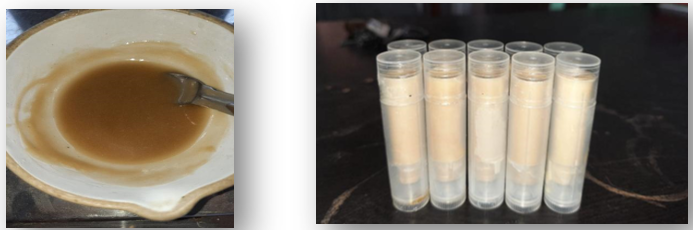
Evaluation Parameters (26)
Physical appearance:
Weight Variation:
A total of three sticks were chosen at random and weighed separately. To determine the weight variation, the individual weights were compared to the average weight. Because the sticks have a cylindrical shape, a screw gauge and a vernier caliper were used to measure their thickness and length, respectively. By measuring the thickness at three distinct locations on the sticks, the average thickness was determined. (13)
Spreadability:
Spreadability is the time, expressed in seconds, required for the top slide to split from the stick between the two slides when subjected to a particular weight. The faster two slides can be separated, the better the spreadability. 500 mg of the formulation were positioned between the two slides, which were 6 by 2 cm each. After that, the spreadability of the time it took for the upper and lower slides to separate was noted. (15,16) The sticks were assessed and ranked using the following grading system in order to determine their spread ability: The following spread ability levels exist: zero, low, average, and high (++, +++).
Formula for calculation:
S = M × l/t
S = Spreadability
M =Weight tied to the upper slide (gm)
l = length of upper glass slide (cm)
t = Time taken (sec)
Melting point:
Since it indicates the upper limit of safe storage, determining the melting point is essential. The prepared sticks' melting point was determined using the hot plate method. After that, the sticks were put inside the device, and at first it was observed that the product was slowly melting. Following three iterations of the aforementioned procedure, the melting point was recorded for every formulation. (17,18)
Force of application:
The force that has to be applied is measured in a similar way using this test. A piece of brown paper was affixed at a 45°C angle to completely cover a 1 square inch region. The pressure readout indicates the force of application. (13,18)
Stability Studies: The produced formulations underwent short-term stability tests, which involved three weeks of storage at 35 ±2°C. The sticks were visually inspected for any physical changes at one-week intervals.
pH measurement: A pH paper was used to evaluate the formulation's pH at room temperature after a little amount of sample was put on a glass slide. The results were then reported.
In vitro drug diffusion studies: (24-25)
Drug release was investigated in vitro using penetration cells. A goat skin was fastened to one end of the glass cylinder. The cell was immersed in a beaker containing 150 milliliters of drug-free phosphate buffer in the receptor compartment after a stick containing one gram of drug was placed in the donor compartment. The cell was immersed one centimetre below the surface of the receptor fluid. The medium in the receptor compartment was stirred using a magnetic stirrer, and the temperature was maintained at 37 °C ± 1°C. To ascertain the drug content, five millilitres of the receptor compartment were taken over time at predefined intervals, and the absorbance was evaluated. The volume of the extracted sample was substituted at each interval. (19)
In-vitro Anti-Inflammatory Test: (20 -23)
Inhibition of albumin denaturation: The anti-inflammatory effect was assessed in vitro using the suppression of protein denaturation method (egg albumin).
The control solution in fifty millilitres: Two millilitres of freshly made egg albumin, twenty millilitres of distilled water, and twenty-eight millilitres of phosphate buffered saline (pH 6.4) were combined to create the control solution.
Fifty millilitres of standard solution: After adding The standard solution was prepared by mixing 2 ml of newly prepared egg albumin with 28 ml of pH a rate of phosphate buffer saline and 20 ml of the sodium diclofenac solution (with dose ranging from 10 to 2000 µg/ml).
Using fifty milliliters of the test solution: 2 milliliters of newly made egg albumin and 28 millilitres of phosphate buffer saline (pH 6.4) were combined. Tectona grandis in varying amounts The test solution was then created by adding 10–2000 µg/ml to the combination in 20 milliliters.
Each solution was incubated at 37 ± 2 °C for 15 minutes, and then heated for 5 minutes at 70 °C in a water bath. At room temperature, the solutions were allowed to cool down. A UV visible spectrophotometer was then used to measure the absorbance at 660 nm using the vehicle as a blank 35. The percentage inhibition of protein denaturation from the control was determined using the following formula:
RESULT & DISCUSSION
Table no 1. Composition of Tectona grandis Herbal stick
|
S. No |
Ingredient (50 gm) |
Quantity |
Function of ingredient |
|
1 |
Tectona grandis Extract |
5ml |
Analgesic and anti-inflammatory |
|
2 |
Bee wax |
7.50 gm |
Hardner |
|
3 |
Coco butter |
10 gm |
Emollient & Skin Permeation |
|
4 |
Coconut oil |
7.00 gm |
Stabilizer & Moisturizer |
|
5 |
Menthol |
1gm |
Counter irritant |
|
6 |
Camphor |
1 gm |
Swamp cooling |
|
7 |
Vitamin E |
0.50gm |
Antioxidant and prolong self-life |
|
8 |
Propylene Glycol |
2 gm |
Solvent |
|
9 |
Peppermint oil |
1 gm |
Fragrance |
|
10 |
Distilled water |
Q.S |
- |
Phytochemical evaluations
The following findings were obtained from a phytochemical investigation of the several methanolic stem extracts of Tectona grandis and were documented. Table 2 lists the alkaloids, polyphenols, tannins, saponins, and sterols that were present in the plant extract.
Table No. 2 Evaluation of Phytochemical Screening
|
S. No |
Phytochemicals |
Test |
Methanol |
|
1 |
Alkaloids |
|
+ |
|
2 |
Flavonoids |
|
- |
|
3 |
Phenolic |
|
+ |
|
4 |
Tannis |
|
+ |
|
5 |
Saponins |
|
+ |
|
6 |
Cardiac glycosides |
- |
- |
|
7 |
Sterols |
|
+ |
|
8 |
Quinones |
|
- |
The formulation's evaluation parameter
The organoleptic properties, pH, homogeneity, consistency, and stability of the phytopharmaceutical stick derived from Tectona grandis were evaluated. It was smooth, homogeneous, and had a pleasant herbal scent. According to table no. 3, the pH ranged from 5.3 to 5.6, which is ideal for topical application and has high Spreadability and stability
Table No. 3 Evaluation of Phytopharmaceutical Stick
|
S. No |
Evaluation Parameter |
Result |
|
1 |
Apperence |
Pale Brown colour |
|
2 |
odour |
Fragrance of mint |
|
3 |
Texture |
Smooth |
|
4 |
Phase sepration |
None |
|
5 |
Weight Variation |
Normal |
|
6 |
Force of Application |
Good |
|
7 |
Spreadability |
Good |
|
8 |
Surface Anamolies |
No Defect |
|
9 |
ph. |
6.5 |
|
10 |
Stability |
Yes |
|
11 |
Melting point |
47 °C |
In-vitro Drug release
A steady and continuous release pattern from the phytopharmaceutical stick created with Tectona Grandis was achieved by the drug release study with the Franz Defusion sales. During the study period, formation revealed a frequent distribution of active components through the membrane. Effective penetration capacity appropriate for the given application was suggested by the release profile. Formulation stability was demonstrated by the absence of abrupt or erratic liberation behavior. The findings confirm that the stick is a useful tool for long-term medical treatment.
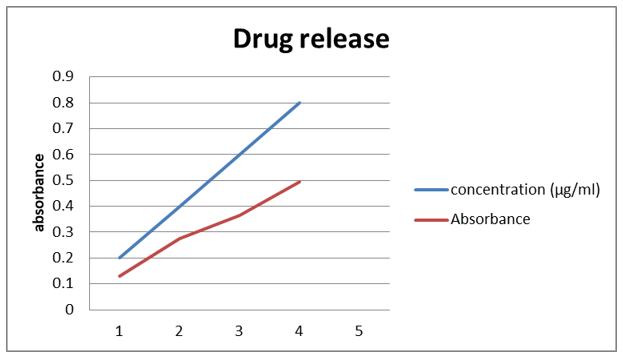
Fig. No 1.15 Graph of Drug Release by Franz Diffusion Cell
Inhibitory Response Percentage
The egg albumin denaturation assay method is an in-vitro test used to evaluate the anti-inflammatory qualities of clove oil. Using a stick containing Tectona grandis stem extract, Figure 6 illustrates how vulnerable the drug is to anti-inflammatory effects in comparison to the common drug, diclofenac sodium. The percentage inhibition was computed using a calculation from the anti-inflammatory test method. Higher doses were observed to more substantially inhibit the denaturation of the egg albumin protein. Diclofenac sodium and Tectona grandis extract stick % inhibition were evaluated.
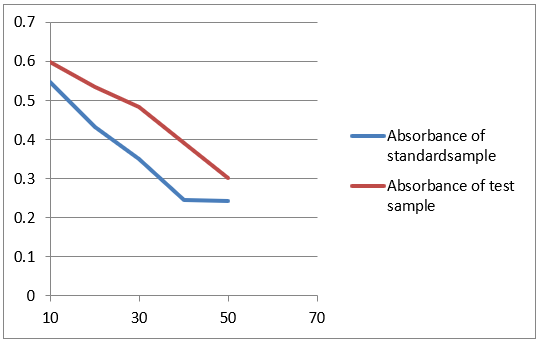
Fig. no 1.16 Graph of Absorbance of Diclofenac (standard sample) and Tectona Grandis (test sample)
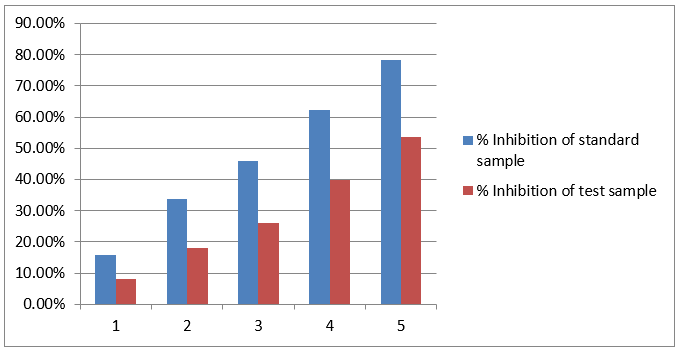
Fig no. 1.17 Graph of % inhibition of Diclofenac (standard sample) and Tectona Grandis (test sample)
CONCLUSION
The creation and thorough testing of a phytopharmaceutical stick based on Tectona grandis for the treatment of pain are the main objectives of the current study. The formulation was created to offer herbal bio-play in a current dose form that is both useful and efficient. The prepared stick's physical examination showed that it had acceptable qualities, such as the right amount of hardness, homogeneity, even texture, and good spread—all of which are essential for patient acceptability and user-friendliness. Large bioactive components with anti-inflammatory and pain-relieving properties, including saphonins, tannins, alkolides, sterols and phenol compounds, were confirmed by the phytochemical screening. These results validate the Committee for Pain Relief Applications and lend credence to the Tectona Grandis's medicinal potential. Franz defusion sales, which carried out a constant and regulated release of active components from Stang's emotionalization, were used to conduct in vitro pharmacological studies. The drug's capacity to sustain the therapeutic level for a prolonged duration is demonstrated by its progressive diffusion over the semi-permeable membrane, which improves the effectiveness of existing pain management without requiring frequent reevaluation. Furthermore, the protein research analysis confirmed the formulation's anti-inflammatory potential by demonstrating a strong inhibition of protein discrimination, a key marker of anti-inflammatory activity. It modifies the usual use of Tectona grandis in the treatment of inflammation and pain in vitro. Lastly, the phytopharmaceutical stick demonstrated the prospective physical, phytochemical, and medicinal qualities of Tectona Grandis.
REFERENCES

Dr. Gourishankar Birtia*, Diksha Dilliwar, Anjali Sahu, Tilak Kumar Sinha, Dron Kumar Sahu, Formulation & Evaluation of Phytopharmaceutical Stick Based on Tectona grandis for Pain Relief Management, Int. J. of Pharm. Sci., 2025, Vol 3, Issue 6, 1760-1768. https://doi.org/10.5281/zenodo.15622038
 10.5281/zenodo.15622038
