

We use cookies to ensure our website works properly and to personalise your experience. Cookies policy
Hindustan College of Pharmacy, Chenappady, Kanjirappally
The present study focuses on the formulation and evaluation of a natural deodorant roll-on using alum stone and aloe vera as key active ingredients. A deodorant roll-on is a liquid or gel personal care product, often containing antimicrobial agents, designed to reduce odour-causing bacteria. It is applied directly to the skin, usually the underarms, using a built-in ball-type applicator that rotates within the container neck to distribute the product, offering precise, controlled application. Alum stone was selected for its well-known antimicrobial and astringent properties, which help control odour-causing bacteria, while aloe vera was incorporated for its soothing, moisturizing, and skin-protective effects. The roll-on formulation was prepared using simple aqueous-based excipients to ensure skin compatibility and ease of application. Various formulations were developed with different concentrations of alum stone and aloe vera gel to optimize performance and stability. The prepared formulations were evaluated for physicochemical parameters, including appearance, clarity, pH, viscosity, and spreadability. The results indicated that the optimized formulation exhibited acceptable pH, good spreadability, and uniform consistency. The study concludes that a natural deodorant roll-on formulated using alum stone and aloe vera is safe, effective, and environmentally friendly, offering a promising alternative to synthetic deodorant products.
Cosmetic products are agents used to enhance appearance, fragrance, and personal hygiene, thereby improving grooming and self-confidence(1). They are classified into skin care, hair care, oral care, and personal hygiene products(2). Deodorants and antiperspirants are personal hygiene products designed to control body odour and perspiration(3). Sweat is initially odourless but develops an unpleasant smell when skin bacteria break down lipids present in sweat. Deodorants prevent or mask body odour mainly by inhibiting bacterial growth, while antiperspirants reduce sweating by blocking sweat glands.
The present work aims to develop a natural deodorant roll-on containing alum stone and aloe vera to reduce body odour without blocking perspiration. Alum stone, a naturally occurring crystalline double sulphate, possesses astringent and antiseptic properties that tighten pores and inhibit odour-causing bacteria(4). Aloe vera, obtained from Aloe barbadensis, contains constituents such as aloin and aloe emodin and exhibits antibacterial, anti-inflammatory, antioxidant, and wound-healing properties, making it beneficial for skin care(5).
Ideal Properties of Deodorants
Uses of Deodorant
AIM AND OBJECTIVES
AIM:
The aim of the present work is to formulate and evaluate natural deodorant roll-on containing alum stone and aloe vera.
OBJECTIVE:
The objective of present study include;
REVIEW OF LITERATURE
1. Surjushe et al. (2008) reviewed the cosmetic and therapeutic uses of Aloe vera, emphasizing its moisturizing, antimicrobial, anti-inflammatory, and wound-healing properties, while stressing the need for proper standardization and clinical validation(9).
2. Alzomor et al. (2014) studied potash alum incorporated into various cosmetic bases such as deodorant lotion, gel, and after-shave cream. The formulations showed good stability and strong antimicrobial and deodorizing properties, indicating potash alum as a safe natural alternative to synthetic deodorants(10).
3. Jabeen et al. (2024) formulated and evaluated a tamarind-based herbal roll-on deodorant. The product demonstrated good stability, skin compatibility, and antibacterial activity, highlighting the potential of plant-based ingredients for safe and long-lasting odour control(11).
4. Pakhare et al. (2024) developed a natural roll-on deodorant using cocoa butter, corn starch, and sodium bicarbonate. The formulation was found to be safe, stable, skin-friendly, and effective in controlling body odour without synthetic chemicals(12).
5. Kasliwal et al. (2025) reported the successful formulation of herbal deodorant gel. Variation in gelling agent concentration significantly influenced product quality, with the optimized formulation showing good skin compatibility, smooth texture, and effective antimicrobial activity, supporting the safe use of herbal ingredients in deodorants(13).
MATERIALS AND METHODS
Ingredients: Alum stone, Aloe vera, Distilled water, Methyl paraben, Trisodium citrate, Citric acid, Essential oil, Tween 20, Xanthum gum.
Collection: Alum stone and Aloe vera were collected from the local market, Kanjirappally.
Equipment: The equipment used are mechanical stirrer, electronic balance, digital pH meter.
Preparation of potash alum: Potash alum crystals were crushed into a fine powder using a clean mortar and pestle. Then the powder was passed through a fine mesh sieve to remove any coarse particles.
Preparation of aloe vera gel: Firstly, wash the freshly aloe vera leaves, then the thorns are removed, slice the aloe vera leaf lengthwise from the top to bottom. Use a spoon or a small knife to scrape out the translucent gel from the inside of the leaf, after extracting the gel, place it into a blender. Blend the gel until it reaches a smooth, water consistency(14).
Formulation of natural deodorant using alum stone and aloe vera: Accurately weighed required quantity of potash alum in a beaker and dissolved in distilled water completely by heating at a range between 60-70?. Required quantity of xanthum gum was agitated in water until uniformly distributed. Agitation was continued further for about 20 minutes. Take another beaker and mix aloe vera gel, and prepared xanthum gum. Then potash alum was added into this mixture with constant stirring until a homogenous mixture was formed. Dissolve methyl paraben in small quantity of ethanol and add to above formulation mixture. Required quantities of citric acid and trisodium citrate is dissolved in sufficient quantity of water and add this to above prepared mixture. Stir until homogenous mixture is formed. In another beaker mix equal amounts of lavender oil and tween 20. Stir continuously(10,14).

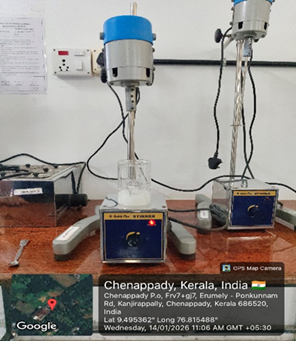
Fig No.1: Formulation of deodorant roll-on F1 Fig No.2: Formulation of deodorant roll-on F2
Table No:1 Composition of deodorant roll-on
|
INGREDIENTS |
F1 |
F2 |
|
Aloe vera gel |
3gm |
5gm |
|
Distilled water |
100ml |
100ml |
|
Potash alum |
1.5gm |
2gm |
|
Essential oil |
0.15ml |
0.2ml |
|
Tween 20 |
0.15ml |
0.2ml |
|
Xanthum gum |
0.3gm |
0.5gm |
|
Methyl paraben |
0.18gm |
0.18gm |
|
Citric acid.H2O |
0.1gm |
0.1gm |
|
Trisodium citrate.2H2O |
4gm |
4gm |
RESULTS
1. Physical appearance
Table 2: Physical appearance
|
Formulations |
Color |
Odour |
State |
Consistency |
|
Formulation F1 |
Off-white |
Pleasant |
Semiliquid |
Smooth |
|
Formulation F2 |
Milky white |
Pleasant |
Thickened semiliquid |
Smooth |
2. pH
The pH of the formulated deodorant roll-on was found to be in range of 4.12 to 4.27 which is in the range of skin pH. Therefore, these formulations are suitable for skin care.
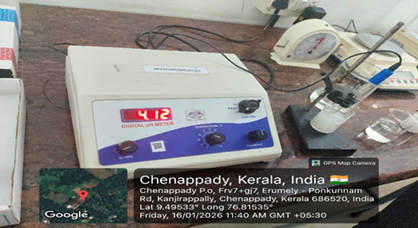
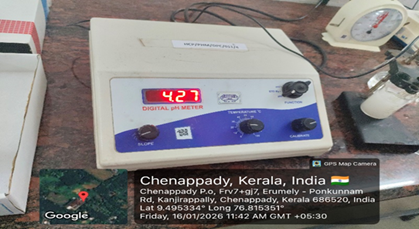
Figure No.3: pH meter showing pH Figure No.4: pH meter showing pH
value of Formulation F1 value of Formulation F2
Table 3: pH of formulated deodorant roll-on
|
Formulations |
pH |
|
Formulation F1 |
4.12 |
|
Formulation F2 |
4.27 |
3. Homogeneity:
The formulated deodorant roll-on was tested for homogeneity by the visual inspection for presence of any lumps, flocculates or aggregates. It was found that the formulations are homogenous and appearance, touch of these formulations was good.
4. Spreadability:
Using the parallel-plate method, 1 g of the sample prepared in 48 h before the test is placed between two glass plates 20 x 20 cm. A weight of 100 g is placed on top for 1 minute. Then the diameter of the sample between the plates is measured.
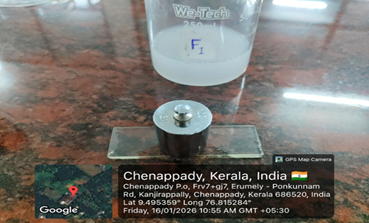
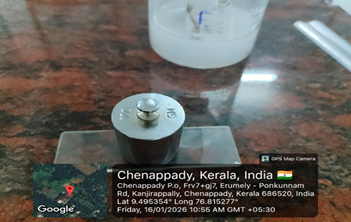
Fig. No.5: Spreadability of Fig. No.6: Spreadability of
Formulation F1 Formulation F2
Table No.4: Spreadability
|
Formulations |
Time |
Spreadability |
|
Formulation F1 |
5 min |
3848.4510mm |
|
Formulation F2 |
5 min |
1963.4954mm |
5. Viscosity:
The viscosity of formulations F1 and F2 was found to be 331.5mPas and 331.9mPas respectively, which lies within the optimal range for roll-on deodorants. F2 is considered the most acceptable formulation.
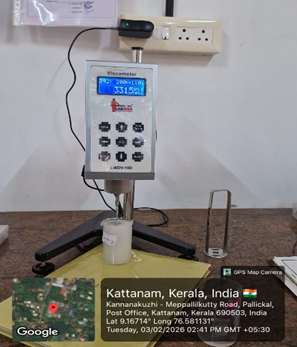
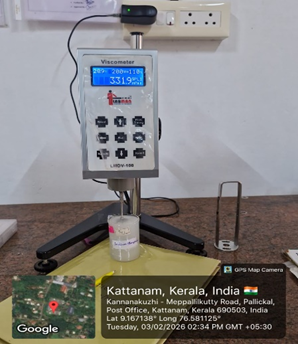
Fig No.7: Brookfield viscometer showing Fig No.8: Brookfield viscometer showing
viscosity of F1 viscosity of F2
6. Stability studies:
Table No.5: Stability studies data for formulation F1
|
Parameter |
Initial days |
First month |
|
Color |
Colour less |
No change |
|
pH |
4.12 |
4.4 |
|
Homogeneity |
Homogeneous |
Homogeneous |
Table No.6: Stability studies data for formulation F2
|
Parameter |
Initial days |
First month |
|
Color |
Colour less |
Milky white |
|
pH |
4.27 |
4.54 |
|
Homogeneity |
Homogeneous |
Homogeneous |
DISCUSSION
A deodorant roll-on is a semiliquid preparation used for killing odour causing bacteria thereby reducing body odor. Two formulations of deodorant roll-on are developed that is, formulation F1 and F2 containing alum stone and aloe vera as the main ingredient in different proportions. Formulation F2 exhibited better results during evaluation process when compared to F1 was selected as the optimized formulation. The physicochemical property of formulated deodorant roll-on was found to be satisfactory. Other physicochemical parameter like homogeneity, pH, viscosity, spreadability was also evaluated. The pH of the formulated deodorant roll-on was found to be in range of 4.12-4.27 which is suitable for skin pH. The viscosity of deodorant roll-on was measured using Brookfield viscometer. Formulation F2 showed more viscosity than formulation F1. The spreadability test was also performed and it was observed that formulation F2 having more viscosity, spreads less when compared to formulation F1. This is due to higher content of xanthum gum which is a thickening agent which makes the formulation F2 more viscous than formulation F1. This result confirms that formulation F2 have more overall effect on skin than formulation F1. Hence, this comparative study revealed that formulation F2 gave excellent result for certain physicochemical parameter, therefore showing better stability and spreadability than formulation F1.
CONCLUSION
From this result, it can be concluded that a natural deodorant roll-on can be successfully formulated using alum stone and aloe vera as key ingredients. These natural components contribute to deodorizing action, antimicrobial effect, and soothing properties, making the formulation suitable for regular topical use.
Among the two formulations, F2 showed better evaluation results in terms of viscosity, spreadability, homogeneity, and overall acceptability. Therefore, formulation F2 was selected as the optimized formulation. The study confirms that natural deodorant roll-ons can be an effective and safer alternative to synthetic deodorants, with reduced risk of skin irritation.
Hence, the formulated natural deodorant roll-on using alum stone and aloe vera is considered safe, effective, stable, and user-friendly, and it holds potential for further development and commercial application.
ACKNOWLEDGEMENT
The authors express sincere gratitude to the Management of Hindustan College of Pharmacy, Chenappady, for providing necessary facilities and infrastructure to conduct this research. The authors thank Dr. Lincy John, M.Pharm, Ph.D., Professor, Department of Pharmaceutics, for guidance and support throughout the study. The authors also acknowledge Dr. Shiny George, Principal, for encouragement and academic support. The authors are thankful to all faculty members of the Department of Pharmaceutics for their valuable suggestions and assistance during the experimental work conducted in 2025.
REFERENCES






Anjana P Sajeev, Aiswariya S, Ashley P A, Ganga Prasad, Rizuvana M Najeeb, Lincy John, Formulation and Evaluation of a Natural Deodorant Roll-On Using Alum Stone and Aloe Vera, Int. J. of Pharm. Sci., 2026, Vol 4, Issue 2, 2198-2204. https://doi.org/10.5281/zenodo.18635523
 10.5281/zenodo.18635523