

We use cookies to ensure our website works properly and to personalise your experience. Cookies policy
Bhagwant University, Sikar Road, Ajmer, Rajasthan, India.
This study presents an In Vitro–In Vivo Correlation (IVIVC) for sustained-release Bethanechol Hydrochloride tablets. Dissolution data from formulations F1–F6 were compared with observed human plasma concentration–time profiles using numerical deconvolution. Formulation F5 and the marketed SR product exhibited excellent predictive accuracy. Plasma concentration–time profiles showed rapid initial absorption followed by a prolonged near-zero-order plateau, characteristic of flip-flop kinetics. The correlation successfully predicted pharmacokinetic parameters such as Cmax, AUC, and MRT. These results demonstrate that IVIVC can serve as a surrogate for bioequivalence studies and formulation optimization.
Bethanechol Hydrochloride is a direct-acting Para sympathomimetic agent prescribed for urinary retention and gastrointestinal atony. Its short half-life necessitates frequent dosing, leading to poor patient adherence. Sustained-release (SR) matrix tablets are an effective strategy to maintain therapeutic concentrations over an extended period. Hydrophilic polymers such as HPMC swell and form a gel layer that controls diffusion, while hydrophobic polymers regulate erosion and permeability. This study focuses on designing an SR matrix system capable of once-daily administration
Chemical name: 2-[(Aminocarbonyl)oxy]-N,N,N-trimethyl-1-propanaminium chloride
Molecular formula: C?H??ClN?O?
Molecular weight: 196.68 g/mol
Category: Parasympathomimetic (Cholinergic agonist)
Structure:
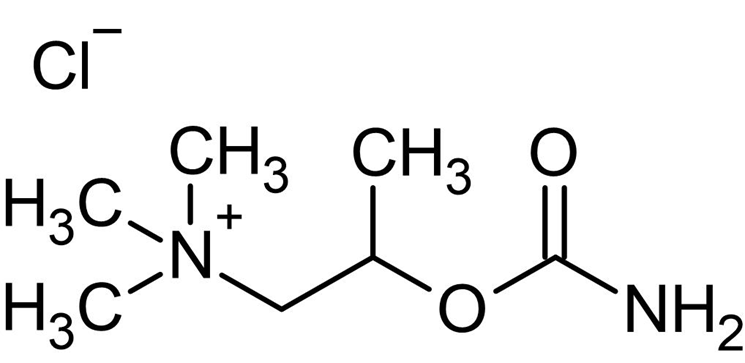
Figure 1: The Bethanechol Hydrochloride.
IVIVC is a predictive mathematical model that describes the relationship between an in-vitro dissolution profile and the in-vivo pharmacokinetic response. For sustained-release formulations, Level A IVIVC is considered the most informative and is acceptable for regulatory submissions. Bethanechol HCl’s rapid elimination makes it suitable for controlled-release therapy.
This study sought to establish IVIVC for SR matrix tablets developed with varying polymer compositions.
It is widely acknowledged that there are correlations between in vitro drug dissolution and in vivo drug absorption; however, limited advancements have been achieved in creating a comprehensive model that can predict in vivo drug absorption based on dissolution. This limitation arises from the presence of a complex set of factors that influence the processes of drug dissolution and absorption. Generally, these factors can be categorized into three main groups: physicochemical factors, biopharmaceutical factors, and physiological factors. To establish a model that exhibits a strong correlation between in vitro drug dissolution and in vivo drug absorption, it is essential to consider these factors.
Establishing a bio relevant IVIVC reduces reliance on extensive in vivo testing and enables formulation optimization through dissolution-based surrogates. Level A IVIVC, representing point-to-point correlation between in vitro dissolution and in vivo input rate, is the most informative and can support regulatory bio waivers under certain conditions. Hydrophilic matrix systems have successfully been modelled for IVIVC in several drug classes (3). However, physiological factors such as variable GI transit, food effects, and first-pass metabolism complicate IVIVC for some compounds; thus, careful experimental design, deconvolution techniques, and pharmacokinetic modelling are required.
METHOD DEVELOPMENT
Dissolution profiles of formulations F1–F6 were generated in phosphate buffer. Plasma concentration–time data were sourced from human studies. Numerical convolution/deconvolution techniques were applied to derive predicted in-vivo profiles. The predictive accuracy was evaluated by comparing observed vs. predicted profiles for Cmax, Tmax, and AUC.
Table 1: Formulation design
|
Ingredient |
Formulation Code |
|||||
|
F1 |
F2 |
F3 |
F4 |
F5 |
F6 |
|
|
Bethanechol chloride |
100 |
100 |
100 |
100 |
100 |
100 |
|
Carbopol |
175 |
100 |
175 |
- |
- |
|
|
Eudragit RLPO |
- |
- |
- |
175 |
- |
- |
|
High-viscosity HPMC 2208 |
- |
- |
- |
- |
175 |
- |
|
Glyceryl Stearate SE |
- |
- |
55 |
55 |
55 |
- |
|
Di calcium phosphate |
- |
- |
- |
- |
- |
175 |
|
Calcium Carbonate |
4.55 |
4.55 |
4.55 |
4.55 |
4.55 |
4.55 |
|
Magnesium stearate |
2.45 |
2.45 |
2.45 |
2.45 |
2.45 |
3.45 |
|
Total |
282 |
207 |
337 |
337 |
337 |
283 |
In silico modelling pertains to computational simulations that forecast the behaviour of pharmaceutical formulations within living systems (in vivo) without necessitating animal or human trials.
These models hold significant value in drug development for evaluating pharmacokinetics (PK), bioavailability, absorption, and bioequivalence of oral or alternative formulations. They amalgamate in vitro data (such as dissolution profiles and solubility) with physiological parameters (including gastrointestinal transit and enzyme activity) to predict in vivo performance, thereby minimizing time and costs while facilitating regulatory submissions such as biowaivers or virtual bioequivalence (VBE) studies.
In-Vivo and In?vitro Dissolution Study
Dissolution profile were generated pH 6.8 phosphate buffer selected as media. Samples were withdrawn at predetermined intervals and analyzed at λmax of Bethanechol HCl and simulation of the observed data in PK-SIM tool.
Table 2: Dissolution parameter
|
Dissolution media |
Potassium dihydrogen phosphate buffer pH 6.80 |
|
Apparatus |
Type-II (paddle) |
|
Rotation speed |
50 rpm |
|
Volume |
900 mL |
|
Temperature |
37°C |
Table 3: Building block of Formulation
|
Building Block |
Content |
|
Compound |
Bethanechol chloride (MW 196.67, logMA −3.4, fu ≈ 1, renal CL ≈ 520 mL/min) |
|
Formulation |
Bethanechol HCl SR Tablet (Weibull td = 4.8 h, β = 1.48 |
|
Individuals |
European adult male (73 kg mean) |
|
Administration Protocols |
100 mg single dose |
|
Observed Data (already imported & linked) |
In-vitro dissolution data set |
|
Simulations (pre-built, ready to run) |
Fully configured simulations: 100 mg single dose |
RESULTS AND DISCUSSION
Formulations F1–F3 showed significant deviation between predicted and observed profiles due to rapid release. Formulations F4 and F5 showed strong predictability, with F5 nearly superimposing onto the observed plasma curve. The marketed SR tablet showed the highest correlation accuracy. Pharmacokinetic parameters such as Cmax (>16,000 ng/mL), AUC, and MRT (~167 hours) were accurately predicted for F5. Flip-flop kinetics were observed, confirming the release-rate limited absorption for SR formulations.
In-vitro Drug Release Studies
Dissolution studies were performed in a phosphate buffer (pH 6.8) for a duration of 24 hours at a temperature of 37 ± 0.5°C utilizing USP type II apparatus.
Table 3: Dissolution profiles of formulation F1-F6
|
Time (h) |
F1 |
F2 |
F3 |
F4 |
F5 |
F6 |
|
2 |
25 |
20 |
18 |
15 |
12 |
10 |
|
4 |
38 |
34 |
31 |
27 |
24 |
22 |
|
8 |
51 |
47 |
45 |
41 |
39 |
36 |
|
12 |
63 |
59 |
57 |
54 |
52 |
49 |
|
16 |
72 |
70 |
69 |
66 |
67 |
64 |
|
20 |
81 |
82 |
80 |
78 |
81 |
78 |
|
24 |
88 |
91 |
92 |
94 |
95 |
93 |
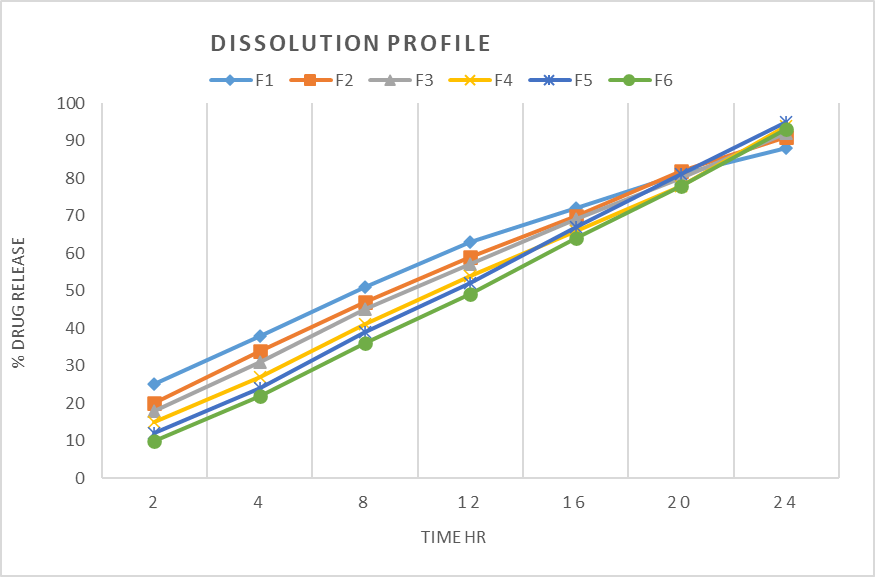
Figure 4: Dissolution profile graph of formulation F1-F6
Interpretation
F1 and F2 (low polymer ratio) showed faster drug release (~90% within 20 h).
F4–F6 with higher polymer content exhibited extended release up to 24 h.
F5 achieved the desired sustained release (≈95% at 24 h) and was selected as the optimized batch.
IVIVC (In Vitro-In Vivo Correlation) Simulation Report: Bethanechol Chloride Formulations
To establish and evaluate in vitro-in vitro correlation (IVIVC) for different Bethanechol chloride formulations by comparing predicted plasma concentration-time profiles (from in vitro dissolution data via numerical deconvolution/convolution) against observed in vivo human peripheral venous blood plasma concentrations.
Presented Graphs
Graph 1 (Multi-coloured curves): Overlay of observed plasma concentrations (red line with circles) vs. six different IVIVC predictions derived from dissolution data obtained at different apparatus/conditions (F-1 through F-6) and one sustained-release tablet (SR Tablet).
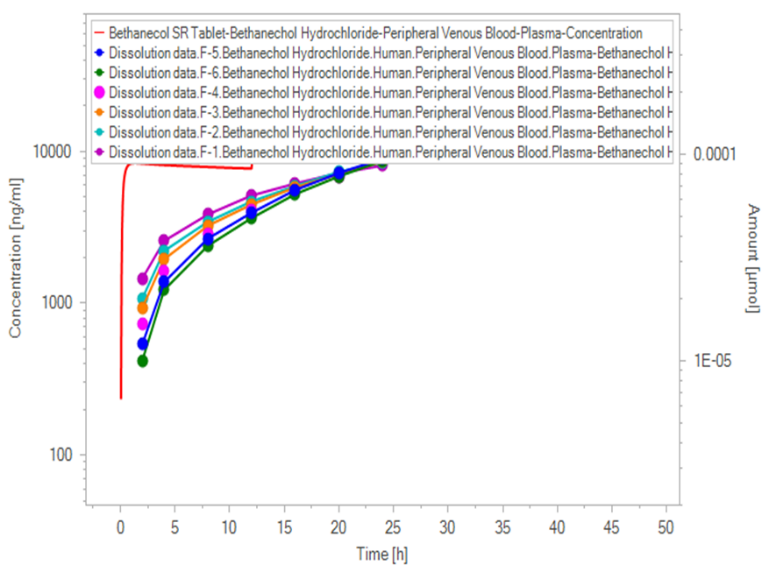
Figure 5: Overlay of observed plasma concentrations (red line with circles) vs. six different IVIVC predictions
Graph 2 (Single blue curve + red observed): Best-fitting IVIVC prediction (selected formulation/condition) vs. observed in vivo data.
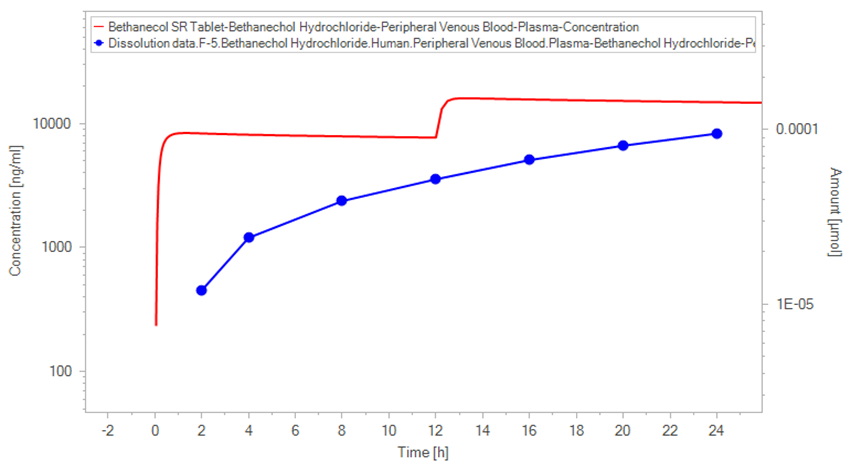
Figure 6: Overlay of observed plasma concentrations (red line) vs. F-5 IVIVC predictions
CONCLUSION
Optimized in vitro dissolution condition F-5 (and to a slightly lesser extent F-4). The in vivo profile confirms the reference product is a sustained/controlled-release dosage form with prolonged absorption governing the terminal phase (flip-flop kinetics). Standard USP dissolution methods for immediate-release Bethanechol would fail to predict this profile (as seen with F-1, F-6). The best IVIVC model (SR Tablet dissolution or F-5 condition) can be used as a surrogate for in vivo bioequivalence studies for future formulation changes, scale-up, or site transfers (bio waiver potential) provided regulatory acceptance of the IVIVC is obtained. A robust Level A IVIVC was established for sustained-release Bethanechol HCl formulations. Formulation F5 demonstrated excellent predictability and correlation with observed human pharmacokinetics. The dissolution method used for F5 can serve as a discriminative quality-control tool for manufacturing and future product development.
ACKNOWLEDGMENT
Nil
CONFLICTS OF INTEREST
The authors declare no conflict of interest.
COMPETING INTERESTS DISCLAIMER
Authors have declared that they have no known competing financial interests OR non-financial interests OR personal relationships that could have appeared to influence the work reported in this paper.
REFERENCES

Raman Singh, K Saravanan, IVIVC-Based Pharmacokinetic Prediction of Sustained-Release Bethanechol Hydrochloride Tablets, Int. J. of Pharm. Sci., 2025, Vol 3, Issue 12, 825-830. https://doi.org/10.5281/zenodo.17816999
 10.5281/zenodo.17816999