

We use cookies to ensure our website works properly and to personalise your experience. Cookies policy
Samarth Institute of Pharmacy, Belhe
Wound healing is a complex biological process often delayed by infection, inflammation, and dehydration. Traditional gauze dressings offer minimal therapeutic action. Recently, medicated gauze pads integrated with controlled drug delivery systems have emerged as promising platforms for active wound management. This review highlights advancements in natural and synthetic materials, nanotechnology-enabled drug carriers, incorporation techniques, and release mechanisms that enhance the performance of medicated gauze pads. Clinical examples, evaluation methodologies, and the potential for smart dressing applications are discussed. The integration of therapeutic and diagnostic functions may define the next generation of wound care products.
The skin is the largest organ of the human body, with an extensive surface area of approximately 1.8 m2, playing a vital role in the protection and function of biological systems, such as hydration, vitamin D synthesis initialization, and thermal regulation. It protects internal tissues and organs from damaging external factors, acts as a physical– chemical barrier against pathogens, and maintains the body’s homeostasis. Through its site and roles, the skin is susceptible to damage, and it can be affected by a plethora of physical, chemical, and biological factors that can produce severe acute and chronic injuries, such as bruises, burns, ulcers (e.g., diabetic ulcers, venous ulcers), and deep cuts (e.g., surgical wounds). Also, systemic factors such as age, metabolic, vascular, autoimmune diseases, or various treatments may affect the healing process. Acute injuries tend to be repaired using a well-organized and effective healing process, which results in long-term skin recovery. Chronic wounds, on the other hand, are described as wounds that cause superficial, partial, or full-thickness skin loss, heal through secondary intention, and do not maintain maximum anatomical and functional integrity. Wound dressings are materials applied to wounds to promote healing, protect them from infection, and prevent further injury. They come in different forms and types; each with its own purposes and benefits. That said, the primary function of wound dressings is to provide a moist environment for wound healing, which promotes the growth of healthy cells and facilitates the process of healing. Wounds, whether acute or chronic, present significant clinical challenges. Conventional gauze dressings primarily serve as protective barriers without offering therapeutic value. Bacteria are known to form a protective polysaccharide coating, especially in chronic wounds, called a ‘‘biofilm.’’ This coating goes unrecognized by host defenses and is impermeable to most systemic and topical antimicrobials. It is for this reason that the primary intervention of wound debridement is essential, disrupting this film and allowing permeation of beneficial host cells and interactive materials from dressings.
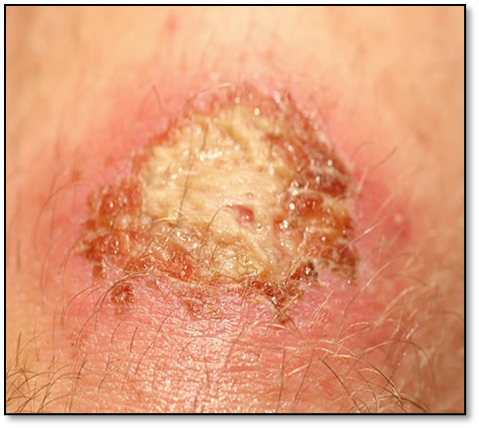
Fig no. 1: Wound marks
The evolution of wound dressings into medicated systems, particularly those capable of controlled drug release, has created a paradigm shift in wound care. Controlled-release gauze pads aim to deliver bioactive agents such as antimicrobials, analgesics, anti-inflammatories, and growth factors in a sustained and localized manner, improving healing outcomes and reducing systemic side effects. There are two categories of dressings: Adhesive dressing and Gauze dressing. An Adhesive dressing is a piece of medical plaster that is used in case of injuries that do not require a full-fledged dressing. They are meant for small injuries or wounds. The Gauge dressing are thick cotton pads that are used to cover large wounds. They are held in place by wrapping with a gauze strip (bandage) or a tape.
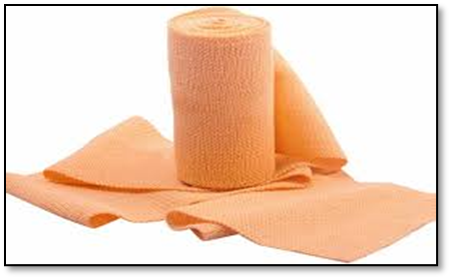
Fig no.2: Crepe Bandage
There are three main categories of “Bandages” that are Roller bandage, Tubular bandage, and Triangular bandage. They are all used in different ways for one common intention and that is to either cover wounds or to apply pressure in controlling bleeding and support the strain or the sprain. Roller bandage are long strips of bandages that can further be subdivided into two types: An Elastic roller bandage that is applied to support a strain or a sprain and is wrapped around the joint or limbs many times. It should be applied firmly. Cotton or Linen roller bandages are used to cover gauze dressings. These bandage can come in any number of widths and lengths and can be used for almost any bandage application, including holding a dressing in place
Materials Used in Controlled-Release Gauze Pads
Substrate Materials
Cotton gauze:
Widely used due to affordability and high porosity. Requires surface modification for advanced functions. However, untreated cotton lacks antimicrobial properties and can adhere to wounds, causing pain upon removal. Surface functionalization (e.g., with chitosan or silver nanoparticles) improves antimicrobial performance and bioactivity.
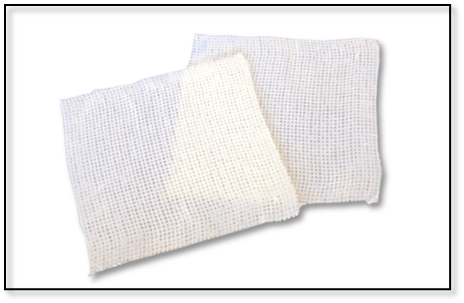
Fig. no.3: Cotton fiber bandage
Cotton gauze is primarily composed of natural cotton fibers, which consist mainly of cellulose along with small amounts of other organic and inorganic compounds. The table below outlines the typical chemical composition of processed medical-grade cotton gauze.
Table No. 1: Chemical Composition Cotton Gauze
|
Component |
Approximate Percentage |
Function/Role |
|
Cellulose |
88–96% |
Main structural polymer; provides strength and absorbency. |
|
Hemicellulose |
2–6% |
Supports cellulose structure; less crystalline. |
|
Lignin |
0.5–1% |
Binds fibers in raw cotton (mostly removed during processing). |
|
Waxes and Fats |
0.4–1% |
Natural protective coating on fibers (removed by scouring). |
|
Pectin |
0.4–1% |
Help bind cell walls; also removed during processing. |
|
Proteins |
0.3–0.5% |
Minor content; removed during bleaching. |
|
Ash (minerals) |
0.5–1.2% |
Includes calcium, magnesium, potassium salts. |
|
Moisture content |
~7–8% |
Natural water content in cotton fibers (varies with humidity). |
Banana pseudo stem fiber: A biodegradable, lignocellulosic natural fiber rich in cellulose. Exhibits high moisture retention, flexibility, and tensile strength. When woven into gauze and coated with bioactive agents (e.g., honey, curcumin), it forms a sustainable substrate for medicated dressings. Eco-friendly and abundantly available in tropical regions. Table 2 shows the chemical composition of banana plant fibers, and their physical properties. It is noted that cellulose is the main constituent of plant fibers followed by hemi-celluloses and lignin interchangeably and pectin respectively. Cellulose is also the reinforcement for lignin, hemi cellulose and Pectin.
Table no.2: Chemical composition of banana fibers
|
Component |
Percentage |
Function/Role |
|
Cellulose (%) |
60-65 |
Main structural polymer; provides strength and absorbency. |
|
Hemi cellulose (%) |
6-19 |
Supports cellulose structure; less crystalline. |
|
Lignin (%) |
5-10 |
Binds fibers (mostly removed during processing) |
|
Pectin (%) |
3-5 |
Natural protective coating on fibers (removed by scouring). |
|
Ash (%) |
1-3 |
Help bind cell walls; also removed during processing. |
|
Extractives (%) |
3-6 |
…… |
Chitosan-coated fibers: Biopolymer offering intrinsic antimicrobial properties and film-forming ability.
Drug-Delivery Platforms
Since ancient times, many different materials have been used to treat wounds in an attempt to stop bleeding, absorb exudates, and promote healing. Some of these materials consisted of honey, animal oils or fat, cobwebs, mud, leaves, sphagnum moss, or animal dung. Although most of these readily available natural substances would later prove to provide little benefit, others such as honey have been studied and shown to provide some value.
Hydrogels: PVA, PEG, and other crosslinked systems enable high drug loading and moisture retention. Hydrogels are complex hydrophilic organic cross-linked polymers, consisting of an 80%–90% water base. These gels are available in a free-flowing amorphous or fixed flexible sheet form. They can absorb a minimum amount of fluid by swelling, but they also can donate moisture to a dry wound, thereby facilitating autolytic debridement and maintaining a moist wound environment that is thermally insulated. They have also been shown to promote granulation and epithelialization and reduce the temperature of a wound bed by up to 5C. They are permeable to gas and water and have proven to be a less effective bacterial barrier than occlusive dressings. The main application of these dressings is hydrating dry wound beds and softening and loosening slough and necrotic wound debris. They are unable to absorb heavy drainage due to their high-water concentration; they absorb very slowly and therefore are not useful on bleeding wounds, and they generally require a secondary dressing. They can be used on a variety of wounds including pressure ulcers, partial and full thickness wounds, and vascular ulcers. Maceration can be of concern, as peri wound skin areas need to be protected from excess hydration. Among its benefits, hydrogels can be used in conjunction with topical medications or antibacterial agents. The fixed form of hydrogels should not be used in infected wounds. Hydrogels need to be covered with secondary dressings while remaining in place for up to 3 days.
Nanoparticles: Polymeric (PLGA), silver, or lipid-based for enhanced drug stability and targeted release. Promotes cell migration , mimic extracellular matrix and enables controlled drug release.
Liposomes & niosomes: Effective for encapsulating both hydrophilic and lipophilic drugs. Delivery of antibiotics such as gentamicin, ciprofloxacin. Delivery of herbal extract such as curcumin and aloe vera. Minimizing scar formation and infection.
Microspheres: Offer prolonged release and protection of encapsulated actives.
Types of Drugs Used in Gauze Pad Systems
Table no.3: Drugs Used in Gauze Pad
|
Sr.no. |
Drug Type |
Examples |
Purpose |
|
1. |
Antimicrobials/ Antibiotics |
Silver nitrate, gentamicin, curcumin, Neomycin, bacitracin, |
Prevent infection |
|
2. |
Antiseptics |
Povidone iodine (eg. Betadine), chlorhexidine, hydrogen peroxide, Alcohol based solutions. |
Prevent and reduce infection by killing or inhibiting the growth of microorganism. |
|
3. |
Anti-inflammatories |
Diclofenac, ibuprofen, hydrocortisone |
Reduce inflammation and swelling |
|
4. |
Analgesics/ Anesthetic |
Lidocaine, ketorolac, Benzocaine |
Enhance tissue regeneration |
|
5. |
Growth factors |
Platelet derived growth factor (PDGF), epidermal growth factor (EGF) |
Enhance tissue regeneration |
|
6. |
Hemostatic agent |
Oxidized cellulose, gelatin sponge, chitosan, calcium alginate |
Stop bleeding by promoting clot formation |
|
7. |
Debriding agent |
Collagenase, papain – urea ointments |
Help to remove dead or damaged tissue from wounds |
|
8. |
Antifungal agents |
Clotrimazole, miconazole , nystatin |
Used when there is a risk of fungal infection. |
|
9. |
Herbal extracts |
Neem, turmeric, aloe Vera |
Natural healing support |
Drug Incorporation Techniques
Sterilized gauze (cotton or banana fiber-based)
Drug substance (e.g., antiseptic or antibiotic) ; Solvent/base (e.g., ethanol, water, gel base) ; Beakers, measuring cylinders ; Magnetic stirrer or shaker Drying oven or desiccator Sterile packaging materials (e.g., aluminum foil, pouches);Tongs, gloves, laminar air flow cabinet.
Procedure:
Mechanisms of Controlled Drug Release
1. Diffusion-based: Gradual release through matrix or reservoir systems.
Application:
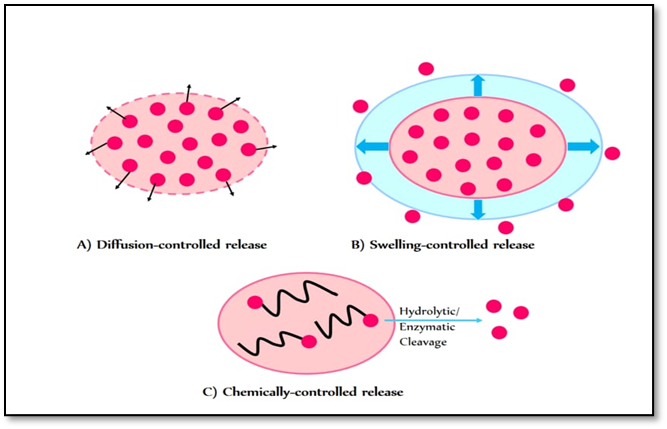
Fig no. 4: Diffusion mechanism
2. Swelling-triggered: Hydrophilic matrices expand in presence of exudate, allowing drug diffusion.
Application:
Hydrogels or cellulose based dressings that absorb moisture before releasing the drug.
3. Degradation-controlled: Release dependent on breakdown of polymeric carrier.
Application:
Useful for sustained release antibiotics, enzymes or anti-inflammatory drugs.
4. Stimuli-responsive: Environmental triggers (pH, temperature, enzymes) regulate release, especially useful in infected or inflamed wounds.
Application:
Advanced gauze pads that release antimicrobials when infection is detected (low pH or high enzyme activity)
Evaluation Techniques to be used
Table no.4: Evaluation Parameter
|
Sr. no. |
Parameter |
Method |
|
1. |
Drug release |
Franz diffusion cell, dialysis membrane |
|
2. |
Antimicrobial activity |
Zone of inhibition, broth dilution |
|
3. |
Tensile strength |
Universal testing machine |
|
4. |
Fluid absorption |
Gravimetric or centrifuge retention test |
|
5. |
Biocompatibility |
MTT assay, haemolysis test |
Commercial and Clinical Insights
1. Acticoat™: Nanocrystalline silver gauze with sustained antimicrobial effect.
Advantage:
Disadvantage:
2. Aquacel Ag™: Combines hydrofiber technology with silver for exudate absorption and microbial control.
Advantages:
Disadvantage:
3. Medihoney™: Medical-grade honey in gauze format for infection control and healing promotion
Challenges and Future Perspectives
CONCLUSION
Controlled-release medicated gauze pads represent a significant advancement in wound care by integrating therapeutic delivery with protective functions. Innovations in materials, drug-carrier systems, and release mechanisms offer opportunities to tailor treatments for various wound types. While challenges remain in terms of scalability and regulatory approval, the future of wound dressings lies in smart, multifunctional platforms that merge therapy with diagnostics.
REFERENCES


Nutan Wakale, Sachin Bhalekar, Ganesh Lamkhade, Shraddha Khaladkar, Innovations in Controlled Drug Delivery Systems: A Review on Advanced Medicated Gauze Pad Designs for Wound Management, Int. J. of Pharm. Sci., 2025, Vol 3, Issue 7, 790-800. https://doi.org/10.5281/zenodo.15826835
 10.5281/zenodo.15826835