
Shambhunath Institute of Pharmacy, Jhalwa, Prayagraj, Uttar Pradesh, 211012
Gmelina arborea Roxb (Family: Verbenaceae) is a stunning tree that grows quickly and is mostly found in tropical Africa and South-East Asia. Since ancient times, Ayurveda has utilized it as medicine to treat a variety of illnesses, including ulcers, diarrhea, thirst, anemia, leprosy, vaginal discharges, piles, fever, and more. Gmelina arborea (Gambhari) has yielded several phytoconstituents thus far, including lignans, flavanoids, coumarins, steroids, terpenes, fatty acids, and iridoid glycosides. It has anti-oxidant, antimicrobial, diuretic, cardio-protective, anthelmintic, anti-ulcer, anti-diabetic, immunomodulatory, anti-pyretic, and analgesic properties, according to a number of in vitro and in vivo experimental investigations. Therefore, it seems to be a good herbal candidate for more research. An effort was made to examine the many facets of Gambhari in this assessment.
Gambhari is a member of the Verbinaceae family (Gmelina arborea Roxb.). The majority of India, the Western Ghats, the Deccan Peninsula, Chittagong, and the base of the North-West Himalaya are all home to it [1]. It is a medium-sized to occasionally huge deciduous tree that grows to a height of 15–20 meters [2]. This species is used as an avenue tree as well as in gardens. Arborea Gmelina Roxb. is a component of the most well-known group Dashamoola, namely Brihath Panchamoola [3]. In English, it is commonly referred to as the Coomb teak, Cashmeri tree, or Candhar tree.In Sanskrit, Kashmarya, Kashmeeri, and Gambhari. The root, fruit, leaf, flower, bark, and other components of the plant can all be utilized medicinally. India is home to 107 of the 2,600 species that make up the Verbinaceae family [4]. The current study covers Gmelina arborea Roxb's traditional use, microscopic and botanical descriptions, and pharmacological actions.
Synonyms:
TAXONOMICAL CLASSIFICATION [5]
The study of methodically identifying and grouping species into related categories is known as taxonomy. The ancient discipline of plant taxonomy divides plants into related groups based on their general morphology, such as the shape of their flowers, leaves, fruits, etc. The Gmelina arborea Roxb. (gambhari) plant's taxonomic categorization is listed in Table 1.
Table 1: Showing Taxonomical classification
|
Kingdom |
Plantae |
|
Class |
Angiosperms |
|
Sub class |
Eudicots |
|
Super order |
Asterids |
|
Order |
Lamiales |
|
Family |
Verbinaceae |
|
Genus |
Gmelina |
|
Species |
Arborea |
ORIGIN AND GEOGRAPHICAL DISTRIBUTION
Southern and southeast Asian damp deciduous woodlands are home to it. Gambhari is present in most of India's deciduous woods up to a height of 1500 meters. [5]
This species, which is indigenous to Asia, has been planted as a plantation tree in a number of nations, mainly in West Africa, South America, Cote d'lvoire, and Nigeria, mainly for its high-quality timber. stretches from the River Chenab's lower Himalayan course (West Pakistan), India, Nepal, Sikkim, Assam, Ceylon, and Burma to Thailand, Laos, Cambodia, Vietnam, and the southern Chinese provinces.[6-8]
ECOLOGY
G. arborea inhabits both dry deciduous forests and rainforests. It can withstand annual rains of 750 to 4000 mm and a broad range of altitudes, roughly from 0 to 1,200 m. This plant loves the sun and enjoys temperatures between 21 and 28°C. [9] It needs base-rich, deep, well-drained, wet, fertile soils with a pH between 5.0 and 8.0. Thin, severely leached acid soils are not conducive to its growth. (10)
MACROSCOPIC CHARACTERS
Gmelina arborea is a lovely, fast-growing, moderate-to-large, unarmed, deciduous tree that may reach a height of 30 m, a circumference of 1.2 to 4.5 m, and a clear bole of 9 to 15 m. The Gamhar tree is a straight tree with heavy foliage that forms a conical crown atop the tall stem and branches on top. Fine white pubescent clothing covers the young parts and branchlets.[11]
Leaves
Petiolate leaves have broad, ovate leaf blades that are 10–25 × 7.5–18 cm, and the petioles are 5–15 cm long. Simple, opposite, cordate, glandular leaves with fulvous tomentose undersides and glabrous tops.[12]
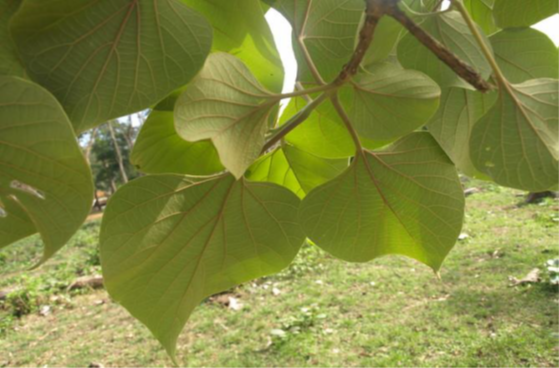
Figure 1 : Gmelina arborea. leaves
Flowers
Short-stalked, hairy, trumpet-shaped flowers with a terminal panicle that is 4-5 cm long and brownish yellow in color are plentiful. The whole inflorescence is fulvous-tomentose, with linear to linear-lanceolate bracts; the calyx is widely campanulate and has five teeth; the corolla is showy, with four stamens that are exserted.[13]
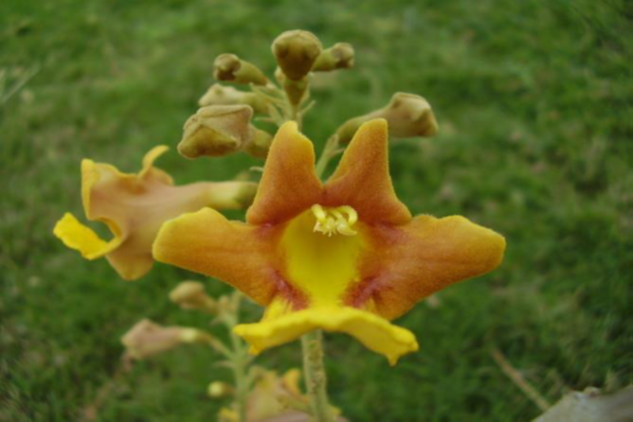
Figure 2 : Gmelina arborea. Flower
Gambhari flowers have a tubular base and a funnel form. The lower lip is often lemon yellow, up to twice as long as the upper, and has three lobes. The top lip is typically orange-pink, deeply split into two oblong, backwardly curled lobules.
Fruits
Fruits are ovoid, fleshy drupes that are 2–2.5 cm long, fragrant, orange-yellow when ripe, and have one or two seeds. [12,13]
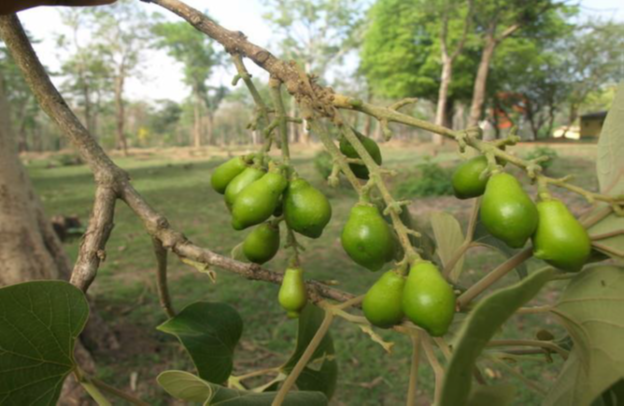
Figure 3 : Gmelina arborea. Fruits
Gambhari fruits are seen in this figure hanging on a twig; they are ovoid in shape, situated on an expanded calyx, and are glossy and golden due to ripening.
Barks
When fresh, the mature rootbark has a yellowish hue. The dried bits are channeled and curled. Because of the vertical fractures, ridges, fissures, and lenticles, the external surface is rough. Mature stem bark is seen in flat, slightly curved sections. Because there are a few fractures, ridges, etc., the external surface is rather uneven. The fracture is granular and brief. [14]
Gambhari bark has noticeable corky circular lenticels and is smooth, pale ashy-gray or grey to yellow with black spots, as seen in the image.
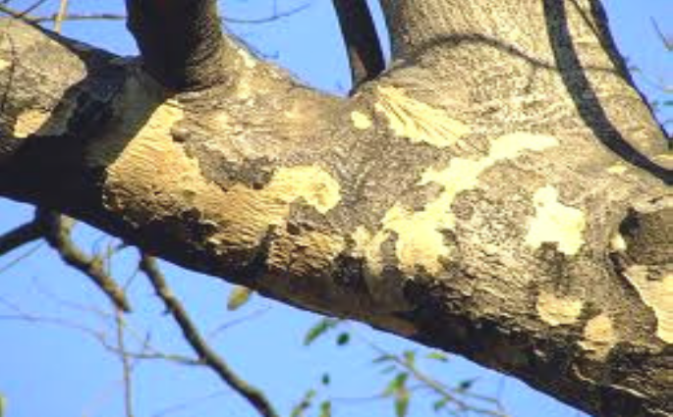
Figure 4 : Gmelina arborea. Barks
CHEMICAL COMPOSITION [15]
Root
Gmelofuran-a, apiosylskimmin-a, apiofuransonyl-(1→6)-beta-D-glucopyranosyl, (1.0.7)-umbelliferone, furanosesquiterpenoid, sesquiterpene, ceryl alcohol, hentriacontanol-1, beta-sitosterol, n-octacosanol, and gmelinol
Leaf
Cluytyl ferulate, n-octacosanol, gmelinol, arboreal, 2-0-methyl arboreal, 2-0-ethylarboreal, isoarboreal, gmelanone, betasitosterol, paulowin, 6"-bromoisoarboreal, and 4-hydroxysesamine. 4,8-dihydroxysesamin, 1,4-dihydroxysesamin (gummadiol), 2- piperonyl-3-(hydroxymethyl)-4 (alpha-hydroxy - 3-4-methylenedioxybenzyl)-4-hydroxy tetrahydrofuran (I), 4-epigummadiol-4-0- glucoside, 1,4-dihydroxy-2,6-dipiperonyl-3,7-dioxabicyclo [3,3,0]-octane, gmelanone, palmitic, oleic and linoleic acids, stigmasterol, stigmastanol, campesterol, alpha-2-sitosterol, butulinol (heartwood); luteolin, apigenin, quercitin, hentriacontanol, beta-sitosterol, quercetin, hentriacontanol, beta - sitosterol, quercetogenin and other flavons.
TRADITIONAL THERAPEUTIC USES
One of the herbs with limitless therapeutic potential that is listed in all of the old Ayurvedic texts is gambhari. It has long been used both orally and topically to treat a variety of conditions pertaining to the central nervous, gastrointestinal, circulatory, respiratory, urinary, and reproductive systems.
Leaves
Juice is used as a wash for painful stomach ulcers, while leaf paste is used to treat headaches.[16] Worms are eliminated by the demulcent leaves. Additionally, the leaves are used to cure wounds, cough, and dyspepsia. [17] Fresh leaf juice is rubbed to lessen burning sensations in the body due to its calming and cooling properties. When gonorrhea and bladder catarrh are inflammatory conditions, leaves are taken as a diuretic together with milk and sugar. [18] Charakap suggested a leaf paste to treat facial paralysis and back stiffness as part of a medicinal clarified butter. [19]
Flowers
Flowers are sweet, bitter, astringent, refrigerant, caustic, and helpful in treating blood disorders and leprosy. [22]
Fruits
The cold fruit infusion is very useful for bilious symptoms and fever of pitta origin. [17] Fruit soup is used for diarrhea. Chakraduta used honey and ripe fruits to check for hemorrhages. To treat urticaria, ripe fruits are dried and boiled in cow's milk. [19] Ripe fruit is good as anabolic in TB to speed the recovery of lung cavitations and cachexia since it is a nutritive tonic and cardiotonic, making it advantageous in cardiac illnesses. Because fruits are diuretics, their juice is used to reduce discomfort and swelling in cases of dysuria, gonorrhea, and cystitis. The fruit is aphrodisiac in addition to being a galactogogue; it is also used to prevent miscarriage and treat semen debility. Fruit may be used as a tonic for the brain and hair. [21]
Roots
The roots have stomachic, laxative, anasarca, acrid, bitter tonic, demulcent, and anti-bilious properties. For gout, pulverized root is administered. It is used to treat indigestion and fever as an infusion or decoction. [18] When women have little milk production, it is administered as galactogogue with liquorice, sugar, and honey. [21]One of the components of "dashmuladikwath" and "bhrihatpanchamool," two ayurvedic remedies that are used as tonics, is the root of G. arborea. Root is used to treat constipation and increase appetite. It also helps with hemorrhoids and diarrhea. [21] Roots contain heated potency, a hefty quality, and reduce vata and kapha. Anthrax, cholera, colic, convulsions, dropsy, epilepsy, headache, drunkenness, rheumatism, sore throat, burning sensations, and snakebite are among the conditions it is used to treat. Additionally, the roots help with urine flow, piles, and hallucinations. [22, 23]
Bark
The bark helps with fever and indigestion and acts as a stomachic and bitter tonic. In order to avoid abortions in the initial phases of pregnancy, bark powder, gingelly seeds, manjista, and shatavari are administered in milk. [16] The root bark's decotion is used for postpartum problems, and it is used internally for oedema of any kind. It has revitalizing and nourishing qualities. The bark has been used both orally and topically to treat scorpion stings and snake bites. [21] Septic wounds are cleaned and healed with root bark decoction. [24]
PHARMACOLOGICAL ACTIVITY
Toxicity study
There were no indications of liver, kidney, or hepatotoxicity in the mice studies, and the extract was well tolerated at the tested doses. Therefore, oral acute and repeated dose toxicities demonstrated the non-toxicity of Gmelina arborea aqueous extract. Future preclinical and clinical research on Gmelina arborea may benefit from the findings of this investigation.[25]
Antioxidant Study
The amount of phenolic content in each extract and the presence of specific bioactive secondary metabolite components in each extract are responsible for the cytotoxic and antioxidant effects of G. arborea.[26] According to the findings, the majority of G. arborea leaf extracts demonstrated strong cytotoxicity, iron chelation, reduction power, and antioxidant activity. Many of these characteristics were present in G. arborea leaf extracts. Plant extracts are a rich source of natural antioxidants that may decrease the advancement of oxidative stressors, according to these in vitro investigations. [27]
Anti-diabetic Activity
When it came to decreasing blood sugar levels, the extracts were far more effective than the usual therapy (Glibenclamide) and control (regular saline water). Ethanol and n-butanol extracts reduce blood sugar more effectively than a typical control. [28] Glibenclamide is comparable to these effects. Ethanol extract was shown to be more effective than other solvent extracts, despite the fact that various components were extracted in different solvents according to their polarity. This extract's effect is noteworthy and validates its usage in conventional diabetes therapy. The best anti-diabetic drugs are alcohol and n-butanol. All of the data were statistically significant (F value > F threshold) at 1% (p >0.01; or 0,00417), according to an ANOVA and z-test. The use of G. arborea bark extract as an anti-diabetic in ethnopharmacology is warranted. Further research on this effect may be done in order to cure diabetes. To determine the chemical components' antidiabetic properties, more study is required.[29-31]
Anti-microbial Activity
With a zone of inhibition of 9.730.64 mm at 1000 mg/kg, the antibacterial activity of Gmelina arborea leaf extract was shown against E. coli and Staphylococcus aureus. When compared to the untreated group, all extract groups showed a substantial (p<0.05) difference in feacal reductions at 2/3 hours; however, there was no change when compared to the usual treatment (p>0.05). According to this study, the methanol leaf extract of Gmelina arborea has antibacterial and antidiarrheal properties. [32]
Anti-diuretic Activity
The diuretic effectiveness of each of the four extracts was evaluated by administering 300 mg/kg orally. Urine volume, pH, and salt and potassium levels were also assessed. After five hours, the diuretic index and the Na+/K+ ratio were measured to determine the diuretic activity.[33] Animal urine's Na+ and K+ concentrations (mmol/l/5h) Diuresis can be brought on by increasing local blood flow, causing early vasodilatation, or preventing tubular reabsorption of anions and water. Increased excretion of water and salt is the basis for its acknowledged anti-hypertensive effectiveness.
Cardioprotective Activity
The findings demonstrate that while maintaining endogenous antioxidant levels, Ksheerapaka and water extracts offer protection against free radicals and oxidative stress. Additionally, they prevented enzyme leakage into the serum by preserving the structural integrity of the heart cells. Discussion: Lekhana and Tarpana are examples of subactivities of Hrudya Karma. Hrudya dravyas are beneficial to the mind and heart. This activity is caused by flavonoids, glycosides, tannins, and triterpenoids. Cardioprotective medications work as cardiac stimulants, vasodilators, and anticoagulants.[34]
Anti-pyretic & Analgesic
One hour after treatment, hyperthermia was decreased by an ethanolic and aqueous extract of Gmelina arborea Roxb. peel at 420 mg/kg body weight, which was equivalent to paracetamol at 50 mg/kg body weight. Chloroform and toluene extract barely slightly reduced body temperature three hours after injection. [35] Despite having a greater analgesic effect than diclofenac sodium at 25 mg/kg, the test chemicals (ethanolic and aqueous extract) seem to mainly block the peripheral pain mechanism.
Anti-ulcer activity
Using a variety of experimental models, including aspirin-induced ulcers, pylorus ligation-induced ulcers, ethanol-induced ulcers, and cold restrain stress-induced ulcers in rats, the impact of hydroalcoholic extracts of Gmelina arborea leaves on stomach ulcers was assessed. Significant anti-ulcer efficacy and stomach ulcer healing were demonstrated by the extracts at dosages of 286 mg/kg and 667 mg/kg in all mice. Extract offers the best protection against ethanol-induced ulcers, according to statistical analysis of data from all four models. [36]
In a different experiment, rats were given a methanolic extract of Gmelina arborea (MEGA) to assess the plant's anti-ulcer properties. Wistar albino rats with ethanol-induced ulcers and pyrolus ligation-induced ulcers served as the models. The gastric lesions generated in both mice are significantly inhibited by MEGA at doses of 100 and 200 mg/kg. When compared to the control, the extract significantly reduced the ulcer index, free acidity, and stomach volume. [37]
Immunomodulary activity
Using animal models such as cyclophosphamide-induced myelosuppression, delayed-type hypersensitivity (DTH) response, and humoral antibody (HA) titre, the effects of G. arborea's methanolic extract and its ethyl acetate fraction on humoral and cell-mediated immune response have been assessed. The DTH response, HA titre, and total white blood cell count were all significantly increased by the test extracts 300 and 500 mg/kg methanolic extract and 50 and 100 mg/kg ethyl acetate fraction. Additionally, test dosages were shown to raise the total WBC count, which is decreased by the cytotoxic medication cyclophosphamide, demonstrating immunostimulant action, and normalize the levels of neutrophils and lymphocytes. [38]
Anti-hypertensive activity
The effects of G. arborea leaf aqueous extract on several oxidative stress indices, blood pressure (b. p.), and the vascular response of an isolated rat aorta were examined by Wansi et al. By dramatically raising the levels of antioxidants including superoxide dismutase, catalase, and nitric oxide, the extract (150 mg/kg and 300 mg/kg) has demonstrated a protective effect. When aortic rings from normotensive rats were precontracted with 5μM phenylephrine, the extract showed vascular relaxant activity. The rats were fed a high sodium chloride solution (9% NaCl) every day and through stomach intubations for a total of two months in order to induce high b.p. In salt-loaded hypertensive rats, the aqueous extract's antihypertensive effects were maintained for almost half an hour at dosages of 30 and 50 mg/kg, which substantially decreased the b. p. by 15.48 and 24.39%, respectively. [39]
CONCLUSION
The significance of Gmelina arborea Roxb. (gambhari), one of the traditional medicinal herbs, is highlighted in this review. Because it is a versatile medicinal plant that grows quickly, it is necessary to remove the use of adulterants and replacements by propagating and cultivating it on a wide scale using conventional methods. Pharmacological activity have not yet been demonstrated.
REFERENCES


Shivangi Upadhyay, Anurag Singh, Shailesh Pathak, Abhash Singh, Pharmacognostic, Phytochemical and Pharmacological Review of Gmelina arborea Roxb., Int. J. of Pharm. Sci., 2026, Vol 4, Issue 2, 2431-2439. https://doi.org/10.5281/zenodo.18663968
 10.5281/zenodo.18663968
