
PDEA’s Shankarrao Ursal College of Pharmaceutical Sciences and Research Centre, Kharadi, Pune
Fungal infections continue to pose a major therapeutic challenge worldwide, affecting skin, nails, mucosal tissues, and systemic organs, particularly in immunocompromised patients. Although several classes of antifungal agents such as azoles, polyenes, echinocandins, and allylamines are clinically available, their effectiveness is often limited by poor aqueous solubility, low bioavailability, inadequate tissue penetration, frequent dosing, and dose-related toxicity. These limitations have driven extensive research into novel drug delivery systems capable of improving antifungal therapy. Among these, microemulsion-based drug delivery systems have emerged as a promising and versatile approach. Microemulsions are thermodynamically stable, isotropic, and transparent dispersions of oil and water stabilized by suitable surfactants and co-surfactants, with droplet sizes typically in the nanometer range. Their unique physicochemical properties, including high solubilization capacity, large interfacial area, low surface tension, and ease of preparation, make them highly suitable for delivering poorly water-soluble antifungal drugs. Microemulsions can enhance drug dissolution, improve permeation across biological barriers such as skin, nail plate, and gastrointestinal mucosa, and provide controlled or sustained drug release, thereby improving therapeutic efficacy and patient compliance.
Fungal infections constitute a significant and growing global health concern, affecting millions of people each year. These infections range from superficial conditions such as dermatophytosis, candidiasis, and onychomycosis to life?threatening systemic mycoses caused by species of Candida, Aspergillus, and Cryptococcus. The incidence of fungal infections has increased substantially over the past few decades due to factors such as immunosuppressive therapies, HIV/AIDS, organ transplantation, prolonged hospitalization, extensive use of broad?spectrum antibiotics, and lifestyle?related changes. Despite the availability of several antifungal agents, effective management of fungal infections remains challenging in clinical practice.[1]
Currently available antifungal drugs, including azoles (clotrimazole, ketoconazole, itraconazole, fluconazole), polyenes (amphotericin B), allylamines (terbinafine), and echinocandins, often exhibit limitations such as poor aqueous solubility, low and variable bioavailability, inadequate penetration into target tissues, and systemic toxicity. Many antifungal agents are highly lipophilic, resulting in formulation difficulties and inconsistent therapeutic outcomes. Conventional dosage forms such as creams, ointments, tablets, and suspensions frequently fail to deliver sufficient drug concentrations at the site of infection, leading to prolonged treatment duration, recurrence of infection, and reduced patient compliance.[2]
To overcome these limitations, novel drug delivery systems have gained increasing attention in antifungal therapy. Among various nano?based delivery approaches, microemulsion systems have emerged as an attractive platform due to their unique physicochemical and biopharmaceutical properties. Microemulsions are thermodynamically stable, isotropic, and optically transparent dispersions composed of oil, water, surfactant, and usually a co?surfactant. Unlike conventional emulsions, microemulsions form spontaneously and possess droplet sizes typically ranging from 10 to 100 nm, resulting in a large interfacial surface area and enhanced drug solubilization.[3]
The small droplet size and low interfacial tension of microemulsions facilitate improved drug diffusion and permeation across biological membranes such as the stratum corneum, nail plate, and gastrointestinal mucosa. Additionally, microemulsions can act as reservoirs for sustained drug release, maintaining therapeutic drug levels for extended periods. These properties make microemulsion systems particularly suitable for topical, transdermal, transungual, oral, and parenteral delivery of antifungal drugs. Moreover, the presence of surfactants and co?surfactants can further enhance membrane permeability by altering lipid packing and increasing drug partitioning into tissues.[4]
In recent years, extensive research has focused on the formulation and optimization of microemulsion?based antifungal delivery systems to improve drug stability, efficacy, and safety. Advances in formulation technologies, including the use of biocompatible surfactants, green excipients, and systematic optimization through pseudo?ternary phase diagrams, have further expanded the applicability of microemulsions in antifungal therapy. Several studies have demonstrated enhanced antifungal activity, improved bioavailability, and reduced dosing frequency using microemulsion formulations compared to conventional dosage forms.[5]
The present review aims to provide a comprehensive and up?to?date overview of the formulation and development of microemulsion systems for antifungal drug delivery. It highlights the types of microemulsions, formulation technologies, preparation methods, evaluation parameters, and recent advancements reported in the literature. Emphasis is placed on the potential of microemulsion?based systems to address current challenges in antifungal therapy and their future prospects in clinical applications.[1]
TYPES OF MICROEMULSIONS
Microemulsions are classified based on the internal structure and distribution of oil and aqueous phases. The type of microemulsion formed depends on the composition of oil, water, surfactant, and cosurfactant, as well as their relative proportions. The three main types of microemulsions are oil-in-water (O/W), water-in-oil (W/O), and bicontinuous microemulsions.[6]
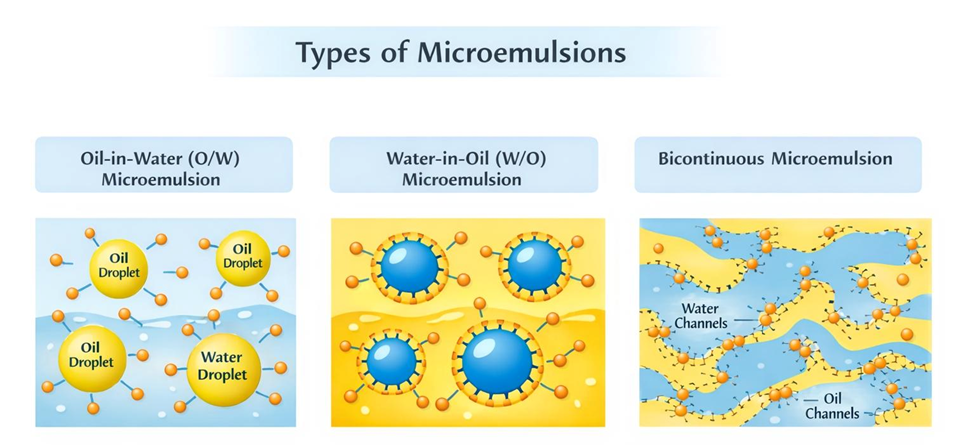
Fig no 1 : Type of microemulsion
In oil-in-water microemulsions, the oil phase is dispersed as fine nanosized droplets within a continuous aqueous phase, stabilized by a surfactant and cosurfactant layer. These systems are particularly suitable for topical and transdermal delivery of lipophilic antifungal drugs because the external aqueous phase provides a non-greasy feel and better patient acceptability.
O/W microemulsions offer enhanced drug solubilization and improved skin permeation by maintaining a high drug concentration gradient at the skin surface. The surfactants used in these systems can interact with the stratum corneum lipids, temporarily disrupting the skin barrier and facilitating deeper drug penetration. Due to their ease of application, low irritation potential, and good spreadability, O/W microemulsions are widely used for topical antifungal formulations.[6]
Water-in-oil microemulsions consist of nanosized aqueous droplets dispersed within a continuous oil phase. The oil phase acts as a penetration enhancer, making these systems particularly useful for delivering drugs through highly resistant biological barriers such as thick skin or nails.
In antifungal therapy, W/O microemulsions are beneficial when prolonged contact with the skin or nail plate is required. The continuous oil phase enhances occlusion, increasing skin hydration and thereby improving drug permeation. However, these systems may exhibit a greasy texture, which can reduce patient compliance for routine topical use. Nevertheless, they are advantageous for delivering hydrophilic antifungal drugs or when deeper penetration is desired.[4]
Bicontinuous microemulsions represent an intermediate structure where both oil and water phases form interpenetrating, continuous domains stabilized by a surfactant film. These systems exhibit dynamic structural flexibility and can solubilize both hydrophilic and lipophilic drugs simultaneously.
Bicontinuous microemulsions are particularly advantageous for antifungal drug delivery because they provide high drug loading capacity and enhanced diffusion pathways. Their unique structure facilitates sustained drug release and improved permeation across the skin barrier. Due to these properties, bicontinuous systems are increasingly explored in advanced topical and transdermal antifungal formulations.[7]
Based on phase behavior, microemulsions are also categorized into four Winsor systems:
DRUG DELIVERY SYSTEMS FOR ANTIFUNGAL THERAPY
Effective drug delivery plays a crucial role in the successful management of fungal infections, as the site of infection often lies within deeper layers of the skin, nails, or mucosal tissues. Conventional antifungal drug delivery systems such as creams, ointments, lotions, and oral dosage forms frequently suffer from limitations including poor drug solubility, low bioavailability, inadequate penetration, systemic side effects, and reduced patient compliance. To overcome these challenges, advanced drug delivery systems have been developed, with microemulsion-based systems emerging as one of the most promising approaches.[8]
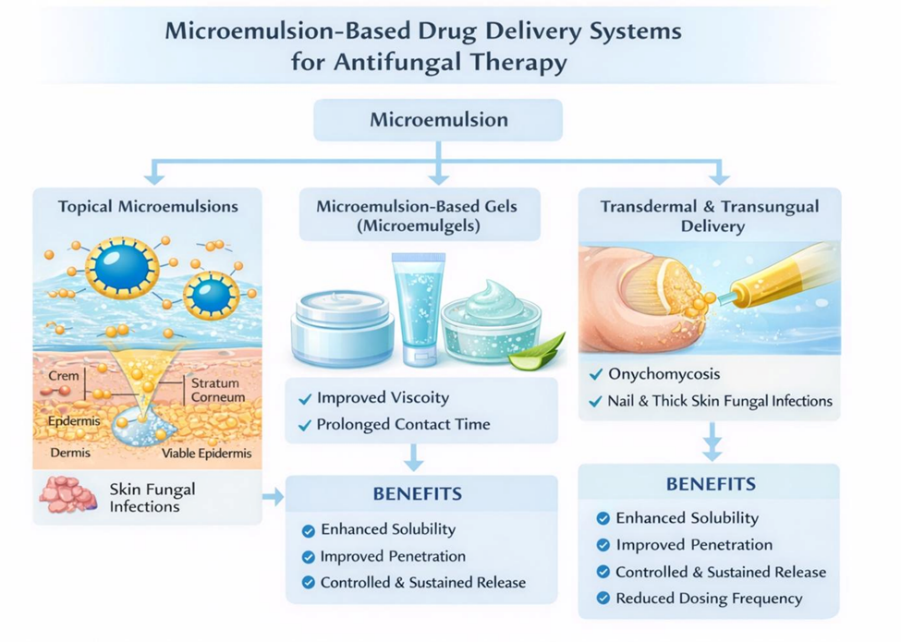
Fig no 2: microemulsions based drug delivery systems fir antifungal therapy
Traditional topical formulations deliver the drug primarily to the skin surface and often fail to achieve sufficient drug concentration at the site of infection. Oral antifungal therapy, although effective in severe cases, may lead to systemic adverse effects, drug interactions, and hepatotoxicity during long-term use. These drawbacks highlight the need for localized, efficient, and safer drug delivery systems[9]
Microemulsion drug delivery systems provide an advanced platform for antifungal therapy due to their thermodynamic stability, nanoscale droplet size, and high solubilization capacity. These systems enhance drug transport across biological barriers by reducing interfacial tension and increasing drug partitioning into the skin. Microemulsions act as reservoirs that maintain a high concentration gradient, promoting sustained and controlled drug release at the site of infection.[10]
Topical microemulsions are designed to deliver antifungal drugs directly to the infected area, minimizing systemic exposure. The presence of surfactants and cosurfactants in microemulsions disrupts the lipid matrix of the stratum corneum, enhancing drug permeation and retention within the skin layers. This approach is particularly beneficial for treating dermatophytosis, candidiasis, and other superficial fungal infections.
To improve viscosity, stability, and ease of application, microemulsions can be incorporated into gel bases using polymers such as Carbopol or HPMC. Microemulgels combine the penetration-enhancing properties of microemulsions with the favorable application characteristics of gels. These systems offer prolonged residence time, controlled drug release, improved patient compliance, and reduced irritation.[9]
Microemulsion systems are increasingly explored for transdermal and transungual antifungal delivery, particularly in the treatment of onychomycosis. Their nanosized droplets and penetration-enhancing components allow better diffusion through the nail plate and thick skin layers, improving therapeutic efficacy where conventional formulations are ineffective.
Enhanced solubility of poorly water-soluble antifungal drugs Improved skin and nail penetration Reduced dosing frequency and side effects High physical and thermodynamic stability Improved patient compliance and therapeutic outcomes[8]
FORMULATION TECHNOLOGIES
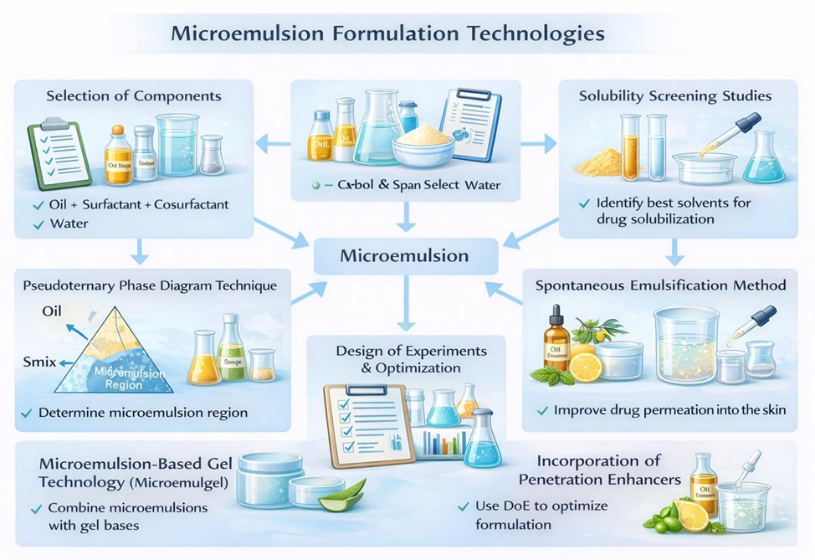
Fig no 3: microemulsions formulation techniques
Formulation technologies play a critical role in the successful development of microemulsion-based antifungal drug delivery systems. The design of a stable and effective microemulsion requires careful selection of formulation components, optimization of their ratios, and application of systematic approaches to ensure desirable physicochemical and therapeutic properties. Recent advancements in formulation technologies have significantly improved the performance, stability, and patient acceptability of microemulsion formulations.[11]
The first and most important step in microemulsion formulation is the selection of suitable components that can efficiently solubilize the antifungal drug and form a stable microemulsion system.
Solubility studies are conducted to identify the oil, surfactant, and cosurfactant that can dissolve the maximum amount of antifungal drug. Excess drug is added to each component, equilibrated, and analyzed. The components showing the highest solubility are selected for further formulation development.[12]
The pseudoternary phase diagram is a key formulation technology used to identify the microemulsion region. It involves plotting the composition of oil, surfactant/co-surfactant mixture (Smix), and water to determine the range of concentrations that form stable microemulsions.
Microemulsions are typically prepared using the spontaneous emulsification method, which does not require high-energy input. The oil phase containing the antifungal drug is mixed with the surfactant and cosurfactant, followed by gradual addition of the aqueous phase with continuous stirring until a clear and transparent system is obtained.[13]
To improve viscosity, spreadability, and residence time on the skin, microemulsions can be incorporated into gel matrices using polymers such as Carbopol 934, Carbopol 940, or HPMC. This technology combines the penetration-enhancing properties of microemulsions with the favorable application characteristics of gels, resulting in improved patient compliance.
Modern formulation development increasingly employs statistical optimization tools such as factorial design, Box-Behnken design, and central composite design. These techniques help evaluate the influence of formulation variables (oil concentration, Smix ratio, water content) on critical quality attributes such as droplet size, viscosity, and drug release.[12]
Certain formulation components such as oleic acid, ethanol, and terpenes act as penetration enhancers by disrupting the lipid structure of the stratum corneum. Their inclusion improves skin permeation and antifungal efficacy without increasing systemic exposure.
Formulation Methods of Microemulsions
This is the most commonly used method for microemulsion formulation. The antifungal drug is dissolved in the oil phase, which is then mixed with a suitable surfactant and co-surfactant (Smix). The aqueous phase is added dropwise under continuous stirring until a clear, transparent, and isotropic system is obtained. Pseudo-ternary phase diagrams are constructed to identify the microemulsion region and optimize component ratios. This method is simple, reproducible, and widely applied in antifungal microemulsion development.[14]
In this method, microemulsions form spontaneously due to the low interfacial tension between oil and water in the presence of surfactants. The oil phase and Smix are mixed first, followed by gradual addition of the aqueous phase with gentle stirring. No external energy input is required, making this method suitable for heat-sensitive antifungal drugs and scalable for industrial production.[15]
The water titration method involves the gradual addition of water to a pre-mixed oil–surfactant–co-surfactant system until a transparent microemulsion forms. This technique is mainly used during formulation optimization to determine water incorporation capacity and stability. It is particularly useful for designing topical and transungual antifungal microemulsions.[16]
This method utilizes temperature-dependent solubility changes of non-ionic surfactants. By altering the temperature, the system undergoes phase inversion from oil-in-water to water-in-oil or vice versa, resulting in microemulsion formation. This technique helps in controlling droplet size and drug solubilization but is less preferred for thermolabile antifungal drugs.[17]
Although microemulsions are thermodynamically stable and do not require high energy, high-pressure homogenization may be used in some cases to ensure uniformity during large-scale production. This method is applied cautiously, as excessive energy is not essential for microemulsion formation.[17.18]
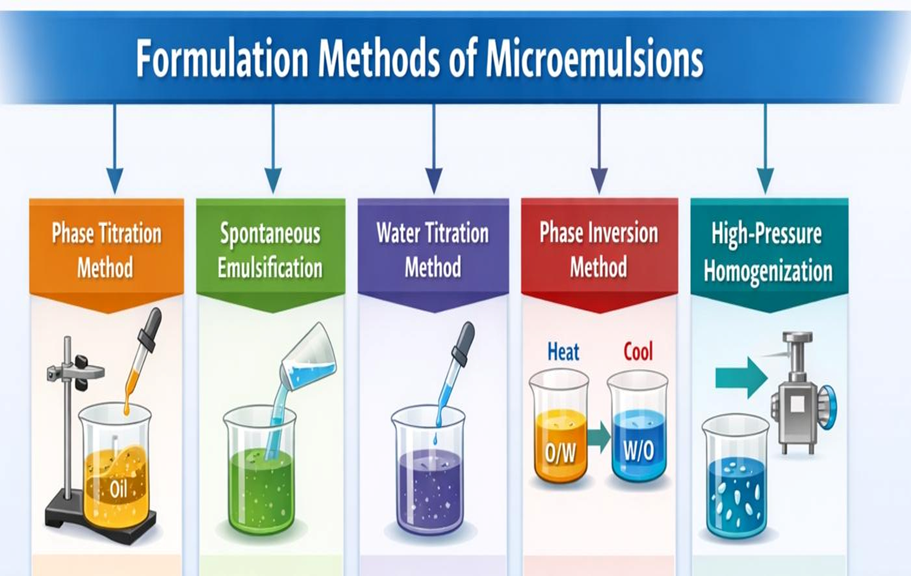
Fig no 4 : formulation method of microemulsion
FORMULATION EVALUATION
The prepared microemulsion is visually examined for clarity, transparency, homogeneity, phase separation, and turbidity. A clear and isotropic appearance indicates successful microemulsion formation.[19]
Droplet size and PDI are determined using dynamic light scattering techniques. Microemulsions typically exhibit droplet sizes below 100 nm with low PDI values, indicating uniform particle size distribution. Smaller droplet size enhances drug solubility and skin permeation.[20]
Zeta potential measurement evaluates the surface charge and stability of the microemulsion. High absolute zeta potential values contribute to electrostatic stabilization and prevent droplet aggregation.[19]
The pH of the formulation is measured using a digital pH meter. For topical antifungal formulations, pH should be maintained within the skin-friendly range (5.5–6.5) to minimize irritation and ensure patient safety.20]
Viscosity is evaluated using a Brookfield viscometer. Proper viscosity ensures ease of application, spreadability, and prolonged retention at the site of application. Microemulsion-based gels should exhibit pseudoplastic or Newtonian flow behavior.[21]
Drug content is analyzed by dissolving a known quantity of formulation in a suitable solvent and measuring absorbance using UV-visible spectroscopy or HPLC. Uniform drug content ensures accurate dosing and formulation consistency.[21]
In vitro drug release is evaluated using Franz diffusion cells or dialysis membrane techniques. The release profile helps assess the rate and extent of drug diffusion from the microemulsion, indicating sustained or controlled release behavior.[23]
Skin permeation studies are performed using excised animal or human skin mounted on Franz diffusion cells. These studies evaluate drug penetration and retention within different skin layers, which is critical for antifungal efficacy.[23]
Stability studies are conducted under different temperature and humidity conditions according to ICH guidelines. Parameters such as droplet size, pH, drug content, and appearance are monitored to ensure long-term stability.[22]
Skin irritation tests are performed to evaluate the safety of the formulation. The absence of erythema, edema, or inflammation confirms the suitability of the microemulsion for topical use.[24]
Marketed Antifungal Formulations :
CONCLUSION
Microemulsion-based formulations represent a promising and advanced approach for the delivery of antifungal drugs, addressing the major limitations associated with conventional dosage forms such as poor solubility, low bioavailability, and inadequate skin or nail penetration. Due to their thermodynamic stability, nanoscale droplet size, and high drug solubilization capacity, microemulsions enhance drug permeation and retention at the site of infection, leading to improved therapeutic efficacy.
The selection of appropriate formulation components, optimization through phase diagram studies, and application of suitable formulation technologies play a crucial role in developing stable and effective microemulsion systems. Comprehensive evaluation parameters further ensure the safety, stability, and performance of these formulations. Overall, microemulsion-based antifungal drug delivery systems offer improved patient compliance, reduced dosing frequency, and superior clinical outcomes, making them a valuable platform for future topical and transdermal antifungal therapies.
REFERENCES

Parth Waghole, Pralhad Tidke, Dr. Sujit Kakade, Dr. Ashok Bhosale, Review on Micro Emulsion Based Drug Delivery System for Anti-Fungal Drug, Int. J. of Pharm. Sci., 2026, Vol 4, Issue 2, 3618-3628. https://doi.org/10.5281/zenodo.18730169
 10.5281/zenodo.18730169
