

We use cookies to ensure our website works properly and to personalise your experience. Cookies policy
1,2,3,4,5B Pharm Graduate, Acharya & BM Reddy College of Pharmacy, Soldevanahalli, Bangalore-560107 Karnataka, India.
6Assistant Professor, Department of Pharmacy Practice, Acharya & BM Reddy College of Pharmacy, Soldevanahalli, Bangalore-560107, Karnataka, India.
Background: Adverse drug reactions (ADRs) are a concern in medication safety, particularly for non-steroidal anti-inflammatory drugs (NSAIDs) which are widely used in both clinical and community healthcare settings. Community pharmacists play a significant role in the recognition of suspected ADRs and in pharmacovigilance through appropriate reporting. However, lack of awareness and limited training and practical barriers may influence their involvement in ADR reporting. Objective: The present study aimed to evaluate the knowledge, attitude and practices of community pharmacists in North Bengaluru regarding ADR reporting, with particular emphasis on NSAID-associated adverse reactions. Materials and Methods: A cross-sectional questionnaire based survey was conducted among 80 community pharmacists of North Bengaluru, Karnataka, India. Data were collected using a structured questionnaire on the demographic characteristics of the participants, their knowledge on ADRs and pharmacovigilance, attitudes toward ADR reporting, workplace practices, reporting barriers and experiences with NSAID associated adverse reactions. Descriptive analysis of the responses collected was done and presented as frequencies and percentages. Results: 89% were knowledgeable about ADRs, but only 38% knew that all severity levels of ADRs should be reported. 78% knew about the Pharmacovigilance Programme of India. 62% knew where to report an ADR. 78% believed they had a responsibility to report ADRs and 76% were interested in participating in PV activities.
Medication safety is a basic determinant of therapeutic quality, as the clinical benefits of medicines must be weighed against their potential risks. Adverse drug reactions (ADRs) are a major cause of preventable morbidity, interruption of treatment, healthcare utilization and economic burden. The safety profile determined prior to marketing cannot predict all outcomes related to general clinical use. However, clinical trials may lack the power to detect rare, delayed or population-specific reactions, and individuals' susceptibility may depend on age, comorbidities, polypharmacy and duration of exposure. Continuous post-marketing surveillance is therefore important for the detection of emerging safety issues and for the promotion of the rational use of medicines.[1-3]
Nonsteroidal anti-inflammatory drugs (NSAIDs) constitute one of the most widely used therapeutic class of drugs, which are employed for the treatment of pain, inflammation and fever. They are widely used in musculoskeletal disorders, inflammatory diseases, postoperative pain and other acute and chronic pain conditions. Their main pharmacological action is inhibition of cyclooxygenase (COX) enzymes, which reduces the synthesis of prostaglandins and related prostanoids. However, these mediators are implicated not only in inflammatory processes, but also in gastrointestinal mucosal protection, renal hemodynamic regulation and vascular homeostasis. Therefore, blockade of COX pathways achieves a therapeutic balance between anti-inflammatory effects and maintenance of essential physiological functions. The extent of this effect is determined by the pharmacological properties, COX selectivity, dose and duration of exposure of the individual NSAIDs.[4-6]
NSAIDs have a broad adverse effects profile. Inhibition of gastric prostaglandin synthesis can lead to damage to the stomach lining, ulcers and bleeding. Reduction in renal prostaglandins may reduce blood flow to the kidneys leading to water retention, electrolyte imbalance and acute renal injury in those at risk. NSAIDs can worsen hypertension and heart failure. Some NSAIDs have been associated with an increased risk of thromboembolic events. Allergic reactions, bronchoconstriction, skin reactions and liver damage can occur with NSAID use. The likelihood and severity of these adverse effects will depend on which drug is used, the dose and length of treatment, but also patient factors, pre-existing disease and concurrent drugs. Careful consideration of appropriate NSAID to prescribe, risk identification in individual patients and prompt detection of suspected adverse effects is important in order to reduce risk.[7-11]
Community pharmacies are a key point of contact for patients using NSAIDs, either through prescription or non-prescription routes. Dispensing, patient counseling and identification of potential medication-related problems by community pharmacists are essential in promoting rational medicine use. Their routine practice may involve inappropriate self-medication, prolonged use of drugs, therapeutic duplication, incorrect dosing and potentially harmful drug combinations. Pharmacists, through appropriate counseling, can raise patient awareness of adverse effects, explain precautions, identify warning symptoms and recommend medical assessment when appropriate. Because they are in frequent contact with people who use medicines, they are also able to identify suspected ADRs and help to monitor the safety of medicines. This responsibility is particularly important for NSAIDs because of their widespread use, which can expose patients to preventable risks that must be adequately identified and monitored.[12-15]
Pharmacovigilance is the science and activities relating to the detection, assessment, understanding and prevention of adverse effects or any other medicine-related problem. Spontaneous reporting of ADRs is an important part of post-marketing surveillance because it allows health care professionals to communicate suspected reactions occurring during routine clinical use. Individual case reports cannot, on their own, establish incidence or causality but their systematic evaluation helps to identify safety signals, characterize known risks and recognize previously unreported reactions. Importantly, the reporting is based on reasonable suspicion rather than definitive proof of causality. Waiting until a causal relationship is established may limit the timely communication of potentially important safety information. Thus, effective pharmacovigilance relies on both accessible reporting mechanisms and the active participation of healthcare professionals.[16-18]
In India, the Pharmacovigilance Program of India (PvPI) provides a national framework for the collection and evaluation of suspected ADR reports to strengthen medicine-safety monitoring . Community pharmacists can contribute to this system by identifying suspected reactions, documenting relevant information and using established reporting channels. However, the existence of a national reporting program does not guaranty consistent participation at the community level. Underreporting may be linked to unawareness of pharmacovigilance programs, uncertainty about reporting procedures, poor training, workload, time constraints and lack of access to reporting facilities. A lack of institutional encouragement and uncertainty about reporting reactions where the causal relationship is not clear may further discourage participation. These barriers may affect the completeness of safety information available and the role of community pharmacists in pharmacovigilance activities.[19-21]
The knowledge, attitude and practice (KAP) framework provides a systematic method to evaluate professional participation in ADR reporting. Knowledge refers to understanding of adverse reactions, risks related to medicines and reporting procedures; attitude refers to perceptions of professional responsibility and readiness to engage in pharmacovigilance and practice refers to the actual recognition, documentation and reporting of suspected reactions. However, it is important to assess these dimensions together, as awareness and favorable attitudes do not necessarily translate into consistent reporting behavior. These may be cross-examined with workplace support and perceived barriers to determine factors influencing the transition from professional awareness to practical engagement.[22,23]
Although ADR reporting among healthcare professionals has been investigated in different settings, the role of community pharmacists in NSAID-related safety surveillance requires further assessment in context. General awareness of ADRs does not necessarily equate to adequate knowledge of NSAID related risks or of the ability to recognize and report suspected reactions. Also, pharmacists’ participation may be influenced by their professional experience, educational background, and workplace reporting facilities. Therefore, assessing these factors in a defined geographical context is important to identify local gaps and understand practical requirements for strengthening pharmacovigilance.[24,25]
The present study entitled “Evaluation of Knowledge, Attitude and Practice Among Community Pharmacists on Adverse Drug Reaction Reporting of NSAIDs in North Bengaluru” was undertaken to evaluate the knowledge, attitudes and practices of community pharmacists in recognizing and reporting ADR with special emphasis on NSAID associated adverse reactions. The study also assesses awareness of pharmacovigilance mechanisms, previous experience of reporting, workplace support and barriers to reporting. This assessment is intended to identify possible gaps between knowledge, attitudes and reporting practices and to provide a scientific basis for enhancing the participation of community pharmacists in medicine-safety surveillance in North Bengaluru.
MATERIALS AND METHODS
2.1 Study Materials and Design
Study Design
A descriptive, cross-sectional, questionnaire-based survey was conducted to assess the knowledge, attitudes, and practices (KAP) of community pharmacists regarding adverse drug reactions (ADRs) associated with non-steroidal anti-inflammatory drugs (NSAIDs).[26]
Study Setting
The study was conducted in selected community pharmacies across North Bengaluru, Karnataka, India. The study locations included Nelamangala, Dasanapura, Madavara, Nagasandra, T. Dasarahalli, Jalahalli East and West, Soldevanahalli, Hesaraghatta, Peenya Phase I and II, Yeshwanthpur, Hebbal, Yelahanka, and Rajajinagara.
Study Duration
The study was conducted over a period of three months.
Study Population and Data Source
The study population comprised registered pharmacists actively employed in community pharmacies within the selected geographical areas. Primary data were collected through face-to-face interviews conducted with eligible participants.[27]
Study Instruments
Data were collected using two structured instruments:
1. Demographic data collection form: A structured form was used to collect participants demographic and professional information, including age, gender, educational qualifications, years of professional experience, and type of pharmacy practice.[28]
2. KAP questionnaire: A structured questionnaire was developed to evaluate community pharmacists' knowledge, attitudes, and practices concerning NSAID-associated ADRs. The questionnaire focused on awareness of common ADRs, identification of potential risk factors, patient counselling, medication safety, and approaches to ADR management.[29]
Eligibility Criteria[30]
Inclusion Criteria
Exclusion Criteria
2.2 Study Methodology
Ethical Approval
Prior to the commencement of the study, ethical approval was obtained from the Institutional Ethics Committee (IEC). The study was conducted in accordance with applicable ethical principles for research involving human participants. Informed consent was obtained from all participants before data collection.[31]
Participant Recruitment and Selection
Eligible community pharmacists were identified and recruited from selected pharmacies within the study area based on the predefined inclusion and exclusion criteria. The purpose and objectives of the study were explained to each participant before obtaining informed consent.[32]
Data Collection Procedure
Data collected from face to face interviews using the demographic form and knowledge attitude and practice (KAP) questionnaire. The questions were based on previous literature and tools used to assess ADR awareness, safe use of NSAIDs and Pharmacovigilance.[33]
Demographic data was collected. In addition, knowledge, attitudes and practices surrounding NSAID-related ADRs were assessed. Specifically, knowledge of NSAID-related ADRs, attitudes towards patient safety and ADR reporting and practices on patient counselling, identification, prevention and management of suspected ADRs were collected.[34]
Statistical Analysis
The collected data were coded, entered and organized by Microsoft excel. Study results were summarized using descriptive statistical methods. Categorical variables were reported as frequencies and percentages and continuous variables were reported using appropriate descriptive statistics. The results were analyzed and interpreted to know the knowledge, attitude and practices of community pharmacists about the NSAID associated ADRs.[35]
RESULT
A.DISTRIBUTION OF PARTICIPANTS BASED ON DEMOGRAPHIC DATA
1.Distribution of participants based on Age Group
Most of participants belongs to age group of 18-24 (n=34, 42%), followed by 25-34 (n=27, 34%). Remaining participants belongs to the age group ≥ 35 as shown in Table No: 01 and Figure No: 01
| Table No: 01 Distribution of Participants based on Age Group | ||
|---|---|---|
| Age group | No. Of participants (n) | Percentage (%) |
| 18-24 | 34 | 42 |
| 25-34 | 27 | 34 |
| 35-44 | 7 | 9 |
| 45-54 | 7 | 9 |
| 55-64 | 4 | 5 |
| 65-74 | 1 | 1 |
| Total | 80 | 100 |
[Figure - see the formatted PDF]
Figure None: 01 Distribution Participants Based on Age Group
2.Distribution of participants based on Gender
In our study 70% of participants were males while remaining participants were females as shown in Table No: 02 and Figure No: 02.
| Table No: 02 Distribution of Participants based on Gender | ||
|---|---|---|
| Gender | No. Of Participants (n) | Percentage (%) |
| Male | 56 | 70 |
| Female | 24 | 30 |
| Total | 80 | 100 |
[Figure - see the formatted PDF]
Figure None: 02 Distribution of Participants Based on Gender
3.Qualification of Participants
In this study, 50% hold Diploma in pharmacy while 42% hold bachelor of pharmacy and remaining holds either Master of Pharmacy or Docter of Pharmacy as shown in Table No: 03 and Figure No: 03.
| Table No: 03 Distribution of Participants based on Qualification | ||
|---|---|---|
| Education | No. Of Participants (n) | Percentage (%) |
| D pharm | 40 | 50 |
| B pharm | 34 | 42 |
| M pharm | 3 | 4 |
| Pharm D | 3 | 4 |
| Total | 80 | 100 |
[Figure - see the formatted PDF]
Figure None: 03 Distribution of Participants Based on Qualification
4.Experience of Participants
Most of participants have an experience of 1-5 years followed by 6-11 years and remaining have ≥ 12 years of experience.
| Table No: 04 Distribution of participants based on Experience | ||
|---|---|---|
| Experience in years | No. Of Participants (n) | Percentage (%) |
| 1-5 | 40 | 49 |
| 6-11 | 16 | 21 |
| 12-17 | 5 | 6 |
| 18-23 | 5 | 6 |
| 24-29 | 9 | 11 |
| 30-34 | 2 | 2 |
| 35-40 | 3 | 4 |
| Total | 80 | 100 |
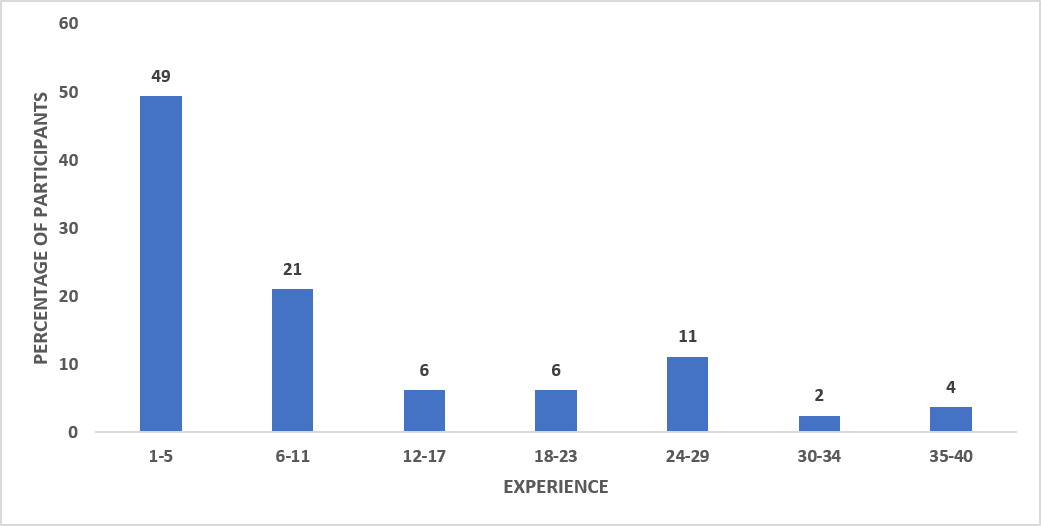
Figure None: 04 Distribution of Participants Based on Experience
B. DISTRIBUTION OF PARTICIPANTS BASED ON RESPONSE TO KNOWLEDGE, ATTITUDE AND PRACTICE QUESTIONNAIRE
Q1. Do you know what are Adverse Drug Reactions?
Description: Out of 80 Participants, Majority of people (n=71, 89%) responded that they knew about ADR while other participants (n=5, 6%) responded they don’t know about ADR and remaining they responded May Be as shown in Table No: 05 and Figure No: 05.
| Table No: 05 Distribution of Responses for Q1 | ||
|---|---|---|
| Responses | No. Of Participants (n) | Percentage (%) |
| Yes | 71 | 89 |
| No | 5 | 6 |
| May be | 4 | 5 |
| Total | 80 | 100 |
[Figure - see the formatted PDF]
Figure None: 05 Distribution of Participants for Q1
Q2. Are you aware about the National Pharmacovigilance Program?
Description: Out of 80 Participants, most of participants (n=63, 78%) responded they are aware of National Pharmacovigilance Program and other participants (n=10, 13%) they are unaware of National Pharmacovigilance Program and remaining responded May Be as shown in Table No: 06 and Figure No: 06.
| Table No: 06 Distribution of Responses for Q2 | ||
|---|---|---|
| Responses | No. Of Participants (n) | Percentage (%) |
| Yes | 63 | 78 |
| No | 10 | 13 |
| May be | 7 | 9 |
| Total | 80 | 100 |
[Figure - see the formatted PDF]
Figure None: 06 Distribution of Participants for Q2
Q3. Do you believe all the drugs available in the market are safe?
Description: In this study, most of participants (n=36, 45%) believed that all drugs available in the market are safe and remaining participants (n=32, 40%) they believed that all drugs available in market are not safe and others believe that it may be safe as shown in Table No: 07 and Figure No: 07.
| Table No: 07 Distribution of Responses for Q3 | ||
|---|---|---|
| Responses | No. Of Participants (n) | Percentage (%) |
| Yes | 36 | 45 |
| No | 32 | 40 |
| May be | 12 | 15 |
| Total | 80 | 100 |
[Figure - see the formatted PDF]
Figure None: 07 Distribution of Participants for Q3
Q4. Do you believe herbal products have no ADRs, i.e. they are safe?
Description: In this study, most of participants (n=41, 51%) believed that herbal products have no ADR or they are safe and remaining of participants (n=25, 31%) believed that herbal products have ADR or they are not safe and other participants believed May Be Safe as shown in Table No: 08 and Figure No: 08.
| Table No: 08 Distribution of Responses for Q4 | ||
|---|---|---|
| Responses | No. Of Participants (n) | Percentage (%) |
| Yes | 41 | 51 |
| No | 25 | 31 |
| May be | 14 | 18 |
| Total | 80 | 100 |
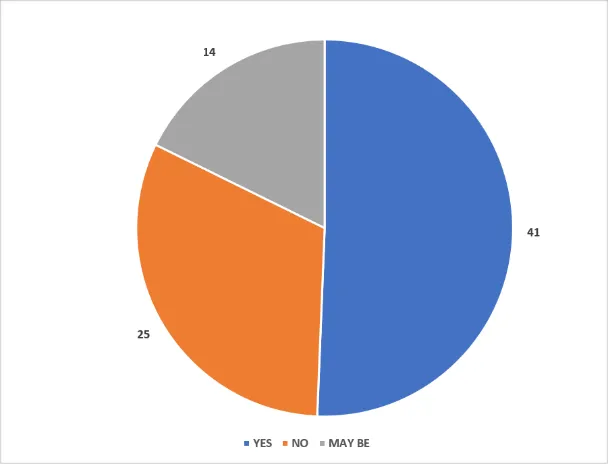
Figure None: 08 Distribution of Participants for Q4
Q5. ADRs associated with herbal drugs should not be reported.
Description: Out of 80 Participants, Majority of participants (n=45, 56%) responded ADRs associated with herbal drugs should not be reported and remaining of participants (n=27, 34%) responded ADRs associated with herbal drugs should be reported and other participants responded May Be reported as shown in Table No: 09 and Figure No: 09.
| Table No: 09 Distribution of Responses for Q5 | ||
|---|---|---|
| Responses | No. Of Participants (n) | Percentage (%) |
| Yes | 45 | 56 |
| No | 27 | 34 |
| May be | 8 | 10 |
| Total | 80 | 100 |
[Figure - see the formatted PDF]
Figure None: 09 Distribution of Participants for Q5
Q6. Which organization is responsible for collecting and monitoring ADR in Pharmacy Council of India?
Description: Out of 80 Participants, most of participants (n=62, 77%) responded that they follow guidelines of CDSCO, remaining follows FDA & WHO guidelines as shown in Table No: 10 and Figure No: 10.
| Table No: 10 Distribution of Responses for Q6 | ||
|---|---|---|
| Distribution of Responses | No. of Participants(n) | Percentage (%) |
| CDSCO | 62 | 77 |
| FDA | 10 | 13 |
| WHO | 8 | 10 |
| TOTAL | 80 | 100 |
[Figure - see the formatted PDF]
Figure None: 10 Distribution of Participants for Q6
Q7. ADRs should be reported only when they are
Description: Out of 80 participants, Majority (n=16, 20%) participants believed that ADRs should be reported only when it will Serious and life threatening and other participants (n=10, 12%) believed ADRs should be reported when it will severe and cause disability while few participants (n=24, 30) responded that Mild and cause less inconvenience and remaining participants (n=30, 38%) believed that ADRs should reported in all forms – mild, severe and even life-threatening as shown in Table No: 11 and Figure No: 11.
| Table No: 11 Distribution of Responses for Q7 | ||
|---|---|---|
| Distribution of Responses | No. Of Participants(n) | Percentage (%) |
| Serious and Life Threatening | 16 | 20 |
| Severe and Cause disability | 10 | 12 |
| Mild and cause less inconvenience | 24 | 30 |
| All of the above | 30 | 38 |
| Total | 80 | 100 |
[Figure - see the formatted PDF]
Figure None: 11 Distribution of Responses for Q7
Q8. Which types of ADRs are usually reported?
Description: Out of 80 Participants, most of participants (n=34, 43%) Usually reported Serious and Life Threatening ADRs while other participants (n=15, 19%) usually reported Severe and Cause disability ADRs, remaining (n=31, 38%) of participants usually reported Mild and cause less inconvenience ADRs as shown in Table 12 No: and Figure No: 12.
| Table No: 12 Distribution of Responses for Q8 | ||
|---|---|---|
| Distribution of Responses | No. of Participants(n) | Percentage (%) |
| Serious and Life Threatening | 34 | 43 |
| Severe and Cause disability | 15 | 19 |
| Mild and Cause less Inconvenience |
31 | 38 |
| TOTAL | 80 | 100 |
[Figure - see the formatted PDF]
Figure None: 12 Distribution of Participants for Q8
Q9. Do you know the nearest pharmacovigilance center located from your working place?
Description: In this study, Most of Participants (n=50, 62%) knew the location of nearest pharmacovigilance center from their work place while others participants (n=23, 29%) don’t know the location of nearest pharmacovigilance center and remaining participants responded May Be as shown in Table No: 13 and Figure No: 13.
| Table No: 13 Distribution of Responses for Q9 | ||
|---|---|---|
| Responses | No. Of Participants(n) | Percentage (%) |
| Yes | 50 | 62 |
| No | 23 | 29 |
| May be | 7 | 9 |
| Total | 80 | 100 |
[Figure - see the formatted PDF]
Figure None: 13 Distribution of Participants for Q9
Q10. Do you think reporting ADRs is a pharmacist duty?
Description: Out of 80 Participants, Majority (n=62, 78%) of people think that reporting of ADRs is a pharmacist duty while others participants (n=13, 16%) think that reporting of ADRs is not pharmacist duty and remaining participants think reporting of ADRs are May Be duty of Pharmacist as shown in Table No: 14 and Figure No: 14.
| Table No: 14 Distribution of Responses for Q10 | ||
|---|---|---|
| Responses | No. Of Participants(n) | Percentage (%) |
| Yes | 62 | 78 |
| No | 13 | 16 |
| May be | 5 | 6 |
| Total | 80 | 100 |
[Figure - see the formatted PDF]
Figure None: 14 Distribution of Participants for Q10
Q11. Do you think serious ADRs encourage pharmacists to report it to the relevant authority?
Description: Out of 80 Participants, Majority (n=62, 77%) of participants think serious ADRs encouraged pharmacists to report it to be relevant authority while other participants (n=12, 15%) think serious ADRs didn’t encouraged pharmacists to report it to be relevant authority and remaining participants think serious ADRs May Be encouraged pharmacists to report to relevant authority as shown in Table No: 15 and Figure No: 15.
| Table No: 15 Distribution of Responses for Q11 | ||
|---|---|---|
| Responses | No. Of Participants(n) | Percentage (%) |
| Yes | 62 | 77 |
| No | 12 | 15 |
| May be | 6 | 8 |
| Total | 80 | 100 |
[Figure - see the formatted PDF]
Figure None: 15 Distribution of Responses for Q11
Q12. Do you believe ADRs reporting should be made mandatory for practicing pharmacists?
Description: Out of 80 Participants, Majority (n=62, 77%) of participants believed that ADRs reporting should be made mandatory for practicing pharmacists while other participants (n=12, 15%) believed ADRs reporting should not be made mandatory for practicing pharmacists and remaining participants believed ADRs reporting May Be made mandatory for practicing pharmacists as shown in Table No: 16 and Figure No: 16.
| Table No: 16 Distribution of Responses for Q12 | ||
|---|---|---|
| Responses | No. Of Participants(n) | Percentage (%) |
| Yes | 62 | 77 |
| No | 12 | 15 |
| May be | 6 | 8 |
| Total | 80 | 100 |
[Figure - see the formatted PDF]
Figure None: 16 Distribution of Responses for Q12
Q13. ADRs reporting in India is not widely promoted by relevant authorities.
Description: In this study, most of participants (n=35, 28%) Disagreed that ADRs reporting in India is not widely promoted by relevant authorities while only (n=8, 10%) strongly agreed and others remain either neutral or agreeing to the statement as shown in Table No: 17 and Figure No: 17.
| Table No: 17 Distribution of Responses for Q13 | ||
|---|---|---|
| Distribution of Responses | No. Of Participants(n) | Percentage (%) |
| Disagree | 35 | 44 |
| Neutral | 20 | 25 |
| Agree | 17 | 21 |
| Strongly agree | 8 | 10 |
| Total | 80 | 100 |
[Figure - see the formatted PDF]
Figure None: 17 Distribution of Participants for Q13
Q14. Are you interested in participating in ADRs reporting system ?
Description: Out of 80 Participants, Most of Participants (n=61,76%) were interested in participating in ADRs reporting system while other participants (n=9, 11%) were not interested in participating in ADRs reporting system and remaining participants May be interested in participating in ADRs reporting system as shown in Table No: 18 and Figure No: 18.
| Table No: 18 Distribution of Responses for Q14 | ||
|---|---|---|
| Responses | No. Of Participants(n) | Percentage (%) |
| Yes | 61 | 76 |
| No | 9 | 11 |
| May be | 10 | 13 |
| Total | 80 | 100 |
[Figure - see the formatted PDF]
Figure None: 18 Distribution of Participants for Q14
Q15. What is your expectation from the pharmacovigilance program?
Description: In this study, Majority of participants (n=39, 49%) expected that Someone from local pharmacovigilance center to coordinate with them while other group participants (n=3, 3%) expected Financial compensation for time and energy spent from pharmacovigilance program and remaining participants (n=38,48%) expected Other services from pharmacovigilance program as shown in Table No: 19 and Figure No: 19.
| Table No: 19 Distribution of Responses for Q15 | ||
|---|---|---|
| Distribution of Responses | No. Of Participants(n) | Percentage (%) |
| Someone from local pharmacovigilance center to coordinate with you | 39 | 49 |
| Financial compensation for time and energy spent | 3 | 3 |
| Other | 38 | 48 |
| Total | 80 | 100 |
[Figure - see the formatted PDF]
Figure None: 19 Distribution of Responses for Q15
Q16. Do you observe any ADRs cases in your practice?
Description: Out of 80 Participants, Most of Participants (n=30, 37%) were observed ADRs cases in their practice and remaining participants (n=50, 63%) were not observed any ADRs cases in their practice as shown in Table No: 20 and Figure No: 20.
| Table No: 20 Distribution of Responses for Q16 | ||
|---|---|---|
| Responses | No. Of Participants(n) | Percentage (%) |
| Yes | 30 | 37 |
| No | 50 | 63 |
| May be | 0 | 0 |
| Total | 80 | 100 |
[Figure - see the formatted PDF]
Figure None: 20 Distribution of Responses for Q16
Q17. If you have observed ADRs cases then to whom have you reported during your practice?
Description: Out of 80 Participants, most of participants (n=23, 29%) responded that they reported ADRs cases to Drug Manufacturer, while other participants reported ADRs cases to HOD of their institute, Government of India and CDSCO and remaining participants reported ADRs cases to other organization as shown in Table No: 21 and Figure No: 21
| Table No: 21 Distribution of Responses for Q17 | ||
|---|---|---|
| Distribution of Responses | No. of Participants(n) | Percentage (%) |
| Drug manufacturer | 23 | 29 |
| HOD of institute | 20 | 25 |
| Government Of India | 8 | 10 |
| CDSCO | 9 | 11 |
| Other | 20 | 25 |
| Total | 80 | 100 |
[Figure - see the formatted PDF]
Figure None: 21 Distribution of Response for Q17
Q18. Is ADR reporting form available at your workplace?
Description: In this study, most of participants (n=37, 46%) responded Sometimes they reported ADR in their workplace while other participants (n=19, 24%) responded that they always reported ADR in their workplace and remaining participants responded that they reported ADR Rarely or Never or often as shown in Table No: 22 and Figure No: 22.
| Table No: 22 Distribution of Responses for Q18 | ||
|---|---|---|
| Distribution of Responses | No. Of Participants(n) | Percentage (%) |
| Always | 19 | 24 |
| Often | 4 | 5 |
| Sometimes | 37 | 46 |
| Rarely | 4 | 5 |
| Never | 16 | 20 |
| Total | 80 | 100 |
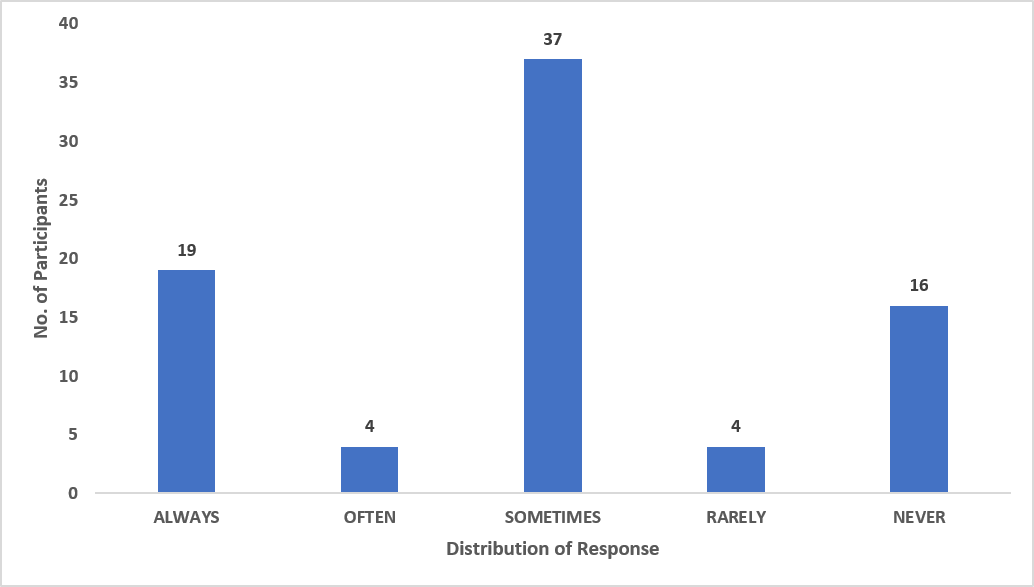
Figure None: 22 Distribution of Response for Q18
Q19. Does your workplace provide information regarding the procedure of reporting ADRs?
Description: Out of 80 participants, most of participants (n=44, 55%) responded that their work place provided information regarding the procedure of reporting of ADRs while other participants (n=25, 31%) responded that their work place don’t provide information and remaining participants responded that their workplace May Be provided information regarding the procedure of reporting ADRs as shown in Table 23 and Figure 23.
| Table No: 23 Distribution of Responses for Q19 | ||
|---|---|---|
| Responses | No. Of Participants(n) | Percentage (%) |
| Yes | 44 | 55 |
| No | 25 | 31 |
| May be | 11 | 14 |
| Total | 80 | 100 |
[Figure - see the formatted PDF]
Figure None: 23 Distribution of Responses for Q19
Q20. Do you feel that you are adequately trained in ADR reporting?
Description: Out of 80 participants, most of participants (n=46, 57%) felt that they are adequately trained in ADR reporting while other participants (n=16, 20%) felt that they were not adequately trained in ADR reporting and remaining participants felt that sometimes they May Be trained in ADR reporting as shown in Table No: 24 and Figure No: 24.
| Table No: 24 Distribution of Responses for Q20 | ||
|---|---|---|
| Responses | No. of Participants(n) | Percentage (%) |
| YES | 46 | 57 |
| NO | 16 | 20 |
| MAY BE | 18 | 23 |
| TOTAL | 80 | 100 |
[Figure - see the formatted PDF]
Figure None: 24 Distribution of Participants for Q20
Q21. Does your workplace encourage you to report an ADR?
Description: In this study, Majority of participants (n=48, 60%) encouraged to report ADR in their workplace and remaining participants didn’t encourage to report ADR in their workplace as shown in Table No: 25 and Figure No: 25.
| Table No: 25 Distribution of Responses for Q21 | ||
|---|---|---|
| Responses | No. of Participants(n) | Percentage (%) |
| YES | 48 | 60 |
| NO | 18 | 22 |
| MAY BE | 14 | 18 |
| TOTAL | 80 | 100 |
[Figure - see the formatted PDF]
Figure None: 25 Distribution of Participants for Q21
C. DISTRIBUTION OF RESPONSES BASED ON BARRIERS IN ADR REPORTING DATA
Q22. Approximately how many NSAID prescriptions or sales do you handle per day?
Description: Out of 80 participants, most of participants (n=58, 72%) handled less than 10 NSAIDs prescriptions per day while other participants (n=12, 15%) handled more than 10 NSAIDs prescriptions per day and remaining participants handled more than 50 NSAIDs prescriptions per day as shown in Table No: 26 and Figure No: 26.
| Table No: 26 Distribution of Responses based on Q22 | ||
|---|---|---|
| Responses | No. Of Participants(n) | Percentage (%) |
| Less than 10 | 58 | 72 |
| 10 to 20 | 12 | 15 |
| 21 to 50 | 7 | 9 |
| More than 50 | 3 | 4 |
| Total | 80 | 100 |
[Figure - see the formatted PDF]
Figure 26: Distribution of Participants for Q22
Q23. Which of the problems do you face while reporting ADRs in your workplace?
Description: In this study, most of participants (n=29, 36%) faced problems like sometimes patients didn’t provide any information or Pharmacists doesn’t have enough time or Unaware of existence of ADR reporting system or Pharmacists have fear or legal problem or unaware of need to report ADR or ADR reporting in India is not widely promoted by relevant authorities and remaining participants responded they faced individual problem of above as shown in Table No:27 and Figure No: 27.
| Table No: 27 Distribution of Responses based on Q23 | ||
|---|---|---|
| Responses | No. Of Participants(n) | Percentage (%) |
| Lack of information provided by patient | 20 | 25 |
| Pharmacist does not have enough time | 13 | 16 |
| Unaware of the existence of a national ADR reporting system | 5 | 6 |
| Unaware of the need to report an ADR | 7 | 9 |
| ADR reporting in India is not widely promoted by relevant authorities | 5 | 6 |
| Fear of facing legal problems | 1 | 1 |
| All of the above | 29 | 37 |
| Total | 80 | 100 |
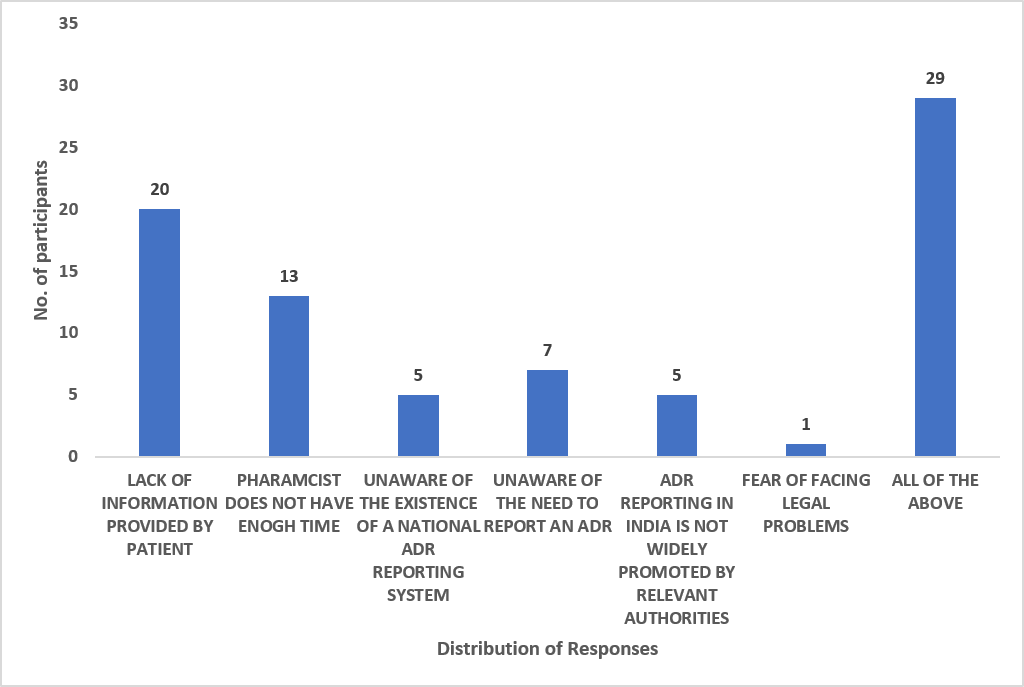
Figure None: 27 Distribution of Participants for Q23
Q24. Have you ever encountered an adverse drug reaction caused by NSAIDs in your pharmacy practice?
Description: Out of 80 participants, most of participants (n=53, 66%) have encountered an ADR caused by NSAIDs in their pharmacy practice and remaining participants haven’t encountered an ADR caused by NSAIDS in their practice as shown in Table No: 28 and Figure No: 28.
| Table No: 28 Distribution of Responses for Q24 | ||
|---|---|---|
| Responses | No. Of Participants(n) | Percentage (%) |
| Yes | 53 | 66 |
| No | 27 | 34 |
| May be | 0 | 0 |
| Total | 80 | 100 |
[Figure - see the formatted PDF]
Figure None: 28 Distribution of Participants for Q24
Q25. Among the NSAIDs you dispense, which ones do you think are most commonly associated with ADRs?
Description: Out of 80 participants, most of participants (n=40, 50%) responded paracetamol is most commonly associated with ADRs and remaining participants responded other NSAIDs as shown in Table No: 29 and Figure No: 29.
| Table No: 29 Distribution of Responses for Q25 | ||
|---|---|---|
| Responses | No. of Participants (n) | Percentage (%) |
| PARACETAMOL | 40 | 50 |
| IBUPROFEN | 8 | 10 |
| ACYCLOFENAC | 8 | 10 |
| DICLOFENAC | 11 | 14 |
| ASPIRIN | 5 | 6 |
| ZOLPIDIEM | 3 | 4 |
| KETOROLAC | 2 | 2 |
| NIMESULIDE | 3 | 4 |
| TOTAL | 80 | 100 |
[Figure - see the formatted PDF]
Figure None: 29 Distribution of Participants for Q25
Q26. Which NSAIDs do you commonly sell or dispense in your pharmacy?
Description: Out of 80 participants, most of participants (n=27, 33%) dispensed paracetamol in their pharmacy and remaining participants dispensed other NSAIDs as shown in Table No: 30 and Figure No: 30.
| Table No: 30 Distribution of Responses for Q26 | ||
|---|---|---|
| Responses | No. Of Participants (n) | Percentage (%) |
| Paracetamol | 27 | 33 |
| Ibuprofen | 4 | 5 |
| Acyclofenac | 8 | 10 |
| Diclofenac | 18 | 23 |
| Aspirin | 22 | 28 |
| Ketorolac | 1 | 1 |
| Total | 80 | 100 |
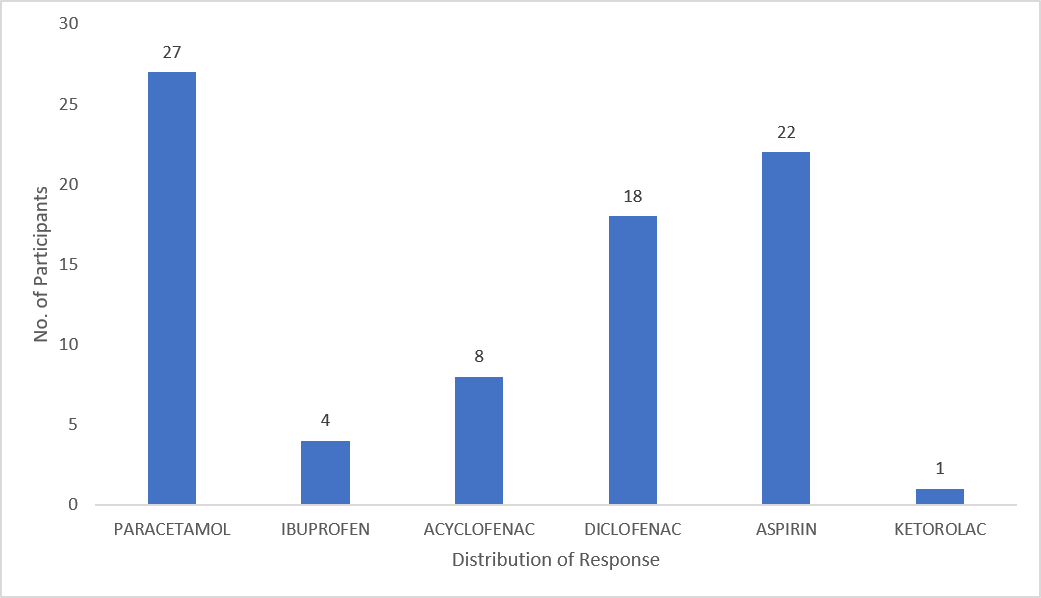
Figure None: 30 Distribution of Responses for Q26
DISCUSSION
The present study evaluated the knowledge, attitude and practice of 80 community pharmacists of North Bengaluru toward adverse drug reaction (ADR) reporting with special reference to NSAID associated reactions. The results show a relatively high level of basic knowledge in pharmacovigilance but also a lack of knowledge and practice in reporting.
Most of the participants were aware of the concept of ADRs (89%) and were aware of the national pharmacovigilance program (78%). However, only 62% were aware of the location of the nearest pharmacovigilance center. Thus, general awareness did not necessarily translate into knowledge about accessible reporting facilities. Furthermore, only 38% agreed that ADRs of all seriousness categories should be reported. The prioritization of serious and life threatening reactions is a tendency that may limit the collection of wider safety information and reflects a need to reinforce understanding of principles of spontaneous ADR reporting .
Attitude related responses were relatively favorable. Around 78% of the respondents felt that ADR reporting was a professional responsibility and 76% were willing to participate in pharmacovigilance activities. Also, 77% supported mandatory ADR reporting for pharmacists in practice. However, these positive perceptions are not necessarily translated into consistent reporting practices. The gap between the professionals’ willingness and practical participation is consistent with the finding reported by Ahmad et al. and Alwidyan et al. who found gaps between pharmacists’ pharmacovigilance awareness and actual reporting behavior .
Findings related to work environment show that although 57% felt appropriately trained and 60% felt encouraged within their workplace, 31% felt that they did not receive any information from their workplace on ADR reporting. Reasons for this included insufficient patient information (25%), not enough time (16%) and lack of knowledge of reporting requirements. It seems that without appropriate training, instructions and support, individuals may lack sufficient knowledge to report ADRs.
Responses on NSAID-related responses showed that 66% of the participants experienced suspected NSAID-associated ADRs in their practice. This highlights the role of community pharmacists in identifying possible medicine-related safety issues. The pharmacists play a key role in the identification of suspected reactions and in facilitating appropriate reporting in view of the known gastrointestinal, renal and cardiovascular risks associated with NSAIDs. The knowledge of NSAID-related adverse effects among pharmacists had been also emphasized in previous studies by Barakat et al. and Kasim et al.
The study shows a gap between pharmacovigilance awareness, favorable attitudes and effective reporting practices in general. Access to recognized reporting channels, practical training and closer coordination with pharmacovigilance centers can improve the participation of community pharmacists in ADR surveillance. These measures may help in better monitoring the safety concerns of NSAID use and promote rational use of medicine.
CONCLUSION
This study assessed the knowledge, attitude and practices of community pharmacists in North Bengaluru towards adverse drug reactions (ADRs) including ADRs associated with non-steroidal anti-inflammatory drugs (NSAIDs). Although many participants (89%) had knowledge of ADRs, not all had knowledge of Pharmacovigilance in India (78%). It was found that only 38% of participants acknowledged that all severities of ADRs should be reported suggesting they primarily associate reporting ADRs with serious ADRs. A positive attitude was shown by 78% of participants who felt it is their professional responsibility to report ADRs. 76% were willing to be involved in pharmacovigilance activities. However, factors such as lack of knowledge on how to report ADRs, lack of information from patients, time constraints and lack of constant support in the workplace limited actual ADR reporting. 66% of participants had identified potential ADRs associated with NSAIDs in practice. Therefore, community pharmacists are key individuals to identify potential safety issues relating to medicines. To increase pharmacovigilance in this population, regular educational sessions, training on identifying and recording ADRs, easier access to standardised reporting forms, and clearer information on which channels to report to are required. Close cooperation between community pharmacists, health care facilities and Pharmacovigilance Centres may improve ADR reporting. Overall, although increasing knowledge in pharmacists may help, additional support within the workplace, easily available reporting methods and continued pharmacist engagement with Pharmacovigilance may be required to improve Pharmacovigilance practices. Improving these factors may improve the contribution of community pharmacists to monitoring ADRs associated with NSAIDs, encourage rational use of medicine, and improve patient safety in community environments.
REFERENCES






Arnab Kuity, Aiswarya Shaji, Saikat Banerjee, Simonti Basak Sithi, Soumily Dinda, Mohan Kumar L., Evaluation of Knowledge, Attitude and Practice Among Community Pharmacists on Adverse Drug Reaction Reporting of NSAIDs in North Bengaluru, Int. J. of Pharm. Sci., 2026, Vol 4, Issue 11, 5575-5598. https://doi.org/10.5281/zenodo.24581388
 10.5281/zenodo.24581388