

We use cookies to ensure our website works properly and to personalise your experience. Cookies policy
Dayanand Institute Of pharmacy, Latur.
The effective delivery of therapeutic agents to the central nervous system (CNS) remains a major challenge because of the blood–brain barrier (BBB), which restricts the penetration of many drugs into brain tissue. Intranasal drug delivery has emerged as a promising, non-invasive approach for brain targeting because drugs administered through the nasal cavity may reach the brain through olfactory and trigeminal pathways while reducing dependence on systemic circulation. However, rapid mucociliary clearance, limited nasal residence time, enzymatic degradation and restricted absorption can reduce the efficiency of conventional nasal formulations. Hydrogel-based intranasal delivery systems have therefore received increasing attention. Hydrogels can provide mucoadhesion, prolonged nasal residence, controlled drug release and improved protection of therapeutic molecules. In particular, thermosensitive and mucoadhesive hydrogels prepared using polymers such as chitosan, poloxamer 407, poloxamer 188, carbopol, alginate and hyaluronic acid have been investigated for nose-to-brain delivery. Chitosan is especially attractive because of its biocompatibility, biodegradability, mucoadhesive properties and ability to enhance epithelial permeation. Recent studies have also combined hydrogels with nanoparticles, lipid carriers and other nanocarriers to improve drug stability, retention and brain delivery. This review discusses the principles, advantages, polymers, preparation methods, evaluation parameters, therapeutic applications, limitations and future prospects of hydrogel-based intranasal systems for neurotherapeutics.
The treatment of neurological and neurodegenerative disorders is complicated by the difficulty of delivering therapeutic molecules to the brain. The blood–brain barrier is a highly selective physiological barrier that restricts the entry of many hydrophilic, high-molecular-weight and enzymatically unstable drugs into the CNS. Consequently, drugs administered by conventional oral or parenteral routes may show limited brain exposure. Intranasal administration has emerged as an alternative strategy because the nasal cavity provides anatomical connections with the CNS through the olfactory and trigeminal pathways.
The nose-to-brain approach is particularly attractive because it is non-invasive and may reduce dependence on systemic drug circulation. However, conventional nasal solutions and suspensions are rapidly removed from the nasal cavity by mucociliary clearance. Short residence time can consequently reduce drug absorption and therapeutic efficiency. In situ hydrogels are designed to address this limitation by undergoing a sol-to-gel transition after administration and remaining at the nasal mucosal surface for a longer period. Hydrogels are three-dimensional polymeric networks capable of absorbing and retaining substantial amounts of water. For intranasal administration, the formulation can be designed as a low-viscosity liquid that is easy to administer and subsequently converts into a gel under physiological conditions. Thermosensitive hydrogels are particularly useful because they can undergo temperature-dependent gelation after contact with the nasal mucosa.
Chitosan-based systems have attracted considerable interest because chitosan exhibits mucoadhesive and permeation-enhancing properties. Recent literature has specifically highlighted chitosan-based hydrogels for intranasal treatment of conditions such as Alzheimer's disease, Parkinson's disease, epilepsy, ischemia and other CNS disorders.
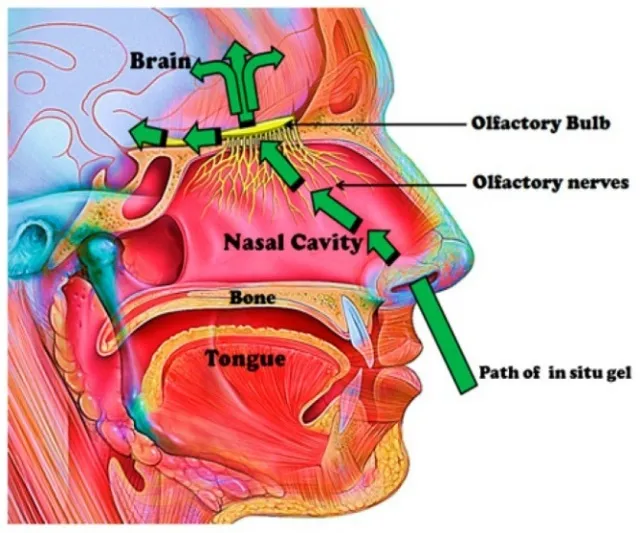
FIG: NASAL CAVITY
2. Principle of Intranasal Nose-to-Brain Delivery
Following intranasal administration, a drug may be absorbed into systemic circulation through the nasal epithelium or transported toward the brain through pathways associated with the olfactory and trigeminal nerves. The olfactory region provides a potential anatomical connection between the nasal cavity and CNS, whereas the trigeminal pathway provides another route toward brain regions.
The basic mechanism can be represented as:
Drug-loaded hydrogel → Intranasal administration → Gel formation → Increased nasal residence → Nasal epithelial interaction → Olfactory/trigeminal pathways → CNS/brain
The hydrogel can increase residence time and provide controlled drug release. Mucoadhesive polymers may interact with mucin present on the nasal surface, reducing the rate at which the formulation is removed. Chitosan may additionally enhance epithelial permeability through interactions with the negatively charged components of the mucosal surface. It is important to note that intranasal administration does not automatically guarantee direct brain delivery. The actual extent of nose-to-brain transport depends on drug properties, formulation characteristics, deposition site, nasal physiology and experimental conditions. Recent reviews therefore emphasize quantitative assessment of brain exposure rather than assuming that increased nasal absorption necessarily represents direct CNS targeting.
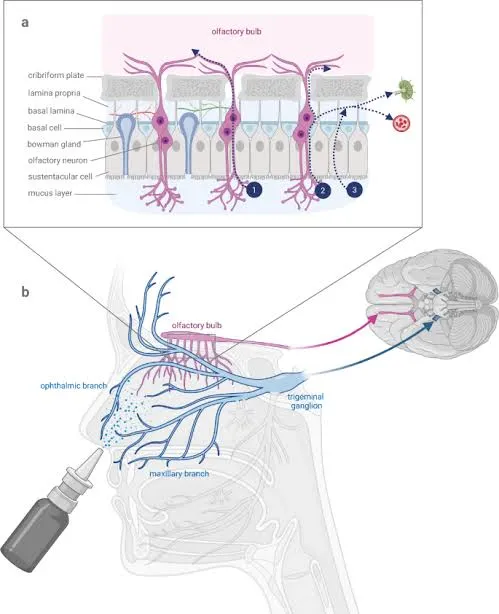
FIG: Nose-to-Brain Delivery
3. Hydrogel-Based Intranasal Delivery System
A hydrogel-based intranasal system generally consists of:
• Hydrogel-forming polymer
• Mucoadhesive polymer
• Buffer/pH-adjusting agent
• Tonicity-adjusting agent
• Optional permeation enhancer or nanocarrier
The formulation can be developed as either a conventional preformed hydrogel or an in situ gelling system. In situ gels are especially attractive because they can be administered as liquids and form a gel after exposure to physiological conditions.
Important polymers
Chitosan: A natural polysaccharide with good biocompatibility and biodegradability. It possesses mucoadhesive and permeation-enhancing characteristics and has been widely investigated for nasal and nose-to-brain delivery.
Poloxamer 407: A thermoresponsive polymer frequently used to prepare nasal in situ gels. It can provide a liquid-to-gel transition near physiological temperature.
Poloxamer 188: Often combined with poloxamer 407 to modify gelation temperature, viscosity and rheological properties.
Carbopol: A cross-linked polymer that provides strong mucoadhesion and can be used in pH-responsive nasal systems.
Alginate: A natural polymer that can provide gel-forming and mucoadhesive characteristics.
Hyaluronic acid: A biocompatible polymer that can improve hydration and mucoadhesion and is investigated in CNS drug delivery systems.
Stimuli-responsive nasal gels may be designed to respond to temperature, pH or ionic conditions.
4. Method of Preparation
4.1 Preparation of a Thermosensitive Hydrogel
A general laboratory procedure for a thermosensitive intranasal hydrogel is as follows.
Step 1: Selection of drug and polymers
A suitable neurotherapeutic drug is selected according to its therapeutic objective, dose, stability, solubility and suitability for intranasal administration. Chitosan and poloxamer can be selected as representative polymers.
Step 2: Preparation of polymer solution
The required quantity of chitosan is dispersed or dissolved in a suitable aqueous acidic medium under continuous stirring. The solution is allowed to hydrate completely.
Step 3: Preparation of poloxamer solution
Poloxamer 407 is gradually added to cold purified water with continuous stirring. The mixture is maintained at a low temperature, commonly using a cold-storage method, to facilitate polymer hydration and minimize premature gel formation.
Step 4: Drug incorporation
The neurotherapeutic drug is dissolved or uniformly dispersed in a suitable portion of the formulation. If the drug has poor aqueous solubility, an appropriate pharmaceutical solubilization strategy or nanocarrier can be incorporated.
Step 5: Mixing
The drug solution and polymer solutions are combined under controlled stirring to obtain a homogeneous formulation.
Step 6: pH and isotonicity adjustment
The pH is adjusted to a range suitable for nasal administration, while osmolarity is optimized to minimize irritation.
Step 7: Removal of air bubbles
The formulation is allowed to stand under refrigerated conditions or subjected to an appropriate deaeration process to remove entrapped air.
Step 8: Storage
The prepared formulation is stored under appropriate temperature conditions until characterization.
A representative formulation-development concept is:
Neurotherapeutic drug + chitosan + poloxamer 407 + aqueous vehicle → homogeneous liquid formulation → intranasal administration → temperature-triggered gel formation.
A published study investigating an intranasal thermosensitive system for Alzheimer's disease used poloxamer 407 and poloxamer 188 and selected a P407/P188 formulation after investigating gelation temperature, osmolarity and compatibility with the olfactory mucosa.
4.2 Nanoparticle-Loaded Hydrogel
An advanced approach is to first prepare drug-loaded nanoparticles and subsequently incorporate them into the hydrogel.
Drug → Nanoparticle preparation → Nanoparticle purification → Characterization → Incorporation into hydrogel → Intranasal administration
For example, chitosan nanoparticles can be prepared by ionic gelation or other suitable techniques and incorporated into a poloxamer-based thermosensitive hydrogel. Such composite systems aim to combine the drug-protection and targeting properties of nanoparticles with the prolonged residence and controlled release provided by the hydrogel.
Recent research has investigated poloxamer 407 hydrogels containing thiolated chitosan nanoparticles for intranasal galantamine delivery, demonstrating the potential of combining nanoparticle and hydrogel technologies.
Similarly, chitosan/guar gum thermoreversible hydrogels containing drug-loaded nanoparticles have been investigated to improve residence and nose-to-brain delivery.
5. Evaluation of Intranasal Hydrogel
The prepared formulation should be evaluated using appropriate pharmaceutical and biological tests.
5.1 Physical appearance
The formulation should be examined for colour, clarity, homogeneity, phase separation and particulate matter.
5.2 pH
The pH should be suitable for nasal administration and should minimize irritation to the nasal mucosa.
5.3 Drug content
Drug content and content uniformity should be determined to ensure accurate dosing.
5.4 Gelation temperature
For thermosensitive formulations, the sol-to-gel transition temperature is an important parameter. The formulation should remain sufficiently fluid during administration and form a stable gel after reaching the nasal physiological environment.
5.5 Rheological evaluation
Viscosity, storage modulus (G′) and loss modulus (G″) can be investigated. These measurements help determine whether the formulation has suitable flow during administration and adequate gel strength after administration.
5.6 Mucoadhesive strength
Mucoadhesion can be evaluated using nasal mucosal tissue or an appropriate laboratory model. Adequate mucoadhesion can increase residence time but excessive viscosity or adhesion may interfere with administration or drug diffusion.
5.7 In-vitro drug release
Drug release can be evaluated using an appropriate diffusion system. Mathematical models such as zero-order, first-order, Higuchi and Korsmeyer–Peppas models may be used to investigate release kinetics.
5.8 Ex-vivo permeation
Excised nasal mucosa can be used to investigate drug permeation and formulation–mucosa interaction.
5.9 Nasal toxicity and histopathology
Nasal irritation and tissue damage must be evaluated before considering further development. Histopathological assessment can identify epithelial damage or inflammatory changes.
5.10 In-vivo brain targeting
Animal studies may investigate plasma and brain drug concentrations, pharmacokinetic parameters and brain-targeting indices. Behavioural or disease-specific endpoints can be incorporated when scientifically justified.
6. Applications in Neurotherapeutics
Hydrogel-based intranasal systems have been investigated for multiple CNS disorders.
Alzheimer's disease
Alzheimer's disease is one of the major areas of research for nose-to-brain delivery. Intranasal hydrogel systems can potentially improve the delivery of drugs whose brain exposure is limited following systemic administration. Recent research has investigated chitosan and poloxamer-based systems for drugs such as galantamine, rivastigmine and other candidate therapeutics.
Parkinson's disease
The delivery of dopaminergic drugs to the brain is complicated by pharmacokinetic limitations and restricted CNS exposure. Chitosan nanoparticle-loaded thermoreversible gels and other intranasal systems have been investigated as approaches for improving brain delivery of dopaminergic agents.
Epilepsy
Intranasal formulations may provide a rapid route for delivery of anticonvulsant drugs to the CNS. Hydrogel systems can potentially provide controlled release while maintaining the drug at the nasal mucosa.
Brain tumors
Intranasal delivery has also been investigated for brain tumor therapeutics because the route may provide an alternative means of increasing local CNS exposure while reducing dependence on systemic administration.
Other neurological disorders
Research has also investigated intranasal hydrogel systems for ischemic conditions, depression, schizophrenia and other neurological disorders. A recent review specifically summarizes applications of chitosan-based intranasal hydrogels across Alzheimer's disease, Parkinson's disease, depression, ischemia, brain tumors, epilepsy, seizures and schizophrenia.
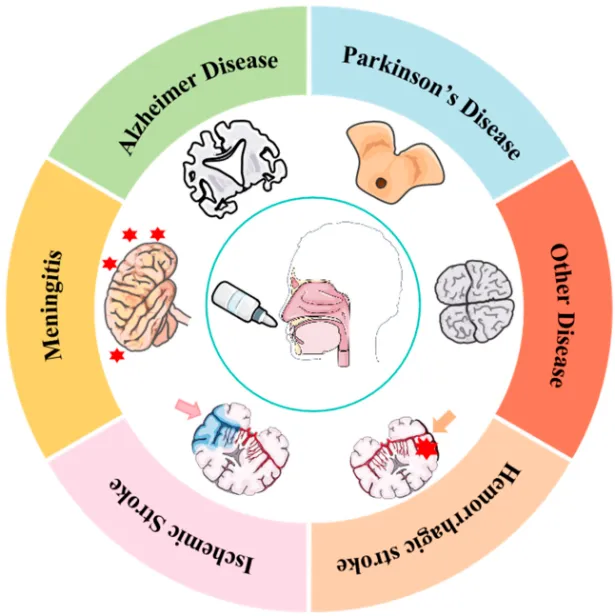
FIG :Neurotherapeutics
7. Advantages
Hydrogel-based intranasal delivery systems provide several potential advantages:
1. Non-invasive route of administration.
2. Potential for nose-to-brain drug transport.
3. Reduced dependence on the blood–brain barrier.
4. Increased nasal residence time.
5. Controlled and sustained drug release.
6. Potential reduction of systemic exposure.
7. Avoidance of gastrointestinal degradation and hepatic first-pass metabolism for drugs administered intranasally.
8. Compatibility with nanoparticles and other advanced delivery systems.
9. Potential improvement in the delivery of poorly brain-penetrating therapeutic molecules.
The major advantages of in situ nasal gels arise from their ability to reduce mucociliary clearance and prolong contact between the formulation and nasal mucosa.
8. Limitations and Challenges
Despite promising results, several challenges remain. The nasal cavity has a relatively small administration volume and possesses efficient mucociliary clearance. Excessively viscous formulations may interfere with administration and drug diffusion. Repeated administration may also raise concerns about local irritation and long-term mucosal safety.
Another major challenge is variability in nasal anatomy and physiology between individuals and between experimental animals and humans. Formulation deposition is also influenced by the administration device and spray characteristics. Recent research on hydrogel-based nasal sprays emphasizes the importance of viscosity, droplet size, spray dynamics and deposition pattern in determining delivery performance.
Importantly, promising animal studies do not necessarily predict clinical success. Appropriate pharmacokinetic studies, brain-distribution measurements, long-term toxicity studies, formulation stability studies and well-designed clinical trials are necessary before therapeutic translation.
9. Future Perspectives
Future development is likely to focus on multifunctional systems that combine hydrogels with nanoparticles, lipid carriers, nanogels or biomimetic vesicles. Such systems may simultaneously improve drug protection, nasal retention, controlled release and CNS exposure.
Smart hydrogels responsive to temperature, pH or other physiological stimuli may allow more precise control of drug release. Sprayable hydrogel formulations and improved nasal delivery devices may further enhance deposition in the desired nasal region. Recent reviews have emphasized the integration of nanocarriers into hydrogel nasal sprays and optimization of spray characteristics as important directions for future development.
The use of chitosan derivatives, including thiolated chitosan, may also improve mucoadhesion and retention. Recent experimental work with galantamine-loaded thiolated chitosan nanoparticles incorporated into poloxamer hydrogel demonstrates this direction of development.
SUMMARY
Hydrogel-based intranasal delivery represents an important emerging strategy for the delivery of neurotherapeutics. The approach combines the advantages of the intranasal route with the prolonged residence and controlled-release properties of hydrogels. Thermosensitive systems are particularly attractive because they can be administered as liquids and undergo gelation after exposure to physiological conditions. Chitosan is a promising polymer because of its mucoadhesive, biocompatible and permeation-enhancing characteristics, while poloxamer polymers can provide useful thermoresponsive behaviour.
The incorporation of nanoparticles, lipid carriers and other nanocarriers into hydrogels provides an additional opportunity to improve drug stability, controlled release and brain exposure. However, formulation optimization must balance mucoadhesion, viscosity, gelation temperature, drug release, nasal safety and brain targeting. Further standardized preclinical and clinical studies are required to establish the actual therapeutic benefit of these systems.
CONCLUSION
Hydrogel-based intranasal delivery systems offer a promising platform for the development of non-invasive neurotherapeutic delivery. By increasing nasal residence time and controlling drug release, hydrogels may overcome some of the limitations associated with conventional intranasal formulations. The olfactory and trigeminal pathways provide potential routes for CNS delivery, while polymers such as chitosan and poloxamer can be engineered to provide mucoadhesion and stimulus-responsive gelation.
Current research increasingly favors composite systems in which nanoparticles or lipid carriers are incorporated into hydrogels. Nevertheless, nose-to-brain delivery should not be considered synonymous with guaranteed direct brain targeting. Robust characterization of brain exposure, nasal safety, pharmacokinetics and therapeutic outcomes remains essential. With continued advances in polymer science, nanotechnology and nasal delivery devices, hydrogel-based intranasal systems may become an important component of future CNS drug-delivery research.
REFERENCES



Todkar Ganesh, Anvirappa Katte, Shredatta Shetkar, Ramprasad Khandare, Nikita Kale, Dnyaneshwari Marlapalle, Amarja Bhoge, Hydrogel-Based Intranasal Delivery System for Neurotherapeutics: A Review, Int. J. of Pharm. Sci., 2026, Vol 4, Issue 11, 486-493. https://doi.org/10.5281/zenodo.23924191
 10.5281/zenodo.23924191