

We use cookies to ensure our website works properly and to personalise your experience. Cookies policy
Matoshri College of Pharmacy Eklahare Nashik, Savitribai Phule Pune University, Pune, Maharashtra, India.
Iron Deficiency Anaemia (IDA) is one of the most prevalent nutritional disorders globally, especially among children in developing nations. It might impact physical growth and cognitive development in addition to affecting the well-being of children. The causes include lack of iron intake through food, increased demand for iron, low absorption of iron and loss of iron from the body. Children with IDA can suffer from symptoms such as pale skin, tiredness, lack of appetite, irritable behavior and low physical activity. Iron supplements remain the first line of treatment for IDA; however, ferrous salts are the most used du e to efficacy and cost-effectiveness. Nevertheless, side effects such as gastrointestinal problems and bad taste can reduce compliance. In addition, ferrous fumarate is a source of iron in foods due to favorable sensory characteristics, even though its iron absorption changes with age and iron level. Vitamin C increases absorption of non-haem iron by enhancing solubility of iron in the body and aiding the process in intestines. Researches on effect of vitamin C supplementation and oral iron therapy have indicated improvement in iron status, but the results have been inconsistent. This paper stresses the significance of IDA treatment.
Iron deficiency anaemia (IDA) is one of the most common disorders associated with blood in children and adolescents and still continues to be one of the major public health concerns due to the high prevalence of iron deficiency in the world. The condition occurs more often in developing countries rather than developed ones and mostly affects children [19]. IDA is usually manifested as the decrease in the level of haemoglobin and the presence of small size of red blood cells (low mean corpuscular volume) as well as low haemoglobin content of these cells (low mean corpuscular haemoglobin) [17].
Iron is a crucial component of children’s growth and development, especially with respect to haemoglobin formation and oxygen transport [17,20]. The body iron status depends on the level of iron intake with food, its absorption and the efficiency of iron reutilization from aged red blood cells [20]. The main sites for iron absorption include duodenum and iron passes through the bloodstream being bound with transferrin. Iron is reutilized from aged red blood cells by macrophages and liver is considered to be a major site for iron storage [20]. In the case of iron deficiency, the body increases iron absorption from the intestine in order to satisfy its needs [20]. The excess iron is accumulated mainly in the form of ferritin and hemosiderin in tissues like liver, spleen and bone marrow [20]. The process of iron entrance into the bloodstream is regulated by ferroportin, which is controlled by hormone hepcidin [20].
IDA develops as a result of poor iron intake, increased iron demands during growth period, blood loss and iron malabsorption. Infancy and adolescence are the periods of time when IDA can occur due to the rapid increase in iron requirements of the body during growth [10,17,19].
Treatment of Children Suffering from Iron Deficiency Anaemia
The treatment of children suffering from iron deficiency anaemia includes oral administration of iron supplements, dietary management and treatment of the underlying causes of anaemia. Oral iron administration is widely used due to its high efficiency, low cost and ease of administration. Ferrous sulphate, ferrous fumarate and ferrous gluconate are among iron preparations used for treating IDA. Choosing the suitable iron preparation is dependent upon the age of the child, degree of anaemia, tolerance of the drug and health status [10,17].
Ferrous fumarate is often used to prevent or treat iron deficient anaemia as it is an effective and economical choice [1,15]. However, oral iron supplements are known to cause various adverse effects such as nausea, vomiting, constipation, diarrhoea and a feeling of discomfort in the gastrointestinal system. The supplements also have an unpleasant taste and can be difficult to administer due to their metallic taste [2,7,8,9,17]. A healthy diet high in meat, legumes, iron fortified cereals and vitamin C containing foods can help increase iron intake [10,19]. However, due to the unpleasant taste and gastrointestinal side effects associated with traditional iron supplements, children may have difficulty adhering to their treatment [2,3,7,8,9]. Therefore, a bi-layered medicinal chocolate may be trialled to help improve the taste and ease of administration. Studies would need to be done to assess the palatability, uniformity of dosage, stability, release and safety of the products [2-7].
Mechanism of action of the triple combination
Step 1: Providing the body with iron through ferrous fumarate
Ferrous fumarate is an iron salt, which can supply the body with iron for hemoglobin synthesis upon gastrointestinal tract (GIT) digestion and disintegration. In terms of mechanism, ferrous fumarate can be beneficial for patients with IDA due to the involvement of iron in hemoglobin synthesis, tissue oxygenation and normal growth and development [1,15,17,20].
Step 2: Enhancing iron absorption with the help of vitamin C
Vitamin C can increase the bioavailability of non-heme iron by keeping it in a reduced state. This effect can be explained by the ability of ascorbic acid to reduce ferric iron to its reduced, soluble form and facilitate its further absorption in the GIT. Thus, there is a rationale for the combined use of vitamin C and oral iron supplements [15,16]. However, the benefits of this combination should be considered in the context of the patient’s dietary iron intake, formulation-specific features and individual iron status [16].
Step 3: Supporting normal RBC production with folic acid
Folic acid is involved in DNA synthesis and normal cell division and proliferation in the human body. The deficiency of this vitamin can lead to impaired RBC production and decreased hemoglobin levels [21]. The addition of folic acid to the combination of ferrous fumarate and vitamin C can be beneficial in cases of concomitant folate deficiency in pediatric patients with IDA [21].
The triple combination of ferrous fumarate, vitamin C and folic acid can be considered for pediatric patients with IDA. Ferrous fumarate can supply the body with iron for hemoglobin synthesis, vitamin C can enhance iron absorption from the GIT, and folic acid can support normal RBC production [15,16,17,21]. However, the addition of folic acid to the combination of ferrous fumarate and vitamin C does not necessarily improve iron absorption, and vitamin C alone is not guaranteed to improve the clinical outcome in pediatric IDA [16].
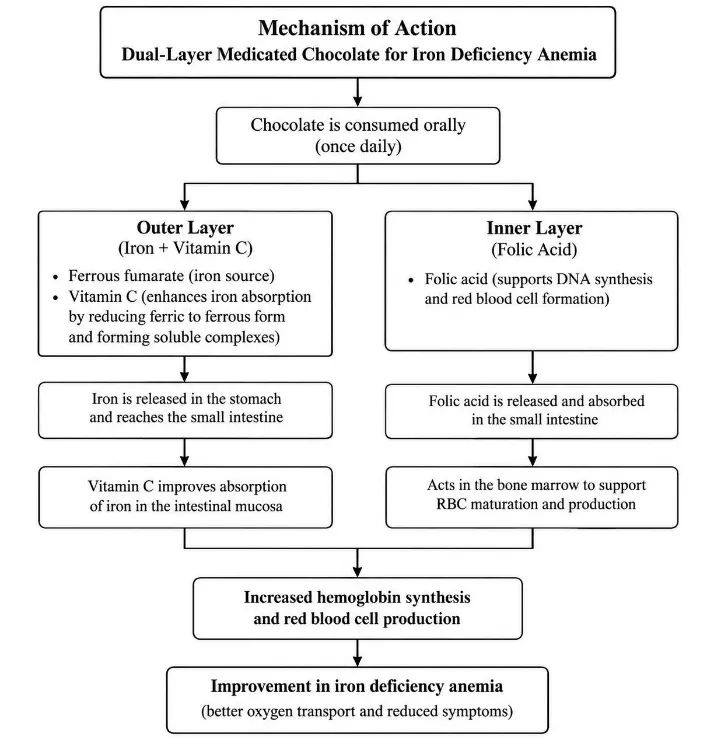
Figure 1: Mechanism of Action
Application to the dual-layer medicated chocolate :
The proposed concept incorporates the combination of folic acid, ferrous fumarate, and vitamin C into a medicated chocolate bar. A two-layer medicated chocolate bar may be a suitable dosage-form concept for pediatric patients who have difficulties swallowing conventional dosage forms, as acceptability and swallowability are important considerations in pediatric formulation development [2-7]. The first layer of the bar would contain vitamin C and ferrous fumarate, whereas the second layer would contain folic acid. Using this concept, the unpalatable taste of the medicated bar could potentially be masked with the sweet taste of chocolate [1,2,7-9].
Nevertheless, it is essential to assess the formulation feasibility of such a medicated bar. Preliminary studies should determine the organoleptic properties of the bar, which may influence acceptability in children [2,7-9]. It is also essential to assess the uniformity of distribution of the active compounds and the hardness of the bar. Drug release/bioaccessibility of the active compounds should be analysed, and stability studies should be performed to determine the shelf life of the formulation [1-7].
The dual-layer medicated chocolate bar is a formulation concept that may offer an alternative way to administer iron and associated nutrients to pediatric patients with IDA. However, extensive preformulation, formulation, quality, stability and safety studies are required before this concept can be considered for clinical use [2-7].
Medicated Chocolate as a Paediatric Drug Delivery System
Children often have a hard time swallowing medicines because of their bitter taste and challenging nature; medicated chocolate could be explored as an alternative vehicle that may make administration more pleasant through a different texture and flavour. Palatability and acceptability are recognised challenges in the development of oral medicines for children [2-9].
Medicated chocolate is made from a mixture containing cocoa butter, sugars, polyphenols, theobromine and other ingredients, which could affect the absorption rates and stability of medication mixed into the final product. Ferrous fumarate has been studied in chocolate drink powder as an iron fortificant [1]. The possible use of carob (Ceratonia siliqua) as an alternative to cocoa would require a separate supporting reference; the current reference list does not establish this claim.
Medicated chocolate may have potential as a pediatric dosage-form concept because it could be easier to administer and more pleasant to consume. However, appropriate formulation and manufacturing controls would be required to ensure consistency, dose uniformity and suitable product characteristics. Further studies would be needed to assess drug compatibility, solubility, dosage levels, stability and practical applicability [1-7].
CONCLUSION
Iron deficiency anemia is a prevalent health condition among children, which can considerably affect their growth and development. Oral iron supplements are considered an appropriate treatment for this disease; however, they have an unpleasant flavor, and many children refuse to take them. A dual-layer medicated chocolate is a potential solution to this problem. It can be enriched with a therapeutically relevant amount of iron, vitamin C, and folic acid. The former is necessary for the body’s proper functioning, while the two latter nutrients are helpful for the production of red blood cells.Also, chocolate can mask the metallic taste of iron and can be attractive to children. However, the developed formulation requires further preclinical and clinical trials to confirm its safety, effectiveness, and stability. Thus, it can be stated that dual-layer medicated chocolate is a promising and convenient innovation that might be beneficial for children with iron deficiency anemia.
REFERENCES





N. R. Pansare, Mansi Bandawane, Rushali Sanap, Sakshi Shinde, Anushka Palve, Dual-Layer Medicated Chocolate for the Management of Iron Deficiency, Int. J. of Pharm. Sci., 2026, Vol 4, Issue 11, 4402-4406. https://doi.org/10.5281/zenodo.24493903
 10.5281/zenodo.24493903