

We use cookies to ensure our website works properly and to personalise your experience. Cookies policy
MBBS 5 th year, Fergana Medical Institute Of Public Health, Uzbekistan.
Immune checkpoint inhibitors (ICIs) and engineered cellular therapies have changed the outlook for several malignancies, yet durable benefit is confined to a minority of patients and is accompanied by variable toxicity. Over the past decade, the gut microbiome has emerged as a host-extrinsic factor that shapes both outcomes. Preclinical work showed that commensal bacteria calibrate dendritic cell maturation, T cell priming and the cytokine milieu of tumours, and clinical cohorts in melanoma, lung, renal, hepatocellular and haematological cancers have linked baseline microbial composition, diversity and metabolic output to response. At the same time, the taxa reported across studies overlap only partly, and exposure to antibiotics consistently predicts worse outcomes. This review summarises the composition and determinants of the healthy gut microbiome, microbial signatures associated with cancer, and the mechanisms through which bacteria and their metabolites regulate antitumour immunity, including regulatory T cell induction, antigen cross-reactivity, innate sensing and short-chain fatty acid signalling. We then examine evidence for microbiome effects on ICIs and chimeric antigen receptor (CAR) T cell therapy, mechanisms of microbiome-associated resistance, and the tumour microenvironment, including intratumoral bacteria. Therapeutic strategies, namely probiotics, prebiotics, faecal microbiota transplantation, dietary intervention and defined or engineered bacterial products, are appraised alongside early clinical trials. Finally, we discuss obstacles to clinical translation, including inconsistent signatures, confounding, causality, standardisation and safety, and outline research priorities for biomarker-guided microbiome modulation.
Cancer remains a leading cause of death worldwide, with an estimated 19.3 million new cases and almost
10.0 million deaths recorded in 2020 [1]. Therapies that release the brakes on the immune system have altered clinical practice more than any other recent development in oncology. Antibodies against cytotoxic T-lymphocyte-associated protein 4 (CTLA-4) and the programmed death 1 (PD-1)/programmed death ligand 1 (PD-L1) axis restore the function of exhausted T cells and can produce remissions that last for years [2]. Ipilimumab was the first agent to prolong overall survival in metastatic melanoma [3], and the anti-PD-1 antibody pembrolizumab subsequently proved superior to ipilimumab in the same disease [4]. Nevertheless, most patients either do not respond at the outset or relapse after an initial benefit, and a considerable proportion develop immune-related adverse events such as colitis.
Tumour-intrinsic determinants of response, including mutational burden, PD-L1 expression and interferon signalling, explain only part of this variability. Attention has therefore turned to host factors, and the gut microbiome has become the most intensively studied among them. The human gut is colonised by tens of trillions of microorganisms, whose collective genes and metabolites interact with epithelial and immune
cells throughout life [5]. Since 2015, several lines of evidence have converged on the idea that this community influences how patients respond to cancer therapy, and the topic has been reviewed from diagnostic, mechanistic and therapeutic perspectives [6–8].
The foundational observations came from mouse models. Two studies published together showed that tumour control by anti-CTLA-4 depended on specific Bacteroides species, and that Bifidobacterium enhanced the efficacy of PD-L1 blockade, in each case through improved dendritic cell function and T cell priming [9,10]. In 2018, three independent human cohorts reported that the composition of the gut microbiome distinguished responders from non-responders to anti-PD-1 therapy in epithelial tumours and melanoma, and that transferring faeces from responders into germ-free or antibiotic-treated mice improved tumour control [11–13]. Parallel retrospective analyses showed that antibiotic exposure around the start of immunotherapy was associated with inferior survival [14]. These findings prompted the first clinical trials of faecal microbiota transplantation (FMT) in patients whose disease had progressed on anti-PD-1 therapy, in which a subset of patients regained disease control [15,16].
Despite this momentum, the field faces genuine uncertainty. The bacterial taxa associated with response differ between cohorts, causal inference from observational data is difficult, and the optimal intervention, whether a single strain, a consortium, a dietary change or whole-community transfer, is unknown. This review integrates the current evidence in a structured manner. We first describe the composition and diversity of the healthy gut microbiome and the factors that shape it, then review microbial signatures associated with cancer and the mechanisms by which microbes regulate immunity. We next consider the tumour microenvironment, the influence of the microbiome on ICIs and CAR-T cell therapy, and mechanisms of resistance, before examining microbial metabolites, therapeutic strategies, clinical trials, and the challenges that must be resolved before microbiome-based approaches can be incorporated into routine care.
2. Gut Microbiome Composition and Diversity
2.1 Composition along the gastrointestinal tract
The adult gut microbiota is dominated by bacteria from two phyla, Bacteroidetes (now often termed Bacteroidota) and Firmicutes (Bacillota), with smaller contributions from Actinobacteria, Proteobacteria and Verrucomicrobia, the last of which includes the mucin-degrading Akkermansia muciniphila [5]. Archaea, fungi, viruses and bacteriophages complete the community, although they are less well characterised. Microbial density rises steeply from the stomach and small intestine to the colon, where anaerobic fermentation of dietary fibre and host-derived glycans sustains the highest biomass. Mucosa-associated communities differ from luminal ones, which matters for oncology because most clinical studies sample stool, a proxy that may not reflect the microbes in direct contact with epithelium or tumour tissue.
2.2 Diversity and community structure
Ecologists describe communities by alpha diversity (richness and evenness within a sample), beta diversity (dissimilarity between samples) and functional capacity. A healthy gut microbiome is generally characterised by high alpha diversity, functional redundancy and resilience, meaning that it can return to a stable state after perturbation [17]. Reduced diversity is associated with inflammatory bowel disease, metabolic disorders and, as discussed below, poorer response to ICIs. Population-level analyses have proposed that community variation can be organised into a small number of enterotypes dominated by Bacteroides, Prevotella or Ruminococcus, although later work has suggested that the variation is better viewed as a gradient than as discrete classes [18]. Importantly, diversity indices summarise a community
but do not identify which organisms or metabolic functions are responsible for an immune effect, so they are best treated as a coarse biomarker.
2.3 Determinants of inter-individual variation
The microbiome is established during birth and early life and changes with age, geography and lifestyle. A comparison of individuals in the United States, Malawi and Venezuelan Amerindian populations showed pronounced differences in composition between infancy and adulthood and across cultures [19]. Diet is among the most powerful modifiers: habitual intake of fibre, fat and protein influences community structure over months to years, and a switch to an animal- or plant-based diet altered microbial gene expression and composition within days [20,21]. Other determinants include medications, particularly antibiotics, proton pump inhibitors and metformin, as well as host genetics, physical activity, bowel transit time, smoking and exposure to pathogens. Cancer patients are subject to additional perturbations such as chemotherapy, radiotherapy, surgery, prolonged hospitalisation, parenteral nutrition and repeated antibiotic prophylaxis. These factors confound associations between microbiome features and treatment outcomes, a point that recurs throughout this review.
2.4 Methodological considerations
The interpretation of microbiome studies depends heavily on method. Sequencing of the 16S ribosomal RNA gene is inexpensive and widely used, but its resolution is usually limited to genus level and it provides only inferred function. Shotgun metagenomics offers species- or strain-level resolution and direct access to gene content, and metatranscriptomics and metabolomics add information on activity. Variation in stool collection, storage, DNA extraction, reference database, bioinformatic pipeline and normalisation of compositional data can each produce different taxonomic profiles from the same specimen. As a result, apparent disagreement between cohorts is sometimes technical rather than biological, an issue that has direct bearing on the search for universal microbial signatures.
3. Gut Microbial Signatures Associated with Cancer
3.1 Colorectal cancer
Colorectal cancer (CRC) has the strongest and best-replicated link to the microbiome. Early sequencing work identified enrichment of Fusobacterium nucleatum in colorectal carcinoma tissue compared with adjacent normal tissue [22], and subsequent studies have linked this organism to tumour progression, chemoresistance and poorer prognosis [23]. Other implicated organisms include enterotoxigenic Bacteroides fragilis and Escherichia coli strains carrying the polyketide synthase (pks) island, which produce genotoxic products. Biofilms containing these organisms were found on colonic mucosa of patients with familial adenomatous polyposis, supporting a role in early tumorigenesis [24]. Large meta-analyses of faecal metagenomes from several countries have identified reproducible CRC-associated signatures that include F. nucleatum, Parvimonas micra and Peptostreptococcus stomatis, together with functional links such as choline degradation, and these signatures have been proposed as non-invasive diagnostic adjuncts [25,26]. Mechanistically, the Fap2 adhesin of F. nucleatum binds the inhibitory receptor TIGIT on natural killer and T cells and dampens their cytotoxicity, illustrating how a single bacterial protein can interfere directly with tumour immunity [27].
3.2 Hepatobiliary and pancreatic cancers
The liver receives blood from the intestine through the portal vein and is therefore exposed to microbial products. In mice, gut bacteria that convert primary into secondary bile acids regulated the accumulation of
hepatic natural killer T cells and thereby influenced liver tumour growth, an effect mediated by chemokine signalling in liver sinusoidal endothelial cells [28]. In pancreatic ductal adenocarcinoma, the tumour microbiome showed higher diversity in long-term survivors, and transfer of microbiota from these patients into mice reshaped the tumour immune infiltrate and slowed tumour growth [29]. Conversely, ablation of the microbiome in mouse models of pancreatic cancer reduced immune suppression and improved the effect of checkpoint blockade, suggesting that the net influence of the microbiome depends on which organisms predominate and on the tissue context [30]. Bacteria within pancreatic tumours have also been shown to metabolise gemcitabine to an inactive form, providing a direct pharmacological route to chemoresistance [31].
3.3 Intratumoral and pan-cancer signatures
A systematic analysis of more than 1,500 tumours across seven cancer types detected bacterial DNA, and often intracellular bacteria within both cancer and immune cells, with composition that differed by tumour type [32]. In breast cancer, intracellular bacteria carried by circulating tumour cells were reported to improve survival of tumour cells under mechanical stress and to promote metastatic colonisation in experimental models [33]. These observations suggest that microbial signatures in cancer are not confined to the gut, and that distal and intratumoral communities may interact with local immunity. The low biomass of tumour samples makes contamination a serious concern, and independent validation using strict negative controls remains essential.
3.4 Interpreting signatures
Microbial associations with cancer may be causal, consequential or incidental. A tumour can alter the intestinal environment through changes in bile acids, mucus and inflammation, and treatments can alter the microbiome in turn. Moreover, cross-sectional case–control comparisons are vulnerable to differences in diet, medication and body mass index. Prospective sampling before disease onset, together with gnotobiotic experiments and interventional trials, is needed to establish causality. With these caveats in mind, the signatures described above provide useful hypotheses regarding which organisms and pathways merit mechanistic study.
4. Mechanisms of Microbiome-Mediated Immune Regulation
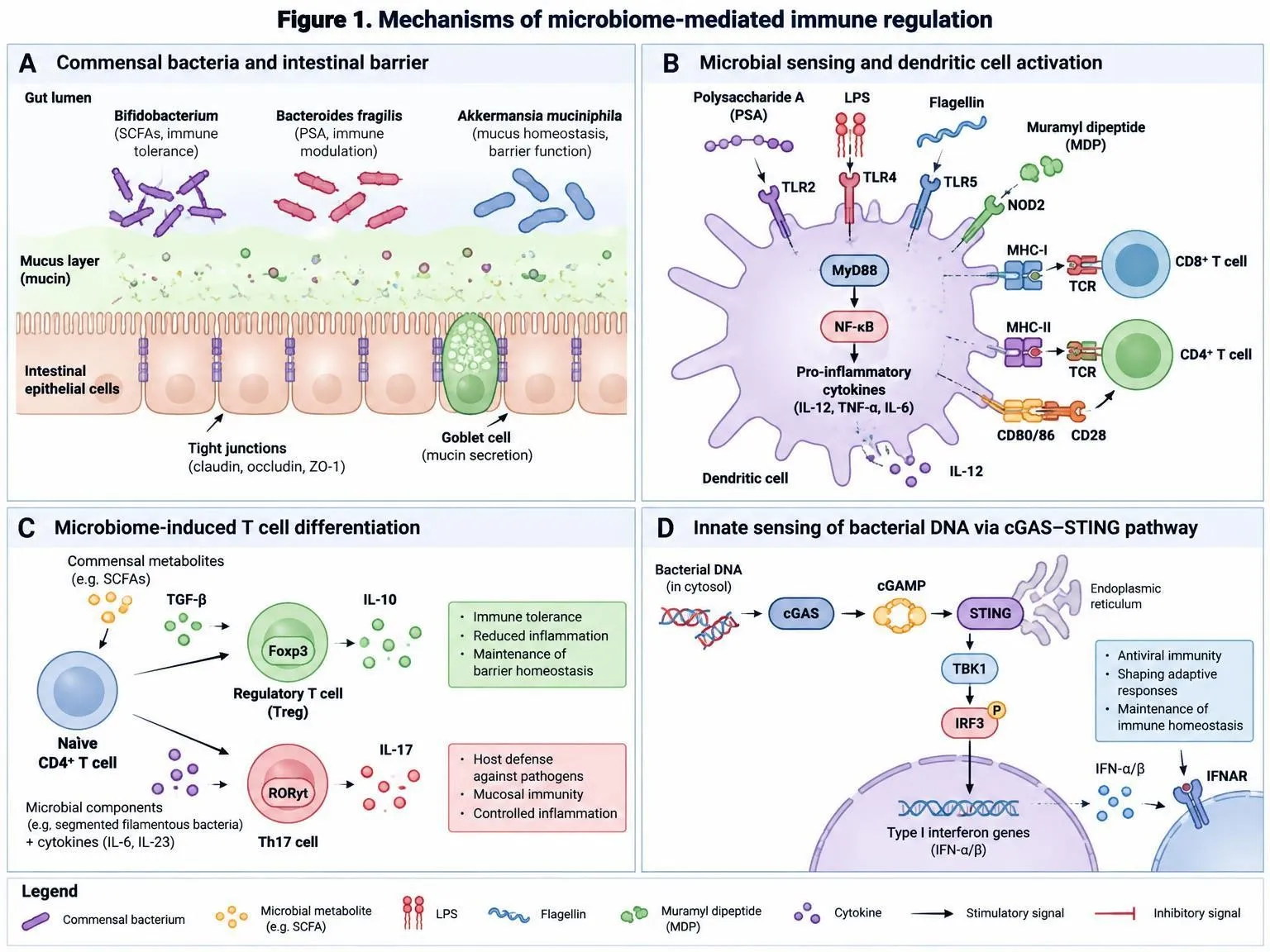
Figure 1: Mechanisms of Microbiome-Mediated Immune Regulation. (a) Commensal Taxa and the Intestinal Barrier; (B) TLR/NOD2 Sensing, MyD88–Nf-Κb Signalling and Dendritic Cell Priming of CD4+ and CD8+ T Cells; (C) Treg and Th17 Differentiation; (D) cGAS–STING–IRF3 Type I Interferon Signalling.
4.1 Education of the host immune system
The microbiota is required for the normal development of gut-associated lymphoid tissue and calibrates both local and systemic immune tone. Germ-free animals have underdeveloped lymphoid structures, fewer effector T cells and weaker responses to vaccines and infection. Microbial products interact with pattern-recognition receptors, such as Toll-like receptors and NOD-like receptors, on epithelial cells, dendritic cells and macrophages, and shape the cytokine environment that governs T cell differentiation [34]. Because lymphocytes, antigen-presenting cells and soluble mediators circulate, the effects are not confined to the intestine and can modify immune responses to tumours at distant sites.
4.2 Induction of effector and regulatory T cell subsets
Specific commensals have defined effects on T cell polarisation. Segmented filamentous bacteria induce intestinal T helper 17 (Th17) cells [35], whereas a mixture of Clostridia strains from the human gut induced colonic regulatory T (Treg) cells [36]. Short-chain fatty acids (SCFAs), especially butyrate and propionate, promote Treg differentiation and homeostasis through inhibition of histone deacetylases and signalling through G-protein-coupled receptors [37,38]. These examples show that the microbiome does not push
immunity in a single direction. In the context of cancer, a microbiota that favours tolerance could limit the activity of ICIs, whereas one that promotes cytotoxic T cell activity could enhance it. A defined consortium of eleven bacterial strains isolated from healthy human donors induced interferon-γ-producing CD8 T cells in the gut and enhanced the effect of checkpoint blockade in mouse tumour models, in a manner that depended on CD103-positive dendritic cells and MHC class I presentation [39].
4.3 Modulation of the response to chemotherapy and radiotherapy
The microbiota also modifies conventional therapy. In mice, the efficacy of oxaliplatin and CpG-oligonucleotide immunotherapy depended on commensals that primed myeloid cells in the tumour microenvironment for reactive oxygen species production and cytokine release [40]. Cyclophosphamide was shown to translocate certain Gram-positive bacteria into secondary lymphoid organs, where they stimulated pathogenic Th17 and memory Th1 responses that contributed to antitumour activity [41]. These findings established that the microbiota can contribute to the immune effects of treatments not primarily designed as immunotherapy, and they anticipated the later work on ICIs.
4.4 Antigenic cross-reactivity and molecular mimicry
Bacterial antigens may resemble tumour antigens closely enough to be recognised by the same T cells. A bacteriophage-encoded protein in Enterococcus hirae contains an epitope that is cross-reactive with a tumour-associated MHC class I antigen, and colonisation with this strain improved the response of mouse tumours to PD-1 blockade [42]. Such mimicry offers a plausible route by which gut commensals might prime tumour-specific immunity, although its relevance in humans, and the frequency with which it occurs, remain to be established.
4.5 Innate immune sensing and type I interferon signalling
Microbial products can activate innate sensing pathways that link to adaptive responses. Commensal-derived signals were found to trigger stimulator of interferon genes (STING)-dependent type I interferon production in monocytes and to reprogramme the tumour microenvironment towards an antitumour state, with effects on the efficacy of immunotherapy [43]. By maintaining basal interferon tone and enhancing antigen presentation, commensals can lower the threshold at which checkpoint blockade produces a productive T cell response. The same pathways may be hijacked by pathogenic or immunosuppressive organisms, which underscores that outcomes depend on community composition and context rather than on the mere presence of bacteria.
5. Gut Microbiome and Tumour Microenvironment
The tumour microenvironment (TME) comprises malignant cells, stromal and endothelial cells, myeloid populations and lymphocytes, together with metabolites, cytokines and extracellular matrix. Its immunological state, often described as ‘hot’ (inflamed) or ‘cold’ (immune-excluded), is a major determinant of response to checkpoint blockade. The gut microbiome influences this state through two broad routes: distal effects mediated by circulating cells and metabolites, and local effects exerted by bacteria that reside within or adjacent to the tumour.
5.1 Distal effects of the gut on tumour immunity
Experimental work indicates that gut commensals shape myeloid cell function within tumours. Intestinal bacteria prepared tumour-infiltrating myeloid cells to respond to therapy, and in their absence the oxaliplatin and CpG-oligonucleotide combination was less effective [40]. Colonisation with
Bifidobacterium augmented dendritic cell activation and CD8 T cell infiltration in subcutaneous tumours [10], and a defined bacterial consortium increased the number of intratumoral interferon-γ-producing CD8 T cells [39]. Type I interferon signalling in monocytes, driven by commensal-derived STING agonists, shifted the tumour myeloid compartment towards an immunostimulatory phenotype [43]. Taken together, these data suggest that the gut can function as a remote regulator of the TME by modulating antigen presentation, myeloid polarisation and the balance between effector and regulatory T cells.
5.2 Intratumoral bacteria
Bacterial DNA and, in some studies, viable bacteria have been detected in a wide range of solid tumours [32]. In pancreatic cancer, the intratumoral microbiota differed between short- and long-term survivors and was associated with the density of CD8 T cells and granzyme expression [29]. Bacteria could also be found to impair therapy directly, as in the case of Gammaproteobacteria expressing cytidine deaminase that inactivated gemcitabine within tumours [31]. Intratumoral organisms may influence immunity through several routes: provision of microbial pattern-recognition ligands, metabolism of drugs and nutrients, and production of antigens. Peptides derived from intratumoral bacteria were shown to be presented on HLA molecules of melanoma cells and recognised by tumour-infiltrating lymphocytes, a finding that raises the possibility that bacteria contribute to the immunopeptidome [44]. Alternatively, F. nucleatum in CRC can engage the inhibitory receptor TIGIT and suppress cytotoxic lymphocytes [27], showing that bacteria within the TME can be immunosuppressive.
5.3 Microbiota and tumour-associated immune suppression
The microbiota can also tilt the TME towards tolerance. Ablation of the microbiome in a pancreatic cancer model reduced the abundance of myeloid-derived suppressor cells and increased the activation of T helper 1 cells and cytotoxic T cells, and the effect depended on innate sensing of microbial ligands [30]. This observation illustrates that suppression of the microbiome is not uniformly beneficial. The balance between immunostimulatory and immunosuppressive influences presumably depends on which species are present, where they are located and the host’s genetic and metabolic background. Mapping the spatial relationship between bacteria and immune cells within tumours, using multiplexed imaging and spatial transcriptomics, is a priority for the field.
6. Microbiome Influence on Immune Checkpoint Inhibitors
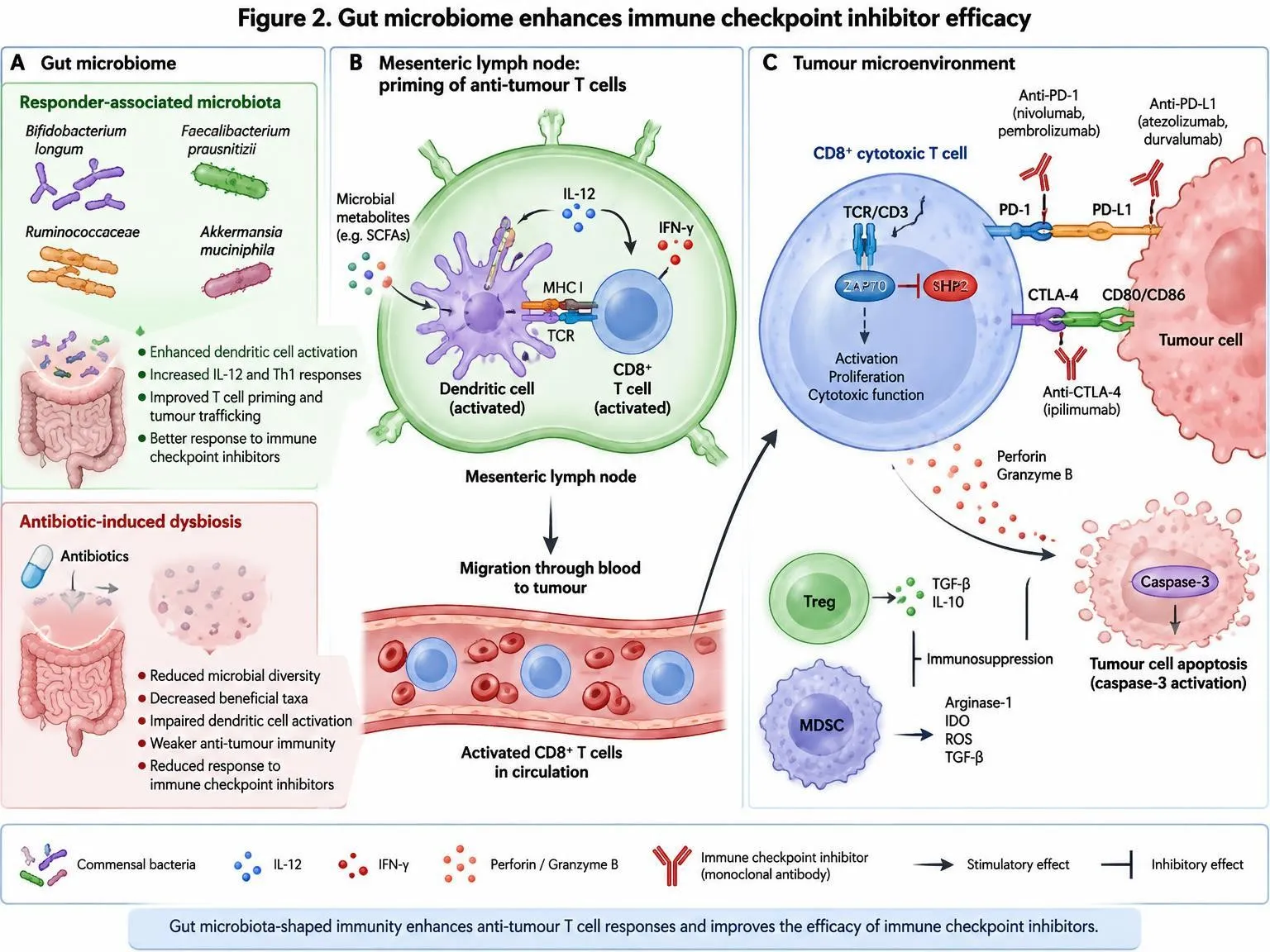
Figure 2: Gut Microbiome Enhancement of Immune Checkpoint Inhibitor Efficacy. (a) Responder-associated Microbiota Versus Antibiotic-Induced Dysbiosis; (B) Dendritic Cell Priming of CD8+ T Cells in the Mesenteric Lymph Node; (C) PD-1/PD-L1 and CTLA-4/CD80/86 Blockade, Perforin/Granzyme-Mediated Tumour Killing and Treg/MDSC Suppression.
6.1 Preclinical evidence
The causal case for microbiome involvement in ICI efficacy rests largely on animal experiments. The antitumour effect of anti-CTLA-4 antibodies was found to be reduced in germ-free or antibiotic-treated mice and could be restored by colonisation with Bacteroides fragilis and Bacteroides thetaiotaomicron, or by adoptive transfer of B. fragilis-specific T cells [9]. Differences in the tumour growth of genetically similar mice obtained from different vendors were attributed to commensal Bifidobacterium, and oral administration of this genus improved the effect of anti-PD-L1 therapy to a degree similar to that of the antibody alone, with the combination nearly abolishing tumour outgrowth [10]. In epithelial tumour models, transfer of faeces from patients who responded to PD-1 blockade conferred better tumour control in recipient mice than faeces from non-responders, and supplementation with Akkermansia muciniphila restored the efficacy of PD-1 blockade in the latter, in an interleukin-12-dependent manner [11].
6.2 Clinical cohorts in melanoma
In patients with metastatic melanoma treated with anti-PD-1 therapy, higher alpha diversity and enrichment of Ruminococcaceae, notably Faecalibacterium, were associated with response, whereas an abundance of Bacteroidales was associated with non-response [12]. A separate cohort identified enrichment of Bifidobacterium longum, Collinsella aerofaciens and Enterococcus faecium in responders [13]. In ipilimumab-treated patients, baseline enrichment of Faecalibacterium and other Firmicutes was linked with longer progression-free survival and a greater risk of colitis, whereas a Bacteroidetes-rich profile was associated with resistance to colitis [45]. Metagenomic and metatranscriptomic profiling in another cohort found taxa such as Faecalibacterium prausnitzii and anabolic metabolic pathways to be overrepresented in responders [46]. A pooled analysis of several melanoma cohorts, however, showed that the lists of taxa found to be associated with response overlapped poorly between studies, although a limited set of species recurred and could be combined into a signature with predictive value [47].
6.3 Lung, renal and hepatocellular carcinoma
In non-small cell lung cancer (NSCLC) and renal cell carcinoma, the abundance of Akkermansia muciniphila correlated with clinical benefit from PD-1 blockade [11]. A larger NSCLC cohort confirmed that the presence of A. muciniphila was associated with a better response and longer survival, and showed that the effect was influenced by the co-occurrence of other taxa [48]. Among Chinese patients with NSCLC, greater alpha diversity and enrichment of species including Alistipes putredinis and Bifidobacterium longum were associated with response to anti-PD-1 therapy [49]. Another study reported that Akkermansia and Ruminococcus were enriched in patients with durable clinical benefit [50]. In hepatocellular carcinoma, responders to anti-PD-1 therapy displayed higher taxa richness and distinct profiles, which included enrichment of Akkermansia muciniphila and Ruminococcaceae [51].
6.4 Summary and critical appraisal
Table 1 summarises representative studies. Two themes emerge. First, high diversity and the presence of fibre-fermenting, SCFA-producing Firmicutes and of Akkermansia tend to be linked with benefit. Second, there is little agreement at the level of individual species. Several explanations are plausible: different tumour types and treatments, differences in diet and geography, small sample sizes, divergent sequencing and statistical pipelines, and the possibility that functionally equivalent roles are filled by different taxa in different people. Reproducible prediction will probably require functional rather than taxonomic signatures, larger and prospectively collected cohorts, and harmonised methods.
Table 1: Representative Clinical Studies Linking Gut Microbiome Features to Response to Immune Checkpoint Inhibitors
| Reference | Tumour type / therapy | Features associated with response | Features associated with non-response or toxicity |
|---|---|---|---|
| Routy et al. [11] | NSCLC, RCC; anti-PD-1/PD-L1 | Akkermansia muciniphila; FMT from responders improved tumour control in mice | Antibiotic exposure |
| Gopalakrishnan et al. [12] | Melanoma; anti-PD-1 | High diversity; Ruminococcaceae, Faecalibacterium |
Bacteroidales |
|---|---|---|---|
| Matson et al. [13] | Melanoma; anti-PD-1 | Bifidobacterium longum, Collinsella aerofaciens, Enterococcus faecium | Not specified |
| Chaput et al. [45] | Melanoma; ipilimumab | Baseline Faecalibacterium and other Firmicutes (longer PFS) | Bacteroidetes-rich profile associated with lower risk of colitis; Firmicutes linked to colitis |
| Peters et al. [46] | Melanoma; ICIs | F. prausnitzii; anabolic pathways | Catabolic pathways |
| Lee et al. [47] | Melanoma; ICIs (multi-cohort) | Recurrent set of taxa forming a multi-species signature | Poor concordance of single taxa between cohorts |
| Derosa et al. [48] | NSCLC; PD-1 blockade |
Presence of A. muciniphila | Absence of A. muciniphila, particularly with antibiotic use |
| Jin et al. [49] | NSCLC; anti-PD-1 | High diversity; Alistipes putredinis, B. longum | Lower diversity |
| Hakozaki et al. [50] | NSCLC; PD-1/PD-L1 | Akkermansia, Ruminococcus | Not specified |
| Zheng et al. [51] | HCC; anti-PD-1 | High richness; Akkermansia, Ruminococcaceae | Lower richness |
Abbreviations: FMT, faecal microbiota transplantation; HCC, hepatocellular carcinoma; ICI, immune checkpoint inhibitor; NSCLC, non-small cell lung cancer; PFS, progression-free survival; RCC, renal cell carcinoma.
7. Microbiome and CAR-T Cell Therapy
BACKGROUND
Chimeric antigen receptor (CAR) T cell therapy involves genetic modification of autologous T cells to express a receptor that recognises a tumour surface antigen. CD19-directed products have produced durable remissions in B cell malignancies [52]. The principal toxicities are cytokine release syndrome (CRS) and immune effector cell-associated neurotoxicity. Patients undergoing CAR-T therapy typically have received multiple lines of chemotherapy and frequent antibiotic courses, and they are lymphodepleted before infusion, which makes them highly vulnerable to microbiome disruption and its consequences.
7.2 Clinical observations
In a multicentre analysis of patients with B cell lymphoma, leukaemia or myeloma treated with anti-CD19 CAR-T cells, the composition of the gut microbiome before infusion was associated with response, and exposure to broad-spectrum antibiotics, specifically those with anti-anaerobic activity, in the weeks before infusion was linked with worse survival and with neurotoxicity [53]. Enrichment of taxa such as Bacteroides, Ruminococcus and Faecalibacterium correlated with a favourable response in that study. Another study of patients with haematological malignancies reported that microbial composition and function correlated with the severity of CRS and with treatment response [54]. A further cohort suggested that patients with a gut microbiome that had not been disrupted by antibiotics had better clinical outcomes [55].
7.3 Proposed mechanisms
Several mechanisms might link the gut microbiome with CAR-T outcomes. Microbial metabolites, in particular SCFAs, can alter T cell fitness, memory formation and cytokine production, as discussed in Section 9. Microbiome-dependent systemic inflammation, including translocation of bacterial products during mucosal injury, may amplify cytokine release. Moreover, the pre-infusion microbiome may modulate the quality of the apheresis product, since T cell subsets and their metabolic state are influenced by microbial signals. Data in this area are limited, mostly retrospective and prone to confounding by disease burden, previous therapies and infection, and mechanistic studies are needed to determine whether the associations are causal.
7.4 Implications for practice
The observations on antibiotics have immediate practical implications. Where possible, unnecessary broad-spectrum antibiotic exposure should be avoided in the period around CAR-T infusion, and antimicrobial stewardship should be integrated into care pathways. Whether specific supplementation or microbiome restoration can improve outcomes remains untested and should be evaluated in prospective trials.
8. Microbiome-Associated Immunotherapy Resistance
8.1 Antibiotic-induced dysbiosis
The clearest clinical evidence for a microbiome effect on immunotherapy outcome comes from studies of antibiotic exposure. In a retrospective study of patients with advanced cancer, antibiotic treatment in the 30 days before ICI initiation was associated with shorter overall survival and a lower response rate [56]. Similarly, patients with renal cell carcinoma and NSCLC who received antibiotics shortly before or after starting PD-1 blockade had shorter progression-free and overall survival [57]. Together with the original report [11], these findings led to the proposal that antibiotic use is an independent adverse prognostic factor in patients receiving ICIs [14]. Antibiotics may of course act as a marker of infection, frailty or advanced disease, but the consistency of the association across tumour types and the supporting animal data suggest that at least part of the effect is mediated through the microbiome.
8.2 Loss of beneficial taxa and functions
Resistance may reflect the absence of organisms that stimulate antitumour immunity. In the cohorts discussed above, non-responders had lower diversity and a lower abundance of Akkermansia, Ruminococcaceae or Bifidobacterium [11–13]. Because these taxa support the production of SCFAs and other metabolites, their loss may reduce dendritic cell and CD8 T cell activation. Transfer of microbiota
from responders into previously refractory patients, discussed in Section 10, provides indirect evidence for this model.
8.3 Presence of immunosuppressive organisms and metabolites
Resistance may also reflect positive suppression. Enrichment of Bacteroidales was associated with non-response to anti-PD-1 therapy in melanoma [12]. Elevated systemic SCFAs were associated with resistance to ipilimumab, an effect linked with an increase in regulatory T cells and reduced upregulation of costimulatory molecules in the setting of CTLA-4 blockade [58]. These observations show that the same metabolite may have different effects depending on the therapy and immunological setting, which complicates the development of universal interventions. Organisms that engage inhibitory receptors, such as F. nucleatum through TIGIT [27], or that inactivate drugs inside tumours [31], represent other potential routes to resistance.
8.4 Resistance is multifactorial
Microbiome-related resistance operates alongside tumour-intrinsic mechanisms such as loss of antigen presentation, defects in interferon signalling and an immunosuppressive TME. It is unlikely to explain resistance in all patients, and the proportion of non-response attributable to the microbiome is unknown. Randomised interventional studies, rather than correlations, are required to estimate this contribution and to identify patients who are most likely to benefit from modulation.
9. Role of Microbial Metabolites in Antitumor Immunity
Metabolites are the principal chemical language through which the microbiome communicates with the host, and they provide a more functional readout of the community than taxonomy alone. Several classes have been linked to antitumour immunity.
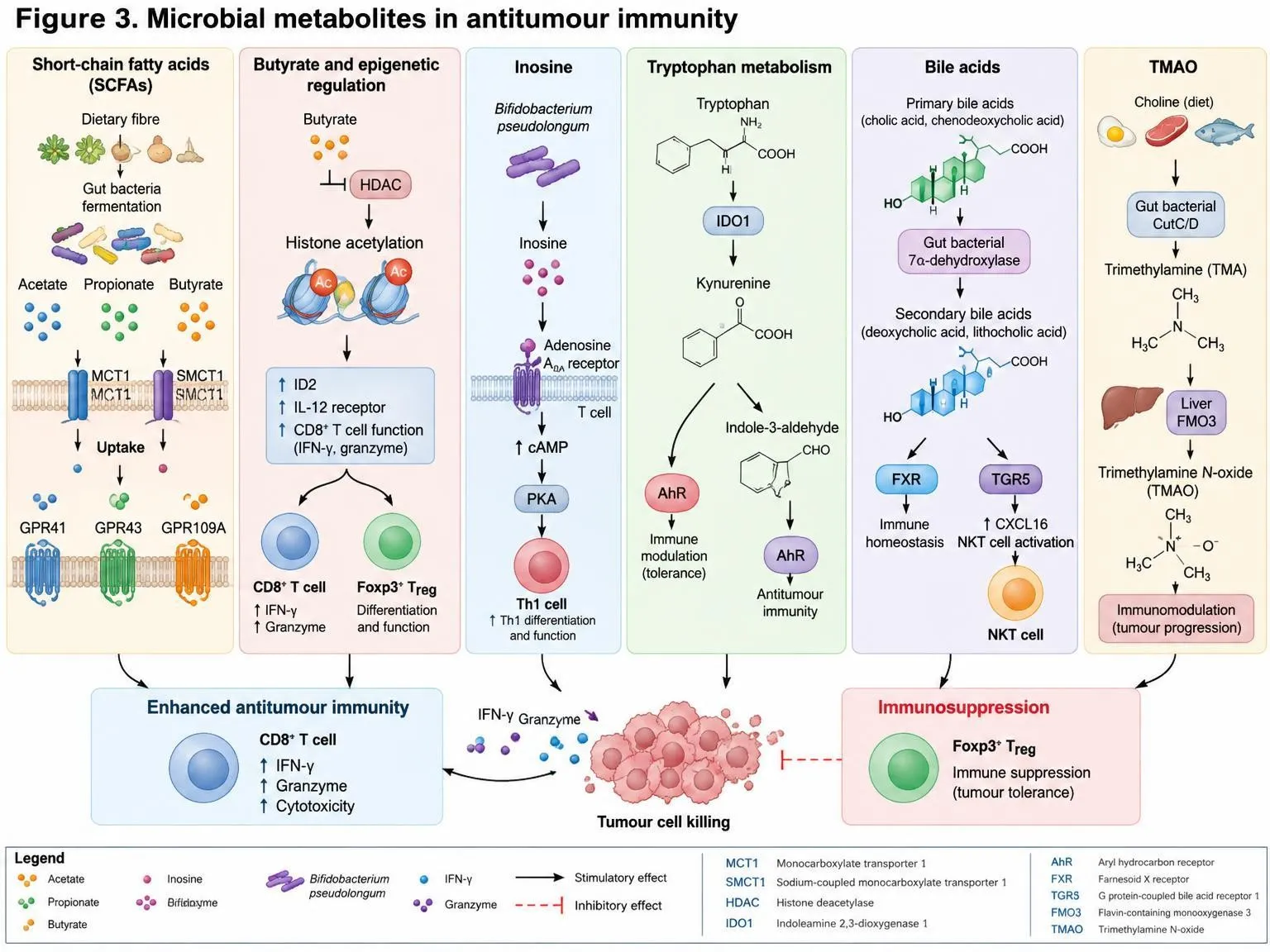
Figure 3: Microbial Metabolites in Antitumour Immunity: SCFA Transport and GPCR Signalling, Butyrate-Mediated HDAC Inhibition, Inosine–A2a Receptor Signalling, Tryptophan–IDO1–AhR Metabolism, Bile-Acid FXR/TGR5 Signalling and TMAO Generation.
9.1 Short-chain fatty acids
SCFAs, mainly acetate, propionate and butyrate, are produced by bacterial fermentation of dietary fibre. In addition to their well-established effects on Treg induction [37,38], they act directly on CD8 T cells. Butyrate and pentanoate (valerate) increased the memory potential of antigen-activated CD8 T cells by altering cellular metabolism, and enhanced their antitumour activity [59]. In mouse models, pentanoate and butyrate improved the effector function of CAR-T cells and of other adoptively transferred T cells through epigenetic remodelling that raised the production of interferon-γ and tumour necrosis factor [60]. Butyrate also potentiated the effect of oxaliplatin by promoting cytotoxic CD8 T cell function through inhibitor of DNA-binding 2 (ID2) and interleukin-12 signalling [61]. In patients, higher faecal concentrations of SCFAs were reported in those who responded to nivolumab or pembrolizumab [62]. In contrast, high circulating concentrations of butyrate and propionate were associated with resistance to ipilimumab [58]. The apparent contradiction may reflect differences in compartment (faecal versus systemic), drug target (PD-1 versus CTLA-4), concentration and the specific immune cell population exposed. SCFAs are therefore not simple ‘good’ metabolites, and context dictates whether they promote or inhibit antitumour immunity.
9.2 Inosine and other purine metabolites
The commensals Bifidobacterium pseudolongum, Akkermansia muciniphila and Lactobacillus johnsonii were found to enhance checkpoint blockade in mice through production of inosine, which signals through the adenosine A2A receptor on T cells. This effect required T cell costimulation and was dependent on the immunological setting [63]. The finding suggests that bacterial metabolites can act as a co-stimulatory signal, and that the benefit may differ between tumours with different levels of inflammation.
9.3 Trimethylamine N-oxide, bile acids and tryptophan metabolites
In pancreatic cancer models, the microbiome-derived metabolite trimethylamine N-oxide (TMAO) activated type I interferon signalling in tumour-associated macrophages, promoted effector T cell activity and improved the response to checkpoint blockade [64]. This is notable because elevated TMAO has been linked with adverse cardiometabolic outcomes, and it again illustrates that the same metabolite can have divergent effects in different organ systems. Secondary bile acids, generated by bacterial transformation of host-derived primary bile acids, regulate NKT cell recruitment in the liver [28] and influence T cell differentiation in the gut. Microbial metabolites of dietary tryptophan, such as indole derivatives, act on the aryl hydrocarbon receptor and affect both epithelial barrier function and immune cell activity, and they are being actively investigated as modifiers of the response to immunotherapy.
9.4 Translational implications
Metabolites offer several advantages as biomarkers and therapeutic agents. They can be quantified in stool or plasma, they may be more consistent across individuals than taxa, and they can in principle be delivered directly. Their disadvantages include the context dependence described above, rapid host metabolism, and uncertain relationships between circulating and tissue-level concentrations. Integrating metabolomic profiling into clinical trials of microbiome interventions would help to establish which metabolic pathways must be restored to achieve benefit.
10. Therapeutic Strategies for Microbiome Modulation
10.1 Probiotics and prebiotics
Probiotics are live microorganisms intended to confer a health benefit, and prebiotics are substrates selectively used by host microorganisms. Commercial probiotics are widely used by patients with cancer, often without medical supervision, but their effect on immunotherapy outcomes is not established and may be harmful. In healthy volunteers, a commercial multi-strain probiotic delayed the restoration of the native mucosal microbiome after antibiotic treatment, whereas autologous FMT restored it within days [65]. In an observational study of patients with melanoma, use of over-the-counter probiotic supplements was associated with lower microbial diversity and, in a subset, a trend towards worse response, whereas higher dietary fibre intake was associated with better progression-free survival [66].
A randomised phase 1 trial in metastatic renal cell carcinoma tested a live bacterial product containing Clostridium butyricum (CBM588) together with nivolumab and ipilimumab. The addition of CBM588 was associated with a higher response rate and longer progression-free survival than the checkpoint combination alone, and the product was well tolerated, although the trial was small and exploratory [67]. These findings suggest that rationally selected strains may differ from generic over-the-counter probiotics in effect, but they require confirmation in larger studies. Prebiotics such as inulin and other fermentable fibres are attractive because they support endogenous SCFA producers, but trials in cancer immunotherapy are limited.
10.2 Faecal microbiota transplantation
FMT involves the transfer of processed stool from a screened donor into the gut of a recipient, and is an established treatment for recurrent Clostridioides difficile infection. In oncology, two phase 1 trials in patients with melanoma refractory to anti-PD-1 therapy used FMT from donors who had responded to treatment, together with re-challenge with PD-1 blockade. One trial reported clinical responses in three of ten patients [15], and the other reported clinical benefit in six of 15 patients [16]. In both, responders showed engraftment of donor-associated taxa, increased activity of CD8 T cells and reduction in the abundance of myeloid cells with suppressive features. A subsequent phase 1 study evaluated FMT from healthy donors combined with anti-PD-1 therapy in patients with NSCLC and melanoma, and demonstrated feasibility and safety together with signs of clinical activity, linked to donor strain engraftment [68]. FMT has also been used to treat immune-related colitis that is refractory to immunosuppressive therapy, with clinical improvement reported in an early case series [69].
FMT has important limitations. The product is biologically complex and variable between donors, the mechanism of action is undefined, and the studies completed so far are small, uncontrolled and restricted to selected patients. Serious infections caused by transmission of drug-resistant organisms have been reported in FMT recipients in other settings, which has led to stricter donor screening requirements. Immunocompromised cancer patients are particularly vulnerable to such risks. Randomised, placebo-controlled studies and standardised, manufactured products are needed.
10.3 Dietary interventions
Diet is the most accessible means of modulating the microbiome, and its effects can be rapid [20,21]. High fibre intake was associated with improved outcomes in patients with melanoma receiving ICIs, and in mice, a diet low in fibre impaired the antitumour immune response, an effect attributed to reduced microbial diversity and impaired T cell infiltration [66]. Dietary approaches under study include increased intake of fermentable fibre and plant diversity, fermented foods, and calorie-restricted or ketogenic regimens. Evidence is mostly observational, and diet is difficult to measure and to randomise. Dietary advice must also be balanced against the risk of malnutrition, cachexia and treatment-related gastrointestinal symptoms in cancer patients, and any intervention should be coordinated with oncology dietitians.
10.4 Next-generation microbiome therapeutics
Next-generation approaches aim to replace undefined communities with characterised, reproducible products. These include defined bacterial consortia (such as the eleven-strain consortium that enhanced CD8 T cell responses and checkpoint blockade in mice [39]), single-strain live biotherapeutics such as Akkermansia muciniphila, postbiotics and purified metabolites, bacteriophages that selectively deplete harmful organisms, and engineered bacteria. In one example, an Escherichia coli Nissle strain engineered to convert ammonia within tumours into L-arginine increased intratumoral arginine, raised the number of T cells within the tumour, and enhanced the effect of PD-L1 blockade in mouse models [70]. Such engineered organisms might be programmed to deliver immunostimulatory payloads in a localised manner, but they raise additional regulatory and biosafety questions, including containment, genetic stability and the risk of bacteraemia in immunosuppressed patients. Several defined products have entered early-phase trials in combination with checkpoint inhibitors, and their status should be verified in trial registries, since programmes in this area have changed rapidly.
Table 2: Strategies for Microbiome Modulation in Cancer Immunotherapy
| Strategy | Proposed mechanism | Evidence in cancer immunotherapy | Main limitations |
|---|---|---|---|
| Probiotics (over-the-counter) | Supplementation with live organisms | Observational data suggest no benefit and possible harm [65,66] | Uncontrolled strains and doses; may delay microbiome recovery |
| Defined live biotherapeutic (e.g. CBM588) |
Enrichment of specific butyrate-producing strains | Randomised phase 1 trial with nivolumab and ipilimumab in RCC [67] | Small, exploratory; single tumour type |
| FMT | Whole-community transfer from donors | Phase 1 trials in melanoma and NSCLC; colitis case series [15,16,68,69] | Donor variability; infection risk; undefined mechanism |
| Dietary fibre and diet change | Support of SCFA producers and diversity | Observational association with improved PFS [66] | Confounding; difficult to randomise; cachexia risk |
| Defined consortia and postbiotics | Reproducible immune activation by selected strains or products | Strong preclinical data [39]; early-phase clinical studies |
Manufacturing, regulation, and limited human data |
| Engineered bacteria | Local delivery of metabolic or immunostimulatory payloads | Preclinical efficacy [70] | Biosafety, containment, regulatory approval |
Abbreviations: FMT, faecal microbiota transplantation; NSCLC, non-small cell lung cancer; PFS, progression-free survival; RCC, renal cell carcinoma; SCFA, short-chain fatty acid.
11. Clinical Trials and Recent Advances
11.1 Interventional trials
The clinical evidence for microbiome modulation in immunotherapy is still at an early phase. The first FMT trials in melanoma showed that disease control can be restored in a minority of patients with refractory disease, and they provided correlative evidence of immune and microbial changes consistent with the preclinical models [15,16]. Combination trials in NSCLC and melanoma have subsequently extended this approach to treatment-naive and other settings and have reported acceptable safety [68]. The randomised trial of CBM588 in renal cell carcinoma showed that a defined bacterial product could be safely combined with dual checkpoint blockade [67]. These studies share common features: small size, absence of placebo controls in most cases, and heterogeneity in donors, products, and endpoints. Their value lies mainly in demonstrating feasibility and generating hypotheses.
11.2 Observational and translational advances
Several advances deserve mention. First, multi-cohort analyses have shown that reproducible predictive signatures may require integration across studies and a focus on functional capacity [47]. Second, the
consistent adverse effect of antibiotics has been replicated in melanoma, lung, renal and haematological malignancies [14,56,57], and in cell therapy [53]. Third, metabolite-based mechanisms have been defined in more detail, with SCFAs, inosine and TMAO providing candidate mediators [59–64]. Fourth, the intratumoral microbiome and bacterial antigen presentation have opened a new area of tumour immunology [32,44]. Fifth, diet has been shown to be a modifiable factor [66].
11.3 Design of future trials
Future trials should be randomised and, wherever feasible, placebo-controlled, with pre-specified microbiome endpoints and sampling before, during and after therapy. Stratification by baseline microbiome features, antibiotic exposure and diet would improve interpretability. The use of defined products, engraftment-tracking by strain-level metagenomics, and parallel immune and metabolite profiling will help to establish mechanisms of action. Patient-reported outcomes and safety monitoring for infection are essential, particularly in immunocompromised populations.
12. Challenges and Future Perspectives
12.1 Reproducibility and signature discordance
The most pressing scientific problem is that the taxa linked with response differ between studies [12,13,47]. Progress will require shared protocols for sampling and sequencing, public deposition of raw data and clinical metadata, and meta-analytic frameworks that account for compositional data, batch effects and confounders. Shifting from taxonomic to functional readouts, including gene families, pathways and metabolites, may reveal convergence that species lists obscure. Strain-level resolution is also likely to matter, because organisms within the same species can differ substantially in gene content and immunological effect.
12.2 Causality and confounding
Most clinical data are observational. Diet, antibiotics, proton pump inhibitors, tumour burden, performance status, body mass index and geography all influence both the microbiome and outcome [14,20,56,57]. Establishing causality demands a combination of gnotobiotic models with human-derived communities, longitudinal sampling, mediation analysis and randomised interventions. Mouse models themselves carry limitations, since laboratory mice have microbiomes and immune systems that differ from those of humans, and transplantation experiments can overstate the effect of single taxa.
12.3 Context dependence of microbial effects
The evidence reviewed here shows that microbial effects depend on tumour type, therapeutic class, anatomical location and host state. SCFAs may favour CD8 T cell function in one setting and Treg expansion in another [58,59], and TMAO may be beneficial in pancreatic cancer models while being linked to cardiometabolic risk [64]. Interventions will therefore need to be matched to the patient and the therapy, and predictive biomarkers will be needed to select those most likely to benefit and least likely to be harmed.
12.4 Safety, regulation and manufacturing
Microbiome-based products are live biological agents, and their use in immunocompromised patients carries a risk of bacteraemia, transmission of resistant organisms and unforeseen immunological effects such as exacerbation of immune-related colitis. FMT requires rigorous donor screening and quality control, and its regulatory status varies between jurisdictions. Defined consortia and engineered strains must meet the standards applied to biological medicines, including consistent manufacturing, stability and
environmental risk assessment [39,70]. Further, the use of unregulated probiotics by patients warrants active counselling, given the potential for harm [65,66].
12.5 Equity and implementation
Microbiome composition varies across populations, and most studies have been conducted in North America, Europe and East Asia. Signatures derived in one population may not generalise to others, and diet-based interventions may be difficult to implement in settings with limited access to specialised nutrition support [19]. Inclusion of diverse cohorts, and cost-effectiveness analysis of stool testing and microbiome interventions, will be needed before clinical adoption.
12.6 Research priorities
Several priorities arise from this review. (i) Large, prospective, multi-centre cohorts with standardised sampling and integrated multi-omic profiling, including metagenomics, metabolomics and immune phenotyping. (ii) Randomised controlled trials of defined interventions, with microbiome endpoints and stratification by antibiotic exposure and diet. (iii) Mechanistic studies of the tumour-resident microbiota and its spatial relationship with immune cells [32,44]. (iv) Development of predictive models that combine microbiome features with tumour genomics, host genetics and clinical variables. (v) Investigation of the microbiome in cell therapy, where early data suggest a strong influence of antibiotic exposure [53,55]. (vi) Antimicrobial stewardship protocols designed specifically for patients starting immunotherapy.
CONCLUSION
The gut microbiome has moved from a speculative modifier of cancer immunotherapy to a well-supported influence on treatment outcome. Preclinical studies show that commensal bacteria and their metabolites can prime dendritic cells, expand cytotoxic T cells and shape the tumour microenvironment, and clinical cohorts in several cancers associate microbial diversity and particular taxa with response to checkpoint inhibitors and, more tentatively, CAR-T cell therapy. The detrimental effect of antibiotics is the most consistent clinical observation, and early trials of FMT and defined bacterial products indicate that the microbiome can be modified to restore or improve responsiveness in some patients.
At the same time, the evidence remains incomplete. Species-level signatures are inconsistent, causal pathways in humans are largely unproven, and most interventional studies are small and uncontrolled. The dual, context-dependent nature of microbial metabolites cautions against simple interventions, and safety in immunocompromised patients must remain a priority. Realising the clinical potential of the microbiome will require harmonised methods, rigorous randomised trials, functional rather than purely taxonomic biomarkers and thoughtful integration of microbiome data with tumour and host features. Until such evidence is available, the most defensible clinical measures are careful avoidance of unnecessary antibiotics, encouragement of a fibre-rich diet where appropriate, and discouragement of unsupervised probiotic use.
REFERENCES









Mohammad Arham Khan, Velayutham Arul Selvam, Anas, Mohmmad Anisur Rahman, Mohammed Muhidur Rahaman, Gopal Sharma, Keshav Nagar, Mohammad Arif, Arpit Barik, Microbiome-Driven Cancer Immunotherapy: Gut Microbial Signatures, Immune Modulation, and Treatment Response, Int. J. of Pharm. Sci., 2026, Vol 4, Issue 11, 5800-5817. https://doi.org/10.5281/zenodo.24583777
 10.5281/zenodo.24583777