

We use cookies to ensure our website works properly and to personalise your experience. Cookies policy
Department of Pharmaceutical Regulatory Affairs, MVM college of Pharmacy, Yelahanka, Bengaluru – 560064, Karnataka, India.
The arrival of quantum technology feels like a paradigm shifting turn for the pharmaceutical industry, it brings in capabilities like chemically precise molecular modelling, quantum-accelerated drug screening, plus quantum-secured data systems that go past what classical computing can realistically do, in scale and precision. Still, the integration of quantum systems into day-to-day pharmaceutical workflows is happening in a kind of regulatory and ethical no man’s land, because there is not yet any dedicated governance model for quantum computing as its own paradigm in drug development, clinical choices, or pharmacovigilance. This review looks through, in a systematic way, the regulatory, ethical, legal, and cybersecurity layers of quantum technology across the whole pharmaceutical value chain. It also critically assesses the current frameworks, including FDA digital health policies, the EU AI Act, EMA guidance, MHRA innovation frameworks, and various WHO initiatives. At the same time, it flags major governance holes around validation standards, explainability, intellectual property structures and also how ready organizations really are for post-quantum cybersecurity. Ethical risks, including algorithmic bias, genomic inequity, privacy vulnerabilities, and dual-use biosecurity concerns, are assessed in relation to established bioethical principles.In response, this review proposes a sector-specific regulatory and ethical framework structured around seven core pillarstransparency, accountability, explainability, cybersecurity, equity, human oversight, and sustainabilitysupported by a multi-level governance architecture and phased implementation roadmap aimed at enabling safe, equitable, and internationally harmonized quantum pharmaceutical innovation.
1.1 Background of Digital Transformation in Pharmaceuticals
The pharmaceutical sector has witnessed a significant evolution during the last three decades and shifted from empirical, trial-and-error approaches to integrated, data-driven discovery platforms [1]. Traditional pharmaceutical research and development (R&D) has been long, expensive, iterative, and associated with high attrition rates [2,7]. Conventional pharmaceutical pipelines only incorporated limited number of in-silico steps to complement experimental high-throughput screening [15]. The first wave of pharmaceutical digitization took place from the late 1990s through to the 2000s, with computer technologies becoming adopted in laboratory, clinical, and regulatory functions [17]. This occurred alongside genome sequencing, combinatorial chemistry, and electronic data collection and storage [7,13].
Today, the pharmaceutical sector is witnessing a rapid upsurge in digitization via artificial intelligence (AI) and machine learning (ML), big data, blockchain, and other connected technologies [3,4]. ML tools have allowed for faster target identification and hit-to-lead processes, as well as virtual clinical trials with improved predictive power over traditional statistical models [5,9]. AI-driven generative chemistry has also enabled the design of multiple chemical entities with desirable properties, thus accelerating lead generation and reducing the pre-clinical attrition significantly [10,11]. Tools such as blockchain have been proposed to increase the trustworthiness of clinical trial data and ensure seamless tracking of pharmaceutical products from manufacturers to pharmacies [6]. In addition, big data analytics (BDA) have enhanced pharmacovigilance and post-marketing surveillance by incorporating electronic health records (EHRs) and patient-reported outcomes into the research and development (R&D) process [20]. Collectively, these technologies have ushered in the new era of Pharma 4.0 [12].
A need for using such digital technologies has been intensified by the prolonged period of pharmaceutical R&D productiveness decline. The latter has been associated with a sharp rise in R&D expenditures without proportional increases in the number of new molecular entities (NMEs) approved by the regulatory agencies [13,14]. The failure probability of a new drug candidate in phase II or III clinical trial remains as high as 40–60% due to the insufficient accuracy of traditional pre-clinical models [8,16]. Computational approaches offer an attractive opportunity to overcome this obstacle by providing more mechanistic understanding of the target engagement or compound performance in humans [9,22]. Specifically, quantum computers have the potential to enable the pharmaceutical sector to meet the rising expectations of society for more effective treatments while also helping it to address the key inefficiencies of the current drug discovery paradigm [24,25]. This technology can facilitate the search for new molecular entities with desirable attributes, thus reducing the time-to-market of new pharmaceutical products [22,25].
At the same time, the complexity of pharmaceutical R&D pipelines continues to grow as the industry embraces more diverse treatment modalities and as the regulatory agencies tighten their requirements. Over the last decade, the field has evolved from small molecule therapeutics to biologics, gene therapies, antisense, and cell-based treatments [6,18]. Such sophisticated pharmaceutical products as cell and gene therapies require a greater degree of process control during manufacturing and more rigorous product-characterization studies to demonstrate their quality, safety, and efficacy [18]. At the same time, the FDA and EMA have issued a series of guidelines on pharmaceutical development, which encourage the application of model-informed drug development (MIDD) and real-world evidence (RWE) approaches [19,20]. As a result, the R&D process became further complicated due to the need to balance empirical and theoretical insights. Therefore, the development of new regulatory frameworks to oversee the performance of quantum computers in the pharmaceutical sector is of paramount importance [21].
The pharmaceutical sector is undergoing a paradigm shift as new computational approaches become adopted to accelerate the R&D process. While such methods as ML, blockchain, big data analytics, and quantum computing offer attractive opportunities to transform drug discovery for the better, they also raise some ethical concerns [3,4,22]. The regulatory science landscape, both in the US and EU, is undergoing rapid changes as agencies adjust their oversight capabilities to keep pace with the rapid technological advances [19]. It is against this background that the current paper explores the potential implications of using quantum computers in the pharmaceutical sector. This study analyzes the main trends in digitization, with a focus on how they can be applied in the R&D process. Furthermore, the paper discusses the relevant regulatory and ethical issues that are likely to emerge as this innovative technology is further adopted by the industry.
1.2 Introduction to Quantum Technology
Quantum technology refers to physical and computational entities that harness the power of quantum mechanics to outperform their classical counterparts in terms of information processing, sensing, communication, and simulation [26]. Unlike their classical analogs, quantum technologies take advantage of the probabilistic nature of quantum mechanics and the peculiarities of quantum-mechanical interactions of matter at the atomic level [27]. The term quantum technology encompasses various areas of research and activity, including quantum computing, cryptography, sensing, and communication, which utilize quantum mechanics to enable fundamentally new approaches to information processing and other functions [28]. In particular, quantum technology has the ability to surpass classical counterparts at solving certain chemical problems, such as the quantum-mechanical modeling of molecular electronic structure, when a quantum computer is used [23,29].
This task becomes exponentially demanding for classical computers as the system size increases while it scales polynomially on a quantum computer. The foundation of quantum technology was laid out in 1900 when Max Planck introduced the concept of light quantization and was further expanded by Einstein in his explanation of the photoelectric effect [30]. In the 1920s–1930s, the foundations of quantum mechanics were in laid out in the works of Heisenberg, Schrodinger, Dirac, and Bohr [30]. Richard Feynman proposed the idea of a quantum computer for the first time in 1982 [31]. Later in 1985, David Deutsch introduced the concept of a universal quantum computer [32]. In 1994, Shor devised an algorithm for quantum factoring, and Grover developed a similar algorithm for database searching [33]. In 2019, Google announced that its quantum computer Sycamore has entered the regime of quantum supremacy by performing a calculation that would take a classical computer more than 10,000 years in just 200 seconds [34].
There are four basic principles that make quantum technology unique. These principles are superposition, entanglement, quantum tunnelling, and interference. Superposition suggests that a quantum computer can be in several states at once, enabling it to carry out exponentially many calculations at once (where n is the number of qubits). The phenomenon of entanglement is instrumental in the ability of a quantum computer to perform these calculations because it connects the quantum states of two or more qubits [36]. Quantum tunnelling allows a particle to pass through a barrier, which can be beneficial for such quantum applications as drug design by providing an insight into the mechanisms of biochemical events [37]. Similarly, quantum annealers can be used to tackle pharma-relevant optimization problems during the design process [38]. The last principle is interference, which can also play a significant role in quantum computing, for instance, by determining the binding free-energy differences of molecules through accelerating quantum search algorithms [33,35].
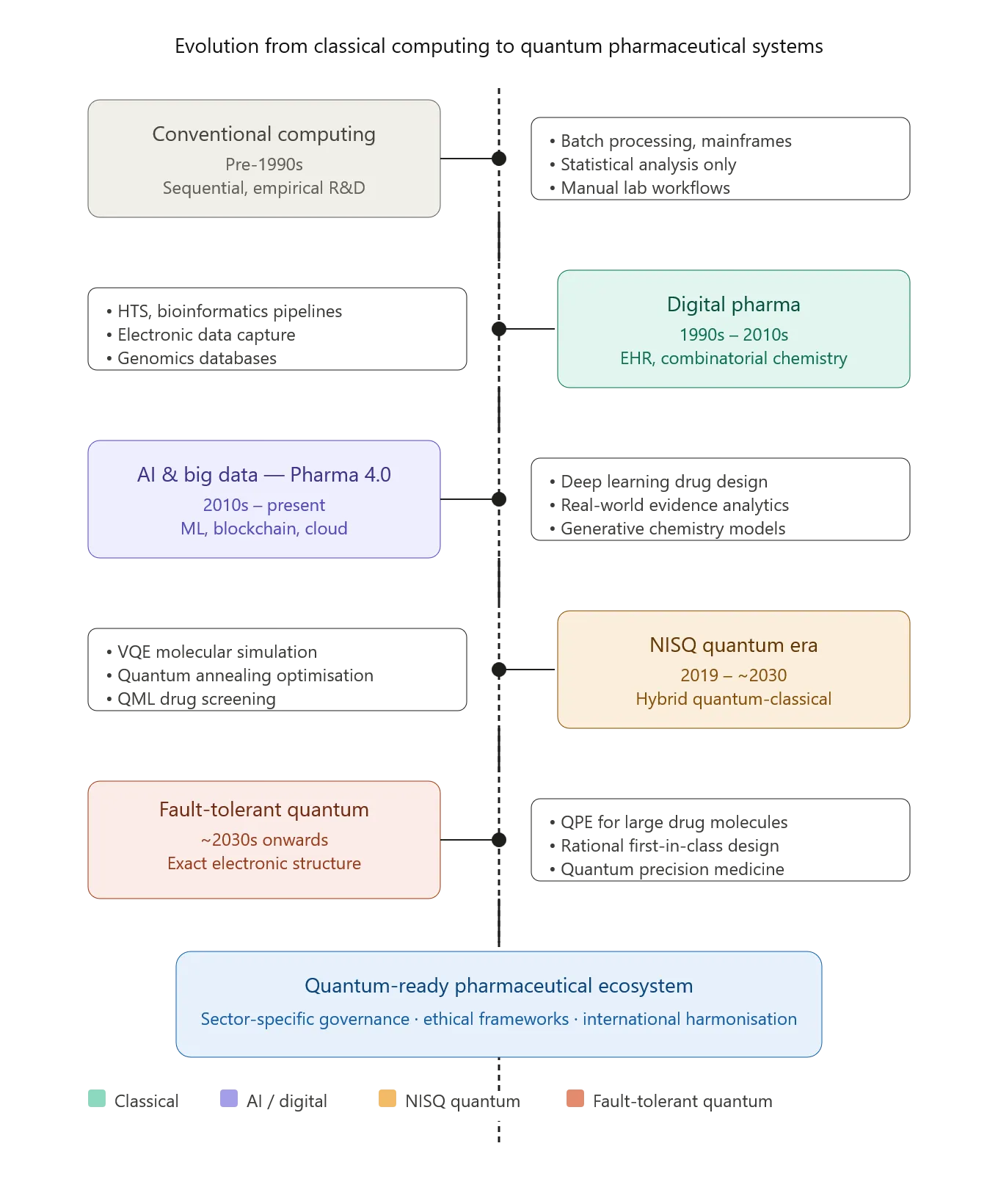
Figure None: 1: Evolutionfrom Classical Computing to Quantum Pharmaceutical Systems
Classical computers perform calculations by manipulating binary bits, whereas quantum computers use qubits. The latter have the ability to occupy a superposition of states, unlike conventional bits that can only take a single value of 0 or 1. Such an ability allows quantum computers to perform calculations exponentially faster than conventional supercomputers on certain problems. Quantum circuits implement quantum algorithms that possess an advantage over classical solutions either exponentially or polynomially [33]. For example, in the pharmaceutical field, quantum computers are expected to be useful for solving the electronic Schrodinger equation for molecular systems [23,24]. This will allow them to calculate the binding energy between two molecules with higher precision than classical algorithms, such as density functional theory (DFT). This property can be leveraged in various tasks, such as binding affinity prediction, toxicity analysis, and drug discovery to design new pharmaceutical compounds [23,24,39].
1.3 Why Quantum Technology Matters in Pharma
The pharmaceutical industry is currently faced with a confluence of challenges that have proved refractory to traditional approaches based on classical computers. Drug discovery remains a capital- and time-intensive process, with research and development (R&D) costs for each approved drug exceeding USD 2.6 billion, and phase II and III clinical trial failures remaining persistently ubiquitous at levels exceeding 90% due to deficiencies in target identification and translational predictive power [13,16]. The advent and proliferation of precision medicine, i.e., the tailoring of therapeutics to individual proteomic, genomic, and metabolic profiles, has created an urgent need to probe molecular interactions at a far greater resolution than conventional in-silico approaches can provide in a cost-effective manner [6,10]. Density-functional theory and classical molecular dynamics, while powerful tools for investigating quantum and classical mechanics respectively, introduce systematic errors in quantum-chemistry calculations, which in turn reduce the accuracy of binding affinity predictions and the reliability of off-target toxicity analyses [23,39]. Quantum computing can address each of these challenges at the root cause by providing exact solutions to electronic-structure problems, enabling exponentially accelerated conformational sampling and binding affinity computations, and facilitating high-dimensional optimization to enable fundamentally new approaches to pharmaceutical R&D and precision medicine [29,35,40].
1.4 Emerging Applications in Pharmaceutical Sciences
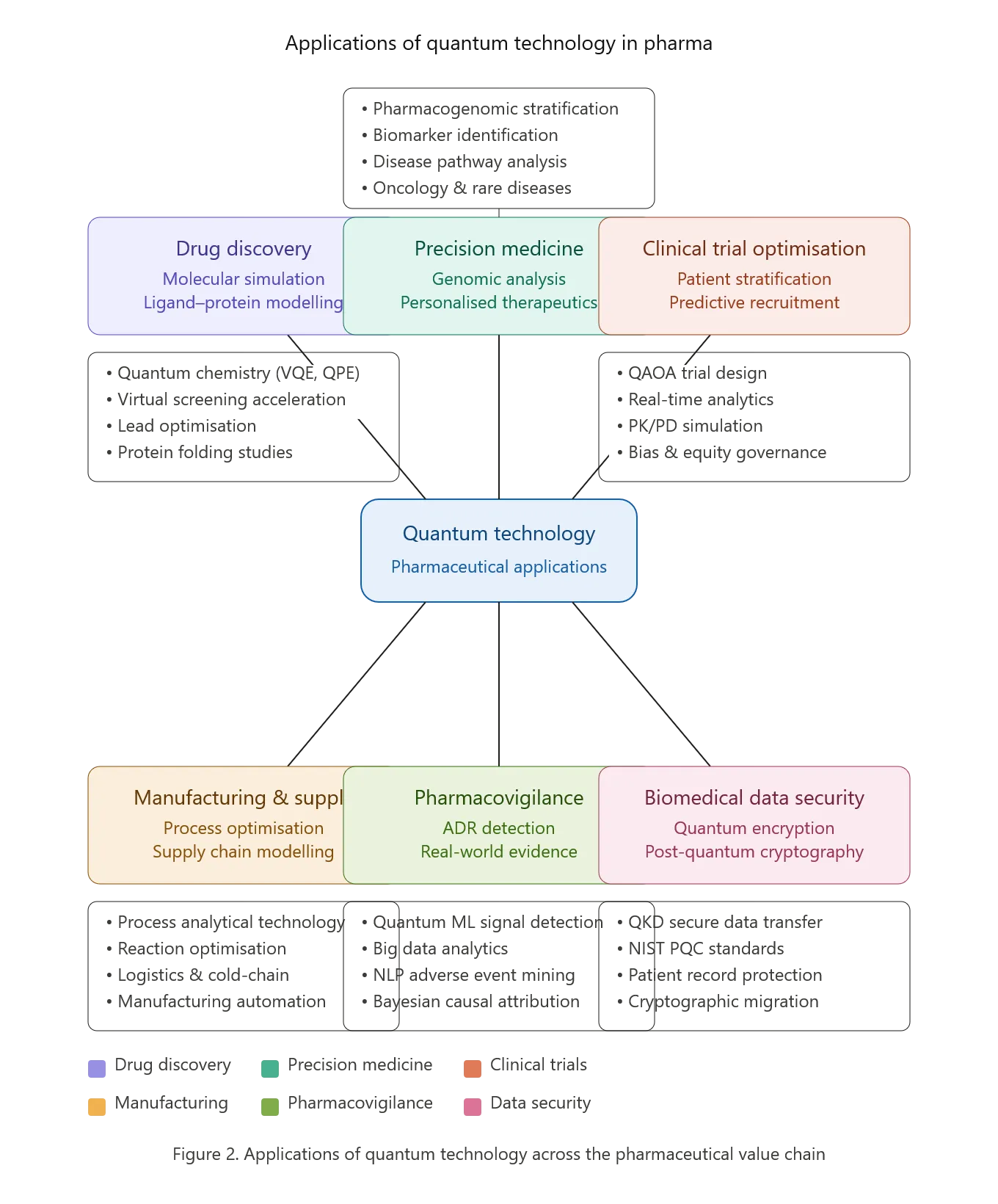
Figure None: 2: Applications of Quantum Technology in Pharmaceutical Sciences
Quantum technology is set to disrupt multiple stages in the pharmaceutical value chain. In molecular modelling, quantum processors utilising VQE and QPE algorithms can perform drug–target binding energy calculations beyond the accuracy of classical DFT approaches for challenging systems including metallo-enzymes and covalent inhibitors [39,40]. Regarding protein-folding, quantum annealing and gate-based quantum algorithms have been proposed to accelerate conformational sampling for both tertiary structure prediction and free energy calculations, providing quantum mechanical insight into folding thermodynamics unavailable from classical alphaFold implementations [29,41]. For drug screening, quantum-enhanced machine learning classifiers have demonstrated utility in virtual screening campaigns against extremely large compound libraries, accelerating lead discovery by several orders of magnitude [35,42]. In genomics, quantum algorithms for sequence alignment and variant calling have been shown to achieve polynomial speedups over classical dynamic programming approaches, with implications for pharmacogenomic biomarker discovery in precision oncology [43]. Quantum optimisation algorithms such as QAOA are being investigated for application to a range of pharmaceutical optimisation problems including clinical trial design, dose-escalation protocols and formulation design [38,44]. Within the supply chain domain, quantum enhanced logistics planning has been demonstrated to solve multi-objective optimisation problems governing pharmaceutical distribution and temperature control at scales inaccessible to classical algorithms [45]. Finally, for pharmacovigilance, quantum machine learning algorithms applied to real-world evidence mining have demonstrated markedly improved performance in detecting post-marketing adverse drug reaction signals compared to classical disproportionality analysis approaches [46].
1.5 Need for Regulatory and Ethical Governance
The rapid transition from theory to practice of quantum technology, and its incorporation into pharmaceutical processes, far exceeds the corresponding development of regulatory mechanisms to control and direct this process. At the current time, there is no regulatory document, whether at the level of the FDA or EMA as national authorities or the ICH as an international regulatory agency, that specifically addresses quantum technology and its unique characteristics in the pharma R&D sphere [19,20,47]. Digital health and SaMD regulations, which serve as the closest analogy to quantum computing oversight, were developed with conventional algorithms in mind and do not account for the probabilistic nature of quantum algorithms, the distinct types of error associated with quantum hardware, or the fundamentally different measurement processes inherent to quantum mechanics [48,49]. Left without specific guidance, pharmaceutical companies may adopt elements of quantum technology – notably quantum-derived simulation results, clinical outcome projections, or pharmacovigilance indications – in their R&D processes without adequate validation, qualification, or auditing procedures relative to classical digital counterparts [47,50].
In similar vein, data privacy considerations present a major regulatory challenge for the integration of quantum technology into pharmaceutical processes. Large-scale quantum computers are capable of surmounting modern cryptographic standards, defeating encryption protocols such as RSA and elliptic curve cryptography and jeopardizing the security of electronic health records, genomic databases, clinical trial data, and regulatory submissions [51,52]. While the NIST recognizes this looming threat and has initiated the process of post-quantum cryptography standardization, there are currently no specific FDA/EMA guidelines for pharma-related processes on how to prepare confidential or regulated data for analysis on a quantum computer [52]. Simultaneously, the use of quantum machine learning algorithms for pharmacovigilance and precision medicine applications may introduce new challenges in terms of interpretability and model transparency, as the complex many-body quantum algorithms and Hilbert space geometry involved in such systems are not amenable to standard review and auditing procedures [48,53]. From a regulatory standpoint, quantum machine learning violates the FDA’s Good Machine Learning Practice guidelines, EMA’s reflection paper on machine learning in health care, and Health Canada’s corresponding guidance, all of which stress the importance of interpretability, transparency, and auditability of medical AI [49,53].
The role of ethical considerations in the discussion of quantum computing and pharma is inextricably linked to the topic of regulation. Even at the conceptual level, the use of quantum technology in pharmaceutical processes invokes debates about ethics that have no direct analogous in the realm of classical algorithms. From a justice perspective, the application of quantum machine learning in pharmaceutical processes threatens to exacerbate long-standing disparities in both drug development and healthcare access more broadly [54,55]. If not carefully calibrated, quantum-assisted precision medicine may generate treatment algorithms that are fundamentally biased towards populations with greater representation in the training data, namely White populations, thus aggravating long-standing inequities in clinical care [54,55]. Moreover, the ability of quantum algorithms to make decisions in the pharma R&D process, ranging from drug target identification and clinical trial design to safety assessments and dose recommendations, raises difficult questions of ethics and accountability, particularly in the context of vulnerable populations [55,56]. In essence, the use of quantum technology in the healthcare sphere, and particularly in pharmaceutical processes, necessitates the development of a unique regulatory framework that takes into account the specific implications for data privacy, justice, and ethics.
1.6 Aim and Scope of the Review
This review aims to identify regulatory, ethical, legal, and cybersecurity issues related to the application of quantum technologies in the pharmaceutical industry and define a governance matrix for the industry-specific regulation of quantum technologies in pharma. While there are studies discussing the technical potential of quantum in pharma [23,29,40] and a number of works describing governance issues related to the application of AI in the healthcare sector [48,49,53], a comprehensive analysis addressing the peculiarities of quantum governance in the pharmaceutical industry has not been published.
The present research is limited to the pharmaceutical industry since it is characterized by specific regulatory and ethical issues related to the safety of patients and clinical data, as well as complex and long drug development cycles, which are not typical for other industries [47,50,55]. The current review considers all stages of the drug development lifecycle where quantum may be applied, ranging from drug discovery and molecular modeling to clinical trials, regulatory submission, pharmacovigilance, and supply chain distribution, as each of these stages implies specific governance challenges [44,45,46].
At the same time, the current review does not claim to be exhaustive. This analysis covers the main factors you would actually have to think about when regulating quantum technologies in the pharmaceutical sector, from looking at the current regulation and the ethical principles already used in pharma and digital health [19,20,48] to also reviewing the key legal along with cybersecurity issues that show up with quantum applications [51,52]. Special focus is given to who ends up being responsible for quantum aided decision-making and what happens after quantum era, especially the cybersecurity threats that could affect the pharmaceutical supply chain.
In the end, this review also lays out a governance matrix, kinda like a map, that gathers the key regulatory, ethical, legal, and cybersecurity concerns tied to using quantum technologies in pharma. With that matrix in hand, the main stakeholders in the pharmaceutical industry, meaning drug developers, technology providers, and regulators, should be able to craft a plan for quantum exploration, while still aligning with ethical principles and regulatory obligations [47,50,56]. So, the present review does not mean you have to place any kind of restriction on quantum technologies in the pharmaceutical industry. Instead, it tries to make sure that using them remains within ethical and regulatory boundaries, while encouraging scientific progress and protecting patient safety [54,56,57].
2. Fundamentals of Quantum Technology Relevant to Pharmaceuticals
2.1 Principles of Quantum Computing
Quantum computing is a new computational approach based on the principles of quantum mechanics rather than classical Boolean logic [27,31]. The basic unit of quantum information is the qubit, which may exist as electron spin states, photon polarization, superconducting circuits, or trapped ions [27,35]. Unlike a classical bit that exists only as 0 or 1, a qubit can exist in a superposition state represented as:
|\psi\rangle = \alpha|0\rangle + \beta|1\rangle
where the probability amplitudes satisfy:
|\alpha|^2 + |\beta|^2 = 1
When measured, the qubit collapses probabilistically into either 0 or 1 [27,35]. Because multiple qubits can exist in superposition simultaneously, quantum systems can process exponentially large information spaces compared with classical systems [33,35].
Another important principle is quantum entanglement, where qubits become strongly correlated such that the state of one qubit influences another regardless of distance [28,36]. Entanglement enables coordinated quantum operations that are impossible in classical computing and serves as a key resource for advanced quantum algorithms [36]. Quantum computations are performed using reversible unitary quantum gates such as Hadamard, Pauli-X/Y/Z, controlled-NOT (CNOT), and controlled-Z (CZ) gates [27,35]. By combining superposition and entanglement, quantum computers achieve quantum parallelism, allowing simultaneous evaluation of many computational states [31,35].
Quantum algorithms are designed to enhance the probability of obtaining useful outputs through constructive interference [33]. The concept of quantum supremacy, experimentally demonstrated by Google in 2019, refers to a quantum processor performing a task beyond the practical capability of classical computers [22,34].
Comparison Table 1: Classical Bits vs Qubits
| Property | Classical Bit | Qubit |
|---|---|---|
| Basic unit | Binary digit (0 or 1) | Quantum two-level system |
| State space | Definite: 0 or 1 | Superposition state |
| Measurement | Deterministic | Probabilistic collapse |
| Parallelism | Classical parallelism | Exponential quantum parallelism |
| Correlations | Local | Quantum entanglement |
| Error profile | Bit-flip errors | Decoherence and gate errors |
| Reversibility | Mostly irreversible | Reversible unitary operations |
Comparison Table 2: Classical Computing vs Quantum Computing
| Dimension | Classical Computing | Quantum Computing |
|---|---|---|
| Information encoding | Binary bits | Qubits |
| Logic operations | Boolean gates | Quantum gates |
| Computational model | Turing machine | Quantum circuit |
| Parallelism | Multi-core processing | Intrinsic quantum parallelism |
| Molecular simulation | Computationally expensive | Potentially efficient |
| Cryptography | RSA/ECC secure | Vulnerable through Shor’s algorithm |
| Error correction | Classical redundancy | Quantum error correction |
| Operating temperature | Room temperature | Near absolute zero |
| Current maturity | Commercially mature | NISQ era |
| Pharmaceutical relevance | Approximate simulation | Accurate molecular modelling |
2.2 Types of Quantum Technologies
Quantum technology encompasses a range of areas that use quantum mechanical phenomena in different ways [26,28].
Quantum computing is the most promising area for pharmaceuticals. Within quantum computing, gate-based models utilize quantum gates to implement algorithms useful for molecular modeling, optimization, and machine learning [27,35]. Leading companies in the field such as IBM, Google, and IonQ are already capitalizing on quantum information processing using noisy intermediate-scale quantum (NISQ) computers that exhibit limited fault tolerance [22,58]. Another major approach to quantum computing is embodied in the architecture of D-Wave and is based on quantum annealing, with applications spanning the optimization of drug formulation or logistics and trial design [38,44].
Quantum communication is another area that is particularly relevant to pharmaceuticals. This domain also exploits quantum mechanical phenomena to perform specific tasks such as distributing encryption keys for secure communication [28]. For example, quantum cryptography or quantum key distribution (QKD) relies on Heisenberg’s uncertainty principle and the no-cloning theorem to implement theoretically secure protocols for encryption [51,59]. The best-known example of QKD is the Bell’s theorem-based BB84 protocol used for encryption of clinical and pharmaceutical data [51,52,59].
The third area of quantum technologies is quantum sensing that uses quantum-mechanical properties of matter for sensing mechanisms and implements unique measurements at the level of single molecules [26]. Applications can show up across biomedical imaging [60], mass spectroscopy [60], and also drug quality control [60]. On the pharma side, quantum sensing may support high-detail imaging plus very sensitive signals tied to pharmaceutical molecules, complexes, and their formulations.
Right now, the state-of-the-art in quantum computers is mostly hybrid, and it leans on quantum processors for the toughest tasks while classical computers do the back-end parts [39,58]. In the pharmaceutical context, quantum machine learning (QML) seems the best bet, because it knits together quantum informatics with artificial intelligence in order to tackle things like drug discovery, clinical trials, and safety evaluation [42,46]. Also, more and more cloud offerings are becoming available for quantum computing services. For instance, IBM Quantum, Amazon Braket, and Microsoft Azure Quantum give access to quantum hardware for pharma organizations [25,58].
2.3 Quantum Computing Architectures
Many different hardware architectures have been proposed to build quantum computers. Each one comes with its own strengths and weaknesses, like really specific pros and cons [27,35]. For instance, superconducting qubits are currently the most mature and are being actively pursued by IBM, Google, and Rigetti [34,58]. In this scheme, the method relies on Josephson junctions, and it has shown quick gate operations while still keeping a reasonable level of scalability [58]. Still, the approach is held back by a few main limitations, mainly the cryogenic setup, electromagnetic crosstalk, and a collection of other noise sources [22,58]. Superconducting qubits have already been used to perform proof-of-concept molecular simulations relevant to pharmaceutical chemistry [39].
Another approach to building a quantum computer is to use trapped ions as qubits [61]. Leading companies in this domain are IonQ and Quantinuum. Trapped ions have exceptionally long coherence times and high fidelity gates, making them particularly attractive for molecular simulation [61]. However, this approach is also associated with significant challenges related to scaling [61].
Yet another approach to building a quantum computer is to use photons as information carriers. This approach is relatively close to being able to be used in practical applications, particularly in the field of quantum communications [59,62]. Photonic quantum computers can operate near-room temperature, which is much more friendly than the cryogenic conditions required by superconducting circuits [62]. However, a photonic approach has its own challenges related to photon losses and the need for probabilistic gates [62].
Topological quantum computers utilize quasi-particles called Majoranas to store and process quantum information [63]. This approach is still largely theoretical but has the potential to have a profoundly disruptive impact on pharmaceutical chemistry by enabling large-scale, high-accuracy molecular simulations [29,63].
Summary Table: Quantum Computing Architectures
| Architecture | Gate Fidelity | Coherence Time | Scalability | Pharmaceutical Relevance |
|---|---|---|---|---|
| Superconducting | ~99% | 50–500 μs | High | Molecular simulation |
| Trapped Ion | ~99.9% | Seconds–minutes | Moderate | Deep quantum chemistry circuits |
| Photonic | Variable | Stable at room temperature | Moderate | QKD and sensing |
| Topological | Theoretical | Potentially highest | Low | Fault-tolerant simulation |
2.4 Current State of Quantum Technology Development
Quantum technology is undergoing a rapid development process enabled by the substantial investments made by technology giants, pharma collaborations, and national initiatives [24,25]. IBM has pioneered the development of quantum processors with more than 1000 qubits, with plans to develop fault-tolerant quantum computing within the next decade [25]. Google has demonstrated quantum supremacy and is currently developing its portfolio of superconducting quantum computers [34]. Microsoft has partnered with quantum technology startups to develop topological quantum computing platforms while simultaneously providing cloud-based quantum inspired solutions through Azure Quantum [63]. IonQ and Quantinuum are developing leading trapped atomic commercial quantum computers, while D-Wave continues to develop its portfolio of quantum annealers for industrial applications [38,61].
The pharmaceutical industry has also been making strategic investments in quantum technology. Roche has partnered with Quantinuum to develop quantum machine learning applications [42]. Biogen has collaborated with Accenture and 1QB to develop quantum inspired drug discovery applications [44]. Boehringer Ingelheim has partnered with Google Quantum AI to develop molecular modeling applications [40]. Merck KGaA has joined IBM Quantum Network to explore pharmaceutical applications of quantum computers [39]. These collaborations are enabling the creation of future pharmaceutical discovery workflows based on quantum technologies [24,58].
National initiatives have played a pretty big role in helping quantum technologies grow, and it kind of makes sense. In the US, there’s the National Quantum Initiative, it gives meaningful support, substantial funding actually, for research efforts in this area [64]. Over in Europe, the Quantum Flagship program started up in order to back long-term work on quantum technologies, kinda like giving a steady road to go down for a while [65]. China has made considerable investments in quantum communication and quantum computing [66]. The National Quantum Mission was launched in India in 2023 with a significant budget allocated to developing quantum computers and communication infrastructure. Some of the applications targeted by this mission include biotechnology and pharmaceutical technologies [67]. Japan has also invested in quantum-AI through its national science fund providing with RIKEN, Fujitsu, and Toshiba [68].
3.1 Quantum-Assisted Drug Discovery
Harnessing the power of quantum computing in pharma
Quantum computing is poised to catalyze drug discovery by enabling accurate modeling of complex molecular systems too challenging for classical computers [23,40]. Quantum chemistry algorithms such as VQE and QPE allow for enhanced predictions of drug-target interactions and binding energies beyond the reach of traditional DFT methods [39,69]. These approaches are particularly advantageous in studying metalloenzymes and allostery, which are characterized by challenging many-body electronic correlations [29,40].
Quantum-enhanced in silico screening can be utilized to score large compound libraries more efficiently by leveraging quantum amplitude estimation to gain valuable insight into hit identification at a reduced quantum computational cost [35,42]. Similarly, quantum generative algorithms could be employed to perform more efficient high-throughput virtual screening during lead optimization [5,69].
A number of proof-of-concept studies and pharma-industry initiatives highlight the growing interest in quantum computing for pharmaceutical research. For example, quantum annealing has been demonstrated on protein-folding algorithms to identify low-energy conformations beyond the reach of classical simulated annealing approaches [41]. In another example, the quantum computing initiative of the Boehringer Ingelheim and Google Quantum AI collaboration has already targeted small-molecule optimization via variational algorithms [40]. Roche and Quantinuum have also reported on quantum machine learning approaches for drug-target interaction prediction, showcasing superior performance against selected benchmarks used in classical deep learning models [42].
Quantum computing can facilitate precision medicine by enabling efficient interrogation of large biological data sets, spanning genomics, proteomics, metabolomics, and beyond [43,70]. For instance, quantum algorithms can accelerate sequence alignment, variant phasing, and pharmacogenomic analysis to enable more efficient stratification of patient populations [43]. Quantum machine learning algorithms could also be leveraged to mine these complex data types for deeper mechanistic and individual-level insight [10,42]. In this regard, quantum-enhanced principal component analysis could be utilized in mining biological data for biomarkers [70]. Target identification in oncology and orphan disease areas could benefit from quantum-driven pathway reconstruction and protein structural simulations [29,70,71].
3.3 Clinical Trial Optimization
One of the main potential applications of quantum computing in medicine is the improvement of clinical trial design and management through the enhancement of patient stratification, recruitment, and predictive modelling [44,72]. Thanks to quantum algorithms, such as QAOA, it becomes possible to optimise the selection of patient cohorts according to eligibility criteria, safety, pharmacogenomic factors, and other considerations to improve the accuracy and efficiency of clinical trials [44]. Moreover, quantum computers can help analyse electronic health records and real-world evidence to predict enrollment trends and optimise trial sites’ selection [45,72]. Another area of application is quantum-assisted pharmacokinetic and pharmacodynamic simulations to improve the prediction of dose-response relationships and adverse event profiles before clinical trials [39,72].
At the same time, the use of quantum technologies in medicine raises several ethical concerns, such as the risk of reinforcing biases if not used carefully [54,55,56]. This danger is especially acute in clinical trials, where marginalised groups may be excluded from the benefits of innovation due to shortcomings in current approaches to diversity, equity, and inclusion [55].
3.4 Pharmaceutical Manufacturing and Process Optimization
Quantum technologies can be employed to make pharmaceutical manufacturing more reliable and optimized by improving intricate processes involved in drug production and supply chains [38,44]. Quantum optimization algorithms can be leveraged to find better solutions to multi-constraint manufacturing problems than classical algorithms [45]. For instance, in the case of process analytical technologies, quantum sensors can be used to perform highly sensitive measurements when monitoring critical quality attributes such as particle size, polymorph, and API concentration to achieve high-quality drug production [60]. Drug discovery and development processes can also benefit from quantum simulation by helping in finding the most optimal catalysts, solvents, and reaction conditions that improve yield while minimizing unwanted by-products [69,73]. Moreover, the manufacturing process can be made more efficient by employing quantum-assisted automation to reduce time, wastage of raw materials, and rework which is very costly to pharmaceutical companies [13,45].
3.5 Pharmacovigilance and Drug Safety Monitoring
Quantum technologies could contribute to pharmacovigilance and drug safety by enabling more efficient and sensitive identification and analysis of adverse drug reactions than classical approaches could [46,74]. Current pharmacovigilance practices are limited in their ability to analyse complex relationships between drugs and large amounts of real world evidence [46]. Quantum machine learning could help in mining and analysing high-dimensional healthcare data sets, thus contributing to more efficient and accurate signal detection for ADRs [46,70]. Additionally, quantum natural language processing could support early identification of safety signals from clinical notes, patient reports, and social media [42,74]. Finally, quantum Bayesian networks could support more efficient assessment of causal relationships, for instance for adverse events in polypharmacy, thus contributing to faster and better regulatory safety decisions [74]
3.6 Quantum Technology in Biomedical Data Security
The current state-of-the-art encryption systems such as RSA and elliptic-curve cryptography used to protect pharmaceutical and biomedical data against cyber threats will be vulnerable to large-scale quantum computers due to Shor’s algorithm (51,75). While quantum computers capable of full error correction do not exist yet, the quantum-enabled threat to the encryption of electronic health records, genomic databases, and submissions to regulating authorities have already been recognized (52,75). However, QKD protocols such as BB84 can provide secure channels for pharmaceutical data exchange (59,75). Also, the post-quantum cryptography standards from NIST can serve as a reliable basis for quantum-safe pharmaceutical cybersecurity (52).
4. Need for Sector-Specific Regulation
4.1 Current AI/Digital Regulations Are Inadequate
The existing regulations of AI-driven digital devices and software are inadequate for quantum computers and quantum machine learning due to their focus on deterministic computational processes (48,49). The FDA’s Software as Medical Device regulations require that “the device is appropriately designed for its intended use and that clinical evaluation of the device supports its safety and effectiveness.” Software processes such as SaMD are assumed to behave deterministically and, therefore, their outputs are considered to be reliable and interpretable with established audit trails. However, the execution of quantum algorithms is probabilistic and dependent on measurement outcomes and specific properties of quantum hardware such as decoherence (49,76). The decision-making process of a quantum computer is further complicated by the fact that it occurs in a high-dimensional space that cannot be recreated by classical computational means for post-processing (53,76). Thus, the application of quantum algorithms for pharmaceutical processes raises questions about their validity, reproducibility, and safety audit trails with regards to patient safety (48,76).
4.2 Existing Regulatory Frameworks Relevant to Quantum Systems
US: FDA Digital Health Center of Excellence: The FDA has issued draft guidance on regulating AI/ML-based SaMD that utilizes “predetermined change control plan (s)” (48,77). The policies relevant to quantum digital health devices are currently undefined, but the Office of Science and Technology Policy National AI Initiative and the NIST AI Risk Management Framework provide general principles of trust and transparency for quantum systems (52,64).
EU: The EMA Reflection Paper acknowledges the complexity of AI application in medicines development, but it does not cover quantum computers (49). The proposed AI Act, 2024 classifies medtech AI as high risk, which may serve as a basis for regulating quantum medtech, but it does not specify requirements for such systems (78). In addition, the GDPR regulation may impact the use of quantum systems in pharmaceutical data processing (79).
UK: The MHRA Software and AI as a Medical Device Change Programme does not yet address quantum systems (80).
India: The National Quantum Mission prepares India to lead the world in quantum technologies, but the CDSCO does not yet have sufficient AI regulations to cover quantum medical devices (67,81). A gap exists in regulating quantum medtech devices in India.
WHO and other international bodies: The World Health Organization’s ethical framework for AI for health can be applied to quantum technologies. However, quantum medical devices are not yet covered by ICH guidelines. International collaboration is needed to harmonize the regulation of quantum medical devices (47,82).
4.3 Major Regulatory Challenges
Validation/verification: The reliability of drug discovery applications of quantum computers is challenging to establish due to the probabilistic nature of qubit operations. Identical procedures produce different outputs on different hardware and exhibit statistical distributions rather than specific values. To satisfy pharmaceutical regulation, a set of requirements analogous to model-informed drug development needs to be defined (19,77). The validation of quantum algorithms requires benchmarking against established classical methods (19,69,76).
Transparency/explainability: Quantum algorithms utilize quantum-mechanical properties of entanglement and superposition to perform calculations that are not interpretable in the classical sense (53,76). Due to the complexity of quantum algorithms, it is currently unclear how to apply existing explainability tools such as SHAP and LIME or assess the fidelity of their quantum counterparts (53,78). An alternative approach is to shift the paradigm from input-output explainability to performance assurance of the quantum processing element (76,77).
Data governance: The application of quantum cloud computing for pharmaceutical processes such as molecular dynamics simulation involves the transmission of sensitive data across borders, which may raise data privacy and sovereignty concerns (52,54,79).
Standardization: A lack of standardized approaches for validating quantum algorithms, assessing qubit performance, and documenting the interaction with classical algorithms constitutes a challenge for achieving regulatory approval of quantum pharmaceutical applications (47,82).
Intellectual Property: The status of quantum algorithms in terms of patentability is unclear due to the novelty of the field and may differ between jurisdictions. The issue of inventorship for quantum computer-assisted drug discovery is also unclear and should be addressed by regulatory agencies (83). This may affect the incentive to develop quantum pharmaceutical applications.
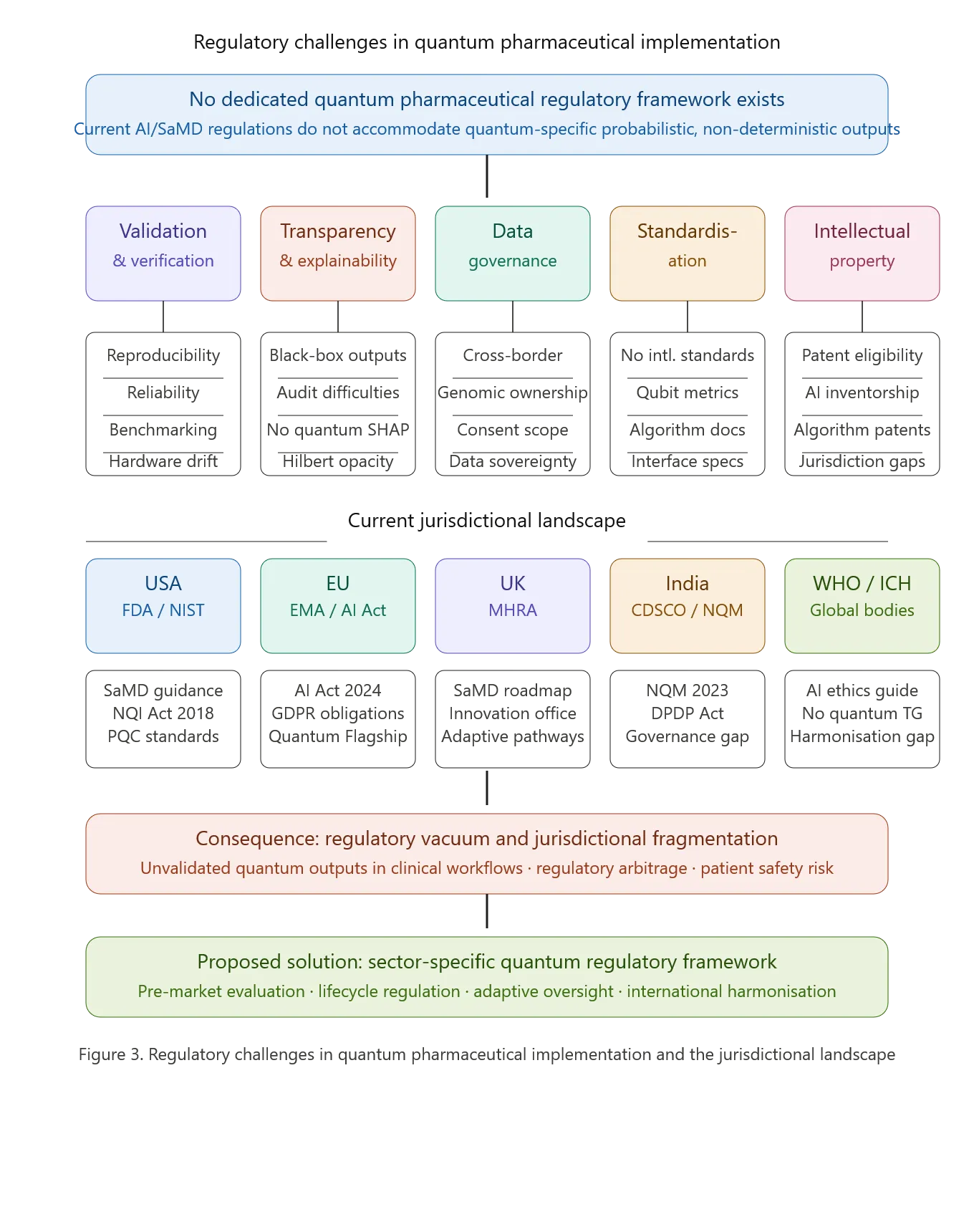
Figure None: 3: Regulatory Challenges in Quantum Pharmaceutical Implementation and the Jurisdictional Landscape
4.4 Regulatory Risk Assessment Models
A risk-based classification of pharmaceutical quantum systems is recommended, analogous to FDA and EMA device classifications but modified for quantum particularities [48,77,84]. Highest regulatory scrutiny should be applied to quantum algorithms with direct impact on drug approval, dose recommendation, or causality assessment of adverse events; intermediate supervision is appropriate for quantum-assisted discovery and optimization under human oversight; lowest oversight applies to quantum sensing and quality control with well-established performance characteristics [48,84].
Lifecycle regulation of pharmaceutical quantum systems should recognize their iterative nature, with ongoing performance improvements through hardware upgrades, error correction advancements, and algorithm refinements, requiring continuous evaluation beyond initial authorization [77,84]. FDA’s Total Product Lifecycle concept for SaMD can serve as a model, promoting controlled evolution through predefined performance boundaries for post-market modifications [77,84].
4.5 Proposed Regulatory Framework for Pharmaceutical Quantum Systems
So, the regulatory framework for pharmaceutical quantum systems should sort of… comprise five main elements, but they need to be organized as one unified system that works across the whole product lifecycle [47,56,84].
For pre-market evaluation of quantum algorithms, the submission should really include validation evidence that shows reproducible performance across different hardware platforms, plus classical benchmarks, uncertainty quantification, and also pharmaceutical relevance, in a way that reviewers can actually check [76,77].
After the product is out, post-market surveillance should mean continuous performance monitoring against predefined drift thresholds and it should consider how hardware and the algorithm might evolve over time [84].
There should be a cybersecurity audit component that is mandated for these pharmaceutical quantum systems, in order to ensure post-quantum encryption readiness of the data infrastructure [52,75].
Then, ethical review procedures should examine potential biases in training data, the implications for patient data privacy, and whether the benefits end up being distributed in a more equitable manner [54,56].
Explainability requirements should also be imposed, but when direct process transparency is hard or infeasible, statistical analogs or specialized interpretability models can be used instead [53,76].
And finally, international convergence for quantum pharmaceutical regulation through ICH, IMDRF, and bilateral agreements is vital, to prevent jurisdictional fragmentation really from getting out of hand [47,82].
5. Ethical Considerations in Quantum Pharmaceutical Systems
5.1 Ethical Principles Relevant to Quantum Technologies
Quantum tech applications in pharma and healthcare settings should stay in line with the core bioethical principles, though they sort of take on new faces once you move into the quantum context [55,56,85]. Beneficence, for instance, is not satisfied just by saying “look it can do more”, it should show clinical usefulness via improved drug discovery, therapy fine-tuning or even safety monitoring; in other words quantum based pharmaceutical systems need to be judged by actual effects on health, not only by plausible ideas or “on paper” promises [56,82]. Non-maleficence also matters, and it covers more than usual, like steering away from harms that could come from incorrect molecular simulations, biased optimization routines, or outright security weaknesses; so, quantum specific hazard assessment protocols really should be put in place [55,84]. Justice pushes for fair access to the upside from quantum driven healthcare, plus making sure genomic data doesn’t get skewed by hidden biases [54,85]. Autonomy is supported when patients get meaningful informed consent for quantum assisted health data handling, including across border data sharing, and also commercial reuse where relevant [55,79]. And accountability has to be real too, meaning there should be clear responsibility assignment for what happens with quantum pharmaceutical system outcomes [56,84].
5.2 Ethical Risks of Quantum Implementation
Algorithmic bias: quantum machine learning models trained on genomic databases that are not well characterized, or are simply not representative, could end up carrying over existing demographic disparities into how targets get chosen, which biomarkers show up, and how precision medicine decisions are actually made [54,70]. There’s also this persistent issue that the bulk of reference catalogs are dominated by variants from European ancestry, and that tends to make the whole situation worse. In practice it may end up reinforcing healthcare inequities through quantum pharmacogenomics, even if that wasn’t the original intent [54,71].
Privacy: quantum computing brings fresh hazards for health data confidentiality beyond what’s usually discussed in standard pharmaceutical contexts [51,75]. The re-identification problem can get sharper, because quantum algorithms may improve pattern recognition in ways that were harder to replicate before. The idea of “harvest now, decrypt later” becomes a real, direct risk for encrypted genomics, clinical trial datasets, and molecular information [52,75].
Global health inequity: another concern is that quantum hardware, plus specialized know-how, is concentrated in a handful of multinational corporations and just a few countries. This concentration creates worry about uneven access to quantum-driven pharmaceutical innovations [24,85]. And it’s not only about drugs. Similar unfairness can also show up in access to quantum-assisted healthcare services, which could then widen the treatment gap between higher income groups and lower income populations [25,67].
Human factor: increased reliance on quantum algorithms for drug design and regulatory decision-making may reduce meaningful human participation in critical pharmaceutical choices [53,84]. The move towards fully automated quantum systems threatens to eliminate human oversight in favor of algorithmic “black box” solutions [56,84].
Dual-use dilemma: the capacity of quantum algorithms for simulating biological processes creates opportunities for developing more sophisticated biological weapons, raising security concerns beyond conventional pharmaceutical oversight [86].
5.3 Ethical Governance Models
Human-in-the-loop design is a key governance approach to quantum pharmaceutical systems, particularly in high-impact areas such as drug target identification and clinical trial design [53,84]. It balances the need for human oversight with the efficiency gains of quantum computing by delegating routine operations to algorithms while retaining critical decision-points for human judgment [53,84]. This model requires quantum systems to provide reliable performance estimates to support informed decision-making [76,84].
Ethics review boards with quantum expertise should be established to evaluate applications of quantum computing in pharmaceutical domain [55,85]. These boards can take different forms, from integrated institutional review boards to standalone entities, but must include multidisciplinary quantum expertise to fulfill their mandate [56,82]. A key responsibility will be to assess the ethical implications of quantum pharmaceutical system deployment in specific populations and contexts [55,85].
Dynamic ethical governance is needed for quantum pharmaceutical innovations through responsible research practices, including anticipatory ethics, reflexivity, inclusiveness, and responsiveness [57,85]. This approach recognizes the unique challenges posed by quantum technologies and the need for proactive ethical consideration during the innovation process [56,57].
5.4 Public Trust and Societal Acceptance
Public engagement and trust are essential for quantum pharmaceutical innovation, you know, so transparency, education, and inclusive governance really matter [82,85]. Beyond the usual ethical principles, quantum pharmaceutical systems should also carry pretty specific transparency duties, especially for parts of the public that are concerned or sensitive [53,56]. When people first hear about quantum tech, it will be key to explain what it can do, and also what it cannot do, in clear everyday language, not in jargon, because that kind of clarity supports broader social acceptance [55,85].
So, public awareness campaigns can help nudge the wider community toward understanding quantum technology opportunities but also the hurdles, which can in turn support evidence-based decisions about using it in healthcare [57,82]. Patient trust in these quantum pharmaceutical systems hinges on privacy by design, responsible governance, and also meaningful individual say over how health data is handled and processed [55,79]. In a similar way, clinicians will be more willing to adopt it if quantum literacy is built for healthcare professionals, not only as a one-off training, but as something sustained [85,86].
6. Cybersecurity and Legal Implications
6.1 Quantum Cybersecurity Threats
The rise of fault tolerant quantum computers could start to undermine the existing encryption protocols used to guard pharmaceutical information [51,75]. Quantum schemes like Shor ’s algorithm, might in practice manage to decrypt material protected with RSA 2048 or elliptic curve cryptography, which in turn could expose electronic health records, genomic datasets, clinical trial results, regulatory notes, as well as intellectual property to people with unauthorized access [51,52].
Then there is the whole “harvest now, decrypt later” approach, it adds yet one more worry because it encourages actors to copy encrypted pharmaceutical data, keep it archived, and then decrypt it later using future quantum hardware [75,87]. This becomes extra critical in the healthcare domain, since it not only contains valuable intellectual property but also keeps sensitive genomic and clinical records with, in many cases, weak cybersecurity protections [87].
6.2 Post-Quantum Cryptography
Post-quantum cryptography (PQC) is basically about encryption methods that are meant to stay secure even if both classical and quantum computers try to attack them, not just one kind of machine [52,75]. In practice, PQC standards are getting more attention for protecting digital health records, genomic databases, and pharmaceutical information from quantum-based risks [52,75]. NIST has already started standardizing PQC algorithms, and the first batch of quantum resistant encryption schemes is expected to show up in 2024 [52,88]. Because of that, migration toward PQC protected systems should be treated as a priority, especially for pharmaceutical and healthcare data, and it helps to set transition timelines based on how business critical each system is [75,88]. The need feels even stronger for clinical database backups, regulatory submissions, and manufacturing information systems, since those environments hold time sensitive information and after a specific date it can lose value pretty fast [88].
Healthcare and pharmaceutical organizations should really use a cryptographic agility mindset. so they can shift between different encryption algorithms smoothly, while still keeping overall system security intact [52,88]. This matters even more when legacy systems have long, drawn out transition schedules. For the near term, hybrid protection models, using a mix of classical methods plus quantum-resistant algorithms, can keep things covered [75,88]. Even so, there’s a clear sense that regulators still need to publish more concrete transition guidance for PQC. Right now, the existing FDA and EMA guidance, doesn’t fully cover the pharmaceutical sector’s particular needs [52,77].
6.3 Legal Liability and Accountability
Using quantum computers for pharmaceutical research and development brings up messy legal liability questions, and it really needs fresh thinking around product liability, medical negligence, and the way software validation gets handled [83,84]. In a lot of situations, it will be hard to pin blame for any damages linked to quantum assisted drug development on just one actor, because quantum pharmaceutical systems usually lean on several tightly coupled parts and they do not really act in isolation [56,84]. That means when quantum assisted drug discovery goes wrong, liability allocation is likely to get heated, with arguments about whether manufacturers can actually be blamed for mistakes inside the quantum machine learning side of things [83,89]. At the same time, software developers probably should not face strict liability for algorithmic failures, since quantum computing is inherently probabilistic, not deterministic and sort of “best guess” in practice [76,89].
So, legal frameworks for quantum pharmaceutical systems should be shaped around accountability and an objective method of risk assessment, rather than promising absolute safety guarantees [76,89]. In negligence disputes, courts may end up preferring a statistical way of looking at causation, weighing the likelihood that a particular quantum pharmaceutical setup contributed to the harm, even if the chain of responsibility is blurred [56,89].
6.4 Cross-Border Legal Challenges
The nature of quantum pharmaceutical systems as a kind of global infrastructure brings in legal headaches at more than one level [52,79,90]. Data privacy laws, across different jurisdictions, can end up clashing, especially when we talk about storing and processing genomic data along with clinical records [79,90]. Meanwhile, big multinational pharmaceutical companies often struggle to steer through uneven export control rules for quantum hardware, and for the algorithms too [90].
A number of unresolved legal issues pertain specifically to quantum pharmaceutical systems, including quantum-enabled intellectual property, liability for algorithmic failures occurring on foreign jurisdictions, and the jurisdiction over quantum data privacy disputes [83,90]. Multilateral agreements will be needed to establish a coherent international legal framework for quantum pharmaceutical systems, with input from private sector stakeholders [83,90]. Existing international organizations, including WIPO, WTO, and UNCITRAL, are likely to play a role in developing model treaties and standardization documents for quantum pharmaceutical systems [83,90].
7. Sector-Specific Ethical and Regulatory Framework
7.1 Framework Objectives
The ethical and regulatory framework aims to achieve four objectives related to responsible quantum technology adoption in the pharmaceutical sector [47,56,84].
Safe implementation of quantum technologies, through appropriate product validation and regulatory oversight according to the level of clinical risk
Advocacy of responsible innovation principles, including the adoption of anticipatory governance to address ethical, safety, and liability concerns before product launch [57,85].
Embedding of ethical governance principles, including beneficence, non-maleficence, justice, autonomy, and accountability throughout the product lifecycle [55,85].
Achievement of regulatory harmony both within countries and across jurisdictions through multilateral agreements, thus promoting equitable development of quantum pharmaceutical technologies [82,90].
7.2 Core Pillars of the Framework
Transparency: Maintaining comprehensive documentation throughout the product development cycle will be critical for achieving regulatory and public trust [53,76]. It will be necessary to establish public registries of quantum pharmaceutical products, similar to clinical trial registries, to enhance transparency and facilitate independent review [77,82].
Accountability: Clear assignment of responsibility should be established for all aspects of quantum pharmaceutical system development, spanning different business functions, with particular attention paid to the end-use application [56,84,89].
Explainability: Where quantum systems are unable to provide direct insight into their decision-making processes, alternative approaches to interpretability such as statistical explanation and sensitivity analysis should be utilized [53,76]. Explainability will be required at different levels depending on the clinical risk category of the system [77,84].
Cybersecurity: Robust encryption practices should be mandated for all pharmaceutical data, with a transition to post-quantum secure algorithms following the release of relevant standards [52,88]. Regular quantum threat assessments should be conducted, along with updates to incident response plans [52,88]. Regulatory agencies might consider requiring attestation of PQC migration by pharmaceutical companies as part of periodic submission processes [75,88].
Equity: Efforts should be made to ensure that training data sets are representative of the general population to minimize potential biases in algorithmic performance [54,85]. Similarly, steps should be taken to make quantum pharmaceutical technologies accessible to a diverse range of patients and avoid monopolistic practices [54,82]. These considerations should inform regulatory review and approval decisions for quantum pharmaceutical products [54,82].
Human Oversight: You really want human in the loop governance for quantum pharmaceutical systems, and not just as a checkbox, with special focus on the areas that are of heightened clinical significance [53,84]. Then, competency requirements should be set up for the people in clinical and regulatory work who are doing quantum pharmaceutical oversight [56,84]. Also, human oversight capability should stay in place even as the automated quantum processes get more sophisticated over time [76,84].
Sustainability: The pharma sector should lean into a responsible style of adopting quantum computing, weighing both the environmental impact and long-term technical sustainability [91]. A lot of attention should go to the energy needs of quantum computing hardware, particularly the big scale cryogenic setups [91]. At the same time, industry actors should be careful not to lock themselves into one technology platform in a way that turns out irreversible, because that could limit future regulatory or therapeutic options [57,91].
7.3 Stakeholder Responsibilities
Pharmaceutical industry: The pharmaceutical sector has primary responsibility for the ethical and regulatory compliance of quantum pharmaceutical systems [56,84]. Companies should establish internal governance structures to review and oversee quantum technology adoption in a manner that promotes patient welfare and regulatory compliance. Effective oversight will require multidisciplinary expertise, including computational biology, clinical pharmacology, ethics, regulatory affairs, and information technology [47,82].
Regulators: Regulatory agencies should develop the technical expertise and guidance documents needed to evaluate quantum pharmaceutical technologies [77,82]. New specialized units, such as quantum technology divisions within the FDA, may be needed to support this mission [48,77].
Technology developers: Quantum computer manufacturers and software developers should be responsible for disclosing technical details about their products’ performance characteristics and limitations [76,88]. Additionally, technology developers should engage in quantum pharmaceutical conformity assessment activities to support regulatory review of their products [84,89].
Healthcare professionals: Clinicians and pharmacists should develop sufficient technical understanding of quantum computing to be able to critically review quantum-assisted recommendations and effectively communicate quantum-related information to patients [85,86].
Patients and the public: Patients should be aware of the potential benefits and risks of quantum technologies and have an opportunity to participate in relevant decision-making on a societal level [55,79,85].
7.4 Multi-Level Governance Model
The governance model consists of three levels, spanning the organizational, national, and international levels of the pharmaceutical supply chain [47,82,84].
The institutional level pertains to oversight within individual healthcare organizations and pharmaceutical companies. This includes the establishment of institutional oversight committees for quantum technologies as well as institutional review boards with relevant quantum expertise [56,84,85].
At the national level, medicines regulatory agencies should be responsible for developing the quantum-specific regulatory framework within their jurisdiction, potentially with the support of national-level quantum technology advisory boards [77,80].
The international level covers the harmonization of regulatory practices between jurisdictions as well as the development of model standards and governance principles through organizations such as the ICH and WHO [82,90].
Across all the levels, periodic third-party audits should be rolled out, to confirm the adherence with the quantum governance principles. In those audits there should be included a check on how well the system holds up under adversarial attacks resistance, also performance drift evaluation, and algorithmic bias review, especially after major system upgrades or when post market safety concerns show up [76,84,88]. The findings from these audits ought to be made known to the competent authorities through standardized reporting ways, on the institutional scale, national scale, and even at the international level [76,88].
7.5 Implementation Roadmap
Short-Term Priorities (Years 1–3):
Governance infrastructure development: During the NISQ era , it’s probably best to push early on the groundwork for governance mechanisms that support responsible quantum pharmaceutical work [47,77]. In practice , that means something like publishing FDA/EMA discussion papers on how regulatory bodies might handle quantum computing methods, then setting up an ICH working group on quantum topics, starting up NIST pilot programs for PQC transition, building institutional “quantum governance” policy templates, and also rolling out core quantum literacy modules specifically for regulators.
Mid-Term Priorities (Years 4–7):
Transition to operational governance: With the expected arrival of early fault-tolerant quantum computers, the emphasis will shift to implementing quantum-specific regulatory and ethics requirements [84,88]. This period should see publication of ICH guidelines on quantum computational validation, introduction of PQC attestation requirements by FDA/EMA/MHRA, establishment of national quantum pharmaceutical advisory boards, implementation of quantum conformity assessment procedures within the EU AI Act framework, and publication of WHO guidance on quantum health governance [78,82].
Long-Term Priorities (Years 8–15):
Global harmonization and sustainability planning: As fault-tolerant quantum computers enable practical applications in pharmaceutical R&D, the focus will shift to achieving global regulatory coordination and developing sustainable quantum pharmaceutical ecosystems [29,63]. This includes ICH/IMDRF-led international regulatory alignment, multilateral agreements on quantum data governance, equitable global access initiatives supported by WHO and development banks, and adaptive governance strategies to accommodate future quantum technology advances [83,90,91]
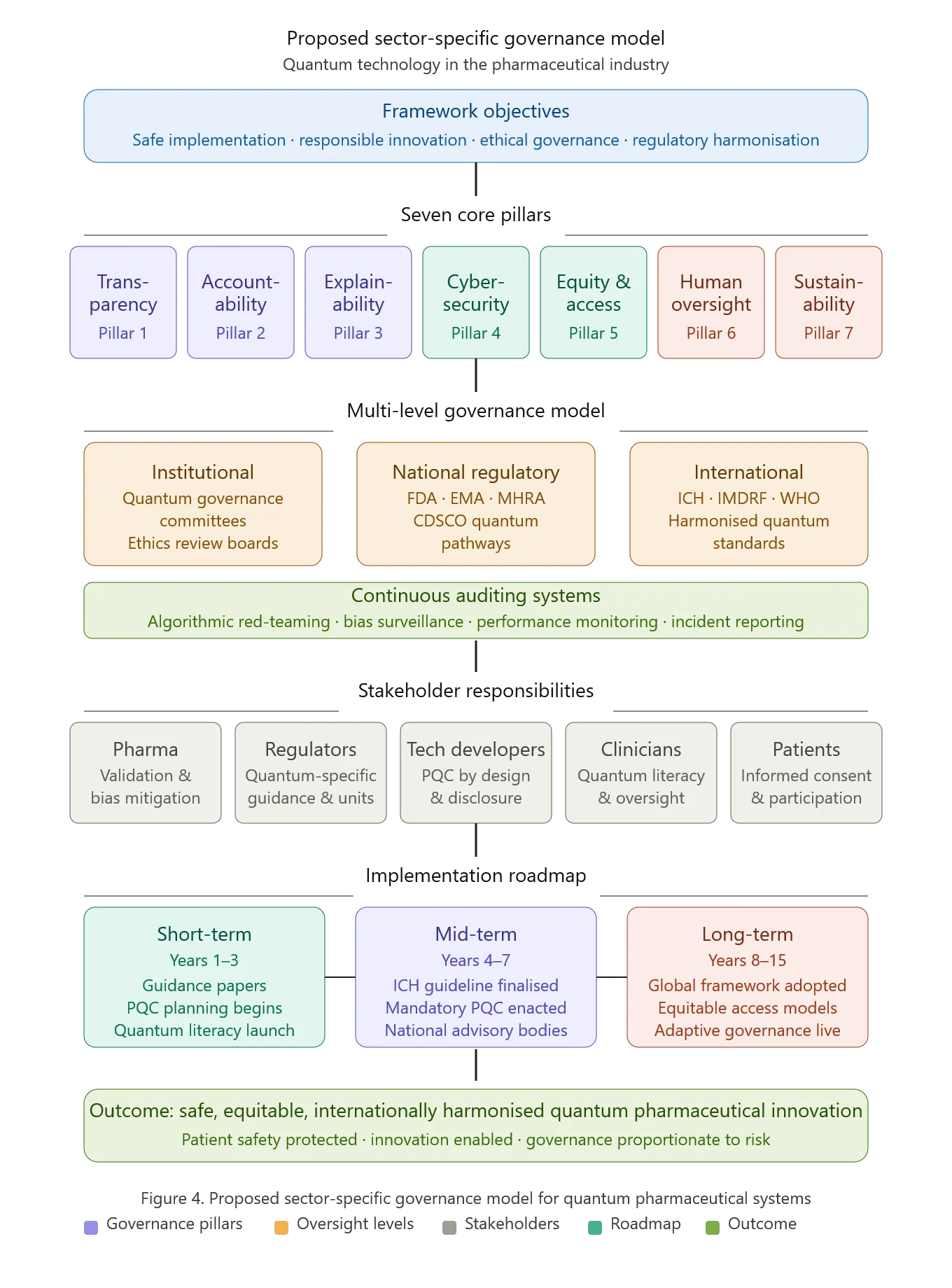
Figure None: 4: Proposed Sector-Specific Governance Model for Quantum Pharmaceutical Systems
8. Future Perspectives
Quantum technology is disruptive to pharmaceuticals and healthcare and will introduce governance issues beyond current experience (24,63,91). Preparations to harness its potential benefits while managing its risks require substantial investment in quantum-adequate clinical and pre-clinical research and development frameworks, post-quantum data management infrastructure, workforce development, and responsive regulatory environments (47,58,84,88). Such transformations are unlikely to occur in a short time and will require considerable efforts to be made over the next decade or so.
The future applications of quantum technology in drug discovery and development envision an evolution from relatively simple systems, which may be used for proof-of-concept studies, to increasingly complex biomedical problems, such as G-protein coupled receptors, intrinsically disordered proteins, and nucleic acid therapeutics, as quantum hardware matures (29,69). This process will benefit from quantum computing’s capacity to perform chemical accuracy simulations of molecular interactions, enabling the design of therapeutics with optimized efficacy and safety profiles and ultimately leading to reduced attrition rates in pharmaceutical R&D (39,63). Similarly, the convergence of quantum computing with artificial intelligence and synthetic biology is expected to generate substantial value across therapeutic areas (5,86,92). However, such dual-use research raises critical security concerns requiring preemptive governance measures (86,92).
Harmonization of regulatory approaches at the global level through such forums as ICH, IMDRF, WHO, and similar organizations will be critically important to avoid multiple, conflicting requirements while ensuring equitable access to quantum-based pharmaceuticals (82,90). At the same time, society needs to develop new ethical principles to guide quantum-assisted drug discovery and clinical decision-making, addressing such issues as the appropriate roles of quantum-derived algorithms in healthcare and balancing the need for innovation with social responsibility (54,56,85).
CONCLUSION
Quantum technology presents unprecedented opportunities for the pharmaceutical industry and healthcare, including chemically accurate simulations of biomedical processes, advanced data encryption and management, and enhanced artificial intelligence tools for personalized treatment design, but also poses serious security, liability, and ethical risks (23,29,69). The overarching conclusion of this review is that the opportunities offered by quantum pharmaceuticals can be fully capitalized on, and its risks mitigated, only if the relevant regulatory and governance frameworks are prepared ahead of the clinical translation of quantum technologies.
Such preparation is needed because of the long development-innovation cycles inherent in pharmaceutical R&D and the corresponding need to intervene early and often in this process (47,84,85). Indeed, even now, when the majority of practical applications of quantum computing are still to come, researchers and policymakers have identified numerous governance and regulatory issues that will require multi-stakeholder collaborations to be resolved (76,91). Moreover, historical evidence indicates that the governance of emerging health-care-related technologies typically emerges too late and is frequently deficient, failing to consider diverse patient populations’ needs adequately (56,85). Thus, getting governance right the first time around is critically important in the case of quantum pharmaceuticals, where the opportunities and risks are both significant. Addressing this challenge will benefit from the proposed balanced approach to regulation that employs a risk-adaptive, multi-layered design to promote innovation while ensuring patient safety, data privacy, and societal acceptance across jurisdictions (76,91).
Because of the complexity and global nature of the issue, international collaborations are critically important and should be facilitated by relevant regulatory agencies, including ICH, IMDRF, WHO, and others, to ensure uniformity of approach and avoid multiple, varying jurisdiction-specific requirements (82,90,93).
Acknowledgement
The author would like to express sincere gratitude to MVM College of Pharmacy, Yelahanka, Bengaluru – 560064, for providing the necessary support and facilities to carry out this research work.
REFERENCES


G. R. Madhu, Agilandeswari Devarajan, Vijayanadhan V., Sunanda N., Quantum Technology in the Pharmaceutical Industry: Regulatory, Ethical, and Governance Challenges - a Comprehensive Review, Int. J. of Pharm. Sci., 2026, Vol 4, Issue 11, 5706-5731. https://doi.org/10.5281/zenodo.24582965
 10.5281/zenodo.24582965