
View Article

Abstract

RP-HPLC remains the gold standard in the pharmaceutical industry for quality control of both drug substances and drug products. Checking the reliability of these procedures requires thorough validation according to ICH guidelines, especially Q2(R1). In establishing the stability-indicating capability of a method, it requires forced degradation studies or so-called stress testing as outlined under ICH Q1 guidelines. The paper reviews in detail the parameters required to validate a method, namely specificity, linearity, accuracy, precision, and robustness, and also describes the procedure to be followed for acid, base, oxidative, thermal, and photolytic stress conditions. This paper aims at serving as a strategic tool for an analytical chemist in the development of robust yet regulatory-compliant analytical procedures.

Keywords

RP-HPLC, Method Validation, ICH Q2(R1), Forced Degradation, Stability Indicating Method, Stress Testing.

Introduction

HPLC remained the dominant separation technique in pharmaceutical analysis due to its high sensitivity, reproducibility, and suitability for non-volatile and thermally labile compounds. The HPLC techniques, RP-HPLC, which uses a non-polar stationary phase and  polar mobile phase, also most common separation technique. [1]The prime objective of an analytical method in a regulatory context is to deliver results that are accurate and guarantee patient safety, and hence method validation is required. Validation is defined as the accumulation of documented evidence that provides a high degree of assurance that a specific process will consistently produce a product meeting its predetermined specifications and quality attributes. The major guidance towards this task comes from the International Council for Harmonisation through the ICH Q2(R1) guidelines. [2]

Concurrently, regulatory agencies such as the U.S. Food and Drug Administration (FDA) and the European Medicines Agency (EMA) require that analytical methods for stability assessment be stability-indicating; that is, the methods must quantify the API without interference from degradation products. This objective is realized via stress testing (forced degradation), as described in ICH Q1A(R2). The present review synthesizes these two critical components validation and stress testing into a unified workflow. [3,4]

HPLC Methodology: Strategic Mobile Phase Selection:

The choice of mobile phase is the most critical parameter in controlling selectivity and retention factor in RP-HPLC. [5]

Strategic Method Development in RP-HPLC

Stationary Phase Selection (The Column) [6-8] While C18 is the workhorse, modern separation requires a nuanced choice.

Table 1: HPLC Column Classification and Selection Guide

Column Chemistry

Characteristics

Recommended Application

C18 (ODS)

High hydrophobicity, dense carbon loading.

General purpose; first choice for most small molecules.

C8 (Octyl)

Lower hydrophobicity than C18.

Use when retention on C18 is excessive (> 30 mins) or for highly hydrophobic drugs.

Phenyl-Hexyl

interactions.

Superior for aromatic compounds, isomers, and conjugated systems.

Cyano (CN)

Intermediate polarity; can operate in Normal or Reverse Phase.

Good for polar compounds; offers orthogonal selectivity to C18.

Pentafluorophenyl (PFP)

Fluorine-based interactions.

Excellent for halogenated compounds and separating positional isomers.

Polar Embedded

Amide or carbamate group embedded in alkyl chain.

Prevents peak tailing for basic drugs; compatible with 100% aqueous mobile phases.

Mobile Phase Optimization

Organic Modifiers

  • Acetonitrile has low viscosity and, therefore yields sharp chromatographic peaks; it has low UV absorbance at 190 nm. It is an aprotic solvent that has strong dipole capabilities.
  • Methanol exhibits higher viscosity and often presents different selectivity, which may be advantageous when acetonitrile cannot resolve peaks due to its distinct solvation mechanisms.
  • Tetrahydrofuran Strong solvent strength but unstable and high UV. Rarely used in modern stability methods. [9]

Buffer Selection

Buffer choice is dictated by the target pH and detection method.

  • Phosphate (pH 2.0–8.0): Excellent buffering and UV transparent. Disadvantages include non-volatility and a tendency to precipitate at high organic content, and is also incompatible with LC–MS.
  • Acetate (pH 3.8–5.8): Volatile and LC–MS–compatible. Drawback: higher UV cutoff (~210 nm).
  • Formate (pH 2.8–4.8): volatile and LC–MS–compatible.
  • Trifluoroacetic acid: Also serves as a buffer and as an ion-pairing agent; it sharpens peaks for peptides and proteins but suppresses ionization in MS. [10]

Gradient vs. Isocratic

  • Isocratic uses a mobile phase of constant composition. Simple to perform, this mode spreads peaks that elute late and cannot accommodate a wide polarity range.
  • Gradient chromatography relies on time-dependent variation of organic composition, such as from 5% to 90% B. This mode concentrates peaks by band compression, improves sensitivity, and allows elution of highly retained impurities. Smoke analyses and the like require the use of SIMs with gradient elution to allow all degradation products to be eluted within a reasonable length of run time. [11]

Principle of HPLC :

  • High-Performance Liquid Chromatography (HPLC) is a separation technique in which a small volume of a liquid sample is injected into a column packed with fine spherical particles, typically 3–5 micrometers in diameter, forming the stationary phase. During passage of the sample through the column, the constituent components are conveyed by the liquid mobile phase and are mobilized through the column under high pressure by a pump. Separation results from a variety of chemical and physical interactions between the analyte molecules and the stationary-phase particles. The separated compounds elute from the column and are detected by a very sensitive detector positioned at the column outlet. The detector measures the molar concentration of solutes eluting per unit time and produces a signal that is expressed as a chromatogram. The different properties utilized to separate the analytes in HPLC are collectively termed modes. [12]

Working Principle of RP-HPLC :

The Core Concept: Differential Migration

  • The separation mechanism in RP-HPLC depends on the partition coefficient of the analyte between two phases: a solid particle stationary phase and a liquid solvent mobile phase. Its origin is a hydrophobic interaction, best explained by the concept of the “river and rocks” analogy.
  • The stationary phase generally consists of silica particles coated with non-polar C18 or octadecylsilane chains.
  • The mobile phase is made of a polar solvent-water or buffer with an organic modifier-flowing through the column. Hydrophobic or non-polar analytes would interact strongly with C18 chains and thus elute later, whereas polar analytes interact more with the mobile phase and elute earlier. [13]

Instrumentation:

The contemporary design of the HPLC system consists of five critical components, which follow a path designed with the purpose of minimal band broadening.
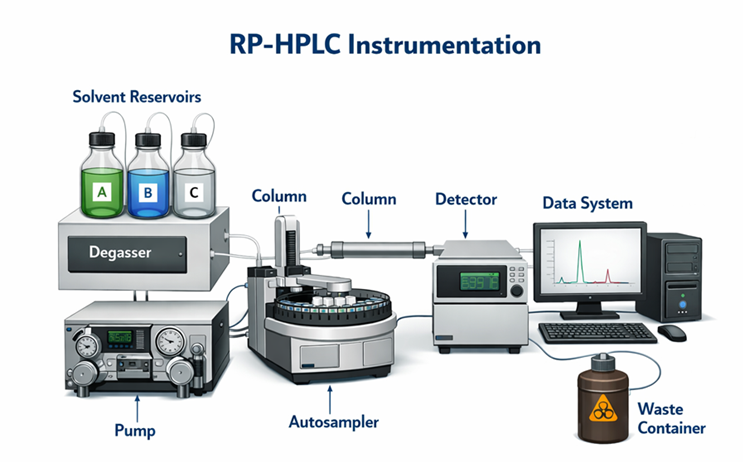
  1. Pump: The primary function of the pump is the delivery of the mobile phase at a high pressure, even up to 6000 psi, through the packed column.
  2. Injector: The injector is responsible for injecting a defined volume of the sample into the highly pressurized mobile phase using a 6-port rotary valve.
  3. Column: The column is considered the primary "engine" responsible for the separation process.
  4. Detector: The detector monitors the eluent and translates the presence of compounds into an electric signal. The data system then detects the signal over time, resulting in the Chromatogram. [14]

Figure 1 : Instrumentation of HPLC

RP-HPLC Method Validation Parameters:

Specificity and Selectivity:

Specificity is the ability to distinguish the analyte of interest from the expected co-existing substances like impurities, degradation products, and matrix interference. In RP-HPLC, this specificity is typically done through purity confirmation of the peak purity test using a Photo Diode Array detector, where the purity angle must be below the purity threshold. [15, 16]

Linearity and Range:

Linearity is the area of main interest in calibration, relating to the extent to which an analytical method’s response is proportional to, and increases with, an increment of sample amount within a given concentration interval. It is usually evaluated by examining the relationship of the response to concentration changes, by inspection of graphs of experimental data, or by using linear regression calculations. The results of these calculations, described by the correlation coefficient, indicate the quality of linear relationship. A linear relationship is established by using A, C, m, and b, where A is peak area, C is concentration, m is slope, and b is intercept, by A = mC + b. A value close to 1 is expected in pharmaceutical analysis. [11]

Accuracy (Recovery)

Accuracy represents the closeness of the measured value to the known value or reference value. Accuracy is commonly assessed by a series of recovery tests at three concentrations (for example, 50%, 100%, and 150%) with three injections at each concentration. [17,18]

Precision

Precision covers repeatability (intra-day), intermediate precision (inter-day) and reproducibility between labs. Precision is expressed as the Relative Standard Deviation (% RSD) in which the standard deviation is divided by the mean and multiplied by 100%. In the case of drug substances, an RSD of the standard is common. [19, 20]

Limit of Detection (LOD) and Limit of Quantitation (LOQ)

LOD is the lowest level of analyte present in the sample that can be detected but not necessarily analyzed with much precision. LOQ is the lowest level of analyte present in the sample that can be analyzed with acceptable precision as well as accuracy. [8]

Robustness

Robustness is termed as the capability of the given method to withstand slight systematic variations in the parameters, for example, changes in pH by a unit, variations in the organic phase, and changes in the temperature of the column. In essence, it is an assessment of the method’s robustness. [21]

Summary of Acceptance Criteria

The following table summarizes standard acceptance criteria widely accepted by regulatory bodies (FDA, EMA) for pharmaceutical assays. [18, 20]

Table 1: Standard Acceptance Criteria for Analytical Method Validation

Validation Parameter

Acceptance Criteria (General Limit)

Remarks

System Suitability

RSD<2.0% for peak area

Tailing factor (T) ≤2.0; Plate count (N) >2000

Specificity

No interference at retention time of analyte

Peak Purity Angle < Purity Threshold

Linearity

Correlation Coefficient (R2) ≥0.999

Minimum 5 concentration levels

Accuracy (Recovery)

98.0%−102.0%

Measured at 50%, 100%, 150% levels

Precision (Repeatability)

%RSD≤2.0%

n=6 at 100% or n=9 (3x3 levels)

Intermediate Precision

%RSD≤2.0% (overall)

Different days/analysts/equipment

LOD

Signal-to-Noise Ratio (S/N) ≈3:1

Or based on σ of response

LOQ

Signal-to-Noise Ratio (S/N) ≈10:1

Precision at LOQ should be RSD ≤10%

Robustness

System suitability must still pass

Variations in pH, Flow, Temp, Mobile Phase

Stability of Solution

Change in response ≤2.0% over time

typically 24-48 hours

The Regulatory Landscape:

ICH Q1A(R2): Stability Testing of New Drug Substances and Products:

The parent guideline, ICH Q1A(R2), requires stress testing to predict probable degradation products and confirm the analytical methodology. It states that the nature of the stress testing will depend on the individual drug substance and the type of drug product involved. Stress testing has to be conducted on the drug substance (API). For the drug product formulation, this has to be conducted only if an interaction between API and excipients is suspected. [22]

ICH Q1B: Photostability Testing

In contrast to Q1A, ICH Q1B is extremely prescriptive and gives specific light sources and required exposure duration. Two different light-source configurations are proposed:

  1. Artificial daylight lamp that combines visible and ultraviolet outputs such as a Xenon arc lamp, and
  2. Combination of a cool white fluorescent lamp with a near-UV fluorescent lamp. The minimum requirements for light exposure are 1.2 million lux-hours visible light and 200 Wh/m² UV energy. [23]

ICH Q2(R1) and Q3A/B: Validation and Impurities:

ICH Q2(R1) defines validation parameters, and Specificity is shown by peak purity analysis that is performed during stress studies. In parallel, ICH Q3A and Q3B define reporting, identification, and qualification criteria for degradation products; therefore, the need for a selective ion monitoring (SIM) approach which is able to detect impurities at very low levels, normally at 0.05% or 0.1%, is emphasized. [24, 25]

Scientific Basis and Protocols for Stress Conditions:

The design of a forced degradation study must be predictive. The following subsections detail the mechanism and recommended protocols for each stress type.

Hydrolytic Degradation [27]

Hydrolysis refers to the splitting of a molecule by its reaction with water. It is among the most frequently occurring degradation routes, particularly for pharmaceuticals containing hydrolytically sensitive functional groups such as esters, amides, lactones, and lactams. [26]

  • Acidic Hydrolysis

Mechanism: Protonation of electronegative atoms such as oxygen or nitrogen increases their susceptibility to nucleophilic attack by water.

Protocol: In stress testing, we usually begin by exposing the substance to 0.1 N HCl at room temperature. If after 24 hours there is no significant degradation, then the temperature can be ramped up to 60 °C. In cases where a molecule is highly stable, the acid strength can be increased to 1.0 N or even to 5.0 N HCl. The goal is usually about 5-20% degradation.

  • Alkaline Hydrolysis

Mechanism: Hydroxide ions (OH?) function as strong nucleophiles and often promote degradation more aggressively than acidic conditions.

Protocol: Stress testing is usually begun with 0.1 N NaOH at room temperature.

Precaution: Many silica-based HPLC columns are unstable at elevated pH levels. Therefore, samples should be neutralized to around pH 7 prior to injection to avoid column damage.
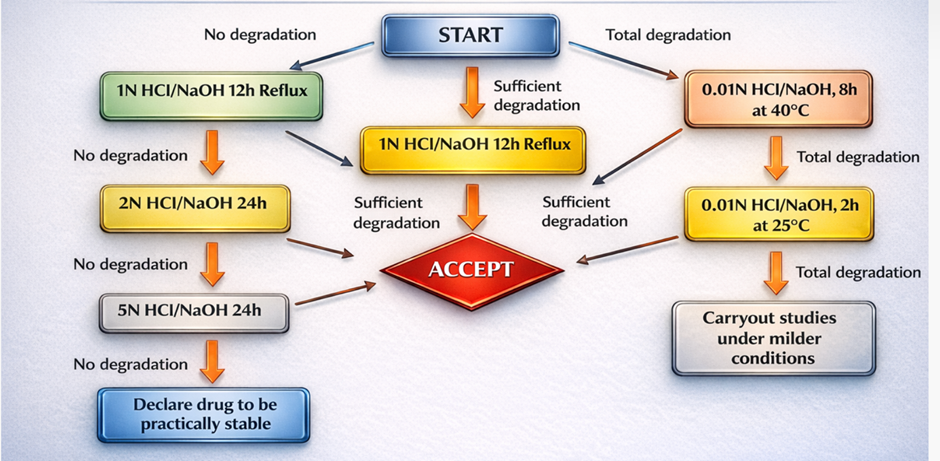
Figure 2 : Flow chart of Acidic hydrolysis and Alkaline hydrolysis

  • Neutral Hydrolysis

Protocol: The drug substance is refluxed in water to evaluate degradation that occurs solely due to moisture exposure, in the absence of acid or base-catalysed effects.
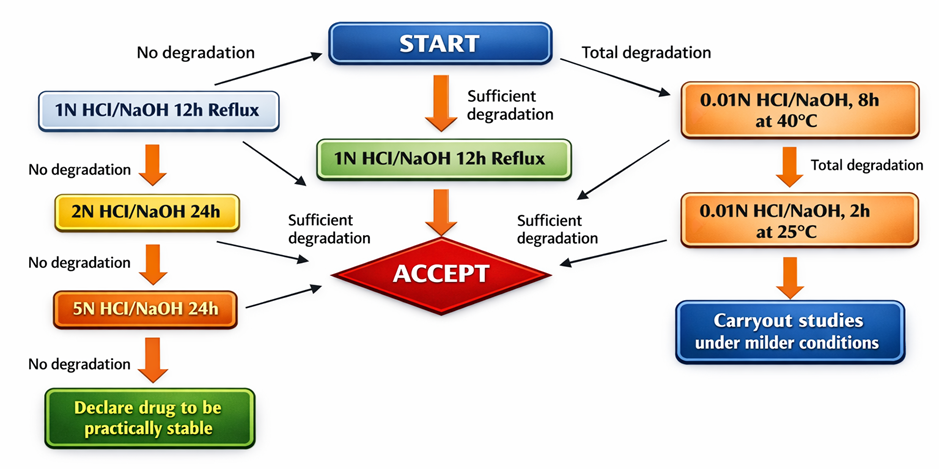
Figure 3 : Flow chart of Neutral hydrolysis

Oxidative Degradation [28]

Oxidative stress is notoriously difficult to control due to the complex nature of radical chain reactions (initiation, propagation, termination).

  • Peroxide Oxidation:

Application of Hydrogen Peroxide as the Standard Reagent.

Protocol: Solutions to be prepared between 0.3% to 3.0% H2

Storage: Store at room temperature and under light-excluded conditions for 7 days.

Warning: Do not heat peroxide solutions. When H2O2 is heated, hydroxyl radicals form that simulate the action of heat-induced degradation and thus may generate false results.
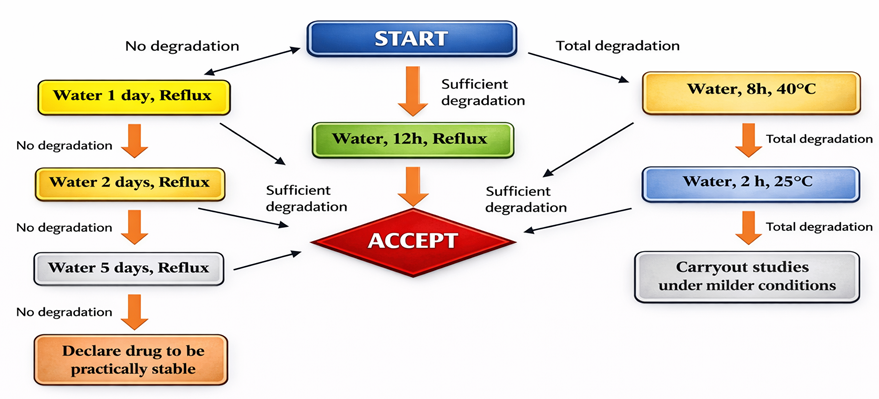
Figure 4 : Flow chart of Oxidative degradation

  • Radical Initiators: For drugs resistant to peroxide, AIBN (Azobisisobutyronitrile) can be used to induce free-radical oxidation, which more closely mimics long-term environmental oxidation. [29]

Photolytic Degradation:

In photolysis, the drug molecule absorbs one photon, jumping into an excited state, either a singlet state or a triplet state. In the excited state, bonds can break or rearrangements can occur.
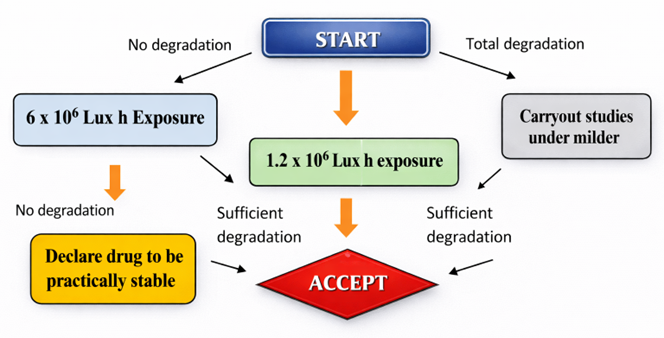
  • Protocol: Both solid and solution samples are exposed to light by means of a proven actinometric system (such as Quinine Chemical Actinometry).
  • Dark control: A basic dark control involves wrapping the sample in aluminum foil. This is done to facilitate the differentiation between the heat-induced changes and the light-induced changes in the sample. [23]

Figure 5 : Flow chart of Photolytic degradation

Table 2: Comprehensive Forced Degradation Protocol Summary

Stress Type

Reagent/ Condition

Temp

Duration

Precaution

Acid

0.1 N - 1.0 N HCl

60°C

1-48 hrs

Neutralize before injection.

Alkali

0.1 N - 1.0 N NaOH

RT - 60°C

10 min - 24 hrs

Monitor closely; often rapid. Neutralize.

Oxidation

3% -30% $H_2O_2$

RT

1-24 hrs

Peroxide peak can interfere in HPLC (early elution).

Thermal (Dry)

Oven

80°C - 105°C

3-10 days

Use sealed vs. open containers to test volatility.

Thermal (Wet)

Water/Buffer slurry

80°C

1-5 days

Distinguishes hydrolysis from pyrolysis.

Photolytic

UV + Visible (Q1B)

Chamber

~1 week

Use Dark Control. Keep temperature controlled.

Analytical Methodology and Validation:

Specificity and Peak Purity

The cornerstone of a SIM is specificity. The analyst must demonstrate that the API peak is spectrally pure.

  • Photodiode Array (PDA): This is your frontline detector. It matches the UV spectra measured at the upslope, at the summit and at the downslope of the peak. If the spectra match then the peak is likely pure.
  • Mass Spectrometry (MS): LC-MS has the highest specificity. It will disclose co-eluting impurities of similar UV spectra but of different molecular mass. [30, 31]

Mass Balance Calculation

Mass balance is a critical quality attribute of a forced degradation study. It confirms that the loss in API correlates with the increase in degradation products.

Regulatory expectations suggest mass balance should be within 95% to 105%.

  • Deviations: If mass balance is low (e.g., 80%), it suggests:
  1. The formation of non-chromatophoric degradants (cannot be seen by UV).
  2. Degradants retained on the column.
  3. Formation of volatile degradants. [32]

Challenges and Troubleshooting:

Over-Degradation

Overdegradation of the drug by more than 20% leads to an induction of secondary degradation by causing breakdown of the main degradation product itself. This leads to an inherently complex chromatogram, contrary to actual stability. Solution: Stop the reaction as soon as it reaches an observation of 10 - 15% degradation.

Fluorescence and Precipitation

Some drugs precipitate in acidic or basic media.

  • Solution: Use co-solvents (Methanol or Acetonitrile) in the stress media to keep the drug in solution. [33]

CONCLUSION:

RP-HPLC still tops the list of the most reliable analytical technique for quality control purposes in the context of the pharmaceutical industry, particularly if it is rationally harmonized with ICH guidelines for the validation of analytical methods or forced degradation studies. With some good judgment in the RP-HPLC method development approaches, combined with rigorous criteria of RP-HPLC validation, i.e., specificity, precision, accuracy, robustness, and sensitivity, in good scientific judgment for the stress testing procedure, RP-HPLC can truly be a stability-indicating technique. Highlighted in the current treatment is the point that close control of the experimental parameter, the use of good judgment in the settings of the chromatographic procedure, or the help of analytical tools such as peak purity analysis and mass balance, are vital for maintaining regulatory requirements for the work.

REFERENCES

  1. Snyder LR, Kirkland JJ, Glajch JL. Practical HPLC method development. Hoboken (NJ): John Wiley & Sons; 2012.
  2. Dong MW. Modern HPLC for practicing scientists. Hoboken (NJ): John Wiley & Sons; 2006.
  3. Ermer J, Miller JHM, editors. Method validation in pharmaceutical analysis: A guide to best practice. Chichester (UK): John Wiley & Sons; 2006.
  4. International Conference on Harmonisation (ICH). Validation of analytical procedures: Text and methodology Q2(R1). Geneva: ICH; 2005.
  5. International Conference on Harmonisation (ICH). Stability testing of new drug substances and products Q1A(R2). Geneva: ICH; 2003.
  6. Kazakevich Y, LoBrutto R, editors. HPLC for pharmaceutical scientists. Hoboken (NJ): John Wiley & Sons; 2007.
  7. Tindall A. Mobile phase buffers, part II: Buffer selection and preparation. LC GC North Am. 2003;21(1):28-32.
  8. Dolan JW. Gradient elution, Part I: The basics. LC GC North Am. 2013;31(6):456-63.
  9. Snyder LR, Dolan JW. High-performance gradient elution: The practical application of the linear-solvent-strength model. Hoboken (NJ): John Wiley & Sons; 2006.
  10. Jandera P. Programmed elution in liquid chromatography. J Chromatogr A. 2006;1126(1-2):195-218.
  11. Ahuja S, Dong MW, editors. Handbook of pharmaceutical analysis by HPLC. Amsterdam: Elsevier; 2005.
  12. Ali AH. High-performance liquid chromatography (HPLC): A review. Ann Adv Chem. 2022;6:010-020.
  13. Skoog DA, Holler FJ, Crouch SR. Principles of instrumental analysis. 7th ed. Boston: Cengage Learning; 2017.
  14. Meyer VR. Practical high-performance liquid chromatography. Hoboken (NJ): John Wiley & Sons; 2010.
  15. Shabir GA. Validation of high-performance liquid chromatography methods for pharmaceutical analysis: Understanding the differences and similarities between validation requirements of the US Food and Drug Administration, the US Pharmacopeia and the International Conference on Harmonization. J Chromatogr A. 2003;987(1-2):57-66.
  16. Swartz ME, Krull IS. Handbook of analytical validation. Boca Raton (FL): CRC Press; 2018.
  17. Chandran S, Singh RSP. Comparison of various international guidelines for analytical method validation. Pharmazie.2007;62(1):4-14.
  18. Ravisankar P, Navya CN, Pravallika D, Sri DN. A review on step-by-step analytical method validation. IOSR J Pharm.2015;5(10):7-19.
  19. Borman P, Elder D. Q2(R1) Validation of analytical procedures. In: ICH Quality Guidelines. Weinheim: Wiley-VCH; 2017. p.127-166.
  20. U.S. Food and Drug Administration. Analytical procedures and methods validation for drugs and biologics: Guidance for industry. Silver Spring (MD): FDA; 2015.
  21. Tiwari G, Tiwari R. Bioanalytical method validation: An updated review. Pharm Methods. 2010;1(1):25-38.
  22. International Conference on Harmonisation (ICH). Stability testing of new drug substances and products Q1A(R2). Geneva: ICH; 2003.
  23. International Conference on Harmonisation (ICH). Photostability testing of new drug substances and products Q1B. Geneva: ICH; 1996.
  24. International Conference on Harmonisation (ICH). Validation of analytical procedures: Text and methodology Q2(R1). Geneva: ICH; 2005.
  25. International Conference on Harmonisation (ICH). Impurities in new drug substances Q3A(R2). Geneva: ICH; 2006.
  26. Alsante KM, Martin L, Baertschi SW. A stress testing benchmarking study. Pharm Technol. 2003;27(2):60-72.
  27. Reynolds DW, et al. Available guidance and best practices for conducting forced degradation studies. Pharm Technol.2002;26(2):48-56.
  28. Baertschi SW, Alsante KM. Stress testing: The chemistry of drug degradation. In: Pharmaceutical stress testing. Boca Raton (FL): CRC Press; 2005. p.1-48.
  29. Harmon PA, Burgess C. The distinction between forced degradation and accelerated stability. Drug Dev Ind Pharm.2009.
  30. Singh S, Bakshi M. Guidance on conduct of stress tests to determine inherent stability of drugs. Pharm Technol.2000;24(6):1-14.
  31. Dolan JW. Peak purity and the PDA detector. LCGC North Am. 2002;20(10).
  32. Aubry AF, et al. Validating stability-indicating methods. Pharm Technol. 2009.
  33. Ngwa G. Forced degradation as an integral part of HPLC stability-indicating method development. Drug Deliv Technol.2010;10(5).   

Reference

  1. Snyder LR, Kirkland JJ, Glajch JL. Practical HPLC method development. Hoboken (NJ): John Wiley & Sons; 2012.
  2. Dong MW. Modern HPLC for practicing scientists. Hoboken (NJ): John Wiley & Sons; 2006.
  3. Ermer J, Miller JHM, editors. Method validation in pharmaceutical analysis: A guide to best practice. Chichester (UK): John Wiley & Sons; 2006.
  4. International Conference on Harmonisation (ICH). Validation of analytical procedures: Text and methodology Q2(R1). Geneva: ICH; 2005.
  5. International Conference on Harmonisation (ICH). Stability testing of new drug substances and products Q1A(R2). Geneva: ICH; 2003.
  6. Kazakevich Y, LoBrutto R, editors. HPLC for pharmaceutical scientists. Hoboken (NJ): John Wiley & Sons; 2007.
  7. Tindall A. Mobile phase buffers, part II: Buffer selection and preparation. LC GC North Am. 2003;21(1):28-32.
  8. Dolan JW. Gradient elution, Part I: The basics. LC GC North Am. 2013;31(6):456-63.
  9. Snyder LR, Dolan JW. High-performance gradient elution: The practical application of the linear-solvent-strength model. Hoboken (NJ): John Wiley & Sons; 2006.
  10. Jandera P. Programmed elution in liquid chromatography. J Chromatogr A. 2006;1126(1-2):195-218.
  11. Ahuja S, Dong MW, editors. Handbook of pharmaceutical analysis by HPLC. Amsterdam: Elsevier; 2005.
  12. Ali AH. High-performance liquid chromatography (HPLC): A review. Ann Adv Chem. 2022;6:010-020.
  13. Skoog DA, Holler FJ, Crouch SR. Principles of instrumental analysis. 7th ed. Boston: Cengage Learning; 2017.
  14. Meyer VR. Practical high-performance liquid chromatography. Hoboken (NJ): John Wiley & Sons; 2010.
  15. Shabir GA. Validation of high-performance liquid chromatography methods for pharmaceutical analysis: Understanding the differences and similarities between validation requirements of the US Food and Drug Administration, the US Pharmacopeia and the International Conference on Harmonization. J Chromatogr A. 2003;987(1-2):57-66.
  16. Swartz ME, Krull IS. Handbook of analytical validation. Boca Raton (FL): CRC Press; 2018.
  17. Chandran S, Singh RSP. Comparison of various international guidelines for analytical method validation. Pharmazie.2007;62(1):4-14.
  18. Ravisankar P, Navya CN, Pravallika D, Sri DN. A review on step-by-step analytical method validation. IOSR J Pharm.2015;5(10):7-19.
  19. Borman P, Elder D. Q2(R1) Validation of analytical procedures. In: ICH Quality Guidelines. Weinheim: Wiley-VCH; 2017. p.127-166.
  20. U.S. Food and Drug Administration. Analytical procedures and methods validation for drugs and biologics: Guidance for industry. Silver Spring (MD): FDA; 2015.
  21. Tiwari G, Tiwari R. Bioanalytical method validation: An updated review. Pharm Methods. 2010;1(1):25-38.
  22. International Conference on Harmonisation (ICH). Stability testing of new drug substances and products Q1A(R2). Geneva: ICH; 2003.
  23. International Conference on Harmonisation (ICH). Photostability testing of new drug substances and products Q1B. Geneva: ICH; 1996.
  24. International Conference on Harmonisation (ICH). Validation of analytical procedures: Text and methodology Q2(R1). Geneva: ICH; 2005.
  25. International Conference on Harmonisation (ICH). Impurities in new drug substances Q3A(R2). Geneva: ICH; 2006.
  26. Alsante KM, Martin L, Baertschi SW. A stress testing benchmarking study. Pharm Technol. 2003;27(2):60-72.
  27. Reynolds DW, et al. Available guidance and best practices for conducting forced degradation studies. Pharm Technol.2002;26(2):48-56.
  28. Baertschi SW, Alsante KM. Stress testing: The chemistry of drug degradation. In: Pharmaceutical stress testing. Boca Raton (FL): CRC Press; 2005. p.1-48.
  29. Harmon PA, Burgess C. The distinction between forced degradation and accelerated stability. Drug Dev Ind Pharm.2009.
  30. Singh S, Bakshi M. Guidance on conduct of stress tests to determine inherent stability of drugs. Pharm Technol.2000;24(6):1-14.
  31. Dolan JW. Peak purity and the PDA detector. LCGC North Am. 2002;20(10).
  32. Aubry AF, et al. Validating stability-indicating methods. Pharm Technol. 2009.
  33. Ngwa G. Forced degradation as an integral part of HPLC stability-indicating method development. Drug Deliv Technol.2010;10(5).   

Photo
Chauhan Ajaykumar
Corresponding author

Sigma Institute of Pharmacy, Sigma University, Bakrol,, Vadodara, Gujarat, India 390019

Photo
Dalwadi Mitali
Co-author

Sigma Institute of Pharmacy, Sigma University, Bakrol,, Vadodara, Gujarat, India 390019

Photo
Vahoniya Mrunal
Co-author

Sigma Institute of Pharmacy, Sigma University, Bakrol,, Vadodara, Gujarat, India 390019

Chauhan Ajaykumar, Dalwadi Mitali, Vahoniya Mrunal, A Comprehensive Review on RP-HPLC Method Development, Validation, and Forced Degradation Studies According to ICH Guidelines, Int. J. of Pharm. Sci., 2026, Vol 4, Issue 1, 1913-1923. https://doi.org/10.5281/zenodo.18303633

More related articles
A Review on From Tradition to Innovation: A Review...
Ankita Gadekar , Gauri Gite , Kalyani Jangam , Suraj Gholap , ...
Formulation And Evaluation of Gel Containing Zinc ...
Vasudev Jitendra Sharma, Mayur Gokul Jayswal, Raza Khan, Dr. Mohd...
Formulation And Evaluation of Anti-Fungal Cream...
Rutuja Desale , Paurnima Malik, Diksha Barde, Gayatri Bhere, Ashwini Kathore, Tejaswini Asawe, ...
Formulation And Evaluation of Herbal Shampoo...
Mallayya Swami, Mahalaxmi Hipparagi, Apsana N., Apsanabegum B., Asifa M., Bhagyashree U., Amoghhasid...
Related Articles
Formulation And Evaluation of Herbal Gel of Syzygiumcumini of Antioxidant Activi...
Dr. Hemalata Sagar Wadkar, Krishna B. Kendre, Aditi A. Mardhekar, Tejashree P. Patil, ...
From Therapeutic Sedation to Investigative Intervention: An Integrative Review o...
Varaganti Sai Chitra Prathyusha, Pratyush Mishra, Ankita Vijay Thul, Sanjeev Kumar, Harjeet Singh, G...
Introduction Of Lord of Shiva Plant: A Review...
Prajakta Patil, Parth Palamkar, Ranjit Patil, Abhishek Patil, Pavan vilas chavan, Shivani Patil, ...
A Review on From Tradition to Innovation: A Review of Aloe Vera's Evolving Role ...
Ankita Gadekar , Gauri Gite , Kalyani Jangam , Suraj Gholap , ...
More related articles
A Review on From Tradition to Innovation: A Review of Aloe Vera's Evolving Role ...
Ankita Gadekar , Gauri Gite , Kalyani Jangam , Suraj Gholap , ...
Formulation And Evaluation of Gel Containing Zinc Oxide Nanoparticle of Ketocona...
Vasudev Jitendra Sharma, Mayur Gokul Jayswal, Raza Khan, Dr. Mohd. Rehan Deshmukh, Prof. (Dr.) G. J....
A Review on From Tradition to Innovation: A Review of Aloe Vera's Evolving Role ...
Ankita Gadekar , Gauri Gite , Kalyani Jangam , Suraj Gholap , ...
Formulation And Evaluation of Gel Containing Zinc Oxide Nanoparticle of Ketocona...
Vasudev Jitendra Sharma, Mayur Gokul Jayswal, Raza Khan, Dr. Mohd. Rehan Deshmukh, Prof. (Dr.) G. J....
