
Valmik Naik College of Pharmacy, Telwadi, Kannad, Chh. Sambhajinagar
Nanoemulsions are submicron-sized colloidal dispersions composed of two immiscible liquids stabilized by surfactants. With droplet sizes typically ranging from 20 to 200 nm, nanoemulsion have attracted significant attention in pharmaceuticals, cosmetics, food, and agricultural industries due to their high kinetic stability, optical transparency, and enhanced bioavailability of encapsulated compounds. This review summarizes the composition, methods of preparation, characterization techniques, advantages, and applications of nanoemulsions, along with recent advancements and challenges in their development.
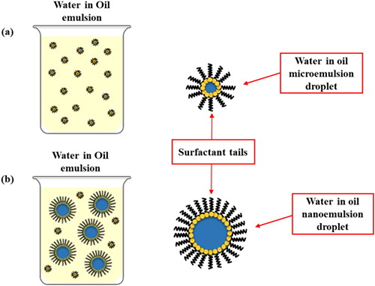
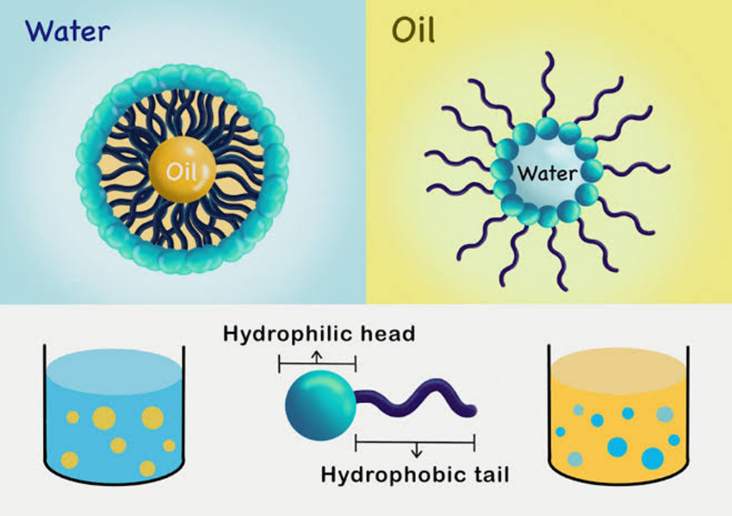
Emulsions are heterogeneous systems consisting of two immiscible liquids—commonly oil and water—where one phase is dispersed as droplets within the other. When the droplet size is reduced to the nanometer range, the system is referred to as a nanoemulsion. Unlike microemulsions, nanoemulsions are thermodynamically unstable but kinetically stable, meaning they can remain stable for long durations without phase separation. Nanoemulsions have become a promising carrier system for poorly water-soluble drugs, nutraceuticals, and bioactive compounds. Their small droplet size enhances surface area, solubility, absorption, and controlled release, making them highly desirable in modern formulation science.
Composition of Nanoemulsions
A typical nanoemulsion consists of:
Methods of Preparation
Nanoemulsions can be prepared using either high-energy or lowenergy methods.
1. High-Energy Methods
These methods use mechanical energy to reduce droplet size to the nanometer range.
2. Low-Energy Methods
These techniques rely on physicochemical properties such as temperature or composition changes to form nano-sized droplets without high mechanical energy input.
Characterization of Nanoemulsions
Characterization is essential to determine droplet size, stability, and performance. Common techniques include:
Advantages of Nanoemulsions
Applications
1. Pharmaceutical Industry
Used for oral, topical, intravenous, and ocular drug delivery to improve absorption and therapeutic efficiency.
2. Food Industry
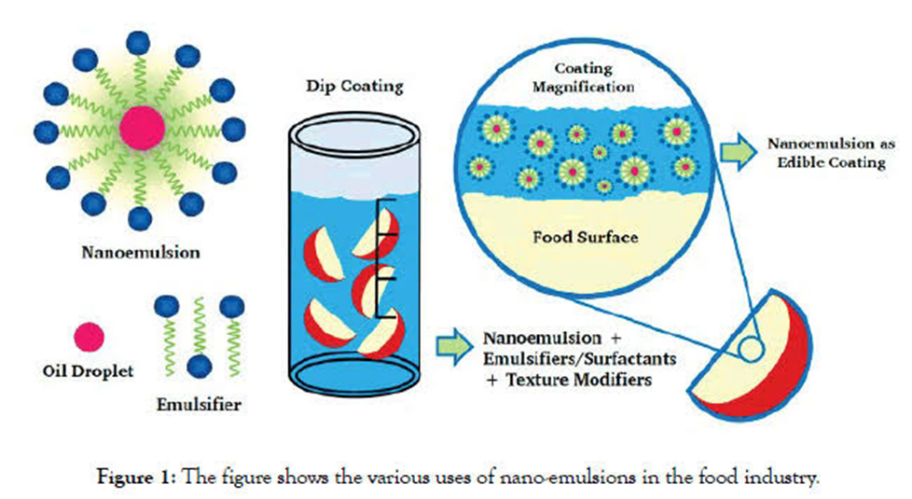
Nanoemulsions are applied for encapsulating flavors, vitamins, and antioxidants to enhance stability and bioavailability.
3. Cosmetics
Employed in creams, lotions, and serums to enhance penetration of active ingredients and improve texture.
4. Agriculture
Used for pesticide delivery and controlled release of agrochemicals with reduced environmental impact.
Challenges and Future Perspectives
Despite their advantages, nanoemulsions face challenges such as thermodynamic instability, potential toxicity of surfactants, and
scale-up difficulties. Future research focuses on developing biocompatible, sustainable, and cost-effective nanoemulsion systems using natural surfactants and green preparation methods.
Nanoemulsion
CONCLUSION
Nanoemulsions represent a versatile and efficient delivery system capable of overcoming solubility and stability challenges of hydrophobic compounds. With ongoing advancements in formulation science and nanotechnology, nanoemulsions hold immense potential in pharmaceuticals, food, cosmetics, and agriculture. However, further studies on long-term safety, regulatory acceptance, and large-scale production are essential for their commercial success.
REFERENCES

Niket Pradhan, Mohammed Sufiyan, A Review on Nanoemulsion, Int. J. of Pharm. Sci., 2026, Vol 4, Issue 1, 323-327. https://doi.org/10.5281/zenodo.18153942
 10.5281/zenodo.18153942
